Atropine
Uitgangsvraag
Wat is het effect van de verschillende atropineconcentraties op de remming van progressieve myopie?
Aanbeveling
Bespreek de impact van leefstijl voordat je start met een farmacologische of optische interventie om de progressie van myopie te vertragen.
Bespreek met het kind en de ouders de mogelijke opties ter beperking van progressieve myopie bij een indicatie voor progressieve myopie, waaronder optische en medicamenteuze interventies.
Leg de voor- en nadelen van deze opties uit en bepaal samen met het kind en de ouders welke interventie de voorkeur heeft.
Gebruik geen atropine 0,01% als eerste keus medicamenteuze interventie bij progressieve myopie.
Bied kinderen die de voorkeur geven aan een medicamenteuze interventie een interventie met atropine 0,05% oogdruppels. Bespreek met kind en ouders dat deze interventie een aantal jaar zal moeten worden voortgezet.
Overweeg hogere doseringen (0,5% of 1%) van atropine bij snelle progressie met grote kans op hoge myopie (< -6D, >26mm) of onvoldoende effect (6 t/m 9 jr>0,25mm; 10 t/m 12 jr >0,15mm) op lagere concentraties atropine en/of optische interventies. Schrijf multifocale meekleurende glazen voor bij atropine 0,5% of 1%.
Stop niet plotseling met atropine 0,5% of 1% maar bouw langzaam af (bijvoorbeeld 0,5%-0,25%-0,1%-0,05%) en controleer op rebound.
Overwegingen
Waarom deze aanbeveling?
Sterke aanbeveling tegen het routinematig gebruik van atropine 0,01% bij progressieve myopie gezien de lage effectiviteit. Vooral bij myope kinderen <10 jaar is de groeisnelheid vaak hoog. Een effectievere interventie zal dan de kans op minder myopie op volwassen leeftijd vergroten.
Sterke aanbeveling voor het gebruik van atropine 0,05% bij kinderen met progressieve myopie. Deze concentratie atropine heeft de voorkeur boven lagere concentraties vanwege de hogere effectiviteit, en boven hogere concentraties gezien de kleinere kans op bijwerkingen en de afwezige noodzaak voor multifocale meekleurende glazen.
Sterke aanbeveling om bij onvoldoende effect van atropine 0,05% of optische middelen tegen myopieprogressie (zie module Multi-modale myopieremming) atropine 0,5% of 1% te overwegen. Een groeisnelheid >0,25mm/jaar voor kinderen 6-9 jaar en >0,15mm/jaar voor kinderen 10-12 jaar kan worden beschouwd als onvoldoende effect. Een effectievere interventie zal dan de kans vergroten op adequate remming van de myopieprogressie.
Sterke aanbeveling om de bijwerkingen fotofobie door pupilvergroting en leesproblemen door accommodatie parese van hoge dosis atropine te verminderen door multifocale meekleurende glazen voor te schrijven. Sterke aanbeveling om niet acuut te stoppen met hoge dosis atropine maar in 1-2 jaar af te bouwen in concentratie (bijvoorbeeld 0,5%-0,25%-0,1%-0,05%) om de kans op rebound aslengte groei te verminderen.
Eindoordeel: sterke aanbeveling (voor en tegen).
Balans tussen gewenste en ongewenste effecten
Er is literatuuronderzoek verricht naar het effect van verschillende concentraties atropine ten opzichte van elkaar bij kinderen met progressieve myopie. Er werd één netwerkmeta-analyse geïncludeerd gepubliceerd in 2022, waarin zestien gerandomiseerde studies naar acht verschillende concentraties werden opgenomen. Voor de cruciale uitkomstmaat aslengte werden klinisch relevante verschillen voor alle concentraties gevonden in het voordeel van de patiënten die atropine kregen ten opzichte van controle. Daarnaast werden er klinisch relevante verschillen gevonden voor de volgende concentraties ten opzichte van andere concentraties:
- 0,05% versus 0,01%
- 1% versus 0,025%
- 1% versus 0,01%
- 1% versus 0,02%
- 1% versus 0,05%
- 1% versus 0,1%
- 1% versus 0,5%
De kwaliteit van het bewijs voor de cruciale uitkomstmaat aslengte was voor onderstaande vergelijkingen matig tot hoog:
- 0,025% versus controle
- 0,05% versus controle
- 0,1% versus controle
- 0,05% versus 0,01%
- 1% versus 0,025%
Voor de overige vergelijkingen is de kwaliteit van bewijs laag tot zeer laag, al is een dose-respons relatie aannemelijk.
Voor de cruciale uitkomstmaat refractie werden klinisch relevante verschillen gevonden in het voordeel van de patiënten die atropine kregen voor onderstaande vergelijkingen:
- 0,05% versus controle
- 0,1% versus controle
- 0,5% versus controle
- 1% versus controle
Ook voor de uitkomst maat refractie is een dose-respons relatie aannemelijk.
De kwaliteit van het bewijs voor de cruciale uitkomstmaat refractie was voor onderstaande vergelijkingen matig tot hoog:
- 0,025% versus controle
- 0,05% versus controle
Voor de overige vergelijkingen is de kwaliteit van bewijs laag tot zeer laag.
Voor de belangrijke uitkomstmaat therapietrouw werd geen klinisch relevant verschil gevonden. Voor de belangrijke uitkomstmaat bijwerkingen werd wel een klinisch relevant verschil gevonden. De kwaliteit van het bewijs voor beide uitkomstmaten was hoog.
Kwaliteit van bewijs
De overall kwaliteit van bewijs voor de concentraties 0,01% 0,025%, 0,05%, 0,1% en 1% atropine is redelijk. Dit betekent dat we redelijk zeker zijn over het gevonden geschatte effect van de cruciale uitkomstmaten.
De overall kwaliteit van bewijs voor de concentraties 0,02%, 0,25% en 0,5% is laag. Dit betekent dat we onzeker zijn over het gevonden geschatte effect van de cruciale uitkomstmaten. Het aantal trials die deze concentraties getest hebben is bijzonder beperkt.
Er is afgewaardeerd vanwege ernstige:
- Risk of Bias: methodologische beperkingen door problemen met het randomisatieproces.
- Indirectheid: indirectheid van het bewijs, door indirecte vergelijkingen.
- Imprecisie: onnauwkeurigheid, omdat het betrouwbaarheidsinterval een of beide grenzen van klinische relevantie overschrijdt.
Aanvullende literatuur over atropine
Naast de geïncludeerde netwerkmeta-analyse zijn er meerdere relevante gerandomiseerde gecontroleerde studies gepubliceerd over het gebruik van atropine bij myopiecontrole. Het merendeel van deze onderzoeken betreft lage doseringen, voornamelijk 0,01%, terwijl maar enkele studies hogere concentraties hebben onderzocht (tot 0,5%).
Atropine 0,5%
- Wang (2017): RCT bij Oost-Aziatische kinderen (N=54 vs N=55, gemiddelde leeftijd 8,9 jaar). Na 12 maanden: progressie -0,8 D (interventie) versus -2,0 D (placebo); SER-verschil 1,2 D (p<0,01). AL: 23,0 mm versus 24,3 mm; verschil -1,3 mm (p<0,01).
Atropine 0,05%
- Zhu (2023): RCT (2 jaar) bij Chinese kinderen (N=72 vs N=70, leeftijd 9,2 jaar). SER-progressie -0,46 D versus -1,72 D (placebo); verschil 1,32 D (p<0,001). AL: 0,26 mm versus 0,76 mm; verschil 0,50 mm (p=0,002). Geen rebound na staken van de interventie.
Atropine 0,05, 0,025% en 0,01%
- Zhang (2024): LAMP-trial met 5 jaar follow-up; 0,05%, 0,025% en 0,01%. Deze studie bouwde voort op de eerdere 2 jaars trial waarbij lage atropines met placebo werden vergeleken. Na 2 jaar werd de placebo op atropine 0,05% gezet en vergeleek de studie de atropineconcentraties onderling. SER-progressie respectievelijk -1,34 D, -1,97 D en -2,34 D ; AL-toename 0,79, 1,11 en 1,24 mm. De verschillen (60 maanden) tussen atropine 0,05% versus 0,025% en 0,01% waren statistisch significant; de verschillen tussen atropine 0,025% versus 0,01% niet. Gedurende het 3e jaar stopte een deel van de studie participanten met atropine; echter 87,9% van de kinderen groeide weer te hard. Na herstart met 0,05% werd de myopieprogressie opnieuw vertraagd.
Atropine 0,01–0,02%
- Wei (2020): 0,01% vs placebo; 1–2 jaar follow-up bij Oost-Aziatische kinderen (N=133; 9,9 jaar). SER: -0,20 D versus -0,34 D; verschil 0,14 D (p=0,027).
- Cui (2021): 0,02% (N=105), 0,01% (N=106) versus enkelvoudige brillenglazen (N=89); 2 jaar follow-up. SER: -0,80 D / -0,93 D / -1,33 D; AL: 0,62 / 0,72 / 0,88 mm (alle p<0,001).
- Moriche-Carretero (2021): Spaanse kinderen (7,6 jaar), 2 jaar follow-up. 0,01% atropine versus untreated control; SER -0,51 D vs -0,76 D; verschil 0,24 D (p<0,001); AL-verschil 0,17 mm.
- Lee (2022): Australische kinderen (11–12 jaar), 2 jaar follow-up. 0,01% atropine versus placebo; SER-verschil 0,14 D (p=0,09); AL-verschil 0,05 mm (p=0,1).
- Sen (2022): Indiase kinderen (5–15 jaar), 2 jaar follow-up. 0,01% atropine versus placebo; SER-progressie -4,31 D vs -4,93 D; verschil 0,72 D (p=0,0002).
- Repka (2023): Amerikaanse kinderen, 2 jaar follow-up. 0,01% atropine versus placebo; geen significant verschil in SER of AL.
- Zadnik (2023): Noord-Amerikaanse en Europese kinderen; 3 jaar follow-up. 0,02% atropine, 0,01% atropine en placebo; 0,02% geen effect, 0,01% beperkte effectiviteit (SER-verschil 0,24 D, p<0,001).
- Liang (2023): Chinese kinderen (9,8 jaar), 1 jaar follow-up. 0,01% atropine versus placebo; SER -3,2 D vs -3,64 D (p<0,001); AL 24,95 vs 25,16 mm.
- Wang (2024): Chinese kinderen met intermitterende exotropie (9,1 jaar), 1 jaar follow-up. 0,01% atropine versus placebo; SER-verschil -0,51 D vs -0,75 D (p<0,001); AL 0,31 vs 0,42 mm (p<0,001).
- Moriche-Carretero (2024): Spaanse kinderen, 5 jaar follow-up. 0,01% atropine versus placebo; SER -2,76 D vs -3,06 D; verschil 0,29 D (p<0,001); AL 0,23 mm (p<0,001).
- Loughman (2025a): Ierse kinderen (11,8 jaar), 2 jaar follow-up. 0,01% atropine versus placebo; SER-verschil 0,12 D (p<0,001); AL-verschil -0,07 mm (p<0,001).
- Loughman (2025b): Zelfde RCT, subgroep die overstapte naar 0,05% atropine liet een duidelijke extra remming van myopieprogressie zien. Ierse kinderen (11,8 jaar), 2 jaar follow-up. Switch van 0,01% atropine naar 0,05% versus placebo.
- Hansen (2024): Deense kinderen (N=32 per groep), follow-up 2 jaar; 0,01% vs 0,01% met laadfase (0,1%) vs placebo. Minder progressie voor atropinegroepen, geen extra effect van de laadfase.
- Hansen (2025): Vervolgpublicatie; geen additioneel effect van de laadfase met 0,1%. 6 maanden.
- Xu (2025): Chinese kinderen (10,1 jaar, atropine 0,01% N=70, placebo N=51); tweemaal daagse toediening van 0,01% atropine significant effectiever dan eenmaal daags.
Samenvatting
De recente literatuur bevestigt het dosis-responsverband tussen de concentratie atropine en de remming van myopieprogressie. Atropine 0,01% heeft een beperkt maar consistent effect, terwijl hogere concentraties (0,05–1,0%) duidelijk effectiever zijn, zij het met meer bijwerkingen.
Bijwerkingen
De oculaire bijwerkingen die voornamelijk optreden bij hoge dosis (0,5%, 1,0%) atropine zijn pupilverwijding, fotofobie, en accommodatie parese door blokkade van muscarinereceptoren in de m. sphincter pupillae en m. ciliaris (Mitchelson, 2012)). Om deze bijwerkingen te couperen dienen multifocale meekleurende glazen voorgeschreven te worden bij hoge dosis atropine (Klaver, 2020). De additie voor een goede leesvisus bij hoge dosis atropine dient tenminste +2,5 - +3,0 te zijn en gecontroleerd te worden met gestandaardiseerde leesteksten. Een zeldzamere oculaire bijwerking is perioculaire dermatitis of allergisch contacteczeem door veelvuldig direct huidcontact (Kothari, 2018). Huidcontact dient bij toediening van de atropine druppel vermeden te worden; perioculaire bescherming door vaseline kan daarbij helpen.
Daarnaast kunnen systemische anticholinerge bijwerkingen optreden door absorptie via het nasolacrimale systeem. Dit risico neemt toe bij jonge kinderen en hoge dosis. Beschreven effecten in het farmacotherapeutisch kompas zijn droge mond, flushing, tachycardie, hoofdpijn, duizeligheid en verminderd zweten, veroorzaakt door remming van parasympathische muscarinereceptoren. Zeldzaam zijn neurologische en gedragsmatige bijwerkingen, zoals rusteloosheid, prikkelbaarheid, hyperactiviteit, en verwardheid door centrale anticholinerge effecten nadat atropine de bloed-hersenbarrière passeert (Fray, 2024). Bij optreden van deze symptomen dient hoge dosis atropine gestaakt te worden. De kans op systemische opname van atropine wordt kleiner als na toediening van de druppel de traanpunten kort dichtgedrukt worden (punctumocclusie). Ook is het raadzaam een gewicht van tenminste 20 kg aan te houden voor hoge dosis atropine; een groter distributievolume en lagere plasmaconcentratie vermindert de kans op systemische bijwerkingen.
Hoge dosis atropine
Atropine 0,5% en 1% zijn het meest effectief in myopiecontrole (Figuur 2 en 5). Indien er sprake is van een snelle myopieprogressie met een sterke verwachting op het ontwikkelen van hoge myopie, of als dit reeds ontwikkeld is, kan direct beginnen met een hoge dosis raadzaam zijn om de uiteindelijke graad van myopie zo beperkt mogelijk te houden. De groeisnelheid is het hoogst op jonge leeftijd, waardoor hier potentieel het grootste effect te behalen is door de groeisnelheid krachtig te remmen. Om de bijwerkingen fotofobie en accommodatie parese van atropine 0,5% of 1% tegen te gaan dienen multifocale meekleurende glazen voorgeschreven worden.
Rebound
Stoppen met atropine kan gevolgen hebben voor myopieprogressie. Bij de ATOM studie (Chua 2006) werd forse toename in myope refractie beschreven na het stoppen van hoge dosis (1%) atropine; dit werd geduid als rebound (catch-up) van de myopieprogressie. De refractie progressie kon echter niet worden gestaafd met eenzelfde proportionele toename van de aslengte. Een verklaring kan zijn dat atropine de positie van de lens verandert en dat de lens daarna zijn oorspronkelijke plek weer inneemt. Rebound van de myope refractie werd niet gezien bij stoppen met lage doseringen van atropine. Niet acuut stoppen met hoge dosis atropine maar in 1-2 jaar afbouwen in concentratie is raadzaam. Een voorbeeld schema is met 0,5%-0,25%-0,1%-0,05% per 6 maanden te verminderen.
Buiten de rebound, hebben veel studies laten zien dat myopieprogressie in zowel refractie als aslengte weer de oorspronkelijke groeicurve aanneemt na het stoppen. Veel van de onderzochte kinderen die stopten hadden een leeftijd van 10-13 jaar, de verwachte groei bij deze leeftijd is nog fors. De studie van Zhang (2024) laat zien dat myopiecontrole gedurende tenminste 5 jaar een goede respons geeft; de huidige klinische praktijk laat zien dat dit door veel kinderen goed volgehouden wordt.
‘Non-respons’ op myopiecontrole is slecht gedefinieerd; een groeisnelheid >0,25mm/jr voor kinderen 6-9 jaar en >0,15mm/jr voor kinderen 10-12 jaar kan worden beschouwd als onvoldoende effect. Atropine 0,01% heeft de grootste proportie suboptimale responders (~30%; Usmani 2023); bij atropine 1% is dit 14% (Chua 2006). Ophogen van de dosis na een start op lage dosis vergroot de kans op optimale respons. Om de bijwerkingen fotofobie en accommodatie parese van atropine 0,5% of 1% tegen te gaan dienen multifocale meekleurende glazen voorgeschreven worden. Ook multi-modale combinaties van atropine met optische middelen kunnen overwogen worden.
Waarden en voorkeuren van patiënten (en eventueel hun naasten/verzorgers)
In de spreekkamer is het belangrijk om met kind en ouders/verzorgers de voor- en nadelen te bespreken van atropine. Persoonlijke voorkeuren dienen meegewogen te worden in de beslissing. Leefstijl interventies dienen altijd terug te blijven komen naast het starten van een interventie. Atropine heeft een duidelijk dose-respons effect: hoe hoger de concentratie atropine, hoe groter de remming op myopieprogressie. De bijwerkingen volgen eenzelfde patroon: meer fotofobie (lichtschuwheid), accommodatie parese (leesproblemen) en allergische reactie bij hogere concentraties. Meekleurende multifocale glazen in de bril kunnen de eerste twee bijwerkingen goed verminderen en zorgen voor een goede compliance. Bij een allergische reactie dient men de concentratie te verminderen of atropine interventie te stoppen.
Kostenaspecten
Atropine interventie brengt meer kosten met zich mee dan geen beperkende maatregel. Deze kosten voor de oogdruppels worden vergoed vanuit de basisverzekering. Bij een lage dosis atropine (<0,5%) zijn er de gebruikelijke aanvullende kosten voor de gewone myopie brillen. Bij hoge concentraties (0,5 en 1%) zijn er aanvullende kosten voor meekleurende, multifocale brillenglazen. Deze brillen worden niet vergoed vanuit de basisverzekering. Daardoor is het van belang in gesprek te gaan met ouders of de (bijkomende) kosten gedragen kunnen worden van de interventie.
Gelijkheid ((health) equity/equitable)
Myopiecontrole met hogere doses atropine brengt kosten voor multifocale meekleurende glazen met zich mee. Lagere concentraties atropine (0,05% en lager) hebben geen extra optische aanpassingen nodig behoudens de myopie correctie. Atropine wordt vergoed en is toegankelijk voor iedereen.
Aanvaardbaarheid:
Ethische aanvaardbaarheid
De interventie lijkt aanvaardbaar voor de betrokkenen mits alle voor- en nadelen zijn afgewogen. Er zijn geen ethische bezwaren.
Duurzaamheid
Bij de interventie spelen geen noemenswaardige duurzaamheidsaspecten een rol.
Haalbaarheid
De interventie met atropine oogdruppels is haalbaar en wordt door veel oogzorgverleners die myopiecontrole aanbieden voorgeschreven. Met de resultaten van de momenteel nog lopende klinische trial MAD is meer duidelijkheid te verwachten welke kinderen op welk moment beter resultaat hebben met atropine 0,5% en welke kinderen al goed resultaat hebben met atropine 0,05%. De resultaten van de MAD trial zullen in 2028 beschikbaar komen.
Onderbouwing
In the Netherlands, atropine has been an intervention modality for myopia progression since many years. This pharmacologic agent acts as a muscarinic antagonist of 5 muscarine receptors, which are expressed in multiple ocular tissues including the ciliary body and muscles, retina, choroid and sclera. Atropine blocks the action of acetylcholine but also of several other neurotransmitters (Barathi, 2014; Carr, 2018; Thomson, 2021). The mechanism by which atropine inhibits myopia progression is still not completely understood, but dopamine release, choroidal thickening, reduced extracellular matrix degradation and reduced scleral remodeling are considered drug pathways (Yam, 2025). Atropine comes in various dosages, ranging from 0.01% to 1% which are associated with efficacy and side effects. These include pupil dilation, reduced accommodation, and risk of rebound upon early cessation. To mitigate these effects, higher dosages often require photochromic and progressive spectacles and are tapered to lower concentrations before cessation (Klaver 2020). This module will discuss the efficacy of the various dosages of atropine on myopia control and provide recommendations for treatment. It is important to note that although publications are on the rise, there is a lack of studies directly comparing low dose versus high dose atropine. For this reason, ZonMw has granted performance of such a trial in the Netherlands (Myopia Atropine Dose trial) which is ongoing. Results are expected in 2028.
Axial lenght
|
Moderate GRADE |
0.025%, 0.05%, and 0.1% concentrations of atropine probably lead to a reduction in axial length in patients with myopia compared with control.
Sources: (Ha, 2022 (Chia, 2012; Yam, 2019)) |
|
Low GRADE |
0.01% concentration of atropine may result in a reduction in axial length in patients with myopia compared with control.
Sources: (Ha, 2022; Yam, 2019; Wei, 2020; Alam, 2020, Fu, 2020; Hieda, 2020; Zhao and Hao, 2021; Saxena, 2021) |
|
Very low GRADE |
The evidence is uncertain about the effect of 0.02%, 0.5% or 1% concentrations of atropine on axial length in patients with myopia compared with control.
Sources: (Ha, 2022 (Shih, 1999; Shih, 2001; Chua, 2006; Yi, 2015; Han, 2019; Zhu, 2020; Fu, 2020)) |
Concentrations versus concentration
|
Moderate GRADE |
0.05% concentration of atropine probably leads to a stronger reduction in axial length in patients with myopia compared with 0.01% concentration.
Sources: (Ha, 2022 (Chia, 2012; Yam, 2019; Wei, 2020; Alam, 2020; Fu, 2020; Hieda, 2020, Zhao and Hao, 2021; Saxena, 2021)) |
|
Moderate GRADE |
1% concentration of atropine probably leads to a stronger reduction in axial length in patients with myopia compared with 0.025% concentration.
Sources: (Ha, 2022 (Chua, 2006; Yi, 2015, Han, 2019; Yam, 2019; Zhu, 2020)) |
|
Low GRADE |
1% concentration of atropine may result in a stronger reduction in axial length in patients with myopia compared with 0.01% or 0.05% or 0.1% or 0.5%.
Sources: (Ha, 2022 (Shih, 2001; Chua, 2006; Yi, 2015; Han, 2019; Zhu, 2020; Chia, 2012; Yam, 2019; Wei, 2020; Alam, 2020; Fu, 2020; Hieda, 2020; Zhao and Hao, 2021; Saxena, 2021)) |
|
Very low GRADE |
The evidence is uncertain about the effect of 1% concentration of atropine on axial length in patients with myopia compared with 0.02%.
Sources: (Ha, 2022 (Chua, 2006; Yi, 2015; Han, 2019; Zhu, 2020; Fu, 2020)) |
Refraction
|
Moderate GRADE |
0.05% concentration of atropine probably reduces refractive progression in patients with myopia compared with control.
Sources: (Ha, 2022 (Yam, 2019)) |
|
Moderate GRADE |
0.025% concentration of atropine probably leads to no change in refractive progression in patients with myopia compared with control.
Sources: (Ha, 2022 (Yam, 2019)) |
|
Moderate GRADE |
0.5% or 1% concentrations of atropine probably reduces refractive progression in patients with myopia compared with control.
Sources: (Ha, 2022 (Shih, 1999; Shih, 2001; Chia, 2012; Yen, 1989; Chua, 2006; Yi ,2015; Han, 2019; Zhu, 2020)) |
|
Low GRADE |
0.1%, concentration of atropine may reduce refractive progression in patients with myopia compared with control.
Sources: (Ha, 2022 (Shih, 1999; Chia, 2012)) |
|
Low GRADE |
0.01% concentration of atropine probably reduces refractive progression slightly in patients with myopia compared with control.
Sources: (Ha, 2022 (Chia, 2012; Diaz-Llopis & Pinozo-Durán, 2018; Yam, 2019; Wei, 2020; Alam, 2020; Fu, 2020; Hieda, 2020; Zhao & Hao, 2021; Saxena, 2021) + alle nieuwe studies)) |
|
Very low GRADE |
The evidence is uncertain about the effect of 0.02% or 0.25% concentrations of atropine on refraction in patients with myopia compared with control.
Sources: (Ha, 2022 (Fu, 2020; Shih, 1999)) |
Adverse events
|
High GRADE |
Atropine results in an increase in adverse events when compared with control in patients with myopia.
Source: (Ha, 2022) |
Compliance
|
HIGH GRADE |
Atropine results in little to no difference in compliance in patients with myopia when compared with control.
Source: (Ha, 2022) |
Conclusions
|
HIGH GRADE |
Atropine results in little to no difference in compliance in patients with myopia when compared with control. Sources: Ha. 2022 |
Summary of Findings
Not applicable, as the Summary of Findings table does not accommodate network meta-analyses.
Description of studies
A total of one network meta-analysis which included sixteen studies was included in the analysis of the literature. Important study characteristics and results are summarized in table 2. The assessment of the risk of bias is summarized in the risk of bias tables (under the tab ‘Evidence tabellen’).
Ha (2022) performed a network meta-analysis. The search period for the studies extended until April 14, 2021. The inclusion criteria were randomized controlled trials (RCTs) focusing on children with progressive myopia and evaluating the efficacy of atropine in slowing the progression of myopia. The studies were selected according to the following criteria: (1) participants were younger than18 years with myopia, (2) atropine of any concentration was used in at least 1 treatment arm, (3) treatment duration was at least 12 months, and (4) reporting of at least 1 outcome of interest, including annual rate of myopia progression.
Sixteen RCTs were included in the analysis. Six RCTs included patients with a Chinese ethnicity, five RCTs included patients with East Asian ethnicity, two RCTs included patients with South-East Asian ethnicity, two RCTs included patients with South Asian ethnicity and one RCT included patients with Spanish ethnicity.
Table 3. Characteristics of included studies
|
Study |
Participants |
Comparison |
Follow-up |
Outcome measures |
Comments |
Risk of bias (per outcome measure)* |
|
Included in network meta-analysisHa, 2022 |
||||||
|
Yen (1989) |
N at baseline Intervention: 32 Control: 32
Age (mean, range) Total: 9 years (range 6 to 14)
Sex (male/ female) Total: 118/129 |
Intervention: 1% Control: 1.Cyclopentolate 1% 2.Saline |
12 months |
Refraction
Adverse events (side effect): photophobia
|
Funding: NR
Conflicts of interest: NR |
Some concerns (deviations from the intended interventions, selection of the reported result) |
|
Shih, 1999 |
N at baseline Intervention 1: 41 Intervention 2: 47 Intervention 3: 49 Control: 49
Age (mean, SD) Intervention 1:9.8 years Intervention 2: 9.7 years Intervention 3: 8.9 years Control:8.3 years
Sex (male/ female) NR |
Intervention 1: 0.5% Intervention 2: 0.25% Intervention 3: 0.1%
Control: tropicamide 0.5% |
20-23 months |
Refraction
Adverse events
|
Funding: Grant.
Conflicts of interest: NR |
Some concerns (deviations from the intended interventions, measurement of the outcome, selection of the reported result) |
|
Shih, 2001 |
N at baseline Intervention: 66 Control: 61
Age (mean, SD) Total: range 6 to 13 years
Sex NR |
Intervention:atropine 0.5% with multifocal glasses Control 1: single vision lenses Control 2: multi-focal lenses
|
18 months |
Axial length
Refraction
|
Funding: NR
Conflicts of interest: NR |
High (randomisationprocessunclear) |
|
Chua, 2006 |
N at baseline Intervention: 166 Control: 190
Age (mean, SD) Intervention: 9.2 years Control:9.2 years
Sex (% male) Intervention: 52.5 Control:57.5 |
Intervention: 1% Control: placebo |
24 months |
Axial length
Refraction
Adverse events
|
Funding: supported by the National Medical Research Council, Singapore (grant)
Conflicts of interest: the authors declare no commercial or financial interest in the material |
Low |
|
Chia, 2012 |
N at baseline Intervention 1: 139 Intervention 2: 141 Control: 75
Age (mean, SD) Intervention 1: 9.7 years (1.5) Intervention 2: 9.7 years (1.6) Control:9.5 years (1.5)
Sex (% female) Intervention 1: 47.2 Intervention 2: 46.5 Control:48.8 |
Intervention 1: 0.5% Intervention 2: 0.1% Control: 0.01% |
24 months |
Axial length
Refraction
Adverse events
Compliance |
Funding: supported by the National Medical Research Council, and SingHealth(grant)
Conflicts of interest: the authors have no proprietary or commercial interest in the material discussed |
Low |
|
Yi, 2015 |
N at baseline Intervention: 68 Control: 64
Age (mean, SD) Intervention: 9.91 years (1.36) Control:9.72 years (1.40)
Sex (male/ female) Intervention: 30/38 Control:35/29 |
Intervention: 1% Control: vehicle eyedrops |
12 months |
Axiallength
Refraction
Adverse events
|
Funding: NR
Conflicts of interest: NR
|
Some concerns (randomisation process unclear) |
|
Diaz-Llopis and Pinozo-Durán, 2018 |
N at baseline Intervention: 100 Control: 100
Age (mean, SD) Intervention: 10.4 years (2.5) Control:10.1 years (2.2)
Sex (male/ female) Intervention: 56/44 Control:48/52 |
Intervention: 0.01% Control: no treatment |
60 months |
Refraction
|
Funding: NR
Conflicts of interest: no conflict of interest declared. |
High (randomisation process, deviations from the intended interventions) |
|
Han, 2019 |
N at baseline Intervention: 53 Control: 25
Article not available (Chinese language)
|
Intervention: 1% Control:Not specified |
24 months |
Axiallength
Refraction |
|
Low |
|
Yam, 2019 |
N at baseline Intervention 1: 102 Intervention 2: 91 Intervention 3: 97 Control: 93
Age (mean, SD) Intervention 1: 8.45 years (1.81) Intervention 2: 8.54 years (1.71) Intervention 3: 8.23 years (1.83) Control: 8.42 years (1.72)
Sex (male) Intervention 1: 54 Intervention 2: 65 Intervention 3: 63 Control: 66 |
Intervention 1: 0.05% Intervention 2: 0.025% Intervention 3: 0.01%
Control: placebo |
12 months |
Axial length
Refraction
Adverse events
Compliance |
Funding: General Research Fund, Direct Grants of the Chinese University of Hong Kong, UBS Optimus Foundation Grant, CUHK Jockey Club Children Eye Care Programme.
Conflicts of interest: the authors have no proprietary or commercial interest in any materials discussed in the study. |
Low |
|
Wei, 2020 |
N at baseline Intervention: 76 Control: 83
Age (mean, SD) Intervention: 9.44 years (1.80) Control: 9.84 years (1.53)
Sex (male/ female) Intervention: 56/54 Control:61/49 |
Intervention: 0.01% Control: placebo |
12 months |
Axial length
Refraction
Adverse events
|
Funding: author Wang obtained funding.
Conflicts of interest: none reported. |
Low |
|
Zhu, 2020 |
N at baseline Intervention: 262 Control: 308
Age (mean, SD) Intervention: 9.11 years (0.09) Control: 9.19 years (0.14)
Sex (male/ female) Intervention: 130/132 Control:156/152 |
Intervention: 1% Control: saline (placebo) |
48 months divided in phases: 0-24mo: atropine 1% 1x/mo; 24-36 mo: atropine 1% 1x/2mo; 36-48mo: atropine stop.
|
Axial length
Refraction
Adverse events
Effect of rebound
|
Funding: Grant from National Natural Science Foundation of China
Conflicts of interest: authors declared that no competing interests exist. |
Some concerns (deviations from the intended interventions, measurement of the outcome, selection of the reported result) |
|
Alam, 2020 |
N at baseline Intervention: 24 Control: 12
Age (mean, SD) Total: range 6 to 18
Sex NR |
Intervention: 0.01% Control: artificial eye drops |
12 months |
Axial length
Refraction
|
Funding: self-funded
Conflicts of interest: authors declare no conflict of interest. |
Some concerns (randomisation process, deviations from the intended interventions, measurement of the outcome) |
|
Fu, 2020 |
N at baseline Intervention 1: 117 Intervention 2: 119 Control: 100
Age (mean, SD) Intervention 1: 9.4 years (1.8) Intervention 2: 9.3 years (1.9) Control:9.5 years (1.5)
Sex (male/ female) Intervention 1: 59/58 Intervention 2: 60/59 Control:52/48 |
Intervention 1 : 0.02% Intervention 2 : 0.01% Control :SV spectacles |
12 months |
Axial length
Refraction
|
Funding: funded by Medical Science and Technology Research Project of Henan Health Commission, Key R&D and Promotion Project of Henan Science and Technology Department, Key Scientific Research Project of Universities of Henan Education Department.
Conflicts of interest: None declared. |
High (randomisation process, missing outcome data) |
|
Hieda, 2020 |
N at baseline Intervention : 77 Control: 81
Age (mean, SD) Intervention: 8.99 years (1.44) Control: 8.98 years (1.50)
Sex (male/ female) Intervention: 38/46 Control:36/48 |
Intervention: 0.01% Control: placebo |
24 months |
Axial length
Refraction
Adverse events
Compliance rate |
Funding: supported by Eye-Lens Pte., Ltd., Singapore (sponsor had no role in the design or conduct of the research).
Conflicts of interest: multiple authors received honoraria, non-financial support, consultant fees. |
Low |
|
Zhao and Hao, 2021 |
N at baseline Intervention: 20 Control: 20
Age (mean, SD) Intervention: 9.65 years (1.53) Control: 9.7 years (1.49)
Sex (male/ female) Intervention: 10/10 Control:11/9 |
Intervention: 0.01% Control:spectacles and orthokeratology, also combinations |
12 months |
Axial length
Refraction
Adverse events: Schirmer test and tear breakup time
|
Funding: Funded by Life Science Society of Liaoning.
Conflicts of interest: authors declare that they have no conflict of interest. |
High (randomisation process, missing outcome data, measurement of the outcome) |
|
Saxena, 2021 |
N at baseline Intervention: 47 Control: 45
Age (mean, SD) Intervention: 10.6 years (2.2) Control: 10.8 years (2.2)
Sex NR |
Intervention: 0.01% Control: placebo |
12 months |
Axial length
Refraction
Adverse events (side effects) |
Funding: Support provided by Appa Ocular Devices (P) Ltd. The sponsor had no role in the design or conduct of the research.
Conflicts of interest: authors hav no proprietary or commercial interest in any materials discussed in the article. |
Low |
*For further details, see risk of bias table in the appendix
Results
Axial length (critical)
Thirteen studies reported the outcome measure axial length (Shih, 2001; Chua, 2006; Chia, 2012; Yi, 2015; Han, 2019; Yam. 2019; Wei, 2020; Zhu, 2020; Alam, 2020; Fu, 2020; Hieda, 2020; Zhao and Hao, 2021; Saxena, 2021) for various concentrations of atropine. Figure 1 shows a network plot of the studies incorporated in the meta-analysis from Ha (2022). It graphically shows that the trials comparing atropine 0.01% to controls have been most abundant, followed by atropine 1%. Studies comparing other dosages have been scarce.
Overall, all concentrations were more effective than control (0%) and 1% was more effective than all other concentrations (figure 2). Figure 3 provides an overview of the head-to-head comparisons for different doses of atropine in myopia intervention.
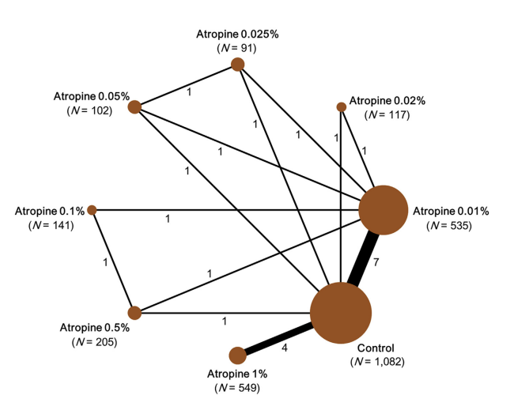
Figure 1. Networkplot for demonstrating how atropine trials (in the meta-analysis included in Ha 2022) examining axial length are connected through evidence
Each node represents an atropine dosage. The size of the nodes represent the total study population examined; the thickness of the lines and the number indicate how many studies contributed to the comparison
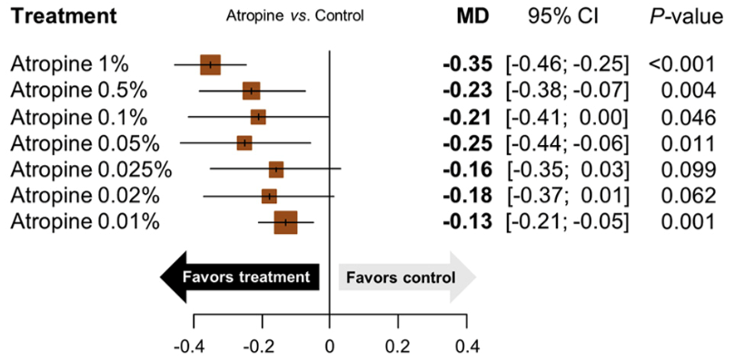
Figure 2. Forest plot of network meta-analysis comparing different doses of atropine for myopia interventions; mean annual axial length change
Each atropine concentration was compared with the control treatment, which was the reference group. CI= confidence interval; MD= mean difference (Ha, 2022)
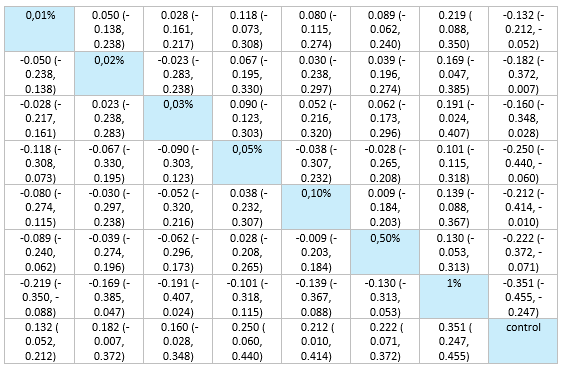
Figure 3. Net league table of head-to-head comparisons for different doses of atropine in myopia intervention: mean difference in axial length change
The estimate is shown in the shared cell between the treatment column and row
Level of evidence in literature (versus control)
0.025%, 0.05% and 0.1%: The level of evidence regarding the outcome measure axial length was downgraded by one level because of imprecision (confidence interval crossed one boundary of minimal important difference).
0.01%: The level of evidence regarding the outcome measure axial length was downgraded by two levels because of imprecision (confidence interval crossed one boundary of minimal important difference) and because of applicability (bias due to indirectness).
0.02%, 0.5% and 1%: The level of evidence regarding the outcome measure axial length was downgraded by three levels because of study limitations (issues with randomization process), because of imprecision (confidence interval crossed one or two boundaries of minimal important difference) or because of applicability (bias due to indirectness).
Level of evidence in literature (versus other concentrations)
0.05% versus 0.01% & 1% versus 0.025%: The level of evidence regarding the outcome measure axial length was downgraded by one level because of imprecision (confidence interval crossed one boundary of minimal important difference).
1% versus 0.01% or 0.05% or 0.1% or 0.5%: The level of evidence regarding the outcome measure axial length was downgraded by two levels because of imprecision (confidence interval crossed one or two boundaries of minimal important difference) or because of applicability (bias due to indirectness (no direct comparison between concentrations).
1% versus 0.02%: The level of evidence regarding the outcome measure axial length was downgraded by three levels because of study limitations (issues with randomization process), because of imprecision (confidence interval crossed one boundary of minimal important difference) or because of applicability (bias due to indirectness, no direct comparison between concentrations).
Refraction (critical)
Sixteen studies reported the outcome measure axial length (Yen, 1989; Shih, 1999; Shih, 2001; Chua, 2006; Chia, 2012; Yi, 2015; Díaz-Llopis and Pinozo-Durán, 2018; Han, 2019; Yam. 2019; Wei, 2020; Zhu, 2020; Alam, 2020; Fu, 2020; Hieda, 2020; Zhao and Hao, 2021; Saxena, 2021) for different concentration of atropine. Figure 4 shows a network plot of the trials incorporated in the meta-analysis from Ha (2022). It graphically shows that the trials comparing atropine 0.01% to controls have been most abundant, followed by atropine 1%. Studies comparing other dosages have been scarce. Overall, all concentrations were more effective than control (0%) and 1% was more effective than all other concentrations (figure 5). Figure 6 provides an overview of the head-to-head comparisons for different doses of atropine in myopia intervention.
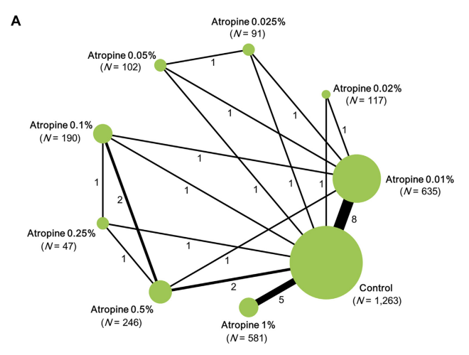
Figure 4. Networkplot demonstrating how atropine trials (in the meta-analysis included in Ha 2022) examining mean change in annual refraction are connected through evidence
Each node represents an atropine dosage. The size of the nodes represents the total study population examined; the thickness of the lines and the number indicate how many studies contributed to the comparison
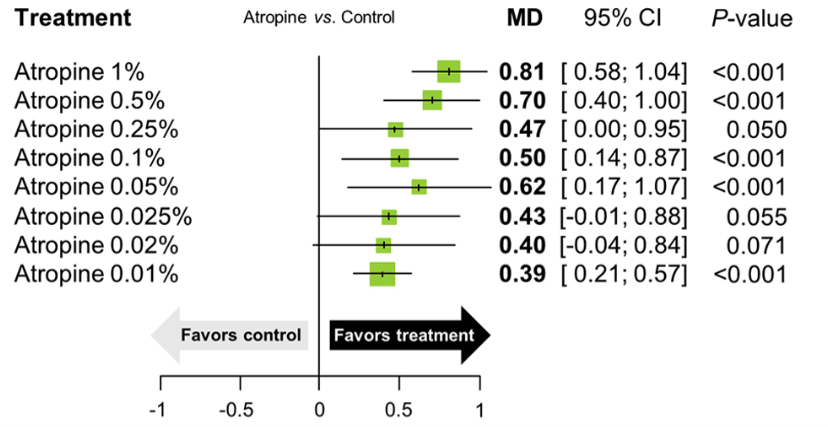
Figure 5. Forest plot of network meta-analysis comparing different doses of atropine for myopia interventions; mean annual refraction change
Each atropine concentration was compared with the control treatment, which was the reference group. CI= confidence interval; MD= mean difference (Ha, 2022)
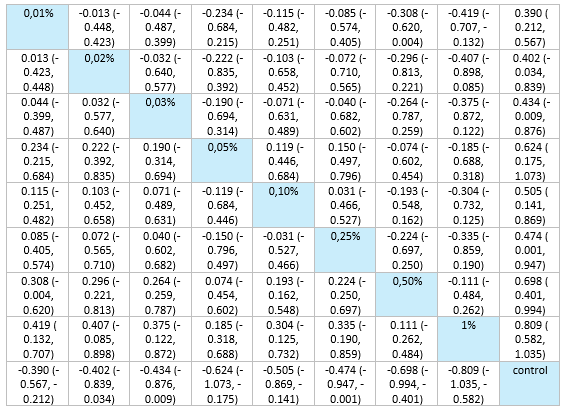
Figure 6. Net league table of head-to-head comparisons for different doses of atropine in myopia intervention: mean difference in refraction change
The estimate is shown in the shared cell between the treatment column and row
Level of evidence of the literature (versus control)
0.025% and 0.05%: The level of evidence regarding the outcome measure refraction was downgraded by one level because of imprecision (confidence interval crossed one boundary of minimal important difference).
0.5% and 1%: The level of evidence regarding the outcome measure refraction was downgraded by one level because of study limitations (issues with randomizations process) 0.1%: The level of evidence regarding the outcome measure refraction was downgraded by two levels of study limitations (issues with randomizations process) and because of imprecision (confidence interval crossed one boundary of minimal important difference).
0.01%: The level of evidence regarding the outcome measure refraction was downgraded by two levels because of imprecision (confidence interval crossed one boundary of minimal important difference) and because of applicability (bias due to indirectness (no direct comparison between concentrations)).
0.02% and 0.25%: The level of evidence regarding the outcome measure refraction was downgraded by three levels because of study limitations (issues with randomizations process), because of imprecision (confidence interval crossed one or two boundaries of minimal important difference) or because of incoherence (direct and indirect estimates did not align).
Adverse events (important)
Seven studies reported the outcome measure adverse events (Chia, 2012; Hieda, 2020; Saxena, 2021; Wei, 2020; Yam, 2019; Yen, 1989; Yi, 2015). Since the studies reported different adverse events for different concentrations of atropine, the results were not pooled (Table 4).
Table 4. Adverse events: number of patients experiencing adverse events, comparing atropine concentrations with control
|
Studie |
Adverse event |
0.01% atropine |
0.025% atropine |
0.05% atropine |
0.1% atropine |
0.5% atropine |
1% atropine |
Control |
|
Yen, 1989 |
Photophobia |
|
|
|
|
|
32/32 (100%) |
0/32 (0%) |
|
Chia, 2012 |
Allergic conjunctivitis |
|
|
|
6/155 (3.9%) |
7/161 (4.3%) |
|
0/84 (0%) |
|
Dermatitis involvingeyelids |
|
|
|
1/155 (0.6%) |
3/161 (1.9%) |
|
0/84(0%) |
|
|
Stye/chalazion |
|
|
|
12/155 (7.7%) |
12/161(7.5%) |
|
2/84 (2.4%) |
|
|
Loss of distant BCVA >1 line |
|
|
|
20/155 (12.9%) |
13/161(8.1%) |
|
11/84 (13.1%) |
|
|
Others, eye-related |
|
|
|
2/155 (1.3%) |
3/161 (1.9%) |
|
1/84 (1.2%) |
|
|
Severe adverse events (requiring hospitalization) |
|
|
|
3/155 (1.9%) |
3/161 (1.9%) |
|
1/84 (1.2%) |
|
|
Yi, 2015 |
Itching and distention of eyes |
|
|
|
|
|
0 |
0 |
|
Ocular redness |
|
|
|
|
|
0 |
0 |
|
|
Foreign body sensation |
|
|
|
|
|
0 |
0 |
|
|
Yam, 2019 |
Photophobia at 2 weeks |
6/110 (5.5%) |
20/108 (18.5%) |
34/109 (31.2%) |
|
|
|
14/111 (12.6%) |
|
Photophobia at 1 year |
2/110 (1.8%) |
6/108 (5.6%) |
8/109 (7.3%) |
|
|
|
4/111 (3.6%) |
|
|
Allergic conjunctivitis |
7/110 (6.4%) |
7/108 (6.5%) |
3/109 (2.8%) |
|
|
|
7/111 (6.3%) |
|
|
Hospitalization |
3/110 (2.7%) |
5/108 (4.6%) |
3/109 (2.8%) |
|
|
|
2/111 (1.8%) |
|
|
Wei, 2020 |
Photophobia |
5/76 (6.6%) |
|
|
|
|
|
1/83 (1.2%) |
|
Allergic conjunctivitis |
3/76 (3.9%) |
|
|
|
|
|
1/83 (1.2%) |
|
|
Near-blurredvision |
0 |
|
|
|
|
|
0 |
|
|
Hieda, 2020 |
Photophobia |
1/84 (1.2%) |
|
|
|
|
|
0/84 (0%) |
|
Near-visionimpairment |
0/84 (0%) |
|
|
|
|
|
1/84(1.2%) |
|
|
Suspectedhemiplegicalteration migraine |
1/84 (1.2%) |
|
|
|
|
|
0/84 (0%) |
|
|
Optic-disc hemorrhage |
0/84 (0%) |
|
|
|
|
|
1/84(1.2%) |
|
|
Saxena, 2021 |
Photophobia |
0 |
|
|
|
|
|
0 |
|
Blurring of vision |
0 |
|
|
|
|
|
0 |
|
|
Total |
231/3507 (6.6%) |
46/1482 (3.1%) |
||||||
Level of evidence of literature
The level of evidence for the outcome measure adverse events comes from randomized controlled trials and therefore starts at high. The level of evidence is not downgraded, resulting in a high level of evidence
Compliance (important)
Three studies reported the outcome measure compliance, defined as at least 75% expected use (Chia, 2012; Hieda, 2020; Yam, 2019).
Chia (2013) reported compliance, comparing 0.5% atropine and 0.1% atropine with a control group that received 0.01% atropine. In the group that received 0.5% atropine, 159 of the 161 patients (98.7%) were compliant, compared with 83 of the 84 patients (98.9%) in the group that received 0.01% atropine. The risk ratio was 1.00 (95% CI 0.97 to 1.03). There was no difference between the groups.
In the group that received 0.1% atropine, 150 of the 155 patients (96.8%) were compliant, compared with 83 of the 84 patients (98.9%) in the group that received 0.01% atropine. The risk ratio was 0.98 (95% CI 0.94 to 1.02. This difference was not statistically significant and not considered clinically relevant.
Yam (2019) reported compliance, comparing 0.05% atropine, 0.025% atropine and 0.01% atropine with a control group that received placebo. In the group that received 0.05% atropine, 102 of the 109 patients (93.6%) were compliant, compared with 100 of the 111 patients (90.1%) in the group that received placebo. The risk ratio was 1.04 (95% CI 0.96 to 1.12), in favour of the patients who received 0.05% atropine. This difference was not statistically significant and not considered clinically relevant.
In the group that received 0.025% atropine, 103 of the 108 patients (95.4%) were compliant, compared with 100 of the 111 patients (90.1%) in the group that received placebo. The risk ratio was 1.06 (95% CI 0.98 to 1.14), in favour of the patients who received 0.025% atropine. This difference was not statistically significant and not considered clinically relevant.
In the group that received 0.01% atropine, 100 of the 110 patients (90.9%) were compliant, compared with 100 of the 111 patients (90.1%) in the group that received placebo. The risk ratio was 1.01 (95% CI 0.93 to 1.10), in favour of the patients who received 0.01% atropine. This difference is not statistically significant and was not considered clinically relevant.
Hieda (2020) reported compliance at 24 months, comparing 0.1% atropine with placebo. In the group that received 0.1% atropine, 70 of the 84 patients (83.3%) were compliant, compared with 72 of the 84 patients (85.7%) in the group that received placebo. The risk ratio was 0.97 (95% CI 0.85 to 1.11), in favour of the patients who received placebo. This difference was not statistically significant and not considered clinically relevant.
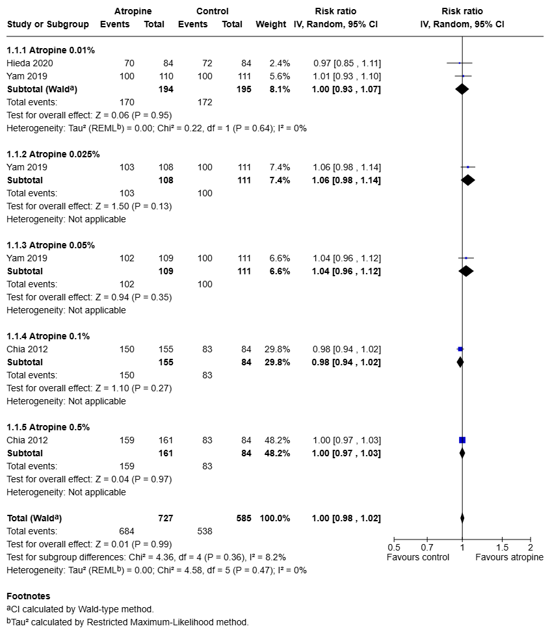
Figure 7. Compliance for atropine versus control
Level of evidence of literature
The level of evidence for the outcome measure compliance comes from randomized controlled trials and therefore starts at high. The level of evidence is not downgraded, resulting in a high level of evidence.
A systematic review of the literature was performed to answer the following question(s):
What is the effect of different atropine concentrations on the inhibition of progressive myopia?
Table 1. PICO 1
| Patients | Children with progressive myopia |
| Intervention | Atropine eye drops at varying concentrations |
| Control | Placebo |
| Outcomes | Effectiveness on axial length, effectiveness on refraction, side effects (e.g. pupil size, photophobia, acceptance, reduced accommodation, reduced near vision), treatment adherence (adherence, compliance) |
| Other selection criteria | Study design: systematic reviews and randomized controlled trials |
Table 2. PICO 2
| Patients | Children with progressive myopia |
| Intervention | Atropine eye drops at varying concentrations |
| Control | Atropine eye drops at varying concentrations (0.01-1%) |
| Outcomes | Effectiveness on axial length, effectiveness on refraction, side effects (e.g. pupil size, photophobia, acceptance, reduced accommodation, reduced near vision), treatment adherence (adherence, compliance) |
| Other selection criteria | Study design: systematic reviews and randomized controlled trials |
Relevant outcome measures
The guideline panel considered effectivity on axial length and refraction as a critical outcome measure for decision making; and adverse events and compliance/adherence to therapy as important outcome measures for decision making.
A priori, the guideline panel did not define the outcome measures listed above but used the definitions used in the studies.
The guideline panel defined the following differences as a minimal clinically (patient) important difference:
- Axial length: 0.1 mm (first year).
- Refraction: 0.25D myopie progression per year.
- Complications: 10% (RR < 0.9 and RR > 1.1).
- Compliance/adherence: 10% (RR < 0.9 and RR > 1.1).
Search and select (Methods)
A systematic literature search was performed by a medical information specialist using the following bibliographic databases: Embase.com and Ovid/Medline. Both databases were searched till 16th July 2024 for systematic reviews, RCTs and observational studies. Systematic searches were completed using a combination of controlled vocabulary/subject headings (e.g., Emtree-terms, MeSH) wherever they were available and natural language keywords. The overall search strategy was derived from two primary search concepts: (1) children with progressive myopia; (2) usage of different atropine concentrations. Duplicates were removed using EndNote software. After deduplication a total of 1696 records were imported for title/abstract screening. Studies were selected based on the criteria described in Table 1. Titles and abstracts were screened using the ASReview software version 1.6.2. The settings TF-IDF and Naïve bayes were used. Seven studies were used as prior knowledge for inclusion (Brennan, 2021, Long, 2023; Repka, 2023; Yam, 2023; Li, 2024; Moriche-Carretero, 2024; Sánchez-Tena, 2024). One study was used as prior knowledge for exclusions (Chan, 2024).
The first 10% of references were screened by the working group and the guideline methodologist. The remaining articles were subsequently screened by the guideline methodologist, using the following stopping rule: stop after 170 subsequent exclusions.
Initially, 46 studies were selected based on title and abstract screening. After reading the full text, 45 studies were excluded (see the exclusion table under the tab ‘Evidence tabellen’), and 1 study was included.
- Barathi VA, Chaurasia SS, Poidinger M, Koh SK, Tian D, Ho C, Iuvone PM, Beuerman RW, Zhou L. Involvement of GABA transporters in atropine-treatedmyopic retina as revealed by iTRAQ quantitative proteomics. J ProteomeRes. 2014 Nov 7;13(11):4647-58. doi: 10.1021/pr500558y. Epub 2014 Oct 1. PMID: 25211393; PMCID: PMC4227558.
- Brennan NA, Toubouti YM, Cheng X, Bullimore MA. Efficacy in myopia control. Prog Retin Eye Res. 2021 Jul;83:100923. doi: 10.1016/j.preteyeres.2020.100923. Epub 2020 Nov 27. PMID: 33253901.
- Brignardello-Petersen R, Florez ID, Izcovich A, Santesso N, Hazlewood G, Alhazanni W, Yepes-Nuñez JJ, Tomlinson G, Schünemann HJ, Guyatt GH; GRADE working group. GRADE approach to drawing conclusions from a network meta-analysis using a minimally contextualised framework. BMJ. 2020 Nov 11;371:m3900. doi: 10.1136/bmj.m3900. PMID: 33177059.
- Bullimore MA, Brennan NA. Myopia Control: WhyEachDiopter Matters. Optom Vis Sci. 2019 Jun;96(6):463-465. doi: 10.1097/OPX.0000000000001367. PMID: 31116165.
- Carr BJ, Mihara K, Ramachandran R, Saifeddine M, Nathanson NM, Stell WK, Hollenberg MD. Myopia-InhibitingConcentrations of Muscarinic Receptor Antagonists Block Activation of Alpha2A-Adrenoceptors In Vitro. InvestOphthalmol Vis Sci. 2018 Jun 1;59(7):2778-2791. doi: 10.1167/iovs.17-22562. PMID: 29860464.
- Chan SS, Choi KY, Chan HH. Paediatric norms for photopic electroretinogram testing based on a large cohort of Chinese preschool children. BMJ Open Ophthalmol. 2024 Feb 21;9(1):e001393. doi: 10.1136/bmjophth-2023-001393. PMID: 38388004; PMCID: PMC10882341.
- Cui C, Li X, Lyu Y, Wei L, Zhao B, Yu S, Rong J, Bai Y, Fu A. Safety and efficacy of 0.02% and 0.01% atropine on controlling myopia progression: a 2-year clinical trial. Sci Rep. 2021 Nov 15;11(1):22267. doi: 10.1038/s41598-021-01708-2. PMID: 34782708; PMCID: PMC8592985.
- Fray, Georgina. (2024). 6183 Behavioural side effects of atropine eye drops. Archives of Disease in Childhood. 109. A375.2-A376. 10.1136/archdischild-2024-rcpch.597.
- Ha A, Kim SJ, Shim SR, Kim YK, Jung JH. Efficacy and Safety of 8 Atropine Concentrations for Myopia Control in Children: A Network Meta-Analysis. Ophthalmology. 2022 Mar;129(3):322-333. doi: 10.1016/j.ophtha.2021.10.016. Epub 2021 Oct 22. PMID: 34688698.
- Haarman AEG, Enthoven CA, Tideman JWL, Tedja MS, Verhoeven VJM, Klaver CCW. The Complications of Myopia: A Review and Meta-Analysis. Invest Ophthalmol Vis Sci. 2020 Apr 9;61(4):49. doi: 10.1167/iovs.61.4.49. PMID: 32347918; PMCID: PMC7401976.
- Hansen NC, Hvid-Hansen A, Møller F, Bek T, Larsen DA, Jacobsen N, Kessel L. Two-Year Results of 0.01% Atropine Eye Drops and 0.1% Loading Dose for Myopia Progression Reduction in Danish Children: A Placebo-Controlled, Randomized Clinical Trial. J Pers Med. 2024 Feb 2;14(2):175. doi: 10.3390/jpm14020175. PMID: 38392608; PMCID: PMC10890135.
- Hansen N, Hvid-Hansen A, Møller F, Bek T, Larsen D, Jacobsen N, Kessel L. 3-year results of 0.01% and 0.1% loading dose atropine treatment including washout in Danish children with myopia: a placebo-controlled, randomised clinical trial. Br J Ophthalmol. 2025 Aug 20;109(9):1056-1063. doi: 10.1136/bjo-2024-326918. PMID: 40122578; PMCID: PMC12418564.
- Klaver C, Polling JR; Erasmus Myopia Research Group. Myopia management in the Netherlands. Ophthalmic Physiol Opt. 2020 Mar;40(2):230-240. doi: 10.1111/opo.12676. PMID: 32202320.
- Kothari M, Jain R, Khadse N, Rathod V, Mutha S. Allergic reactions to atropine eye drops for retardation of progressive myopia in children. Indian J Ophthalmol. 2018 Oct;66(10):1446-1450. doi: 10.4103/ijo.IJO_165_18. PMID: 30249831; PMCID: PMC6173048.
- Lee SS, Lingham G, Blaszkowska M, Sanfilippo PG, Koay A, Franchina M, Chia A, Loughman J, Flitcroft DI, Hammond CJ, Azuara-Blanco A, Crewe JM, Clark A, Mackey DA. Low-concentration atropine eyedrops for myopia control in a multi-racial cohort of Australian children: A randomised clinical trial. Clin Exp Ophthalmol. 2022 Dec;50(9):1001-1012. doi: 10.1111/ceo.14148. Epub 2022 Sep 9. PMID: 36054556; PMCID: PMC10086806.
- Li Y, Yip M, Ning Y, Chung J, Toh A, Leow C, Liu N, Ting D, Schmetterer L, Saw SM, Jonas JB, Chia A, Ang M. Topical Atropine for Childhood Myopia Control: The Atropine Treatment Long-Term Assessment Study. JAMA Ophthalmol. 2024 Jan 1;142(1):15-23. doi: 10.1001/jamaophthalmol.2023.5467. PMID: 38019503; PMCID: PMC10690578.
- Liang X, Wei S, Li SM, An W, Du J, Sun Y, Gan J, Bai W, Cai Z, Song Q, Yin L, Wang N. Effect of Atropine 0.01% Eye Drops on the Difference in Refraction and Axial Length between Right and Left Eyes. Ophthalmic Res. 2023;66(1):496-505. doi: 10.1159/000528878. Epub 2023 Jan 5. PMID: 36603556.
- Long H, Shi MH, Li X. Efficacy and safety of atropine in myopic children: A meta-analysis of randomized controlled trials. J Fr Ophtalmol. 2023 Oct;46(8):929-940. doi: 10.1016/j.jfo.2023.01.030. Epub 2023 May 3. PMID: 37147148.
- Loughman J, Kobia-Acquah E, Lingham G, Butler J, Loskutova E, Mackey DA, Lee SSY, Flitcroft DI. Myopia outcome study of atropine in children: Two-year result of daily 0.01% atropine in a European population. Acta Ophthalmol. 2024 May;102(3):e245-e256. doi: 10.1111/aos.15761. Epub 2023 Sep 11. PMID: 37694816.
- Loughman J, Lingham G, Nkansah EK, Kobia-Acquah E, Flitcroft DI. Efficacy and Safety of Different Atropine Regimens for the Treatment of Myopia in Children: Three-Year Results of the MOSAIC Randomized Clinical Trial. JAMA Ophthalmol. 2025 Feb 1;143(2):134-144. doi: 10.1001/jamaophthalmol.2024.5703. PMID: 39786755; PMCID: PMC11843376.
- Mitchelson F. Muscarinic receptor agonists and antagonists: effects on ocular function. Handb Exp Pharmacol. 2012;(208):263-98. doi: 10.1007/978-3-642-23274-9_12. PMID: 22222703.
- Moriche-Carretero M, Revilla-Amores R, Diaz-Valle D, Morales-Fernández L, Gomez-de-Liaño R. Myopia progression and axial elongation in Spanish children: Efficacy of atropine 0.01% eye-drops. J Fr Ophtalmol. 2021 Dec;44(10):1499-1504. doi: 10.1016/j.jfo.2021.07.005. Epub 2021 Nov 10. PMID: 34774348.
- Moriche-Carretero M, Revilla-Amores R, Gutiérrez-Blanco A, Moreno-Morillo FJ, Martinez-Perez C, Sánchez-Tena MÁ, Alvarez-Peregrina C. Five-year results of atropine 0.01% efficacy in the myopia control in a European population. Br J Ophthalmol. 2024 May 21;108(5):715-719. doi: 10.1136/bjo-2022-322808. PMID: 37268328.
- Nikolakopoulou A, Higgins JPT, Papakonstantinou T, Chaimani A, Del Giovane C, Egger M, Salanti G. CINeMA: An approach for assessing confidence in the results of a network meta-analysis. PLoS Med. 2020 Apr 3;17(4):e1003082. doi: 10.1371/journal.pmed.1003082. PMID: 32243458; PMCID: PMC7122720.
- Papakonstantinou T, Nikolakopoulou A, Higgins JPT, Egger M & Salanti G. CINeMA: Software for semiautomated assessment of the confidence in the results of network meta-analysis. Campbell Systematic Reviews 2020;16:e1080.
- Repka MX, Weise KK, Chandler DL, Wu R, Melia BM, Manny RE, Kehler LAF, Jordan CO, Raghuram A, Summers AI, Lee KA, Petersen DB, Erzurum SA, Pang Y, Lenhart PD, Ticho BH, Beck RW, Kraker RT, Holmes JM, Cotter SA; Pediatric Eye Disease Investigator Group. Low-Dose 0.01% Atropine Eye Drops vs Placebo for Myopia Control: A Randomized Clinical Trial. JAMA Ophthalmol. 2023 Aug 1;141(8):756-765. doi: 10.1001/jamaophthalmol.2023.2855. PMID: 37440213; PMCID: PMC10346510.
- Sánchez-Tena MÁ, Ballesteros-Sánchez A, Martinez-Perez C, Alvarez-Peregrina C, De-Hita-Cantalejo C, Sánchez-González MC, Sánchez-González JM. Assessing the rebound phenomenon in different myopia control treatments: A systematic review. Ophthalmic Physiol Opt. 2024 Mar;44(2):270-279. doi: 10.1111/opo.13277. Epub 2024 Jan 9. PMID: 38193312.
- Sen S, Yadav H, Jain A, Verma S, Gupta P. Effect of atropine 0.01% on progression of myopia. Indian J Ophthalmol. 2022 Sep;70(9):3373-3376. doi: 10.4103/ijo.IJO_256_22. PMID: 36018124; PMCID: PMC9675497.
- Thomson K, Kelly T, Karouta C, Morgan I, Ashby R. Insightsintothemechanismbywhich atropine inhibitsmyopia: evidenceagainstcholinergichyperactivityandmodulation of dopamine release. Br J Pharmacol. 2021 Nov;178(22):4501-4517. doi: 10.1111/bph.15629. Epub 2021 Oct 10. PMID: 34302355; PMCID: PMC9293064.
- Wang YR, Bian HL, Wang Q. Atropine 0.5% eyedrops for the treatment of children with low myopia: A randomized controlled trial. Medicine (Baltimore). 2017 Jul;96(27):e7371. doi: 10.1097/MD.0000000000007371. PMID: 28682887; PMCID: PMC5502160.
- Wei S, Li SM, An W, Du J, Liang X, Sun Y, Gan J, Bai W, Tian J, Cai Z, Yin L, Wang N. Myopia progression after cessation of low-dose atropine eyedrops treatment: A two-year randomized, double-masked, placebo-controlled, cross-over trial. Acta Ophthalmol. 2023 Mar;101(2):e177-e184. doi: 10.1111/aos.15235. Epub 2022 Aug 23. PMID: 35999653.
- Wang Z, Li T, Zuo X, Zhang T, Liu L, Zhou C, Leng Z, Chen X, Wang L, Wang X, Liu H. 0.01% Atropine Eye Drops in Children With Myopia and Intermittent Exotropia: The AMIXT Randomized Clinical Trial. JAMA Ophthalmol. 2024 Aug 1;142(8):722-730. doi: 10.1001/jamaophthalmol.2024.2295. PMID: 38958962; PMCID: PMC11223046.
- Xu S, Wang M, Qu Y, Wang Y, Jiang J, Zhou F, Zhao W, Zheng B, Chen W, Lei X, Li Z, Hu Y, Yang X. Twice-daily administration improves the effectiveness of 0.01% atropine for controlling myopia in slowing axial elongation and refractive progression. Ophthalmic Physiol Opt. 2025 Jul 23. doi: 10.1111/opo.13558. Epub ahead of print. PMID: 40698880.
- Yam JC, Zhang XJ, Zaabaar E, Wang Y, Gao Y, Zhang Y, Li X, Kam KW, Tang F, Chu WK, Zhou X, Zhang W, He X, Wu PC, Rose KA, Morgan I, He M, Ohno-Matsui K, Jonas JB, Zhang M, Tham CC, Chen LJ, Pang CP. Interventionstoreduceincidenceandprogression of myopia in childrenandadults. ProgRetin Eye Res. 2025 Oct 16;109:101410. doi: 10.1016/j.preteyeres.2025.101410. Epub ahead of print. PMID: 41109517.
- Yam JC, Zhang XJ, Zhang Y, Yip BHK, Tang F, Wong ES, Bui CHT, Kam KW, Ng MPH, Ko ST, Yip WWK, Young AL, Tham CC, Chen LJ, Pang CP. Effect of Low-Concentration Atropine Eyedrops vs Placebo on Myopia Incidence in Children: The LAMP2 Randomized Clinical Trial. JAMA. 2023 Feb 14;329(6):472-481. doi: 10.1001/jama.2022.24162. Erratum in: JAMA. 2023 Apr 4;329(13):1123. doi: 10.1001/jama.2023.3989. PMID: 36786791; PMCID: PMC9929700.
- Zadnik K, Schulman E, Flitcroft I, Fogt JS, Blumenfeld LC, Fong TM, Lang E, Hemmati HD, Chandler SP; CHAMP Trial Group Investigators. Efficacy and Safety of 0.01% and 0.02% Atropine for the Treatment of Pediatric Myopia Progression Over 3 Years: A Randomized Clinical Trial. JAMA Ophthalmol. 2023 Oct 1;141(10):990-999. doi: 10.1001/jamaophthalmol.2023.2097. Erratum in: JAMA Ophthalmol. 2023 Oct 1;141(10):1005. doi: 10.1001/jamaophthalmol.2023.4206. PMID: 37261839; PMCID: PMC10236322.
- Zhang XJ, Zhang Y, Yip BHK, Kam KW, Tang F, Ling X, Ng MPH, Young AL, Wu PC, Tham CC, Chen LJ, Pang CP, Yam JC. Five-Year Clinical Trial of the Low-Concentration Atropine for Myopia Progression (LAMP) Study: Phase 4 Report. Ophthalmology. 2024 Sep;131(9):1011-1020. doi: 10.1016/j.ophtha.2024.03.013. Epub 2024 Mar 16. PMID: 38494130.
- Zhu Q, Tang GY, Hua ZJ, Xue LP, Zhou Y, Zhang JY, Zhu YT, Zhang XF. 0.05% atropine on control of myopia progression in Chinese school children: a randomized 3-year clinical trial. Int J Ophthalmol. 2023 Jun 18;16(6):939-946. doi: 10.18240/ijo.2023.06.17. PMID: 37332542; PMCID: PMC10250955.
Risk of bias tables
The risk of bias table is included in the network meta-analysis of Ha (2022).
Table of excluded studies
|
Reference |
Reason for exclusion |
|
Long H, Shi MH, Li X. Efficacy and safety of atropine in myopic children: A meta-analysis of randomized controlled trials. J Fr Ophtalmol. 2023 Oct;46(8):929-940. doi: 10.1016/j.jfo.2023.01.030. Epub 2023 May 3. PMID: 37147148. |
NMA by Ha (2022) was included |
|
Yam JC, Zhang XJ, Zhang Y, Yip BHK, Tang F, Wong ES, Bui CHT, Kam KW, Ng MPH, Ko ST, Yip WWK, Young AL, Tham CC, Chen LJ, Pang CP. Effect of Low-Concentration Atropine Eyedrops vs Placebo on Myopia Incidence in Children: The LAMP2 Randomized Clinical Trial. JAMA. 2023 Feb 14;329(6):472-481. doi: 10.1001/jama.2022.24162. Erratum in: JAMA. 2023 Apr 4;329(13):1123. doi: 10.1001/jama.2023.3989. PMID: 36786791; PMCID: PMC9929700. |
Yam (2019) included in Ha (2022). Already a direct comparison between the concentrations atropine in Ha (2022). |
|
Brennan NA, Toubouti YM, Cheng X, Bullimore MA. Efficacy in myopia control. Prog Retin Eye Res. 2021 Jul;83:100923. doi: 10.1016/j.preteyeres.2020.100923. Epub 2020 Nov 27. PMID: 33253901. |
Publiced before april 2021 (search date Ha (2022)) |
|
Repka MX, Weise KK, Chandler DL, Wu R, Melia BM, Manny RE, Kehler LAF, Jordan CO, Raghuram A, Summers AI, Lee KA, Petersen DB, Erzurum SA, Pang Y, Lenhart PD, Ticho BH, Beck RW, Kraker RT, Holmes JM, Cotter SA; Pediatric Eye Disease Investigator Group. Low-Dose 0.01% Atropine Eye Drops vs Placebo for Myopia Control: A Randomized Clinical Trial. JAMA Ophthalmol. 2023 Aug 1;141(8):756-765. doi: 10.1001/jamaophthalmol.2023.2855. PMID: 37440213; PMCID: PMC10346510. |
Already a direct comparison between the concentrations atropine in Ha (2022). |
|
Sánchez-Tena MÁ, Ballesteros-Sánchez A, Martinez-Perez C, Alvarez-Peregrina C, De-Hita-Cantalejo C, Sánchez-González MC, Sánchez-González JM. Assessing the rebound phenomenon in different myopia control treatments: A systematic review. OphthalmicPhysiolOpt. 2024 Mar;44(2):270-279. doi: 10.1111/opo.13277. Epub 2024 Jan 9. PMID: 38193312. |
Does not meet PICO criteria |
|
Moriche-Carretero M, Revilla-Amores R, Gutiérrez-Blanco A, Moreno-Morillo FJ, Martinez-Perez C, Sánchez-Tena MÁ, Alvarez-Peregrina C. Five-year results of atropine 0.01% efficacy in the myopia control in a European population. Br J Ophthalmol. 2024 May 21;108(5):715-719. doi: 10.1136/bjo-2022-322808. PMID: 37268328. |
Already a direct comparison between the concentrations atropine in Ha (2022). |
|
Li Y, Yip M, Ning Y, Chung J, Toh A, Leow C, Liu N, Ting D, Schmetterer L, Saw SM, Jonas JB, Chia A, Ang M. Topical Atropine for Childhood Myopia Control: The Atropine Treatment Long-Term Assessment Study. JAMA Ophthalmol. 2024 Jan 1;142(1):15-23. doi: 10.1001/jamaophthalmol.2023.5467. PMID: 38019503; PMCID: PMC10690578. |
Already a direct comparison between the concentrations atropine in Ha (2022). |
|
Shih YF, Chen CH, Chou AC, Ho TC, Lin LL, Hung PT. Effects of different concentrations of atropine on controlling myopia in myopic children. J OculPharmacolTher. 1999 Feb;15(1):85-90. doi: 10.1089/jop.1999.15.85. PMID: 10048351. |
Included in NMA by Ha (2022) |
|
Shaminah, S. B., Ashiff, S. M., Lyu, F. A meta analysis on atropine controlling myopia progression in children 2019 |
Publiced before april 2021 (search date Ha (2022)) |
|
Chen C, Yao J. Efficacy and Adverse Effects of Atropine for Myopia Control in Children: A Meta-Analysis of Randomised Controlled Trials. J Ophthalmol. 2021 Dec 10;2021:4274572. doi: 10.1155/2021/4274572. PMID: 34925913; PMCID: PMC8683246. |
Does not meet PICO criteria |
|
Gong Q, Janowski M, Luo M, Wei H, Chen B, Yang G, Liu L. Efficacy and Adverse Effects of Atropine in Childhood Myopia: A Meta-analysis. JAMA Ophthalmol. 2017 Jun 1;135(6):624-630. doi: 10.1001/jamaophthalmol.2017.1091. PMID: 28494063; PMCID: PMC5710262. |
Does not meet PICO criteria |
|
Pineles SL, Kraker RT, VanderVeen DK, Hutchinson AK, Galvin JA, Wilson LB, Lambert SR. Atropine for the Prevention of Myopia Progression in Children: A Report by the American Academy of Ophthalmology. Ophthalmology. 2017 Dec;124(12):1857-1866. doi: 10.1016/j.ophtha.2017.05.032. Epub 2017 Jun 29. PMID: 28669492. |
Publiced before april 2021 (search date Ha (2022)) |
|
Zhao C, Cai C, Ding Q, Dai H. Efficacy and safety of atropine to control myopia progression: a systematic review and meta-analysis. BMC Ophthalmol. 2020 Dec 7;20(1):478. doi: 10.1186/s12886-020-01746-w. PMID: 33287746; PMCID: PMC7720573. |
Does not meet PICO criteria |
|
Gan J, Li SM, Wu S, Cao K, Ma D, He X, Hua Z, Kang MT, Wei S, Bai W, Wang N. Varying Dose of Atropine in Slowing Myopia Progression in Children Over Different Follow-Up Periods by Meta-Analysis. Front Med (Lausanne). 2022 Jan 13;8:756398. doi: 10.3389/fmed.2021.756398. PMID: 35096861; PMCID: PMC8792607. |
NMA by Ha (2022) was included |
|
Hou P, Wu D, Nie Y, Wei H, Liu L, Yang G. Comparison of the efficacy and safety of different doses of atropine for myopic control in children: a meta-analysis. Front Pharmacol. 2023 Sep 11;14:1227787. doi: 10.3389/fphar.2023.1227787. PMID: 37767401; PMCID: PMC10520549. |
NMA by Ha (2022) was included |
|
Wei XL, Wu T, Dang KR, Hu KK, Lu XT, Gong M, Du YR, Hui YN, Tian XM, Du HJ. Efficacy and safety of atropine at different concentrations in prevention of myopia progression in Asian children: a systematic review and Meta-analysis of randomized clinical trials. Int J Ophthalmol. 2023 Aug 18;16(8):1326-1336. doi: 10.18240/ijo.2023.08.20. PMID: 37602338; PMCID: PMC10398521. |
NMA by Ha (2022) was included |
|
Song YY, Wang H, Wang BS, Qi H, Rong ZX, Chen HZ. Atropine in ameliorating the progression of myopia in children with mild to moderate myopia: a meta-analysis of controlled clinical trials. J OculPharmacolTher. 2011 Aug;27(4):361-8. doi: 10.1089/jop.2011.0017. Epub 2011 Jun 7. PMID: 21649523. |
Publiced before april 2021 (search date Ha (2022)) |
|
Wang XY, Deng HW, Yang J, Zhu XM, Xiang FL, Tu J, Huang MX, Wang Y, Gan JH, Yang WH. The optimal atropine concentration for myopia control in Chinese children: a systematic review and network Meta-analysis. Int J Ophthalmol. 2024 Jun 18;17(6):1128-1137. doi: 10.18240/ijo.2024.06.19. PMID: 38895669; PMCID: PMC11144781. |
NMA by Ha (2022) was included |
|
LI, S. Y., Yang, Y. X., Yang, C., Yang, Z. Y., Xue, Y. X., & Feng, J. H. (2023). Meta-analysis of different concentrations of atropine eye drops in controlling myopia progression in children and adolescents. International Eye Science, 23(1), 96-102. |
NMA by Ha (2022) was included |
|
Zhao Y, Feng K, Liu RB, Pan JH, Zhang LL, Xu ZP, Lu XJ. Atropine 0.01% eye drops slow myopia progression: a systematic review and Meta-analysis. Int J Ophthalmol. 2019 Aug 18;12(8):1337-1343. doi: 10.18240/ijo.2019.08.16. PMID: 31456926; PMCID: PMC6694061. |
Publiced before april 2021 (search date Ha (2022)) |
|
Puspita, I., Rahmah, M. N., Maharani, R. N., Patong, R. Y., Kamaruddin, M. I., EFFICACY OF ATROPINE EYE DROPS AS THERAPY OF PROGRESSIVE MYOPIA IN CHILDREN : A SYSTEMATIC REVIEW, 2024 |
Does not meet PICO criteria |
|
Li FF, Yam JC. Low-Concentration Atropine Eye Drops for Myopia Progression. Asia Pac J Ophthalmol (Phila). 2019 Sep-Oct;8(5):360-365. doi: 10.1097/APO.0000000000000256. PMID: 31478936; PMCID: PMC6784858. |
Publiced before april 2021 (search date Ha (2022)) |
|
Chia A, Chua WH, Cheung YB, Wong WL, Lingham A, Fong A, Tan D. Atropine for the treatment of childhood myopia: safety and efficacy of 0.5%, 0.1%, and 0.01% doses (Atropine for the Treatment of Myopia 2). Ophthalmology. 2012 Feb;119(2):347-54. doi: 10.1016/j.ophtha.2011.07.031. Epub 2011 Oct 2. PMID: 21963266. |
Included in NMA by Ha (2022) |
|
Surachatkumtonekul, T., Jutasompakorn, P., Wiriyaudomchart, S., Hokierti, K., & Sri-in, J. (2023). Efficacy of Atropine Eye Drops for Suppressing Myopia Progression in Thai Children. SirirajMedical Journal, 75(11), 794-799. |
Retrospective cohort study |
|
Lee CY, Sun CC, Lin YF, Lin KK. Effects of topical atropine on intraocular pressure and myopia progression: a prospective comparative study. BMC Ophthalmol. 2016 Jul 19;16:114. doi: 10.1186/s12886-016-0297-y. PMID: 27435576; PMCID: PMC4950753. |
Publiced before april 2021 (search date Ha (2022)) |
|
Medghalchi A, Behboudi H, Akbari M, Moghadam RS, Kazemnejad E, Sabnan S. The Preventive Role of Atropine Eye Drops on Myopia Progression: A Double-Blind Randomized Clinical Trial. Int J Prev Med. 2023 Apr 26;14:45. doi: 10.4103/ijpvm.ijpvm_175_22. PMID: 37351034; PMCID: PMC10284217. |
Already a direct comparison between the concentrations atropine in Ha (2022). |
|
GU, Z. M., Lan, C. J., Zhong, W. Q., LI, X. Y., Xiang, X. L., &Liao, X. (2022). Meta-analysis of the effect of different concentrations of atropine inhibiting spherical equivalent degree and axial length of myopia in children. International Eye Science, 1671-1677. |
NMA by Ha (2022) was included |
|
Chia A, Lu QS, Tan D. Five-Year Clinical Trial on Atropine for the Treatment of Myopia 2: Myopia Control with Atropine 0.01% Eyedrops. Ophthalmology. 2016 Feb;123(2):391-399. doi: 10.1016/j.ophtha.2015.07.004. Epub 2015 Aug 11. PMID: 26271839. |
Already a direct comparison between the concentrations atropine in Ha (2022). |
|
Li FF, Zhang Y, Zhang X, Yip BHK, Tang SM, Kam KW, Young AL, Chen LJ, Tham CC, Pang CP, Yam JC. Age Effect on Treatment Responses to 0.05%, 0.025%, and 0.01% Atropine: Low-Concentration Atropine for Myopia Progression Study. Ophthalmology. 2021 Aug;128(8):1180-1187. doi: 10.1016/j.ophtha.2020.12.036. Epub 2021 Jan 8. PMID: 33422558. |
Already a direct comparison between the concentrations atropine in Ha (2022). |
|
Yam JC, Li FF, Zhang X, Tang SM, Yip BHK, Kam KW, Ko ST, Young AL, Tham CC, Chen LJ, Pang CP. Two-Year Clinical Trial of the Low-Concentration Atropine for Myopia Progression (LAMP) Study: Phase 2 Report. Ophthalmology. 2020 Jul;127(7):910-919. doi: 10.1016/j.ophtha.2019.12.011. Epub 2019 Dec 21. PMID: 32019700. |
Yam (2019) included in Ha (2022). Already a direct comparison between the concentrations atropine in Ha (2022). |
|
Li FF, Kam KW, Zhang Y, Tang SM, Young AL, Chen LJ, Tham CC, Pang CP, Yam JC. Differential Effects on Ocular Biometrics by 0.05%, 0.025%, and 0.01% Atropine: Low-Concentration Atropine for Myopia Progression Study. Ophthalmology. 2020 Dec;127(12):1603-1611. doi: 10.1016/j.ophtha.2020.06.004. Epub 2020 Jun 7. PMID: 32525048. |
Publiced before april 2021 (search date Ha (2022)) |
|
Joachimsen L, Farassat N, Bleul T, Böhringer D, Lagrèze WA, Reich M. Side effects of topical atropine 0.05% compared to 0.01% for myopia control in German school children: a pilot study. Int Ophthalmol. 2021 Jun;41(6):2001-2008. doi: 10.1007/s10792-021-01755-8. Epub 2021 Feb 25. PMID: 33634343; PMCID: PMC8172502. |
Observational case series |
|
Chia A, Ngo C, Choudry N, Yamakawa Y, Tan D. Atropine Ophthalmic Solution to Reduce Myopia Progression in Pediatric Subjects: The Randomized, Double-Blind Multicenter Phase II APPLE Study. Asia Pac J Ophthalmol (Phila). 2023 Jul-Aug 01;12(4):370-376. doi: 10.1097/APO.0000000000000609. Epub 2023 May 10. PMID: 37523428. |
The study compared concentrations of atropine that were too low. |
|
Tran HDM, Sankaridurg P, Naduvilath T, Ha TTX, Tran TD, Jong M, Coroneo M, Tran YH. A Meta-Analysis Assessing Change in Pupillary Diameter, Accommodative Amplitude, and Efficacy of Atropine for Myopia Control. AsiaPac J Ophthalmol (Phila). 2021 Aug 27;10(5):450-460. doi: 10.1097/APO.0000000000000414. PMID: 34456234. |
NMA by Ha (2022) was included |
|
Fu A, Stapleton F, Wei L, Wang W, Zhao B, Watt K, Ji N, Lyu Y. Effect of low-dose atropine on myopia progression, pupil diameter and accommodative amplitude: low-dose atropine and myopia progression. Br J Ophthalmol. 2020 Nov;104(11):1535-1541. doi: 10.1136/bjophthalmol-2019-315440. Epub 2020 Feb 21. PMID: 32086237. |
Included in NMA by Ha (2022) |
|
Cui C, Li X, Lyu Y, Wei L, Zhao B, Yu S, Rong J, Bai Y, Fu A. Safety and efficacy of 0.02% and 0.01% atropine on controlling myopia progression: a 2-year clinical trial. Sci Rep. 2021 Nov 15;11(1):22267. doi: 10.1038/s41598-021-01708-2. PMID: 34782708; PMCID: PMC8592985. |
Already a direct comparison between the concentrations atropine in Ha (2022). |
|
Zhong, M., Lyu, Y., FU, A., Zhang, J., Wei, L., Zhao, B., & Wang, W. (2019). Effects of 0.01% and 0.02% atropine eye drops on pupil diameter and accommodation amplitude in myopic children: one-year randomized, double blind, controlled trail. Chinese Journal of Experimental Ophthalmology, 540-545. |
Publiced before april 2021 (search date Ha (2022)) |
|
Tran HDM, Ha TTX, Tran YH, Coroneo M, Tran TD, Truong TU, Sankaridurg P. Impact of Various Concentrations of Low-Dose Atropine on Pupillary Diameter and Accommodative Amplitude in Children with Myopia. J OculPharmacolTher. 2024 May;40(4):232-239. doi: 10.1089/jop.2023.0173. Epub 2024 Apr 15. PMID: 38621178. |
Atropine concentrations differ from Ha (2022) |
|
Fu A, Stapleton F, Wei L, Wang W, Zhao B, Watt K, Yu S, Cui C, Lyu Y. Risk factors for rapid axial length elongation with low concentration atropine for myopia control. Sci Rep. 2021 Jun 3;11(1):11729. doi: 10.1038/s41598-021-88719-1. PMID: 34083576; PMCID: PMC8175344. |
Reason? |
|
Hu, B., Xiao, T., Liao, M., Chen, X., Zeng, X., Yi, S., Effects of atropine eye drops of different concentrations and administration frequencies on pupil diameter, accommodative amplitude, and tear film function in myopic children, 2024 |
Fulltextnotavailable |
|
Wang M, Cui C, Sui Y, Yu SA, Ma JX, Fu AC. Effect of 0.02% and 0.01% atropine on astigmatism: a two-year clinical trial. BMC Ophthalmol. 2022 Apr 7;22(1):161. doi: 10.1186/s12886-022-02385-z. PMID: 35392841; PMCID: PMC8991778. |
Did not meet PICO criteria |
|
Zhang XJ, Zhang Y, Yip BHK, Kam KW, Tang F, Ling X, Ng MPH, Young AL, Wu PC, Tham CC, Chen LJ, Pang CP, Yam JC. Five-Year Clinical Trial of the Low-Concentration Atropine for Myopia Progression (LAMP) Study: Phase 4 Report. Ophthalmology. 2024 Sep;131(9):1011-1020. doi: 10.1016/j.ophtha.2024.03.013. Epub 2024 Mar 16. PMID: 38494130. |
Yam (2019) included in Ha (2022). Already a direct comparison between the concentrations atropine in Ha (2022). |
|
Yam JC, Jiang Y, Tang SM, Law AKP, Chan JJ, Wong E, Ko ST, Young AL, Tham CC, Chen LJ, Pang CP. Low-Concentration Atropine for Myopia Progression (LAMP) Study: A Randomized, Double-Blinded, Placebo-Controlled Trial of 0.05%, 0.025%, and 0.01% Atropine Eye Drops in Myopia Control. Ophthalmology. 2019 Jan;126(1):113-124. doi: 10.1016/j.ophtha.2018.05.029. Epub 2018 Jul 6. PMID: 30514630. |
Included in NMA by Ha (2022) |
|
Yam JC, Zhang XJ, Zhang Y, Wang YM, Tang SM, Li FF, Kam KW, Ko ST, Yip BHK, Young AL, Tham CC, Chen LJ, Pang CP. Three-Year Clinical Trial of Low-Concentration Atropine for Myopia Progression (LAMP) Study: Continued Versus Washout: Phase 3 Report. Ophthalmology. 2022 Mar;129(3):308-321. doi: 10.1016/j.ophtha.2021.10.002. Epub 2021 Oct 7. PMID: 34627809. |
Did not meet PICO criteria |
|
Yam JC, Jiang Y, Lee J, Li S, Zhang Y, Sun W, Yuan N, Wang YM, Yip BHK, Kam KW, Chan HN, Zhang XJ, Young AL, Tham CC, Cheung CY, Chu WK, Pang CP, Chen LJ. The Association of Choroidal Thickening by Atropine With Treatment Effects for Myopia: Two-Year Clinical Trial of the Low-concentration Atropine for Myopia Progression (LAMP) Study. Am J Ophthalmol. 2022 May;237:130-138. doi: 10.1016/j.ajo.2021.12.014. Epub 2021 Dec 21. PMID: 34942105. |
Yam (2019) included in Ha (2022). Already a direct comparison between the concentrations atropine in Ha (2022). |
Beoordelingsdatum en geldigheid
Publicatiedatum : 26-08-2026
Beoordeeld op geldigheid : 26-08-2026
Het cluster Oog is als houder van deze richtlijn de eerstverantwoordelijke voor de actualiteit van deze richtlijn.
Algemene gegevens
De ontwikkeling van deze richtlijn werd ondersteund door het Kennisinstituut van de Federatie Medisch Specialisten (www.demedischspecialist.nl/kennisinstituut) en werd gefinancierd door de Stichting Kwaliteitsgelden Medisch Specialisten (SKMS). Patiëntenparticipatie bij deze richtlijn werd medegefinancierd uit de Kwaliteitsgelden Patiënten Consumenten (SKPC) binnen het programma Kwaliteit, Inzicht en Doelmatigheid in de medisch specialistische Zorg (KIDZ). De financier heeft geen enkele invloed gehad op de inhoud van de richtlijnmodule.
Samenstelling werkgroep
Voor het ontwikkelen van de richtlijnmodule is in 2023 een multidisciplinaire werkgroep ingesteld, bestaande uit vertegenwoordigers van alle relevante specialismen (zie hiervoor de Samenstelling van de werkgroep) die betrokken zijn bij de zorg voor patiënten met kinderen met progressieve myopie.
Werkgroep
Dr. M. (Martha) Tjon-Fo-Sang, oogarts, Het Oogziekenhuis Rotterdam, Rotterdam (voorzitter), NOG
Prof. Dr. C.C.W. (Caroline) Klaver, oogarts, Erasmusmc, Rotterdam & Radboudumc, Nijmegen, NOG
Dr. J.W.L. (Willem) Tideman, oogarts, Martini Ziekenhuis Groningen; Post-doc, Erasmusmc, Rotterdam, NOG
Prof. Dr. M.M. (Mies) van Genderen, oogarts, Bartiméus, Zeist & UMC Utrecht, Utrecht, NOG,
Dhr. G.J. (Gerlof) du Bois, patiëntvertegenwoordiger, Voorzitter patiëntengroep
Hoge Myopie (Oogvereniging)
Mevr. K.E.M. (Karin) van Hees – Teuben, optometrist, Lens Optiek, OVN
Drs. D. (Daisy) Laan, orthoptist en optometrist, Flevoziekenhuis, Almere, NVVO
Drs. H. (Marieke) Schut, gedragskundige, Bartimeus, Utrecht, NVO
Klankbordgroep
Drs. V. (Vasanthi) Iyer, arts M+G/jeugdarts, AJN Jeugdartsen Nederland, AJN
Mevr. E. (Esmee) Bennen, optometrist, Visser Contactlenzen, OVN
Mevr. C.W.M. (Corlien) Stoop, orthoptist, Catharina ziekenhuis, Eindhoven, NVVO
Met ondersteuning van
Dr. R. (Romy) Zwarts-van de Putte, adviseur, Kennisinstituut van de Federatie Medisch Specialisten
Drs. E.R.L. (Evie) Verweg, junior adviseur, Kennisinstituut van de Federatie Medisch Specialisten
Drs. B.L. (Babette) Gal-de Geest, adviseur, Kennisinstituut van de Federatie Medisch Specialisten
A. (Alies) Oost, medisch informatiespecialist, Kennisinstituut van de Federatie Medisch Specialisten
Belangenverklaringen
Een overzicht van de belangen van werkgroepleden en het oordeel over het omgaan met eventuele belangen vindt u in onderstaande tabel. De ondertekende belangenverklaringen zijn op te vragen bij het secretariaat van het Kennisinstituut van de Federatie Medisch Specialisten via secretariaat@kennisinstituut.nl.
Gemelde (neven)functies en belangen werkgroep
|
Naam |
Hoofdfunctie |
Nevenwerkzaamheden |
Persoonlijke financiële belangen |
Persoonlijke relaties |
Extern gefinancierd onderzoek |
Intellectuele belangen en reputatie |
Overige belangen |
Datum |
Restrictie |
|
Tjon Fo Sang |
Oogarts, Oogziekenhuis Rotterdam |
Geen |
nvt |
nvt |
nvt |
nvt |
nvt |
29-10-2023 |
Geen restricties |
|
Van Genderen |
Oogarts, hoogleraar oogheelkunde, Stichting Bartiméus, o,6 FTE, betaald |
Adviescomissies: |
nvt |
nvt |
ja, gefinancierd door Bartiméus Fonds, ZonMW, Wishdom Foundation) |
nvt |
nvt |
17-10-2023 |
Geen restricties |
|
Laan |
Optometrist en Orthoptist bij het Flevoziekenhuis in Almere |
Bestuurslid Nederlandse Vereniging van Orthoptisten |
nvt |
nvt |
nvt |
nvt |
nvt |
4-10-2023 |
Geen restricties |
|
Du Bois |
Voorzitter patiëntengroep Hoge Myopie - Oogvereniging |
Geen |
nvt |
nvt |
nvt |
nvt |
nvt |
28-10-2023 |
Geen restricties |
|
Tideman |
Oogarts martini ziekenhuis Groningen |
Geen andere werkzaamheden |
nvt |
nvt |
Topcon heeft Generation R gesponsord om de groeicurve te kunnen gebruiken |
We hebben de groeicurve ontwikkeld voor goed myopie management. Deze zijn open source beschikbaar in Acta Ophthalmologica |
nvt |
31-10-2023 |
Geen restricties |
|
Van Hees-Teuben |
Optometrist, Lens Optiek |
Auteur voor een aantal vakbladen (tegen auteursvergoeding) |
nvt |
nvt |
nvt |
nvt |
nvt |
7-11-2023 |
Geen restricties |
|
Schut |
Gedragsdeskundige bij Bartiméus (gedragsdeskundige kind & jeugd, 24 uur per week, betaald) |
Supervisor en docent bij RINO Utrecht bij OG-opleiding en GZ-opleiding (opleidingsinstelling, gemiddeld 2 uur per week, betaald) |
nvt |
nvt |
nvt |
nvt |
nvt |
5-12-2023 |
Geen restricties |
|
Klaver |
Hoogleraar OHK Erasmus MC 0,6 fte |
Sporadisch advies functies farmaceutische industrie t.b.v. (maculadegeneratie) |
nvt |
nvt |
Epidemiologie myopie |
Word regelmating uitgenodigd voor internationale congressen als Key Opinion Leader in het myopie veld. |
nvt |
16-7-2026 |
Geen restricties |
Gemelde (neven)functies en belangen klankbordgroep
|
Naam |
Hoofdfunctie |
Nevenwerkzaamheden |
Persoonlijke financiële belangen |
Persoonlijke relaties |
Extern gefinancierd onderzoek |
Intellectuele belangen en reputatie |
Overige belangen |
Datum |
Restrictie |
|
Iyer |
AJN Ambassadeur Visus Inzicht (onbetaald) Officieel werkzaam als instituutsopleider bij TNO 0,5 fte |
Lobbywerkzaamheden in huidige rol van voorzitter Stichting Netwerk Zicht op Buiten;; het netwerk houdt zich bezig met de gevolgen voor de fysieke gezondheid vanwege o.a. leefstijl/de toegenomen schermgebruik bij de jeugd. |
Geen financieel voordeel |
nee |
Publicatiekosten beschikbaar gesteld; verder niet gefinancierd |
Boegbeeldfunctie bij beroepsvereniging, AJN ambassadeur Visus Inzicht en voorzitter van de Stichting Netwerk Zicht op Buiten |
nee |
24-10-2025 |
Geen restricties |
|
Stoop |
Orthopist, Catharina ziekenhuis Eindhoven |
Per september 2025 (na het afronden van de module myopie remmende glazen) toegetreden tot de medical advice board van Hoya (brillenglazen fabrikant). Tot op heden is er een bijeenkomst geweest, De bedoeling van de bijeenkomst (maximaal 2 á 3) is om de kennis van het behandelen van de myopie tot een hoger niveau te brengen in Nederland. En hoe zorg je dat alle spelers op de markt (orthoptist, optometrist, opticien, contactlensspecilialist en oogarts) beter samenwerken tbv de patienten. Onkosten vergoeding 75 euro per uur en reiskosten 0.21 euro/km.
|
nvt |
nvt |
nvt |
nvt |
nvt |
13-7-2026 |
Geen restricties |
|
Bennen |
Optometrist, Visser Contactlenzen |
Geen |
nvt |
nvt |
nvt |
nvt |
nvt |
13-1-2025 |
Geen restricties |
Inbreng patiëntenperspectief
Inbreng patiëntenperspectief
De werkgroep besteedde aandacht aan het patiëntenperspectief door het uitnodigen van de Oogvereniging voor de invitational conference en een afgevaardigde vanuit deze patiëntenorganisatie in de werkgroep. De verkregen input is meegenomen bij het opstellen van de uitgangsvragen, de keuze voor de uitkomstmaten en bij het opstellen van de overwegingen van de verschillende richtlijnmodules. De conceptrichtlijn is tevens voor commentaar voorgelegd aan de Oogvereniging en de eventueel aangeleverde commentaren zijn bekeken en verwerkt.
Kwalitatieve raming van mogelijke financiële gevolgen in het kader van de Wkkgz
Bij de richtlijnmodule voerde de werkgroep conform de Wet kwaliteit, klachten en geschillen zorg (Wkkgz) een kwalitatieve raming uit om te beoordelen of de aanbevelingen mogelijk leiden tot substantiële financiële gevolgen. Bij het uitvoeren van deze beoordeling is de richtlijnmodule op verschillende domeinen getoetst (zie het stroomschema bij Werkwijze).
|
Module |
Uitkomst raming |
Toelichting |
|
geen financiële gevolgen |
Hoewel uit de toetsing volgt dat de aanbeveling(en) breed toepasbaar zijn (>40.000 patiënten), volgt uit de toetsing dat [het overgrote deel (±90%) van de zorgaanbieders en zorgverleners al aan de norm voldoet OF het geen nieuwe manier van zorgverlening of andere organisatie van zorgverlening betreft, het geen toename in het aantal in te zetten voltijdsequivalenten aan zorgverleners betreft en het geen wijziging in het opleidingsniveau van zorgpersoneel betreft]. Er worden daarom geen financiële gevolgen verwacht. |
Werkwijze
Voor meer details over de gebruikte richtlijnmethodologie (GRADE) verwijzen wij u naar de Werkwijze. Relevante informatie voor de ontwikkeling van deze richtlijn is hieronder weergegeven.
Zoekverantwoording
Algemene informatie
|
Cluster/richtlijn: NOG De behandeling van progressieve myopie op kinderleeftijd |
|
|
Uitgangsvraag/modules:Module 2 Wat is het effect van de verschillende atropine concentraties op de remming van progressieve myopie? |
|
|
Database(s):Embase.com, Ovid/Medline |
Datum: 16 juli 2024 |
|
Periode: geen restrictie |
Talen: geen restrictie |
|
Literatuurspecialist: Alies Oost |
|
|
BMI-zoekblokken: voor verschillende opdrachten wordt (deels) gebruik gemaakt van de zoekblokken van BMI-Online https://blocks.bmi-online.nl/ Deduplication: voor het ontdubbelen is gebruik gemaakt van http://dedupendnote.nl/ |
|
|
Toelichting: Voor deze vraag is gezocht op de elementen:
→ De sleutelartikelen worden gevonden met deze search. → In overleg met de adviseur is ervoor gekozen om geen limitering voor kinderen toe te passen. → Er zal worden gescreend met behulp van ASreview. |
|
|
Te gebruiken voor richtlijntekst: In de databases Embase.com en Ovid/Medline is op 16juli 2024 systematisch gezocht naar systematische reviews, RCTs en observationele studies over atropine bij myopie.De literatuurzoekactie leverde 1696 unieke treffers op. |
|
Zoekopbrengst
|
|
EMBASE |
OVID/MEDLINE |
Ontdubbeld |
|
SR |
120 |
71 |
|
|
RCT |
571 |
268 |
|
|
Observationele studies |
818 |
370 |
|
|
Totaal |
1509 |
709 |
1696* |
Zoekstrategie
Embase.com
|
No. |
Query |
Results |
|
#1 |
'myopia'/exp OR 'high myopia'/exp OR myopia*:ti,ab,kw OR myopy:ti,ab,kw OR myopic:ti,ab,kw OR nearsight*:ti,ab,kw OR shortsight*:ti,ab,kw OR (((near OR short) NEAR/3 sight*):ti,ab,kw) OR 'refraction error'/de OR (((refraction OR refractive) NEAR/3 (error* OR disorder*)):ti,ab,kw) |
60637 |
|
#2 |
'atropine'/exp OR 'atropin*':ti,ab,kw OR 'mydriatic agent'/exp OR mydriatic*:ti,ab,kw OR 'muscarinic receptor blocking agent'/exp OR ((muscarin* NEAR/3 (agent* OR antagonist* OR anti OR block* OR inhibit*)):ti,ab,kw) OR antimuscarin*:ti,ab,kw OR 'cholinergic receptor blocking agent'/exp OR (((cholinergic OR cholinolytic* OR parasympathetic OR acetylcholin*) NEAR/3 (agent* OR antagonist* OR anti OR block* OR inhibit*)):ti,ab,kw) OR parasympathicolytic*:ti,ab,kw OR parasympatholytic*:ti,ab,kw OR anticholinerg*:ti,ab,kw |
451011 |
|
#3 |
#1 AND #2 NOT ('conference abstract'/it OR 'editorial'/it OR 'letter'/it OR 'note'/it) NOT (('animal'/exp OR 'animal experiment'/exp OR 'animal model'/exp OR 'nonhuman'/exp) NOT 'human'/exp) |
2190 |
|
#4 |
'meta analysis'/exp OR 'meta analysis (topic)'/exp OR metaanaly*:ti,ab OR 'meta analy*':ti,ab OR metanaly*:ti,ab OR 'systematic review'/de OR 'cochrane database of systematic reviews'/jt OR prisma:ti,ab OR prospero:ti,ab OR (((systemati* OR scoping OR umbrella OR 'structured literature') NEAR/3 (review* OR overview*)):ti,ab) OR ((systemic* NEAR/1 review*):ti,ab) OR (((systemati* OR literature OR database* OR 'data base*') NEAR/10 search*):ti,ab) OR (((structured OR comprehensive* OR systemic*) NEAR/3 search*):ti,ab) OR (((literature NEAR/3 review*):ti,ab) AND (search*:ti,ab OR database*:ti,ab OR 'data base*':ti,ab)) OR (('data extraction':ti,ab OR 'data source*':ti,ab) AND 'study selection':ti,ab) OR ('search strategy':ti,ab AND 'selection criteria':ti,ab) OR ('data source*':ti,ab AND 'data synthesis':ti,ab) OR medline:ab OR pubmed:ab OR embase:ab OR cochrane:ab OR (((critical OR rapid) NEAR/2 (review* OR overview* OR synthes*)):ti) OR ((((critical* OR rapid*) NEAR/3 (review* OR overview* OR synthes*)):ab) AND (search*:ab OR database*:ab OR 'data base*':ab)) OR metasynthes*:ti,ab OR 'meta synthes*':ti,ab |
1045576 |
|
#5 |
'clinical trial'/exp OR 'randomization'/exp OR 'single blind procedure'/exp OR 'double blind procedure'/exp OR 'crossover procedure'/exp OR 'placebo'/exp OR 'prospective study'/exp OR rct:ab,ti OR random*:ab,ti OR 'single blind':ab,ti OR 'randomised controlled trial':ab,ti OR 'randomized controlled trial'/exp OR placebo*:ab,ti |
4069542 |
|
#6 |
'major clinical study'/de OR 'clinical study'/de OR 'case control study'/de OR 'family study'/de OR 'longitudinal study'/de OR 'retrospective study'/de OR 'prospective study'/de OR 'comparative study'/de OR 'cohort analysis'/de OR ((cohort NEAR/1 (study OR studies)):ab,ti) OR (('case control' NEAR/1 (study OR studies)):ab,ti) OR (('follow up' NEAR/1 (study OR studies)):ab,ti) OR (observational NEAR/1 (study OR studies)) OR ((epidemiologic NEAR/1 (study OR studies)):ab,ti) OR (('cross sectional' NEAR/1 (study OR studies)):ab,ti) |
8318599 |
|
#7 |
'case control study'/de OR 'comparative study'/exp OR 'control group'/de OR 'controlled study'/de OR 'controlled clinical trial'/de OR 'crossover procedure'/de OR 'double blind procedure'/de OR 'phase 2 clinical trial'/de OR 'phase 3 clinical trial'/de OR 'phase 4 clinical trial'/de OR 'pretest posttest design'/de OR 'pretest posttest control group design'/de OR 'quasi experimental study'/de OR 'single blind procedure'/de OR 'triple blind procedure'/de OR (((control OR controlled) NEAR/6 trial):ti,ab,kw) OR (((control OR controlled) NEAR/6 (study OR studies)):ti,ab,kw) OR (((control OR controlled) NEAR/1 active):ti,ab,kw) OR 'open label*':ti,ab,kw OR (((double OR two OR three OR multi OR trial) NEAR/1 (arm OR arms)):ti,ab,kw) OR ((allocat* NEAR/10 (arm OR arms)):ti,ab,kw) OR placebo*:ti,ab,kw OR 'sham-control*':ti,ab,kw OR (((single OR double OR triple OR assessor) NEAR/1 (blind* OR masked)):ti,ab,kw) OR nonrandom*:ti,ab,kw OR 'non-random*':ti,ab,kw OR 'quasi-experiment*':ti,ab,kw OR crossover:ti,ab,kw OR 'cross over':ti,ab,kw OR 'parallel group*':ti,ab,kw OR 'factorial trial':ti,ab,kw OR ((phase NEAR/5 (study OR trial)):ti,ab,kw) OR ((case* NEAR/6 (matched OR control*)):ti,ab,kw) OR ((match* NEAR/6 (pair OR pairs OR cohort* OR control* OR group* OR healthy OR age OR sex OR gender OR patient* OR subject* OR participant*)):ti,ab,kw) OR ((propensity NEAR/6 (scor* OR match*)):ti,ab,kw) OR versus:ti OR vs:ti OR compar*:ti OR ((compar* NEAR/1 study):ti,ab,kw) OR (('major clinical study'/de OR 'clinical study'/de OR 'cohort analysis'/de OR 'observational study'/de OR 'cross-sectional study'/de OR 'multicenter study'/de OR 'correlational study'/de OR 'follow up'/de OR cohort*:ti,ab,kw OR 'follow up':ti,ab,kw OR followup:ti,ab,kw OR longitudinal*:ti,ab,kw OR prospective*:ti,ab,kw OR retrospective*:ti,ab,kw OR observational*:ti,ab,kw OR 'cross sectional*':ti,ab,kw OR cross?ectional*:ti,ab,kw OR multicent*:ti,ab,kw OR 'multi-cent*':ti,ab,kw OR consecutive*:ti,ab,kw) AND (group:ti,ab,kw OR groups:ti,ab,kw OR subgroup*:ti,ab,kw OR versus:ti,ab,kw OR vs:ti,ab,kw OR compar*:ti,ab,kw OR 'odds ratio*':ab OR 'relative odds':ab OR 'risk ratio*':ab OR 'relative risk*':ab OR 'rate ratio':ab OR aor:ab OR arr:ab OR rrr:ab OR ((('or' OR 'rr') NEAR/6 ci):ab))) |
15242050 |
|
#8 |
#3 AND #4- SR |
120 |
|
#9 |
#3 AND #5 NOT #8- RCT |
571 |
|
#10 |
#3 AND (#6 OR #7) NOT (#8 OR #9) - observationeel |
818 |
|
#11 |
#8 OR #9 OR #10 |
1509 |
Ovid/Medline
|
# |
Searches |
Results |
|
1 |
exp Myopia/ or myopia*.ti,ab,kf. or myopy.ti,ab,kf. or myopic.ti,ab,kf. or nearsight*.ti,ab,kf. or shortsight*.ti,ab,kf. or ((near or short) adj3 sight*).ti,ab,kf. or Refractive Errors/ or ((refraction or refractive) adj3 (error* or disorder*)).ti,ab,kf. |
44394 |
|
2 |
exp Atropine/ or 'atropin*'.ti,ab,kf. or exp Mydriatics/ or mydriatic*.ti,ab,kf. or exp Muscarinic Antagonists/ or (muscarin* adj3 (agent* or antagonist* or anti or block* or inhibit*)).ti,ab,kf. or antimuscarin*.ti,ab,kf. or Cholinergic Antagonists/ or ((cholinergic or cholinolytic* or parasympathetic or acetylcholin*) adj3 (agent* or antagonist* or anti or block* or inhibit*)).ti,ab,kf. or parasympathicolytic*.ti,ab,kf. or parasympatholytic*.ti,ab,kf. or anticholinerg*.ti,ab,kf. |
183600 |
|
3 |
(1 and 2) not (comment/ or editorial/ or letter/) not ((exp animals/ or exp models, animal/) not humans/) |
1142 |
|
4 |
meta-analysis/ or meta-analysis as topic/ or (metaanaly* or meta-analy* or metanaly*).ti,ab,kf. or systematic review/ or cochrane.jw. or (prisma or prospero).ti,ab,kf. or ((systemati* or scoping or umbrella or "structured literature") adj3 (review* or overview*)).ti,ab,kf. or (systemic* adj1 review*).ti,ab,kf. or ((systemati* or literature or database* or data-base*) adj10 search*).ti,ab,kf. or ((structured or comprehensive* or systemic*) adj3 search*).ti,ab,kf. or ((literature adj3 review*) and (search* or database* or data-base*)).ti,ab,kf. or (("data extraction" or "data source*") and "study selection").ti,ab,kf. or ("search strategy" and "selection criteria").ti,ab,kf. or ("data source*" and "data synthesis").ti,ab,kf. or (medline or pubmed or embase or cochrane).ab. or ((critical or rapid) adj2 (review* or overview* or synthes*)).ti. or (((critical* or rapid*) adj3 (review* or overview* or synthes*)) and (search* or database* or data-base*)).ab. or (metasynthes* or meta-synthes*).ti,ab,kf. |
760293 |
|
5 |
exp clinical trial/ or randomized controlled trial/ or exp clinical trials as topic/ or randomized controlled trials as topic/ or Random Allocation/ or Double-Blind Method/ or Single-Blind Method/ or (clinical trial, phase i or clinical trial, phase ii or clinical trial, phase iii or clinical trial, phase iv or controlled clinical trial or randomized controlled trial or multicenter study or clinical trial).pt. or random*.ti,ab. or (clinic* adj trial*).tw. or ((singl* or doubl* or treb* or tripl*) adj (blind$3 or mask$3)).tw. or Placebos/ or placebo*.tw. |
2752155 |
|
6 |
Epidemiologic studies/ or case control studies/ or exp cohort studies/ or Controlled Before-After Studies/ or Case control.tw. or cohort.tw. or Cohort analy$.tw. or (Follow up adj (study or studies)).tw. or (observational adj (study or studies)).tw. or Longitudinal.tw. or Retrospective*.tw. or prospective*.tw. or consecutive*.tw. or Cross sectional.tw. or Cross-sectional studies/ or historically controlled study/ or interrupted time series analysis/ [Onder exp cohort studies vallenooklongitudinale, prospectieveenretrospectieve studies] |
4778227 |
|
7 |
Case-control Studies/ or clinical trial, phase ii/ or clinical trial, phase iii/ or clinical trial, phase iv/ or comparative study/ or control groups/ or controlled before-after studies/ or controlled clinical trial/ or double-blind method/ or historically controlled study/ or matched-pair analysis/ or single-blind method/ or (((control or controlled) adj6 (study or studies or trial)) or (compar* adj (study or studies)) or ((control or controlled) adj1 active) or "open label*" or ((double or two or three or multi or trial) adj (arm or arms)) or (allocat* adj10 (arm or arms)) or placebo* or "sham-control*" or ((single or double or triple or assessor) adj1 (blind* or masked)) or nonrandom* or "non-random*" or "quasi-experiment*" or "parallel group*" or "factorial trial" or "pretest posttest" or (phase adj5 (study or trial)) or (case* adj6 (matched or control*)) or (match* adj6 (pair or pairs or cohort* or control* or group* or healthy or age or sex or gender or patient* or subject* or participant*)) or (propensity adj6 (scor* or match*))).ti,ab,kf. or (confounding adj6 adjust*).ti,ab. or (versus or vs or compar*).ti. or ((exp cohort studies/ or epidemiologic studies/ or multicenter study/ or observational study/ or seroepidemiologic studies/ or (cohort* or 'follow up' or followup or longitudinal* or prospective* or retrospective* or observational* or multicent* or 'multi-cent*' or consecutive*).ti,ab,kf.) and ((group or groups or subgroup* or versus or vs or compar*).ti,ab,kf. or ('odds ratio*' or 'relative odds' or 'risk ratio*' or 'relative risk*' or aor or arr or rrr).ab. or (("OR" or "RR") adj6 CI).ab.)) |
5738806 |
|
8 |
3 and 4- SR |
71 |
|
9 |
(3 and 5) not 8- RCT |
268 |
|
10 |
(3 and (6 or 7)) not (8 or 9) - observationeel |
370 |
|
11 |
8 or 9 or 10 |
709 |