Multi-modale myopieremming
Uitgangsvraag
Wat is de plaats van een multi-modale combinatie van middelen (optisch en medicatie) ten opzichte van een unimodale (optisch of medicatie) bij de beperking van progressieve myopie op de kinderleeftijd?
Aanbeveling
Bespreek de impact van leefstijl voordat je start met een farmacologische of optische interventie om de progressie van myopie te vertragen.
Bespreek met het kind dat aan de indicatie voor interventie voldoet (zie module indicatiestelling) en de ouders de mogelijkheid om over te stappen naar een hogere dosis atropine, een ander type interventie of een combinatie van interventies bij kinderen met progressieve myopie en een axiale progressie ondanks gebruik van één myopieremmende interventie van:
- > 0,25 mm/jaar van 6 t/m 9 jaar; of
- > 0,15 mm/jaar van 10 t/m 12 jaar.
Bespreek met het kind en de ouders welke multi-modale combinaties ter beperking van progressieve myopie in aanmerking komen, waaronder:
- myopie remmende zachte contactlenzen met atropine;
- orthokeratologie met atropine;
- myopie remmende brillenglazen met atropine.
Leg de voor- en nadelen van deze opties uit en bepaal samen met het kind en de ouders welke interventie de voorkeur heeft.
Verwijs het kind en de ouders naar een tertiair centrum wanneer er ondanks alle mogelijkheden van multimodale combinaties nog steeds sprake is van progressieve myopie.
Bied een combinatieinterventie op basis van de atropine dosis die het kind al gebruikt. Als het kind enkel een optische interventie heeft gehad, voeg atropine in een concentratie van 0,05% toe aan de interventie.
Overwegingen
Waarom deze aanbeveling?
Ondanks dat een aantal studies de toegevoegde waarde aantonen van atropine bij optische myopieremmende middelen, is er een tekort aan vergelijkingen tussen de verschillende modaliteiten binnen één studie. Er zijn geen studies beschikbaar waar alleen patiënten met een snel progressieve myopie een combinatie krijgen om de progressie te remmen. De beperkte en korte studies met een multi-modale aanpak tonen een minimaal additioneel effect van atropine druppels bij de verschillende optische modaliteiten. Derhalve is de rationale voor de aanbeveling voor een multi-modale aanpak bij myopen met een snelle progressie zeer zwak.
Eindoordeel: Conditionele aanbeveling.
Balans tussen gewenste en ongewenste effecten
Meerdere studies rapporteren het remmende effect van farmaceutische en optische middelen op de progressie van myopie (Schmidt, 2025; Shih, 1999). Echter, blijkt dat bij ongeveer 20% van de kinderen, die met één middel ter beperking van myopieprogressie wordt ingezet, de toename in aslengte onvoldoende wordt vertraagd. Deze groep, aangeduid als de non-responders, (Chia, 2015; Chamberlain, 2019; Walline, 2020; Cho, 2012; Lam, 2020; Sacchi, 2019) kan in aanmerking komen voor het versterken van de interventie (= step-up), een aanpassing van de interventie (= switch), of een combinatie van interventies (= multi-modale combinatie).
De step-up mogelijkheden bestaan alleen bij het gebruik van atropinedruppels ter beperking van myopieprogressie en worden in de module atropine besproken.
Voor de switch- mogelijkheden verwijzen we naar Figuur 1 verderop in deze module.
Er is literatuuronderzoek verricht naar het effect van een multi-modale combinatie (optisch en farmaceutisch) ten opzichte van een unimodale (optisch of farmaceutisch) bij kinderen met een myope groei die sneller is dan volgens de leeftijd verwacht mag worden ondanks gebruik van één enkel middel. Er werden drie observationele studies geïncludeerd in de analyse. Voor de cruciale uitkomstmaten aslengte en refractie werden klinisch relevante verschillen gevonden in het voordeel van patiënten die een combinatie kregen. De kwaliteit van bewijs van de geïncludeerde studies was zeer laag. Voor de belangrijke uitkomstmaten therapietrouw en complicaties werden geen relevante artikelen gevonden.
In de geïncludeerde studies in de literatuuranalyse zijn er geen aanwijzingen voor andere en/of aanvullende ongewenste effecten op multi-modale combinaties, anders dan reeds bij de modaliteit zelf benoemd zijn. De specifieke aanbevelingen over iedere modaliteit staan reeds in de betreffende modules genoemd.
De beperkte effectiviteit van atropine 0,01% als unimodale modaliteit is besproken in de module Atropine. Daarom zijn in de literatuursearch van deze module alleen studies geïncludeerd die combinaties onderzochten met hogere concentratie atropinedruppels.
Er is geen eenduidig bewijs beschikbaar voor een voorkeur voor een multi-modale combinatie afhankelijk van leeftijd of de hoogte van de myopie. De keuze hiervoor zal dus mede afhangen van de aspecten die hieronder in de overwegingen worden besproken.
Kwaliteit van bewijs
De algehele kwaliteit van bewijs is zeer laag. Dit betekent dat we zeer onzeker zijn over het gevonden geschatte effect van de cruciale uitkomstmaten.
Er is afgewaardeerd vanwege (ernstige):
- Inconsistentie: inconsistentie van de resultaten.
- Indirectheid: indirectheid van het bewijs, door verschillen in populatie. De resultaten van de studies zijn het grootste gedeelte gebaseerd op een Aziatische populatie.
- Imprecisie: onnauwkeurigheid, omdat het betrouwbaarheidsinterval de grens van klinische relevantie overschrijdt en vanwege het niet bereiken van de optimale steekproefgrootte.
Non-responders
Meerdere studies rapporteren het remmende effect van farmaceutische en optische interventies op de progressie van myopie (Schmidt, 2025; Shih, 1999). Naast de variatie in gerapporteerde succespercentages blijkt steeds weer dat bij ongeveer 20% van de kinderen bij wie één interventie ter beperking van myopieprogressie wordt ingezet, de toename van aslengte mogelijk te weinig wordt afgeremd. Deze groep, die ondanks monomodale interventie een te hoge groeisnelheid behoudt voor zijn leeftijd
- meer dan 0,25mm/jaar (6 - 9 jaar); of
- meer dan 0,15mm/jaar (10 - 12 jaar).
Wordt aangeduid als de non-responders (Chia, 2015; Chamberlain, 2019; Walline 2020; Cho, 2012; Lam, 2020; Sacchi, 2019).
Er kan worden betwijfeld of deze zogenaamde “non-respons” daadwerkelijk een gebrek aan effect weerspiegelt, of dat het eerder het gevolg is van het intrinsiek niet- lineaire groeipatroon van het oog. De progressie van myopie bij kinderen wordt immers gekenmerkt door periodes van versnelde axiale groei afgewisseld met tragere fases (Donovan, 2012). Eénmalig versnelde toename in aslengte ondanks interventie hoeft dan ook niet te duiden op falen van de interventie; deze groei kan mogelijk, zonder ingrijpen, nog groter zijn geweest (Guggenheim, 2023). Het is daarom aan te raden om de zes maandelijkse metingen te vergelijken met de gemiddelde groei op jaarbasis en rekening te houden met seizoensgebonden invloeden.
Dit leidt tot een fundamentele vraag: duidt snelle progressie ondanks unimodale myopieremming op het uitblijven van een respons, of maskeert het juist een onderliggend effect? Snelle progressie van myopie kan op een onderliggende systemische of oculaire aandoening duiden, zoals erfelijke netvliesdystrofieën of collageen gerelateerde afwijkingen. Genetische diagnostiek is bij het vermoeden daarvan geïndiceerd. Voor meer informatie, zie de module indicatiestelling.
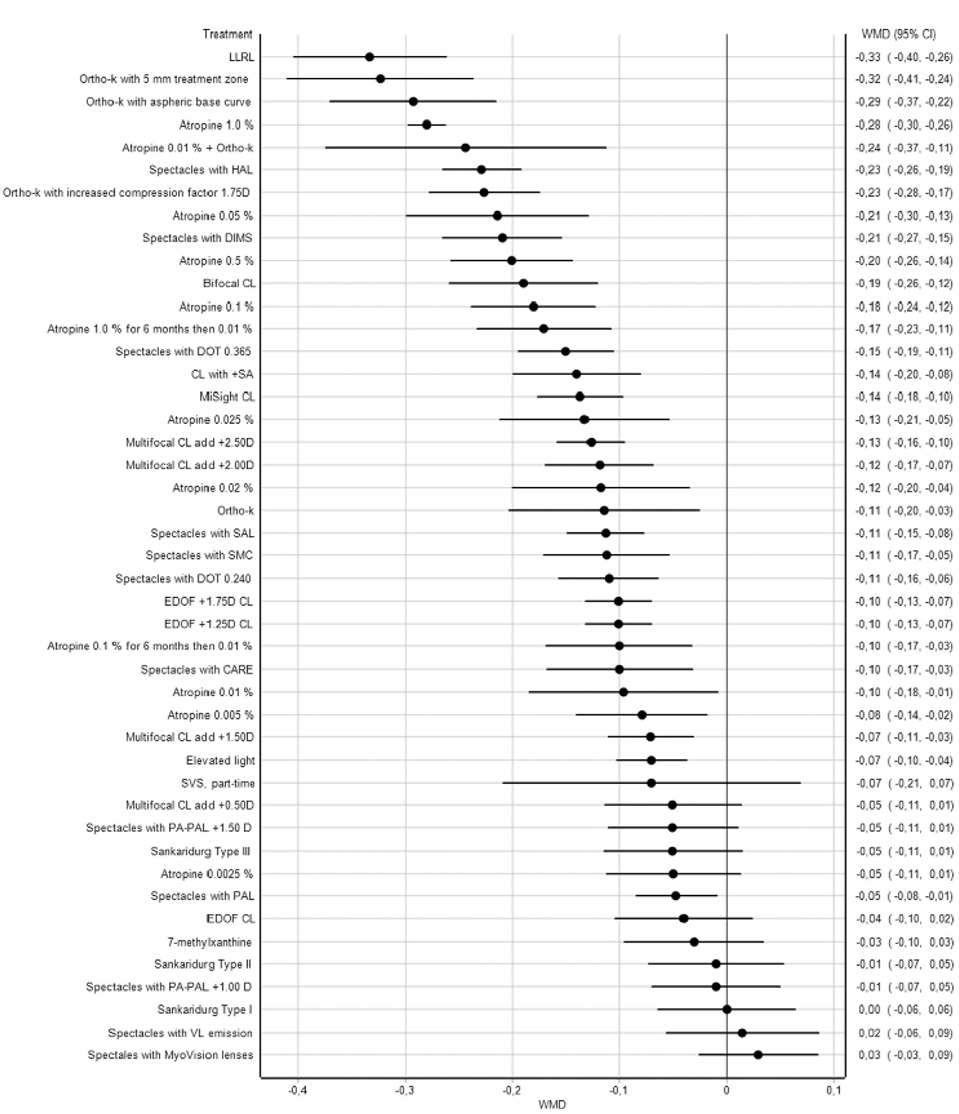
Figuur 1. Netwerkmeta-analyse over het effect van interventies voor myopiecontrole op de toename van de axiale lengte na één jaar ten opzichte van de uitgangswaarde
Negatieve waarden duiden op een langzamere toename van de axiale lengte (d.w.z. het gewenste effect). Samenvattende schattingen (punten en lijnen) voor elk type interventie worden weergegeven als een gewogen gemiddeld verschil (WMD) en het 95%-betrouwbaarheidsinterval, beide uitgedrukt in millimeters (mm). De verticale zwarte lijn geeft de referentie aan, namelijk het gebruik van enkelvoudige brillenglazen. Een interventie levert geen statistisch significant verschillend resultaat op vergeleken met de referentie wanneer het betrouwbaarheidsinterval de referentielijn omvat (Schmidt, 2025)
Recent is er een netwerkanalyse verricht naar het gemiddelde effect van ieder optisch of farmaceutisch middel voor myopieremming, zie figuur 1 (Schmidt, 2025). Na 1 jaar lijken atropinedruppels het meeste effect te hebben op de remming van de aslengte, successievelijk gevolgd door de contactlenzen (inclusief ortho-k) en de myopieremmende brillenglazen. Uit de netwerkanalyse (Schmidt, 2025) kan worden geconcludeerd dat voor een additioneel myopie-remmend effect er overgestapt kan worden naar een hogere concentratie atropine (=step-up) of van van een optisch middel naar atropine druppels (=switch). Voor de step-up met atropine druppels verwijzen we voor het gebruik en de eventuele bijwerkingen daarvan naar de module atropine.
Recentelijk zijn er onderzoeken gepubliceerd waarin het remmende effect van multi-modale combinaties, bestaande uit een optische en een farmaceutische interventie, zijn geëvalueerd. Een vergelijking tussen deze onderzoeken wordt bemoeilijkt door verschillen in inclusie- en exclusiecriteria, onderzoeksopzet en onderzoekspopulatie. Daarnaast betreft het merendeels kleinschalige studies met een beperkte follow-upduur, uitgevoerd binnen Aziatische populaties en niet specifiek gericht op non-responders. Niettemin wil de werkgroep enkele onderzoeken benoemen.
Guo (2024), Li (2024), Tan (2023), Yu (2022) en Zhao (2020) beschrijven het synergistisch remmende effect van het toevoegen van lage concentraties atropine (0,01% of 0,025%) aan Ortho-K-lenzen. In alle onderzoeken resulteerde deze combinatie in een significant sterkere remming van de axiale lengtegroei vergeleken met uitsluitend ortho-K. Yu (2022) en Tan (2023) rapporteerden echter dat dit effect uitsluitend aanwezig was gedurende respectievelijk de eerste vier en zes maanden van de interventie; daarna werd geen significant verschil meer waargenomen tussen de groepen. Daarnaast waren niet alle studies volledig geblindeerd en werd in alle gevallen atropine toegevoegd aan ortho-K; het omgekeerde scenario, namelijk het toevoegen van ortho-K aan een bestaande interventie met atropinedruppels, is nog niet onderzocht.
Voor myopie remmende brillenglazen is deze vergelijking wél uitgevoerd. Guemes (2025) voegden atropine 0,025% toe aan DIMS-myopie remmende brillenglazen, terwijl Sim (2025) HAL-myopie remmende brillenglazen toevoegden aan een interventie met atropinedruppels. Na 1 jaar follow-up bleek de combinatie effectiever in het vertragen van de toename van de aslengte dan het gebruik van alleen atropine 0,025% Guemes (2025). Ook de verslechtering van de refractie was kleiner in de combinatiegroep, hoewel dit verschil statistisch niet significant was Guemes (2025). In de éénjarige studie van Sim (2025) werd ook een klinisch significant geringere progressie van de aslengte waargenomen bij kinderen die een multi-modale combinatie ontvingen. Ook in dit onderzoek was het effect van de combinatie het meest uitgesproken gedurende de eerste zes maanden na de start van de interventie. In deze studie werd bij 24% van de kinderen werd een hyperope verschuiving in de aslengte vastgesteld. Deze bevinding is fysiologisch moeilijk te verklaren, maar wordt door de auteurs niet nader toegelicht.
Jones (2022) onderzochten het effect van het toevoegen van atropine 0,01% aan zachte multifocale contactlenzen. In deze driejarige studie concludeerden zij dat de toevoeging van atropine 0,01% aan zachte multifocale contactlenzen geen betere myopiecontrole opleverde dan het gebruik van de lenzen alleen.
Stoppen
Wereldwijd is het combineren van modaliteiten nog in de initiële fase en met name uitgevoerd in combinatie met 0,01% atropine wat maakt dat er daarom ook nog niets bekend is over het rebound-effect bij een multi-modale combinatie aanpak.
Waarden en voorkeuren van patiënten (en eventueel hun naasten/verzorgers)
Het is belangrijk om de verschillende opties voor het remmen van de snelle progressie van de myopie ondanks een unimodale aanpak met zowel de ouders als het kind te bespreken, inclusief de lange duur van de interventie. Hierbij dienen leefstijl interventies altijd terug te blijven komen. Of aanpassen van het plan voor myopieremming een optie is, hangt af van de persoonlijke voorkeur van de ouders en het kind, de financiële haalbaarheid, de uitgangswaarden en de coöperativiteit.
Kostenaspecten
Multi-modale myopieremming kost meer ten opzichte van de unimodale. Echter er zijn geen studies die wij kunnen gebruiken om uitspraken te doen ten aanzien van de kosten-effectiviteit.
Gelijkheid ((health) equity/equitable)
De multi-modale interventie leidt tot een mogelijke afname van gezondheidsgelijkheid omdat de optische middelen ter beperking van progressieve myopie tot nu toe niet vergoed worden vanuit de basisverzekering. Atropine druppels zitten wel in de basisverzekering, maar als er in gevallen met een snel progressieve myopie mogelijk gekozen wordt voor een additionele interventie, brengt dit per definitie meerkosten met zich mee. Diegenen waarvoor additionele middelen niet haalbaar zijn, vallen daarmee mogelijk terug in de risicocijfers voor de complicaties van myopie op latere leeftijd met een unimodaal myopieremmend middel. De mogelijke complicaties op latere leeftijd zijn ablatio, myope maculadegeneratie, cataract en glaucoom.
Het is belangrijk om in de spreekkamer bewust stil te staan bij deze ongelijkheid en samen met ouders te bespreken welke opties haalbaar zijn binnen hun context.
Aanvaardbaarheid:
Ethische aanvaardbaarheid
De interventie lijkt aanvaardbaar voor de betrokkenen mits alle voor- en nadelen zijn afgewogen. Er zijn geen ethische bezwaren in de zin dat er risico bestaat op meer of ergere bijwerkingen of dropouts bij een multi-modale aanpak.
Duurzaamheid
Aspecten ten aanzien van de duurzaamheid van de componenten van de multi-modale aanpak zijn gelijk aan die welke bij de verschillende modaliteiten reeds beschreven staan.
Haalbaarheid
De interventie en/of diagnostiek is over het algemeen al standaardzorg in de praktijk. Echter, de incidentie van myopie neemt zo schrikbarend toe, dat er verwacht wordt dat er een golf aan myopie-zorg aankomt. In dit laatste aspect worden belemmeringen voorzien in alle aspecten rondom de levering van deze zorg
De veiligheid van de afzonderlijke modaliteiten is reeds beschreven in de betreffende modules en verschilt bij gecombineerd gebruik niet van die bij gebruik van één enkele modaliteit. Door te kiezen voor een combinatie kan het individu dat hiervoor gevoelig is, worden blootgesteld aan een cumulatieve belasting van de bijwerkingen van de afzonderlijke modaliteiten, terwijl er geen bewijs is dat hij/zij profiteert van een cumulatief effect (Michel, 2022).
Onderbouwing
Many studies have demonstrated that pharmaceutical and optical options can be used for myopia control. However, in addition to the variation in response rates for each of these modalities, approximately 20% of patients have insufficient response to a single-modality approach. (Chia, 2016; Chamberlain, 2019; Walline, 2020; Cho, 2012; Lam, 2020; Sacchi, 2019). These individuals, who despite a single-modality approach exhibit an accelerated axial elongation rate for their age:
- greater than 0.25mm/yr (ages 6 - 9 ) or
- greater than 0.15mm/yr (ages 10 - 12).
are referred to in the literature as non-responders (Chia, 2015; Chamberlain, 2019; Walline, 2020; Cho, 2012; Lam, 2020; Sacchi, 2019). It may be argued that combining multiple modalities (multi-modal myopia control) could be beneficial.
There is currently no international consensus or protocol regarding whether, and if so which, multi-modal myopia control (pharmacological and optical) is most effective for patients with myopia who continue to show axial length progression despite undergoing a single form of myopia control (either pharmacological or optical).
Summary of Findings
|
Outcome Timeframe |
Study results and measurements |
Absolute effect estimates |
Certainty of the evidence (Quality of evidence) |
Summary |
|
|
a single-modality approach |
multi-modal myopia control |
||||
|
Adverse events
|
-
|
|
|
-
|
There are no studies found from which a GRADE conclusion could be drawn for the outcome measure adverse events. |
|
Difference: -
|
|||||
|
Compliance
|
-
|
|
|
- |
There are no studies found from which a GRADE conclusion could be drawn for the outcome measure compliance |
|
Difference: -
|
|||||
|
Axial length
|
Measured by: Scale: - Based on data from 179 participants in 1 study during 2 years
|
Difference: MD 0.02 lower (CI 95% 0.16 lower - 0.12 higher) |
Very low Severe risk of bias due to serious inconsistency, indirect evidence, and serious imprecision1 |
We are uncertain whether multi-modal myopia control will improve or worsen the change in axial length compared to a single-modality approach. (Wan, 2018) |
|
|
Measured by: Scale: - Based on data from 97 participants in 2 studies during 1 year
|
Difference: MD 0.13 lower (CI 95% 0.19 lower - 0.08 lower) |
Very low Severe risk of bias due to serious inconsistency, indirect evidence, and serious imprecision2 |
We are uncertain whether multi-modal myopia control will improve or worsen the change in axial length compared to a single-modality approach. (;Edinest, 2024; Wen, 2024 |
||
|
Refraction
|
Measured by: Scale: - Based on data from 27 participants in 1 study
|
|
|
Very low Due to serious imprecision3 |
We are uncertain whether multi-modal myopia control will improve or worsen the change in refractive error compared to a single-modality approach (Erdinest, 2024 |
|
Difference: MD 0.31 higher (CI 95% 0.03 lower - 0.65 higher) |
|||||
1. Inconsistency: serious. The direction of the effect is not consistent.;
Indirectness: serious. Differences between the target population and the group being studied;
Imprecision: serious. Wide confidence intervals;
2. Inconsistency: serious. The direction of the effect is not consistent.;
Indirectness: serious. Differences between the target population and the group being studied;
Imprecision: serious. Wide confidence intervals;
3. Imprecision: serious. Low number of patients (<100), Data from only one study, Wide confidence intervals.
Description of studies
A total of three studies were included in the analysis of the literature. Important study characteristics and results are summarized in table 2. The assessment of the risk of bias is summarized in the risk of bias tables (under the tab ‘Evidence tabellen’).
Wan (2018) conducted a retrospective multi-center study assessing the combined effect of orthokeratology (OK) and low-dose atropine (0.025% or 0.125%) on myopia progression in 179 children. Inclusion criteria were patients, ages 7–17 years old, with distance corrected acuity of 0.01 logMAR (20/20) or better. Participants were stratified by baseline myopia (<-6.00 D vs. ≥-6.00 D) and followed for two years. The study was conducted in China.
Wen (2024) conducted a preliminary retrospective study to evaluate the add-on effect of 0.05% atropine in enhancing myopia control among children exhibiting rapid progression despite orthokeratology (OK) treatment. The study included 70 participants who had been using OK lenses for 6 to 24 months and demonstrated axial length (AL) elongation exceeding 0.15 mm over a 6-month period or 0.3 mm over a 12-month period. During the subsequent 12-month phase, participants were divided into two groups: one continued with OK lenses alone, while the other received nightly 0.05% atropine ophthalmic solution in addition to OK lenses. The participants had a mean age of 10.1 years in the combined treatment group and 10.3 years in the single-modality approach (orthokeratology) group. The study was conducted in China.
Erdinest (2024) conducted a retrospective study to evaluate the efficacy of combining 0.05% atropine eye drops with multifocal (MF60) peripheral defocus soft contact lenses in managing rapid myopia progression in children. The criteria for inclusion in the study required that each eye have a cycloplegic spherical equivalent refraction (SER) of −3.00 D or higher, along with a best-corrected visual acuity of 0.3 logMAR or better. Additionally, the children participating in the study recorded myopia progression of a minimum of−1.00 D in the year leading up to the study’s commencement. An additional criterion was that one of the parents had myopia above 3.00 D.
The study involved three groups: a treatment group (TG) of 15 children (average age 12.87 years), an MF60-only group of 12 children (average age 12.8 years), and a control group (CG) of 14 children (average age 12.1 years). All participants had exhibited significant myopia and axial length progression prior to the study and had not previously undergone myopia control interventions. The study was conducted in Israel.
Table 2. Characteristics of included studies
|
Study |
Participants |
Comparison |
Follow-up |
Outcome measures |
Comments |
Risk of bias (per outcome measure)* |
|
Individual studies |
||||||
|
Wan, 2018 |
<6D Atropine 0.125% N at baseline Intervention: 20 Control: 26
Age (mean, SD) Intervention: 10.6, 1.2 Control: 10.2, 1.7
Sex (male/female) Intervention: 10/10 Control: 13/13
Atropine 0.025% N at baseline Intervention: 20 Control: 20
Age (mean, SD) Intervention: 10.4, 1.3 Control: 10.3, 1.4
Sex (male/female) Intervention: 10/10 Control: 10/10
³6D Atropine 0.125% N at baseline Intervention: 24 Control: 29
Age (mean, SD) Intervention: 11, 1.8 Control: 10.8, 1.8
Sex (male/female) Intervention: 12/12 Control: 15/14
Atropine 0.025% N at baseline Intervention: 20 Control: 20
Age (mean, SD) Intervention: 10.8, 1.2 Control: 10.9, 1.3
Sex (male/female) Intervention: 10/10 Control: 10/10 |
Intervention: OK lenses and atropine treatment (0.125% and 0.025%)
Control: OK lenses alone |
2 years |
Axial length
|
Funding: This study was supported in part by the Ministry of Science and Technology, Taiwan, R.O.C. (MOST105-2628-B-039-008-MY3 and MOST107-2320-B-039-049-MY3), China Medical University Hospital, Taichung, Taiwan (DMR-106-178), and China Medical University, Taichung, Taiwan (CMU107-ASIA-23). This work was also supported by CMU under the Aim for Top University Plan of the Ministry of Education, Taiwan. The sponsor or funding organization had no role in the design or conduct of this research.
Conflicts of Interest: The authors declare no conflict of interest.
|
Some concern (lack of adjustment for confounders) |
|
Wen, 2024 |
N at baseline Intervention: 35 Control: 35
Age (mean, SD) Intervention: 10.1, 1.1 Control: 10.3, 1.4
Sex (male/female) Intervention: 15/20 Control: 14/21 |
Intervention: OK lenses and atropine 0.05% Control: OK lenses alone |
1 year |
Axial length
|
Funding: This study was supported by a grant of the Key Research and Development Plan of Hubei Province, China (2020BCB013), Clinical medical technology innovation guidance project of Hunan Province, China (2021SK50509) and National Key Research and Development Plan, China (2022YFE0124600).
|
Some concern (lack of adjustment for confounders) |
|
Erdinest, 2024 |
N at baseline Intervention: 15 Control: 12
Age (mean, SD) Intervention: 12.9, 1.04 Control: 12.8, 0.8
Sex (male/female) Intervention:8/7 Control: 6/6 |
Intervention: MF60 contact lenses and atropine 0.05% Control: only MF60 contact lenses |
1 year |
Axial length
Refraction |
Funding: This research received no external funding.
Conflicts of Interest: The authors declare no conflicts of interest.
|
Some concern (lack of adjustment for confounders) |
*For further details, see risk of bias table in the appendix
Results
Efficacy on axial length (critical)
Wan (2018) reported axial length in children treated with 0.125% or 0.025% atropine and orthokeratology lenses and orthokeratology lenses alone, stratified into low (<-6 D) and high (≥-6 D) myopia groups. Mean differences were:
<-6D
0.125% atropine: -0.03 mm/2yrs (95% CI -0.09 to 0.03) in favour of the children with atropine and orthokeratology lenses. This difference is not considered clinically relevant.
0.025% atropine: -0.18 mm/2yrs (95% CI -0.29 to -0.07) in favour of the children with atropine and orthokeratology lenses. This difference is not considered clinically relevant.
≥-6D
0.125% atropine: -0.07 mm/2yrs (95% CI -0.15 to 0.01) in favour of the children with atropine and orthokeratology lenses. This difference is not considered clinically relevant.
0.025% atropine: 0.18 mm/2yrs (95% CI 0.11 to 0.25) in favour of the children with orthokeratology lenses alone. This difference is not considered clinically relevant.
Wen (2024) reported axial length in children treated with 0.05% atropine and orthokeratology lenses (n=35) and orthokeratology lenses alone (n=35). The mean difference was -0.13 mm/yr (95% CI -0.19 to -0.07) in favour of the children with atropine and orthokeratology lenses. This difference is considered clinically relevant.
Erdinest (2024) reported axial length in children treated with 0.05% atropine and multifocal lenses (MF60) (n=15) and MF60 lenses alone (n=12). The mean difference was -0.14 mm/yr (95% CI -0.31 to 0.03) in favour of the children with atropine and MF60 lenses. This difference is considered clinically relevant.
Efficacy on refractive error (critical)
Erdinest (2024) reported spherical equivalent in children treated with 0.05% atropine and multifocal lenses (MF60) (n=15) and MF60 lenses alone (n=12). The mean difference was 0.31 D/yr (95% CI -0.03 to 0.65) in favour of the children with atropine and MF60 lenses. This difference is considered clinically relevant.
Adverse events (important)
The outcome measure adverse events was not reported.
Compliance (important)
The outcome measure compliance was not reported.
A systematic review of the literature was performed to answer the following question:
What are the (un)favorable effects of multi-modal myopia control (optical and pharmacological) compared to a single-modality approach (either optical or pharmacological) in terms of efficacy and safety in the treatment of progressive myopia in children?
Table 1. PICO
| Patients | Children with progressive myopia |
| Intervention | Multi-modal myopia control (optical and pharmacological)* |
| Control | Single-modality approach (either optical or pharmacological)* |
| Outcomes | Short term and long term: efficacy on axial length, efficacy on refraction, adverse events (e.g., eye strain, headaches, dizziness, diplopia, nausea, limited visual field, metamorphopsia, reduced accommodation, reduced reading vision), compliance/adherence to therapy |
| Other selection criteria | Study design: systematic reviews, randomized controlled trials and observational studies |
* Based on the results of the module atropine, it was decided to exclude the 0.01% concentration in this search.
Relevant outcome measures
The guideline panel considered efficacy on axial length and refraction as a critical outcome measure for decision making; and adverse events and compliance/adherence to therapy as important outcome measures for decision making.
A priori, the guideline panel did not define the outcome measures listed above but used the definitions used in the studies.
The guideline panel defined the following differences as a minimal clinically important difference:
- Axial length: 0.1 mm (first year).
- Refraction: 0,25D myopie progression per year.
- Adverse events: 10% (RR < 0.9 and RR > 1.1).
- Compliance/adherence: 10% (RR < 0.9 and RR > 1.1).
Search and select (Methods)
A systematic literature search was performed by a medical information specialist using the following bibliographic databases: Embase.com and Ovid/Medline. Both databases were searched from until 13 august 2024 for systematic reviews, RCTs and observational studies. Systematic searches were completed using a combination of controlled vocabulary/subject headings (e.g., Emtree-terms, MeSH) wherever they were available and natural language keywords. The overall search strategy was derived from two primary search concepts: (1) myopia; (2) combination therapy (optical and pharmacological). Duplicates were removed using EndNote software. After deduplication a total of 526 records were imported for title/abstract screening. Initially, 37 studies were selected based on title and abstract screening. After reading the full text, 34 studies were excluded (see the exclusion table under the tab ‘Evidence tabellen’), and three studies were included.
- Chamberlain P, Peixoto-de-Matos SC, Logan NS, Ngo C, Jones D, Young G. A 3-year Randomized Clinical Trial of MiSight Lenses for Myopia Control. Optom Vis Sci. 2019 Aug;96(8):556-567. doi: 10.1097/OPX.0000000000001410. PMID: 31343513.
- Chia A, Lu QS, Tan D. Five-Year Clinical Trial on Atropine for the Treatment of Myopia 2: Myopia Control with Atropine 0.01% Eyedrops. Ophthalmology. 2016 Feb;123(2):391-399. doi: 10.1016/j.ophtha.2015.07.004. Epub 2015 Aug 11. PMID: 26271839.
- Cho P, Cheung SW. Retardation of myopia in Orthokeratology (ROMIO) study: a 2-year randomized clinical trial. Invest Ophthalmol Vis Sci. 2012 Oct 11;53(11):7077-85. doi: 10.1167/iovs.12-10565. PMID: 22969068.
- Donovan L, Sankaridurg P, Ho A, Chen X, Lin Z, Thomas V, Smith EL 3rd, Ge J, Holden B. Myopia progression in Chinese children is slower in summer than in winter. Optom Vis Sci. 2012 Aug;89(8):1196-202. doi: 10.1097/OPX.0b013e3182640996. PMID: 22797511; PMCID: PMC4696401.
- Erdinest N, Atar-Vardi M, London N, Landau D, Smadja D, Pras E, Lavy I, Morad Y. Treatment of Rapid Progression of Myopia: Topical Atropine 0.05% and MF60 Contact Lenses. Vision (Basel). 2024 Jan 19;8(1):3. doi: 10.3390/vision8010003. PMID: 38391084; PMCID: PMC10885127.
- Guemes-Villahoz N, Talavero González P , Porras-Ángel P, Bella-Gala R, Ruiz-Pomeda A, Martin-Garcia B , Hernandez-Garcia E , Gomez de Liaño N , Shah R , Garcia-Feijoo J, Gomez-de-LiañoR. Atropine and Spectacle lens Combination Treatment (ASPECT): 12-month results of a randomised controlled trial for myopia control using a combination of Defocus Incorporated Multiple Segments (DIMS) lenses and 0.025%. Br J Ophthalmol 2025;0:1–7.
- Guggenheim JA, Walline JJ. Identifying non-responders to treatments for myopia. Ophthalmic Physiol Opt. 2023 Sep;43(5):945-946. doi: 10.1111/opo.13162. Epub 2023 May 10. PMID: 37162175.
- Guo Y, Liu Y, Hu Z, Li Y, Zhang H, Zhao S. Efficacy and safety of 0.01% atropine combined with orthokeratology lens in delaying juvenile myopia: An observational study. Medicine (Baltimore). 2024 Jun 14;103(24):e38384. doi: 10.1097/MD.0000000000038384. PMID: 38875374; PMCID: PMC11175863.
- Jones JH, Mutti DO, Jones-Jordan LA, Walline JJ. Effect of Combining 0.01% Atropine with Soft Multifocal Contact Lenses on Myopia Progression in Children. Optom Vis Sci. 2022;99(5):434-42.
- Lam CSY, Tang WC, Tse DY, Lee RPK, Chun RKM, Hasegawa K, Qi H, Hatanaka T, To CH. Defocus Incorporated Multiple Segments (DIMS) spectacle lenses slow myopia progression: a 2-year randomised clinical trial. Br J Ophthalmol. 2020 Mar;104(3):363-368. doi: 10.1136/bjophthalmol-2018-313739. Epub 2019 May 29. PMID: 31142465; PMCID: PMC7041503.
- Li B, Yu S, Gao S, Sun G, Pang X, Li X, et al. Effect of 0.01% atropine combined with orthokeratology lens on axial elongation: a 2-year randomized, double-masked, placebo-controlled, cross-over trial. Front Med (Lausanne). 2024;11:1358046.
- Michel MC, Staskin D. Study designs for evaluation of combination treatment: focus on individual patient benefit. Biomedicines. 2022;10(2):270.
- Sacchi M, Serafino M, Villani E, Tagliabue E, Luccarelli S, Bonsignore F, Nucci P. Efficacy of atropine 0.01% for the treatment of childhood myopia in European patients. Acta Ophthalmol. 2019 Dec;97(8):e1136-e1140. doi: 10.1111/aos.14166. Epub 2019 Jun 13. PMID: 31197953.
- Schmidt DC, Hvid-Hansen A, Jacobsen N, Jakobsen TM, Larsen PM, Lindblad KK, Møller F, Slyngborg A, Subhi Y, Kessel L. Efficacy of interventions for myopia control in children: A systematic review with network meta-analyses. Acta Ophthalmol. 2025 Apr 11. doi: 10.1111/aos.17496. Epub ahead of print. PMID: 40219611.
- Shih YF, Chen CH, Chou AC, Ho TC, Lin LL, Hung PT. Effects of different concentrations of atropine on controlling myopia in myopic children. J Ocul Pharmacol Ther. 1999 Feb;15(1):85-90. doi: 10.1089/jop.1999.15.85. PMID: 10048351.
- Sim BX, Loh KL, Htoon HM, Sri Y, Balakrishnan M, Chan Poh Lin P, et al. Additive Effect of Highly Aspherical Lenslet Target Spectacles to Children Inadequately Controlled by Atropine Monotherapy. Ophthalmol Sci. 2025;5(4):100753.
- Tan Q, Ng AL, Cheng GP, Woo VC, Cho P. Combined 0.01% atropine with orthokeratology in childhood myopia control (AOK) study: A 2-year randomized clinical trial. Cont Lens Anterior Eye. 2023;46(1):101723.
- Walline JJ, Walker MK, Mutti DO, Jones-Jordan LA, Sinnott LT, Giannoni AG, Bickle KM, Schulle KL, Nixon A, Pierce GE, Berntsen DA; BLINK Study Group. Effect of High Add Power, Medium Add Power, or Single-Vision Contact Lenses on Myopia Progression in Children: The BLINK Randomized Clinical Trial. JAMA. 2020 Aug 11;324(6):571-580. doi: 10.1001/jama.2020.10834. PMID: 32780139; PMCID: PMC7420158.
- Wan L, Wei CC, Chen CS, Chang CY, Lin CJ, Chen JJ, Tien PT, Lin HJ. The Synergistic Effects of Orthokeratology and Atropine in Slowing the Progression of Myopia. J Clin Med. 2018 Sep 7;7(9):259. doi: 10.3390/jcm7090259. PMID: 30205439; PMCID: PMC6162849.
- Wen L, Liu H, Xu Q, Pan W, Lin Z, Xiao Z, Yang Z, Lan W, Chen Z. Add-on effect of using 0.05% atropine in fast progressors of orthokeratology: A preliminary retrospective study. Cont Lens Anterior Eye. 2025 Feb;48(1):102282. doi: 10.1016/j.clae.2024.102282. Epub 2024 Jul 27. PMID: 39069400.
- Yu S, Du L, Ji N, Li B, Pang X, Li X, et al. Combination of orthokeratology lens with 0.01% atropine in slowing axial elongation in children with myopia: a randomized double-blinded clinical trial. BMC Ophthalmol. 2022;22(1):438.
- Zhao Q, Hao Q. Clinical efficacy of 0.01% atropine in retarding the progression of myopia in children. Int Ophthalmol. 2021 Mar;41(3):1011-1017. doi: 10.1007/s10792-020-01658-0. Epub 2020 Nov 17. PMID: 33205372; PMCID: PMC7943497.
Risk of bias tables
|
Author, year |
Selection of participants
Was selection of exposed and non-exposed cohorts drawn from the same population?
|
Exposure
Can we be confident in the assessment of exposure?
|
Outcome of interest
Can we be confident that the outcome of interest was not present at start of study?
|
Confounding-assessment
Can we be confident in the assessment of confounding factors?
|
Confounding-analysis
Did the study match exposed and unexposed for all variables that are associated with the outcome of interest or did the statistical analysis adjust for these confounding variables?
|
Assessment of outcome
Can we be confident in the assessment of outcome?
|
Follow up
Was the follow up of cohorts adequate? In particular, was outcome data complete or imputed?
|
Co-interventions
Were co-interventions similar between groups?
|
Overall Risk of bias
|
|
Definitely yes, probably yes, probably no, definitely no |
Definitely yes, probably yes, probably no, definitely no |
Definitely yes, probably yes, probably no, definitely no |
Definitely yes, probably yes, probably no, definitely no |
Definitely yes, probably yes, probably no, definitely no |
Definitely yes, probably yes, probably no, definitely no |
Definitely yes, probably yes, probably no, definitely no |
Definitely yes, probably yes, probably no, definitely no |
Low, Some concerns, High |
|
|
Wan, 2018 |
Probably yes
Reason: Patients with regular examinations, who had complete clinical data during the study period (2 years, from 2014 to 2016) were included in this study. |
Probably yes
Reason: All patients had a visual acuity with near and distance correction of 0.01 logMAR (20/20) or better
|
Definitely yes
Reason: It’s not possible to have the outcomes of interest at the start.
|
Probably no
Reason: Not reported
|
Definitely no
Reason: no adjustments for confounding factors |
Definitely yes
Reason: No missing data |
Probably yes
Reason: follow-up time was adequate |
Probably yes
Reason: there were no co-interventions |
Some concerns
|
|
Wen, 2024 |
Probably yes
Reason: patients who were fitted with OK lenses at Changsha Aier Eye Hospital
|
Definitely yes
Reason: All data were obtained from the patients’ medical records.
|
Definitely yes
Reason: It’s not possible to have the outcomes of interest at the start.
|
Probably no
Reason: Not reported
|
Probably yes
Reason: None of the baseline parameters were associated with axial elongation
|
Definitely yes
Reason: No missing data |
Probably yes
Reason: follow-up time was adequate |
Probably yes
Reason: there were no co-interventions |
Some concerns
|
|
Erdinest, 2024 |
Probably yes
Reason: participant had the same inclusion criteria |
Probably yes
Reason: each eye have a cycloplegic spherical equivalent refraction (SER) of−3.00 D or higher, along with a best-corrected visual acuity of 0.3 logMAR or better. |
Definitely yes
Reason: It’s not possible to have the outcomes of interest at the start.
|
Probably no
Reason: Not reported
|
Definitely no
Reason: no adjustments for confounding factors |
Definitely yes
Reason: No missing data |
Probably yes
Reason: follow-up time was adequate |
Probably yes
Reason: there were no co-interventions |
Some concerns
|
Table of excluded studies
|
Reference |
Reason for exclusion |
|
Tang T, Lu Y, Li X, Zhao H, Wang K, Li Y, Zhao M. Comparison of the long-term effects of atropine in combination with Orthokeratology and defocus incorporated multiple segment lenses for myopia control in Chinese children and adolescents. Eye (Lond). 2024 Jun;38(9):1660-1667. doi: 10.1038/s41433-024-02987-5. Epub 2024 Feb 28. PMID: 38418604; PMCID: PMC11156845. |
This study evaluates 0.01% atropine, which is considered not relevant for the current research question. |
|
Nucci P, Lembo A, Schiavetti I, Shah R, Edgar DF, Evans BJW. A comparison of myopia control in European children and adolescents with defocus incorporated multiple segments (DIMS) spectacles, atropine, and combined DIMS/atropine. PLoS One. 2023 Feb 16;18(2):e0281816. doi: 10.1371/journal.pone.0281816. PMID: 36795775; PMCID: PMC9934319. |
This study evaluates 0.01% atropine, which is considered not relevant for the current research question. |
|
Huang Z, Chen XF, He T, Tang Y, Du CX. Synergistic effects of defocus-incorporated multiple segments and atropine in slowing the progression of myopia. Sci Rep. 2022 Dec 24;12(1):22311. doi: 10.1038/s41598-022-25599-z. Erratum in: Sci Rep. 2023 Jun 14;13(1):9650. doi: 10.1038/s41598-023-36663-7. PMID: 36566245; PMCID: PMC9789944. |
This study evaluates 0.01% atropine, which is considered not relevant for the current research question. |
|
Xu S, Li Z, Zhao W, Zheng B, Jiang J, Ye G, Feng Z, Long W, He L, He M, Hu Y, Yang X. Effect of atropine, orthokeratology and combined treatments for myopia control: a 2-year stratified randomised clinical trial. Br J Ophthalmol. 2023 Nov 22;107(12):1812-1817. doi: 10.1136/bjo-2022-321272. PMID: 36229177. |
This study evaluates 0.01% atropine, which is considered not relevant for the current research question. |
|
Chen Z, Zhou J, Xue F, Qu X, Zhou X. Two-year add-on effect of using low concentration atropine in poor responders of orthokeratology in myopic children. Br J Ophthalmol. 2022 Aug;106(8):1069-1072. doi: 10.1136/bjophthalmol-2020-317980. Epub 2021 Mar 11. PMID: 33707188. |
This study evaluates 0.01% atropine, which is considered not relevant for the current research question. |
|
Kinoshita N, Konno Y, Hamada N, Kanda Y, Shimmura-Tomita M, Kaburaki T, Kakehashi A. Efficacy of combined orthokeratology and 0.01% atropine solution for slowing axial elongation in children with myopia: a 2-year randomised trial. Sci Rep. 2020 Jul 29;10(1):12750. doi: 10.1038/s41598-020-69710-8. PMID: 32728111; PMCID: PMC7391648. |
This study evaluates 0.01% atropine, which is considered not relevant for the current research question. |
|
Kinoshita N, Konno Y, Hamada N, Kanda Y, Shimmura-Tomita M, Kakehashi A. Additive effects of orthokeratology and atropine 0.01% ophthalmic solution in slowing axial elongation in children with myopia: first year results. Jpn J Ophthalmol. 2018 Sep;62(5):544-553. doi: 10.1007/s10384-018-0608-3. Epub 2018 Jul 4. PMID: 29974278. |
This study evaluates 0.01% atropine, which is considered not relevant for the current research question. |
|
Li B, Yu S, Gao S, Sun G, Pang X, Li X, Wang M, Zhang F, Fu A. Effect of 0.01% atropine combined with orthokeratology lens on axial elongation: a 2-year randomized, double-masked, placebo-controlled, cross-over trial. Front Med (Lausanne). 2024 Apr 23;11:1358046. doi: 10.3389/fmed.2024.1358046. PMID: 38716420; PMCID: PMC11074463. |
This study evaluates 0.01% atropine, which is considered not relevant for the current research question. |
|
Yu S, Du L, Ji N, Li B, Pang X, Li X, Ma N, Huang C, Fu A. Combination of orthokeratology lens with 0.01% atropine in slowing axial elongation in children with myopia: a randomized double-blinded clinical trial. BMC Ophthalmol. 2022 Nov 15;22(1):438. doi: 10.1186/s12886-022-02635-0. PMID: 36380280; PMCID: PMC9665032. |
This study evaluates 0.01% atropine, which is considered not relevant for the current research question. |
|
Du L, Chen J, Ding L, Wang J, Yang J, Xie H, Xu X, He X, Zhu M. Add-On Effect of 0.01% Atropine in Orthokeratology Wearers for Myopia Control in Children: A 2-Year Retrospective Study. Ophthalmol Ther. 2023 Oct;12(5):2557-2568. doi: 10.1007/s40123-023-00755-4. Epub 2023 Jul 5. PMID: 37405578; PMCID: PMC10442030. |
This study evaluates 0.01% atropine, which is considered not relevant for the current research question. |
|
Tan Q, Ng AL, Choy BN, Cheng GP, Woo VC, Cho P. One-year results of 0.01% atropine with orthokeratology (AOK) study: a randomised clinical trial. Ophthalmic Physiol Opt. 2020 Sep;40(5):557-566. doi: 10.1111/opo.12722. Epub 2020 Aug 10. PMID: 32776533. |
This study evaluates 0.01% atropine, which is considered not relevant for the current research question. |
|
Zhou H, Zhao G, Li Y. Adjunctive effects of orthokeratology and atropine 0.01% eye drops on slowing the progression of myopia. Clin Exp Optom. 2022 Jul;105(5):520-526. doi: 10.1080/08164622.2021.1943318. Epub 2021 Jul 6. PMID: 34228946. |
This study evaluates 0.01% atropine, which is considered not relevant for the current research question. |
|
Hao Q, Zhao Q. Changes in subfoveal choroidal thickness in myopic children with 0.01% atropine, orthokeratology, or their combination. Int Ophthalmol. 2021 Sep;41(9):2963-2971. doi: 10.1007/s10792-021-01855-5. Epub 2021 May 5. PMID: 33954859; PMCID: PMC8364521. |
This study evaluates 0.01% atropine, which is considered not relevant for the current research question. |
|
Tan Q, Ng AL, Cheng GP, Woo VC, Cho P. Combined 0.01% atropine with orthokeratology in childhood myopia control (AOK) study: A 2-year randomized clinical trial. Cont Lens Anterior Eye. 2023 Feb;46(1):101723. doi: 10.1016/j.clae.2022.101723. Epub 2022 May 31. PMID: 35654683. |
This study evaluates 0.01% atropine, which is considered not relevant for the current research question. |
|
Tan Q, Ng AL, Cheng GP, Woo VC, Cho P. Combined Atropine with Orthokeratology for Myopia Control: Study Design and Preliminary Results. Curr Eye Res. 2019 Jun;44(6):671-678. doi: 10.1080/02713683.2019.1568501. Epub 2019 Jan 24. PMID: 30632410. |
This study evaluates 0.01% atropine, which is considered not relevant for the current research question. |
|
Zhao W, Li Z, Hu Y, Jiang J, Long W, Cui D, Chen W, Yang X. Short-term effects of atropine combined with orthokeratology (ACO) on choroidal thickness. Cont Lens Anterior Eye. 2021 Jun;44(3):101348. doi: 10.1016/j.clae.2020.06.006. Epub 2020 Jun 30. PMID: 32620344. |
This study evaluates 0.01% atropine, which is considered not relevant for the current research question. |
|
Hiraoka T, Kiuchi G, Hiraoka R, Maruo K, Oshika T. Multifocal Contact Lenses and 0.01% Atropine Eye Drops for Myopia Control Study: Research Protocol for a 1-Year, Randomized, Four-Arm, Clinical Trial in Schoolchildren. Eye Contact Lens. 2023 Apr 1;49(4):172-177. doi: 10.1097/ICL.0000000000000977. Epub 2023 Feb 27. PMID: 36848188. |
Protocol, wrong study design |
|
Zhao Q, Hao Q. Clinical efficacy of 0.01% atropine in retarding the progression of myopia in children. Int Ophthalmol. 2021 Mar;41(3):1011-1017. doi: 10.1007/s10792-020-01658-0. Epub 2020 Nov 17. PMID: 33205372; PMCID: PMC7943497. |
This study evaluates 0.01% atropine, which is considered not relevant for the current research question. |
|
Wang Z, Wang P, Jiang B, Meng Y, Qie S, Yan Z. The efficacy and safety of 0.01% atropine alone or combined with orthokeratology for children with myopia: A meta-analysis. PLoS One. 2023 Jul 26;18(7):e0282286. doi: 10.1371/journal.pone.0282286. PMID: 37494360; PMCID: PMC10370708. |
This study evaluates 0.01% atropine, which is considered not relevant for the current research question. |
|
Jiang J, Long W, Hu Y, Zhao F, Zhao W, Zheng B, Feng Z, Li Z, Yang X. Accommodation and vergence function in children using atropine combined with orthokeratology. Cont Lens Anterior Eye. 2023 Feb;46(1):101704. doi: 10.1016/j.clae.2022.101704. Epub 2022 May 5. PMID: 35527114. |
This study evaluates 0.01% atropine, which is considered not relevant for the current research question. |
|
Zhao Q, Hao Q. Comparison of the Clinical Efficacies of 0.01% Atropine and Orthokeratology in Controlling the Progression of Myopia in Children. Ophthalmic Epidemiol. 2021 Oct;28(5):376-382. doi: 10.1080/09286586.2021.1875010. Epub 2021 Jan 20. PMID: 33472507. |
This study evaluates 0.01% atropine, which is considered not relevant for the current research question. |
|
Gao C, Wan S, Zhang Y, Han J. The Efficacy of Atropine Combined With Orthokeratology in Slowing Axial Elongation of Myopia Children: A Meta-Analysis. Eye Contact Lens. 2021 Feb 1;47(2):98-103. doi: 10.1097/ICL.0000000000000746. PMID: 33060414. |
This study evaluates 0.01% atropine, which is considered not relevant for the current research question. |
|
Yu Y, Liu J. The effect of 0.01% atropine and orthokeratology on ocular axial elongation for myopia children: A meta-analysis (a PRISMA-compliant article). Medicine (Baltimore). 2022 May 6;101(18):e29191. doi: 10.1097/MD.0000000000029191. PMID: 35550467; PMCID: PMC9276445. |
Raw data are not reported in article |
|
Gao Y, Yu Y. The effect of 0.01% atropine on ocular axial elongation for myopia children: A protocol for systematic review and meta-analysis. Medicine (Baltimore). 2022 Jun 3;101(22):e29409. doi: 10.1097/MD.0000000000029409. PMID: 35665735; PMCID: PMC9276353. |
Protocol, wrong study design |
|
Yang N, Bai J, Liu L. Low concentration atropine combined with orthokeratology in the treatment of axial elongation in children with myopia: A meta-analysis. Eur J Ophthalmol. 2022 Jan;32(1):221-228. doi: 10.1177/1120672121998903. Epub 2021 Mar 7. PMID: 33678055. |
Raw data are not reported in article |
|
Niu, Y. L. (2019). Effect of low grade atropine combined with keratoplasty on middle grade myopia in adolescents. International Eye Science, 1940-1944. |
Article in Chinese |
|
Zambrano Peralta P, Ortiz Quito M, Guerrero Ortiz F, Cervantes Anaya L. Orthokeratology vs. orthokeratology combined with atropine for the control of myopia in children: systematic review. Arch Soc Esp Oftalmol (Engl Ed). 2023 Oct;98(10):568-576. doi: 10.1016/j.oftale.2023.08.001. Epub 2023 Aug 22. PMID: 37619667. |
Article in Spanish |
|
Xiao L, Lv J, Zhu X, Sun X, Dong W, Fang C. Therapeutic effects of orthokeratology lens combined with 0.01% atropine eye drops on juvenile myopia. Arq Bras Oftalmol. 2023 Apr 3;87(5):e20220247. doi: 10.5935/0004-2749.2022-0247. PMID: 39298733; PMCID: PMC11626931. |
This study evaluates 0.01% atropine, which is considered not relevant for the current research question. |
|
Du LF, He F, Tan HX, Gao N, Song WQ, Luo YX. Comparisons of Three Methods for Myopia Control in Adolescents. J Ophthalmol. 2022 Sep 29;2022:9920002. doi: 10.1155/2022/9920002. PMID: 36211597; PMCID: PMC9536993. |
This study evaluates 0.01% atropine, which is considered not relevant for the current research question. |
|
Liu, Y., Guo, Y. F., Sun, H. S., Yin, D., Zhang, L., & LI, Y. F. (2023). Effect of orthokeratology combined with 0.01% atropine solution on adolescents with myopia. International Eye Science, 1279-1284. |
Article in Chinese |
|
Li, P. (2021). Effect of orthokeratology combined with 0.01% Atropine Sulfate Ophthalmic Gel on curative effect and analysis influencing factors on children's myopia. International Eye Science, 698-701. |
Duplicate |
|
Zhang G, Jiang J, Qu C. Myopia prevention and control in children: a systematic review and network meta-analysis. Eye (Lond). 2023 Nov;37(16):3461-3469. doi: 10.1038/s41433-023-02534-8. Epub 2023 Apr 27. PMID: 37106147; PMCID: PMC10630522. |
Wrong study design |
|
Zeng, G., Cui, J., & Peng, C. (2024). Feasibility and ethnic differences of 0.005% atropine eye drops combined with orthokeratology in controlling low myopia in adolescents. International Eye Science, 315-319. |
Article in Chinese |
|
Cui, C., FU, A., Wei, L., Zhao, B., YU, S., Zhang, J., ... & LI, X. (2023). Effects of 0.01% atropine on ocular biometrics in myopic adolescents. Chinese Journal of Experimental Ophthalmology, 330-337. |
Article in Chinese |
Beoordelingsdatum en geldigheid
Publicatiedatum : 26-08-2026
Beoordeeld op geldigheid : 26-08-2026
Het cluster Oog is als houder van deze richtlijn de eerstverantwoordelijke voor de actualiteit van deze richtlijn.
Algemene gegevens
De ontwikkeling van deze richtlijn werd ondersteund door het Kennisinstituut van de Federatie Medisch Specialisten (www.demedischspecialist.nl/kennisinstituut) en werd gefinancierd door de Stichting Kwaliteitsgelden Medisch Specialisten (SKMS). Patiëntenparticipatie bij deze richtlijn werd medegefinancierd uit de Kwaliteitsgelden Patiënten Consumenten (SKPC) binnen het programma Kwaliteit, Inzicht en Doelmatigheid in de medisch specialistische Zorg (KIDZ). De financier heeft geen enkele invloed gehad op de inhoud van de richtlijnmodule.
Samenstelling werkgroep
Voor het ontwikkelen van de richtlijnmodule is in 2023 een multidisciplinaire werkgroep ingesteld, bestaande uit vertegenwoordigers van alle relevante specialismen (zie hiervoor de Samenstelling van de werkgroep) die betrokken zijn bij de zorg voor patiënten met kinderen met progressieve myopie.
Werkgroep
Dr. M. (Martha) Tjon-Fo-Sang, oogarts, Het Oogziekenhuis Rotterdam, Rotterdam (voorzitter), NOG
Prof. Dr. C.C.W. (Caroline) Klaver, oogarts, Erasmusmc, Rotterdam & Radboudumc, Nijmegen, NOG
Dr. J.W.L. (Willem) Tideman, oogarts, Martini Ziekenhuis Groningen; Post-doc, Erasmusmc, Rotterdam, NOG
Prof. Dr. M.M. (Mies) van Genderen, oogarts, Bartiméus, Zeist & UMC Utrecht, Utrecht, NOG,
Dhr. G.J. (Gerlof) du Bois, patiëntvertegenwoordiger, Voorzitter patiëntengroep
Hoge Myopie (Oogvereniging)
Mevr. K.E.M. (Karin) van Hees – Teuben, optometrist, Lens Optiek, OVN
Drs. D. (Daisy) Laan, orthoptist en optometrist, Flevoziekenhuis, Almere, NVVO
Drs. H. (Marieke) Schut, gedragskundige, Bartimeus, Utrecht, NVO
Klankbordgroep
Drs. V. (Vasanthi) Iyer, arts M+G/jeugdarts, AJN Jeugdartsen Nederland, AJN
Mevr. E. (Esmee) Bennen, optometrist, Visser Contactlenzen, OVN
Mevr. C.W.M. (Corlien) Stoop, orthoptist, Catharina ziekenhuis, Eindhoven, NVVO
Met ondersteuning van
Dr. R. (Romy) Zwarts-van de Putte, adviseur, Kennisinstituut van de Federatie Medisch Specialisten
Drs. E.R.L. (Evie) Verweg, junior adviseur, Kennisinstituut van de Federatie Medisch Specialisten
Drs. B.L. (Babette) Gal-de Geest, adviseur, Kennisinstituut van de Federatie Medisch Specialisten
A. (Alies) Oost, medisch informatiespecialist, Kennisinstituut van de Federatie Medisch Specialisten
Belangenverklaringen
Een overzicht van de belangen van werkgroepleden en het oordeel over het omgaan met eventuele belangen vindt u in onderstaande tabel. De ondertekende belangenverklaringen zijn op te vragen bij het secretariaat van het Kennisinstituut van de Federatie Medisch Specialisten via secretariaat@kennisinstituut.nl.
Gemelde (neven)functies en belangen werkgroep
|
Naam |
Hoofdfunctie |
Nevenwerkzaamheden |
Persoonlijke financiële belangen |
Persoonlijke relaties |
Extern gefinancierd onderzoek |
Intellectuele belangen en reputatie |
Overige belangen |
Datum |
Restrictie |
|
Tjon Fo Sang |
Oogarts, Oogziekenhuis Rotterdam |
Geen |
nvt |
nvt |
nvt |
nvt |
nvt |
29-10-2023 |
Geen restricties |
|
Van Genderen |
Oogarts, hoogleraar oogheelkunde, Stichting Bartiméus, o,6 FTE, betaald |
Adviescomissies: |
nvt |
nvt |
ja, gefinancierd door Bartiméus Fonds, ZonMW, Wishdom Foundation) |
nvt |
nvt |
17-10-2023 |
Geen restricties |
|
Laan |
Optometrist en Orthoptist bij het Flevoziekenhuis in Almere |
Bestuurslid Nederlandse Vereniging van Orthoptisten |
nvt |
nvt |
nvt |
nvt |
nvt |
4-10-2023 |
Geen restricties |
|
Du Bois |
Voorzitter patiëntengroep Hoge Myopie - Oogvereniging |
Geen |
nvt |
nvt |
nvt |
nvt |
nvt |
28-10-2023 |
Geen restricties |
|
Tideman |
Oogarts martini ziekenhuis Groningen |
Geen andere werkzaamheden |
nvt |
nvt |
Topcon heeft Generation R gesponsord om de groeicurve te kunnen gebruiken |
We hebben de groeicurve ontwikkeld voor goed myopie management. Deze zijn open source beschikbaar in Acta Ophthalmologica |
nvt |
31-10-2023 |
Geen restricties |
|
Van Hees-Teuben |
Optometrist, Lens Optiek |
Auteur voor een aantal vakbladen (tegen auteursvergoeding) |
nvt |
nvt |
nvt |
nvt |
nvt |
7-11-2023 |
Geen restricties |
|
Schut |
Gedragsdeskundige bij Bartiméus (gedragsdeskundige kind & jeugd, 24 uur per week, betaald) |
Supervisor en docent bij RINO Utrecht bij OG-opleiding en GZ-opleiding (opleidingsinstelling, gemiddeld 2 uur per week, betaald) |
nvt |
nvt |
nvt |
nvt |
nvt |
5-12-2023 |
Geen restricties |
|
Klaver |
Hoogleraar OHK Erasmus MC 0,6 fte |
Sporadisch advies functies farmaceutische industrie t.b.v. (maculadegeneratie) |
nvt |
nvt |
Epidemiologie myopie |
Word regelmating uitgenodigd voor internationale congressen als Key Opinion Leader in het myopie veld. |
nvt |
16-7-2026 |
Geen restricties |
Gemelde (neven)functies en belangen klankbordgroep
|
Naam |
Hoofdfunctie |
Nevenwerkzaamheden |
Persoonlijke financiële belangen |
Persoonlijke relaties |
Extern gefinancierd onderzoek |
Intellectuele belangen en reputatie |
Overige belangen |
Datum |
Restrictie |
|
Iyer |
AJN Ambassadeur Visus Inzicht (onbetaald) Officieel werkzaam als instituutsopleider bij TNO 0,5 fte |
Lobbywerkzaamheden in huidige rol van voorzitter Stichting Netwerk Zicht op Buiten;; het netwerk houdt zich bezig met de gevolgen voor de fysieke gezondheid vanwege o.a. leefstijl/de toegenomen schermgebruik bij de jeugd. |
Geen financieel voordeel |
nee |
Publicatiekosten beschikbaar gesteld; verder niet gefinancierd |
Boegbeeldfunctie bij beroepsvereniging, AJN ambassadeur Visus Inzicht en voorzitter van de Stichting Netwerk Zicht op Buiten |
nee |
24-10-2025 |
Geen restricties |
|
Stoop |
Orthopist, Catharina ziekenhuis Eindhoven |
Per september 2025 (na het afronden van de module myopie remmende glazen) toegetreden tot de medical advice board van Hoya (brillenglazen fabrikant). Tot op heden is er een bijeenkomst geweest, De bedoeling van de bijeenkomst (maximaal 2 á 3) is om de kennis van het behandelen van de myopie tot een hoger niveau te brengen in Nederland. En hoe zorg je dat alle spelers op de markt (orthoptist, optometrist, opticien, contactlensspecilialist en oogarts) beter samenwerken tbv de patienten. Onkosten vergoeding 75 euro per uur en reiskosten 0.21 euro/km.
|
nvt |
nvt |
nvt |
nvt |
nvt |
13-7-2026 |
Geen restricties |
|
Bennen |
Optometrist, Visser Contactlenzen |
Geen |
nvt |
nvt |
nvt |
nvt |
nvt |
13-1-2025 |
Geen restricties |
Inbreng patiëntenperspectief
Inbreng patiëntenperspectief
De werkgroep besteedde aandacht aan het patiëntenperspectief door het uitnodigen van de Oogvereniging voor de invitational conference en een afgevaardigde vanuit deze patiëntenorganisatie in de werkgroep. De verkregen input is meegenomen bij het opstellen van de uitgangsvragen, de keuze voor de uitkomstmaten en bij het opstellen van de overwegingen van de verschillende richtlijnmodules. De conceptrichtlijn is tevens voor commentaar voorgelegd aan de Oogvereniging en de eventueel aangeleverde commentaren zijn bekeken en verwerkt.
Kwalitatieve raming van mogelijke financiële gevolgen in het kader van de Wkkgz
Bij de richtlijnmodule voerde de werkgroep conform de Wet kwaliteit, klachten en geschillen zorg (Wkkgz) een kwalitatieve raming uit om te beoordelen of de aanbevelingen mogelijk leiden tot substantiële financiële gevolgen. Bij het uitvoeren van deze beoordeling is de richtlijnmodule op verschillende domeinen getoetst (zie het stroomschema bij Werkwijze).
|
Module |
Uitkomst raming |
Toelichting |
|
geen financiële gevolgen |
Hoewel uit de toetsing volgt dat de aanbeveling(en) breed toepasbaar zijn (>40.000 patiënten), volgt uit de toetsing dat [het overgrote deel (±90%) van de zorgaanbieders en zorgverleners al aan de norm voldoet OF het geen nieuwe manier van zorgverlening of andere organisatie van zorgverlening betreft, het geen toename in het aantal in te zetten voltijdsequivalenten aan zorgverleners betreft en het geen wijziging in het opleidingsniveau van zorgpersoneel betreft]. Er worden daarom geen financiële gevolgen verwacht. |
Werkwijze
Voor meer details over de gebruikte richtlijnmethodologie (GRADE) verwijzen wij u naar de Werkwijze. Relevante informatie voor de ontwikkeling van deze richtlijn is hieronder weergegeven.
Zoekverantwoording
Algemene informatie
|
Cluster/richtlijn: NOG Behandeling van progressieve myopie op kinderleeftijd |
|
|
Uitgangsvraag/modules: Wat is de plaats van een multi-modale combinatie van middelen (optisch en medicatie) ten opzichte van een unimodale (optisch of medicatie) bij de beperking van progressieve myopie op de kinderleeftijd? |
|
|
Database(s): Embase.com, Ovid/Medline |
Datum: 13 augustus 2024 |
|
Periode: geen restrictie |
Talen: geen restrictie |
|
Literatuurspecialist: Alies Oost |
|
|
BMI-zoekblokken: voor verschillende opdrachten wordt (deels) gebruik gemaakt van de zoekblokken van BMI-Online https://blocks.bmi-online.nl/ Deduplication: voor het ontdubbelen is gebruik gemaakt van http://dedupendnote.nl/ |
|
|
Toelichting: Voor deze vraag is gezocht op de elementen:
à De sleutelartikelen worden gevonden met deze search. à In overleg met de adviseur is ervoor gekozen om geen limitering toe te passen voor studies m.b.t. kinderen. à Er zal worden gescreend met behulp van ASreview. |
|
|
Te gebruiken voor richtlijntekst: In de databases Embase.com en Ovid/Medline is op 13 augustus 2024 systematisch gezocht naar systematische reviews, RCTs en observationele studies over combinatietherapie (optisch en pharmacotherapeutisch) bij myopie. De literatuurzoekactie leverde 526 unieke treffers op. |
|
Zoekopbrengst
|
|
EMBASE |
OVID/MEDLINE |
Ontdubbeld |
|
SR |
57 |
42 |
|
|
RCT |
192 |
89 |
|
|
Observationele studies |
226 |
106 |
|
|
Totaal |
475 |
237 |
526 |
Zoekstrategie
Embase.com
|
No. |
Query |
Results |
|
#1 |
'myopia'/exp OR 'high myopia'/exp OR myopia*:ti,ab,kw OR myopy:ti,ab,kw OR myopic:ti,ab,kw OR nearsight*:ti,ab,kw OR shortsight*:ti,ab,kw OR (((near OR short) NEAR/3 sight*):ti,ab,kw) OR 'refraction error'/de OR (((refraction OR refractive) NEAR/3 (error* OR disorder*)):ti,ab,kw) |
60967 |
|
#2 |
('atropine'/exp OR 'atropin*':ti,ab,kw OR 'mydriatic agent'/exp OR mydriatic*:ti,ab,kw OR 'muscarinic receptor blocking agent'/exp OR ((muscarin* NEAR/3 (agent* OR antagonist* OR anti OR block* OR inhibit*)):ti,ab,kw) OR antimuscarin*:ti,ab,kw OR 'cholinergic receptor blocking agent'/exp OR (((cholinergic OR cholinolytic* OR parasympathetic OR acetylcholin*) NEAR/3 (agent* OR antagonist* OR anti OR block* OR inhibit*)):ti,ab,kw) OR parasympathicolytic*:ti,ab,kw OR parasympatholytic*:ti,ab,kw OR anticholinerg*:ti,ab,kw) AND ('soft contact lens'/exp OR 'multifocal contact lens'/exp OR 'bifocal contact lens'/exp OR 'hydrophilic contact lens'/exp OR 'contact lens'/de OR (((multifocal OR bifocal OR 'dual focus' OR dualfocus OR defocus OR correct* OR hydrophil* OR 'ring focus*') NEAR/4 ('contact lens*' OR contactlens* OR cl OR cls OR scl OR scls OR softlens* OR 'soft contact*')):ti,ab,kw) OR misight:ti,ab,kw OR (((myopia OR myopy OR myopic*) NEAR/3 (lens* OR contactlens* OR cl OR cls OR scl OR scls OR softlens* OR 'soft contact*')):ti,ab,kw) OR mfscl*:ti,ab,kw OR 'spectacles'/exp OR spectacle*:ti,ab,kw OR (((eye OR bifocal) NEAR/3 glass*):ti,ab,kw) OR eyeglass*:ti,ab,kw OR glasses:ti,ab,kw OR miyosmart:ti,ab,kw OR 'defocus incorporated multiple segment*':ti,ab,kw OR dims:ti,ab,kw OR stellest:ti,ab,kw OR hal:ti,ab,kw OR hals:ti,ab,kw OR 'highly aspherical lenslet*':ti,ab,kw OR 'cylindric* annular refractive element*':ti,ab,kw OR myocare:ti,ab,kw OR myovision:ti,ab,kw OR ((dot NEAR/3 lens*):ti,ab,kw) OR 'diffusion optics technolog*':ti,ab,kw OR sightglass*:ti,ab,kw OR shamir:ti,ab,kw OR pal:ti,ab,kw OR pals:ti,ab,kw OR 'progressive additionlens*':ti,ab,kw OR (('progressive addition' NEAR/3 lens*):ti,ab,kw) OR 'orthokeratology lens'/exp OR 'reverse geometry contact lens'/exp OR 'corneal reshaping contact lens'/exp OR orthokeratolog*:ti,ab,kw OR 'ortho k':ti,ab,kw OR orthok:ti,ab,kw OR 'ok lens*':ti,ab,kw OR (((overnight* OR night*) NEAR/4 (lens* OR contactlens* OR softlens* OR cl OR cls OR scl OR scls OR 'corneal reshap*')):ti,ab,kw) OR (('corneal refractive' NEAR/3 (therap* OR lens*)):ti,ab,kw) OR ((corneal NEAR/3 (reshap* OR 're shap*')):ti,ab,kw) OR (('reverse geometr*' NEAR/3 (lens* OR contactlens* OR softlens* OR cl OR cls OR scl OR scls)):ti,ab,kw) OR combination:ti OR combined:ti) OR ((combin* NEAR/3 (atropin* OR atp)):ti,ab,kw) OR ((fast NEAR/3 progress*):ti,ab,kw) OR ((non NEAR/3 respon*):ti,ab,kw) |
102833 |
|
#3 |
#1 AND #2 NOT ('conference abstract'/it OR 'editorial'/it OR 'letter'/it OR 'note'/it) NOT (('animal'/exp OR 'animal experiment'/exp OR 'animal model'/exp OR 'nonhuman'/exp) NOT 'human'/exp) |
700 |
|
#4 |
'meta analysis'/exp OR 'meta analysis (topic)'/exp OR metaanaly*:ti,ab OR 'meta analy*':ti,ab OR metanaly*:ti,ab OR 'systematic review'/de OR 'cochrane database of systematic reviews'/jt OR prisma:ti,ab OR prospero:ti,ab OR (((systemati* OR scoping OR umbrella OR 'structured literature') NEAR/3 (review* OR overview*)):ti,ab) OR ((systemic* NEAR/1 review*):ti,ab) OR (((systemati* OR literature OR database* OR 'data base*') NEAR/10 search*):ti,ab) OR (((structured OR comprehensive* OR systemic*) NEAR/3 search*):ti,ab) OR (((literature NEAR/3 review*):ti,ab) AND (search*:ti,ab OR database*:ti,ab OR 'data base*':ti,ab)) OR (('data extraction':ti,ab OR 'data source*':ti,ab) AND 'study selection':ti,ab) OR ('search strategy':ti,ab AND 'selection criteria':ti,ab) OR ('data source*':ti,ab AND 'data synthesis':ti,ab) OR medline:ab OR pubmed:ab OR embase:ab OR cochrane:ab OR (((critical OR rapid) NEAR/2 (review* OR overview* OR synthes*)):ti) OR ((((critical* OR rapid*) NEAR/3 (review* OR overview* OR synthes*)):ab) AND (search*:ab OR database*:ab OR 'data base*':ab)) OR metasynthes*:ti,ab OR 'meta synthes*':ti,ab |
1053109 |
|
#5 |
'clinical trial'/exp OR 'randomization'/exp OR 'single blind procedure'/exp OR 'double blind procedure'/exp OR 'crossover procedure'/exp OR 'placebo'/exp OR 'prospective study'/exp OR rct:ab,ti OR random*:ab,ti OR 'single blind':ab,ti OR 'randomised controlled trial':ab,ti OR 'randomized controlled trial'/exp OR placebo*:ab,ti |
4087639 |
|
#6 |
'major clinical study'/de OR 'clinical study'/de OR 'case control study'/de OR 'family study'/de OR 'longitudinal study'/de OR 'retrospective study'/de OR 'prospective study'/de OR 'comparative study'/de OR 'cohort analysis'/de OR ((cohort NEAR/1 (study OR studies)):ab,ti) OR (('case control' NEAR/1 (study OR studies)):ab,ti) OR (('follow up' NEAR/1 (study OR studies)):ab,ti) OR (observational NEAR/1 (study OR studies)) OR ((epidemiologic NEAR/1 (study OR studies)):ab,ti) OR (('cross sectional' NEAR/1 (study OR studies)):ab,ti) |
8360113 |
|
#7 |
'case control study'/de OR 'comparative study'/exp OR 'control group'/de OR 'controlled study'/de OR 'controlled clinical trial'/de OR 'crossover procedure'/de OR 'double blind procedure'/de OR 'phase 2 clinical trial'/de OR 'phase 3 clinical trial'/de OR 'phase 4 clinical trial'/de OR 'pretest posttest design'/de OR 'pretest posttest control group design'/de OR 'quasi experimental study'/de OR 'single blind procedure'/de OR 'triple blind procedure'/de OR (((control OR controlled) NEAR/6 trial):ti,ab,kw) OR (((control OR controlled) NEAR/6 (study OR studies)):ti,ab,kw) OR (((control OR controlled) NEAR/1 active):ti,ab,kw) OR 'open label*':ti,ab,kw OR (((double OR two OR three OR multi OR trial) NEAR/1 (arm OR arms)):ti,ab,kw) OR ((allocat* NEAR/10 (arm OR arms)):ti,ab,kw) OR placebo*:ti,ab,kw OR 'sham-control*':ti,ab,kw OR (((single OR double OR triple OR assessor) NEAR/1 (blind* OR masked)):ti,ab,kw) OR nonrandom*:ti,ab,kw OR 'non-random*':ti,ab,kw OR 'quasi-experiment*':ti,ab,kw OR crossover:ti,ab,kw OR 'cross over':ti,ab,kw OR 'parallel group*':ti,ab,kw OR 'factorial trial':ti,ab,kw OR ((phase NEAR/5 (study OR trial)):ti,ab,kw) OR ((case* NEAR/6 (matched OR control*)):ti,ab,kw) OR ((match* NEAR/6 (pair OR pairs OR cohort* OR control* OR group* OR healthy OR age OR sex OR gender OR patient* OR subject* OR participant*)):ti,ab,kw) OR ((propensity NEAR/6 (scor* OR match*)):ti,ab,kw) OR versus:ti OR vs:ti OR compar*:ti OR ((compar* NEAR/1 study):ti,ab,kw) OR (('major clinical study'/de OR 'clinical study'/de OR 'cohort analysis'/de OR 'observational study'/de OR 'cross-sectional study'/de OR 'multicenter study'/de OR 'correlational study'/de OR 'follow up'/de OR cohort*:ti,ab,kw OR 'follow up':ti,ab,kw OR followup:ti,ab,kw OR longitudinal*:ti,ab,kw OR prospective*:ti,ab,kw OR retrospective*:ti,ab,kw OR observational*:ti,ab,kw OR 'cross sectional*':ti,ab,kw OR cross?ectional*:ti,ab,kw OR multicent*:ti,ab,kw OR 'multi-cent*':ti,ab,kw OR consecutive*:ti,ab,kw) AND (group:ti,ab,kw OR groups:ti,ab,kw OR subgroup*:ti,ab,kw OR versus:ti,ab,kw OR vs:ti,ab,kw OR compar*:ti,ab,kw OR 'odds ratio*':ab OR 'relative odds':ab OR 'risk ratio*':ab OR 'relative risk*':ab OR 'rate ratio':ab OR aor:ab OR arr:ab OR rrr:ab OR ((('or' OR 'rr') NEAR/6 ci):ab))) |
15312125 |
|
#8 |
#3 AND #4 - SR |
57 |
|
#9 |
#3 AND #5 NOT #8 - RCT |
192 |
|
#10 |
#3 AND (#6 OR #7) NOT (#8 OR #9) - observationeel |
226 |
|
#11 |
#8 OR #9 OR #10 |
475 |
Ovid/Medline
|
# |
Searches |
Results |
|
1 |
exp Myopia/ or myopia*.ti,ab,kf. or myopy.ti,ab,kf. or myopic.ti,ab,kf. or nearsight*.ti,ab,kf. or shortsight*.ti,ab,kf. or ((near or short) adj3 sight*).ti,ab,kf. or Refractive Errors/ or ((refraction or refractive) adj3 (error* or disorder*)).ti,ab,kf. |
44597 |
|
2 |
((exp Atropine/ or 'atropin*'.ti,ab,kf. or exp Mydriatics/ or mydriatic*.ti,ab,kf. or exp Muscarinic Antagonists/ or (muscarin* adj3 (agent* or antagonist* or anti or block* or inhibit*)).ti,ab,kf. or antimuscarin*.ti,ab,kf. or Cholinergic Antagonists/ or ((cholinergic or cholinolytic* or parasympathetic or acetylcholin*) adj3 (agent* or antagonist* or anti or block* or inhibit*)).ti,ab,kf. or parasympathicolytic*.ti,ab,kf. or parasympatholytic*.ti,ab,kf. or anticholinerg*.ti,ab,kf.) and (exp Contact Lenses/ or ((multifocal or bifocal or 'dual focus' or dualfocus or defocus or correct* or hydrophil* or 'Ring Focus*') adj4 ('contact lens*' or contactlens* or cl or cls or scl or scls or softlens* or 'soft contact*')).ti,ab,kf. or misight.ti,ab,kf. or ((myopia or myopy or myopic*) adj3 (lens* or contactlens* or cl or cls or scl or scls or softlens* or 'soft contact*')).ti,ab,kf. or mfscl*.ti,ab,kf. or exp Eyeglasses/ or spectacle*.ti,ab,kf. or ((eye or bifocal) adj3 glass*).ti,ab,kf. or eyeglass*.ti,ab,kf. or glasses.ti,ab,kf. or miyosmart.ti,ab,kf. or 'defocus incorporated multiple segment*'.ti,ab,kf. or dims.ti,ab,kf. or stellest.ti,ab,kf. or hal.ti,ab,kf. or hals.ti,ab,kf. or 'highly aspherical lenslet*'.ti,ab,kf. or 'cylindric* annular refractive element*'.ti,ab,kf. or myocare.ti,ab,kf. or myovision.ti,ab,kf. or (dot adj3 lens*).ti,ab,kf. or 'diffusion optics technolog*'.ti,ab,kf. or sightglass*.ti,ab,kf. or shamir.ti,ab,kf. or pal.ti,ab,kf. or pals.ti,ab,kf. or 'progressive additionlens*'.ti,ab,kf. or ('progressive addition' adj3 lens*).ti,ab,kf. or exp Orthokeratologic Procedures/ or orthokeratolog*.ti,ab,kf. or 'ortho k'.ti,ab,kf. or orthok.ti,ab,kf. or 'ok lens*'.ti,ab,kf. or ((overnight* or night*) adj4 (lens* or contactlens* or softlens* or cl or cls or scl or scls or 'corneal reshap*')).ti,ab,kf. or ('corneal refractive' adj3 (therap* or lens*)).ti,ab,kf. or (corneal adj3 (reshap* or 're shap*')).ti,ab,kf. or ('reverse geometr*' adj3 (lens* or contactlens* or softlens* or cl or cls or scl or scls)).ti,ab,kf. or combination.ti. or combined.ti.)) or (combin* adj3 (atropin* or atp)).ti,ab,kf. or (fast adj3 progress*).ti,ab,kf. or (non adj3 respon*).ti,ab,kf. |
55691 |
|
3 |
(1 and 2) not (comment/ or editorial/ or letter/) not ((exp animals/ or exp models, animal/) not humans/) |
395 |
|
4 |
meta-analysis/ or meta-analysis as topic/ or (metaanaly* or meta-analy* or metanaly*).ti,ab,kf. or systematic review/ or cochrane.jw. or (prisma or prospero).ti,ab,kf. or ((systemati* or scoping or umbrella or "structured literature") adj3 (review* or overview*)).ti,ab,kf. or (systemic* adj1 review*).ti,ab,kf. or ((systemati* or literature or database* or data-base*) adj10 search*).ti,ab,kf. or ((structured or comprehensive* or systemic*) adj3 search*).ti,ab,kf. or ((literature adj3 review*) and (search* or database* or data-base*)).ti,ab,kf. or (("data extraction" or "data source*") and "study selection").ti,ab,kf. or ("search strategy" and "selection criteria").ti,ab,kf. or ("data source*" and "data synthesis").ti,ab,kf. or (medline or pubmed or embase or cochrane).ab. or ((critical or rapid) adj2 (review* or overview* or synthes*)).ti. or (((critical* or rapid*) adj3 (review* or overview* or synthes*)) and (search* or database* or data-base*)).ab. or (metasynthes* or meta-synthes*).ti,ab,kf. |
767408 |
|
5 |
exp clinical trial/ or randomized controlled trial/ or exp clinical trials as topic/ or randomized controlled trials as topic/ or Random Allocation/ or Double-Blind Method/ or Single-Blind Method/ or (clinical trial, phase i or clinical trial, phase ii or clinical trial, phase iii or clinical trial, phase iv or controlled clinical trial or randomized controlled trial or multicenter study or clinical trial).pt. or random*.ti,ab. or (clinic* adj trial*).tw. or ((singl* or doubl* or treb* or tripl*) adj (blind$3 or mask$3)).tw. or Placebos/ or placebo*.tw. |
2763928 |
|
6 |
Epidemiologic studies/ or case control studies/ or exp cohort studies/ or Controlled Before-After Studies/ or Case control.tw. or cohort.tw. or Cohort analy$.tw. or (Follow up adj (study or studies)).tw. or (observational adj (study or studies)).tw. or Longitudinal.tw. or Retrospective*.tw. or prospective*.tw. or consecutive*.tw. or Cross sectional.tw. or Cross-sectional studies/ or historically controlled study/ or interrupted time series analysis/ [Onder exp cohort studies vallen ook longitudinale, prospectieve en retrospectieve studies] |
4801407 |
|
7 |
Case-control Studies/ or clinical trial, phase ii/ or clinical trial, phase iii/ or clinical trial, phase iv/ or comparative study/ or control groups/ or controlled before-after studies/ or controlled clinical trial/ or double-blind method/ or historically controlled study/ or matched-pair analysis/ or single-blind method/ or (((control or controlled) adj6 (study or studies or trial)) or (compar* adj (study or studies)) or ((control or controlled) adj1 active) or "open label*" or ((double or two or three or multi or trial) adj (arm or arms)) or (allocat* adj10 (arm or arms)) or placebo* or "sham-control*" or ((single or double or triple or assessor) adj1 (blind* or masked)) or nonrandom* or "non-random*" or "quasi-experiment*" or "parallel group*" or "factorial trial" or "pretest posttest" or (phase adj5 (study or trial)) or (case* adj6 (matched or control*)) or (match* adj6 (pair or pairs or cohort* or control* or group* or healthy or age or sex or gender or patient* or subject* or participant*)) or (propensity adj6 (scor* or match*))).ti,ab,kf. or (confounding adj6 adjust*).ti,ab. or (versus or vs or compar*).ti. or ((exp cohort studies/ or epidemiologic studies/ or multicenter study/ or observational study/ or seroepidemiologic studies/ or (cohort* or 'follow up' or followup or longitudinal* or prospective* or retrospective* or observational* or multicent* or 'multi-cent*' or consecutive*).ti,ab,kf.) and ((group or groups or subgroup* or versus or vs or compar*).ti,ab,kf. or ('odds ratio*' or 'relative odds' or 'risk ratio*' or 'relative risk*' or aor or arr or rrr).ab. or (("OR" or "RR") adj6 CI).ab.)) |
5760371 |
|
8 |
3 and 4 - SR |
42 |
|
9 |
(3 and 5) not 8 - RCT |
89 |
|
10 |
(3 and (6 or 7)) not (8 or 9) - observationeel |
106 |
|
11 |
8 or 9 or 10 |
237 |