
Interne fixatie niet-gedisloceerde collum femoris fractuur
Uitgangsvraag
Wat is de aanbevolen operatieve interventie bij een niet-gedisloceerde collum femoris fractuur?
Aanbeveling
Kies voor een implantaat waar voldoende technische ervaring mee is opgedaan.
Overwegingen
Balans tussen gewenste en ongewenste effecten
Er is een systematisch literatuuronderzoek uitgevoerd naar de voor- en nadelen van het gebruik van een dynamic hip screw (DHS) ten opzichte van schroeven (cannulated hip screws) bij volwassenen met een niet-gedisloceerde collum femoris fractuur.
De cruciale uitkomstmaat betrof het optreden van complicaties gerelateerd aan de fractuur of het implantaat (zoals wondinfectie, non-union en avasculaire necrose). Twee gerandomiseerde studies rapporteerden deze uitkomsten.
Er werd geen klinisch relevant verschil gevonden tussen beide behandelgroepen voor wondinfectie en non-union. In beide gevallen omvat het betrouwbaarheidsinterval zowel geen effect als een mogelijk voordeel van platen of schroeven, wat leidt tot onzekerheid over het werkelijke effect. De bewijskracht is zeer laag, vanwege risico op bias en ernstige imprecisie.
Voor avasculaire necrose werd een hogere incidentie gezien in de fixed-angle plate-groep, wat duidt op een klinisch relevant verschil in het nadeel van platen. Echter, gezien het risico op bias en imprecisie, is de bewijskracht laag voor deze uitkomstmaat.
De belangrijke uitkomstmaten betroffen functionele status, mortaliteit, re-operaties, kwaliteit van leven en opnameduur:
- Voor functionele status, gemeten met de WOMAC-score, lieten twee studies een klein verschil zien in het voordeel van schroeven maar dit verschil was niet klinisch relevant. De bewijskracht voor deze uitkomstmaat is laag, vanwege risico op bias en imprecisie.
- Voor mortaliteit op twaalf maanden werd in vier studies geen klinisch relevant verschil gevonden. De bewijskracht voor deze uitkomstmaat is laag, vanwege risico op bias en imprecisie.
- Voor re-operaties werd in vier studies een iets lagere incidentie gezien bij patiënten behandeld met een fixed-angle plate. Dit verschil was klinisch relevant. De bewijskracht is laag, vanwege risico op bias en imprecisie.
- Voor kwaliteit van leven, gemeten met de EQ-5D, werd in twee studies gerapporteerd. Er werd een klein verschil gezien in het voordeel van schroeven (MD –0.03) maar dit viel binnen de grenzen voor klinische relevantie. De bewijskracht is matig, vanwege het risico op bias.
- De opnameduur werd slechts in één studie gerapporteerd en liet een gemiddeld vier dagen kortere opname zien in de fixed-angle plate-groep. Vanwege het ontbreken van vergelijkbare gegevens kon geen uitspraak worden gedaan over de klinische relevantie en werd de bewijskracht niet beoordeeld.
- Uit de landelijke registratie (DHFA) van 2024 blijkt dat bij de keuze voor de behandeling voor een niet-gedisloceerde mediale collum fractuur in 29% van de gevallen voor een dynamische heupschroef wordt gekozen versus 17% voor drie gecannuleerde schroeven. Een groot deel van de niet-gedisloceerde fracturen krijgt toch een prothese.
Kwaliteit van bewijs
De overall kwaliteit van bewijs is zeer laag. Dit betekent dat we zeer onzeker zijn over het gevonden geschatte effect van de cruciale uitkomstmaten. Er is afgewaardeerd vanwege zeer ernstige risk of bias en imprecisie.
Waarden en voorkeuren van patiënten (en eventueel hun naasten/verzorgers)
Voor de patiënten is er geen verschil in gewenste effecten tussen de beide behandelingen. Avasculaire necrose is een ongewenst effect wat significant minder voorkomt bij de behandeling met drie gecannuleerde schroeven, echter was de bewijskracht laag. Bij zowel de gewenste als ongewenste effecten werden geen duidelijke subgroepen geïdentificeerd. Omdat de verschillen in uitkomsten tussen beide behandelopties beperkt zijn, is het van belang om samen met de patiënt de voor- en nadelen van beide interventies te bespreken en, rekening houdend met de voorkeuren en persoonlijke situatie van de patiënt, gezamenlijk te besluiten welke behandeling het meest passend is.
Kostenaspecten
De interventie (DHS) levert meer materiaal kosten op ten opzichte van de controle behandeling (drie gecannuleerde schroeven). Dit weegt niet op tegen het verschil in effectiviteit aangezien er geen klinisch significant verschil is in uitkomstmaten.
Gelijkheid ((health) equity/equitable)
De te leveren interventie leidt naar verwachting niet tot verschillen in gezondheidsgelijkheid.
Aanvaardbaarheid:
Ethische aanvaardbaarheid
De interventie lijkt aanvaardbaar voor de betrokkenen. Er zijn geen ethische bezwaren.
Duurzaamheid
Bij de interventie spelen de volgende duurzaamheidsaspecten een rol. Een standaard dynamische heup schroef bestaat uit minimaal vier los verpakte onderdelen, de drie gecannuleerde schroeven uit drie los verpakte onderdelen. Er wordt zowel meer metaal als verpakkingsmateriaal gebruikt bij het gebruik van een dynamische heupschroef.
Haalbaarheid
De haalbaarheid van de beschreven interventie hangt af van de beschikbaarheid van de materialen en de ervaring met de betreffende ingreep van de uitvoerende chirurg. Bij de dynamische heupschroef zit een richtapparaat die zorgt voor een vaste hoek van het implantaat, de drie gecannuleerde schroeven kunnen in elke richting worden ingebracht.
Rationale van de aanbeveling: weging van argumenten voor en tegen de interventies
Wanneer er wordt gekozen voor kopsparend opereren maakt de keuze van het implantaat niet uit. Uit de geanalyseerde literatuur komt geen klinisch relevant verschil in de complicaties wondinfectie en non-union. Er was een klein klinisch relevant verschil in avasculaire necrose ten nadele van de DHS echter met een lage bewijskracht. De functionele uitkomst van gecannuleerde schroeven leek iets beter echter was dit verschil niet klinisch relevant. Er was geen klinisch relevant verschil in mortaliteit en kwaliteit van leven. De expert opinion is dat de gecannuleerde schroeven technisch lastiger te plaatsen zijn, omdat er geen gebruik wordt gemaakt van een richtapparaat.
Hierdoor kunnen de schroeven makkelijker in de verkeerde hoek of plaats worden geplaatst. De belangrijkste factoren voor een goede uitkomst zijn de beschikbaarheid van de materialen en de ervaring met de betreffende ingreep van de uitvoerende chirurg.
Onderbouwing
In the surgical management of certain hip fractures, a choice must be made between a dynamic hip screw (DHS) and multiple cannulated screws. The DHS involves an open procedure in which the fracture site is exposed, leading to increased blood loss and a higher risk of postoperative infection. In contrast, fixation with three cannulated screws is a minimally invasive technique associated with reduced soft tissue disruption, lower infection rates, and lower overall costs. However, this method is technically more demanding and suboptimal screw placement increases the risk of fixation failure and non-union. The decision between these techniques depends on various clinical factors and requires careful consideration of the advantages and limitations of each approach.
Summary of Findings
|
Outcome Timeframe |
Study results and measurements |
Absolute effect estimates |
Certainty of the evidence (Quality of evidence) |
Summary |
|
|
Screws |
Plates |
||||
|
Complications: Wound infection (critical)
|
Relative risk: 1.32 (CI 95% 0.64 - 2.75) Based on data from 1253 participants in two studies1 |
40 per 1000 |
53 per 1000 |
Very low Due to serious risk of bias, Due to very serious imprecision2 |
The evidence is very uncertain that the use of a plate reduces wound infections compared to cannulated hip screws in adult patients with non-displaced femoral neck fractures. |
|
Difference: 13 more per 1000 (CI 95% 14 fewer - 70 more) |
|||||
|
Complications: Non-union (critical)
|
Relative risk: 1.00 (CI 95% 0.63 - 1.58) Based on data from 1219 participants in two studies3 |
40 per 1000 |
40 per 1000 |
Very Low Due to serious risk of bias, Due to very serious imprecision4 |
The evidence is very uncertain regarding any difference in the risk of non-union between plate fixation and cannulated hip screws in adult patients with non-displaced femoral neck fractures. |
|
Difference: 0 fewer per 1000 (CI 95% 15 fewer - 23 more) |
|||||
|
Complications: Avascular necrosis (critical)
|
Relative risk: 1.78 (CI 95% 1.15 - 2.77) Based on data from 1219 participants in two studies5 |
40 per 1000 |
71 per 1000 |
Low Due to serious risk of bias, Due to serious imprecision6 |
Plate fixation may increase the risk of avascular necrosis compared to cannulated hip screws in adult patients with non-displaced femoral neck fractures. |
|
Difference: 31 more per 1000 (CI 95% 6 more - 71 more) |
|||||
|
Mortality (important)
|
Relative risk: 0.93 (CI 95% 0.73 - 1.19) Based on data from 1277 participants in three studies7 |
178 per 1000 |
166 per 1000 |
Low Due to serious risk of bias, Due to serious imprecision8 |
Plate fixation may not reduce the risk of mortality compared to screw fixation in adult patients with non-displaced femoral neck fractures. |
|
Difference: 12 fewer per 1000 (CI 95% 48 fewer - 34 more) |
|||||
|
Re-operations (important)
|
Relative risk: 0.86 (CI 95% 0.65 - 1.13) Based on data from 1279 participants in three studies9 |
235 per 1000 |
208 per 1000 |
Low Due to serious risk of bias, Due to serious imprecision10 |
Plate fixation may reduce the risk of re-operations compared to screw fixation in adult patients with non-displaced femoral neck fractures. |
|
Difference: 26 fewer per 1000 (CI 95% 69 fewer - 23 more) |
|||||
|
Functional status / performance (important)
|
Based on data from 466 participants in one study11 |
|
|
Low Due to serious risk of bias, Due to serious imprecision12 |
Plate fixation may not improve functional status compared to screw fixation in adult patients with non-displaced femoral neck fractures. |
|
Difference: MD 3.37 higher (CI 95% 0.03 lower - 6.71 higher) |
|||||
|
Quality of Life (important)
|
Based on data from 487 participants in one study13 |
|
|
Moderate Due to serious bias14 |
The evidence suggests no difference between plate fixation and screw fixation in QoL for adult patients with non-displaced femoral neck fractures.
|
|
Difference: MD 0.03 lower (CI 95% 0.06 lower - 0.0 lower) |
|||||
|
Length of hospital stay
|
No data |
Not applicable. |
No GRADE (no evidence was found)
|
Not applicable. |
|
1. Systematic review [2] with included studies: Griffin 2014, FAITH 2017, Baseline/comparator Control arm of reference used for intervention.
2. Risk of Bias: serious. Imprecision: very serious.
3. Systematic review [2] with included studies: FAITH 2017, Griffin 2014, Baseline/comparator Control arm of reference used for intervention.
4. Risk of Bias: serious. Imprecision: very serious.
5. Systematic review [2] with included studies: FAITH 2017, Griffin 2014, Baseline/comparator Control arm of reference used for intervention.
6. Risk of Bias: serious. Imprecision: serious.
7. Systematic review [2] with included studies: Griffin 2014, Watson 2013, FAITH 2017, Baseline/comparator Control arm of reference used for intervention.
8. Risk of Bias: serious. Imprecision: serious.
9. Systematic review [2] with included studies: Griffin 2014, Watson 2013, FAITH 2017 Baseline/comparator Control arm of reference used for intervention.
10. Risk of Bias: serious. High risk of detection bias; Imprecision: serious.
11. Systematic review [2] with included studies: FAITH 2017, Baseline/comparator Control arm of reference used for intervention.
12. Risk of Bias: serious. Imprecision: serious.
13. Systematic review [2] with included studies: FAITH 2017, Baseline/comparator Control arm of reference used for intervention.
14. Risk of Bias: serious. Unexplained attrition.
Description of studies
One systematic review, with three eligible randomized controlled trials, was included in the analysis of the literature. Important study characteristics and results are summarized in table 2. The assessment of the risk of bias is summarized in the risk of bias tables (under the tab ‘Evidence tabellen’).
Table 2. Characteristics of included studies
|
Study |
Participants |
Comparison |
Follow-up |
Outcome measures |
Comments |
Risk of bias (per outcome measure)* |
|
Included in systematic review Lewis 2021 |
||||||
|
FAITH, 2017
|
N at baseline: 1108 Intervention: 535 Control: 535
Age (mean, SD) Intervention: 72.2 (12) Control: 72 (12.3)
Sex (male: female) Intervention: 212/323 Control: 210/325
Setting: multi-centre study completed in eight different countries (Australia, Canada, Germany, India, the Netherlands, Norway, UK, USA). |
Intervention: SHS; type at discretion of the attending surgeon, single large diameter (8 mm) partly threaded screw fixed to proximal femur with a side plate, no supplemental fixation.
Control: Cancellous Screws; type at the discretion of the attending surgeon; multiple threaded screws; minimum of 2 screws with diameter of 6.5 mm.
|
12m |
Function (WOMAC; at 12m), HRQoL (EQ-5D), mortality, revision surgery, complications (AVN, non-union).
|
National Institutes of Health, Canadian Institutes of Health Research, Stichting NutsOhra, Netherlands Organisation for Health Research and Development, Physicians’ Services Incorporated.
Study is registered in a clinical trial register. |
- Unexplained attrition for measures of QoL. - Reasons for re-operation not reported. |
|
Griffin, 2014 |
N at baseline: 174 Intervention: 51 Control: 123
Age (mean, SD) Intervention: 83 (7.6) Control: 83 (7.7)
Sex (female %) Intervention: 73% Control: 75%
Setting: single centre; hospital; UK |
Intervention: Targon Femoral Neck hip plate - fixation was achieved in accordance with the manufacturer’s recommended technique. Surgeons received a standardised training package.
Control: Cannulated screws - used at discretion of attending surgeon, using standardised clinical management |
12m |
Mortality, revision surgery, HRQoL (EQ-5D: 6, 12, 52wk), length of hospital stay, mortality, complications (wound infection, non-union, AVN).
|
The Bupa Foundation supported salaries and consumables, B. Braun UK supported the Targon system but had no involvement in data collection or analysis.
We did not include data for HRQoL which were not reported in the study report. |
- Reasons for re-operation not reported.
|
|
Watson, 2013 |
N at baseline: 60 Intervention: 31 Control: 29
Age (mean, range) Intervention: 77.9 (53-89) Control: 76.7 (53-93)
Sex (male: female) Intervention: 6:25 Control: 5:24
Setting: hospital; Australia |
Intervention: DHS - 2-hole, with or without an anti-rotation screw.
Control: Cancellous Screws - 3 partially threaded cannulated 6.5 mm titanium cancellous screws, in an inverted V configuration; type of screw is not specified. |
24m |
Mortality (24m), revision surgery, function (WOMAC; at 12m), HRQoL (SF-12; at 12m).
|
Victorian Orthopaedic Research Trust as partial funding; statistical position funding from educational grant from Synthes. |
Reasons for re-operation not reported. |
SHS, Sliding hip screw; DHS, Dynamic hip screw; N, number of patients, m, months; HRQoL, health related quality of Life; WOMAC, Western Ontario and McMaster Universities Osteoarthritis Index; AVN, avascular necrosis; mm, millimeters
*For further details, see risk of bias table in the appendix
a This plate design differs from a fixed angle plate, and is neither static nor dynamic
Results
Three trials compared screws with angle plates. The other plates in this comparison were fixed-angle plates with a dynamic design.
Complications (related to the implant, fracture or both) (crucial)
Three trials reported complication rates comparing fixed angle plates to screws. The results were pooled in a meta-analysis. Complications were grouped into wound infection, non-union and avascular necrosis:
- For wound infections, 14/593 (2.4%) patients in the fixed angle plate group experienced a wound infection compared to 14/660 (2.1%) in the screw group. This resulted in a relative risk (RR) of 1.32 (95% CI 0.64 to 2.75), in favour of the screw group (see figure 1, sub analysis 6.1.1). This difference was considered clinically relevant.
- Regarding non-union, 34/583 (5.8%) of patients in the fixed angle plate group developed a non-union versus 35/636 (5.5%) patients in the screw group. This resulted in a RR of 1.00 (95% CI 0.63 to 1.58), not favouring any of the treatments (see figure 1, sub analysis 6.1.2). This difference was not considered clinically relevant.
- For avascular necrosis, the complication occurred in 51/583 (8.7%) patients treated with fixed angle plates compared to 29/636 (4.6%) in the screw group. This resulted in a RR of 1.78 (95% CI 1.15 to 2.77), in favour of the screw group (see figure 1, sub analysis 1.1.3). This difference was considered clinically relevant.
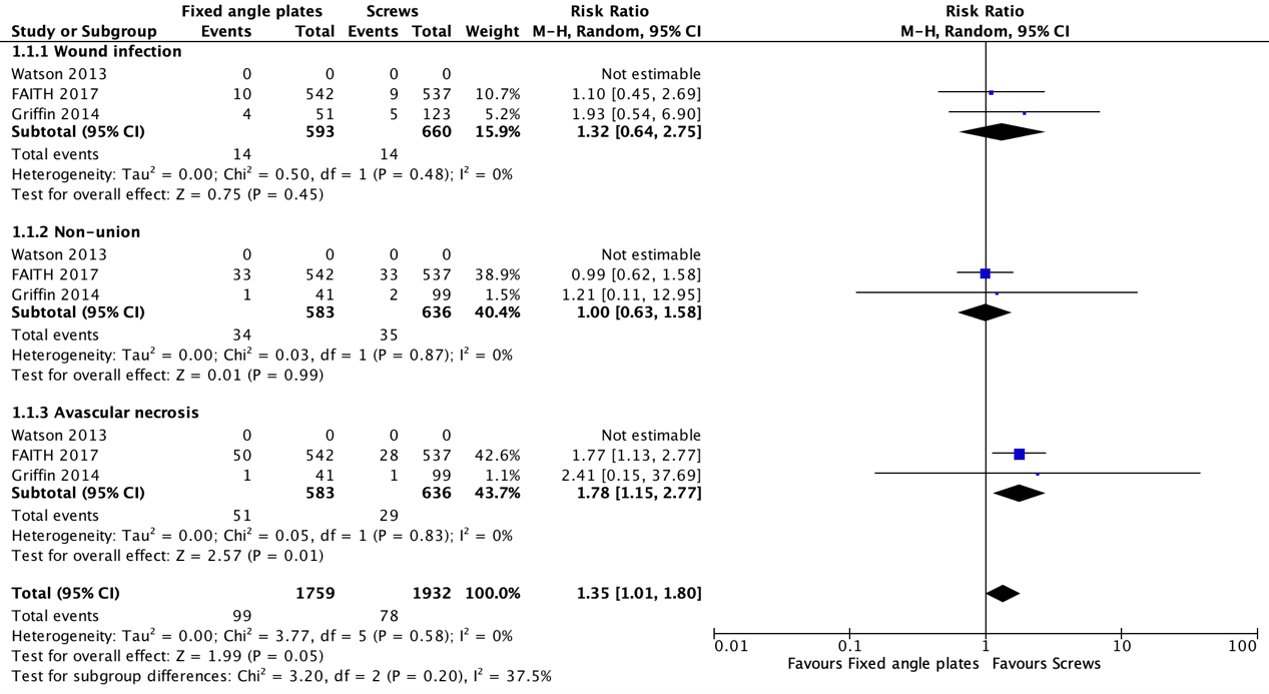
Figure 1. Forest plot of complications comparing plates and screws on complications
Risk Ratio, random effects model. Z: p-value of overall effect; df: degrees of freedom; I2; statistical heterogeneity; CI: confidence interval
Functional status/performance (important)
One trial (FAITH, 2017) reported on functional status or performance, measured with the WOMAC scale. The WOMAC score ranges from 0 to 96, with lower scores indicating better outcomes (less pain, stiffness, and better function).
The mean difference in WOMAC score between patients treated with fixed angle plates (n=17) and screws (n=15) was 3.37 (0.03 to 6.71) points, in favour of screws. The observed mean difference does not approach the predefined threshold for clinical relevance (24 points for WOMAC). Therefore, this difference is not considered clinically relevant.
Watson (2013) also reported on functional status, measured using the WOMAC score, but did not provide standard deviations (SDs). At 24 months, the median WOMAC score was 41 (IQR 26 to 59; n=12) in the group treated with a dynamic fixed angle plate and 29 (IQR 26 to 36.5; n=16) in the group treated with screws. Although a lower score suggests better function, the use of medians and IQRs, along with the small sample size and absence of SDs, limits the ability to draw firm conclusions or include these data in a meta-analysis. The observed difference suggests a possible advantage for screws, but no conclusions can be made regarding clinical relevance.
Mortality (important)
Three trials reported mortality within a twelve months period following treatment with either fixed angle plates or screws. The results were pooled in a meta-analysis. Across all studies, 93/613 (15.2%) of patients treated with fixed angle plates died within twelve months, compared to 118/664 (17.8%) of patients treated with screws. This resulted in a pooled RR of 0.93 (95% CI 0.73 to 1.19), in favour of fixed angle plates (see figure 2). This difference was not considered clinically relevant.

Figure 2. Forest plot of functional status comparing plates and screws on mortality within 12 months
Risk Ratio, random effects model. Z: p-value of overall effect; df: degrees of freedom; I2; statistical heterogeneity; CI: confidence interval
Re-operations (important)
Re-operations, defined as unplanned return to theatre in the Cochrane review (Lewis 2021), was reported in three trials. One trial (Griffin 2014) reported outcomes at twelve months; the others at 24 months. The results were pooled in a meta-analysis. The trials did not systematically report indications. Where specified, procedures included refixation, removal of fixation, resection of the femoral head, and conversion to arthroplasty. Overall, 121/614 (19.7%) of patients treated with fixed angle plates underwent a re-operation compared to 156/665 (23.5%) in the screw group. This resulted in a pooled RR of 0.86 (95% CI 0.65 to 1.13), in favour of fixed angle plates (see figure 3). This difference was considered clinically relevant.

Figure 3. Forest plot of functional status comparing plates and screws on revision surgery
Risk Ratio, random effects model. Z: p-value of overall effect; df: degrees of freedom; I2; statistical heterogeneity; CI: confidence interval
Quality of life (important)
One trial (FAITH, 2017) reported health-related quality of life (HRQoL) at twelve months using the EQ-5D scale, where scores range from 0 (death) to 1 (perfect health). The mean EQ-5D scores was slightly higher in the screw group (n=238) compared to the fixed angle plate group (n=249), with a MD of -0.03 (95% CI -0.06 to -0.00), in favour of fixed angle plates. This difference was not considered clinically relevant.
Watson (2013) reported mean values without SDs, using the SF-12 physical component score (0–100 scale, higher scores indicating better quality of life). At twelve months, the reported mean score was 38.47 (IQR 25.6 to 51.6; n=23) in the fixed angle plate group and 45.92 (IQR 35.6 to 56.3; n=19) in the screw group. While the direction of effect suggests slightly better HRQoL for screws, no conclusion can be made regarding clinical relevance.
Length of hospital stay (important)
Length of hospital stay was reported in one trial (Griffin, 2014). The mean length of stay was 18 days for patients treated with fixed angle plates and 22 days for those treated with screws. Since this outcome was reported in only one study, no effect estimate could be calculated, and no conclusions can be drawn regarding clinical relevance.
A systematic review of the literature was performed to answer the following question(s):
What are the benefits and harms of a free-gliding hip screw in comparison with a compression hip screw in adult patients with non-displaced fractures of the femoral neck?
Table 1. PICO
| Patients | Adult patients with non-displaced fractures of the femoral neck |
| Intervention | Dynamic hip screw (DHS), femoral neck system (FNS), sliding hip screw |
| Control | Cannulated hip screw (CHS) |
| Outcomes | Complications, re-operations, length of stay, performance/function, mortality, quality of life |
| Other selection criteria |
Study design: systematic reviews and randomized controlled trials Minimal follow-up: not specified |
Relevant outcome measures
The guideline panel considered function and complications as critical outcome measures for decision making; and reoperations, length of stay, costs, performance, mortality and quality of life as important outcome measures for decision making.
The working group defined the following differences as a minimal clinically (patient) important differences:
- Complications: difference of 25% in risk ratio (<0.8 or >1.25).
- Functional status/performance: difference of 16 points on the Harris Hip Score (Singh 2016), difference of 24 points for WOMAC (Monticone, 2017).
- Mortality: difference of 10% in risk ratio (<0.8 or >1.25).
- Re-operations: difference of 10% in risk ratio (<0.8 or >1.25).
- Quality of life: difference of 10%:
- EQ-5D: 0.07 to 0.08 (Sims, 2016).
- SF-12.
- Length of hospital stay: ≥1 day.
The guideline panel did not predefine all the outcome measures listed above but instead adopted the definitions as reported in the included studies.
Complications
- Wound infection: used study authors' definitions, which were often described as deep infection or superficial infection.
- Non-union: used study authors' definitions, which were variably defined in the included studies and used various means of diagnosis.
- Avascular necrosis (AVN): used study authors' definitions, which were variably defined in the included studies and used various means of diagnosis; we included data described as late segmental collapse for this outcome.
Performance / function
Functional status (region-specific) was assessed using tools such as the Hip Rating Questionnaire, Harris Hip Score, Oxford Hip Score, and the Western Ontario and McMaster Universities Osteoarthritis Index (WOMAC).
- Hip Rating Questionnaire.
- Oxford Hip Score.
- Harris Hip Score.
- WOMAC: scores range from 0 to 96, with lower scores indicating less pain, stiffness, and functional limitations.
Quality of Life (HRQoL)
Assessed using validated instruments including the Short Form Health Survey (SF-36), the Short Form-12 (SF-12), and the EuroQol 5-Dimension scale (EQ-5D).
- EQ-5D: scores in this scale range from 0 (dead) to 1 (best quality of life).
- SF-12: scores range from 0 to 100, with higher scores indicating better quality of life.
Re-operations
Re-operations were defined as a secondary procedure required for a complication resulting directly or indirectly from the index operation/primary procedure.
Search and select (Methods)
A systematic literature search was performed by a medical information specialist using the following bibliographic databases: Embase.com and Ovid/Medline. Both databases were searched from 2005 to the 29th of April 2025 for systematic reviews, RCTs, and observational studies. Systematic searches were completed using a combination of controlled vocabulary/subject headings (e.g., Emtree-terms, MeSH), wherever they were available, and natural language keywords. The overall search strategy was derived from two primary search concepts: (1) femoral neck fractures; (2) gliding hip screw. Duplicates were removed using EndNote software. After deduplication a total of 1671 records were imported for title/abstract screening.
- FAITH-2 Investigators. Fixation using alternative implants for the treatment of hip fractures (FAITH-2): the clinical outcomes of a multi-centre 2x2 factorial randomized controlled pilot trial in young femoral neck fracture patients. Journal of Orthopaedic Trauma 2020 Jul 24 [Epub ahead of print]. [DOI: 10.1097/ BOT.0000000000001773].
- Griffin XL, Parsons N, Achten J, Costa ML. The Targon femoral neck hip screw versus cannulated screws for internal fixation of intracapsular fractures of the hip: a randomised controlled trial. Bone and Joint Journal 2014;96(5):652-7. PMID: 24788501.
- Griffin XL, Parsons N, Achten J, Costa ML. Warwick Hip Trauma Study: a randomised clinical trial comparing interventions to improve outcomes in internally fixed intracapsular fractures of the proximal femur. Protocol for the WHiT Study. BMC Musculoskeletal Disorders 2010;11(184):1-8. PMID: 20716348.
- Lewis SR, Macey R, Eardley WG, Dixon JR, Cook J, Griffin XL. Internal fixation implants for intracapsular hip fractures in older adults. Cochrane Database Syst Rev. 2021 Mar 9;3(3):CD013409. doi: 10.1002/14651858.CD013409.pub2. PMID: 33687067; PMCID: PMC8092427.
- Sims AL, Parsons N, Achten J, Gri#in XL, Costa ML, Reed MR. The World Hip Trauma Evaluation Study 3: hemiarthroplasty evaluation by multicentre investigation - WHITE 3: HEMI - an abridged protocol. Bone & Joint Resaerch 2016;5(1):18-25. PMID: 26825319.
- Singh JA, Schleck C, Harmsen S, Lewallen D. Clinically important improvement thresholds for Harris Hip Score and its ability to predict revision risk after primary total hip arthroplasty. BMC Musculoskelet Disord. 2016 Jun 10;17:256. doi: 10.1186/s12891-016-1106-8. PMID: 27286675; PMCID: PMC4901425.
- Watson A, Zhang Y, Beattie S, Page RS. Prospective randomized controlled trial comparing dynamic hip screw and screw fixation for undisplaced subcapital hip fractures. ANZ Journal of Surgery 2013;83(9):679-83. PMID: 22998439.
Risk of bias table
|
Study reference
|
Was the allocation sequence adequately generated?
|
Was the allocation adequately concealed?
|
Blinding: Was knowledge of the allocated interventions adequately prevented? Were patients blinded? Were healthcare providers blinded? Were data collectors blinded? Were outcome assessors blinded? Were data analysts blinded? |
Was loss to follow-up (missing outcome data) infrequent?
|
Are reports of the study free of selective outcome reporting?
|
Was the study apparently free of other problems that could put it at a risk of bias?
|
Overall risk of bias If applicable/necessary, per outcome measure
|
|
FAITH, 2017 |
Definitely yes
Reason: Computer-generated randomisation |
Definitely yes
Reason: Quote: "Local research personnel at each site performed randomisation by minimization using the centralised computer system. Surgeons and patients were not masked but the data analyst, while doing the analyses, remained masked to treatment groups." |
Probably yes
Reason: It is not possible to blind surgeons to treatment groups. Study authors describe the experience level of surgeons in each group, and we noted these were evenly balanced. However, it is unclear if each surgeon was equally experienced with both types of implants
Quote: "An independent Central Adjudication Committee, adjudicated all primary and key secondary outcomes (mortality, fracture healing, and fracture complications, including avascular necrosis, non-union, implant failure, and infections)" however the protocol states that assessors could not be blind of intervention used.
Study authors did not report whether participants were blinded to treatment allocation. However, we did not expect that lack of blinding would influence the data for participant-reported subjective outcome measures
We did not expect that lack of blinding of assessors of objective measures (mortality) would influence objective outcome data
|
Probably no
Reason: Overall losses in each group are balanced. Because the highest number of losses was caused by death, which might be expected in this age group, we were not concerned by these losses. We noted an inconsistent number of participants for which data is reported for each of the HRQoL measures which may indicate attrition bias for these measures. |
Probably yes
Reason: Study registered with a clinical trials register (NCT00761813; first received in September 2008), and protocol published 2014. Registration was completed shortly after the start of the study and the reported outcomes were consistent with those in the clinical trials registration documents |
Probably yes
Reason: We identified no other sources of bias |
LOW
|
|
Watson, 2013 |
Definitely yes
Reason: Computer-generated block randomisation
|
Definitely yes
Reason: Sealed sequential envelopes
|
Probably no
Reason: It is not possible to blind surgeons to treatment groups. Study authors do not report the number of surgeons, their level of surgical experience, and whether they are experienced with both types of implants
Study authors do not report whether outcome assessors were blinded
We expected lack of blinding of outcome assessors will not influence outcome Data. |
Probably no
Reason: Only 1 participant loss in each group for mortality and unplanned return to theatre, and we judged these outcomes to be at low risk of bias. For functional status and HRQoL, we noted more losses in the DHS group, and risk of attrition bias was high |
Probably no
Reason: Study authors do not report prepublished protocol or clinical trials registration. It is not feasible to effectively assess risk of selective reporting bias without these documents. |
Probably yes
Reason: We identified no other sources of bias |
Some concerns |
|
Griffin 2014 |
Probably yes
Reason: Treatment allocation was determined using a computer-generated, randomised number sequence administrated by an independent Clinical Trials Unit via a secure online programme. |
Probably yes
Reason: Allocation managed centrally and code only broken at the end of the trial. |
Probably no
Reason: It is not possible to blind surgeons to treatment groups. Although operations were performed under the supervision of an experienced consultant surgeon, we noted that surgeons had been given training with the use of one of the implants (TFN) and were therefore likely to be less experienced with this device
It is not possible to blind surgeons to treatment groups. Because surgeons assessed the subjective outcomes (re-operation and complications), we judged detection bias for subjective outcomes to be high risk.
Study authors did not report whether participants were blinded to treatment allocation. However, we did not expect that lack of blinding would influence the data for participant-reported subjective outcome measures.
We did not expect that lack of blinding of assessors of objective measures (mortality) would influence objective outcome data.
|
Probably no
Reason: Loss to follow-up was clearly reported and equal between groups. Most losses could be explained by death, which is expected in this population
|
Probably yes
Reason: Study is registered on a clinical trials register (ISRCTN49197425, first received April 2010), and protocol submitted in May 2010. Registration was completed shortly after the start of the study and the reported outcomes were mostly consistent with those in the clinical trials registration documents |
Probably yes
Reason: We identified no other sources of bias |
Some concerns |
Table of excluded studies
|
Reference |
Reason for exclusion |
|
Rahman AFA, Gouda A, Ibrahim R. Methods of fixation used in management of femoral neck fractures in adults: a systematic review. Current Orthopaedic Practice. 2018; 29(4): 378-383. |
Includes observational studies |
|
Amer KM, Congiusta DV, Smith B, Jain K, Shaath MK, Dalcortivo RL, Ahmed IH, Vosbikian MM. Cephalomedullary Nailing has a Higher Reoperation Rate Compared to Sliding Hip Screw Fixation in the Treatment of Intertrochanteric Femur Fractures: A Systematic Literature Review and Meta-analysis. Arch Bone Jt Surg. 2023;11(10):595-604. doi: 10.22038/ABJS.2023.64311.3088. PMID: 37873525; PMCID: PMC10590488. |
Wrong population (patients with intertrochanteric fractures) |
|
Borris, Lars & Thorninger, Rikke & Brink, Ole. (2020). Journal of Traumatology and Clinical Orthopaedics Original research Premature discontinuation of a randomized comparison between a new implant Dynaloc ® and cancellous screws for femoral neck fractures: An ethical dilemma. Journal of Traumatology and Clinical Orthopaedics. 2. 1-6. 10.14312/2399-8180.2020-1. |
Wrong comparison of interventions |
|
Gupta GK, Rai A, Mandal S, Rani S, Shekhar S, Halder S, Prasad P, Kumar A, Haque ZU. Comparison of Femoral Neck System Versus Cannulated Cancellous Screws for the Fixation of Femoral Neck Fracture in Young Adults: A Systematic Review and Meta-Analysis. Cureus. 2022 Nov 29;14(11):e32011. doi: 10.7759/cureus.32011. PMID: 36589187; PMCID: PMC9798663. |
Includes retrospective studies |
|
Huang X, Leung F, Xiang Z, Tan PY, Yang J, Wei DQ, Yu X. Proximal femoral nail versus dynamic hip screw fixation for trochanteric fractures: a meta-analysis of randomized controlled trials. ScientificWorldJournal. 2013;2013:805805. doi: 10.1155/2013/805805. Epub 2013 Feb 19. PMID: 23533361; PMCID: PMC3590640. |
Wrong population (patients with intertrochanteric fractures) |
|
Jiang QL, Cao Y, Bai X, Deng Y, Li Y. Femoral neck system versus dynamic hip screw for fixation of femoral neck fracture in the adult: a meta-analysis. J Pak Med Assoc. 2024 Feb;74(2):335-340. doi: 10.47391/JPMA.9556. PMID: 38419236. |
Includes retrospective studies |
|
Meta-analysis of femoral neck system and cannulated compression screw internal fixation in the treatment of femoral neck fractures in young and middle-aged patients. Li Hi, Liu C, Jin G, Zhang H, Gu M, Jin R. 2025 |
No full text avalaible |
|
Lu Y, Huang Z, Xu Y, Huang Q, Ren C, Li M, Li Z, Sun L, Xue H, Zhang K, Wang Q, Ma T. Femoral neck system versus cannulated screws for fixation of femoral neck fracture in young adults: a systematic review and meta-analysis. Am J Transl Res. 2022 Aug 15;14(8):5480-5490. PMID: 36105033; PMCID: PMC9452327. |
Includes retrospective studies |
|
Ma JX, Kuang MJ, Xing F, Zhao YL, Chen HT, Zhang LK, Fan ZR, Han C, Ma XL. Sliding hip screw versus cannulated cancellous screws for fixation of femoral neck fracture in adults: A systematic review. Int J Surg. 2018 Apr;52:89-97. doi: 10.1016/j.ijsu.2018.01.050. Epub 2018 Feb 20. PMID: 29471156. |
Includes retrospective studies |
|
Patel S, Kumar V, Baburaj V, Dhillon MS. The use of the femoral neck system (FNS) leads to better outcomes in the surgical management of femoral neck fractures in adults compared to fixation with cannulated screws: A systematic review and meta-analysis. Eur J Orthop Surg Traumatol. 2023 Jul;33(5):2101-2109. doi: 10.1007/s00590-022-03407-8. Epub 2022 Oct 6. PMID: 36201031. |
Includes observational studies |
|
Rajnish RK, Srivastava A, Rathod PM, Haq RU, Aggarwal S, Kumar P, Dhammi IK, Dadra A. Does the femoral neck system provide better outcomes compared to cannulated screws fixation for the management of femoral neck fracture in young adults? A systematic review of literature and meta-analysis. J Orthop. 2022 May 11;32:52-59. doi: 10.1016/j.jor.2022.05.007. PMID: 35601207; PMCID: PMC9118353. |
Includes retrospective studies |
|
Saad A, Patralekh MK, Jain VK, Shrestha S, Botchu R, Iyengar KP. Femoral neck system reduces surgical time and complications in adults with femoral neck fractures: A systematic review and meta-analysis. J Clin Orthop Trauma. 2022 Jun 11;30:101917. doi: 10.1016/j.jcot.2022.101917. PMID: 35755934; PMCID: PMC9218557. |
Includes retrospective studies |
|
Tian P, Kuang L, Li ZJ, Xu GJ, Fu X. Comparison Between Femoral Neck Systems and Cannulated Cancellous Screws in Treating Femoral Neck Fractures: A Meta-Analysis. Geriatr Orthop Surg Rehabil. 2022 Jul 6;13:21514593221113533. doi: 10.1177/21514593221113533. PMID: 35832467; PMCID: PMC9272162. |
Includes retrospective studies |
|
Wang Q. A meta-analysis of different internal fixation strategies of Pauwels III femoral neck fractures. Journal of Shanghai Jiaotong University (Medical Science. 2018: 1045-1052. |
Wrong language (Chinese) |
|
Wu ZF, Luo ZH, Hu LC, Luo YW. Efficacy of the femoral neck system in femoral neck fracture treatment in adults: A systematic review and meta-analysis. World J Clin Cases. 2022 Nov 6;10(31):11454-11465. doi: 10.12998/wjcc.v10.i31.11454. PMID: 36387785; PMCID: PMC9649536. |
Includes retrospective studies |
|
Xu H, Liu Y, Sezgin EA, Tarasevičius Š, Christensen R, Raina DB, Tägil M, Lidgren L. Comparative effectiveness research on proximal femoral nail versus dynamic hip screw in patients with trochanteric fractures: a systematic review and meta-analysis of randomized trials. J Orthop Surg Res. 2022 Jun 3;17(1):292. doi: 10.1186/s13018-022-03189-z. PMID: 35658909; PMCID: PMC9164432. |
Wrong population (patients with intertrochanteric fractures) |
|
Zhang J, Chang X, Sun Z, Tang X. Comparison of femoral neck system versus cannulated compression screws in treating femoral neck fractures: A systematic review and meta-analysis. Asian J Surg. 2023 Aug;46(8):3259-3260. doi: 10.1016/j.asjsur.2023.03.013. Epub 2023 Mar 16. PMID: 36933962. |
No full text avalaible |
|
Zhang LL, Zhang Y, Ma X, Liu Y. Multiple cannulated screws vs. dynamic hip screws for femoral neck fractures : A meta-analysis. Orthopade. 2017 Nov;46(11):954-962. English. doi: 10.1007/s00132-017-3473-8. PMID: 29022057. |
Overlap in included RCTs |
|
Zhuang K, Wu J, Yang Y, Bai T, Li B. Comparison of clinical efficacy between femoral neck system and cannulated screw in Pauwels type III femoral neck fracture: A meta-analysis. J Back Musculoskelet Rehabil. 2025 Jan;38(1):71-82. doi: 10.1177/10538127241296340. Epub 2025 Jan 9. PMID: 39970468. |
Includes retrospective studies |
|
Lim EJ, Shon HC, Cho JW, Oh JK, Kim J, Kim CH. Dynamic Hip Screw versus Cannulated Cancellous Screw in Pauwels Type II or Type III Femoral Neck Fracture: A Systematic Review and Meta-Analysis. J Pers Med. 2021 Oct 11;11(10):1017. doi: 10.3390/jpm11101017. PMID: 34683158; PMCID: PMC8541281. |
Includes studies with children (Singh 2017) |
Beoordelingsdatum en geldigheid
Publicatiedatum : 15-09-2026
Beoordeeld op geldigheid : 15-09-2026
Samenstelling werkgroep
Voor het ontwikkelen van de richtlijnmodule is in 2023 een multidisciplinair cluster ingesteld. Het cluster Letsel na ongeval bestaat uit meerdere richtlijnen (zie hier de actuele clusterindeling). De stuurgroep bewaakt het proces van modulair onderhoud binnen het cluster. De expertisegroepsleden brengen hun expertise in, indien nodig. De volgende personen uit het cluster zijn betrokken geweest bij de herziening van deze modules:
Clusterstuurgroepleden
- Dr. M.F. (Frank) Termaat, Nederlandse Vereniging voor Heelkunde
- Dr. E.M. (Eelco) Fennema, Nederlandse Vereniging voor Heelkunde
- Drs. R.P.T.C.G. (René) Groetelaers, Nederlandse Vereniging voor Heelkunde
- Prof. dr. V.A. (Victor) de Ridder, Nederlandse Vereniging voor Heelkunde
- Dr. S. (Sarah) Woltz, Nederlandse Vereniging voor Heelkunde
- Dr. J. (Jakob) van Oldenrijk, Nederlandse Orthopaedische Vereniging
- Dhr. dr. C.L.P. (Marc) van de Ree, Nederlandse Orthopaedische Vereniging
- Drs. H.H. (Hugo) Wijnen, Nederlandse Vereniging voor Klinische Geriatrie
- Dr. T. (Tim) de Jong, Nederlandse Vereniging voor Plastische Chirurgie
- Drs. H. (Hassan) Amghar, Nederlandse Vereniging voor Radiologie
- Dhr. dr. H.R. (Herman) Holtslag, Nederlandse Vereniging voor Revalidatieartsen
- Dhr. Prof. dr. W.C. (Wilco) Peul, Nederlandse Vereniging voor Neurochirurgie
Betrokken clusterexpertisegroepleden
- Dr. S.M. (Sander) Verhage, Nederlandse Vereniging voor Heelkunde
- Dhr. Drs. M.V. (Matthijs) Nijenhuis, Nederlandse Vereniging voor Heelkunde
- Dhr. Dr. M.H. (Matthijs) van Gool, Nederlandse Vereniging voor Heelkunde
- Dhr. Dr. R.C. (Robert) Dettmers, Nederlandse Vereniging voor Heelkunde
- Dhr. dr. M.P. (Matthijs) Somford, Nederlandse Orthopaedische Vereniging
- Mevr. drs. M.R. (Mariëlle) Hofman, Nederlandse Vereniging voor Klinische Geriatrie
- Dhr. drs. D. (Dawi) van der Stap, Nederlandse Vereniging voor Klinische Geriatrie
- Mevr. drs. M. (Matthea) Dijkshoorn, Nederlandse Vereniging voor Klinische Geriatrie
- Mevr. I.C. (Isabelle) Huig, Nederlandse Vereniging voor Anesthesiologie
- Dr. J. (Jorgos) Alexandridis, Nederlandse Vereniging voor Spoedeisende Hulp Artsen
- Dhr. Drs. Ö.(Özcan) Sir, Nederlandse Vereniging voor Spoedeisende Hulp Artsen
Met ondersteuning van
- Dr. M.S. (Matthijs) Ruiter, senior adviseur, Kennisinstituut van de Federatie Medisch Specialisten
- M. (Mitchel) Griekspoor, adviseur, Kennisinstituut van de Federatie Medisch Specialisten
- E. (Esther) van der Bijl, medisch informatiespecialist, Kennisinstituut van de Federatie Medisch Specialisten
Belangenverklaringen
Een overzicht van de belangen van de clusterleden en het oordeel over het omgaan met eventuele belangen vindt u in onderstaande tabel. De ondertekende belangenverklaringen zijn op te vragen bij het secretariaat van het Kennisinstituut van de Federatie Medisch Specialisten via secretariaat@kennisinstituut.nl.
Gemelde (neven)functies en belangen stuurgroepleden
|
Naam |
Hoofdfunctie |
Nevenwerkzaamheden |
Persoonlijke financiële belangen |
Persoonlijke relaties |
Extern gefinancierd onderzoek |
Intellectuele belangen en reputatie |
Overige belangen |
Restrictie |
|
Dr. M.F. (Frank) Termaat |
LUMC Leiden; Traumachirurg (betaald dienstverband) |
|
Geen. |
Geen. |
Geen. |
Geen. |
Geen. |
Geen. |
|
Dr. E.M. (Eelco) Fennema |
Traumachirurg, Heelkunde Friesland, Nijsmellinghe Drachten |
Geen. |
Geen. |
Geen. |
Geen. |
Geen. |
Geen. |
Geen. |
|
Drs. R.P.T.C. (René) Groetelaers |
Traumachirurg Máxima Medisch Centrum Veldhoven - Eindhoven (0,8 FTE) Traumachirurg St Jans Gasthuis Weert (0,2 FTE) |
|
Geen. |
Geen. |
Geen. |
Geen. |
Geen. |
Geen. |
|
Prof. dr. V.A. (Victor) de Ridder |
Prof. Dr. V.A. de Ridder MBA BA LLB FRCS Professor Emergency Care and Logistics, Trauma and Pediatric Trauma Acad Zh Utrecht UMCU |
(Alle bovengenoemde nevenwerkzaamheden zijn onbetaald.) |
Geen. |
Geen. |
Geen. |
Geen. |
Geen. |
Geen. |
|
Dr. S. (Sarah) Woltz |
Traumachrirug Spaarne Gasthuis |
|
Geen. |
Geen. |
Geen. |
Geen. |
Geen. |
Geen. |
|
Dr. J. (Jakob) van Oldenrijk |
Orthopedisch chirurg - Traumatoloog, Erasmus Medisch Centrum Rotterdam |
|
Geen. |
Geen. |
Geen. |
Geen. |
Geen. |
Geen. |
|
Dhr. dr. C.L.P. (Marc) van de Ree |
Orthopedisch chirurg Erasmus MC |
Voorzitter CORE (Kennisagenda NOV) |
Geen. |
Geen. |
Geen. |
Geen. |
Geen. |
Geen. |
|
Drs. H.H. (Hugo) Wijnen |
Klinisch geriater |
Klinisch geriater, ziekenhuis Arnhem |
Geen. |
Geen. |
Geen. |
Geen. |
Rijnstate heeft via Hugo Wijnen een educational grant van Vifor ontvangen t.w.v. 4000 euro Rijnstate heeft via Hugo Wijnen transformatiegelden (120.000 euro) ontvangen van de zorgverzekeraar wat door het ziekenhuis wordt ingezet voor de verbetering van de transmurale samenwerking en uitplaatsing van patiënten uit het ziekenhuis in de regio. Een deel van deze gelden worden gebruikt voor de uitbreiding van het arbeidscontract van Hugo Wijnen (0,1 fte gedurende 2 jaar). Deze tijd gebruikt hij om de transmurale samenwerking te optimaliseren (0,1 fte gedurende 2 jaar) |
Geen. |
|
Dr. T. (Tim) de Jong |
Plastisch chirurg |
Richtlijncommissie NVPC; onbetaald. |
Geen. |
Geen. |
Geen. |
Geen. |
Geen. |
Geen. |
|
Drs. H. (Hassan) Amghar |
Radioloog |
Waarnemend radioloog - Jeroen Bosch Ziekenhuis |
Geen. |
Geen. |
Geen. |
Geen. |
Geen. |
Geen. |
|
Dhr. dr. H.R. (Herman) Holtslag |
Revalidatiearts, Amsterdam UMC |
|
Geen. |
Geen. |
Geen. |
Geen. |
Geen. |
Geen. |
|
Dhr. Prof. dr. W.C. (Wilco) Peul |
Prof. dr. Neurochirurg te LUMC |
|
|
|
|
Geen. |
Geen. |
Geen. |
Gemelde (neven)functies en belangen betrokken expertisegroepleden
|
Naam |
Hoofdfunctie |
Nevenwerkzaamheden |
Persoonlijke financiële belangen |
Persoonlijke relaties |
Extern gefinancierd onderzoek |
Intellectuele belangen en reputatie |
Overige belangen |
Restrictie |
|
Dr. S.M. (Sander) Verhage |
Chirurg Haaglanden Medisch Centrum |
Geen. |
Geen. |
Geen. |
Geen. |
Geen. |
Geen. |
Geen. |
|
Dhr. Drs. M.V. (Matthijs) Nijenhuis |
Traumachirurg, Amsterdam UMC |
Cursuscoordinator CASH NTS |
Geen. |
Geen. |
Geen. |
Geen. |
Geen. |
Geen. |
|
Dhr. Dr. M.H. (Matthijs) van Gool |
Traumachirurg, Maasstad ziekenhuis |
Geen. |
Geen. |
Geen. |
Geen. |
Geen. |
Geen. |
Geen. |
|
Dhr. Dr. R.C. (Robert) Dettmers |
Traumachirurg isala ziekenhuis zwolle |
Atls instructeur |
Geen. |
Geen. |
Geen. |
Geen. |
Geen. |
Geen. |
|
Dhr. dr. M.P. (Matthijs) Somford |
Orthopedisch chirurg, zelfstandige |
Geen. |
Geen. |
Geen. |
Geen. |
Geen. |
Geen. |
Geen. |
|
Mevr. drs. M.R. (Mariëlle) Hofman |
Klinisch geriater Elisabeth tweestedenziekenhuis |
Geen. |
Geen. |
Geen. |
Adfice it Studie, Financier: ZonMW, Inhoud onderzoek: RCT, effectiviteit beslisondersteuning medicatie afbouw valrisico verhogende medicatie, Projectleidersrol: nee. |
Geen. |
Geen. |
Geen. |
|
Dhr. drs. D. (Dawi) van der Stap |
Klinisch Geriater Maasstad Ziekenhuis |
Geen. |
Geen. |
Geen. |
Aanleveren patiënt inclusie,Financier: ZonMW, Inhoud onderz. 1:Frail-hip implementatie, Inhoud onderz. 2: PENG-studie, Inhoud onderz. 3: Frail Hip studie. Geen projectleidersrol |
Geen. |
Geen. |
Geen. |
|
Mevr. drs. M. (Matthea) Dijkshoorn |
Klinisch geriater, Tjongerschans (na fusie, vanaf 1-1-25: Frisiusmc) |
Geen. |
Geen. |
Geen. |
Geen. |
Geen. |
Geen. |
Geen. |
|
Mevr. I.C. (Isabelle) Huig |
(urgentie)-anesthesioloog in het Erasmus MC |
Geen. |
Geen. |
Geen. |
Geen. |
Geen. |
Geen. |
Geen. |
|
Dr. J. (Jorgos) Alexandridis |
SEH-arts KNMG te CWZ, Nijmegen |
APLS instructeur voorzitter wetenschapscommissie NVSHA |
Geen. |
Geen. |
Geen. |
Geen. |
Geen. |
Geen. |
|
Dhr. Drs. Ö.(Özcan) Sir |
dr. Ozcan Sir, SEH-arts Radboudumc |
Geen. |
Geen. |
Geen. |
Geen. |
Geen. |
Geen. |
Geen. |
Inbreng patiëntenperspectief
Kwalitatieve raming van mogelijke financiële gevolgen in het kader van de Wkkgz
Bij de richtlijnmodule voerden de clusterleden conform de Wet kwaliteit, klachten en geschillen zorg (Wkkgz) een kwalitatieve raming uit om te beoordelen of de aanbevelingen mogelijk leiden tot substantiële financiële gevolgen. Bij het uitvoeren van deze beoordeling is de richtlijnmodule op verschillende domeinen getoetst (zie het stroomschema bij Werkwijze).
|
Module |
Uitkomst raming |
Toelichting |
|
Interne fixatie niet-gedisloceerde collum femoris fractuur |
Geen substantiële financiële gevolgen. |
Hoewel uit de toetsing volgt dat de aanbeveling(en) breed toepasbaar zijn (>40.000 patiënten), volgt ook uit de toetsing dat het geen nieuwe manier van zorgverlening of andere organisatie van zorgverlening betreft, het geen toename in het aantal in te zetten voltijdsequivalenten aan zorgverleners betreft en het geen wijziging in het opleidingsniveau van zorgpersoneel betreft. Er worden daarom geen substantiële financiële gevolgen verwacht.
|
Werkwijze
Voor meer details over de gebruikte richtlijnmethodologie verwijzen wij u naar de Werkwijze. Relevante informatie voor de ontwikkeling/herziening van deze richtlijnmodule is hieronder weergegeven.
Zoekverantwoording
Algemene informatie
|
Cluster/richtlijn: Letsel na ongeval - Proximale femurfracturen - Module Interne fixatie |
|
|
Uitgangsvraag/modules: Wat is de beste operatieve interventie bij een niet-gedisloceerde collum femoris fractuur? |
|
|
Database(s): Embase.com, Ovid/Medline |
Datum: 29 april 2025 |
|
Periode: vanaf 2005 |
Talen: geen restrictie |
|
Literatuurspecialist: Esther van der Bijl |
Rayyan review: https://new.rayyan.ai/reviews/1432784/overview |
|
BMI-zoekblokken: voor verschillende opdrachten wordt (deels) gebruik gemaakt van de zoekblokken van BMI-Online https://blocks.bmi-online.nl/ Deduplication: voor het ontdubbelen is gebruik gemaakt van http://dedupendnote.nl/ |
|
|
Toelichting: De sleutelartikelen worden gevonden met deze search. Twee artikelen werden ingetrokken (retracted), deze zijn uit de set verwijderd. Ingetrokken artikelen:
In overleg worden in eerste instantie alleen de SR’s aangeboden in Rayyan. |
|
|
Te gebruiken voor richtlijntekst: A systematic literature search was performed by a medical information specialist using the following bibliographic databases: Embase.com and Ovid/Medline. Both databases were searched from 2005 to the 29th of April 2025 for systematic reviews, RCTs and observational studies. Systematic searches were completed using a combination of controlled vocabulary/subject headings (e.g., Emtree-terms, MeSH) wherever they were available and natural language keywords. The overall search strategy was derived from two primary search concepts: (1) femoral neck fractures; (2) gliding hip screw. Duplicates were removed using EndNote software. After deduplication a total of 1671 records were imported for title/abstract screening. |
|
Zoekopbrengst - 29 juli 2025
|
|
EMBASE |
OVID/MEDLINE |
Ontdubbeld |
|
SR |
168 |
119 |
177* |
|
RCT |
394 |
221 |
460 |
|
Observationele studies |
943 |
678 |
1034 |
|
Totaal |
1505 |
1018 |
1671 |
*in Rayyan
Zoekstrategie - 29 juli 2025
Embase.com
|
No. |
Query |
Results |
|
#1 |
'proximal femur fracture'/exp OR 'hip fracture'/exp OR ('proximal femur'/exp/mj AND 'fracture'/exp/mj) OR (((fem?r* OR hip* OR trochanter* OR intertrochanter* OR intratrochanter* OR pertrochanter* OR subtrochanter*) NEAR/3 (fractur* OR broke* OR break* OR dislocat*)):ti,ab,kw) OR (((fem?r* OR hip*) NEAR/4 (neck OR collum OR proximal) NEAR/4 (fractur* OR broke* OR break* OR dislocat*)):ti,ab,kw) OR (((intracapsular OR 'intra capsular') NEAR/4 (fem?r* OR hip) NEAR/4 (fractur* OR broke* OR break* OR dislocat*)):ti,ab,kw) OR 'garden 1':ti,ab,kw OR 'garden i':ti,ab,kw OR 'garden 2':ti,ab,kw OR 'garden ii':ti,ab,kw OR nof:ti,ab,kw |
102465 |
|
#2 |
'dynamic hip screw'/exp OR 'femoral neck system'/exp OR 'sliding hip screw'/exp OR (((dynamic* OR sliding) NEAR/3 hip* NEAR/3 screw*):ti,ab,kw) OR ((fem?r* NEAR/3 neck NEAR/3 system):ti,ab,kw) OR dhs:ti,ab,kw OR fns:ti,ab,kw OR shs:ti,ab,kw |
14977 |
|
#3 |
#1 AND #2 |
2632 |
|
#4 |
#3 AND [2005-2025]/py NOT ('conference abstract'/it OR 'editorial'/it OR 'letter'/it OR 'note'/it) NOT (('animal'/exp OR 'animal experiment'/exp OR 'animal model'/exp OR 'nonhuman'/exp) NOT 'human'/exp) |
1915 |
|
#5 |
'meta analysis'/exp OR 'systematic review'/exp OR 'scoping review'/exp OR 'rapid review'/exp OR 'umbrella review'/exp OR 'cochrane database of systematic reviews'/jt OR 'network meta-analysis'/exp OR 'networkmeta analy*':ti,ab,kw OR 'networkmetaanaly*':ti,ab,kw OR metaanaly*:ti,ab,kw OR 'meta analy*':ti,ab,kw OR metanaly*:ti,ab,kw OR prisma:ti,ab,kw OR prospero:ti,ab,kw OR metaanali*:ti,ab,kw OR 'meta anali*':ti,ab,kw OR metanali*:ti,ab,kw OR (((systemati* OR scoping OR umbrella OR 'structured literature') NEAR/3 (review* OR overview*)):ti,ab,kw) OR (((structured OR systemic*) NEAR/3 (review* OR overview* OR synth*) NEAR/3 literature):ti,ab,kw) OR ((systemic* NEAR/1 review*):ti,ab,kw) OR (((systemati* OR literature OR database* OR 'data base*') NEAR/10 search*):ti,ab,kw) OR (((structured OR comprehensive* OR systemic*) NEAR/3 search*):ti,ab,kw) OR (((literature NEAR/3 (review* OR overview*)):ti,ab,kw) AND (search*:ti,ab,kw OR database*:ti,ab,kw OR 'data base*':ti,ab,kw)) OR (('data extraction*':ti,ab,kw OR 'data source*':ti,ab,kw) AND ('study selection*':ti,ab,kw OR 'studies selection*':ti,ab,kw)) OR ('search strateg*':ti,ab,kw AND 'selection criteria*':ti,ab,kw) OR ('data source*':ti,ab,kw AND 'data synth*':ti,ab,kw) OR medline*:ti,ab,kw OR pubmed*:ti,ab,kw OR 'pub med*':ti,ab,kw OR embase:ti,ab,kw OR cochrane*:ti,ab,kw OR (((critical* OR rapid*) NEAR/2 (review* OR overview* OR synth*)):ti) OR ((((critical* OR rapid*) NEAR/3 (review* OR overview* OR synth*)):ab) AND (search*:ab OR database*:ab OR 'data base*':ab)) OR metasynth*:ti,ab,kw OR 'meta synth*':ti,ab,kw OR 'review* of review*':ti,ab,kw |
1103956 |
|
#6 |
'clinical trial'/exp OR 'randomization'/exp OR 'single blind procedure'/exp OR 'double blind procedure'/exp OR 'crossover procedure'/exp OR 'placebo'/exp OR 'prospective study'/exp OR rct:ab,ti OR random*:ab,ti OR 'single blind':ab,ti OR 'randomized controlled trial'/exp OR placebo*:ab,ti |
4260290 |
|
#7 |
'major clinical study'/de OR 'clinical study'/de OR 'family study'/de OR 'longitudinal study'/de OR 'retrospective study'/de OR 'prospective study'/de OR 'cohort analysis'/de OR 'case control study'/de OR 'comparative study'/exp OR 'control group'/de OR 'controlled study'/de OR 'controlled clinical trial'/de OR 'crossover procedure'/de OR 'double blind procedure'/de OR 'phase 2 clinical trial'/de OR 'phase 3 clinical trial'/de OR 'phase 4 clinical trial'/de OR 'pretest posttest design'/de OR 'pretest posttest control group design'/de OR 'quasi experimental study'/de OR 'single blind procedure'/de OR 'triple blind procedure'/de OR ((cohort NEAR/1 (study OR studies)):ab,ti) OR (('case control' NEAR/1 (study OR studies)):ab,ti) OR (('follow up' NEAR/1 (study OR studies)):ab,ti) OR (observational NEAR/1 (study OR studies)) OR ((epidemiologic NEAR/1 (study OR studies)):ab,ti) OR (('cross sectional' NEAR/1 (study OR studies)):ab,ti) OR (((control OR controlled) NEAR/6 trial):ti,ab,kw) OR (((control OR controlled) NEAR/6 (study OR studies)):ti,ab,kw) OR (((control OR controlled) NEAR/1 active):ti,ab,kw) OR 'open label*':ti,ab,kw OR (((double OR two OR three OR multi OR trial) NEAR/1 (arm OR arms)):ti,ab,kw) OR ((allocat* NEAR/10 (arm OR arms)):ti,ab,kw) OR placebo*:ti,ab,kw OR 'sham-control*':ti,ab,kw OR (((single OR double OR triple OR assessor) NEAR/1 (blind* OR masked)):ti,ab,kw) OR nonrandom*:ti,ab,kw OR 'non-random*':ti,ab,kw OR 'quasi-experiment*':ti,ab,kw OR crossover:ti,ab,kw OR 'cross over':ti,ab,kw OR 'parallel group*':ti,ab,kw OR 'factorial trial':ti,ab,kw OR ((phase NEAR/5 (study OR trial)):ti,ab,kw) OR ((case* NEAR/6 (matched OR control*)):ti,ab,kw) OR ((match* NEAR/6 (pair OR pairs OR cohort* OR control* OR group* OR healthy OR age OR sex OR gender OR patient* OR subject* OR participant*)):ti,ab,kw) OR ((propensity NEAR/6 (scor* OR match*)):ti,ab,kw) OR versus:ti OR vs:ti OR compar*:ti OR ((compar* NEAR/1 study):ti,ab,kw) OR (('observational study'/de OR 'cross-sectional study'/de OR 'multicenter study'/de OR 'correlational study'/de OR 'follow up'/de OR cohort*:ti,ab,kw OR 'follow up':ti,ab,kw OR followup:ti,ab,kw OR longitudinal*:ti,ab,kw OR prospective*:ti,ab,kw OR retrospective*:ti,ab,kw OR observational*:ti,ab,kw OR 'cross sectional*':ti,ab,kw OR cross?ectional*:ti,ab,kw OR multicent*:ti,ab,kw OR 'multi-cent*':ti,ab,kw OR consecutive*:ti,ab,kw) AND (group:ti,ab,kw OR groups:ti,ab,kw OR subgroup*:ti,ab,kw OR versus:ti,ab,kw OR vs:ti,ab,kw OR compar*:ti,ab,kw OR 'odds ratio*':ab OR 'relative odds':ab OR 'risk ratio*':ab OR 'relative risk*':ab OR 'rate ratio':ab OR aor:ab OR arr:ab OR rrr:ab OR ((('or' OR 'rr') NEAR/6 ci):ab))) |
18039470 |
|
#8 |
#4 AND #5 - SR |
168 |
|
#9 |
#4 AND #6 NOT #8 - RCT |
394 |
|
#10 |
#4 AND #7 NOT (#8 OR #9) - Observationeel |
943 |
|
#11 |
#8 OR #9 OR #10 - Totaal |
1505 |
Ovid/Medline
|
# |
Searches |
Results |
|
1 |
exp Hip Fractures/ or exp Femoral Neck Fractures/ or exp Proximal Femoral Fractures/ or ((fem?r* or hip* or trochanter* or intertrochanter* or intratrochanter* or pertrochanter* or subtrochanter*) adj3 (fractur* or broke* or break* or dislocat*)).ti,ab,kf. or ((fem?r* or hip*) adj4 (neck or collum or proximal) adj4 (fractur* or broke* or break* or dislocat*)).ti,ab,kf. or ((intracapsular or intra capsular) adj4 (fem?r* or hip) adj4 (fractur* or broke* or break* or dislocat*)).ti,ab,kf. or garden 1.ti,ab,kf. or garden i.ti,ab,kf. or garden 2.ti,ab,kf. or garden ii.ti,ab,kf. or nof.ti,ab,kf. |
71155 |
|
2 |
(((dynamic* or sliding) adj3 hip* adj3 screw*) or (fem?r* adj3 neck adj3 system) or dhs or fns or shs).ti,ab,kf. |
11704 |
|
3 |
1 and 2 |
1856 |
|
4 |
limit 3 to yr="2005 -Current" |
1462 |
|
5 |
4 not (comment/ or editorial/ or letter/) not ((exp animals/ or exp models, animal/) not humans/) |
1422 |
|
6 |
exp Meta-Analysis/ or exp Network Meta-Analysis/ or exp Systematic Review/ or (networkmeta analy* or networkmetaanaly* or metaanaly* or meta analy* or metanaly* or prisma or prospero or metaanali* or meta anali* or metanali*).ti,ab,kf. or ((systemati* or scoping or umbrella or structured literature) adj3 (review* or overview*)).ti,ab,kf. or ((structured or systemic*) adj3 (review* or overview* or synth*) adj3 literature).ti,ab,kf. or (systemic* adj1 review*).ti,ab,kf. or ((systemati* or literature or database* or data base*) adj10 search*).ti,ab,kf. or ((structured or comprehensive* or systemic*) adj3 search*).ti,ab,kf. or ((literature adj3 (review* or overview*)) and (search* or database* or data base*)).ti,ab,kf. or ((data extraction* or data source*) and (study selection* or studies selection*)).ti,ab,kf. or (search strateg* and selection criteria*).ti,ab,kf. or (data source* and data synth*).ti,ab,kf. or (medline* or pubmed* or pub med* or embase or cochrane*).ti,ab,kf. or cochrane.jw. or ((critical* or rapid*) adj2 (review* or overview* or synth*)).ti. or (((critical* or rapid*) adj3 (review* or overview* or synth*)) and (search* or database* or data base*)).ab. or metasynth*.ti,ab,kf. or meta synth*.ti,ab,kf. |
828719 |
|
7 |
exp clinical trial/ or randomized controlled trial/ or exp clinical trials as topic/ or randomized controlled trials as topic/ or Random Allocation/ or Double-Blind Method/ or Single-Blind Method/ or (clinical trial, phase i or clinical trial, phase ii or clinical trial, phase iii or clinical trial, phase iv or controlled clinical trial or randomized controlled trial or multicenter study or clinical trial).pt. or random*.ti,ab. or (clinic* adj trial*).tw. or ((singl* or doubl* or treb* or tripl*) adj (blind$3 or mask$3)).tw. or Placebos/ or placebo*.tw. |
2886949 |
|
8 |
Case-control Studies/ or clinical trial, phase ii/ or clinical trial, phase iii/ or clinical trial, phase iv/ or comparative study/ or control groups/ or controlled before-after studies/ or controlled clinical trial/ or double-blind method/ or historically controlled study/ or matched-pair analysis/ or single-blind method/ or (((control or controlled) adj6 (study or studies or trial)) or (compar* adj (study or studies)) or ((control or controlled) adj1 active) or "open label*" or ((double or two or three or multi or trial) adj (arm or arms)) or (allocat* adj10 (arm or arms)) or placebo* or "sham-control*" or ((single or double or triple or assessor) adj1 (blind* or masked)) or nonrandom* or "non-random*" or "quasi-experiment*" or "parallel group*" or "factorial trial" or "pretest posttest" or (phase adj5 (study or trial)) or (case* adj6 (matched or control*)) or (match* adj6 (pair or pairs or cohort* or control* or group* or healthy or age or sex or gender or patient* or subject* or participant*)) or (propensity adj6 (scor* or match*))).ti,ab,kf. or (confounding adj6 adjust*).ti,ab. or (versus or vs or compar*).ti. or exp cohort studies/ or epidemiologic studies/ or ((multicenter study/ or observational study/ or seroepidemiologic studies/ or (cohort* or 'follow up' or followup or longitudinal* or prospective* or retrospective* or observational* or multicent* or 'multi-cent*' or consecutive*).ti,ab,kf.) and ((group or groups or subgroup* or versus or vs or compar*).ti,ab,kf. or ('odds ratio*' or 'relative odds' or 'risk ratio*' or 'relative risk*' or aor or arr or rrr).ab. or (("OR" or "RR") adj6 CI).ab.)) or Case control.tw. or cohort.tw. or Cohort analy$.tw. or (Follow up adj (study or studies)).tw. or (observational adj (study or studies)).tw. or Longitudinal.tw. or Retrospective*.tw. or prospective*.tw. or consecutive*.tw. or Cross sectional.tw. or Cross-sectional studies/ or historically controlled study/ or interrupted time series analysis/ |
8025089 |
|
9 |
5 and 6 - SR |
119 |
|
10 |
(5 and 7) not 9 - RCT |
221 |
|
11 |
(5 and 8) not (9 or 10) - Observationeel |
678 |
|
12 |
9 or 10 or 11 - Totaal |
1018 |