
Ontspanningsoefeningen bij COPD
Uitgangsvraag
Zijn mind-body interventies en ontspanningsoefeningen geschikt voor de behandeling van dyspneu bij mensen met gevorderde COPD?
Aanbeveling
Mind-body interventies (zoals yoga, Tai Chi, Qi-Pong en Pilates) en ontspanningsoefeningen ter vermindering van dyspneu bij mensen met gevorderde COPD worden niet aangeraden. (1B)
Overwegingen
De hier genoemde mind-body interventies (yoga, Tai Chi, Qi-Pong en Pilates) zijn gericht op de relatie tussen lichaam en geest. Toegenomen bewustzijn zou kunnen leiden tot een betere controle op de ademhaling en daarmee invloed kunnen hebben op de dyspneu. Echter, gerandomiseerd onderzoek laat geen effect zien van de onderzochte interventies op dyspneu bij mensen met COPD. Er zijn op dit moment onvoldoende aanwijzingen voor een positief effect om yoga, Tai Chi, Qi-Pong of Pilates aan te raden ter behandeling van dyspneu bij mensen met COPD.
In 2008 is een Cochrane review gepubliceerd naar het effect van onder andere ontspanningsoefeningen op dyspneu. Bausewein et al. includeerden drie RCT's die het effect van ontspanningsoefeningen evalueerden bij mensen met COPD [Bausewein 2008]. Eén studie [Gift 1992] vergeleek progressieve spierrelaxatie met geen behandeling bij 26 mensen; de visual analogue scale (VAS)-scores voor dyspneu na 4 weken behandeling bedroegen 41 vs. 20 (geen p-waarde vermeld). De tweede studie [Renfroe 1988] evalueerde eveneens progressieve spierrelaxatie in vergelijking met geen behandeling bij 14 mensen en vond een significant effect op dyspneu (VAS score: gemiddeld verschil 2,4, standaarddeviatie 2,4, p=0,04). De derde studie [Louie 2004] evalueerde geleide verbeelding in vergelijking met geen behandeling bij 26 mensen en vond geen significant verschil in de modified Borg-score (p=0,626). De Cochrane review vond dat er onvoldoende evidentie was om ontspanningsoefeningen aan te bevelen ter behandeling van dyspneu.
Onderbouwing
Conclusies / Summary of Findings
Actieve mind-body bewegingstherapie / meditatieve beweging
|
Zeer lage GRADE |
Er is bewijs van zeer lage kwaliteit dat actieve mind-body bewegingstherapie in het algemeen geen significant effect heeft op dyspneu in vergelijking met looptraining bij patiënten met COPD. Het bewijs is gebaseerd op (een meta-analyse van) twee gerandomiseerde studies met methodologische beperkingen en onvoldoende precisie en wordt bevestigd door een tweede meta-analyse. [Gendron 2018, Wu 2018] |
|
Lage GRADE |
Er is bewijs van lage kwaliteit dat de combinatie van actieve mind-body bewegingstherapie en looptraining geen significant effect heeft op dyspneu in vergelijking met looptraining alleen bij patiënten met COPD. Het bewijs is gebaseerd op twee gerandomiseerde studies met methodologische beperkingen. [Gendron 2018] |
|
Zeer lage GRADE |
Er is bewijs van lage tot zeer lage kwaliteit dat Tai Chi geen significant effect heeft op dyspneu in vergelijking met gewone zorg bij patiënten met COPD. Het bewijs is gebaseerd op (meta-analyses van) meerdere gerandomiseerde studies met methodologische beperkingen en/of onvoldoende precisie, maar wordt deels tegengesproken door een tweede meta-analyse. [Ngai 2016, Wu 2018] |
|
Zeer lage GRADE |
Er is bewijs van zeer lage kwaliteit dat de combinatie van Tai Chi en ademhalingsoefeningen een significant effect heeft op dyspneu in vergelijking met ademhalingsoefeningen alleen bij patiënten met COPD. Het bewijs is gebaseerd op één gerandomiseerde studie met methodologische beperkingen en onvoldoende precisie. [Ngai 2016] |
|
Lage GRADE |
Er is bewijs van lage kwaliteit dat actieve mind-body bewegingstherapie in het algemeen een significant effect heeft op kwaliteit van leven in vergelijking met looptraining bij patiënten met COPD. Het bewijs is gebaseerd op (een meta-analyse van) drie gerandomiseerde studies met methodologische beperkingen en onvoldoende precisie, maar wordt tegengesproken door een tweede meta-analyse. [Gendron 2018, Wu 2018] |
|
Zeer lage GRADE |
Op basis van het beschikbare tegenstrijdige bewijs van lage tot zeer lage kwaliteit kan geen eensluidende uitspraak gedaan worden over het effect van de combinatie van actieve mind-body bewegingstherapie en looptraining of looptraining op kwaliteit van leven in vergelijking met looptraining of alleen looptraining bij patiënten met COPD. [Gendron 2018] |
|
Zeer lage GRADE |
Er is bewijs van lage tot zeer lage kwaliteit dat Tai Chi geen significant effect heeft op kwaliteit van leven in vergelijking met gewone zorg bij patiënten met COPD. Het bewijs is gebaseerd op (meta-analyses van) meerdere gerandomiseerde studies met methodologische beperkingen en/of onvoldoende precisie, maar wordt deels tegengesproken door een tweede meta-analyse. [Ngai 2016, Wu 2018] |
|
Lage GRADE |
Er is bewijs van lage kwaliteit dat de combinatie van Tai Chi en ademhalingsoefeningen geen significant effect heeft op kwaliteit van leven in vergelijking met ademhalingsoefeningen alleen bij patiënten met COPD. Het bewijs is gebaseerd op een meta-analyse van twee gerandomiseerde studies met methodologische beperkingen. [Ngai 2016] |
|
Matige GRADE |
Er is bewijs van matige kwaliteit dat de combinatie van Tai Chi en oefentherapie geen significant effect heeft op kwaliteit van leven in vergelijking met oefentherapie alleen bij patiënten met COPD. Het bewijs is gebaseerd op een één gerandomiseerde studie met methodologische beperkingen. [Ngai 2016] |
|
Zeer lage GRADE |
Er is bewijs van lage tot zeer lage kwaliteit dat meditatieve beweging in het algemeen een significant effect heeft op de inspanningstolerantie in vergelijking met looptraining bij patiënten met COPD. Het bewijs is gebaseerd op (meta-analyses van) meerdere gerandomiseerde studie met methodologische beperkingen en onvoldoende precisie, maar wordt tegengesproken door een andere studie. [Wu 2018, Gendron 2018] |
|
Lage GRADE |
Er is bewijs van lage kwaliteit dat de combinatie van actieve mind-body bewegingstherapie en looptraining of wandeltherapie geen significant effect heeft op de inspanningstolerantie in vergelijking met looptraining alleen bij patiënten met COPD. Het bewijs is gebaseerd op een meta-analyse van twee gerandomiseerde studies met methodologische beperkingen. [Gendron 2018] |
|
Zeer lage GRADE |
Er is bewijs van zeer lage kwaliteit dat Tai Chi een significant effect heeft op de loopafstand, maar niet op de inspanningsduur en VO2max, in vergelijking met gewone zorg bij patiënten met COPD. Het bewijs is gebaseerd op twee meta-analyses van meerdere gerandomiseerde studie met methodologische beperkingen en onvoldoende precisie, maar wordt tegengesproken door een derde meta-analyse. [Ngai 2016, Wu 2018, Gendron 2018] |
|
Geen GRADE |
Over het effect van actieve mind-body bewegingstherapie op fysiek functioneren bij patiënten met COPD kan geen uitspraak gedaan worden bij gebrek aan gerandomiseerde studies. |
Yoga ademen
|
Zeer lage GRADE |
Er is bewijs van lage tot zeer lage kwaliteit dat de combinatie van yoga ademen en voorlichting geen significant effect heeft op dyspneu in vergelijking met voorlichting alleen bij patiënten met COPD. Het bewijs is gebaseerd op één gerandomiseerde studie met methodologische beperkingen en onvoldoende precisie. [Kaminsky 2017] |
|
Lage GRADE |
Er is bewijs van lage kwaliteit dat de combinatie van yoga-ademen en voorlichting geen significant effect heeft op kwaliteit van leven in vergelijking met voorlichting alleen bij patiënten met COPD. Het bewijs is gebaseerd op één gerandomiseerde studie met methodologische beperkingen en onvoldoende precisie. [Kaminsky 2017] |
|
Lage GRADE |
Er is bewijs van lage kwaliteit dat de combinatie van yoga-ademen en voorlichting geen significant effect heeft op de inspanningstolerantie in vergelijking met voorlichting alleen bij patiënten met COPD. Het bewijs is gebaseerd op één gerandomiseerde studie met methodologische beperkingen en onvoldoende precisie. [Kaminsky 2017] |
Samenvatting literatuur
Literatuurbespreking
De literatuurzoektocht identificeerde drie relevante systematische reviews:
- In een Cochrane review zochten Gendron et al. naar gerandomiseerde studies die actieve mind-body bewegingstherapie (yoga, Tai Chi, Qi-Pong en Pilates), al dan niet toegevoegd aan longrevalidatie, vergeleken met longrevalidatie alleen bij COPD patiënten [Gendron 2018]. Ze includeerden 10 studies (gepubliceerd tot juli 2017) met een totaal van 762 patiënten. De meeste van deze studies beschouwden niet-gestructureerde looptraining als longrevalidatie. De meeste meta-analyses gerapporteerd in deze Cochrane review maakten geen onderscheid naargelang het type bewegingstherapie.
- In een tweede Cochrane review zochten Ngai et al. naar gerandomiseerde studies die het effect van Tai Chi evalueerden bij COPD patiënten [Ngai 2016]. Ze includeerden 12 studies (gepubliceerd tot september 2015) met een totaal van 984 patiënten. Wat betreft Tai Chi geeft deze review een vollediger beeld dan de review van Gedron et al., ook al is deze laatste recenter.
- Wu et al. zochten naar gerandomiseerde studies die het effect van meditatieve beweging (yoga, Tai Chi, Qi-Pong) evalueerden bij COPD patiënten [Wu 2018]. Ze includeerden 16 studies (gepubliceerd tot augustus 2017) met een totaal van 1176 patiënten [Wu 2018]. Sommige van deze studies (maar niet allemaal) werden ook geïncludeerd in de reviews van Gendron et al. en Ngai et al. De meta-analyses gerapporteerd in deze review maakten geen onderscheid naargelang het type beweging.
Aanvullend werden nog een gerandomiseerde studie gevonden:
- Kaminsky et al. randomiseerden 46 patiënten met COPD en dyspneu tussen yoga (Pranayama) ademen en voorlichting (N=23) of voorlichting alleen (N=23) [Kaminsky 2017].
Kwaliteit van het bewijs
De drie reviews waren van goede kwaliteit [Gendron 2018, Ngai 2016, Wu 2018]. Er werd gezocht in meerdere databanken zonder taalrestrictie. Het reviewproces gebeurde door twee onafhankelijke reviewers, enkel in de review van Wu et al. was het onduidelijk of ook de data-extractie door twee reviewers gebeurde.
In de studie van Kaminsky [2017] was de allocatiemethode onduidelijk, waren de patiënten niet geblindeerd en werd geen intention-to-treat analyse uitgevoerd.
Resultaten
Effect op dyspneu
Gendron et al. vonden geen significant effect van alleen actieve mind-body bewegingstherapie op dyspneu in vergelijking met looptraining, zowel gemeten met de modified Medical Research Council (mMRC) schaal (gemiddeld verschil = 0,00; 95%BI -0,37 tot 0,37), de Borg-schaal (gemiddeld verschil = -0,44; 95%BI -0,88 tot 0,00) als de Chronic Respiratory Questionnaire (CRQ) dyspneu subschaal (gemiddeld verschil na behandeling = -0,21; 95%BI -2,81 tot 2,38) [Gendron 2018]. Ook actieve mind-body bewegingstherapie toegevoegd aan looptraining toonde geen significant effect op dyspneu (CRQ dyspneu subschaal) in vergelijking met looptraining (gemiddeld verschil = 0,04; 95%BI -2,18 tot 2,26).
Ngai et al. vonden geen significant effect van Tai Chi op dyspneu in vergelijking met gewone zorg, zowel gemeten met de mMRC-schaal (gemiddeld verschil = -0,15; 95%BI -0,56 tot 0,26), de Borg-schaal (gemiddeld verschil = -0,20; 95%BI -0,67 tot 0,27), de CRQ dyspneu subschaal (gemiddeld verschil = 0,05; 95%BI -1,32 tot 1,42) als de University of California, San Diego Shortness of Breath Questionnaire (UCSD SOB) (gemiddeld verschil = 5; 95%BI -11,62 tot 21,62) [Ngai 2016]. Tai Chi in combinatie met ademhalingsoefeningen had wel een significant effect op dyspneu (Borg-schaal) in vergelijking met ademhalingsoefeningen alleen (gemiddeld verschil = 1,30; 95%BI -2,02 tot -0,58).
Wu et al. [2018] vonden wel een significant effect van meditatieve beweging op dyspneu gemeten met de CRQ dyspneu subschaal (gemiddeld verschil t.o.v. basiswaarden = 0,9; 95%BI 0,51 tot 1,29) in vergelijking met geen beweging, hoewel zij exact dezelfde twee studies [Leung 2013, Yeh 2010] includeerden in hun meta-analyse als Ngai et al. Het verschil zit in de benadering van de uitkomst, waarbij Wu et al. de verandering t.o.v. de basiswaarden evalueerden en Ngai et al. de eindwaarden na behandeling. Wu et al. vonden geen significant effect van meditatieve beweging op dyspneu gemeten met de CRQ dyspneu subschaal wanneer deze vergeleken werd met wandeltraining (gemiddeld verschil t.o.v. basiswaarden = 0,46; 95%BI -0,28 tot 1,20).
Kaminsky et al. vonden na 12 weken geen significant effect van yoga ademen en voorlichting op dyspneu, gemeten met verschillende maten in vergelijking met voorlichting alleen (mMRC: 2,1 vs. 2,4; p=0,21; Baseline-Transition Dyspnea Index (BDI/TDI): 0,89 vs. -0,05; geen p-waarde; COPD Assessment Test (CAT): 17,7 vs. 17,5; p=0,31; Borg-score: 2,18 vs. 2,50; p=0,32) [Kaminsky 2017].
Effect op kwaliteit van leven
Gendron et al. vonden een significant positief effect van alleen actieve mind-body bewegingstherapie op kwaliteit van leven in vergelijking met looptraining, zowel gemeten met de Saint George Respiratory Questionnaire (SGRQ) (gemiddeld verschil = -5,83; 95%BI -8,75 tot -2,92) als met de CAT (gemiddeld verschil = 6,58; 95%BI -9,16 tot -4,00) [Gendron 2018]. Ook actieve mind-body bewegingstherapie toegevoegd aan looptraining toonde een significant effect op kwaliteit van leven in vergelijking met looptraining wanneer gemeten met het SF-36 instrument (algemene gezondheid: gemiddeld verschil = 5,42; 95%BI 3,82 tot 7,02; mentale gezondheid: gemiddeld verschil = 3,29; 95%BI 1,45 tot 4,95), maar niet met de SGRQ-schaal (gemiddeld verschil = -2,57; 95%BI -7,76 tot 2,62).
Ngai et al. vonden geen significant effect van Tai Chi op kwaliteit van leven in vergelijking met gewone zorg, zowel gemeten met de SGRQ-schaal (gemiddeld verschil = -7,85; 95%BI -16,53 tot 0,83) als met de CRQ-schaal (gemiddeld verschil = 0,41; 95%BI -0,54 tot 1,35) [Ngai 2016]. Op de CRQ mastery subschaal werd wel een significant effect gevonden (gemiddeld verschil = 0,89; 95%BI 0,30 tot 1,47). Tai Chi in combinatie met ademhalingsoefeningen had eveneens geen significant effect op kwaliteit van leven (SGRQ) in vergelijking met ademhalingsoefeningen alleen (gemiddeld verschil = 1,32; 95%BI -5,92 tot 3,28), net als Tai Chi in combinatie met oefentherapie in vergelijking met oefentherapie alleen (gemiddeld verschil = -3,76; 95%BI -8,72 tot 1,20).
Wu et al. [Wu 2018] vonden wel een significant effect van meditatieve beweging op kwaliteit van leven gemeten met de CRQ-schaal (gemiddeld verschil t.o.v. basiswaarden = 1,92; 95%BI 0,54 tot 3,31) in vergelijking met geen beweging. Ook hier geldt dezelfde opmerking over de verschillende benadering dan Ngai et al. Wu et al. vonden geen significant effect van meditatieve beweging op kwaliteit van leven gemeten met de CRQ-schaal wanneer deze vergeleken werd met wandeltraining (gemiddeld verschil t.o.v. basiswaarden = 0,00; 95%BI -0,32 tot 0,33).
Kaminsky et al. vonden na 12 weken geen significant effect van yoga ademen en voorlichting op kwaliteit van leven gemeten met de SGRQ-schaal in vergelijking met voorlichting alleen (42,2 vs. 49,8; p=0,39) [(Kaminsky 2017].
Effect op inspanningstolerantie
Gendron et al. vonden geen significant effect van Tai Chi (gemiddeld verschil = 19,22; 95%BI -1,86 tot 40,30) of Qi-Pong (gemiddeld verschil = -0,16; 95%BI -10,11 tot 9,80) op de 6-minuten loopafstand, maar wel een negatief effect van yoga (gemiddeld verschil = -69,30; 95%BI -117,73 tot 20,87) [Gendron 2018]. Ook gemeten met incrementele fietsproef werd geen significant effect gevonden van actieve mind-body bewegingstherapie (gemiddeld verschil = 55; 95%BI -157,82 tot 267,82). Actieve mind-body bewegingstherapie toegevoegd aan looptraining toonde eveneens geen significant effect op de 6-minuten loopafstand in vergelijking looptraining alleen (gemiddeld verschil = 14,09; 95%BI -3,68 tot 31,86).
Ngai et al. vonden wel een significant effect van Tai Chi op inspanningstolerantie in vergelijking met gewone zorg gemeten met de 6-minuten loopafstand (gemiddeld verschil = 29,64; 95%BI 10,52 tot 48,77) en de Endurance Shuttle wandeltest (ESWT) (gemiddeld verschil = 373; 95%BI 135,42 tot 610,58), maar niet met de Incremental Shuttle wandeltest (ISWT) (gemiddeld verschil = 2; 95%BI -95,26 tot 99,26), de inspanningsduur (gemiddeld verschil = 1; 95%BI -1,1 tot 3,1) of de VO2max (gemiddeld verschil = -2; 95%BI -5,76 tot 1,76) [Ngai 2016].
Wu et al. vonden eveneens een significant effect van meditatieve beweging op de 6-minuten loopafstand, zowel in vergelijking met geen beweging (3 maanden: gemiddeld verschil = 25 meter; 95%BI 16,25 tot 34,54; 6 maanden: gemiddeld verschil = 36 meter; 95%BI 22,23 tot 49,27), als in vergelijking met looptraining (3 maanden: gemiddeld verschil = 16 meter; 95%BI 11,59 tot 19,48; 6 maanden: gemiddeld verschil = 19 meter; 95%BI 9,0 tot 29,72) [Wu 2018].
Kaminsky et al. vonden na 12 weken geen significant grotere toename van de 6-minuten loopafstand met yoga-ademen en voorlichting in vergelijking met voorlichting alleen (+28 vs. -15; p=0,06) [Kaminsky 2017]. Het absolute verschil na 12 weken was wel significant (gemiddeld verschil = 65; 95%BI 2 tot 129; p=0,04).
Effect op fysiek functioneren
Er werden geen meta-analyses of gerandomiseerde studies geïncludeerd die het effect van ontspanningsoefeningen op fysiek functioneren evalueerden.
Zoeken en selecteren
Onderzoeksvraag
Om de uitgangsvraag van deze module te beantwoorden is een systematische literatuurzoektocht uitgevoerd. De onderzoeksvraag die hiervoor is opgesteld is PICO-gestructureerd en luidt:
Wat is het effect van mind-body interventies en ontspanningsoefeningen op dyspneu bij mensen met gevorderde COPD?
P: patiënten met gevorderde COPD
I: mind-body interventies en ontspanningsoefeningen
C: andere interventie, geen interventie
O: dyspneu, kwaliteit van leven, fysiek functioneren, inspanningstolerantie
Relevante uitkomstmaten
Cruciale uitkomstmaten: dyspneu en kwaliteit van leven
Belangrijke uitkomstmaten: fysiek functioneren, inspanningstolerantie
Zoeken en selecteren
Zoekdatum 1 23 december 2019
Zoekdatum 2 19 maart 2020
Databases OVID Medline, Embase, Cochrane Library, Cinahl
Zoeklimieten Publicatiedatum: 2009-2019
Talen: Engels en Nederland
Studie design: meta-analyses, systematic reviews, randomized controlled trials
Resultaten
Vier onderzoeken zijn opgenomen in de literatuuranalyse, drie systematische reviews en één randomized controlled trial. De belangrijkste studiekarakteristieken en resultaten van de vier opgenomen studies zijn weergegeven in de evidence tabel. De beoordeling van de kwaliteit is opgenomen in het GRADE profiel.
Referenties
- Bausewein C, Booth S, Higginson I. Non-pharmacological interventions for breathlessness in advanced stages of malignant and non-malignant diseases. Cochrane Database Syst Rev 2008 Apr 16;(2):CD005623
- Gendron LM, Nyberg A, Saey D, Maltais F, Lacasse Y. Active mind-body movement therapies as an adjunct to or in comparison with pulmonary rehabilitation for people with chronic obstructive pulmonary disease. Cochrane Database Syst Rev. 2018;10:CD012290.
- Gift A, Moore A, Soeken K. Relaxation to reduce dyspnea and anxiety in COPD patients. Nursing Research 1992;41 (4):242–6.
- Kaminsky DA, Guntupalli KK, Lippmann J, Burns SM, Brock MA, Skelly J, et al. Effect of Yoga Breathing (Pranayama) on Exercise Tolerance in Patients with Chronic Obstructive Pulmonary Disease: A Randomized, Controlled Trial. J Altern Complement Med. 2017;23(9):696-704.
- Louie SW. The effects of guided imagery relaxation in people with COPD. Occup Ther Int. 2004; 11(3): 145-59.
- Ngai SP, Jones AY, Tam WW. Tai Chi for chronic obstructive pulmonary disease (COPD). Cochrane Database Syst Rev. 2016(6):CD009953.
- Renfroe K. Effect of progressive relaxation on dyspnoea and state anxiety in patients with chronic obstructive pulmonary disease. Heart Lung 1988;17:408–13.
- Wu LL, Lin ZK, Weng HD, Qi QF, Lu J, Liu KX. Effectiveness of meditative movement on COPD: a systematic review and meta-analysis. Int.
Evidence tabellen
Systematische reviews
|
Study ID |
Methods |
Patient characteristics |
Intervention |
Results |
Critical appraisal of study quality |
|
Gendron 2018 |
|
|
Active mind body movement therapies +/- pulmonary rehabilitation
vs.
Pulmonary rehabilitation alone |
CRITICAL OUTCOMES
IMPORTANT OUTCOMES
|
Level of evidence: high risk of bias
|
|
Ngai 2016 |
|
|
Tai Chi
|
CRITICAL OUTCOMES
IMPORTANT OUTCOMES
|
Level of evidence: high risk of bias
|
|
Wu 2018 |
|
|
Meditative movement
|
CRITICAL OUTCOMES
IMPORTANT OUTCOMES
|
Level of evidence: high risk of bias
|
Primaire studies
|
Study ID |
Methods |
Patient characteristics |
Intervention |
Results |
Critical appraisal of study quality |
|
Kaminsky 2017 |
|
|
Pranayama breathing with education (N=21)
vs.
Education alone (N=22) |
CRITICAL OUTCOMES
IMPORTANT OUTCOMES
|
Level of evidence: high risk of bias
|
GRADE profielen
Active mind-body movement therapy vs. pulmonary rehabilitation
|
Quality assessment |
No of patients |
Effect |
Quality |
Importance |
||||||||||||
|
No of studies |
Design |
Risk of bias |
Inconsistency |
Indirectness |
Imprecision |
Other considerations |
AMBMT |
PR |
Relative |
Absolute |
||||||
|
Dyspnoea: mMRC |
||||||||||||||||
|
2 |
RCT |
Serious1 |
No serious inconsistency |
No serious indirectness |
Very serious2 |
None |
62 |
65 |
MD 0.00 -0.37 to 0.37 |
- |
VERY LOW |
CRITICAL |
||||
|
Dyspnoea: Borg-scale |
||||||||||||||||
|
1 |
RCT |
Very serious3 |
No serious inconsistency |
No serious indirectness |
Serious4 |
None |
70 |
69 |
MD -0.44 -0.88 to 0.00 |
- |
VERY LOW |
CRITICAL |
||||
|
Dyspnoea: CRQ dyspnoea subscale |
||||||||||||||||
|
1 |
RCT |
Serious5 |
No serious inconsistency |
No serious indirectness |
Very serious6 |
None |
8 |
3 |
MD -0.21 -2.81 to 2.38 |
- |
VERY LOW |
CRITICAL |
||||
|
Quality of life: SGRQ total score |
||||||||||||||||
|
3 |
RCT |
Serious7 |
No serious inconsistency |
No serious indirectness |
Serious8 |
None |
124 |
125 |
MD -5.83 -8.75 to ‑2.92 |
- |
LOW |
CRITICAL |
||||
|
Quality of life: CAT |
||||||||||||||||
|
1 |
RCT |
Very serious9 |
No serious inconsistency |
No serious indirectness |
No serious imprecision |
None |
36 |
38 |
MD -6.58 -9.16 to ‑4.00 |
- |
LOW |
CRITICAL |
||||
|
Exercise tolerance: incremental cyclo-ergometry |
||||||||||||||||
|
1 |
RCT |
Very serious10 |
No serious inconsistency |
No serious indirectness |
Serious11 |
None |
18 |
18 |
MD 55 -157.82 to 267.82 |
- |
VERY LOW |
IMPORTANT |
||||
|
Physical functioning |
||||||||||||||||
|
0 |
No evidence |
IMPORTANT |
||||||||||||||
1 High risk of bias: unclear allocation concealment, no blinding of patients and clinicians, unclear ITT analysis.
2 Estimated SMD = 0.01 (95%CI -0.58 to 0.59); CI includes -0.5 and 0.5.
3 High risk of bias: unclear allocation concealment, no blinding, no ITT analysis.
4 Estimated SMD = -0.33 (95%CI -0.67 to 0.00); CI includes -0.5.
5 High risk of bias: no blinding.
6 Estimated SMD = -0.15 (95%CI -1.48 to 1.18); CI includes -0.5 and 0.5.
7 High risk of bias: unclear allocation concealment, no blinding of patients and clinicians, unclear or no ITT analysis.
8 Estimated SMD = -0.47 (95%CI -0.79 to -0.15); CI includes -0.5.
9 High risk of bias: unclear allocation concealment, no blinding, unclear ITT analysis.
10 High risk of bias: unclear allocation concealment, no blinding, unclear ITT analysis.
11 Estimated SMD = 0.17 (95%CI -0.49 to 0.82); CI includes 0.5.
Active mind-body movement therapy + pulmonary rehabilitation vs. pulmonary rehabilitation alone
|
Quality assessment |
No of patients |
Effect |
Quality |
Importance |
||||||||||||
|
No of studies |
Design |
Risk of bias |
Inconsistency |
Indirectness |
Imprecision |
Other considerations |
AMBMT + PR |
PR |
Relative |
Absolute |
||||||
|
Dyspnoea: CRQ dyspnoea subscale |
||||||||||||||||
|
1 |
RCT |
Very serious2 |
No serious inconsistency |
No serious indirectness |
No serious imprecision |
None |
40 |
40 |
MD 0.04 -2.18 to 2.26 |
- |
LOW |
CRITICAL |
||||
|
Dyspnoea: Borg-scale |
||||||||||||||||
|
1 |
RCT |
Very serious1 |
No serious inconsistency |
No serious indirectness |
No serious imprecision |
None |
94 |
98 |
MD -0.10 -0.37 to 0.17 |
- |
LOW |
CRITICAL |
||||
|
Quality of life: SGRQ total score |
||||||||||||||||
|
1 |
RCT |
Very serious1 |
No serious inconsistency |
No serious indirectness |
No serious imprecision |
None |
94 |
98 |
MD -2.57 -7.76 to 2.62 |
- |
LOW |
CRITICAL |
||||
|
Quality of life: SF-36 general health |
||||||||||||||||
|
1 |
RCT |
Very serious2 |
No serious inconsistency |
No serious indirectness |
No serious imprecision |
None |
40 |
40 |
MD 5.42 3.82 to 7.02 |
- |
LOW |
CRITICAL |
||||
|
Quality of life: SF-36 mental health |
||||||||||||||||
|
1 |
RCT |
Very serious2 |
No serious inconsistency |
No serious indirectness |
Serious3 |
None |
40 |
40 |
MD 3.20 1.45 to 4.95 |
- |
VERY LOW |
CRITICAL |
||||
|
Exercise tolerance: 6MWD |
||||||||||||||||
|
2 |
RCT |
Very serious4 |
No serious inconsistency |
No serious indirectness |
No serious imprecision |
None |
134 |
138 |
MD 14.09 -3.68 to 31.86 |
- |
LOW |
IMPORTANT |
||||
|
Physical functioning |
||||||||||||||||
|
0 |
No evidence |
IMPORTANT |
||||||||||||||
1 High risk of bias: no blinding, no ITT analysis.
2 High risk of bias: no allocation concealment, no blinding, no ITT analysis.
3 Estimated SMD = 0.79 (95%CI 0.34 to 1.25); CI includes 0.5.
4 High risk of bias: no allocation concealment (1 study), no blinding or ITT analysis (2 studies).
Tai Chi vs. usual care
|
Quality assessment |
No of patients |
Effect |
Quality |
Importance |
||||||||||||
|
No of studies |
Design |
Risk of bias |
Inconsistency |
Indirectness |
Imprecision |
Other considerations |
Tai Chi |
Usual care |
Relative |
Absolute |
||||||
|
Dyspnoea: Borg-scale |
||||||||||||||||
|
1 |
RCT |
Very serious1 |
No serious inconsistency |
No serious indirectness |
No serious imprecision |
None |
70 |
67 |
MD -0.2 -0.67 to 0.27 |
- |
LOW |
CRITICAL |
||||
|
Dyspnoea: UCSD SOB Questionnaire |
||||||||||||||||
|
1 |
RCT |
Very serious2 |
No serious inconsistency |
No serious indirectness |
Very serious3 |
None |
5 |
5 |
MD 5 -11.62 to 21.62 |
- |
VERY LOW |
CRITICAL |
||||
|
Dyspnoea: mMRC |
||||||||||||||||
|
2 |
RCT |
Very serious4 |
No serious inconsistency |
No serious indirectness |
Serious5 |
None |
47 |
49 |
MD -0.15 -0.56 to 0.26 |
- |
VERY LOW |
CRITICAL |
||||
|
Dyspnoea: CRQ dyspnoea subscale |
||||||||||||||||
|
2 |
RCT |
Serious6 |
Serious18 |
No serious indirectness |
Very serious7 |
None |
24 |
24 |
MD 0.05 -1.32 to 1.42 |
- |
VERY LOW |
CRITICAL |
||||
|
Quality of life: SGRQ total score |
||||||||||||||||
|
3 |
RCT |
Very serious1,4 |
Serious8 |
No serious indirectness |
Serious9 |
None |
117 |
116 |
MD -7.85 -16.53 to 0.83 |
- |
VERY LOW |
CRITICAL |
||||
|
Quality of life: CRQ total score |
||||||||||||||||
|
2 |
RCT |
Serious6 |
No serious inconsistency |
No serious indirectness |
Serious10 |
None |
24 |
24 |
MD 0.41 -0.54 to 1.35 |
- |
LOW |
CRITICAL |
||||
|
Exercise tolerance: 6MWD |
||||||||||||||||
|
6 |
RCT |
Very serious11 |
No serious inconsistency |
No serious indirectness |
Serious12 |
None |
160 |
158 |
MD 29.64 10.52 to 48.77 |
- |
VERY LOW |
IMPORTANT |
||||
|
Exercise tolerance: ISWT |
||||||||||||||||
|
1 |
RCT |
Serious13 |
No serious inconsistency |
No serious indirectness |
Very serious14 |
None |
19 |
19 |
MD 2 -95.26 to 99.26 |
- |
VERY LOW |
IMPORTANT |
||||
|
Exercise tolerance: ESWT |
||||||||||||||||
|
1 |
RCT |
Serious13 |
No serious inconsistency |
No serious indirectness |
Serious15 |
None |
19 |
19 |
MD 373 135.72 to 610.58 |
- |
VERY LOW |
IMPORTANT |
||||
|
Exercise tolerance: exercise duration |
||||||||||||||||
|
1 |
RCT |
Very serious2 |
No serious inconsistency |
No serious indirectness |
Very serious16 |
None |
5 |
5 |
MD 1 -1.1 to 3.1 |
- |
VERY LOW |
IMPORTANT |
||||
|
Exercise tolerance: Peak VO2 uptake |
||||||||||||||||
|
1 |
RCT |
Very serious2 |
No serious inconsistency |
No serious indirectness |
Very serious17 |
None |
5 |
5 |
MD -2 -5.76 to 1.76 |
- |
VERY LOW |
IMPORTANT |
||||
|
Physical functioning |
||||||||||||||||
|
0 |
No evidence |
IMPORTANT |
||||||||||||||
1 High risk of bias: unclear allocation concealment, no blinding of patients and clinicians, no ITT analysis.
2 High risk of bias: unclear allocation concealment, no blinding of patients and clinicians.
3 Estimated SMD = 0.34 (95%CI -0.92 to 1.59); CI includes -0.5 and 0.5.
4 High risk of bias: unclear randomization (1 study) and allocation concealment (2 studies), no blinding of patients and clinicians (2 studies), unclear ITT analysis (2 studies).
5 Estimated SMD = -0.13 (95%CI -0.52 to 0.26); CI includes -0.5.
6 High risk of bias: unclear allocation concealment (1 study), no blinding of patients and clinicians (2 studies).
7 Estimated SMD = 0.07 (95%CI -1.36 to 1.49); CI includes -0.5 and 0.5.
8 I2 85%, non-overlapping CI.
9 Estimated SMD = -0.66 (95%CI -1.44 to 0.12); CI includes -0.5.
10 Estimated SMD = 0.43 (95%CI -0.15 to 1.00); CI includes 0.5.
11 High risk of bias: unclear allocation concealment (5 studies), no blinding of patients and clinicians (6 studies), no unclear ITT analysis (4 studies).
12 Estimated SMD = 0.66 (95%CI 0.43 to 0.89); CI includes - 0.5.
13 High risk of bias: no blinding of patients and clinicians.
14 Estimated SMD = 0.01 (95%CI -0.62 to 0.65); CI includes -0.5 and 0.5.
15 Estimated SMD = 0.98 (95%CI 0.30 to 1.65); CI includes 0.5.
16 Estimated SMD = 0.54 (95%CI -0.74 to 1.81); CI includes -0.5 and 0.5.
17 Estimated SMD = -0.59 (95%CI -1.87 to 0.69); CI includes -0.5 and 0.5.
18 I² 85%.
Tai Chi + breathing exercise vs. breathing exercise
|
Quality assessment |
No of patients |
Effect |
Quality |
Importance |
||||||||||||
|
No of studies |
Design |
Risk of bias |
Inconsistency |
Indirectness |
Imprecision |
Other considerations |
Tai Chi + BE |
BE |
Relative |
Absolute |
||||||
|
Dyspnoea: Borg-scale |
||||||||||||||||
|
1 |
RCT |
Very serious1 |
No serious inconsistency |
No serious indirectness |
Serious2 |
None |
40 |
40 |
MD -1.3 -2.02 to ‑0.58 |
- |
VERY LOW |
CRITICAL |
||||
|
Quality of life: SGRQ total score |
||||||||||||||||
|
2 |
RCT |
Very serious2 |
No serious inconsistency |
No serious indirectness |
No serious imprecision |
None |
60 |
60 |
MD -1.32 -5.92 to 3.28 |
- |
LOW |
CRITICAL |
||||
|
Exercise tolerance: 6MWD |
||||||||||||||||
|
1 |
RCT |
Very serious1 |
No serious inconsistency |
No serious indirectness |
Serious4 |
None |
30 |
30 |
MD 22 -6 to 50 |
- |
VERY LOW |
IMPORTANT |
||||
|
Physical functioning |
||||||||||||||||
|
0 |
No evidence |
IMPORTANT |
||||||||||||||
1 High risk of bias: unclear randomization and allocation concealment, no blinding of patients and clinicians, unclear ITT analysis.
2 Estimated SMD = -0.78 (95%CI -1.24 to -0.33); CI includes -0.5.
3 High risk of bias: unclear randomization (1 study) and allocation concealment (2 studies), no blinding of patients and clinicians (2 studies), unclear ITT analysis (2 studies).
4 Estimated SMD = 0.39 (95%CI -0.12 to 0.90); CI includes 0.5.
Tai Chi + exercise vs. exercise
|
Quality assessment |
No of patients |
Effect |
Quality |
Importance |
||||||||||||
|
No of studies |
Design |
Risk of bias |
Inconsistency |
Indirectness |
Imprecision |
Other considerations |
Tai Chi + exercise |
Exercise |
Relative |
Absolute |
||||||
|
Dyspnoea |
||||||||||||||||
|
0 |
No evidence |
CRITICAL |
||||||||||||||
|
Quality of life: SGRQ total score |
||||||||||||||||
|
1 |
RCT |
Serious1 |
No serious inconsistency |
No serious indirectness |
No serious imprecision |
None |
98 |
94 |
MD -3.76 -8.72 to 1.2 |
- |
MODERATE |
CRITICAL |
||||
|
Exercise tolerance: 6MWD |
||||||||||||||||
|
1 |
RCT |
Serious1 |
No serious inconsistency |
No serious indirectness |
No serious imprecision |
None |
98 |
94 |
MD 1.5 -18.76 to 21.76 |
- |
MODERATE |
IMPORTANT |
||||
|
Physical functioning |
||||||||||||||||
|
0 |
No evidence |
IMPORTANT |
||||||||||||||
1 High risk of bias: no blinding.
Meditative movement vs. non-exercise
|
Quality assessment |
No of patients |
Effect |
Quality |
Importance |
||||||||||||
|
No of studies |
Design |
Risk of bias |
Inconsistency |
Indirectness |
Imprecision |
Other considerations |
MM |
Usual care |
Relative |
Absolute |
||||||
|
Dyspnoea: CRQ dyspnoea at 3 months |
||||||||||||||||
|
2 |
RCT |
Serious1 |
No serious inconsistency |
No serious indirectness |
Serious2 |
None |
24 |
24 |
MD 0.9 0.51 to 1.29 |
- |
LOW |
CRITICAL |
||||
|
Quality of life: CRQ total score at 3 months |
||||||||||||||||
|
2 |
RCT |
Serious1 |
No serious inconsistency |
No serious indirectness |
Very serious3 |
None |
24 |
24 |
MD 1.92 0.54 to 3.31 |
- |
VERY LOW |
CRITICAL |
||||
|
Quality of life: CRQ mastery at 3 months |
||||||||||||||||
|
2 |
RCT |
Serious1 |
Serious4 |
No serious indirectness |
Very serious5 |
None |
24 |
24 |
MD 1.57 -0.49 to 3.62 |
- |
VERY LOW |
CRITICAL |
||||
|
Exercise tolerance: 6MWD at 3 months |
||||||||||||||||
|
8 |
RCT |
Serious6 |
No serious inconsistency |
No serious indirectness |
Serious7 |
None |
309 |
335 |
MD 25.40 16.25 to 34.54 |
- |
LOW |
IMPORTANT |
||||
|
Exercise tolerance: 6MWD at 6 months |
||||||||||||||||
|
4 |
RCT |
Serious8 |
No serious inconsistency |
No serious indirectness |
Serious9 |
None |
226 |
229 |
MD 35.75 22.23 to 49.27 |
- |
LOW |
IMPORTANT |
||||
|
Physical functioning |
||||||||||||||||
|
0 |
No evidence |
IMPORTANT |
||||||||||||||
1 High risk of bias: no blinding of patients and clinicians (see Ngai 2016).
2 Estimated SMD = 1.22 (95%CI 0.00 to 2.44); CI includes 0.5.
3 Estimated SMD = 3.44 (95%CI -3.63 to 10.52); CI includes -0.5 and 0.5.
4 I2 96%.
5 Estimated SMD = 2.90 (95%CI -2.46 to 8.26); CI includes -0.5 and 0.5.
6 High risk of bias: unclear randomization (4 studies), unclear allocation concealment (6 studies), unclear blinding (2 studies), unclear ITT analysis (3 studies).
7 Estimated SMD = 1.05 (95%CI 0.43 to 1.68); CI includes 0.5.
8 High risk of bias: unclear randomization (1 study), unclear allocation concealment (3 studies), unclear blinding (2 studies), unclear ITT analysis (1 study).
9 Estimated SMD = 1.61 (95%CI 0.35 to 2.86); CI includes 0.5.
Meditative movement vs. walking exercise
|
Quality assessment |
No of patients |
Effect |
Quality |
Importance |
||||||||||||
|
No of studies |
Design |
Risk of bias |
Inconsistency |
Indirectness |
Imprecision |
Other considerations |
MM |
Walking exercise |
Relative |
Absolute |
||||||
|
Dyspnoea: CRQ dyspnoea at 6 months |
||||||||||||||||
|
2 |
RCT |
Serious1 |
Serious2 |
No serious indirectness |
Very serious2 |
3None |
103 |
103 |
MD 0.46 -0.28 to 1.20 |
- |
VERY LOW |
CRITICAL |
||||
|
Quality of life: CRQ mastery |
||||||||||||||||
|
2 |
RCT |
Serious1 |
No serious inconsistency |
No serious indirectness |
Very serious4 |
None |
103 |
103 |
MD 0.0 -0.32 to 0.33 |
- |
VERY LOW |
CRITICAL |
||||
|
Exercise tolerance: 6MWD at 3 months |
||||||||||||||||
|
2 |
RCT |
Serious5 |
No serious inconsistency |
No serious indirectness |
Serious6 |
None |
112 |
112 |
MD 15.53 11.59 to 19.48 |
- |
LOW |
IMPORTANT |
||||
|
Exercise tolerance: 6MWD at 6 months |
||||||||||||||||
|
4 |
RCT |
Serious7 |
Serious8 |
No serious indirectness |
Serious9 |
None |
215 |
215 |
MD 19.36 9.00 to 29.72 |
- |
VERY LOW |
IMPORTANT |
||||
|
Physical functioning |
||||||||||||||||
|
0 |
No evidence |
IMPORTANT |
||||||||||||||
Yoga (Pranayama) breathing
|
Quality assessment |
No of patients |
Effect |
Quality |
Importance |
||||||||||||
|
No of studies |
Design |
Risk of bias |
Inconsistency |
Indirectness |
Imprecision |
Other considerations |
Yoga + education |
Education |
Relative |
Absolute |
||||||
|
Dyspnoea: mMRC at 12 w |
||||||||||||||||
|
1 |
RCT |
Serious1 |
No serious inconsistency |
No serious indirectness |
Serious2 |
None |
21 |
22 |
- |
2.1 vs. 2.4 (p=0.21) |
LOW |
CRITICAL |
||||
|
Dyspnoea: BDI/TDI at 12 w |
||||||||||||||||
|
1 |
RCT |
Serious1 |
No serious inconsistency |
No serious indirectness |
Serious3 |
None |
21 |
22 |
- |
0.89 vs. ‑0.05 |
LOW |
CRITICAL |
||||
|
Dyspnoea: CAT at 12 w |
||||||||||||||||
|
1 |
RCT |
Serious1 |
No serious inconsistency |
No serious indirectness |
Very serious4 |
None |
21 |
22 |
- |
17.7 vs. 17.5 (p=0.31) |
VERY LOW |
CRITICAL |
||||
|
Dyspnoea: Borg-score at 12 w |
||||||||||||||||
|
1 |
RCT |
Serious1 |
No serious inconsistency |
No serious indirectness |
Serious5 |
None |
17 |
22 |
- |
2.18 vs. 2.50 (p=0.32) |
LOW |
CRITICAL |
||||
|
Quality of life: SGRQ at 12 w |
||||||||||||||||
|
1 |
RCT |
Serious1 |
No serious inconsistency |
No serious indirectness |
Serious6 |
None |
21 |
22 |
- |
42.2 vs. 49.8 (p=0.39) |
LOW |
CRITICAL |
||||
|
Exercise tolerance: 6MWD at 12 w |
||||||||||||||||
|
1 |
RCT |
Serious1 |
No serious inconsistency |
No serious indirectness |
Serious7 |
None |
21 |
22 |
MD 65 2 to 129 |
- |
LOW |
IMPORTANT |
||||
|
Physical functioning |
||||||||||||||||
|
0 |
No evidence |
IMPORTANT |
||||||||||||||
1 High risk of bias: unclear allocation concealment, unclear blinding of patients and clinicians, no ITT analysis (3 dropouts).
2 Estimated SMD = -0.31 (95%CI -0.91 to 0.29); CI includes -0.5.
3 Estimated SMD = 0.45 (95%CI -0.15 to 1.06); CI includes 0.5.
4 Estimated SMD = 0.03 (95%CI –0.57 to 0.63); CI includes -0.5 and 0.5.
5 Estimated SMD = -0.17 (95%CI -0.80 to 0.47); CI includes -0.5.
6 Estimated SMD = -0.43 (95%CI -1.03 to 0.18); CI includes -0.5.
7 Estimated SMD = 0.57 (95%CI -0.04 to 1.18); CI includes 0.5.
Verantwoording
Beoordelingsdatum en geldigheid
Publicatiedatum : 21-12-2021
Beoordeeld op geldigheid : 03-08-2021
Actualisatie
Deze richtlijn is goedgekeurd op 3 augustus 2021. De Long Alliantie Nederland (LAN) bewaakt samen met betrokken verenigingen de houdbaarheid van (de modules van) deze richtlijn. Zo nodig zal de richtlijn tussentijds op onderdelen worden bijgesteld. De geldigheidstermijn van de richtlijn is maximaal 5 jaar na vaststelling. Indien de richtlijn dan nog actueel wordt bevonden, wordt de geldigheidsduur van de richtlijn verlengd.
Houderschap richtlijn
De houder van de richtlijn (LAN) moet kunnen aantonen dat de richtlijn zorgvuldig en met de vereiste deskundigheid tot stand is gekomen.
IKNL draagt zorg voor het beheer en de ontsluiting van de richtlijn.
Juridische betekenis van richtlijnen
Een richtlijn is een kwaliteitsstandaard. Een kwaliteitsstandaard beschrijft wat goede zorg is, ongeacht de financieringsbron (Zorgverzekeringswet (Zvw), Wet langdurige zorg (Wlz), Wet maatschappelijke ondersteuning (Wmo), aanvullende verzekering of eigen betaling door de cliënt/patiënt). Opname van een kwaliteitsstandaard in het Register van Zorginstituut Nederland betekent dus niet noodzakelijkerwijs dat de in de kwaliteitsstandaard beschreven zorg verzekerde zorg is.
De richtlijn bevat aanbevelingen van algemene aard. Het is mogelijk dat deze aanbevelingen in een individueel geval niet van toepassing zijn. Er kunnen zich feiten of omstandigheden voordoen waardoor het wenselijk is dat in het belang van de patiënt van de richtlijn wordt afgeweken. Wanneer van de richtlijn wordt afgeweken, dient dit beargumenteerd gedocumenteerd te worden. De toepassing van de richtlijnen in de praktijk is de verantwoordelijkheid van elke zorgverlener, zowel BIG-geregistreerd als niet BIG-geregistreerd.
Algemene gegevens
Financiering
Deze richtlijn is gefinancierd door IKNL. De inhoud van de richtlijnis niet beïnvloed door de financierende instantie.
Procesbegeleiding
IKNL is het kennis- en kwaliteitsinstituut voor professionals en bestuurders in de oncologische en palliatieve zorg dat zich richt op het continu verbeteren van de oncologische en palliatieve zorg.
IKNL benadert preventie, diagnose, behandeling, nazorg en palliatieve zorg als een keten waarin de patiënt centraal staat. Om kwalitatief goede zorg te waarborgen ontwikkelt IKNL producten en diensten ter verbetering van de oncologische zorg, de nazorg en de palliatieve zorg, zowel voor de inhoud als de organisatie van de zorg binnen en tussen instellingen. Daarnaast draagt IKNL nationaal en internationaal bij aan de beleidsvorming op het gebied van oncologische en palliatieve zorg.
IKNL rekent het (begeleiden van) ontwikkelen, implementeren en evalueren van multidisciplinaire, evidence-based richtlijnen voor de oncologische en palliatieve zorg tot een van haar primaire taken. IKNL werkt hierbij conform de daarvoor geldende (inter)nationale kwaliteitscriteria. Bij ontwikkeling gaat het in toenemende mate om onderhoud (modulaire revisies) van reeds bestaande richtlijnen.
Doel en doelgroep
Doel
Een richtlijn is een aanbeveling ter ondersteuning van de belangrijkste knelpunten uit de dagelijkse praktijk. Deze richtlijn is zoveel mogelijk gebaseerd op wetenschappelijk onderzoek en consensus. De richtlijn 'Palliatieve zorg bij COPD' geeft aanbevelingen over begeleiding en behandeling van mensen met gevorderde COPD en beoogt hiermee de kwaliteit van de zorgverlening te verbeteren.
Doelpopulatie
Deze richtlijn is gericht op mensen met gevorderde COPD met palliatieve zorgbehoeften. De markering van de palliatieve fase bij mensen met gevorderde COPD wordt besproken in module ‘Palliatieve zorg bij COPD’. Als in deze richtlijn geschreven wordt over ‘gevorderde COPD’ doelen wij op mensen met gevorderde COPD en palliatieve zorgbehoeften. Ten behoeve van de leesbaarheid van de richtlijn is gekozen voor de kortere term ‘gevorderde COPD’.
Deze richtlijn is geschreven met het oog op zorg aan alle mensen met gevorderde COPD, ongeacht hun levensbeschouwing, religie of cultuur. Hierbij dient rekening gehouden te worden met de gezondheidsvaardigheden van de patiënt (onder andere het gemak waarmee geschreven tekst begrepen wordt). Wanneer een andere dan een autochtoon Nederlandse religieuze/culturele achtergrond van de patiënt invloed heeft op de beleving en keuzes in de zorg rondom het levenseinde, raadpleeg dan, naast deze richtlijn, de handreiking 'Palliatieve zorg aan mensen met een niet-westerse achtergrond' [IKNL 2011]. Tevens is er van Pharos de folder 'Lessen uit gesprekken over leven en dood' met algemene voorlichting over palliatieve zorg aan mensen met een migratieachtergrond [Pharos 2017].
Doelgroep
Deze richtlijn is bestemd voor alle zorgverleners die betrokken zijn bij de zorg voor mensen met gevorderde COPD, zoals huisartsen, longartsen, specialisten ouderengeneeskunde, artsen voor verstandelijk gehandicapten, overige medisch specialisten, (long)verpleegkundigen, verpleegkundig specialisten, physician assistants, fysiotherapeuten, ergotherapeuten, logopedisten, diëtisten, overige paramedici, apothekers, geestelijk verzorgers, IKNL-consulenten en psychologen. De inhoud van de richtlijn is ook relevant voor zorgverleners in het maatschappelijke en sociale domein en vrijwilligers en hun coördinatoren die werkzaam zijn in de palliatieve en terminale fase. Indien in de richtlijn wordt gesproken over zorgverleners rondom mensen met COPD, kunnen afhankelijk van de specifieke situatie van de patiënt alle bovengenoemde zorgverleners bedoeld worden.
Samenstelling werkgroep
Alle werkgroepleden en klankbordleden zijn afgevaardigd namens wetenschappelijke, beroeps- en patiëntenverenigingen en hebben daarmee het mandaat voor hun inbreng. Bij de samenstelling van de werkgroep is geprobeerd rekening te houden met landelijke spreiding, inbreng van betrokkenen uit zowel academische als algemene ziekenhuizen/instellingen en vertegenwoordiging van de verschillende verenigingen/disciplines.
Het patiëntperspectief is vertegenwoordigd door het Longfonds.
Werkgroepleden
|
Naam |
Functie |
Rol |
Vereniging |
|
Mw. dr. D.J.A. Janssen |
Specialist ouderengeneeskunde en kaderarts palliatieve zorg |
Voorzitter |
Verenso |
|
Mw. dr. E.M.L. Verschuur |
Projectleider Compassion, onderzoeker, docent |
Lid kerngroep |
LAN |
|
Dhr. F.J. Allema |
Kaderhuisarts en scenarts |
|
CAHAG (NHG) |
|
Mw. M. Bryobhokun |
Manager zorg |
|
Longfonds |
|
Dhr. J. Donkers |
Longervaringsdeskundige |
|
Longfonds |
|
Mw. H.H. Eijsbroek |
Openbaar apotheker |
|
KNMP |
|
Dhr. dr. A.de Graeff |
Internist-oncoloog |
|
NIV, Palliactief |
|
Mw. dr. C.H.M. Houben |
Psycholoog en onderzoeker |
|
NIP/PAZ LVMP |
|
Dhr. dr. J.W. de Jong |
Longarts |
|
NVALT |
|
Mw. M. Liefting |
Gespecialiseerd longverpleegkundige, verpleegkundige palliatieve zorg |
|
V&VN Longverpleeg-kundigen, |
|
Dhr. W. van Litsenburg |
Verpleegkundig specialist |
|
V&VN Longverpleeg-kundigen |
|
Mw. P. van Melick |
Diëtist |
|
NVD |
|
Mw. dr. K.J.M. Mooren |
Longarts |
|
NVALT |
|
Mw. M.E. Sackman-Gerritsen |
Ergotherapeut |
|
Ergotherapie Nederland |
|
Mw. A.L. van der Valk |
Fysiotherapeut |
|
KNGF |
Klankbordleden
|
Naam |
Functie |
Vereniging |
|
Mw. dr. G. Boland |
Projectleider programma Preventie en zorg chronische aandoeningen |
Pharos |
|
Mw. T.J. Klemmeier |
Longverpleegkundige |
IMIS |
|
Mw. E. Kuin-van der Velde |
Verpleegkundig specialist |
V&VN Praktijkverpleegkundigen en Praktijkondersteuners |
|
Mw. dr. A. Leendertse |
Longervaringsdeskundige |
Longfonds |
|
Mw. A. van der Pouw |
Verpleegkundig specialist |
V&VN Verpleegkundig Specialisten, V&VN Longverpleegkundigen |
|
Mw. F.F. Stok |
Logopedist |
NVLF |
|
Mw. drs. ir. E. bij de Vaate |
Longarts |
Kenniscentra Complex Chronische Longaandoeningen |
|
Dhr. dr. E.C. Vasbinder |
Ziekenhuisapotheker, opleider |
NVZA |
Leden Pallialine.be-redactieraad (Federatie Palliatieve Zorg Vlaanderen)
|
Naam |
Functie |
Organisatie |
|
Dhr. N. Derycke |
Stafmedewerker, equipearts |
Palliatieve Hulpverlening Antwerpen (PHA) |
|
Mw. A. Janssen |
Wetenschappelijk medewerker |
Federatie palliatieve zorg Vlaanderen |
|
Dhr. J. Wens |
Huisarts, hoofddocent, professor general practice |
Universiteit Antwerpen |
Ondersteuning
|
Functie |
Organisatie |
|
|
Mw. B.C.M. Borggreve |
Procesbegeleider, adviseur richtlijnen |
IKNL |
|
Mw. C.A. van den Berg |
Procesbegeleider, adviseur richtlijnen |
IKNL |
|
Mw. F.E.A.H. Essers |
Secretaresse |
IKNL |
|
Dhr. J. Vlayen |
Literatuuronderzoeker |
ME/TA |
Belangenverklaringen
Om de beïnvloeding van de richtlijnontwikkeling of formulering van de aanbevelingen door conflicterende belangen te minimaliseren zijn de leden van werkgroep gemandateerd door de wetenschappelijke en beroepsverenigingen.
Alle leden van de richtlijnwerkgroep hebben verklaard onafhankelijk gehandeld te hebben bij het opstellen van de richtlijn. Een onafhankelijkheidsverklaring ‘Code ter voorkoming van oneigenlijke beïnvloeding door belangenverstrengeling' zoals vastgesteld door onder meer de KNAW, KNMG, Gezondheidsraad, CBO, NHG en Orde van Medisch Specialisten is door de werkgroepleden bij aanvang en bij afronding van het traject ingevuld. Deze vindt u in onderstaande tabel. De ondertekende belangenverklaring zijn opvraagbaar via info@iknl.nl,
|
Werkgroeplid |
Functie |
Nevenfuncties |
Gemelde belangen voor aanvang |
Ondernomen actie |
Gemelde belangen na afronding |
Ondernomen actie |
|
D. Janssen |
|
Geen |
|
Geen |
|
Geen |
|
E. Verschuur |
|
Geen |
Geen |
- |
Geen |
- |
|
F. Allema |
|
|
|
Geen |
|
Geen |
|
M. Bryobhokun |
|
Geen |
|
Geen |
|
Geen |
|
J. Donkers |
|
|
Geen |
- |
Geen |
- |
|
H. Eijsbroek |
|
Geen |
|
Geen |
|
Geen |
|
A. de Graeff |
|
Geen |
Geen |
- |
Geen |
- |
|
C. Houben |
|
|
Geen |
- |
Geen |
- |
|
J.W. de Jong |
|
Geen |
Geen |
- |
Geen |
- |
|
M. Liefting |
|
Geen |
Geen |
- |
Geen |
- |
|
W. van Litsenburg |
|
|
Geen |
- |
Geen |
- |
|
P. van Melick |
|
|
Geen |
- |
Geen |
- |
|
K. Mooren |
|
|
Geen |
- |
Geen |
- |
|
M. Sacksman |
|
|
Geen |
- |
Geen |
- |
|
A. van der Valk |
|
|
|
Geen |
|
Geen |
|
Klankbordlid |
Functie |
Nevenfuncties |
Gemelde belangen voor aanvang |
Ondernomen actie |
Gemelde belangen na afronding |
Ondernomen actie |
|
G. Boland |
|
Geen |
Geen |
- |
Geen |
- |
|
T. Klemmeier |
|
|
Geen |
- |
Geen |
- |
|
E. Kuin |
|
|
Geen |
- |
Geen |
- |
|
A. van der Pouw |
|
|
Geen |
- |
Geen |
- |
|
F. Stok |
|
|
|
Geen |
|
Geen |
|
E. bij de Vaate |
|
|
|
Geen |
|
Geen |
|
E. Vasbinder |
|
|
|
- |
|
- |
Inbreng patiëntenperspectief
Twee patiëntvertegenwoordigers namen (via het Longfonds) zitting in de richtlijnwerkgroep: een ervaringsdeskundige (patiënt met COPD) en een beleidsmedewerker van het Longfonds. De input van patiëntvertegenwoordigers is nodig voor de ontwikkeling van kwalitatief goede richtlijnen. Goede zorg voldoet immers aan de wensen en eisen van zowel zorgverlener als patiënt.
Door middel van onderstaande werkwijze is informatie verkregen en zijn de belangen van de patiënt meegenomen:
- Bij aanvang van het richtlijntraject hebben de patiëntvertegenwoordigers knelpunten aangeleverd.
- Via het Longfonds en sociale media is een enquête gehouden voor het inventariseren van knelpunten.
- De patiëntvertegenwoordigers waren aanwezig bij de vergaderingen van de richtlijnwerkgroep.
- De patiëntvertegenwoordigers hebben de conceptteksten beoordeeld om het patiëntperspectief in de formulering van de definitieve tekst te optimaliseren.
- Pharos heeft de conceptteksten beoordeeld om het patiëntperspectief voor mensen met beperkte gezondheidsvaardigheden in de formulering van de definitieve tekst zo goed mogelijk weer te geven.
- Het Longfonds is geconsulteerd in de externe commentaarronde.
- Het Longfonds heeft ingestemd met de inhoud van de richtlijn.
Informatie voor patiënten en/of een patiëntsamenvatting wordt opgesteld en gepubliceerd op de daarvoor relevante sites zoals bijvoorbeeld Thuisarts en www.overpalliatievezorg.nl.
Methode ontwikkeling
Evidence based
Implementatie
Bevorderen van het toepassen van de richtlijn in de praktijk begint met een brede bekendmaking en verspreiding van de richtlijn. Bij verdere implementatie gaat het om gerichte interventies om te bevorderen dat zorgverleners de nieuwe kennis en kunde opnemen in hun routines van de palliatieve zorgpraktijk, inclusief borging daarvan. Als onderdeel van elke richtlijn stelt IKNL samen met de richtlijnwerkgroep een implementatieplan op. Activiteiten en interventies voor verspreiding en implementatie vinden zowel op landelijk als regionaal niveau plaats. Deze kunnen eventueel ook op maat gemaakt worden per instelling of specialisme. Informatie hierover is te vinden op https://iknl.nl/.
Het implementatieplan bij deze richtlijn is een belangrijk hulpmiddel om effectief de aanbevelingen uit deze richtlijn te implementeren voor de verschillende disciplines. Vragen over het implementatieplan kunnen gesteld worden aan info@iknl.nl.
Werkwijze
Elke module van de richtlijn bestaat uit een richtlijntekst. De teksten naar aanleiding van de uitgangsvragen zijn opgebouwd volgens het volgende vaste stramien: uitgangsvraag en aanbevelingen, literatuurbespreking, conclusies en overwegingen. De referenties zijn aangeleverd per module (of paragraaf) en de evidence tabellen en GRADE profielen staan in de bijlagen. De antwoorden op de uitgangsvragen (derhalve de aanbevelingen in deze richtlijn) zijn voor zover mogelijk gebaseerd op gepubliceerd wetenschappelijk onderzoek. De modules die betrekking hebben op de onderwerpen palliatieve zorg bij COPD, ACP, angst, depressie, dyspneu en prikkelhoest zijn via de evidence-based systematische methodiek uitgewerkt. De modules die betrekking hebben op de onderwerpen organisatie van zorg, voorlichting, het sociale domein en zingeving & spiritualiteit zijn zonder systematisch literatuuronderzoek uitgewerkt, omdat de werkgroep verwachtte geen studies te vinden die antwoord geven op de vraag, specifiek voor de Nederlandse situatie.
De GRADE-methodiek
De modules die betrekking hebben op de onderwerpen palliatieve zorg bij COPD, ACP, angst, depressie, dyspneu en prikkelhoest zijn via de evidence-based GRADE methodiek uitgewerkt.
Selectie
Naast de selectie op relevantie werd tevens geselecteerd op bewijskracht. Hiervoor werd gebruik gemaakt van de volgende hiërarchische indeling van studiedesigns gebaseerd op bewijskracht:
- Gerandomiseerde gecontroleerde studies (RCT's).
- Niet gerandomiseerde gecontroleerde studies (CCT's).
Waar deze niet voorhanden waren werd verder gezocht naar vergelijkend cohortonderzoek.
Critical appraisal
De kwaliteit van bewijs wordt weergegeven in vier categorieën: hoog, matig, laag en zeer laag. RCT's starten hoog en observationele studies starten laag. Vijf factoren verlagen de kwaliteit van de evidentie (beperkingen in onderzoeksopzet, inconsistentie, indirectheid, imprecisie, publicatie bias) en drie factoren kunnen de kwaliteit van de evidentie verhogen (sterke associatie, dosis-respons relatie, plausibele (residuele) confounding) (zie tabel 1).
Tabel 1. GRADE-methodiek voor het graderen van bewijs
|
Kwaliteit van bewijs |
Onderzoeksopzet |
Verlagen als |
Verhogen als |
|
Hoog (A) |
Gerandomiseerde studie |
Beperkingen in de onderzoeksopzet -1 ernstig -2 zeer ernstig
Inconsistenties -1 ernstig -2 zeer ernstig
Indirectheid -1 ernstig -2 zeer ernstig
Imprecisie -1 ernstig -2 zeer ernstig
Publicatiebias -1 waarschijnlijk -2 zeer waarschijnlijk |
Sterke associatie + 1 sterk + 2 zeer sterk
Dosis-respons relatie + 1 bewijs voor deze relatie
Aanwezigheid van plausibele residuele confounding + 1 zou een aangetoond effect verminderen, of + 1 zou een onterecht effect suggereren als de resultaten geen effect laten zien |
|
Matig (B) |
|
||
|
Laag (C) |
Observationele studie |
||
|
Zeer laag (D) |
|
Algehele kwaliteit van bewijs
Omdat het beoordelen van de kwaliteit van bewijs in de GRADE-benadering per uitkomstmaat geschiedt, is er behoefte aan het bepalen van de algehele kwaliteit van bewijs. Zowel voor als na het literatuuronderzoek wordt door de richtlijnwerkgroep bepaald welke uitkomstmaten cruciaal, belangrijk en niet belangrijk zijn. Het niveau van de algehele kwaliteit van bewijs wordt in principe bepaald door de cruciale uitkomstmaat met de laagste kwaliteit van bewijs.
Als echter de kwaliteit van het bewijs verschilt tussen de verschillende cruciale uitkomstmaten zijn er twee opties:
- De uitkomstmaten wijzen in verschillende richtingen (zowel gewenst als ongewenste effecten) of de balans tussen gewenste en ongewenste effecten is onduidelijk, dan bepaalt de laagste kwaliteit van bewijs van de cruciale uitkomstmaten de algehele kwaliteit van bewijs;
- De uitkomstmaten wijzen in dezelfde richting (richting gewenst of richting ongewenst effecten), dan bepaalt de hoogste kwaliteit van bewijs van de cruciale uitkomstmaat dat op zichzelf voldoende is om de interventie aan te bevelen van de algehele kwaliteit van bewijs.
Tabel 2. Formulering conclusies op basis van kwaliteit van bewijs per uitkomstmaat
|
Kwaliteit van bewijs |
Interpretatie |
Formulering conclusie |
|
Hoog |
Er is veel vertrouwen dat het werkelijk effect dicht in de buurt ligt van de schatting van het effect. |
Er is bewijs van hoge kwaliteit dat... (Referenties) |
|
Matig |
Er is matig vertrouwen in de schatting van het effect: het werkelijk effect ligt waarschijnlijk dicht bij de schatting van het effect, maar er is een mogelijkheid dat het hier substantieel van afwijkt. |
Er is bewijs van matige kwaliteit dat... (Referenties) |
|
Laag |
Er is beperkt vertrouwen in de schatting van het effect: het werkelijke effect kan substantieel verschillend zijn van de schatting van het effect. |
Er is bewijs van lage kwaliteit dat.... (Referenties) |
|
Zeer laag |
Er is weinig vertrouwen in de schatting van het effect: het werkelijke effect wijkt waarschijnlijk substantieel af van de schatting van het effect. |
Er is bewijs van zeer lage kwaliteit dat.... (Referenties) |
|
Formulering algehele kwaliteit van bewijs: hoog/matig/laag/zeer laag. |
||
Overwegingen en aanbevelingen
Aanbevelingen in richtlijnen geven een antwoord op de uitgangsvraag. De GRADE methodiek kent twee soorten aanbevelingen: sterke aanbevelingen of conditionele (zwakke) aanbevelingen. De sterkte van de aanbevelingen reflecteert de mate van vertrouwen waarin - voor de groep patiënten waarvoor de aanbevelingen zijn bedoeld - de gewenste effecten opwegen tegen de ongewenste effecten.
Tabel 3. Gradering van aanbevelingen
|
Sterkte aanbeveling |
Cijfer |
|
Sterke aanbeveling |
1 |
|
Zwakke aanbeveling |
2 |
|
Kwaliteit van de evidence |
Letter |
|
Hoog |
A |
|
Matig |
B |
|
Laag |
C |
|
Zeer laag |
D |
Formulering:
- Sterke aanbeveling: Doe / geef / enzovoort (gebiedende wijs)
- Zwakke/conditionele aanbeveling: Overweeg te doen / te geven / enzovoort
Naast het bewijs uit de literatuur (conclusies) zijn er andere overwegingen die meespelen bij het formuleren van de aanbeveling. Deze aspecten worden besproken onder het kopje ‘Overwegingen' in de richtlijntekst. Hierin worden de conclusies (op basis van de literatuur) geplaatst in de context van de dagelijkse praktijk en vindt een afweging plaats van de voor- en nadelen van de verschillende beleidsopties. De uiteindelijk geformuleerde aanbeveling is het resultaat van de conclusie(s) in combinatie met deze overwegingen.
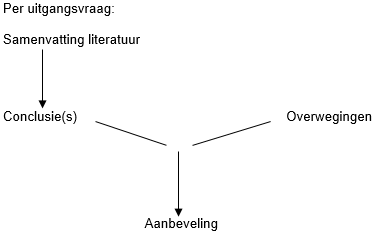
Figuur 1. Van bewijs naar aanbeveling
Bij de overwegingen kon men informatie kwijt over:
- veiligheid (bijvoorbeeld bijwerkingen, risico’s en complicaties)
- patiëntperspectief (waarden en voorkeuren van de patiënt)
- professioneel perspectief (bijvoorbeeld tijdsbesparing)
- beschikbaarheid, werkbaarheid en wenselijkheid van organisatie van zorg aspecten: kosten, voorzieningen, coördinatie, communicatie, gegevensverwerking, taakverdeling, verantwoordelijkheden, enzovoort
- kosteneffectiviteit, hierbij wordt aandacht besteed aan het perspectief (maatschappelijk perspectief versus gezondheidszorgperspectief)
Bij overwegingen kan men denken aan alle aspecten die niet vallen onder de systematische literatuuranalyse bij de uitgangsvraag, maar wel van belang zijn bij het formuleren van de aanbeveling.
Wijzigingen
Bij het opstellen van de conceptrichtlijn zijn enkele wijzigingen in de evidence-based uitgangsvragen doorgevoerd.
Binnen de module niet-medicamenteuze behandeling van dyspneu werd onder andere gezocht naar de effecten van voorlichting en de effecten van niet-invasieve beademing op dyspneu. Tijdens het schrijven van de modules is besloten de resultaten van de onderzoeksvraag Wat is het effect van voorlichting op dyspneu bij mensen met COPD? onder te brengen bij de module Voorlichting.
Tijdens het schrijven van de submodule Niet-invasieve beademing is besloten deze submodule niet meer evidence-based, maar consensus-based te schrijven. De rationale hiervoor is beschreven in de inleiding van deze submodule.
Tijdens het schrijven van module Hoesten is besloten de uitgangsvraag te wijzigen van Welke (niet-) medicamenteuze palliatieve behandeling is geschik voor hoesten bij mensen met gevorderde COPD? te wijzigen in Welke (niet-)medicamenteuze palliatieve behandeling is geschik voor prikkelhoest bij mensen met gevorderde COPD? De rationale hiervoor is beschreven in de inleiding van deze module.
Methodiek bij de modules zonder systematisch literatuuronderzoek
Bij de modules die betrekking hebben op de onderwerpen organisatie van zorg, voorlichting, het sociale domein en zingeving & spiritualiteit is geen systematisch literatuuronderzoek verricht, omdat de werkgroep verwachtte geen studies te vinden die antwoord geven op de vraag, specifiek voor de Nederlandse situatie.
Per module waren één of meerdere werkgroepleden verantwoordelijk voor het schrijven van de samenvatting literatuur, overwegingen, conclusies en aanbevelingen. De gehele werkgroep kon schriftelijk of tijdens de plenaire bijeenkomsten commentaar geven op deze teksten en aanbevelingen. Uiteindelijk werden de definitieve aanbevelingen in de plenaire bijeenkomst geaccordeerd.
De aanbevelingen zijn uitsluitend gebaseerd op overwegingen die zijn opgesteld door de werkgroepleden op basis van kennis uit de praktijk en waar mogelijk onderbouwd door (niet systematisch) literatuuronderzoek.
De teksten zijn gebaseerd op bewijs uit de literatuur, maar de artikelen zijn niet methodologisch beoordeeld. De overwegingen staan onder een apart kopje in de richtlijntekst. Hierin wordt de context van de dagelijkse praktijk beschreven en vindt een afweging plaats van de voor- en nadelen van de verschillende beleidsopties.
Evaluatie
De evaluatie van de richtlijn zal worden uitgevoerd door de regiehoudende vereniging.
Zoekverantwoording
The search for all research questions regarding nonpharmacological and pharmacological treatment of dyspnea was combined. Below you see the combined results for the nonpharmacological interventions.
First search
2086 unique hits were screened on title and abstract (Table 1). Of these, 1966 were excluded. The most important reasons for exclusion were:
- Other intervention: interventions other than those specified
- Wrong study design: narrative reviews, case reports, etc.
Of the remaining 120 papers, the full-text was retrieved. Based on the full-text, an additional 96 papers were excluded. Eventually, non-invasive ventilation was excluded as outcome, which led to the exclusion of another 8 studies. Table 3 provides an overview of the excluded studies with reasons.
Table 1. Overall search results for search 1.
|
Database |
Number of hits |
|
OVID Medline |
885 |
|
OVID PreMedline |
34 |
|
EMBASE.com |
1344 |
|
Cochrane Database of Systematic Reviews |
48 |
|
CENTRAL |
995 |
|
Total hits |
3306 |
|
N excluded (language, duplicates) |
1220 |
|
Total unique eligible hits |
2086 |
Second search
802 unique hits were screened on title and abstract (Table 2). Of these, 757 were excluded. The most important reasons for exclusion were:
- Other intervention: interventions other than those specified
- Wrong study design: narrative reviews, case reports, etc.
Of the remaining 45 papers, the full-text was retrieved. Based on the full-text, an additional 40 papers were excluded. Eventually, non-invasive ventilation was excluded as outcome, which led to the exclusion of another 4 studies. One study (Maddocks 2019) was added by the clinical experts. Table 4 provides an overview of the excluded studies with reasons.
Table 2. Overall search results for search 2.
|
Database |
Number of hits |
|
OVID Medline |
397 |
|
OVID PreMedline |
9 |
|
EMBASE.com |
546 |
|
Cochrane Database of Systematic Reviews |
10 |
|
CENTRAL |
371 |
|
Total hits |
1333 |
|
N excluded (language, duplicates) |
531 |
|
Total unique eligible hits |
802 |
Table 3. Overview of excluded studies based on full-text evaluation for search 1.
|
Reference |
Reason for exclusion |
|
Abdallah S, Wilkinson-Maitland C, Saad N, Bourbeau J, Smith B, Jensen D. A Randomized double blind, placebo controlled clinical trial evaluating the effects of immediate release morphine on breathlessness and exercise endurance in COPD: responders vs. Non-Responders. Canadian journal of respiratory critical care and sleep medicine [Internet]. 2017; 1(3):[159‐ pp.]. Available from: https://www.cochranelibrary.com/central/doi/10.1002/central/CN-01654927/full |
Pharmacological intervention |
|
Abdallah SJ, Wilkinson-Maitland C, Saad N, Li PZ, Smith BM, Bourbeau J, et al. Effect of morphine on breathlessness and exercise endurance in advanced COPD: a randomised crossover trial. The European respiratory journal. 2017;50(4). |
Pharmacological intervention |
|
Ahmadi Z, Currow DC, Ekstrom M. Palliative oxygen for chronic breathlessness: what new evidence? Curr. 2017;11(3):159-64. |
Only Medline search, no quality assessment of included studies |
|
Ambrosino N, Fracchia C. Strategies to relieve dyspnoea in patients with advanced chronic respiratory diseases. A narrative review. Pulmonology. 2019;25(5):289-98. |
Narrative review |
|
Barbetta C, Currow DC, Johnson MJ. Non-opioid medications for the relief of chronic breathlessness: current evidence. Expert Rev Respir Med. 2017;11(4):333-41. |
No quality assessment of included studies |
|
Barneche M, Dell'Era S, Roux N, Santos E, Terrasa S, Bykhovsky I, et al. High flow nasal cannula improves exercise capacity in COPD patients: crossover trial. Eur Respir J [Internet]. 2018; 52. Available from: https://www.cochranelibrary.com/central/doi/10.1002/central/CN-01914655/full. |
Abstract |
|
Barnestein-Fonseca P, Leiva-Fernández F, Vazquez-Alarcon R, Aguiar-Leiva V, Lobnig-Becerra M, Leiva-Fernández J. Can we improve the inhalation techniques in patient with COPD?. Tiepoc study. Value in health [Internet]. 2015; 18(7):[A495‐ pp.]. Available from: https://www.cochranelibrary.com/central/doi/10.1002/central/CN-01107047/full. |
Abstract |
|
Barnestein-Fonseca P, Vazquez-Alarcon R, Leiva-Fernandez F, Aguiar-Leiva V, Lobnig-Becerra M, Leiva-Fernandez J. Inhalation technique evolution after training in COPD. The role of the device. Value in health [Internet]. 2014; 17(7):[A600 p.]. Available from: https://www.cochranelibrary.com/central/doi/10.1002/central/CN-01037786/full. |
Abstract |
|
Bausewein C, Simon ST. Inhaled nebulized and intranasal opioids for the relief of breathlessness. Curr. 2014;8(3):208-12. |
No quality assessment of included studies |
|
Baxter DA, Shergis JL, Fazalbhoy A, Coyle ME. Muscle energy technique for chronic obstructive pulmonary disease: A systematic review. Chiropractic and Manual Therapies. 2019;27(1). |
No selected intervention |
|
Beaumont M, Mialon P, Le Ber C, Le Mevel P, Peran L, Meurisse O, et al. Effects of inspiratory muscle training on dyspnoea in severe COPD patients during pulmonary rehabilitation: controlled randomised trial. Eur Respir J. 2018;51(1):01. |
Included in Beaumont2018 |
|
Benzo R, Vickers K, Novotny PJ, Tucker S, Hoult J, Neuenfeldt P, et al. Health Coaching and Chronic Obstructive Pulmonary Disease Rehospitalization. A Randomized Study. Am J Respir Crit Care Med. 2016;194(6):672-80. |
Wrong population, wrong intervention |
|
Bonnevie T, Gravier F, Medrinal C, Prieur G, Tardif C, Muir J, et al. Nasal vs oronasal interface during exercise under noninvasive ventilation in COPD: a randomized crossover study. Eur Respir J [Internet]. 2018; 52. Available from: https://www.cochranelibrary.com/central/doi/10.1002/central/CN-01914677/full. |
Abstract |
|
Brighton LJ, Miller S, Farquhar M, Booth S, Deokhee Y, Gao W, Bajwah S, Man WDC, Higginson IJ, Maddocks M. Holistic services for people with advanced disease and chronic breathlessness: a systematic review and meta-analysis. Thorax. 2019;74:270-281. |
Majority of studies included patients with cancer, only a minority included patients with COPD |
|
Buchan K, Badlan K, Fletcher M, Kendrick A. Does exercising COPD patients on non invasive ventilation (NIV) enable them to walk further? A randomised controlled trial. Eur Respir J [Internet]. 2014; 44. Available from: https://www.cochranelibrary.com/central/doi/10.1002/central/CN-01767383/full. |
Abstract |
|
Buchan K, Badlan K, Fletcher M, Kendrick A. Does exercising with domiciliary non-invasive ventilation (NIV) improve quality of life (QOL) in patients with severe chronic obstructive pulmonary disease (COPD)? Thorax [Internet]. 2014; 69:[A66 p.]. Available from: https://www.cochranelibrary.com/central/doi/10.1002/central/CN-01039400/full. |
Abstract |
|
Butler SJ, Lee AL, Goldstein RS, Brooks D. Active Video Games as a Training Tool for Individuals With Chronic Respiratory Diseases: A SYSTEMATIC REVIEW. Journal of Cardiopulmonary Rehabilitation and Prevention. 2019;39(2):85-90. |
Yoga only a part of the intervention in 1 selected study |
|
Chai C, Liam C, Pang Y, Tan S, Ng D, Wong T. Dyspnea improvement in patients with lung diseases in a single session of mindful breathing: a randomized controlled study. Respirology (Carlton, Vic) [Internet]. 2018; 23:[197‐8 pp.]. Available from: https://www.cochranelibrary.com/central/doi/10.1002/central/CN-01763570/full. |
Abstract |
|
Charususin N, Gosselink R, Decramer M, Demeyer H, McConnell A, Saey D, et al. Randomised controlled trial of adjunctive inspiratory muscle training for patients with COPD. Thorax. 2018;73(10):942-50. |
Wrong population (stable patients) |
|
Chuang HY, Chang HY, Fang YY, Guo SE. The effects of threshold inspiratory muscle training in patients with chronic obstructive pulmonary disease: A randomised experimental study. J Clin Nurs. 2017;26(23-24):4830-8. |
Wrong population (stable patients) |
|
Clari M, Matarese M, Ivziku D, De Marinis MG. Self-Care of People with Chronic Obstructive Pulmonary Disease: A Meta-Synthesis. Patient. 2017;10(4):407-27. |
No selected intervention |
|
Collins E, O'Connell S, Jelinek C, Butler J, McBurney C, Gozali C, et al. Contrasting breathing retraining and helium-oxygen during exercise training in COPD: a randomized clinical trial. American journal of respiratory and critical care medicine [Internet]. 2014; 189(no pagination). Available from: https://www.cochranelibrary.com/central/doi/10.1002/central/CN-01476336/full. |
Wrong population (stable patients) |
|
Coultas D, Jackson B, Russo R, Peoples J, Ashmore J, Sloan J, et al. A lifestyle physical activity intervention for COPD improved mental health-related quality of life among severely impaired patients. American journal of respiratory and critical care medicine [Internet]. 2017; 195. Available from: https://www.cochranelibrary.com/central/doi/10.1002/central/CN-01408789/full. |
Abstract |
|
Coultas D, Jackson B, Russo R, Peoples J, Ashmore J, Sloan J, et al. Six month results of a behavioral self-management intervention to enhance lifestyle physical activity among patients with COPD. American journal of respiratory and critical care medicine [Internet]. 2014; 189(no pagination). Available from: https://www.cochranelibrary.com/central/doi/10.1002/central/CN-01131496/full. |
Abstract |
|
Currow D, Ekstrom M, Fazekas B, Plummer J, Quinn S, McDonald C, et al. A phase III, multi-site, randomised, double blind, placebo controlled parallel arm study of daily extended release (ER) morphine for chronic breathlessness. Eur Respir J [Internet]. 2016; 48. Available from: https://www.cochranelibrary.com/central/doi/10.1002/central/CN-01361110/full. |
Abstract |
|
Currow D, Louw S, McCloud P, Fazekas B, Plummer J, McDonald C, et al. Regular extended release morphine for chronic breathlessness: a multi-centre double-blind randomised controlled trial. American journal of respiratory and critical care medicine [Internet]. 2018; 197(MeetingAbstracts). Available from: https://www.cochranelibrary.com/central/doi/10.1002/central/CN-01620879/full. |
Abstract |
|
Currow D, Louw S, McCloud P, Fazekas B, Plummer J, McDonald C, et al. Regular extended release morphine for chronic breathlessness: a multi-centre doubleblind RCT. Eur Respir J [Internet]. 2018; 52. Available from: https://www.cochranelibrary.com/central/doi/10.1002/central/CN-01914752/full. |
Abstract |
|
Currow D, Watts GJ, Johnson M, McDonald CF, Miners JO, Somogyi AA, et al. A pragmatic, phase III, multisite, double-blind, placebo-controlled, parallel-arm, dose increment randomised trial of regular, low-dose extended-release morphine for chronic breathlessness: Breathlessness, Exertion And Morphine Sulfate (BEAMS) study protocol. BMJ Open. 2017;7(7):e018100. |
Study protocol |
|
Cutts S, Burls A, Akinlabi K, Hurst J, Mandal S, Mansell S. A randomised crossover trial investigating the effect of a portable positive pressure ventilation device on exercise tolerance in patients with COPD. Eur Respir J [Internet]. 2018; 52. Available from: https://www.cochranelibrary.com/central/doi/10.1002/central/CN-01914754/full. |
Abstract |
|
de Araujo CL, Karloh M, Dos Reis CM, Palú M, Mayer AF. Pursed-lips breathing reduces dynamic hyperinflation induced by activities of daily living test in patients with chronic obstructive pulmonary disease: A randomized cross-over study. Journal of rehabilitation medicine. 2015;47(10):957-62. |
Wrong population (stable patients) |
|
Efficacy of short-term intrapulmonary percussive ventilation in patients with chronic obstructive pulmonary disease. Disability and rehabilitation 37 (10) (pp 899-903), 2015 Date of publication: 2015 [Internet]. 2015. Available from: https://www.cochranelibrary.com/central/doi/10.1002/central/CN-01193168/full |
Double |
|
Efficacy of short-term intrapulmonary percussive ventilation in patients with chronic obstructive pulmonary disease. Disability and rehabilitation 37 (10) (pp 899-903), 2015 Date of publication: 2015 [Internet]. 2015. Available from: https://www.cochranelibrary.com/central/doi/10.1002/central/CN-01193168/full |
No full text available |
|
Ekstrom M, Nilsson F, Abernethy AA, Currow DC. Effects of opioids on breathlessness and exercise capacity in chronic obstructive pulmonary disease. A systematic review. Ann Am Thorac Soc. 2015;12(7):1079-92. |
Pharmacological intervention |
|
Ferreira DH, Silva JP, Quinn S, Abernethy AP, Johnson MJ, Oxberry SG, et al. Blinded Patient Preference for Morphine Compared to Placebo in the Setting of Chronic Refractory Breathlessness--An Exploratory Study. J Pain Symptom Manage. 2016;51(2):247-54. |
Wrong outcome |
|
Fukuoka A, Ueda M, Ariyama Y, Iwai K, Kai Y, Kunimatsu M, et al. Effect of laughter yoga on pulmonary rehabilitation in patients with chronic obstructive pulmonary disease. Journal of nara medical association [Internet]. 2016; 67(1‐3):[11‐20 pp.]. Available from: https://www.cochranelibrary.com/central/doi/10.1002/central/CN-01262172/full. |
Stable COPD patients |
|
Gass R, Merola P, Monteiro MB, Cardoso DM, Paiva DN, Teixeira PJ, et al. Effects of Expiratory Positive Airway Pressure on Exercise Tolerance, Dynamic Hyperinflation, and Dyspnea in COPD. Respir Care. 2017;62(10):1298-306. |
Wrong intervention |
|
Gimeno-Santos E, Frei A, Steurer-Stey C, De Batlle J, Rabinovich RA, Raste Y, et al. Determinants and outcomes of physical activity in patients with COPD: A systematic review. Thorax. 2014;69(8):731-9. |
No focus on breathlessness |
|
Gloeckl R, Heinzelmann I, Matthaei M, Seeberg S, Damisch T, Jerrentrup A, et al. Benefits of an oxygen reservoir cannula versus a conventional nasal cannula during exercise in hypoxemic COPD patients: A crossover trial. Respiration. 2014;88(5):399-405. |
Long-term oxygen therapy as life-sustaining treatment |
|
Gloeckl R, Jarosch I, Schneeberger T, Lausen M, Fiedler C, Kenn K. Comparison of two demand oxygen delivery systems (liquid oxygen versus concentrator) during walking in hypoxemic COPD patients-preliminary results of a randomized, single-blinded cross-over trial. American journal of respiratory and critical care medicine Conference: american thoracic society international conference, ATS 2017 United states [Internet]. 2017; 195(no pagination). Available from: https://www.cochranelibrary.com/central/doi/10.1002/central/CN-01408997/full. |
No full text available |
|
Gloeckl R, Oversohl J, Andrianopoulos V, Stegemann A, Kenn K. Acute effects of non-invasive ventilation during exercise in hypercapnic COPD patients-preliminary results of a randomized cross-over trial. Eur Respir J [Internet]. 2017; 50. Available from: https://www.cochranelibrary.com/central/doi/10.1002/central/CN-01791881/full. |
Abstract |
|
Gloeckl R, Jarosch I, Schneeberger T, Fiedler C, Lausen M, Weingaertner J, et al. Comparison of supplemental oxygen delivery by continuous versus demand based flow systems in hypoxemic COPD patients – A randomized, single-blinded cross-over study. Respir Med. 2019;156:26-32. |
Comparison of different systems, not intervention with no intervention |
|
Guleria R, Arora S, Tiwari P, Mohan A, Kalaivani M, Madan K. Comparison of yoga with pulmonary rehabilitation on body composition, inflammatory biomarkers and dyspnoea in patients with COPD. Eur Respir J [Internet]. 2018; 52. Available from: https://www.cochranelibrary.com/central/doi/10.1002/central/CN-01914876/full. |
Abstract |
|
Hardy W, Cropp A, Laman D, Jasko J, Nisha P. Portable positive pressure device to relieve dyspnea after exercise in COPD patients: a pilot study. American journal of respiratory and critical care medicine [Internet]. 2017; 195. Available from: https://www.cochranelibrary.com/central/doi/10.1002/central/CN-01408883/full. |
No full text available |
|
Howard C, Dupont S. 'The COPD breathlessness manual': a randomised controlled trial to test a cognitive-behavioural manual versus information booklets on health service use, mood and health status, in patients with chronic obstructive pulmonary disease. NPJ Prim Care Respir Med. 2014;24:14076. |
Wrong intervention |
|
Janowiak P, Krajnik M, Podolec Z, Bandurski T, Damps-Konstanska I, Sobanski P, et al. Dosimetrically administered nebulized morphine for breathlessness in very severe chronic obstructive pulmonary disease: a randomized, controlled trial. BMC polm. 2017;17(1):186. |
Pharmacological intervention |
|
Ko F, Cheung N-K, Rainer T, Lum C, Hui D. Intergrated care programme for patients with chronic obstructive pulmonary disease (COPD) - A randomized controlled trial. Respirology (carlton, vic) [Internet]. 2015; 20:[38‐ pp.]. Available from: https://www.cochranelibrary.com/central/doi/10.1002/central/CN-01126367/full. |
Abstract |
|
Ko F, Cheung N-K, Rainer T, Lum C, Wong I, Hui D. Comprehensive care programme for patients with chronic obstructive pulmonary disease (COPD) -A randomized controlled trial (RCT). Eur Respir J [Internet]. 2015; 46. Available from: https://www.cochranelibrary.com/central/doi/10.1002/central/CN-01126663/full. |
Wrong population (not exclusively with breathlessness) |
|
Ko FW, Cheung NK, Rainer TH, Lum C, Wong I, Hui DS. Comprehensive care programme for patients with chronic obstructive pulmonary disease: a randomised controlled trial. Thorax. 2017;72(2):122-8. |
Wrong population (not exclusively with breathlessness) |
|
Kruis A, Boland M, Assendelft W, Gussekloo J, Tsiachristas A, Stijnen T, et al. Effectiveness of integrated disease management for primary care chronic obstructive pulmonary disease patients: results of cluster randomised trial. Nederlands tijdschrift voor geneeskunde [Internet]. 2015; 159(13). Available from: https://www.cochranelibrary.com/central/doi/10.1002/central/CN-01084183/full. |
Wrong intervention |
|
Kruis AL, Boland MR, Assendelft WJ, Gussekloo J, Tsiachristas A, Stijnen T, et al. Effectiveness of integrated disease management for primary care chronic obstructive pulmonary disease patients: results of cluster randomised trial. Bmj. 2014;349:g5392. |
No selected intervention |
|
Langer D, Ciavaglia C, Webb K, Preston M, Neder J, Gosselink R, et al. Inspiratory muscle training reduces respiratory neural drive (RND) during exercise in patients with COPD. Eur Respir J [Internet]. 2014; 44. Available from: https://www.cochranelibrary.com/central/doi/10.1002/central/CN-01081083/full. |
Abstract |
|
Lee A, Dolmage T, Rhim M, Goldstein R, Brooks D. Effects of listening to music during a constant endurance exercise test in people with COPD. Respirology (carlton, vic) [Internet]. 2017; 22(Suppl 2):[136 [tp‐060] pp.]. Available from: https://www.cochranelibrary.com/central/doi/10.1002/central/CN-01370070/full. |
Abstract |
|
Leelarungrayub J, Pinkaew D, Puntumetakul R, Klaphajone J. Effects of a simple prototype respiratory muscle trainer on respiratory muscle strength, quality of life and dyspnea, and oxidative stress in COPD patients: a preliminary study. Int J Chron Obstruct Pulmon Dis. 2017;12:1415-25. |
Wrong population |
|
Lenferink A, Brusse-Keizer M, van der Valk PDLPM, Frith PA, Zwerink M, Monninkhof EM, et al. Self-management interventions including action plans for exacerbations versus usual care in patients with chronic obstructive pulmonary disease. Cochrane Database Syst Rev. 2017;2017(8). |
Wrong intervention (treatment of exacerbations) |
|
Liao H, Pei W, Li H, Luo Y, Wang K, Li R, et al. Efficacy of long-term noninvasive positive pressure ventilation in stable hypercapnic COPD patients with respiratory failure: A meta-analysis of randomized controlled trials. Int J Chron Obstruct Pulmon Dis. 2017;12:2977-85. |
Intervention is non-invasive ventilation |
|
Lin FL, Yeh ML, Lai YH, Lin KC, Yu CJ, Chang JS. Two-month breathing-based walking improves anxiety, depression, dyspnoea and quality of life in chronic obstructive pulmonary disease: A randomised controlled study. J Clin Nurs. 2019;28(19-20):3632-40. |
Wrong population (not advanced COPD) |
|
Lisy K, White H, Pearson A. Overview of reviews: mechanical interventions for the treatment and management of chronic obstructive pulmonary disease. Int J Nurs Pract. 2014;20(6):701-8. |
Only Cochrane reviews |
|
Livermore N, Dimitri A, Sharpe L, McKenzie DK, Gandevia SC, Butler JE. Cognitive behaviour therapy reduces dyspnoea ratings in patients with chronic obstructive pulmonary disease (COPD). Respir Physiolo Neurobiol. 2015;216:35-42. |
Wrong intervention |
|
Long A, Cartwright M, Reilly C. Fan therapy to the face during exercise improves breathlessness and recovery time in patients with chronic obstructive pulmonary disease: a pilot randomised cross over trial. Thorax [Internet]. 2018; 73:[A252‐ pp.]. Available from: https://www.cochranelibrary.com/central/doi/10.1002/central/CN-01935307/full. |
Abstract |
|
Lu Y, Li P, Li N, Wang Z, Li J, Liu X, et al. Effects of Home-Based Breathing Exercises in Subjects With COPD. Respir Care. 2019. |
No full text available |
|
Marquez-Martin E, Ruiz FO, Ramos PC, Lopez-Campos JL, Azcona BV, Cortes EB. Randomized trial of non-invasive ventilation combined with exercise training in patients with chronic hypercapnic failure due to chronic obstructive pulmonary disease. Respir Med. 2014;108(12):1741-51. |
Intervention is non-invasive ventilation |
|
Maskey-Warzechowska M, Mierzejewski M, Gorska K, Golowicz R, Jesien L, Krenke R. Effects of Osteopathic Manual Therapy on Hyperinflation in Patients with Chronic Obstructive Pulmonary Disease: A Randomized Cross-Over Study. Advances in experimental medicine and biology. 2019. |
Wrong intervention |
|
McNamara RJ, Epsley C, Coren E, McKeough ZJ. Singing for adults with chronic obstructive pulmonary disease (COPD). Cochrane Database Syst Rev. 2017;2017(12). |
Wrong population |
|
Menadue C, Piper AJ, van 't Hul AJ, Wong KK. Non-invasive ventilation during exercise training for people with chronic obstructive pulmonary disease. Cochrane Database Syst Rev. 2014;2014(5). |
Intervention is non-invasive ventilation |
|
Mitchell KE, Johnson-Warrington V, Apps LD, Bankart J, Sewell L, Williams JE, et al. A self-management programme for COPD: a randomised controlled trial. Eur Respir J. 2014;44(6):1538-47. |
Wrong population |
|
Mularski RA, Rocker G. Managing dyspnea in advanced chronic obstructive pulmonary disease: balancing all the evidence. Ann Am Thorac Soc. 2015;12(7):978-80. |
Editorial |
|
Nagata K, Kikuchi T, Horie T, Shiraki A, Kitajima T, Kadowaki T, et al. Domiciliary High-Flow Nasal Cannula Oxygen Therapy for Patients with Stable Hypercapnic Chronic Obstructive Pulmonary Disease. A Multicenter Randomized Crossover Trial. Ann Am Thorac Soc. 2018;15(4):432-9. |
Long-term oxygen therapy as life-sustaining treatment |
|
Nicolini A, Mollar E, Grecchi B, Landucci N. Comparison of intermittent positive pressure breathing and temporary positive expiratory pressure in patients with severe chronic obstructive pulmonary disease. Arch Bronconeumol. 2014;50(1):18-24. |
Intervention is non-invasive ventilation |
|
Nicolini A, Santo M, Ferrari-Bravo M, Barlascini C. Open-mouthpiece ventilation versus nasal mask ventilation in subjects with COPD exacerbation and mild to moderate acidosis: A randomized trial. Respir Care. 2014;59(12):1825-31. |
Intervention is non-invasive ventilation |
|
Nicolini A, Grecchi B, Ferrari-Bravo M, Barlascini C. Safety and effectiveness of the high-frequency chest wall oscillation vs intrapulmonary percussive ventilation in patients with severe COPD. Int J Chron Obstruct Pulmon Dis. 2018;13:617-25. |
Wrong intervention |
|
Nicolini A, Mascardi V, Grecchi B, Ferrari-Bravo M, Banfi P, Barlascini C. Comparison of effectiveness of temporary positive expiratory pressure versus oscillatory positive expiratory pressure in severe COPD patients. Clin Respir J. 2018;12(3):1274-82. |
Breathlessness not an outcome |
|
Nyberg A, Tistad M, Wadell K. Effects of an internet based tool for self-management in patients with COPD-a controlled pragmatic pilot trial. Eur Respir J [Internet]. 2017; 50(Suppl 61):[Oa515 p.]. Available from: https://www.cochranelibrary.com/central/doi/10.1002/central/CN-01926392/full. |
Abstract |
|
Ou Y, Lin Z, Wu W, Luo Q, Chen R. The efficacy of non-invasive mechanical ventilation as a rescue therapy for relieving dyspnea in patients with stable severe COPD. Chest [Internet]. 2016; 149(4 suppl. 1):[A347 p.]. Available from: https://www.cochranelibrary.com/central/doi/10.1002/central/CN-01161141/full. |
Abstract |
|
Ou Y-E, Lin Z-M, Wu W-L, Luo Q, Chen R-C. Efficacy of non-invasive ventilation as a rescue therapy for relieving dyspnea in patients with stable severe COPD. Respir Med. 2016;121:74-80. |
Intervention is non-invasive ventilation |
|
Panigrahi A, Sohani S, Amadi C, Joshi A. Role of music in the management of chronic obstructive pulmonary disease (COPD): a literature review. Technol Health Care. 2014;22(1):53-61. |
Only PubMed, no quality assessment of included studies |
|
Papp ME, Wandell PE, Lindfors P, Nygren-Bonnier M. Effects of yogic exercises on functional capacity, lung function and quality of life in participants with obstructive pulmonary disease: a randomized controlled study. Eur J Phys Rehabil Med. 2017;53(3):447-61. |
Wrong population |
|
Perkins-Porras L, Riaz M, Okekunle A, Zhelezna S, Chakravorty I, Ussher M. Feasibility study to assess the effect of a brief mindfulness intervention for patients with chronic obstructive pulmonary disease: A randomized controlled trial. Chron. 2018;15(4):400-10. |
Wrong population |
|
Ranjita R, Hankey A, Nagendra H, Mohanty S. Yoga-based pulmonary rehabilitation for the management of dyspnea in coal miners with chronic obstructive pulmonary disease: a randomized controlled trial. Journal of Ayurveda and integrative medicine [Internet]. 2016; 7(3):[158‐66 pp.]. Available from: https://www.cochranelibrary.com/central/doi/10.1002/central/CN-01752104/full. |
Wrong population |
|
Ricci C, Terzoni S, Gaeta M, Sorgente A, Destrebecq A, Gigliotti F. Physical training and noninvasive ventilation in COPD patients: a meta-analysis. Respir Care. 2014;59(5):709-17. |
Intervention is non-invasive ventilation |
|
Rossi V, Cirio S, Piran M, Bettinelli G, Zocchi L, Ceriana P, et al. High flow nasal cannula during walking in severe COPD patients: a randomized controlled trial. Eur Respir J [Internet]. 2018; 52. Available from: https://www.cochranelibrary.com/central/doi/10.1002/central/CN-01915269/full. |
Abstract |
|
Russo D, Romaggi C, Grecchi B, Nicolini A. Comparison of intrapulmonary percussive ventilation and high frequency chest wall oscillation in patients with severe COPD. Eur Respir J [Internet]. 2014; 44. Available from: https://www.cochranelibrary.com/central/doi/10.1002/central/CN-01099780/full. |
Abstract |
|
Schneeberger T, Gloeckl R, Stegemann A, Schonheit-Kenn U, Oversohl J, Andrianopoulos V, et al. Short-term effects of non-invasive ventilation during exercise in hypercapnic patients with very severe COPD-a randomized controlled cross-over trial. American journal of respiratory and critical care medicine [Internet]. 2018; 197(MeetingAbstracts). Available from: https://www.cochranelibrary.com/central/doi/10.1002/central/CN-01619129/full. |
Abstract |
|
Senthilnathan C, Abinaya P, Rajalaxmi V, Mohan KG, Subramanian S. Efficacy of physical training program on chronic obstructive pulmonary disease. Biomedicine (india) [Internet]. 2018; 38(2). Available from: https://www.cochranelibrary.com/central/doi/10.1002/central/CN-01650575/full. |
No full text available |
|
Simon ST, Higginson IJ, Booth S, Harding R, Weingartner V, Bausewein C. Benzodiazepines for the relief of breathlessness in advanced malignant and non-malignant diseases in adults. Cochrane Database Syst Rev. 2016;10:CD007354. |
Pharmacological intervention |
|
Smallwood N, Gaffney N, Gorelik A, Irving L, Le B, Philip J. Breathlessness and palliative oxygen therapy in advanced chronic obstructive pulmonary disease. Intern Med J. 2018;48(4):483-4. |
Letter |
|
Smith T, Roberts M, Cho J, Wheatley J. Non-pharmacological intervention to improve breathlessness mastery in COPD: pilot study. Respirology (Carlton, Vic) [Internet]. 2019; 24:[37‐ pp.]. Available from: https://www.cochranelibrary.com/central/doi/10.1002/central/CN-01942247/full. |
Abstract |
|
Sutanto YS, Makhabah DN, Aphridasari J, Doewes M, Suradi, Ambrosino N. Videogame assisted exercise training in patients with chronic obstructive pulmonary disease: A preliminary study. Pulmonology. 2019;25(5):275-82. |
Yoga only a part of the intervention |
|
Testa A, Galeri S, Villafane JH, Corbellini C, Pillastrini P, Negrini S. Efficacy of short-term intrapulmonary percussive ventilation in patients with chronic obstructive pulmonary disease. Disabil Rehabil. 2015;37(10):899-903. |
Wrong population |
|
Tomruk M, Keles E, Ozalevli S, Alpaydin A. Effects of thoracic kinesio taping on pulmonary functions, respiratory muscle strength and functional capacity in COPD patients: a pilot randomized controlled study. Eur Respir J [Internet]. 2017; 50. Available from: https://www.cochranelibrary.com/central/doi/10.1002/central/CN-01791916/full. |
Abstract |
|
Tomruk M, Keleş E, Özalevli S, Alpaydin AÖ. Effects of thoracic kinesio taping on pulmonary functions, respiratory muscle strength and functional capacity in patients with chronic obstructive pulmonary disease: A randomized controlled trial. Explore. 2019. |
Wrong intervention |
|
Uronis HE, Ekstrom MP, Currow DC, McCrory DC, Samsa GP, Abernethy AP. Oxygen for relief of dyspnoea in people with chronic obstructive pulmonary disease who would not qualify for home oxygen: a systematic review and meta-analysis. Thorax. 2015;70(5):492-4. |
Summary of Cochrane review |
|
Valenza MC, Valenza-Pena G, Torres-Sanchez I, Gonzalez-Jimenez E, Conde-Valero A, Valenza-Demet G. Effectiveness of controlled breathing techniques on anxiety and depression in hospitalized patients with COPD: a randomized clinical Trial. Respir Care. 2014;59(2):209-15. |
Wrong outcomes |
|
von Trott P, Oei SL, Ramsenthaler C. Acupuncture for Breathlessness in Advanced Diseases: A Systematic Review and Meta-analysis. Journal of Pain and Symptom Management. 2019. |
Wrong intervention |
|
Wada J, Borges-Santos E, Silva R, Porras D, Paisani D, Silva C, et al. Effects of respiratory muscle stretching on thoracoabdominal mechanics, functional capacity and dyspnea in COPD patients. Eur Respir J [Internet]. 2014; 44. Available from: https://www.cochranelibrary.com/central/doi/10.1002/central/CN-01099782/full. |
Abstract |
|
Wada JT, Borges-Santos E, Porras DC, Paisani DM, Cukier A, Lunardi AC, et al. Effects of aerobic training combined with respiratory muscle stretching on the functional exercise capacity and thoracoabdominal kinematics in patients with COPD: a randomized and controlled trial. Int J Chron Obstruct Pulmon Dis. 2016;11:2691-700. |
Wrong intervention |
|
Wang T, Tan JY, Xiao LD, Deng R. Effectiveness of disease-specific self-management education on health outcomes in patients with chronic obstructive pulmonary disease: An updated systematic review and meta-analysis. Patient Educ Couns. 2017;100(8):1432-46. |
Wrong population |
|
Watson JS. Non-pharmacological management of chronic breathlessness in stable chronic obstructive pulmonary disease. Br J Community Nurs. 2018;23(8):376-81. |
Narrative review |
|
Williams MT, Cafarella P, Paquet C, Frith P. Cognitive Behavioral Therapy for Management of Dyspnea: A Pilot Study. Respir Care. 2015;60(9):1303-13. |
Retrospective control group |
|
Wu W, Guan L, Zhang X, Li X, Yang Y, Guo B, et al. Effects of two types of equal-intensity inspiratory muscle training in stable patients with chronic obstructive pulmonary disease: A randomised controlled trial. Respir Med. 2017;132:84-91. |
Wrong population |
|
Xiao C-M, Zhuang Y-C. Efficacy of liuzijue qigong in individuals with chronic obstructive pulmonary disease in remission. J Am Geriatr Soc [Internet]. 2015; 63(7):[1420‐5 pp.]. Available from: https://www.cochranelibrary.com/central/doi/10.1002/central/CN-01085644/full. |
Wrong intervention |
|
Yilmaz Yelvar GD, Çirak Y, Parlak Demir Y, Dalkilinç M, Bozkurt B. Immediate effect of manual therapy on respiratory functions and inspiratory muscle strength in patients with COPD. Int J Chron Obstruct Pulmon Dis. 2016;11(1):1353-7. |
No control group |
|
Yohannes AM, Junkes-Cunha M, Smith J, Vestbo J. Management of Dyspnea and Anxiety in Chronic Obstructive Pulmonary Disease: A Critical Review. J Am Med Dir Assoc. 2017;18(12):1096.e1-.e17. |
No quality assessment of included studies |
|
Zhou L, Guan L, Wu W, Li X, Chen X, Guo B, et al. High-pressure versus low-pressure home non-invasive positive pressure ventilation with built-in software in patients with stable hypercapnic COPD: a pilot study. Sci. 2017;7(1):16728. |
Intervention is non-invasive ventilaion |
|
Zwerink M, Brusse-Keizer M, van der Valk PD, Zielhuis GA, Monninkhof EM, van der Palen J, et al. Self management for patients with chronic obstructive pulmonary disease. Cochrane Database Syst Rev. 2014(3):CD002990. |
Wrong population |
Table 4. Overview of excluded studies based on full-text evaluation for search 2.
|
Reference |
Reason for exclusion |
|
Ankjaergaard KL, Tonnesen P, Laursen LC, Hansen EF, Andreassen HF, Wilcke JT. Home Non Invasive Ventilation (NIV) treatment for COPD patients with a history of NIV-treated exacerbation; a randomized, controlled, multi-center study. BMC polm. 2016;16:32. |
Outcome is mortalty; no palliative intervention (QOL is a secondary outcome); study protocol |
|
Bonnevie T, Gravier F, Medrinal C, Prieur G, Tardif C, Muir J, et al. Nasal vs oronasal interface during exercise under noninvasive ventilation in COPD: a randomized crossover study. Eur Respir J [Internet]. 2018; 52. Available from: https://www.cochranelibrary.com/central/doi/10.1002/central/CN-01914677/full. |
Abstract |
|
Buchan K, Badlan K, Fletcher M, Kendrick A. Does exercising COPD patients on non invasive ventilation (NIV) enable them to walk further? A randomised controlled trial. Eur Respir J [Internet]. 2014; 44. Available from: https://www.cochranelibrary.com/central/doi/10.1002/central/CN-01767383/full. |
Abstract |
|
Cardoso DM, Fregonezi GAF, Jost RT, Gass R, Alberton CL, Albuquerque IM, et al. Acute effects of Expiratory Positive Airway Pressure (EPAP) on different levels in ventilation and electrical activity of sternocleidomastoid and parasternal muscles in Chronic Obstructive Pulmonary Disease (COPD) patients: a randomized controlled trial. Braz J Phys Ther. 2016;20(6):525-34. |
Wrong intervention; wrong outcomes |
|
Chykiamis N, Armstrong M, Spencer V, Lane N, Hartley T, Gray W, et al. Influence of the vita breath on exercise tolerance in patients with COPD. Eur Respir J [Internet]. 2018; 52. Available from: https://www.cochranelibrary.com/central/doi/10.1002/central/CN-01914734/full. |
Abstract |
|
Chynkiamis N, Armstrong M, Lane N, Hartley T, Bourke S, Vogiatzis I. Effect of the vitabreath device on exercise capacity & symptoms in COPD. Thorax [Internet]. 2018; 73:[A7‐ pp.]. Available from: https://www.cochranelibrary.com/central/doi/10.1002/central/CN-01934566/full. |
Abstract |
|
Cui L, Liu H, Sun L. Multidisciplinary respiratory rehabilitation in combination with non-invasive positive pressure ventilation in the treatment of elderly patients with severe chronic obstructive pulmonary disease. Pakistan journal of medical sciences [Internet]. 2019; 35(2):[500‐5 pp.]. |
Intervention is non-invasive ventilation |
|
Cutts S, Burls A, Akinlabi K, Hurst J, Mandal S, Mansell S. A randomised crossover trial investigating the effect of a portable positive pressure ventilation device on exercise tolerance in patients with COPD. Eur Respir J [Internet]. 2018; 52. Available from: https://www.cochranelibrary.com/central/doi/10.1002/central/CN-01914754/full. |
Abstract |
|
Diaz de Teran T, Barbagelata E, Cilloniz C, Nicolini A, Perazzo T, Perren A, et al. Non-invasive ventilation in palliative care: a systematic review. Minerva Med. 2019;110(6):555-63. |
No full text available |
|
Effects of budesonide combined with noninvasive ventilation on PCT, sTREM-1, chest lung compliance, humoral immune function and quality of life in patients with AECOPD complicated with type II respiratory failure. Open medicine (poland) [Internet]. 2019; 14(1):[271‐8 pp.]. Available from: https://www.cochranelibrary.com/central/doi/10.1002/central/CN-01984553/full |
Evaluates the added effect of budesonide |
|
Gass R, Merola P, Monteiro MB, Cardoso DM, Paiva DN, Teixeira PJ, et al. Effects of Expiratory Positive Airway Pressure on Exercise Tolerance, Dynamic Hyperinflation, and Dyspnea in COPD. Respir Care. 2017;62(10):1298-306. |
Proof-of-concept |
|
Ghaemi F, Rahimi B. Comparing and investigating the effects of bi-level non-invasive ventilator with high and low inspiratory pressure in a group of patients suffering from COPD exacerbation over the period of 2015-2016. Biosciences biotechnology research asia [Internet]. 2016; 13(3):[1415‐9 pp.]. Available from: https://www.cochranelibrary.com/central/doi/10.1002/central/CN-01216031/full |
Study about the optimal pressure |
|
Gloeckl R, Andrianopoulos V, Stegemann A, Oversohl J, Schneeberger T, Schoenheit-Kenn U, et al. High-pressure non-invasive ventilation during exercise in COPD patients with chronic hypercapnic respiratory failure: A randomized, controlled, cross-over trial. Respirology. 2019;24(3):254-61. |
NIV during exercise |
|
Gloeckl R, Oversohl J, Andrianopoulos V, Stegemann A, Kenn K. Acute effects of non-invasive ventilation during exercise in hypercapnic COPD patients-preliminary results of a randomized cross-over trial. Eur Respir J [Internet]. 2017; 50. Available from: https://www.cochranelibrary.com/central/doi/10.1002/central/CN-01791881/full. |
Wrong intervention |
|
Gurgun A, Tuncel S, Karapolat H, Uluer H. The effect of adding noninvasive ventilation to supplemental oxygen during exercise training in severe COPD: a randomized controlled study. Chest [Internet]. 2015; 148(4). Available from: https://www.cochranelibrary.com/central/doi/10.1002/central/CN-01129032/full |
Abstract |
|
Han B, maoliang T, Liu H, Li B, Jun J, Yang G, et al. Impact of auto-titrating scale of epap in noninvasive ventilation (niv) on aecopd patients. Chest [Internet]. 2019; 156(4):[A957‐ pp.]. Available from: https://www.cochranelibrary.com/central/doi/10.1002/central/CN-01996924/full |
Abstract |
|
Han B. Noninvasive positive pressure ventilation to relieve dyspnea of COPD patients during exercise training: a prospective study. Chest [Internet]. 2016; 149(4 suppl. 1):[A492 p.]. Available from: https://www.cochranelibrary.com/central/doi/10.1002/central/CN-01161133/full |
Abstract |
|
Hardy W, Cropp A, Laman D, Jasko J, Nisha P. Portable positive pressure device to relieve dyspnea after exercise in COPD patients: a pilot study. American journal of respiratory and critical care medicine [Internet]. 2017; 195. Available from: https://www.cochranelibrary.com/central/doi/10.1002/central/CN-01408883/full. |
Abstract |
|
Hensel M, Strunden MS, Tank S, Gagelmann N, Wirtz S, Kerner T. Prehospital non-invasive ventilation in acute respiratory failure is justified even if the distance to hospital is short. Am J Emerg Med. 2019;37(4):651-6. |
No separate data for COPD; exacerbation |
|
Koopman M, Franssen F, Delbressine J, Wouters E, Mathew D, Vink T, et al. Oxygen and ventilation during exercise in hyperinflated desaturating COPD patients. Eur Respir J [Internet]. 2017; 50. Available from: https://www.cochranelibrary.com/central/doi/10.1002/central/CN-01788010/full. |
Abstract |
|
Liao H, Pei W, Li H, Luo Y, Wang K, Li R, et al. Efficacy of long-term noninvasive positive pressure ventilation in stable hypercapnic COPD patients with respiratory failure: A meta-analysis of randomized controlled trials. Int J Chron Obstruct Pulmon Dis. 2017;12:2977-85. |
Found in first search |
|
Macintyre EJ, Asadi L, McKim DA, Bagshaw SM. Clinical Outcomes Associated with Home Mechanical Ventilation: A Systematic Review. Can Respir J. 2016;2016. |
Studies with only COPD-patients were excluded |
|
Marquez-Martin E, Ruiz FO, Ramos PC, Lopez-Campos JL, Azcona BV, Cortes EB. Randomized trial of non-invasive ventilation combined with exercise training in patients with chronic hypercapnic failure due to chronic obstructive pulmonary disease. Respir Med. 2014;108(12):1741-51. |
Found in first search |
|
Menadue C, Piper AJ, van 't Hul AJ, Wong KK. Non-invasive ventilation during exercise training for people with chronic obstructive pulmonary disease. Cochrane Database Syst Rev. 2014(5):CD007714. |
Found in first search |
|
Moga AM, de Marchie M, Saey D, Spahija J. Bi-level Positive Airway Pressure (BiPAP) with standard exhalation valve does not improve maximum exercise capacity in patients with COPD. Copd. 2015;12(1):46-54. |
Intervention is non-invasive ventilation |
|
Mulhall P, Criner G. Non-pharmacological treatments for COPD. Respirology. 2016;21(5):791-809. |
Narrative review |
|
Nicolini A, Mollar E, Grecchi B, Landucci N. Comparison of intermittent positive pressure breathing and temporary positive expiratory pressure in patients with severe chronic obstructive pulmonary disease. Arch Bronconeumol. 2014;50(1):18-24. |
Found in first search |
|
Nicolini A, Santo M, Ferrari-Bravo M, Barlascini C. Open-mouthpiece ventilation versus nasal mask ventilation in subjects with COPD exacerbation and mild to moderate acidosis: A randomized trial. Respir Care. 2014;59(12):1825-31. |
Not relevant for research question |
|
Osadnik CR, Tee VS, Carson-Chahhoud KV, Picot J, Wedzicha JA, Smith BJ. Non-invasive ventilation for the management of acute hypercapnic respiratory failure due to exacerbation of chronic obstructive pulmonary disease. Cochrane Database Syst Rev. 2017;7:CD004104. |
Outcome is mortality and intubation |
|
Ou Y-E, Lin Z-M, Wu W-L, Luo Q, Chen R-C. Efficacy of non-invasive ventilation as a rescue therapy for relieving dyspnea in patients with stable severe COPD. Respir Med. 2016;121:74-80. |
Found in first search |
|
Ou Y, Lin Z, Wu W, Luo Q, Chen R. The efficacy of non-invasive mechanical ventilation as a rescue therapy for relieving dyspnea in patients with stable severe COPD. Chest [Internet]. 2016; 149(4 suppl. 1):[A347 p.]. Available from: https://www.cochranelibrary.com/central/doi/10.1002/central/CN-01161141/full |
Abstract |
|
Perez-Bautista O, Venegas A, Uncal M, Hernandez-Zenteno R, Flores-Trujillo F, Velazquez-Montero A, et al. Non invasive positive pressure ventilation for reducing exacerbation in very severe chronic obstructive pulmonary disease (COPD). Eur Respir J [Internet]. 2016; 48. Available from: https://www.cochranelibrary.com/central/doi/10.1002/central/CN-01361056/full. |
Abstract |
|
Ricci C, Terzoni S, Gaeta M, Sorgente A, Destrebecq A, Gigliotti F. Physical training and noninvasive ventilation in COPD patients: a meta-analysis. Respir Care. 2014;59(5):709-17. |
Found in first search |
|
Russo D, Simonelli C, Paneroni M, Saleri M, Piroddi IMG, Cardinale F, et al. Is there an optimal level of positive expiratory pressure (PEP) to improve walking tolerance in patients with severe COPD? Arch Bronconeumol. 2016;52(7):354-60. |
Wrong intervention |
|
Schneeberger T, Gloeckl R, Stegemann A, Schonheit-Kenn U, Oversohl J, Andrianopoulos V, et al. Short-term effects of non-invasive ventilation during exercise in hypercapnic patients with very severe COPD-a randomized controlled cross-over trial. American journal of respiratory and critical care medicine [Internet]. 2018; 197(MeetingAbstracts). Available from: https://www.cochranelibrary.com/central/doi/10.1002/central/CN-01619129/full. |
Abstract |
|
Sellares J, Ferrer M, Anton A, Loureiro H, Bencosme C, Alonso R, et al. Discontinuing noninvasive ventilation in severe chronic obstructive pulmonary disease exacerbations: A randomised controlled trial. Eur Respir J. 2017;50(1). |
Wrong intervention |
|
Struik FM, Sprooten RTM, Kerstjens HAM, Bladder G, Zijnen M, Asin J, et al. Nocturnal non-invasive ventilation in COPD patients with prolonged hypercapnia after ventilatory support for acute respiratory failure: a randomised, controlled, parallel-group study. Thorax. 2014;69(9):826-34. |
Included in review |
|
Tuncel S, Gurgun A, Karapolat H, Uluer H. The effects of adding non-invasive positive pressure ventilation to supplemental oxygen during exercise training in severe COPD: a randomized controlled study. Eur Respir J [Internet]. 2014; 44. Available from: https://www.cochranelibrary.com/central/doi/10.1002/central/CN-01735298/full. |
Abstract |
|
Vitacca M, Kaymaz D, Lanini B, Vagheggini G, Ergun P, Gigliotti F, et al. Non-invasive ventilation during cycle exercise training in patients with chronic respiratory failure on long-term ventilatory support: A randomized controlled trial. Respirology. 2018;23(2):182-9. |
Intervention is non-invasive ventilation |
|
Vogiatzis I, Chynkiamis N, Armstrong M, Lane N, Hartley T, Gray W, et al. Intermittent use of portable NIV increases exercise tolerance in COPD: a randomised, cross-over trial. Journal of clinical medicine [Internet]. 2019; 8(1). Available from: https://www.cochranelibrary.com/central/doi/10.1002/central/CN-01926395/full |
Wrong design |
|
Walker DJ, Walterspacher S, Ekkernkamp E, Storre JH, Windisch W, Dreher M. Walking with Non-Invasive Ventilation Does Not Prevent Exercise-Induced Hypoxaemia in Stable Hypercapnic COPD Patients. Copd. 2015;12(5):546-51. |
Wrong outcomes |
|
Wilson ME, Majzoub AM, Dobler CC, Curtis JR, Nayfeh T, Thorsteinsdottir B, et al. Noninvasive Ventilation in Patients With Do-Not-Intubate and Comfort-Measures-Only Orders: A Systematic Review and Meta-Analysis. Crit Care Med. 2018;46(8):1209-16. |
Intervention is non-invasive ventilation |
|
Zhou L, Guan L, Wu W, Li X, Chen X, Guo B, et al. High-pressure versus low-pressure home non-invasive positive pressure ventilation with built-in software in patients with stable hypercapnic COPD: a pilot study. Sci. 2017;7(1):16728. |
Found in first search |
|
Zhou L, Li X, Guan L, Chen J, Guo B, Wu W, et al. Home noninvasive positive pressure ventilation with built-in software in stable hypercapnic COPD: a short-term prospective, multicenter, randomized, controlled trial. Int J Chron Obstruct Pulmon Dis. 2017;12:1279-86. |
Included in review |
Search strings
The search strings for the research questions about nonpharmacological and pharmacological treatment of breathlessness were combined in one search. An extra search for the nonpharmacological treatment was performed in a later stadium.
First search
MEDLINE (OVID)
1 Lung Diseases, Obstructive/ (18154)
2 exp Pulmonary Disease, Chronic Obstructive/ (53494)
3 emphysema$.mp. (32731)
4 (chronic$ adj3 bronchiti$).mp. (10870)
5 (obstruct$ adj3 (pulmonary or lung$ or airway$ or airflow$ or bronch$ or respirat$)).mp. (104473)
6 COPD.mp. (37766)
7 COAD.mp. (252)
8 COBD.mp. (17)
9 AECB.mp. (210)
10 or/1-9 (139970)
11 exp DYSPNEA/ (20661)
12 (dyspnoe$ or dyspne$).mp. (49027)
13 dyspnoeic.mp. (203)
14 breathless$.mp. (4147)
15 (breathing adj3 labored).mp. (214)
16 (breathing adj3 laboured).mp. (44)
17 (breathing adj3 difficult$).mp. (1822)
18 or/11-17 (53270)
19 exp Analgesics, Opioid/ (112926)
20 exp Morphine/ or exp Morphine Derivatives/ (49988)
21 morphin*.mp. (57074)
22 exp Fentanyl/ (15496)
23 fentanyl.mp. (19763)
24 exp Oxycodone/ (2169)
25 oxycodon*.mp. (3276)
26 hydromorphin*.mp. (9)
27 exp Benzodiazepines/ (64564)
28 benzodiazepin*.mp. (44366)
29 exp Sertraline/ (2956)
30 sertralin*.mp. (4468)
31 exp Mirtazapine/ (1263)
32 mirtazapin*.mp. (1961)
33 19 or 20 or 21 or 22 or 23 or 24 or 25 or 26 or 27 or 28 or 29 or 30 or 31 or 32 (206160)
34 exp Patient Education as Topic/ (83693)
35 exp Health Education/ (237804)
36 exp Patient Participation/ (24824)
37 exp Decision Making/ (194601)
38 exp Communication/ (298072)
39 exp counseling/ (42782)
40 exp Health Communication/ (2062)
41 exp Consumer Health Information/ (8533)
42 exp Information Dissemination/ (15931)
43 exp Information Systems/ (217752)
44 exp Information Services/ (962013)
45 exp Computer-Assisted Instruction/ (11633)
46 exp Computer Systems/ (173310)
47 exp Telephone/ (21433)
48 exp Telecommunications/ (87837)
49 exp teaching materials/ (117173)
50 exp internet/ (75942)
51 ((patient or client or providing or provision of or supplying or supplied) adj (education or information)).mp. (106646)
52 (audio* or video* or cassette* or tape* or dvd* or compact dis* or cd or cds or multimedia or multi media).mp. (464609)
53 (internet or web or website* or online or blog* or weblog* or podcast* or computer program* or computer mediated or computer based or computer assisted or electronic mail* or email* or mail*).mp. (568081)
54 (telephon* or phone or phones or text messag* or sms).mp. (79411)
55 (pamphlet* or booklet* or leaflet* or flyer* or brochure* or print* material* or written material*).mp. (29297)
56 ((education* or teaching or instruction* or counsel?ing or advisory or information*) adj (material* or program* or session*)).mp. (56184)
57 or/34-56 (2953955)
58 Breathing Exercises/ (3305)
59 (breath$ adj3 (exercis$ or retrain$)).ti,ab. (2283)
60 buteyko.ti,ab. (31)
61 (diaphragm$ adj3 breath$).ti,ab. (432)
62 (breath$ adj3 control$).ti,ab. (3248)
63 (relax$ adj3 breath$).ti,ab. (372)
64 tidal breath$.ti,ab. (1325)
65 Respiratory therapy/ (6502)
66 physiotherap$.ti,ab. (19995)
67 physical therapy.ti,ab. (13669)
68 yawn.ti,ab. (136)
69 sigh.ti,ab. (540)
70 58 or 59 or 60 or 61 or 62 or 63 or 64 or 65 or 66 or 67 or 68 or 69 (48747)
71 yoga.mp. or exp Yoga/ (3482)
72 meditation.mp. or exp Meditation/ (4526)
73 imagery.mp. or exp "Imagery (Psychotherapy)"/ (12270)
74 visualisation.mp. (5626)
75 exp Relaxation/ or relaxation.mp. (113806)
76 exp Music/ or music.mp. (19943)
77 71 or 72 or 73 or 74 or 75 or 76 (155226)
78 oxygen*.mp. (616668)
79 ventilat*.mp. (164762)
80 respiratory care service*.mp. (58)
81 (breathlessness adj3 service*).mp. (24)
82 33 or 57 or 70 or 77 or 78 or 79 or 80 or 81 (3974452)
83 10 and 18 and 82 (3728)
84 limit 83 to yr="2014 -Current" (885)
PREMEDLINE (OVID)
1 Lung Diseases, Obstructive/ (5)
2 exp Pulmonary Disease, Chronic Obstructive/ (133)
3 emphysema$.mp. (268)
4 (chronic$ adj3 bronchiti$).mp. (64)
5 (obstruct$ adj3 (pulmonary or lung$ or airway$ or airflow$ or bronch$ or respirat$)).mp. (1359)
6 COPD.mp. (864)
7 COAD.mp. (6)
8 COBD.mp. (0)
9 AECB.mp. (0)
10 or/1-9 (1745)
11 exp DYSPNEA/ (47)
12 (dyspnoe$ or dyspne$).mp. (707)
13 dyspnoeic.mp. (3)
14 breathless$.mp. (94)
15 (breathing adj3 labored).mp. (5)
16 (breathing adj3 laboured).mp. (0)
17 (breathing adj3 difficult$).mp. (65)
18 or/11-17 (833)
19 exp Analgesics, Opioid/ (203)
20 exp Morphine/ or exp Morphine Derivatives/ (41)
21 morphin*.mp. (663)
22 exp Fentanyl/ (13)
23 fentanyl.mp. (235)
24 exp Oxycodone/ (5)
25 oxycodon*.mp. (121)
26 hydromorphin*.mp. (0)
27 exp Benzodiazepines/ (49)
28 benzodiazepin*.mp. (555)
29 exp Sertraline/ (4)
30 sertralin*.mp. (100)
31 exp Mirtazapine/ (4)
32 mirtazapin*.mp. (46)
33 19 or 20 or 21 or 22 or 23 or 24 or 25 or 26 or 27 or 28 or 29 or 30 or 31 or 32 (1758)
34 exp Patient Education as Topic/ (149)
35 exp Health Education/ (480)
36 exp Patient Participation/ (78)
37 exp Decision Making/ (541)
38 exp Communication/ (796)
39 exp counseling/ (99)
40 exp Health Communication/ (8)
41 exp Consumer Health Information/ (59)
42 exp Information Dissemination/ (56)
43 exp Information Systems/ (712)
44 exp Information Services/ (733)
45 exp Computer-Assisted Instruction/ (18)
46 exp Computer Systems/ (325)
47 exp Telephone/ (68)
48 exp Telecommunications/ (308)
49 exp teaching materials/ (115)
50 exp internet/ (225)
51 ((patient or client or providing or provision of or supplying or supplied) adj (education or information)).mp. (969)
52 (audio* or video* or cassette* or tape* or dvd* or compact dis* or cd or cds or multimedia or multi media).mp. (8671)
53 (internet or web or website* or online or blog* or weblog* or podcast* or computer program* or computer mediated or computer based or computer assisted or electronic mail* or email* or mail*).mp. (12858)
54 (telephon* or phone or phones or text messag* or sms).mp. (2098)
55 (pamphlet* or booklet* or leaflet* or flyer* or brochure* or print* material* or written material*).mp. (684)
56 ((education* or teaching or instruction* or counsel?ing or advisory or information*) adj (material* or program* or session*)).mp. (1318)
57 or/34-56 (27584)
58 Breathing Exercises/ (9)
59 (breath$ adj3 (exercis$ or retrain$)).ti,ab. (47)
60 buteyko.ti,ab. (1)
61 (diaphragm$ adj3 breath$).ti,ab. (8)
62 (breath$ adj3 control$).ti,ab. (38)
63 (relax$ adj3 breath$).ti,ab. (14)
64 tidal breath$.ti,ab. (16)
65 Respiratory therapy/ (4)
66 physiotherap$.ti,ab. (729)
67 physical therapy.ti,ab. (563)
68 yawn.ti,ab. (1)
69 sigh.ti,ab. (6)
70 58 or 59 or 60 or 61 or 62 or 63 or 64 or 65 or 66 or 67 or 68 or 69 (1373)
71 yoga.mp. or exp Yoga/ (172)
72 meditation.mp. or exp Meditation/ (188)
73 imagery.mp. or exp "Imagery (Psychotherapy)"/ (379)
74 visualisation.mp. (150)
75 exp Relaxation/ or relaxation.mp. (1972)
76 exp Music/ or music.mp. (489)
77 71 or 72 or 73 or 74 or 75 or 76 (3262)
78 oxygen*.mp. (8543)
79 ventilat*.mp. (2248)
80 respiratory care service*.mp. (0)
81 (breathlessness adj3 service*).mp. (1)
82 33 or 57 or 70 or 77 or 78 or 79 or 80 or 81 (42856)
83 10 and 18 and 82 (39)
84 limit 83 to yr="2014 -Current" (34)
EMBASE (VIA EMBASE.COM)
#1 'chronic obstructive lung disease'/exp (127439)
#2 emphysema*:ti,ab (36093)
#3 (chronic* NEAR/3 bronchiti*):ti,ab (15253)
#4 (obstruct* NEAR/3 (pulmonary OR lung* OR airway* OR airflow* OR bronch* OR respirat*)):ti,ab (120989)
#5 copd:ti,ab OR coad:ti,ab OR cobd:ti,ab OR aecb:ti,ab (82444)
#6 #1 OR #2 OR #3 OR #4 OR #5 (226402)
#7 'dyspnea'/de OR dyspnoe*:ab,ti OR dyspne*:ab,ti OR breathless*:ab,ti OR ((breathing NEAR/3 labored):ab,ti) OR ((breathing NEAR/3 laboured):ab,ti) OR ((breathing NEAR/3 difficult*):ab,ti) (184222)
#8 'narcotic analgesic agent'/exp OR 'morphine'/exp OR 'morphine derivative'/exp OR 'fentanyl'/exp OR 'oxycodone'/exp OR 'hydromorphone'/exp OR 'benzodiazepine derivative'/exp OR 'sertraline'/exp OR 'mirtazapine'/exp (549788)
#9 morphin*:ti,ab OR fentanyl:ti,ab OR oxycodon*:ti,ab OR hydromorphin*:ti,ab OR benzodiazepin*:ti,ab OR sertralin*:ti,ab OR mirtazapin*:ti,ab (147911)
#10 'patient education'/exp (110173)
#11 'patient information'/exp (26081)
#12 ((patient OR client) NEAR/1 (education OR information)):ti,ab (39416)
#13 'mass communication'/exp (54530)
#14 audio*:ti,ab OR video*:ti,ab OR cassette*:ti,ab OR tape?:ti,ab OR dvd*:ti,ab OR 'compact dis*':ti,ab OR cd:ti,ab OR cds:ti,ab OR multimedia:ti,ab OR 'multi media':ti,ab (473531)
#15 internet:ti,ab OR web:ti,ab OR website*:ti,ab OR online:ti,ab OR 'on line':ti,ab OR blog*:ti,ab OR weblog*:ti,ab OR podcast*:ti,ab OR portal?:ti,ab OR 'computer program*':ti,ab OR 'computer mediated':ti,ab OR 'computer based':ti,ab OR 'computer assisted':ti,ab (433066)
#16 telephon*:ti,ab OR phone:ti,ab OR phones:ti,ab OR 'text messag*':ti,ab OR sms:ti,ab (126277)
#17 pamphlet*:ti,ab OR booklet*:ti,ab OR leaflet*:ti,ab OR flyer*:ti,ab OR brochure*:ti,ab OR 'print* material*':ti,ab (44113)
#18 ((education* OR teaching OR instruction* OR counseling OR advisory OR information*) NEAR/1 (material* OR pack* OR program* OR session* OR guide*)):ti,ab (88230)
#19 'information service'/exp (15917)
#20 'breathing exercise'/exp OR 'respiratory exerciser'/exp (7516)
#21 (breath* NEAR/3 (exercis* OR retrain*)):ti,ab (4038)
#22 buteyko:ti,ab (52)
#23 (diaphragm* NEAR/3 breath*):ti,ab (819)
#24 (breath* NEAR/3 control*):ti,ab (5090)
#25 (relax* NEAR/3 breath*):ti,ab (783)
#26 'tidal breath*':ti,ab (2306)
#27 physiotherap*:ti,ab (44062)
#28 'physical therapy':ti,ab (25920)
#29 yawn:ti,ab (217)
#30 sigh:ti,ab (835)
#31 'yoga'/exp OR 'meditation'/exp OR 'guided imagery'/exp OR 'relaxation training'/exp OR 'music'/exp (40949)
#32 yoga:ti,ab OR meditation:ti,ab OR imagery:ti,ab OR visualisation:ti,ab OR relaxation:ti,ab OR music:ti,ab (178319)
#33 'oxygen'/exp (207358)
#34 oxygen*:ti,ab (641742)
#35 'assisted ventilation'/exp (165231)
#36 ventilat*:ti,ab (234737)
#37 'respiratory care service*':ti,ab (81)
#38 (breathlessness NEAR/3 service*):ti,ab (59)
#39 #8 OR #9 OR #10 OR #11 OR #12 OR #13 OR #14 OR #15 OR #16 OR #17 OR #18 OR #19 OR #20 OR #21 OR #22 OR #23 OR #24 OR #25 OR #26 OR #27 OR #28 OR #29 OR #30 OR #31 OR #32 OR #33 OR #34 OR #35 OR #36 OR #37 OR #38 (3298031)
#40 #6 AND #7 AND #39 (9078)
#41 #6 AND #7 AND #39 AND ([article]/lim OR [article in press]/lim OR [review]/lim) AND ([dutch]/lim OR [english]/lim) AND ([embase]/lim OR [medline]/lim) AND [2014-2020]/py AND [medline]/lim (1344)
COCHRANE LIBRARY (VIA WILEY)
#1 MeSH descriptor: [Lung Diseases, Obstructive] explode all trees
#2 MeSH descriptor: [Pulmonary Disease, Chronic Obstructive] explode all trees
#3 emphysema*:ti,ab
#4 (chronic* NEAR/3 bronchiti*):ti,ab
#5 (obstruct* NEAR/3 (pulmonary or lung* or airway* or airflow* or bronch* or respirat*)):ti,ab
#6 COPD:ti,ab
#7 COAD:ti,ab
#8 COBD:ti,ab
#9 AECB:ti,ab
#10 #1 OR #2 OR #3 OR #4 OR #5 OR #6 OR #7 OR #8 OR #9
#11 MeSH descriptor: [Dyspnea] explode all trees
#12 (dyspnoe* OR dyspne*):ti,ab
#13 breathless*:ti,ab
#14 (breathing NEAR/3 (labored OR laboured OR difficult*)):ti,ab
#15 #11 OR #12 OR #13 OR #14
#16 #10 AND #15 with Cochrane Library publication date Between Jan 2014 and Dec 2019
#17 MeSH descriptor: [Analgesics, Opioid] explode all trees
#18 MeSH descriptor: [Morphine] explode all trees
#19 MeSH descriptor: [Morphine Derivatives] explode all trees
#20 MeSH descriptor: [Fentanyl] explode all trees
#21 MeSH descriptor: [Oxycodone] explode all trees
#22 MeSH descriptor: [Benzodiazepines] explode all trees
#23 MeSH descriptor: [Sertraline] explode all trees
#24 MeSH descriptor: [Mirtazapine] explode all trees
#25 (morphin* OR fentanyl OR oxycodon* OR hydromorphin* OR benzodiazepin* OR sertraline* OR mirtazapin*):ti,ab
#26 #17 OR #18 OR #19 OR #20 OR #21 OR #22 OR #23 OR #24 OR #25
#27 MeSH descriptor: [Patient Education as Topic] explode all trees
#28 ((patient OR client OR providing OR "provision of" OR supplying OR supplied) NEAR/1 (education OR information)):ti,ab
#29 MeSH descriptor: [Teaching Materials] explode all trees
#30 (audio* OR video* OR cassette* OR tape? OR dvd* OR "compact dis*" OR cd OR cds OR multimedia OR "multi media"):ti,ab
#31 MeSH descriptor: [Internet] explode all trees
#32 MeSH descriptor: [Telecommunications] explode all trees
#33 (internet OR web OR website* OR online OR "on line" OR "electronic mail*" OR email* OR mail* OR blog* OR weblog* OR podcast* OR portal? OR "computer program*" OR "computer mediated" OR "computer based" OR "computer assisted"):ti,ab
#34 MeSH descriptor: [Computer-Assisted Instruction] explode all trees
#35 (telephon* OR phone OR phones OR "text messag*" OR sms):ti,ab
#36 (pamphlet* OR booklet* OR leaflet* OR flyer* OR poster* OR brochure* OR "print* material*"):ti,ab
#37 ((education* OR teaching OR instruction* OR counsel?ing OR advisory OR information*) NEAR/1 (material* OR program* OR session*)):ti,ab
#38 MeSH descriptor: [Communication] explode all trees
#39 MeSH descriptor: [Counseling] explode all trees
#40 MeSH descriptor: [Information Services] explode all trees
#41 MeSH descriptor: [Information Dissemination] explode all trees
#42 "shared decision":ti,ab
#43 #27 or #28 or #29 or #30 or #31 or #32 or #33 or #34 or #35 or #36 or #37 or #38 or #39 or #40 or #41 or #42
#44 MeSH descriptor: [Breathing Exercises] explode all trees
#45 MeSH descriptor: [Respiratory Therapy] explode all trees
#46 (breath* NEAR/3 (exercis* or retrain*)):ti,ab
#47 buteyko:ti,ab
#48 (diaphragm* NEAR/3 breath*):ti,ab
#49 (breath* NEAR/3 control*):ti,ab
#50 (relax* NEAR/3 breath*):ti,ab
#51 (tidal NEAR/1 breath*):ti,ab
#52 physiotherap*:ti,ab
#53 (physical NEAR/1 therapy):ti,ab
#54 yawn:ti,ab
#55 sigh:ti,ab
#56 #44 OR #45 OR #46 OR #47 OR #48 OR #49 OR #50 OR #51 OR #52 OR #53 OR #54 OR #55
#57 MeSH descriptor: [Meditation] explode all trees
#58 MeSH descriptor: [Yoga] explode all trees
#59 MeSH descriptor: [Imagery (Psychotherapy)] explode all trees
#60 MeSH descriptor: [Relaxation] explode all trees
#61 MeSH descriptor: [Music] explode all trees
#62 (yoga OR meditation OR imagery OR visualisation OR relaxation OR music):ti,ab
#63 oxygen*:ti,ab
#64 ventilat*:ti,ab
#65 "respiratory care service*":ti,ab
#66 (breathlessness NEAR/3 service*):ti,ab
#67 #57 OR #58 OR #59 OR #60 OR #61 OR #62 OR #63 OR #64 OR #65 OR #66
#68 #26 OR #43 OR #56 OR #67
#69 #16 AND #68
Second search
MEDLINE (OVID)
1 walking/ (32071)
2 Dependent Ambulation/ (177)
3 Physical Therapy Modalities/is [Instrumentation] (1611)
4 Exercise Therapy/is [Instrumentation] (1227)
5 mobility limitation/ (4482)
6 Ventilators, Mechanical/ (8631)
7 Noninvasive Ventilation/ (1958)
8 ventilat*.mp. (166650)
9 NIV.mp. (2403)
10 or/1-9 (205391)
11 Lung Diseases, Obstructive/ (18168)
12 exp Pulmonary Disease, Chronic Obstructive/ (54403)
13 emphysema$.mp. (33004)
14 (chronic$ adj3 bronchiti$).mp. (10919)
15 (obstruct$ adj3 (pulmonary or lung$ or airway$ or airflow$ or bronch$ or respirat$)).mp. (105896)
16 COPD.mp. (38590)
17 COAD.mp. (269)
18 COBD.mp. (17)
19 AECB.mp. (210)
20 or/11-19 (141676)
21 exp DYSPNEA/ (20992)
22 (dyspnoe$ or dyspne$).mp. (49732)
23 dyspnoeic.mp. (204)
24 breathless$.mp. (4214)
25 (breathing adj3 labored).mp. (218)
26 (breathing adj3 laboured).mp. (45)
27 (breathing adj3 difficult$).mp. (1860)
28 or/21-27 (54048)
29 10 and 20 and 28 (1843)
30 limit 29 to yr="2014 -Current" (397)
PREMEDLINE (OVID)
1 walking/ (40)
2 Dependent Ambulation/ (0)
3 Physical Therapy Modalities/is [Instrumentation] (0)
4 Exercise Therapy/is [Instrumentation] (2)
5 mobility limitation/ (9)
6 Ventilators, Mechanical/ (3)
7 Noninvasive Ventilation/ (5)
8 ventilat*.mp. (2174)
9 NIV.mp. (80)
10 or/1-9 (2248)
11 Lung Diseases, Obstructive/ (0)
12 exp Pulmonary Disease, Chronic Obstructive/ (35)
13 emphysema$.mp. (249)
14 (chronic$ adj3 bronchiti$).mp. (61)
15 (obstruct$ adj3 (pulmonary or lung$ or airway$ or airflow$ or bronch$ or respirat$)).mp. (1244)
16 COPD.mp. (789)
17 COAD.mp. (9)
18 COBD.mp. (0)
19 AECB.mp. (0)
20 or/11-19 (1617)
21 exp DYSPNEA/ (25)
22 (dyspnoe$ or dyspne$).mp. (676)
23 dyspnoeic.mp. (2)
24 breathless$.mp. (79)
25 (breathing adj3 labored).mp. (5)
26 (breathing adj3 laboured).mp. (0)
27 (breathing adj3 difficult$).mp. (72)
28 or/21-27 (796)
29 10 and 20 and 28 (9)
30 limit 29 to yr="2014 -Current" (9)
EMBASE (VIA EMBASE.COM)
#1 'chronic obstructive lung disease'/exp (131636)
#2 emphysema*:ti,ab (36882)
#3 (chronic* NEAR/3 bronchiti*):ti,ab (15395)
#4 (obstruct* NEAR/3 (pulmonary OR lung* OR airway* OR airflow* OR bronch* OR respirat*)):ti,ab (124044)
#5 copd:ti,ab OR coad:ti,ab OR cobd:ti,ab OR aecb:ti,ab (85844)
#6 #1 OR #2 OR #3 OR #4 OR #5 (232156)
#7 'dyspnea'/de OR dyspnoe*:ab,ti OR dyspne*:ab,ti OR breathless*:ab,ti OR ((breathing NEAR/3 labored):ab,ti) OR ((breathing NEAR/3 laboured):ab,ti) OR ((breathing NEAR/3 difficult*):ab,ti) (189176)
#8 'walking'/exp (115128)
#9 'walking difficulty'/exp (11645)
#10 'mechanical ventilator'/exp (3296)
#11 ventilat*:ti,ab (239077)
#12 niv:ti,ab (6152)
#13 #8 OR #9 OR #10 OR #11 OR #12 (365003)
#14 #6 AND #7 AND #13 (4202)
#15 #6 AND #7 AND #13 AND ([article]/lim OR [article in press]/lim OR [review]/lim) AND ([dutch]/lim OR [english]/lim) AND ([embase]/lim OR[medline]/lim) AND [2014-2020]/py AND [medline]/lim (546)
COCHRANE LIBRARY (VIA WILEY)
#1 MeSH descriptor: [Lung Diseases, Obstructive] explode all trees
#2 MeSH descriptor: [Pulmonary Disease, Chronic Obstructive] explode all trees
#3 emphysema*:ti,ab
#4 (chronic* NEAR/3 bronchiti*):ti,ab
#5 (obstruct* NEAR/3 (pulmonary or lung* or airway* or airflow* or bronch* or respirat*)):ti,ab
#6 COPD:ti,ab
#7 COAD:ti,ab
#8 COBD:ti,ab
#9 AECB:ti,ab
#10 #1 OR #2 OR #3 OR #4 OR #5 OR #6 OR #7 OR #8 OR #9
#11 MeSH descriptor: [Dyspnea] explode all trees
#12 (dyspnoe* OR dyspne*):ti,ab
#13 breathless*:ti,ab
#14 (breathing NEAR/3 (labored OR laboured OR difficult*)):ti,ab
#15 #11 OR #12 OR #13 OR #14
#16 ventilat*:ti,ab
#17 NIV:ti,ab
#18 MeSH descriptor: [Ventilators, Mechanical] explode all trees
#19 MeSH descriptor: [Mobility Limitation] explode all trees
#20 MeSH descriptor: [Walking] explode all trees
#21 MeSH descriptor: [Dependent Ambulation] explode all trees
#22 MeSH descriptor: [Physical Therapy Modalities] explode all trees and with qualifier(s): [instrumentation - IS]
#23 MeSH descriptor: [Exercise Therapy] explode all trees and with qualifier(s): [instrumentation - IS]
#24 MeSH descriptor: [Mobility Limitation] explode all trees
#25 #16 OR #17 OR #18 OR #19 OR #20 OR #21 OR #22 OR #23 OR #24
#26 #10 AND #15 AND #25 with Cochrane Library publication date Between Jan 2014 and Mar 2020
MEDLINE (OVID)
1 Lung Diseases, Obstructive/ (18154)
2 exp Pulmonary Disease, Chronic Obstructive/ (53494)
3 emphysema$.mp. (32731)
4 (chronic$ adj3 bronchiti$).mp. (10870)
5 (obstruct$ adj3 (pulmonary or lung$ or airway$ or airflow$ or bronch$ or respirat$)).mp. (104473)
6 COPD.mp. (37766)
7 COAD.mp. (252)
8 COBD.mp. (17)
9 AECB.mp. (210)
10 or/1-9 (139970)
11 anxiety/ (77403)
12 anxiety disorders/ (32691)
13 agoraphobia/ (2569)
14 Obsessive-Compulsive Disorder/ (14002)
15 panic disorder/ (6788)
16 phobic disorders/ (10531)
17 exp stress disorders, traumatic/ (34808)
18 exp Anti-Anxiety Agents/ (68751)
19 (anxiety or anxieties or anxious or agoraphobi$ or phobi$ or panic disorder$ or panic attack$ or (obsess$ adj3 compuls$) or post?traumatic stress$ or PTSD).tw. (196011)
20 (feel$ adj5 (apprehens$ or dread or disaster$ or fear$ or worry or worried)).tw. (1483)
21 manifest anxiety scale/ (609)
22 11 or 12 or 13 or 14 or 15 or 16 or 17 or 18 or 19 or 20 or 21 (298849)
23 10 and 22 (1755)
24 limit 23 to yr="2009 -Current" (1024)
PREMEDLINE (OVID)
1 Lung Diseases, Obstructive/ (5)
2 exp Pulmonary Disease, Chronic Obstructive/ (133)
3 emphysema$.mp. (268)
4 (chronic$ adj3 bronchiti$).mp. (64)
5 (obstruct$ adj3 (pulmonary or lung$ or airway$ or airflow$ or bronch$ or respirat$)).mp. (1359)
6 COPD.mp. (864)
7 COAD.mp. (6)
8 COBD.mp. (0)
9 AECB.mp. (0)
10 or/1-9 (1745)
11 anxiety/ (228)
12 anxiety disorders/ (67)
13 agoraphobia/ (0)
14 Obsessive-Compulsive Disorder/ (18)
15 panic disorder/ (3)
16 phobic disorders/ (5)
17 exp stress disorders, traumatic/ (81)
18 exp Anti-Anxiety Agents/ (73)
19 (anxiety or anxieties or anxious or agoraphobi$ or phobi$ or panic disorder$ or panic attack$ or (obsess$ adj3 compuls$) or post?traumatic stress$ or PTSD).tw. (6345)
20 (feel$ adj5 (apprehens$ or dread or disaster$ or fear$ or worry or worried)).tw. (60)
21 manifest anxiety scale/ (0)
22 11 or 12 or 13 or 14 or 15 or 16 or 17 or 18 or 19 or 20 or 21 (6495)
23 10 and 22 (28)
24 limit 23 to yr="2009 -Current" (28)
EMBASE (VIA EMBASE.COM)
#1 'chronic obstructive lung disease'/exp (127439)
#2 emphysema*:ti,ab (36093)
#3 (chronic* NEAR/3 bronchiti*):ti,ab (15253)
#4 (obstruct* NEAR/3 (pulmonary OR lung* OR airway* OR airflow* OR bronch* OR respirat*)):ti,ab (120989)
#5 copd:ti,ab OR coad:ti,ab OR cobd:ti,ab OR aecb:ti,ab (82444)
#6 #1 OR #2 OR #3 OR #4 OR #5 (226402)
#7 'anxiety disorder'/exp OR 'anxiety'/exp OR 'agoraphobia'/exp OR 'obsessive compulsive disorder'/exp OR 'panic'/exp OR 'phobia'/exp OR 'acute stress disorder'/exp OR 'anxiolytic agent'/exp (578145)
#8 anxiety:ti,ab OR anxieties:ti,ab OR anxious:ti,ab OR agoraphobi*:ti,ab OR phobi*:ti,ab OR 'panic disorder*':ti,ab OR 'panic attack*':ti,ab OR ((obsess* NEAR/3 compuls*):ti,ab) OR 'post?traumatic stress*':ti,ab OR ptsd:ti,ab (322735)
#9 (feel* NEAR/5 (apprehens* OR dread OR disaster* OR fear* OR worry OR worried)):ti,ab (2671)
#10 'manifest anxiety scale'/exp (80)
#11 #7 OR #8 OR #9 OR #10 (641313)
#12 #6 AND #11 (5607)
#13 #6 AND #11 AND ([article]/lim OR [article in press]/lim OR [review]/lim) AND ([dutch]/lim OR [english]/lim) AND ([embase]/lim OR [medline]/lim) AND [2009-2020]/py AND [medline]/lim (1918)
COCHRANE LIBRARY (VIA WILEY)
#1 MeSH descriptor: [Lung Diseases, Obstructive] explode all trees
#2 MeSH descriptor: [Pulmonary Disease, Chronic Obstructive] explode all trees
#3 emphysema*:ti,ab
#4 (chronic* NEAR/3 bronchiti*):ti,ab
#5 (obstruct* NEAR/3 (pulmonary or lung* or airway* or airflow* or bronch* or respirat*)):ti,ab
#6 COPD:ti,ab
#7 COAD:ti,ab
#8 COBD:ti,ab
#9 AECB:ti,ab
#10 #1 OR #2 OR #3 OR #4 OR #5 OR #6 OR #7 OR #8 OR #9
#11 MeSH descriptor: [Anxiety] explode all trees
#12 MeSH descriptor: [Anxiety Disorders] explode all trees
#13 MeSH descriptor: [Agoraphobia] explode all trees
#14 MeSH descriptor: [Obsessive-Compulsive Disorder] explode all trees
#15 MeSH descriptor: [Panic Disorder] explode all trees
#16 MeSH descriptor: [Phobic Disorders] explode all trees
#17 MeSH descriptor: [Stress Disorders, Traumatic] explode all trees
#18 MeSH descriptor: [Anti-Anxiety Agents] explode all trees
#19 MeSH descriptor: [Manifest Anxiety Scale] explode all trees
#20 (anxiety or anxieties or anxious or agoraphobi* or phobi* or (panic NEAR/1 disorder*) or (panic NEAR/1 attack*) or (obsess* NEAR/3 compuls*) or (post? NEAR/1 traumatic) or PTSD):ti,ab
#21 (feel* NEAR/5 (apprehens* or dread or disaster* or fear* or worry or worried)):ti,ab
#22 #11 OR #12 OR #13 OR #14 OR #15 OR #16 OR #17 OR #18 OR #19 OR #20 OR #21
#23 #10 AND #22 with Cochrane Library publication date Between Jan 2009 and Dec 2019
CINAHL
S1 (MH "Pulmonary Disease, Chronic Obstructive+") OR (MH "Lung Diseases, Obstructive+") (53845)
S2 emphysema* (4635)
S3 (chronic* N3 bronchiti*) (1067)
S4 (obstruct* N3 (pulmonary or lung* or airway* or airflow* or bronch* or respirat*)) (33148)
S5 COPD or COAD or COBD or AECB (20025)
S6 S1 OR S2 OR S3 OR S4 OR S5 (68153)
S7 (MH "Anxiety") OR (MH "Anxiety Disorders") (47148)
S8 (MH "Agoraphobia") OR (MH "Panic Disorder") (2187)
S9 (MH "Obsessive-Compulsive Disorder") (4418)
S10 (MH "Phobic Disorders") (2132)
S11 (MH "Stress Disorders, Post-Traumatic+") (20292)
S12 (MH "Antianxiety Agents+") (11476)
S13 (anxiety or anxieties or anxious or agoraphobi* or phobi* or "panic disorder*" or "panic attack*" or (obsess* N3 compuls*) or "post?traumatic stress*" or PTSD) (108843)
S14 (feel* N5 (apprehens* or dread or disaster* or fear* or worry or worried)) (1405)
S15 S7 OR S8 OR S9 OR S10 OR S11 OR S12 OR S13 OR S14 (123722)
S16 S6 AND S15 -> Limiters - Published Date: 20090101-20191231 (972)