
Screening sarcopenie
Uitgangsvraag
Welke screeningsinstrumenten hebben de voorkeur om het risico op sarcopenie bij ouderen met een kwetsbare gezondheid op de polikliniek geriatrie of ouderengeneeskunde, afdeling geriatrie en andere ziekenhuisafdelingen te bepalen?
Aanbeveling
Gebruik geen screeningsinstrumenten, zoals de SARC-F en de MSRA, om op sarcopenie te screenen bij ouderen met een kwetsbare gezondheid op de polikliniek geriatrie of ouderengeneeskunde, afdeling geriatrie en andere ziekenhuisafdelingen met betrokkenheid van geriatrie/ouderengeneeskunde.
Overweeg om bij aanwijzingen voor functionele achteruitgang of bij een risicoanalyse voor de aanwezigheid van sarcopenie*, direct over te gaan op een spierkracht meting (zie module Meetinstrumenten spierkracht).
* bijvoorbeeld: moeite met opstaan van stoel of bed zonder gebruik te maken van de armen, gebruik loophulpmiddel, vallen, balansproblemen, immobiliteit, beperkte ervaren spierkracht, moeite met traplopen, beperkingen in ADL/IADL, ondervoeding en tijdens risicoanalyse ivm ingrijpende behandeling zoals bijvoorbeeld operatie
Overwegingen
Voor- en nadelen van de interventie en de kwaliteit van het bewijs
In deze literatuursamenvatting werd een systematische review geïncludeerd die de sensitiviteit en specificiteit van verschillende screeningsinstrumenten voor sarcopenie bij oudere patiënten in het ziekenhuis rapporteerde (Huang, 2023). Dit review includeerde studies in verschillende settings, maar in deze literatuuranalyse zijn alleen de studies meegenomen die in de ziekenhuissetting plaatsvonden met EWGSOP-2 als referentiestandaard. Dit waren vier studies die de SARC-F (Gade, 2020; Rossi, 2021; Sanchez-Rodriguez, 2019; Tsekoura, 2020) en de MSRA-5 en MSRA-7 (Rossi, 2021) onderzochten. Op basis van deze literatuursamenvatting is het lastig om te concluderen welk screeninginstrument geprefereerd wordt. De bewijskracht van de conclusies over de SARC-F is zeer laag, met name door risico op bias in de individuele studies, tegenstrijdige resultaten, indirectheid (studies niet in ouderen met een kwetsbare gezondheid en/of geriatrische patiënten) en/of weinig geïncludeerde patiënten. Ook de bewijskracht van de studies over de overige instrumenten was laag tot zeer laag. In het algemeen was de sensitiviteit van de instrumenten laag, wat betekent dat een deel van de patiënten met sarcopenie niet zal worden herkend met het screeningsinstrument. Ook zijn de instrumenten niet zo goed in het uitsluiten van sarcopenie, vanwege een groot aantal fout negatieve uitslagen (onterecht aangewezen als niet-sarcopeen). Bij een positieve uitslag zal ook vervolgdiagnostiek nodig zijn om sarcopenie te diagnosticeren.
Het is belangrijk om te beseffen dat deze studies niet specifiek in ouderen met een kwetsbare gezondheid en/of geriatrische patiënten op de polikliniek en/of een geriatrie afdeling zijn gedaan, wat invloed kan hebben op de extrapolatie van de resultaten naar de praktijk en deze doelgroep. Er werden geen studies geïncludeerd die de betrouwbaarheid van screeninginstrumenten voor sarcopenie bij ouderen met een kwetsbare gezondheid bepaalden.
In de review van Huang worden nog een aantal studies beschreven waarin bij thuiswonende ouderen is onderzocht wat de sensitiviteit en specificiteit is van de SARC-F voor sarcopenie volgens EWGSOP-2 (zie figure 1). Daarbij werden wel verschillende referentiestandaarden gebruikt. In de studies bij thuiswonende ouderen van 60-65 jaar, met als referentiestandaard EWGSOP-2, varieerde de sensitiviteit tussen 33,3- 92,9%, en de specificiteit tussen 82,2-93% (Barbosa-Silva 2016; Parra-Rodriguez, 2016; Krzyminska-Siemaszko, 2020; Zasadzka, 2020). De prevalentie van sarcopenie varieerde in deze studies tussen 8.4 en 21%. In de twee studies bij thuiswonende ouderen van 70+ jaar, met als referentiestandaard EWGSOP-2, was de sensitiviteit 15,4% (Kim, 2019) en 63% (Drey, 2020) en de specificiteit was 47% (Drey, 2020) en 93,6 (Kim, 2019). De prevalentie van sarcopenie was 9.3% in de studie van Kim (2019) en 6.8% in de studie van Drey (2020). De MSRA 5 en 7 werden onderzocht met EWGSOP-2 als referentiestandaard in de studie van Kryminska-Siemaszko (2021), met een sensitiviteit van respectievelijk 94,4 en 88,9%, en een specificiteit van 45,1 en 33,1% in thuiswonende 60-plussers (Krzyminska-Siemaszko, 2021).
Waarden en voorkeuren van patiënten (en evt. hun verzorgers)
De onderzochte screeningsinstrumenten zijn onvoldoende discriminerend om de aanwezigheid van sarcopenie aan te tonen of uit te sluiten. Hiermee kost een screeningsinstrument onnodige tijd voor patiënt.
Kosten (middelenbeslag)
Beschikbare screeningsinstrument naar sarcopenie blijken onvoldoende discriminerend te zijn. Hiermee zal het gebruik onnodige tijd vergen. Indien er aan sarcopenie wordt gedacht dient toch overgegaan te worden op de krachtmeting. Een negatieve uitkomst op een screening sluit sarcopenie niet uit.
Aanvaardbaarheid, haalbaarheid en implementatie
In de criteria voor sarcopenie als voorgesteld in de EWGSOP-2 wordt de SARC-F wel als screeningsinstrument gebruikt ondanks de lage sensitiviteit.
Nadelen hiervan zijn dat gezien de lage sensitiviteit veel patiënten met sarcopenie worden gemist. Het implementeren van een vragenlijst in de EPD’s in de ziekenhuizen zal tijd en hiermee kosten met zich meebrengen. Ook het invullen van de vragenlijst neemt tijd in beslag van zowel patiënt als van de zorgprofessional.
Op de polikliniek geriatrie/ ouderengeneeskunde en op de afdeling geriatrie/ ouderengeneeskunde wordt al een CGA afgenomen waarbij er al uitgebreid naar het functioneren wordt gevraagd. Een aantal vragen uit de SARC-F komt hiermee standaard al aan bod. Naar de mening van de werkgroep is het dan ook niet nodig om de SARC-F als screeningsinstrument te implementeren. Aanvullend op de functionele anamnese en observaties kan er direct worden overgegaan op de krachtsmeting om een juiste inschatting te maken van de aanwezigheid van sarcopenie.
Rationale van de aanbeveling: weging van argumenten voor en tegen de diagnostische procedure
In de onderzochte studies was de sensitiviteit en specificiteit van de screeningsinstrumenten SARC-F, MSRA-5, MSRA-7 en SARC-CalF te laag om de aanwezigheid van sarcopenie volgens de EWGSOP-2 criteria goed te kunnen voorspellen. Er is dan ook onvoldoende bewijs om deze screeningsinstrumenten te implementeren in de ziekenhuizen. Indien er op basis van de functionele anamnese en/of lichamelijk onderzoek wordt gedacht aan de aanwezigheid van sarcopenie, heeft het de voorkeur om direct over te gaan op de krachtsmeting. Aanwijzingen voor functionele achteruitgang zijn bijvoorbeeld: moeite met opstaan van stoel of bed zonder gebruik te maken van de armen, gebruik loophulpmiddel, vallen, balansproblemen, immobiliteit, beperkte ervaren spierkracht, moeite met traplopen, beperkingen in ADL/IADL en ondervoeding. Ook als er een risicoanalyse wordt gedaan voor de aanwezigheid van sarcopenie, bijvoorbeeld voorafgaand aan een risicovolle ingreep, heeft het de voorkeur om direct over te gaan op een krachtsmeting.
Onderbouwing
There are currently several different diagnostic tests available to diagnose sarcopenia. Initially, sarcopenia was determined based on the amount of muscle mass. In 2019, a European consensus was defined and published by the European Working Group on Sarcopenia in Older People 2 (EWGSOP-2). Since the EWGSOP-2 definition for sarcopenia is most commonly used in the Netherlands, it was decided to use the EWGSOP-2 definition for sarcopenia for this module. Screening for sarcopenia is necessary to detect older adults who require further investigation. However, it is unclear which screening methods are appropriate for screening on sarcopenia in frail older people in the outpatient clinic and hospital nursing ward.
1. Validity
1.1 Content validity
|
No GRADE |
No evidence was found regarding the content validity of screening instruments used to assess the risk of sarcopenia in older adults in the hospital. |
1.2 Construct validity
|
No GRADE |
No evidence was found regarding the construct validity of screening instruments used to assess the risk of sarcopenia in older adults in the hospital. |
1.3 Criterion validity
|
Very low GRADE |
The evidence is very uncertain about the criterion validity of the SARC-F as a screening instrument for assessing the risk of sarcopenia in older adults in the hospital.
Sources: Dedeyne, 2022; Ha, 2020; Huang, 2023 (Gade, 2020; Rossi, 2021; Sanchez-Rodriguez, 2019; Tsekoura, 2020), Sanchez-Tocino, 2022; Santos, 2023; Suzan, 2021; Valent, 2022 |
|
Very low GRADE |
The evidence is very uncertain about the criterion validity of the SARC-CalF as a screening instrument for assessing the risk of sarcopenia in older adults in the hospital.
Source: Santos, 2023 |
|
Low GRADE |
The evidence suggests that the MSRA-5 is likely not a valid screening instrument (criterial validity) for assessing the risk of sarcopenia in older adults in the hospital.
Sources: Huang, 2023 (Rossi, 2021) |
|
Low GRADE |
The evidence suggests that the MSRA-7 is likely not a valid screening instrument (criterial validity) for assessing the risk of sarcopenia in older adults in the hospital.
Sources: Huang, 2023 (Rossi, 2021) |
|
Low GRADE |
The evidence suggests that calf circumference might not be a valid screening instrument (criterial validity) for assessing the risk of sarcopenia in older adults in the hospital.
Source: Santos, 2023 |
2. Reliability
2.1 Inter-rater reliability
|
No GRADE |
No evidence was found regarding the inter-rater reliability of screening instruments to assess the risk of sarcopenia in older adults in the hospital. |
2.2 Internal consistency
|
No GRADE |
No evidence was found regarding the internal consistency of screening instruments used to assess the risk of sarcopenia in older adults in the hospital. |
2.3 Measurement error
|
No GRADE |
No evidence was found regarding the measurement error of screening instruments used to assess the risk of sarcopenia in older adults in the hospital. |
Description of studies
Huang (2023) performed a systematic review and meta-analysis to summarize the diagnostic accuracy of screening tools for sarcopenia. Ovid Medline (R) and Epub Ahead of Print, In-Process, In-Data-Review & Other Non- Indexed Citations, Daily and Versions (R) were searched from inception to 5 January 2022. Reference lists of relevant review articles and conference proceedings were also checked for relevant citations and trials. Articles were included when they reported at least one sarcopenia screening instrument and examined the diagnostic accuracy against a widely accepted diagnostic criterion of sarcopenia. Methodological quality of the included studies was assessed using the QUADAS-2 tool by independent review of two authors and COSMIN guidelines were used to rate the measurement properties of each instrument. We adapted the COSMIN assessment of the individual studies from Huang (2023). In total, 42 studies were included by Huang, of which 23 were performed in the hospital setting. It was not specified in Huang (2023) at which departments or specific settings the instruments were validated. Only studies using EWGSOP-2 as reference standard (EWGSOP>2019) were included in our literature analysis. Thereby, another 19 studies were excluded, using the wrong reference standard, and four studies were included (Gade, 2020; Rossi, 2021; Sanchez-Rodriguez, 2019; Tsekoura, 2020) from the systematic review of Huang. In these studies, the validity of the SARC-F and Mini Sarcopenia Risk Assessment (MSRA) questionnaire was investigated. The number of hospital patients included in these studies ranged from 90 (Sanches-Rodriguez, 2019) to 197 (Tsekoura, 2020).
Dedeyne (2021) examined the criterion validity of SARC-F against the EWGSOP-2 criteria in geriatric rehabilitation inpatients. They reported criterion validity (sensitivity, specificity, and AUC) as outcomes. A total of 290 patients were included, with a median age of 84.0 years (IQR 79.0-89.0), and 57% were female. The prevalence of sarcopenia according to EWGSOP-2 was 24.9%.
Ha (2020) examined the criterion validity of the SARC-F against the EWGSOP-2 criteria in patients aged 65 years or older hospitalized with a fresh hip fracture. They reported criterion validity (sensitivity, specificity, PPV, and NPV) as outcomes. A total of 115 patients were included, with a mean age of 76.0 ± SD 6.9 years among the patients without sarcopenia (n=42) and 82.6 and ± SD 7.7 years among the patients with sarcopenia. 81.0% of patients were female among the patients without sarcopenia, compared to 80.8% among those with sarcopenia. The prevalence of sarcopenia according to EWGSOP-2 was 37.4%.
Santos (2023) examined the criterion validity and inter-rater reliability of the SARC-F and SARC-CalF against the EWGSOP-2 criteria in patients aged ≥ 60 years admitted to a university hospital. They reported sensitivity, specificity, PPV, NPV, and κ. A total of 176 patients were included, of whom 58% were 60-69 years of age, 31% were 70-79 years of age, and 11% were ≥ 80 years of age. 46% of patients were female.
Sanchez-Tocino (2022) examined the criterion validity of the SARC-F against the EWGSOP-2 criteria in patients aged 75 to 95 years on chronic hemodialysis. They reported sensitivity, specificity, PPV, and NPV. A total of 60 patients were included, with a mean age of 81.9 ± SD 5.6 years, and 32% of patients were female.
Suzan (2021) examined the criterion validity of the SARC-F against the EWGSOP-2 criteria in patients aged 65 years or older in the hospital setting. A case-control design was used, and sensitivity, specificity, and AUC were reported. A total of 88 patients were included. Mean age of patients with sarcopenia was 77.6 ± SD 6.3 years, and mean age of patients with no sarcopenia was 76.2 ± SD 6.2 years. Among patients with sarcopenia and no sarcopenia, 59% and 64% were female, respectively.
Valent (2022) examined the criterion validity of the SARC-F against the EWGSOP-2 criteria in patients with Parkinsons disease aged 65 years or older recruited from an outpatient clinic and neurological wards of a hospital. They reported sensitivity, specificity, PPV, and NPV. A total of 81 patients were included. Mean age was 73.8 ± SD 5.3 years and 46% were female.
Results
1. Validity (critical outcome)
The domain validity refers to the degree to which an outcome measure measures the construct it purports to measure and contains the measurement properties content validity (including face validity), construct validity (including structural validity, hypotheses testing, and cross-cultural validity/measurement invariance) and criterion validity.
1.1 Content validity
Content validity was not reported in any of the studies included in this literature summary.
1.2 Construct validity
Construct validity was not reported in any of the studies included in this literature summary.
1.3 Criterion validity
A total of four studies included in the review of Huang (2023) were conducted in the hospital setting, using sarcopenia according to EWGSOP-2 as reference standard. Six additional studies also reported criterion validity as an outcome. An overview of the criterion validity of the different screening instruments is given in table 1.
SARC-F
Four studies in the review of Huang (2023) reported the sensitivity and specificity of the SARC-F for sarcopenia in the hospital setting. Sensitivity ranged from 35% (95%CI 16 to 57%) to 81% (95%CI 54 to 96%) and specificity ranged from 49% (95%CI 37 to 61%) to 93% (95%CI 88 to 96%), see figure 1. Prevalence of sarcopenia ranged from 11.7% (Tsekoura, 2020) to 43.4% (Rossi, 2021).
Dedeyne (2021) reported the sensitivity, specificity, and AUC of the SARC-F for sarcopenia in geriatric rehabilitation inpatients. PPV and NPV were also calculated. Sensitivity was 84% (95%CI 71 to 92%), specificity was 20% (95% CI 14 to 27%), AUC was 0.52 (95%CI 0.43 to 0.61), PPV was 26% (95% CI 23 to 29%), and NPV was 79% (95% CI 65 to 88%). The prevalence of sarcopenia according to EWGSOP-2 was 24.9%.
Ha (2020) reported the sensitivity, specificity, PPV, and NPV of the SARC-F for sarcopenia in patients aged 65 years or older hospitalized with a fresh hip fracture. Sensitivity was 95% (95%CI 84 to 99%), specificity was 57% (95% CI 45 to 69%), PPV was 57% (95% CI 50 to 63%), and NPV was 95% (95% CI 84 to 99%). The prevalence of sarcopenia according to EWGSOP-2 was 37.4%.
Santos (2023) reported the sensitivity, specificity, PPV, and NPV of the SARC-F for sarcopenia in hospital patients aged 65 years or older. Sensitivity was 40%, specificity was 79%, PPV was 63%, and NPV was 61% for patients aged 70-79 years old. For patients aged ≥80 years old, sensitivity was 20%, specificity was 60%, PPV was 33%, and NPV was 43%. The prevalence of sarcopenia according to EWGSOP-2 was 37.5%.
Sanchez-Tocino (2022) reported the sensitivity, specificity, PPV, and NPV of the SARC-F for sarcopenia in patients aged 75 to 95 years on chronic hemodialysis. Sensitivity was 46%, specificity was 81%, PPV was 61%, and NPV was 69%. The prevalence of sarcopenia according to EWGSOP-2 was 20%.
Suzan (2021) reported the sensitivity, specificity, and AUC of the SARC-F for sarcopenia in hospital patients aged 65 years or older. Sensitivity was 50%, specificity was 80%, and AUC was 0.70 (95% CI 0.59 to 0.81). Sarcopenia patients and patients with no sarcopenia were recruited according to a 1:1 ratio.
Valent (2022) reported the sensitivity, specificity, PPV, and NPV of the SARC-F for sarcopenia in patients with Parkinsons disease aged 65 years or older at outpatient clinic and neurological hospital wards . Sensitivity was 61%, specificity was 62%, PPV was 40%, and NPV was 80%. The prevalence of sarcopenia according to EWGSOP-2 was 28.4%.
SARC-CalF
Santos (2023) reported the sensitivity, specificity, PPV, and NPV of the SARC-CalF for sarcopenia in hospital patients aged 65 years or older. Sensitivity was 38%, specificity was 74%, PPV was 60%, and NPV was 54% for patients aged 60-69 years old. For patients aged ≥80 years old, sensitivity was 50%, specificity was 20%, PPV was 39%, and NPV was 29%
Calf circumference
Santos (2023) reported the sensitivity, specificity, PPV, and NPV of the calf circumference for sarcopenia in hospital patients aged 65 years or older. Sensitivity was 83%, specificity was 51%, PPV was 51%, and NPV was 86%. In this analysis, also patients aged 60 to 64 were included.
MSRA
One study in the review of Huang (Rossi, 2021) reported the sensitivity and specificity of the MSRA for sarcopenia in the hospital setting. Two different cut-off points were used, the MSRA-5 and MSRA-7. Concerning the MSRA-5, reported sensitivity was 91% and specificity was 16%. For the MSRA-7, reported sensitivity was 88% and specificity was 19%. No confidence intervals were reported.
|
Questionnaire |
N (n studies) |
Meth qual* |
Range of result (rating)** |
|
|
SARC-F |
639 (10)
Dedeyne, 2022; Ha, 2020; Huang, 2023 (Gade, 2020; Rossi, 2021; Sanchez-Rodriguez, 2019; Tsekoura, 2020), Sanchez-Tocino, 2022; Santos, 2023; Suzan, 2021; Valent, 2022 |
Ranging from low risk of bias to high risk of bias |
Sensitivity (-) |
|
|
Lowest |
Highest |
|||
|
20.0%
|
95% (95%CI: 84 to 99%) |
|||
|
639 (10)
Dedeyne, 2022; Ha, 2020; Huang, 2023 (Gade, 2020; Rossi, 2021; Sanchez-Rodriguez, 2019; Tsekoura, 2020); Sanchez-Tocino, 2022; Santos, 2023; Suzan, 2021; Valent, 2022 |
Specificity (-) |
|||
|
Lowest |
Highest |
|||
|
19.9% (95%CI 14.1 to 26.8%) |
93% (95%CI 88 to 96%) |
|||
|
551 (9)
Dedeyne, 2022; Ha, 2020; Huang, 2023 (Gade, 2020; Rossi, 2021; Sanchez-Rodriguez, 2019; Tsekoura, 2020); Sanchez-Tocino, 2022; Santos, 2023; Valent, 2022 |
PPV (-) |
|||
|
Lowest |
Highest |
|||
|
25.7% (95%CI 23 to 29%) |
64% (95%CI 53 to 73%) |
|||
|
551 (9)
Dedeyne, 2022; Ha, 2020; Huang, 2023 (Gade, 2020; Rossi, 2021; Sanchez-Rodriguez, 2019; Tsekoura, 2020); Sanchez-Tocino, 2022; Santos, 2023; Valent, 2022 |
NPV (-) |
|||
|
Lowest |
Highest |
|||
|
42.9% |
95% (95%CI 84 to 99%) |
|||
|
SARC-CalF |
74 (1)
Santos, 2023 |
Some risk of bias |
Sensitivity (-) |
|
|
70-79 years old: 37.5% ≥80 years old: 50.0% |
||||
|
Specificity (-) |
||||
|
70-79 years old: 74.4% ≥80 years old: 20.0% |
||||
|
PPV (-) |
||||
|
70-79 years old: 60.0% ≥80 years old: 38.5% |
||||
|
NPV (-) |
||||
|
70-79 years old: 53.7% ≥80 years old: 28.6% |
||||
|
Calf circumference |
176 (1)
Santos, 2023 |
Some risk of bias |
Sensitivity (+) |
|
|
83.4% |
||||
|
Specificity (-) |
||||
|
50.9% |
||||
|
PPV (-) |
||||
|
51.3% |
||||
|
NPV (+) |
||||
|
86.1% |
||||
|
MSRA-5 |
152 (1)
Rossi, 2021 |
Low risk of bias |
Sensitivity (+) |
|
|
91% |
||||
|
Specificity (-) |
||||
|
16% |
||||
|
MSRA-7 |
152 (1)
Rossi, 2021 |
Low risk of bias |
Sensitivity (+) |
|
|
88% |
||||
|
Specificity (-) |
||||
|
19% |
||||
*Risk of bias assessment based on QUADAS II risk of bias tool: lowest score counts.
**Measurement properties of each study could be rated as: sufficient (+) = ≥80%, insufficient (–) = <80%, or indeterminate (?).
2. Reliability (important outcome)
The domain reliability refers to the degree to which the measurement is free from measurement error, and it contains the measurement properties internal consistency, reliability, and measurement error. The outcome reliability was reported in none of the included studies.
Level of evidence of the literature
1. Validity
1.1 Criterion validity
The level of evidence regarding criterion validity of the screening tool SARC-F was downgraded by three levels because of study limitations (risk of bias), conflicting results (inconsistency), and indirectness (because not all study populations consisted of frail older people) to very low GRADE
The level of evidence regarding criterion validity of the screening tool SARC-CalF was downgraded by three levels because of study limitations (risk of bias), imprecision (due to the sample size <100), and indirectness (because the study population did not consist of frail older people) to very low GRADE.
The level of evidence regarding criterion validity of the screening tool MSRA-5 was downgraded by two levels because of imprecision (no confidence intervals reported) and indirectness (because the study population did not consist of frail older people) to low GRADE.
The level of evidence regarding criterion validity of the screening tool MSRA-7 was downgraded by two levels because of imprecision (no confidence intervals reported) and indirectness (because the study population did not consist of frail older people) to low GRADE.
The level of evidence regarding criterion validity of the screening tool calf circumference was downgraded by two levels because of study limitations (risk of bias), and indirectness (because the study population did not consist of frail older people) to low GRADE.
2. Reliability
The level of evidence regarding the reliability of the screening tools was not graded as no studies were included reporting this outcome measure.
A systematic review of the literature was performed to answer the following question:
What is the validity and reliability of instruments for the screening of risk of sarcopenia in frail older people in the hospital?
| P: | Frail older (>70 years) people in the outpatient clinic, geriatric ward, emergency department, and other hospital wards |
| I: | Screening instruments for the risk of sarcopenia: such as SARC-F, SARC-calf, SARC-F +EBM, MSRA, finger-circle test, calf circumference |
| C: | Other screening instruments for the risk of sarcopenia |
| R: | Diagnosis sarcopenia according to EWGSOP-2 (or sarcopenia according to cut-off for grip strength men <27 kg and women <16 kg) or chair stand test >15sec for five rises) (or FNIH IWGS and SIG criteria) |
| O: | Validity, reliability |
| Timing and setting: |
Outpatient clinic, geriatric ward, emergency department, and other hospital wards |
Relevant outcome measures
The guideline development group considered validity as critical outcome measures for decision making; and reliability as important outcome measure for decision making.
The measurement properties validity and reliability were defined following the taxonomy of the COnsensus-based Standards for the selection of health Measurement INstruments (COSMIN) (Mokkink, 2010).
The working group defined the discriminate validity of the screening tools as follows:
AUC < 0.7: poor; 0.7 ≤ AUC < 0.8: acceptable; 0.8 ≤ AUC < 0.9: excellent; AUC ≥ 0.9: outstanding. The working group defined the reliability of the screening tools as follows: ICC < 0.5: poor; 0.5 ≤ ICC < 0.75: moderate; 0.75 ≥ ICC < 0.9: good; ICC≥ 0.9: excellent.
Search and select (Methods)
The databases Medline (via OVID) and Embase (via Embase.com) were searched with relevant search terms from 2011 until 16th of January 2024. The detailed search strategy is depicted under the tab Methods. The systematic literature search resulted in 1158 hits. Initially, only the 64 systematic reviews were screed on title and abstract. Studies were selected based on the following criteria: systematic reviews reporting the diagnostic accuracy, validity, and/or reliability of screening instruments for sarcopenia in older adults. Ten studies were initially selected based on title and abstract screening. After reading the full text, nine studies were excluded (see the table with reasons for exclusion under the tab Methods), and one study was included. Due to the large number of hits for the observational studies (N=1094), the active learning tool ASReview (https://www.asreview.nl) was used to screen the observational studies on title and abstract by a guideline methodologist. A total of 125 studies were selected based on this title and abstract screening in ASReview. After reading the full text, 119 studies were excluded (see the table with reasons for exclusion under the tab Methods), and six studies were included.
Results
One study was included in the analysis of the literature. Important study characteristics and results are summarized in the evidence tables. The assessment of the risk of bias is summarized in the risk of bias tables.
The COSMIN Risk of Bias tool was used to assess the quality of single studies for each measurement property. Thereby, the worst-score-counts method was used to determine the risk of bias, this means that the lowest rating given in a box determines the final rating, i.e., the quality of the study. The result of each study on a measurement property was rated against the updated criteria for good measurement properties (Table 1). Each result was rated as either sufficient (+), insufficient (–), or indeterminate (?).
Table 1. Criteria for good measurement properties
|
Measurement property |
Rating1 |
Criteria |
|
Structural validity |
+ |
CTT: CFA: CFI or TLI or comparable measure >0.95 OR RMSEA <0.06 OR SRMR <0.082 IRT/Rasch: No violation of unidimensionality3: CFI or TLI or comparable measure >0.95 OR RMSEA <0.06 OR SRMR <0.08 AND no violation of local independence: residual correlations among the items after controlling for the dominant factor < 0.20 OR Q3's < 0.37 AND no violation of monotonicity: adequate looking graphs OR item scalability >0.30 AND adequate model fit: IRT: χ2 >0.01 Rasch: infit and outfit mean squares ≥ 0.5 and ≤ 1.5 OR Z-standardized values > ‐2 and <2 |
|
? |
CTT: Not all information for ‘+’ reported IRT/Rasch: Model fit not reported |
|
|
- |
Criteria for ‘+’ not met |
|
|
Internal consistency |
+ |
At least low evidence4 for sufficient structural validity5 AND Cronbach's alpha(s) ≥ 0.70 for each unidimensional scale or Subscale.6 |
|
? |
Criteria for “At least low evidence for sufficient structural validity” not met |
|
|
- |
At least low evidence4 for sufficient structural validity5 AND Cronbach’s alpha(s) < 0.70 for each unidimensional scale or Subscale.6 |
|
|
Reliability |
+ |
ICC or weighted Kappa ≥ 0.70 |
|
? |
ICC or weighted Kappa not reported |
|
|
- |
ICC or weighted Kappa < 0.70 |
|
|
Measurement error |
+ |
SDC or LoA < MIC |
|
? |
MIC not defined |
|
|
- |
SDC or LoA > MIC |
|
|
Hypotheses testing for construct validity |
+ |
The result is in accordance with the hypothesis7 |
|
? |
No hypothesis defined (by the review team) |
|
|
- |
The result is not in accordance with the hypothesis |
|
|
Cross‐cultural validity\measurement invariance |
+ |
No important differences found between group factors (such as age, gender, language) in multiple group factor analysis OR no important DIF for group factors (McFadden's R2 < 0.02) |
|
? |
No multiple group factor analysis OR DIF analysis performed |
|
|
- |
Important differences between group factors OR DIF was found |
|
|
Criterion validity |
+ |
Correlation with gold standard ≥ 0.70 OR AUC ≥ 0.70 |
|
? |
Not all information for ‘+’ reported |
|
|
- |
Correlation with gold standard < 0.70 OR AUC < 0.70 |
|
|
Responsiveness |
+ |
The result is in accordance with the hypothesis OR AUC ≥ 0.70 |
|
? |
No hypothesis defined (by the review team) |
|
|
- |
The result is not in accordance with the hypothesis OR AUC < 0.70 |
|
|
Test-retest reliability* |
+ |
The p-value <0.5 and Pearson correlation coefficient (Pearson’s r) > 0.7 |
|
- |
The p-value >0.5 or Pearson correlation coefficient (Pearson’s r) < 0.7 |
|
|
AUC: area under the curve, CFA: confirmatory factor analysis, CFI: comparative fit index, CTT: classical test theory, DIF: differential item functioning, ICC: intraclass correlation coefficient, IRT: item response theory, LoA: limits of agreement, MIC: minimal important change, RMSEA: Root Mean Square Error of Approximation, SEM: Standard Error of Measurement, SDC: smallest detectable change, SRMR: Standardized Root Mean Residuals, TLI = Tucker‐Lewis Index |
||
* Criteria retrieved from https://www.scalestatistics.com/test-retest-reliability.html
[1] “+” = sufficient, ” –“ = insufficient, “?” = indeterminate
2 To rate the quality of the summary score, the factor structures should be equal across studies
3 unidimensionality refers to a factor analysis per subscale, while structural validity refers to a factor analysis of a (multidimensional) patient‐reported outcome measure
4 As defined by grading the evidence according to the GRADE approach
5 This evidence may come from different studies
6 The criteria ‘Cronbach alpha < 0.95’ was deleted, as this is relevant in the development phase of a PROM and not when evaluating an existing PROM.
7 The results of all studies should be taken together, and it should then be decided if 75% of the results are in accordance with the hypotheses
The level of evidence of the literature was evaluated as described in the COSMIN user manual for systematic reviews of patient-reported outcome measures (Prinsen, 2018). The following four factors were taken into account: (1) risk of bias (i.e., the methodological quality of the studies), (2) inconsistency (i.e., unexplained inconsistency of results across studies), (3) imprecision (i.e. total sample size of the available studies), and (4) indirectness (i.e. evidence from different populations than the population of interest in the review). The quality of evidence could be downgraded with one level (e.g., from high to moderate evidence) if there is serious risk of bias, with two levels (e.g., from high to low) if there is very serious risk of bias, or with three levels (i.e., from high to very low) if there is extremely risk of bias. The quality of the evidence could be downgraded with one or two levels for inconsistency, imprecision (-1 if total N=50-100; -2 if total N<50) and indirectness.
- Barbosa-Silva TG, Menezes AM, Bielemann RM, Malmstrom TK, Gonzalez MC; Grupo de Estudos em Composição Corporal e Nutrição (COCONUT). Enhancing SARC-F: Improving Sarcopenia Screening in the Clinical Practice. J Am Med Dir Assoc. 2016 Dec 1;17(12):1136-1141. doi: 10.1016/j.jamda.2016.08.004. Epub 2016 Sep 17. PMID: 27650212.Dedeyne L, Reijnierse EM, Pacifico J, Kay JE, Maggs P, Verschueren S, Tournoy J, Gielen E, Lim WK, Maier AB. SARC-F Is Inaccurate to Identify Geriatric Rehabilitation Inpatients at Risk for Sarcopenia: RESORT. Gerontology. 2022;68(3):252-260. doi: 10.1159/000516117. Epub 2021 Jun 1. PMID: 34062544.
- Dedeyne L, Reijnierse EM, Pacifico J, Kay JE, Maggs P, Verschueren S, Tournoy J, Gielen E, Lim WK, Maier AB. SARC-F Is Inaccurate to Identify Geriatric Rehabilitation Inpatients at Risk for Sarcopenia: RESORT. Gerontology. 2022;68(3):252-260. doi: 10.1159/000516117. Epub 2021 Jun 1. PMID: 34062544.
- Drey M, Ferrari U, Schraml M, Kemmler W, Schoene D, Franke A, Freiberger E, Kob R, Sieber C. German Version of SARC-F: Translation, Adaption, and Validation. J Am Med Dir Assoc. 2020 Jun;21(6):747-751.e1. doi: 10.1016/j.jamda.2019.12.011. Epub 2020 Jan 21. PMID: 31980396.
- Gade J, Beck AM, Rønholt F, Andersen HE, Munk T, Vinther A. Validation of the Danish SARC-F in Hospitalized, Geriatric Medical Patients. J Nutr Health Aging. 2020;24(10):1120-1127. doi: 10.1007/s12603-020-1453-x. PMID: 33244571.
- Ha YC, Won Won C, Kim M, Chun KJ, Yoo JI. SARC-F as a Useful Tool for Screening Sarcopenia in Elderly Patients with Hip Fractures. J Nutr Health Aging. 2020;24(1):78-82. doi: 10.1007/s12603-019-1307-6. PMID: 31886812.
- Huang L, Shu X, Ge N, Gao L, Xu P, Zhang Y, Chen Y, Yue J, Wu C. The accuracy of screening instruments for sarcopenia: a diagnostic systematic review and meta-analysis. Age Ageing. 2023 Aug 1;52(8):afad152. doi: 10.1093/ageing/afad152. PMID: 37596923.
- Kim M, Won CW. Prevalence of sarcopenia in community-dwelling older adults using the definition of the European Working Group on Sarcopenia in Older People 2: findings from the Korean Frailty and Aging Cohort Study. Age Ageing. 2019 Nov 1;48(6):910-916. doi: 10.1093/ageing/afz091. PMID: 31329815.
- Krzymińska-Siemaszko R, Tobis S, Lewandowicz M, Wieczorowska-Tobis K. Comparison of four sarcopenia screening questionnaires in community-dwelling older adults from Poland using six sets of international diagnostic criteria of sarcopenia. PLoS One. 2020 Apr 20;15(4):e0231847. doi: 10.1371/journal.pone.0231847. PMID: 32310992; PMCID: PMC7170245.
- Mokkink LB, de Vet HCW, Prinsen CAC, Patrick DL, Alonso J, Bouter LM, Terwee CB. COSMIN Risk of Bias checklist for systematic reviews of Patient-Reported Outcome Measures. Qual Life Res. 2018 May;27(5):1171-1179. doi: 10.1007/s11136-017-1765-4. Epub 2017 Dec 19. PMID: 29260445; PMCID: PMC5891552.
- Parra-Rodríguez L, Szlejf C, García-González AI, Malmstrom TK, Cruz-Arenas E, Rosas-Carrasco O. Cross-Cultural Adaptation and Validation of the Spanish-Language Version of the SARC-F to Assess Sarcopenia in Mexican Community-Dwelling Older Adults. J Am Med Dir Assoc. 2016 Dec 1;17(12):1142-1146. doi: 10.1016/j.jamda.2016.09.008. Epub 2016 Nov 1. PMID: 27815111.
- Rossi AP, Micciolo R, Rubele S, Fantin F, Caliari C, Zoico E, Mazzali G, Ferrari E, Volpato S, Zamboni M. Assessing the Risk of Sarcopenia in the Elderly: The Mini Sarcopenia Risk Assessment (MSRA) Questionnaire. J Nutr Health Aging. 2017;21(6):743-749. doi: 10.1007/s12603-017-0921-4. PMID: 28537342.
- Sánchez-Rodríguez D, Marco E, Dávalos-Yerovi V, López-Escobar J, Messaggi-Sartor M, Barrera C, Ronquillo-Moreno N, Vázquez-Ibar O, Calle A, Inzitari M, Piotrowicz K, Duran X, Escalada F, Muniesa JM, Duarte E. Translation and Validation of the Spanish Version of the SARC-F Questionnaire to Assess Sarcopenia in Older People. J Nutr Health Aging. 2019;23(6):518-524. doi: 10.1007/s12603-019-1204-z. PMID: 31233072.
- Sánchez-Tocino ML, Miranda-Serrano B, Gracia-Iguacel C, de-Alba-Peñaranda AM, Mas-Fontao S, López-González A, Villoria-González S, Pereira-García M, Ortíz A, González-Parra E. Sarcopenia assessed by 4-step EWGSOP2 in elderly hemodialysis patients: Feasibility and limitations. PLoS One. 2022 Jan 13;17(1):e0261459. doi: 10.1371/journal.pone.0261459. PMID: 35025892; PMCID: PMC8758069.
- Sabino Santos, Cláudia Porto, and Recife-PE Pernambuco. "Accuracy and Applicability of the SARC-F and SARC-CalF Questionnaire in the Screening of Sarcopenia in Hospitalized Elderly Patients." Aging Medicine and Healthcare 2023;14(4):201-208. doi:10.33879/AMH.144.2022.05047.
- Suzan V, Yavuzer H, Bag Soytas R, Bektan Kanat B, Arman P, Emiroglu Gedik T, Unal D, Atar O, Bolayirli IM, Doventas A. The relationship between primary sarcopenia and SARC-F, serum MMP9, TIMP1 levels, and MMP9/TIMP1 ratio in the geriatric patients. Eur Geriatr Med. 2021 Dec;12(6):1229-1235. doi: 10.1007/s41999-021-00519-y. Epub 2021 Jun 9. PMID: 34106445.
- Tsekoura M, Billis E, Tsepis E, Lampropoulou S, Beaudart C, Bruyere O, Yilmaz O, Bahat G, Gliatis J. Cross-cultural adaptation and validation of the Greek Version of the SARC-F for evaluating sarcopenia in Greek older adults. J Musculoskelet Neuronal Interact. 2020 Dec 1;20(4):505-512. PMID: 33265078; PMCID: PMC7716680.
- Valent D, Peball M, Krismer F, Lanbach A, Zemann S, Horlings C, Poewe W, Seppi K. Different assessment tools to detect sarcopenia in patients with Parkinsons disease. Front Neurol. 2022 Nov 28;13:1014102. doi: 10.3389/fneur.2022.1014102. PMID: 36518192; PMCID: PMC9742236.
- Zasadzka E, Pieczyńska A, Trzmiel T, Pawlaczyk M. Polish Translation and Validation of the SARC-F Tool for the Assessment of Sarcopenia. Clin Interv Aging. 2020 Apr 22;15:567-574. doi: 10.2147/CIA.S245074. PMID: 32368023; PMCID: PMC7185989.
|
Study reference |
Study characteristics |
Patient characteristics
|
Index test (test of interest) |
Reference test
|
Follow-up |
Outcome measures and effect size |
Comments |
|
Huang, 2023
Study characteristics and results are extracted from the SR (unless stated otherwise) |
SR and meta-analysis
Literature search up to 5 January 2022
Source of funding and conflicts of interest: This study was supported by the Chinese National Science and Technology Pillar Program (2020FYC2005600), Sichuan Science and Technology Program (2021YFS0136) and National Clinical Research Center for Geriatrics, West China Hospital, Sichuan University (Z20191012).
No conflicts of interest
|
Inclusion criteria SR: (i) reported at least one sarcopenia screening instrument; (ii) examination of diagnostic accuracy against a widely accepted diagnostic criterion of sarcopenia, such as AWGS, EWGSOP, International Working Group on Sarcopenia (IWGS) [12], the Foundation for the National Institutes of Health (FNIH) [13] and The Society of Sarcopenia, and Cachexia and Wasting Disorders (SCWD).
Exclusion criteria SR: (i) case series, comments, letters, protocol, meeting reports, animal and cell culture studies; and (ii) non-English-language publications.
42 studies included, of which 23 in hospital setting
Important patient characteristics: See figure 1. |
See figure 1 |
See figure 1
|
Not reported |
See figure 1.
None of the included studies reported content validity. SARC-F and the MSRA questionnaire have excellent reliability, internal consistency and cross-cultural validity. SARC-F and the SPSM have adequate structural validity. We found that the SARC-F had been successfully cross-culturally adapted into French, Spanish, Greek, Korean, Thai, Japanese and Chinese according to the COSMIN checklist. The MSRA instruments had successful Chinese and Polish versions. SARC-F, the Ishii score, the MSRA and the U-TEST had excellent criterion validity.
|
Study quality (ROB): QUADRAS-2 tool used for RoB assessment. See figure 2. COSMIN tool was also used.
Authors conclusions Five screening instruments were available, and the methodological quality assessment of the included studies by the QUADAS- 2 tool was moderate to good. The MSRA and Ishii score had excellent sensitivity for sarcopenia screening at an early stage; SARC-F modified versions and Ishii score had superior specificity for sarcopenia diagnosis. U-TEST and the SPSM are limited by scenarios for sarcopenia identification. |
|
Dedeyne, 2021 |
Observational study
Hospital, Australia
Funding: University of Melbourne (unrestricted grant received by Prof. Andrea B. Maier) and the Medical Research Future Fund (MRFF) provided by the Melbourne Academic Centre for Health (MACH).
No conflicts of interest were declared. |
Inclusion criteria
Exclusion criteria
N at baseline N = 290
Age = 84.0 (79.0-89.0) (median (IQR))
Female: 57%
Sarcopenia according to EWGSOP-2 24.9% |
SARC-F (cut-off ≥4) |
EWGSOP-2 |
Not reported |
AUC = 0.52 (95% CI 0.43 to 0.61) |
Study quality
Low risk of bias |
|
Ha, 2020 |
Observational study
Hospital, South Korea
Funding: grant from Ministry of SMEs and Startups, Republic of Korea (Project NO: P0002726)
No conflicts of interest were declared. |
Inclusion criteria
Exclusion criteria
N at baseline N = 115
Age: 76.0 ± 6.9 years among patients without sarcopenia and 82.6 ± 7.7 years among patients without sarcopenia
Sex: 81.0% female among patients without sarcopenia and 80.8% female among patients with sarcopenia
Sarcopenia according to EWGSOP-2 37.4% |
SARC-F (cut-off ≥4) |
EWGSOP-2 |
Not reported |
|
Study quality
Risk of bias |
|
Santos, 2023 |
Observational study
Hospital, Brazil
Funding: not reported
No conflicts of interest were declared.
|
Inclusion criteria
Exclusion criteria
- In the immediate postoperative period of medium and large surgeries - Having mechanical prostheses - Kidney disease on dialysis - Patients who had alterations in upper limb joints
N at baseline N = 176
Age: 69.8 ± 7.7 years
Sex: 46% female
Sarcopenia according to EWGSOP-2 37.5%
|
SARC-F: cut-off ≥6 points
SARC-CalF cut-off ≥ 11 points
Calf circumference: cut-off ≤34cm for men and ≤33cm for women |
EWGSOP-2 |
Not reported |
70-79 years old: 40.0%
- Specificity:
- PPV:
- NPV:
- Inter-rater reliability (also includes patients aged 60-64):
SARC-CalF
70-79 years old: 37.5%
- Specificity:
- PPV:
- NPV:
- Inter-rater reliability (also includes patients aged 60-64):
Calf circumference (also includes patients aged 60-64) - Sensitivity: 83.4% - Specificity: 50.9% - PPV: 51.3% - NPV: 86.1% |
|
|
Sanchez-Tocino, 2022 |
Observational study
Hospital, Spain
No specific funding was received
No conflicts of interest were declared |
Inclusion criteria - Clinical stability - Age 75 to 95 years - Able to perform physical condition assessment tests or dynamometry - Signing the informed consent form
Exclusion criteria - Intradialysis instability
N at baseline N = 60
Age: 81.9 ± 5.6 years
Sex: 32% female
Sarcopenia according to EWGSOP-2 20% |
SARC-F (cut-off ≥4) |
EWGSOP-2 |
Not reported |
Sensitivity = 46% Specificity = 81% PPV = 61%
|
Study quality
Risk of bias |
|
Suzan, 2021 |
Case-control study
Hospital, Turkey
Funding: The Research Fund of Istanbul University-Cerrahpasa (Project Number 33498)
No conflicts of interest were declared
|
Inclusion criteria - Patients with or without sarcopenia diagnosis
Exclusion criteria - Bed-bound patients
N at baseline N = 44 Age:
- Sarcopenia patients: 77.6 ± SD 6.3 years - Patients with no sarcopenia: 76.2 ± SD 6.2 years
Sex:
- Sarcopenia patients: 59% female - Patients with no sarcopenia: 64% female
Sarcopenia according to EWGSOP-2 50% (selected beforehand) |
SARC-F (cut-off ≥4) |
EWGSOP-2 |
Not reported |
Sensitivity = 50% Specificity = 79.5% AUC = 0.70 (95% CI 0.59 to 9.81) |
Study quality
High risk of bias |
|
Valent, 2022 |
Observational study
Outpatient clinic and neurological wards, Austria
Funding: not reported
No conflicts of interest were reported
|
Inclusion criteria - Patients with Parkinsons disease, diagnosed according to the Movement Disorders Society clinical diagnostic criteria. - Age 65 years or older
Exclusion criteria - Presence of another movement disorder
N at baseline N = 81
Age: 73.8 ± SD 5.3 years
Sex: 46% female
Sarcopenia according to EWGSOP-2 28.4% |
SARC-F (cut-off ≥4) |
EWGSOP-2 |
Not reported |
- Sensitivity = 60.9% - Specificity = 62.1% - PPV = 0.4 - NPV = 0.8 |
Study quality
Risk of bias |
Figure 1. Characteristics of the included studies in the review of Huang (2023). Figure is directly retrieved from the article of Huang (2023)
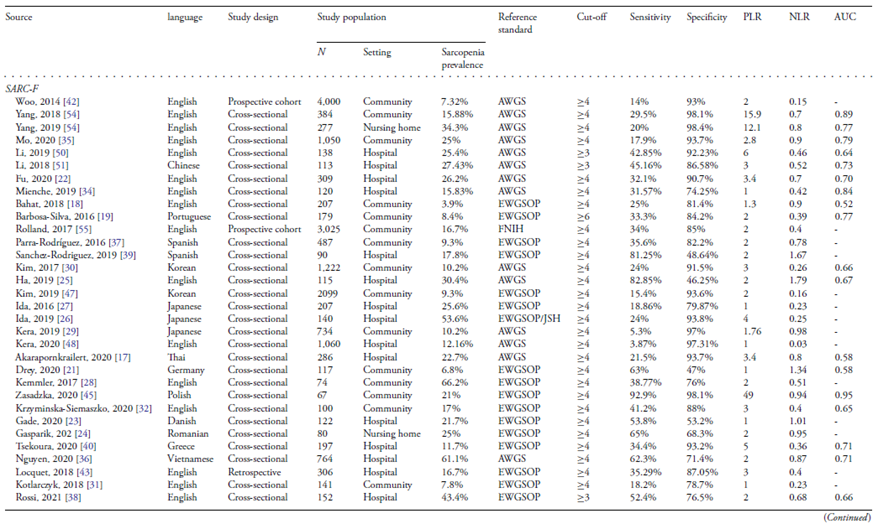
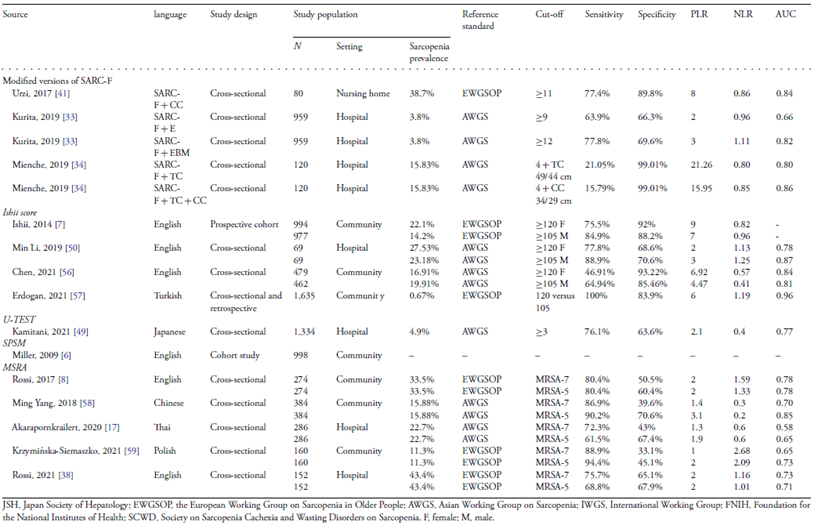
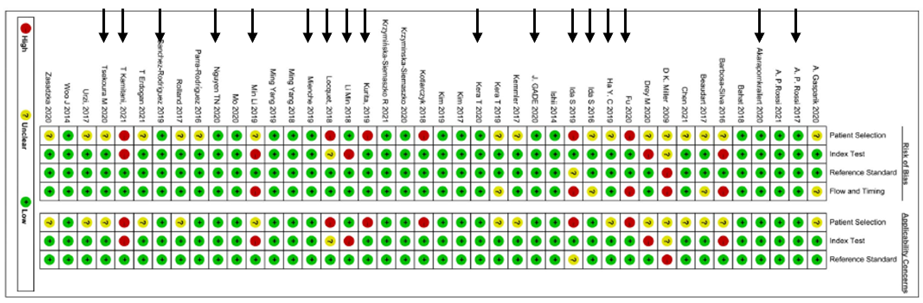
Figure 2. Risk of bias of the included studies by the QUADRAS-tool. Figure is directly retrieved from the article of Huang (2023). Articles with arrows are in hospital setting
Risk of bias tables
|
Study
First author, year |
Appropriate and clearly focused question?1
Yes/no/unclear |
Comprehensive and systematic literature search?2
Yes/no/unclear |
Description of included and excluded studies?3
Yes/no/unclear |
Description of relevant characteristics of included studies?4
Yes/no/unclear |
Assessment of scientific quality of included studies?5
Yes/no/unclear |
Enough similarities between studies to make combining them reasonable?6
Yes/no/unclear |
Potential risk of publication bias taken into account?7
Yes/no/unclear |
Potential conflicts of interest reported?8
Yes/no/unclear |
|
Huang, 2023 |
Yes |
Yes |
No |
Yes |
Yes |
Yes |
Yes |
No |
1. Research question (PICO) and inclusion criteria should be appropriate (in relation to the research question to be answered in the clinical guideline) and predefined
2. Search period and strategy should be described; at least Medline searched
3. Potentially relevant studies that are excluded at final selection (after reading the full text) should be referenced with reasons
4. Characteristics of individual studies relevant to the research question (PICO) should be reported
5. Quality of individual studies should be assessed using a quality scoring tool or checklist (preferably QUADAS-2; COSMIN checklist for measuring instruments) and taken into account in the evidence synthesis
6. Clinical and statistical heterogeneity should be assessed; clinical: enough similarities in patient characteristics, diagnostic tests (strategy) to allow pooling? For pooled data: at least 5 studies available for pooling; assessment of statistical heterogeneity and, more importantly (see Note), assessment of the reasons for heterogeneity (if present)? Note: sensitivity and specificity depend on the situation in which the test is being used and the thresholds that have been set, and sensitivity and specificity are correlated; therefore, the use of heterogeneity statistics (p-values; I2) is problematic, and rather than testing whether heterogeneity is present, heterogeneity should be assessed by eye-balling (degree of overlap of confidence intervals in Forest plot), and the reasons for heterogeneity should be examined.
7. There is no clear evidence for publication bias in diagnostic studies, and an ongoing discussion on which statistical method should be used. Tests to identify publication bias are likely to give false-positive results, among available tests, Deeks test is most valid. Irrespective of the use of statistical methods, you may score “Yes” if the authors discuss the potential risk of publication bias.
8. Sources of support (including commercial co-authorship) should be reported in both the systematic review and the included studies. Note: To get a “yes,” source of funding or support must be indicated for the systematic review AND for each of the included studies.
Risk of bias assessment diagnostic accuracy studies (QUADAS II, 2011)
|
Study reference |
Patient selection
|
Index test |
Reference standard |
Flow and timing |
Comments with respect to applicability |
|
Dedeyne, 2021 |
Was a consecutive or random sample of patients enrolled? Yes
Was a case-control design avoided? Yes
Did the study avoid inappropriate exclusions? Yes
|
Were the index test results interpreted without knowledge of the results of the reference standard? Yes
If a threshold was used, was it pre-specified? Yes
|
Is the reference standard likely to correctly classify the target condition? Yes
Were the reference standard results interpreted without knowledge of the results of the index test? Yes
|
Was there an appropriate interval between index test(s) and reference standard? Unclear
Did all patients receive a reference standard? No, but these were excluded
Did patients receive the same reference standard? Yes
Were all patients included in the analysis? No |
Are there concerns that the included patients do not match the review question? No
Are there concerns that the index test, its conduct, or interpretation differ from the review question? No
Are there concerns that the target condition as defined by the reference standard does not match the review question? No
|
|
CONCLUSION: Could the selection of patients have introduced bias?
RISK: LOW |
CONCLUSION: Could the conduct or interpretation of the index test have introduced bias?
RISK: LOW
|
CONCLUSION: Could the reference standard, its conduct, or its interpretation have introduced bias?
RISK: LOW |
CONCLUSION Could the patient flow have introduced bias?
RISK: UNCLEAR Time interval between the index test and reference test was not described |
|
|
|
Ha, 2020 |
Was a consecutive or random sample of patients enrolled? No: Retrospective sample
Was a case-control design avoided? Yes
Did the study avoid inappropriate exclusions? No: Patients with dementia/mental health issues were excluded, while a proxy could have been asked to fill out the questionnaire
|
Were the index test results interpreted without knowledge of the results of the reference standard? Unclear
If a threshold was used, was it pre-specified? Yes
|
Is the reference standard likely to correctly classify the target condition? Yes
Were the reference standard results interpreted without knowledge of the results of the index test? Unclear
|
Was there an appropriate interval between index test(s) and reference standard? Unclear
Did all patients receive a reference standard? No, but these were excluded
Didpatients receive the same reference standard? Yes
Were all patients included in the analysis? No |
Are there concerns that the included patients do not match the review question? No
Are there concerns that the index test, its conduct, or interpretation differ from the review question? No
Are there concerns that the target condition as defined by the reference standard does not match the review question? No
|
|
|
CONCLUSION: Could the selection of patients have introduced bias?
RISK: HIGH |
CONCLUSION: Could the conduct or interpretation of the index test have introduced bias?
RISK: UNCLEAR
|
CONCLUSION: Could the reference standard, its conduct, or its interpretation have introduced bias?
RISK: UNCLEAR |
CONCLUSION Could the patient flow have introduced bias?
RISK: UNCLEAR |
|
|
Santos, 2023 |
Was a consecutive or random sample of patients enrolled? Yes
Was a case-control design avoided? Yes
Did the study avoid inappropriate exclusions? Unclear: Exclusion of elderly people with cognitive limitations is very broadly defined
|
Were the index test results interpreted without knowledge of the results of the reference standard? Unclear
If a threshold was used, was it pre-specified? Yes
|
Is the reference standard likely to correctly classify the target condition? Yes
Were the reference standard results interpreted without knowledge of the results of the index test? Unclear
|
Was there an appropriate interval between index test(s) and reference standard? Unclear
Did all patients receive a reference standard? Yes
Did patients receive the same reference standard? Yes
Were all patients included in the analysis? Unclear
|
Are there concerns that the included patients do not match the review question? Yes/No/Unclear No
Are there concerns that the index test, its conduct, or interpretation differ from the review question? Yes/No/Unclear No
Are there concerns that the target condition as defined by the reference standard does not match the review question? Yes/No/Unclear No |
|
|
CONCLUSION: Could the selection of patients have introduced bias?
RISK: UNCLEAR |
CONCLUSION: Could the conduct or interpretation of the index test have introduced bias?
RISK: UNCLEAR
|
CONCLUSION: Could the reference standard, its conduct, or its interpretation have introduced bias?
RISK: UNCLEAR |
CONCLUSION Could the patient flow have introduced bias?
RISK: UNCLEAR Time interval between the index test and reference test was not described |
|
|
Sanchez-Tocino, 2022 |
Was a consecutive or random sample of patients enrolled? Yes
Was a case-control design avoided? Yes
Did the study avoid inappropriate exclusions? No, patients with dementia were excluded, while a proxy could have been asked to fill out the questionnaire, and malignancy is not clearly defined
|
Were the index test results interpreted without knowledge of the results of the reference standard? Yes
If a threshold was used, was it pre-specified? Yes
|
Is the reference standard likely to correctly classify the target condition? Yes
Were the reference standard results interpreted without knowledge of the results of the index test? No
|
Was there an appropriate interval between index test(s) and reference standard? Unclear
Did all patients receive a reference standard? Yes
Did patients receive the same reference standard? Yes
Were all patients included in the analysis? Yes |
Are there concerns that the included patients do not match the review question? No
Are there concerns that the index test, its conduct, or interpretation differ from the review question? No
Are there concerns that the target condition as defined by the reference standard does not match the review question? No
|
|
CONCLUSION: Could the selection of patients have introduced bias?
RISK: UNCLEAR |
CONCLUSION: Could the conduct or interpretation of the index test have introduced bias?
RISK: LOW
|
CONCLUSION: Could the reference standard, its conduct, or its interpretation have introduced bias?
RISK: HIGH |
CONCLUSION Could the patient flow have introduced bias?
RISK: UNCLEAR |
||
|
Suzan, 2021 |
Was a consecutive or random sample of patients enrolled? No
Was a case-control design avoided? No
Did the study avoid inappropriate exclusions? Unclear, malignancy is for example not defined
|
Were the index test results interpreted without knowledge of the results of the reference standard? No
If a threshold was used, was it pre-specified? Yes
|
Is the reference standard likely to correctly classify the target condition? Yes
Were the reference standard results interpreted without knowledge of the results of the index test? Yes
|
Was there an appropriate interval between index test(s) and reference standard? Unclear
Did all patients receive a reference standard? Yes
Did patients receive the same reference standard? Yes
Were all patients included in the analysis? Yes |
Are there concerns that the included patients do not match the review question? No
Are there concerns that the index test, its conduct, or interpretation differ from the review question? Yes
Are there concerns that the target condition as defined by the reference standard does not match the review question? No
|
|
CONCLUSION: Could the selection of patients have introduced bias?
RISK: HIGH |
CONCLUSION: Could the conduct or interpretation of the index test have introduced bias?
RISK: HIGH
|
CONCLUSION: Could the reference standard, its conduct, or its interpretation have introduced bias?
RISK: HIGH |
CONCLUSION Could the patient flow have introduced bias?
RISK: UNCLEAR |
||
|
Valent, 2022 |
Was a consecutive or random sample of patients enrolled? Yes
Was a case-control design avoided? Yes
Did the study avoid inappropriate exclusions? Yes
|
Were the index test results interpreted without knowledge of the results of the reference standard? Yes
If a threshold was used, was it pre-specified? Yes
|
Is the reference standard likely to correctly classify the target condition? Yes
Were the reference standard results interpreted without knowledge of the results of the index test? Yes
|
Was there an appropriate interval between index test(s) and reference standard? Unclear
Did all patients receive a reference standard? No, but these were excluded
Did patients receive the same reference standard? Yes
Were all patients included in the analysis? No
|
Are there concerns that the included patients do not match the review question? No
Are there concerns that the index test, its conduct, or interpretation differ from the review question? No
Are there concerns that the target condition as defined by the reference standard does not match the review question? No
|
|
CONCLUSION: Could the selection of patients have introduced bias?
RISK: LOW |
CONCLUSION: Could the conduct or interpretation of the index test have introduced bias?
RISK: LOW
|
CONCLUSION: Could the reference standard, its conduct, or its interpretation have introduced bias?
RISK: LOW |
CONCLUSION Could the patient flow have introduced bias?
RISK: UNCLEAR Time interval between the index test and reference test was not described |
Table of excluded studies
|
Author, year |
Title |
Exclusion reason |
|
Systematic reviews |
||
|
Ibrahim, 2022 |
The feasibility and acceptability of assessing and managing sarcopenia and frailty among older people with upper limb fracture |
Wrong design: no review |
|
Ida, 2018 |
SARC-F for Screening of Sarcopenia Among Older Adults: A Meta-analysis of Screening Test Accuracy |
Wrong P: community-dwelling adults |
|
Lian, 2023 |
Validated Tools for Screening Sarcopenia: A Scoping Review |
Wrong O: no diagnostic accuracy (overview of tools) |
|
Miller, 2018 |
Validated screening tools for the assessment of cachexia, sarcopenia, and malnutrition: a systematic review |
Wrong P: not in elderly specific |
|
Mohd Nawi, 2019 |
Screening Tools for Sarcopenia in Community-Dwellers: A Scoping Review |
Wrong P: community dwelling |
|
Shukla, 2020 |
Instrumented Analysis of the Sit-to-Stand Movement for Geriatric Screening: A Systematic Review |
Wrong P: community-dwelling elderly and no sarcopenia screening |
|
Lu, 2021 |
Screening Accuracy of SARC-F for Sarcopenia in the Elderly: A Diagnostic Meta-Analysis |
All studies included are also included in the more recent review of Huang (2023). |
|
Voelker, 2021 |
Reliability and Concurrent Validity of the SARC-F and Its Modified Versions: A Systematic Review and Meta-Analysis |
All studies included are also included in the more recent review of Huang (2023). |
|
Zheng, 2023 |
Serum creatinine/cystatin C ratio as a muscle mass evaluating tool and prognostic indicator for hospitalized patients: A meta-analysis |
Included in UV2 (diagnostics muscle mass) |
|
Chong, 2021 |
SARC-F at the Emergency Department: Diagnostic Performance for Frailty and Predictive Performance for Reattendances and Acute Hospitalizations |
Wrong reference, study focuses on assessment of frailty instead of sarcopenia |
|
Hiraoka, 2020 |
SARC-F combined with a simple tool for assessment of muscle abnormalities in outpatients with chronic liver disease |
Wrong reference and study focuses on assessment of muscle abnormalities instead of sarcopenia |
|
Ibrahim, 2019 |
The feasibility of assessing frailty and sarcopenia in hospitalised older people: a comparison of commonly used tools |
Wrong I, study focuses on frailty instead of sarcopenia |
|
Kapagan, 2023 |
Validity and Reliability of Study of Osteoporotic Fractures Index in the Diagnosis of Sarcopenia in Turkish Geriatric Patients |
Wrong I (Turkish version of the study of osteoporotic fractures (SOF)) |
|
Lage, 2020 |
Functional tests associated with sarcopenia in moderate chronic obstructive pulmonary disease |
Wrong I and reference (functional tests instead of screening tests) |
|
Maurus, 2021 |
Validation of a proxy-reported SARC-F questionnaire For current and retrospective screening of sarcopenia-related functional impairments |
Wrong reference standard |
|
Sanchez-Tocino, 2023 |
A Sarcopenia Index Derived from Malnutrition Parameters in Elderly Haemodialysis Patients |
Wrong design, prediction model instead of clinimetric/validation study |
|
Zhang, 2020 |
Comparison of the efficacy of Nutritional Risk Screening 2002 and Mini Nutritional Assessment Short Form in recognizing sarcopenia and predicting its mortality |
Wrong I, screening tools for malnutrition instead of sarcopenia used to assess sarcopenia |
|
Observational studies |
||
|
Bahşi, 2021 |
Visceral fat thickness may be useful in determining sarcopenia |
Wrong I (visceral fat thickness) |
|
Salim, 2020 |
Thigh Ultrasound Used to Identify Frail Elderly Patients with Sarcopenia Undergoing Surgery: A Pilot Study |
Wrong I |
|
Nozoe, 2021 |
Reliability and validity of measuring temporal muscle thickness as the evaluation of sarcopenia risk and the relationship with functional outcome in older patients with acute stroke |
Wrong I (temporal muscle thickness by CT) |
|
Dale MacLaine, 2022 |
Prospective comparison of two methods for assessing sarcopenia and interobserver agreement on retrospective CT images |
Wrong I |
|
Waduud, 2049 |
Volumetric versus single slice measurements of core abdominal muscle for sarcopenia |
Wrong I |
|
Yao, 2021 |
Diagnosing sarcopenia at the point of imaging care: analysis of clinical, functional, and opportunistic CT metrics |
Wrong C |
|
Simo-Servat, 2023 |
Role of Muscle Ultrasound for the Study of Frailty in Elderly Patients with Diabetes: A Pilot Study |
Wrong I |
|
Barreto, 2019 |
Validation of the sarcopenia index to assess muscle mass in the critically ill: A novel application of kidney function markers |
Wrong I |
|
Hansen, 2023 |
Assessment of Sarcopenia by Ultrasound. A Feasibility Study in Acutely Admitted Danish Geriatric Inpatients |
Wrong I |
|
Wilson, 2019 |
Bilateral Anterior Thigh Thickness: A New Diagnostic Tool for the Identification of Low Muscle Mass? |
Wrong I (thigh thickness) |
|
Bae, 2023 |
Sarcopenia measured with paraspinous muscle using computed tomography for predicting prognosis in elderly pneumonia patients |
Wrong I |
|
Buccheri, 2023 |
Can artificial intelligence simplify the screening of muscle mass loss? |
Wrong study design |
|
Yee, 2022 |
Evaluation of an alternative skeletal muscle index for skeletal muscle mass assessment in a group of Australian women |
Wrong I (muscle mass) |
|
Ueshima, 2020 |
Estimating appendicular muscle mass in older adults with consideration on paralysis |
Wrong I |
|
Chen, 2023 |
Value of conventional ultrasound and shear wave elastography in the assessment of muscle mass and function in elderly people with type 2 diabetes |
Wrong I (ultrasound) |
|
Steindl, 2020 |
Sarcopenia in neurological patients: Standard values for temporal muscle thickness and muscle strength evaluation |
Wrong I |
|
Chong, 2021 |
SARC-F at the Emergency Department: Diagnostic Performance for Frailty and Predictive Performance for Reattendances and Acute Hospitalizations |
Wrong C |
|
Hiraoka, 2020 |
SARC-F combined with a simple tool for assessment of muscle abnormalities in outpatients with chronic liver disease |
Wrong P (no 65+) and C |
|
Ibrahim, 2019 |
The feasibility of assessing frailty and sarcopenia in hospitalised older people: a comparison of commonly used tools |
Wrong I |
|
Kapagan, 2023 |
Validity and Reliability of Study of Osteoporotic Fractures Index in the Diagnosis of Sarcopenia in Turkish Geriatric Patients |
Wrong I |
|
Lage, 2021 |
Functional tests associated with sarcopenia in moderate chronic obstructive pulmonary disease |
Wrong I |
|
Maurus, 2022 |
Validation of a proxy-reported SARC-F questionnaire for current and retrospective screening of sarcopenia-related functional impairments |
Wrong C |
|
Sánchez-Tocino, 2023 |
A Sarcopenia Index Derived from Malnutrition Parameters in Elderly Haemodialysis Patients |
Wrong C |
|
Zhang, 2020 |
Comparison of the efficacy of Nutritional Risk Screening 2002 and Mini Nutritional Assessment Short Form in recognizing sarcopenia and predicting its mortality |
Wrong I |
|
Rossi, 2021 |
Sarcopenia risk evaluation in a sample of hospitalized elderly men and women: Combined use of the mini sarcopenia risk assessment (msra) and the sarc-f |
Included in SR Huang |
|
Abdalla, 2020 |
One-repetition submaximal protocol to measure knee extensor muscle strength among older adults with and without sarcopenia: A validation study |
Wrong P (no 65+) |
|
Alsadany, 2021 |
Detecting a valid screening method for sarcopenia in acute care setting |
Wrong P (no 65+) |
|
Arayne, 2023 |
Comparison of CT derived body composition at the thoracic T4 and T12 with lumbar L3 vertebral levels and their utility in patients with rectal cancer |
Wrong P (no 65+) |
|
Aslan, 2020 |
Sarcopenia in knee osteoarthritis: the association with clinical and sonographic findings, physical function, and nutrition |
Wrong P, I, C, O and study design |
|
Bai, 2023 |
Role of calf circumference in the evaluation and diagnosis of sarcopenia in the elderly in Shanghai |
Wrong language |
|
Bansal, 2020 |
TO STUDY THE PREVALENCE OF SARCOPENIA IN TYPE-2 DIABETIC PATIENTS IN A RURAL TERTIARY CARE HOSPITAL |
Wrong P (no 65+) |
|
Bellafronte, 2020 |
Bed-side measures for diagnosis of low muscle mass, sarcopenia, obesity, and sarcopenic obesity in patients with chronic kidney disease under non-dialysis-dependent, dialysis dependent and kidney transplant therapy |
Wrong P (no 65+) |
|
Bellanti, 2020 |
Comparison of three nutritional screening tools with the new glim criteria for malnutrition and association with sarcopenia in hospitalized older patients |
Wrong I |
|
Beretta, 2022 |
Association of Subjective Global Assessment and Adductor pollicis muscle thickness with the Sarcopenia in older patients with type 2 diabetes |
Wrong P (no 65+) |
|
Blanquet, 2022 |
Handgrip strength as a valid practical tool to screen early-onset sarcopenia in acute care wards: a first evaluation |
Wrong I (handgrip strength) |
|
Blanquet, 2022 |
Handgrip strength to screen early-onset sarcopenia in heart failure |
Wrong I (handgrip strength) |
|
Bramato, 2022 |
Sarcopenia screening in elderly with Alzheimer's disease: performances of the SARC-F-3 and MSRA-5 questionnaires |
Wrong P (no 65+) |
|
Castillo-Olea, 2019 |
Automatic classification of sarcopenia level in older adults: A case study at Tijuana General Hospital |
Wrong study design |
|
Castillo-Olea, 2020 |
Evaluation of prevalence of the sarcopenia level using machine learning techniques: Case study in tijuana baja california, mexico |
Wrong study design |
|
Cho, 2022 |
Sarcopenia in patients with dementia: correlation of temporalis muscle thickness with appendicular muscle mass |
Wrong I (muscle thickness) |
|
Churilov, 2021 |
GripBMI – A fast and simple sarcopenia screening tool in post-acute inpatient rehabilitation |
Wrong P (no 65+) |
|
Cui, 2020 |
Risk Assessment of Sarcopenia in Patients With Type 2 Diabetes Mellitus Using Data Mining Methods |
Wrong I |
|
Da Luz, 2021 |
SARC-F and SARC-CalF in screening for sarcopenia in older adults with Parkinson's disease |
Wrong P (no 65+) |
|
Damanti, 2022 |
Evaluation of Muscle Mass and Stiffness with Limb Ultrasound in COVID-19 Survivors |
Wrong P (no 65+) |
|
De Luna, 2023 |
Screening Tools for Sarcopenia in Mild to Moderate Parkinson's Disease: Assessing the Accuracy of SARC-F and Calf Circumference |
Wrong P (no 65+) |
|
Do, 2021 |
Validation of the SARC-F for Assessing Sarcopenia in Patients on Peritoneal Dialysis |
Wrong P (no 65+) and wrong C (Asian criteria) |
|
Duarte, 2022 |
SARC-F and SARC-CalF are associated with sarcopenia traits in hemodialysis patients |
Wrong P (no 65+) |
|
Endo, 2021 |
Calf and arm circumference as simple markers for screening sarcopenia in patients with chronic liver disease |
Wrong P (no 65+) |
|
Erken, 2022 |
Prediction of probable sarcopenia with an alternative method: plantar flexion strength |
Wrong I (handgripstrength) |
|
Esme, 2022 |
Ultrasound Assessment of Sarcopenia in Patients With Sarcoidosis |
Wrong I (ultrasound) and P (no 65+) |
|
Fayh, 2021 |
Comparison of revised EWGSOP2 criteria of sarcopenia in patients with cancer using different parameters of muscle mass |
Wrong P (no 65+) |
|
Fonfría-Vivas, 2023 |
Assessing quality of life with SarQol is useful in screening for sarcopenia and sarcopenic obesity in older women |
Wrong P (community dwelling) |
|
Fu, 2020 |
Comparing SARC-F with SARC-CalF for screening sarcopenia in advanced cancer patients |
Wrong P (no 65+) |
|
Gao, 2022 |
High blood urea nitrogen to creatinine ratio is associated with increased risk of sarcopenia in patients with chronic obstructive pulmonary disease |
Wrong I |
|
Ge, 2022 |
A New Index Based on Serum Creatinine and Cystatin C Can Predict the Risks of Sarcopenia, Falls and Fractures in Old Patients with Low Bone Mineral Density |
Wrong C |
|
González Correa, 2020 |
Bioelectrical impedance analysis and dual x-ray absorptiometry agreement for skeletal muscle mass index evaluation in sarcopenia diagnosis |
Wrong I and C |
|
Han, 2022 |
Association Between Anthropometric Indices and Skeletal-Muscle Atrophy in Chinese Patients with Stable Chronic Obstructive Pulmonary Disease: A Cross-Sectional Study |
Wrong P (no 65+) |
|
He, 2023 |
A new, alternative risk score for sarcopenia in Chinese patients with type 2 diabetes mellitus |
Wrong P (no 65+) |
|
Hirai, 2019 |
Comparison of three frailty models and a sarcopenia model in elderly patients with chronic obstructive pulmonary disease |
Wrong I |
|
Jones, 2020 |
Measurement of Muscle Mass and Sarcopenia Using Anthropometry, Bioelectrical Impedance, and Computed Tomography in Surgical Patients with Colorectal Malignancy: Comparison of Agreement Between Methods |
Wrong P (no 65+) |
|
Kim, 2022 |
Oculomics for sarcopenia prediction: a machine learning approach toward predictive, preventive, and personalized medicine |
Wrong study design |
|
Kim, 2023 |
Physical Therapy Assessment Tool Threshold Values to Identify Sarcopenia and Locomotive Syndrome in the Elderly |
Wrong I |
|
Kim, 2023 |
Assessment of existing anthropometric indices for screening sarcopenic obesity in older adults |
Wrong I and O |
|
Kurita, 2019 |
SARC-F Validation and SARC-F+EBM Derivation in Musculoskeletal Disease: The SPSS-OK Study |
Wrong P (no 65+) |
|
Lamers, 2023 |
Validation of SARC-F-Proxy for the Screening of Sarcopenia in Older Patients with Cognitive Impairment |
Wrong P (no 65+) |
|
Lee, 2023 |
Nutritional indices for screening sarcopenia before adult cardiac surgery |
Wrong P (no 65+) |
|
Li, 2020 |
Ultrasound for measuring the cross-sectional area of biceps brachii muscle in sarcopenia |
Wrong P (no 65+) |
|
Lim, 2020 |
Letter to the Editor: Influence of Obesity on Diagnostic Accuracy and Optimal Cutoffs for Sarcopenia Screening in Non-Frail Older Adults: A Comparison of SARC-F versus SARC-CalF |
Wrong study design |
|
Lin, 2019 |
Muscle Mass, Density, and Strength Are Necessary to Diagnose Sarcopenia in Patients With Gastric Cancer |
Wrong I |
|
Lin, 2022 |
Development and validation of a novel diagnostic model for musculoskeletal aging (sarcopenia) based on cuproptosis-related genes associated with immunity |
Wrong study design |
|
Lin, 2022 |
A Comparison of SARC-F, Calf Circumference, and Their Combination for Sarcopenia Screening among Patients Undergoing Peritoneal Dialysis |
Wrong P (no 65+) |
|
Liu, 2023 |
Comparison between bioelectrical impedance analyses and dual-energy X-ray absorptiometry for accuracy in assessing appendicular skeletal muscle mass and diagnosing sarcopenia in hospitalized Chinese older adults |
Wrong I |
|
Locquet, 2018 |
Comparison of the performance of five screening methods for sarcopenia |
|
|
Looijaard, 2018 |
Single Physical Performance Measures Cannot Identify Geriatric Outpatients with Sarcopenia |
Wrong P (community dwelling) |
|
Lu, 2022 |
Comparison of five sarcopenia screening tools in preoperative patients with gastric cancer using the diagnostic criteria of the European Working Group on Sarcopenia in Older People 2 |
Wrong P (no 65+) |
|
Maeda, 2024 |
Predictive value of the Ishii score for sarcopenia and the prognosis of older patients hospitalized with heart failure |
Wrong C (AWGS criteria) |
|
Manabe, 2023 |
Usefulness of the Measurement of Psoas Muscle Volume for Sarcopenia Diagnosis in Patients with Liver Disease |
Wrong P (no 65+) |
|
Matsuzawa, 2021 |
The clinical applicability of ultrasound technique for diagnosis of sarcopenia in hemodialysis patients |
Wrong P (no 65+) |
|
Neira Álvarez, 2021 |
Muscle Assessment by Ultrasonography: Agreement with Dual-Energy X-Ray Absorptiometry (DXA) and Relationship with Physical Performance |
Wrong I (ultrasound) |
|
Nguyen, 2020 |
Reliability and validity of SARC-F questionnaire to assess sarcopenia among vietnamese geriatric patients |
Wrong I (Vietnamese version SARC-F) |
|
Nishikawa, 2021 |
Screening Tools for Sarcopenia |
Wrong study design |
|
Ozkok, 2023 |
Clinical validation of SARC-F by proxy as a practical tool to evaluate sarcopenia in dependent older adults |
Wrong P (no 65+, and 42% nursing home patients) |
|
Panthofer, 2019 |
Derivation and validation of thoracic sarcopenia assessment in patients undergoing thoracic endovascular aortic repair |
Wrong P (no 65+) |
|
Papadopoulos, 2023 |
Performance of the SARC-F in identifying low grip strength and physical performance in older adults with cancer |
Wrong O (physical function and grip strength) |
|
Pasco, 2020 |
Repurposing a fracture risk calculator (FRAX) as a screening tool for women at risk for sarcopenia |
Wrong P (no 65+) |
|
Pigneur, 2023 |
Psoas muscle index is not representative of skeletal muscle index for evaluating cancer sarcopenia |
Wrong P (no 65+) |
|
Rasheedy, 2020 |
The accuracy of the Geriatric Nutritional Risk Index in detecting frailty and sarcopenia in hospitalized older adults |
Wrong P (no 65+) |
|
Roehrich, 2022 |
Comparison of feasibility and results of frailty assessment methods prior to left ventricular assist device implantation |
Wrong P (no 65+) |
|
Rustani, 2019 |
Ultrasound measurement of rectus femoris muscle thickness as a quick screening test for sarcopenia assessment |
Wrong C |
|
Shiroma, 2023 |
A nutritional assessment tool, GNRI, predicts sarcopenia and its components in type 2 diabetes mellitus: A Japanese cross-sectional study |
Wrong C |
|
Khan, 2019 |
MRI quantitation of abdominal skeletal muscle correlates with CT-based analysis: implications for sarcopenia measurement |
Wrong I (CT) and P (no 65+) |
|
Simonsen, 2021 |
Assessment of sarcopenia in patients with upper gastrointestinal tumors: Prevalence and agreement between computed tomography and dual-energy x-ray absorptiometry |
Wrong P (no 65+) |
|
Siqueira, 2021 |
SARC-F has low correlation and reliability with skeletal muscle mass index in older gastrointestinal cancer patients |
Wrong P (no 65+) |
|
So, 2021 |
Psoas muscle volume as an opportunistic diagnostic tool to assess sarcopenia in patients with hip fractures: A retrospective cohort study |
Wrong P (no 65+) |
|
Kizilarslanoğlu, 2023 |
Pectoralis muscle index might be a factor associated with frailty in older women with breast cancer |
Wrong I (CT) and P (no 65+) |
|
Tan, 2021 |
Practicality and Reliability of Self vs Administered Rapid Geriatric Assessment Mobile App |
Wrong P (no 65+) |
|
Lee, 2021 |
Deep neural network for automatic volumetric segmentation of whole-body CT images for body composition assessment |
Wrong I (CT) and P (no 65+) |
|
Vágnerová, 2022 |
Comparison between EWGSOP1 and EWGSOP2 criteria and modelling of diagnostic algorithm for sarcopenic obesity in over 70 years old patients |
Wrong I (EWGSOP1), wrong O (sarcopenic obesity) |
|
Vangelov, 2023 |
The use of the second thoracic vertebral landmark for skeletal muscle assessment and computed tomography-defined sarcopenia evaluation in patients with head and neck cancer |
Wrong P (no 65+) |
|
Venturini, 2020 |
Population specificity affects prediction of appendicular lean tissues for diagnosed sarcopenia: a cross-sectional study |
Wrong P (no 65+) |
|
Verstraeten, 2022 |
Handgrip strength rather than chair stand test should be used to diagnose sarcopenia in geriatric rehabilitation inpatients: REStORing health of acutely unwell adulTs (RESORT) |
Wrong O |
|
Vidal-Cuellar, 2022 |
Identification of Probable sarcopenia based on SARC-F and SARC-CalF in older adults from a low-resource setting |
Wrong P (no 65+) |
|
Leigheb, 2021 |
Sarcopenia diagnosis: Reliability of the ultrasound assessment of the tibialis anterior muscle as an alternative evaluation tool |
Wrong I (ultrasound) and P (no 65+) |
|
Watanabe, 2021 |
Factors associated with sarcopenia screened by finger-circle test among middle-aged and older adults: a population-based multisite cross-sectional survey in Japan |
Wrong I |
|
Ma, 2019 |
Quantification of muscle mass in the legs of patients with peripheral arterial occlusive disease: Associations between volumetric and cross-sectional single-slice measurements for identification of atrophy and focal sarcopenia |
Wrong I (skeletal muscle mass index) and P (no 65+) |
|
Xu, 2022 |
Comparing SARC-CalF With SARC-F for Screening Sarcopenia in Adults With Type 2 Diabetes Mellitus |
Wrong P (no 65+) |
|
Yamada, 2021 |
Validity of measuring psoas muscle mass index for assessing sarcopenia in patients with gynecological cancer |
Wrong P (no 65+) |
|
Yamada, 2021 |
Validity of skeletal muscle mass index measurements for assessing sarcopenia in patients with gynecological cancer |
Wrong P (no 65+) |
|
Pachołek, 2022 |
Sarcopenia identification during comprehensive geriatric assessment |
Wrong study design |
|
Ye, 2023 |
Development and Validation of an Automated Image-Based Deep Learning Platform for Sarcopenia Assessment in Head and Neck Cancer |
Wrong P (no 65+) |
|
Park, 2022 |
Utility of ultrasound as a promising diagnostic tool for stroke-related sarcopenia: A retrospective pilot study |
Wrong I (ultrasound) and P (no 65+) |
|
Yoshida, 2022 |
Assessment of sarcopenia and malnutrition using estimated GFR ratio (eGFRcys/eGFR) in hospitalised adult patients |
Wrong I and P (no 65+) |
|
Yoshiko, 2023 |
Applicability of the seated step test for assessing thigh muscle sarcopenia in older individuals |
Wrong I |
|
Yoshimura, 2021 |
Prognostic role of preoperative sarcopenia evaluation of cervical muscles with long‐term outcomes of patients with oral squamous cell carcinoma |
Wrong P (no 65+) |
|
Yu, 2023 |
A nomogram for screening sarcopenia in Chinese type 2 diabetes mellitus patients |
Wrong C |
|
Zengin, 2021 |
Prevalence of Sarcopenia and Relationships Between Muscle and Bone in Indian Men and Women |
Wrong P (no 65+) |
|
Zhang, 2022 |
Risk factors for osteopenia/osteoporosis and the diagnostic value of CT value in patients with chronic hepatitis B |
Wrong language |
|
Zuo, 2022 |
Utility of multidetector computed tomography quantitative measurements in identifying sarcopenia: a propensity score matched study |
Wrong I (L3 SMI) |
|
Zwart, 2019 |
CT-measured skeletal muscle mass used to assess frailty in patients with head and neck cancer |
Wrong P (no 65+) |
Beoordelingsdatum en geldigheid
Publicatiedatum : 22-01-2026
Beoordeeld op geldigheid : 22-01-2026
Algemene gegevens
De Vereniging van Specialisten Ouderengeneeskunde (Verenso) heeft een verklaring van geen bezwaar afgegeven.
De ontwikkeling/herziening van deze richtlijnmodule werd ondersteund door het Kennisinstituut van de Federatie Medisch Specialisten (www.demedischspecialist.nl/kennisinstituut) en werd gefinancierd uit de Stichting Kwaliteitsgelden Medisch Specialisten (SKMS). De financier heeft geen enkele invloed gehad op de inhoud van de richtlijnmodule.
Samenstelling werkgroep
Voor het ontwikkelen van de richtlijnmodule is in 2023 een multidisciplinaire werkgroep ingesteld, bestaande uit vertegenwoordigers van alle relevante specialismen (zie hiervoor de Samenstelling van de werkgroep) die betrokken zijn bij de zorg voor ondervoeding en sarcopenie bij ouderen met een kwetsbare gezondheid.
Werkgroep
- Dr. W.M.W.H. (Walther) Sipers, klinisch geriater, werkzaam in het Zuyderland Medisch Centrum te Heerlen- Sittard-Geleen, NVKG
- Dr. ir. E. (Emmelyne) Vasse, diëtist-onderzoeker, werkzaam in Ziekenhuis Gelderse Vallei te Ede en bij het Lectoraat Voeding, Diëtetiek & Leefstijl aan de Hogeschool van Arnhem en Nijmegen, NVD
- Dr. CH. (Christian) Oudshoorn, internist en klinisch geriater, werkzaam in het Erasmus MC te Rotterdam, NVKG
- Drs. A. (Aurélie) Rutten, AIOS klinische geriatrie, werkzaam in het Zuyderland MC te Heerlen-Sittard-Geleen, NVKG
- L. (Lichelle) Wong, MSc, AIOS klinische geriatrie, werkzaam in het Zuyderland MC te Heerlen-Sittard-Geleen, NVKG
- Drs. S. (Simone) Verhaar, klinisch geriater, werkzaam in het Catharina Ziekenhuis te Eindhoven, NVKG
- Dr. A.Y. (Astrid) Hagedoorn-Bijlsma, internist ouderengeneeskunde, werkzaam in het Elisabeth-TweeSteden Ziekenhuis te Tilburg, NIV
- Prof. Dr. J. (Jos) Schols, hoogleraar ouderengeneeskunde, werkzaam bij Maastricht University te Maastricht, Verenso
- V. (Vera) Luijckx, MSc, geriatriefysiotherapeut, werkzaam bij Surplus te West-Brabant, KNGF
- L. (Lotte) Kunst-Haasdijk, projectleider, werkzaam als zzp’er, KNGF
Klankbordgroep
- D.S.V.M. (Dominique) Clément, MSc, MDL-arts, werkzaam in het King’s College Hospital te Londen, NVMDL
- Dr. I.A.M. (Ingrid) Gisbertz, MDL-arts, werkzaam bij Bernhoven te Uden, NVMDL
- Dhr. dr. T.E. (Taco) Otto, chirurg, werkzaam in het Dijklander Ziekenhuis te Hoorn, NVvH
- C. (Charlotte) van der Hulst, MSc, verpleegkundig specialist AGZ, werkzaam bij Brentano te Amstelveen, V&VN
- Dr. R. (Robert) Tepaske, anesthesioloog-intensivist, werkzaam bij het Amsterdam UMC – locatie AMC te Amsterdam, NVIC
Met ondersteuning van
- Dr. J. (Janneke) Hoogervorst-Schilp, senior adviseur, Kennisinstituut van de Federatie Medisch Specialisten
- F. (Florien) Ham, MSc, adviseur, Kennisinstituut van de Federatie Medisch Specialisten
- A. (Alies) Oost, medisch informatiespecialist, Kennisinstituut van de Federatie Medisch Specialisten
Belangenverklaringen
Een overzicht van de belangen van werkgroepleden en het oordeel over het omgaan met eventuele belangen vindt u in onderstaande tabel. De ondertekende belangenverklaringen zijn op te vragen bij het secretariaat van het Kennisinstituut van de Federatie Medisch Specialisten.
|
Naam |
Hoofdfunctie |
Nevenwerkzaamheden |
Persoonlijke Financiële Belangen |
Persoonlijke Relaties |
Extern gefinancierd onderzoek |
Intell. belangen en reputatie |
Overige |
Datum |
Restrictie |
||||
|
Werkgroep |
|||||||||||||
|
Hagedoorn-Bijlsma |
Internist ouderengeneeskunde bij vakgroep geriatrie in ETZ |
Vicevoorzitter wetenschapscommissie van NIV en NVKG |
Geen |
Geen |
Geen |
Geen |
Geen |
22-08-2023 |
Geen |
||||
|
Kunst-Haasdijk |
Beleidsadviseur / projectleider, KNGF/NVFG Project beroepsprofielen, betaald als ZZP |
Als ondernemer coach ik mensen naar een meer plantaardige leefstijl en geven we workshop aan teams in bedrijven op het gebied van een gezonde leefstijl. |
Geen |
Geen |
Geen |
Geen |
Geen |
21-08-2023 |
Geen |
||||
|
Luijckx |
Werkgever: Surplus, betaalde functie. Geriatriefysiotherapeut: Verlenen van fysiotherapeutische zorg (onderzoek, behandeling, advisering) aan ouderen met een kwetsbare gezondheid. Betaalde functie. Lid professionele adviesraad (PAR) bij Surplus: Via de PAR aandacht voor zeggenschap binnen Surplus creëren en raad van bestuur adviseren over vakinhoudelijk beleid. |
Geen |
Geen |
Geen |
Geen |
Geen |
Geen |
20-12-2023 |
Geen |
||||
|
Oudshoorn |
Internist en kinisch geriater Erasmus MC |
Geen |
Geen |
Geen |
Geen |
Geen |
Geen |
15-08-2023 |
Geen |
||||
|
Rutten |
AIOS geriatrie Zuyderland MC |
Geen |
Geen |
Geen |
Geen |
Geen |
Geen |
14-11-2023 |
Geen |
||||
|
Schols |
Hoogleraar ouderengeneeskunde Universiteit Maastricht |
*Lid van Gezondheidsraad *Lid van Adviescommissie pakket van Zorginstituut die adviezen geeft over de toelating van dure geneesmiddelen en andere behandelingen tot het vergoedingenpakket in de ZVW en over het pakket van de Wlz --> uitgevraagd in de vergadering, dit betreft geen geneesmiddelen, voedingdinterventies of andere interventies die in de richtlijn voor zullen komen. *Lid van RvT Vitala+ een zorgorganisatie voor geriatrische revalidatiezorg in Maastricht. Voor deze 3 nevenfuncties geldt deelname aan vergaderingen met vacatiegeldvergoeding incl. reiskosten. |
Geen |
Geen |
Betrokken geweest bij extern gefinancierd promotietraject op onderwerp: Samenhang tussen mondzorg, ondervoeding en dysfagie. Project voltooid met promotie in oktober 2022. Daarmee was project afgerond. Financier was Nutricia en financiering geschiedde op basis van officiële overeenkomst met Universiteit Maastricht. Ik was promotor van de promovendus maar geen projectleider. |
Ik heb uiteraard de reputatie van mijn universiteit hoog te houden. Verder geen specifieke zaken |
Geen |
21-09-2023 |
Geen |
||||
|
Sipers (voorzitter) |
Klinisch geriater en opleider Zuyderland Medisch Centrum, full time werkzaam |
SCEN arts, 6x/ jaar 5 dagen dienst volgens rooster. Consulten buiten werktijden om en vergoeding per daadwerkelijk uitgevoerd consult conform tarieven KNMG |
Geen |
Geen |
Geen |
Ik ben door de NVKG gevraagd om deze taak op me te nemen. Dit heeft ermee te maken daar ik reeds enige expertise heb op dit gebied en het een belangrijk thema vind in de dagelijkse zorg voor kwetsbare oudere patiënten. Mijn drijfveer is om zodoende een bijdrage te leveren aan een kwaliteit betere zorg. |
Geen |
28-07-2022 |
Geen |
||||
|
Vasse |
Post-doc onderzoeker/projectleider - Hogeschool van Arnhem en Nijmegen, Lectoraat Voeding, Dietetiek & Leefstijl / Kenniscentrum Ondervoeding (16 uur/week, tot oktober 2024) Projectleider - Alliantie Voeding in de Zorg (8 uur/week) Dietist - Ziekenhuis Gelderse Vallei in Ede (oproepbasis) |
Geen |
Geen |
Geen |
Geen |
Geen |
Geen |
20-07-2023 |
Geen |
||||
|
Verhaar |
Klinisch geriater, Catharina ziekenhuis Eindhoven |
Geen |
Geen |
Geen |
Geen |
Geen |
Geen |
03-08-2023 |
Geen |
||||
|
Wong |
AIOS Zuyderland MC |
Geen |
Geen |
Geen |
Geen |
Geen |
Geen |
17-10-2023 |
Geen |
||||
|
Klankbordgroep |
|||||||||
|
Clément |
Maag-, darm- en leverarts (Consultant Gastroenterologist) King's College Hospital Londen |
Geen |
Geen |
Geen |
Geen |
Geen |
Geen |
15-10-2023 |
Geen |
|
Gisbertz |
MDL arts Bernhoven |
Voorzitter Nederlands voedingsteam overleg Lid commissie Voeding NVMDL |
Geen |
Geen |
Geen |
Geen |
Geen |
23-10-2023 |
Geen |
|
Hulst, van der |
Verpleegkundig specialist AGZ Stichting Brentano Amstelveen. Regiebehandelaar psychogeriatrisch verpleeghuis. |
Geen |
Geen |
Geen |
Geen |
Geen |
Geen |
12-12-2023 |
Geen |
|
Otto |
Chirurg, Dijklander ziekenhuis, Hoorn |
Geen |
Geen |
Geen |
Geen |
Geen |
Geen |
16-12-2023 |
Geen |
|
Tepaske |
Anesthesioloog-Intensivist, Intensive Care volwassenen AUMC. plv. hoofd/ WPM, plv. Opleider fellows IC (tot 1 feb 2024), Stagebegeleider AIOS. Interne, anesthesiologie, heelkunde. Begeleider Nurse practitioners profielen circulation & ventilation. Voorzitter materialen commissie Intensive Care volwassenen Investeringen en Europese aanbestedingen Verder lid van de IC- werkgroepen vv- en va-ECMO, decubitus, klinisch chemisch, peersupport, monitoring & ICT, apotheek & AMC-brede |
Allen onbezoldigd: Lid concillium IC (GIC, tot 1 feb 2024), Lid van de sectie IC van de NVA Lid NVIC Bezoldigd: Docent ICverpleegkundigen, Amstel Academie, opleidingsinstituut AmsterdamUMC, loc VUmc
|
Geen |
Geen |
Geen |
Geen |
Eenmalig vergoeding voor deelname aan masterclass 'meten van metabolisme' van Hamilton, Zwitserland |
01-12-2023 |
Geen |
Inbreng patiëntenperspectief
Er werd aandacht besteed aan het patiëntenperspectief door de Patientenfederatie Nederland en de KBO-PCOB uit te nodigen voor de schriftelijke knelpunteninventarisatie, maar beide hebben geen input gegeven. Daarnaast is de KBO-PCOB uitgenodigd voor de werkgroep, maar heeft afgezien van deelname. De conceptrichtlijn is tevens voor commentaar voorgelegd aan de Patientenfederatie Nederland en de KBO-PCOB en de eventueel aangeleverde commentaren zijn bekeken en verwerkt.
Kwalitatieve raming van mogelijke financiële gevolgen in het kader van de Wkkgz
Bij de richtlijnmodule is conform de Wet kwaliteit, klachten en geschillen zorg (Wkkgz) een kwalitatieve raming uitgevoerd om te beoordelen of de aanbevelingen mogelijk leiden tot substantiële financiële gevolgen. Bij het uitvoeren van deze beoordeling is de richtlijnmodule op verschillende domeinen getoetst (zie het stroomschema op de Richtlijnendatabase).
|
Module |
Uitkomst raming |
Toelichting |
|
Screening sarcopenie |
Geen financiële gevolgen |
Hoewel uit de toetsing volgt dat de aanbeveling(en) breed toepasbaar zijn (>40.000 patiënten), volgt uit de toetsing dat het overgrote deel (±90%) van de zorgaanbieders en zorgverleners al aan de norm voldoet. Er worden daarom geen financiële gevolgen verwacht. |
Werkwijze
Voor meer details over de gebruikte richtlijnmethodologie verwijzen wij u naar de Richtlijnendatabase. Relevante informatie over de ontwikkeling/herziening van deze richtlijnmodules is hieronder weergegeven.
Zoekverantwoording
Zoekstrategie
Embase.com
|
No. |
Query |
Results |
|
#1 |
aged/exp OR geriatrics/exp OR geriatric assessment/exp OR geriatric patient/exp OR elderly care/exp OR frailty/exp OR physical frailty/exp OR geriatric nutritional risk index/exp OR senile dementia/exp OR aged hospital patient/exp OR frail elderly/exp OR institutionalized elderly/exp OR very elderly/exp OR elder*:ti,ab,kw OR eldest:ti,ab,kw OR frail*:ti,ab,kw OR geriatri*:ti,ab,kw OR ((oldest NEXT/1 old*):ti,ab,kw) OR ((very NEXT/1 old*):ti,ab,kw) OR senior*:ti,ab,kw OR senium:ti,ab,kw OR septuagenarian*:ti,ab,kw OR octagenarian*:ti,ab,kw OR octogenarian*:ti,ab,kw OR nonagenarian*:ti,ab,kw OR centarian*:ti,ab,kw OR centenarian*:ti,ab,kw OR supercentenarian*:ti,ab,kw OR ((older NEXT/1 (man OR men OR male* OR woman OR women OR female*)):ti,ab,kw) OR (((old OR older) NEXT/1 (age* OR subject* OR patient* OR pts OR adult* OR population* OR person* OR people OR citizen*)):ti,ab,kw) OR ((senil* NEAR/3 (dement* OR confus* OR alzheimer*)):ti,ab,kw) |
4316524 |
|
#2 |
sarcopenia index/exp OR sarc-f questionnaire/exp OR calf circumference/exp OR (sarcopenia/exp AND (screening/de OR screening test/exp OR mass screening/de OR point of care testing/exp OR questionnaire/exp OR checklist/exp OR scoring system/exp OR rating scale/exp OR clinical assessment tool/exp OR clinical indicator/exp)) OR ((sarcopen* NEAR/3 (screen* OR assess* OR determin* OR index* OR tool* OR test* OR scale* OR score OR questionnaire* OR measur* OR evaluat*)):ti,ab,kw) OR ((calf NEAR/3 circumference):ti,ab,kw) OR sarc f:ti,ab,kw OR sarc calf:ti,ab,kw OR sarc ebm:ti,ab,kw OR msra:ti,ab,kw OR finger circle:ti,ab,kw |
10129 |
|
#3 |
sensitivity and specificity/de OR sensitivity:ab,ti OR specificity:ab,ti OR roc curve:ab,ti OR receiver operator:ab,ti OR receiver operators:ab,ti OR likelihood:ab,ti OR diagnostic error/exp OR diagnostic accuracy/exp OR diagnostic test accuracy study/exp OR inter observer:ab,ti OR intra observer:ab,ti OR interobserver:ab,ti OR intraobserver:ab,ti OR validity:ab,ti OR kappa:ab,ti OR reliability:ab,ti OR reproducibility:ab,ti OR ((test NEAR/2 re-test):ab,ti) OR ((test NEAR/2 retest):ab,ti) OR reproducibility/exp OR accuracy:ab,ti OR differential diagnosis/exp OR validation study/de OR measurement precision/exp OR diagnostic value/exp OR reliability/exp OR predictive value/exp OR ppv:ti,ab,kw OR npv:ti,ab,kw OR (((false OR true) NEAR/3 (negative OR positive)):ti,ab) |
4241378 |
|
#4 |
#1 AND #2 AND #3 AND [2011-2024]/py NOT (conference abstract/it OR editorial/it OR letter/it OR note/it) NOT ((animal/exp OR animal experiment/exp OR animal model/exp OR nonhuman/exp) NOT human/exp) |
1027 |
|
#5 |
meta analysis/exp OR meta analysis (topic)/exp OR metaanaly*:ti,ab OR meta analy*:ti,ab OR metanaly*:ti,ab OR systematic review/de OR cochrane database of systematic reviews/jt OR prisma:ti,ab OR prospero:ti,ab OR (((systemati* OR scoping OR umbrella OR structured literature) NEAR/3 (review* OR overview*)):ti,ab) OR ((systemic* NEAR/1 review*):ti,ab) OR (((systemati* OR literature OR database* OR data base*) NEAR/10 search*):ti,ab) OR (((structured OR comprehensive* OR systemic*) NEAR/3 search*):ti,ab) OR (((literature NEAR/3 review*):ti,ab) AND (search*:ti,ab OR database*:ti,ab OR data base*:ti,ab)) OR ((data extraction:ti,ab OR data source*:ti,ab) AND study selection:ti,ab) OR (search strategy:ti,ab AND selection criteria:ti,ab) OR (data source*:ti,ab AND data synthesis:ti,ab) OR medline:ab OR pubmed:ab OR embase:ab OR cochrane:ab OR (((critical OR rapid) NEAR/2 (review* OR overview* OR synthes*)):ti) OR ((((critical* OR rapid*) NEAR/3 (review* OR overview* OR synthes*)):ab) AND (search*:ab OR database*:ab OR data base*:ab)) OR metasynthes*:ti,ab OR meta synthes*:ti,ab |
994512 |
|
#6 |
major clinical study/de OR clinical study/de OR case control study/de OR family study/de OR longitudinal study/de OR retrospective study/de OR prospective study/de OR comparative study/de OR cohort analysis/de OR ((cohort NEAR/1 (study OR studies)):ab,ti) OR ((case control NEAR/1 (study OR studies)):ab,ti) OR ((follow up NEAR/1 (study OR studies)):ab,ti) OR (observational NEAR/1 (study OR studies)) OR ((epidemiologic NEAR/1 (study OR studies)):ab,ti) OR ((cross sectional NEAR/1 (study OR studies)):ab,ti) |
8030027 |
|
#7 |
case control study/de OR comparative study/exp OR control group/de OR controlled study/de OR controlled clinical trial/de OR crossover procedure/de OR double blind procedure/de OR phase 2 clinical trial/de OR phase 3 clinical trial/de OR phase 4 clinical trial/de OR pretest posttest design/de OR pretest posttest control group design/de OR quasi experimental study/de OR single blind procedure/de OR triple blind procedure/de OR (((control OR controlled) NEAR/6 trial):ti,ab,kw) OR (((control OR controlled) NEAR/6 (study OR studies)):ti,ab,kw) OR (((control OR controlled) NEAR/1 active):ti,ab,kw) OR open label*:ti,ab,kw OR (((double OR two OR three OR multi OR trial) NEAR/1 (arm OR arms)):ti,ab,kw) OR ((allocat* NEAR/10 (arm OR arms)):ti,ab,kw) OR placebo*:ti,ab,kw OR sham-control*:ti,ab,kw OR (((single OR double OR triple OR assessor) NEAR/1 (blind* OR masked)):ti,ab,kw) OR nonrandom*:ti,ab,kw OR non-random*:ti,ab,kw OR quasi-experiment*:ti,ab,kw OR crossover:ti,ab,kw OR cross over:ti,ab,kw OR parallel group*:ti,ab,kw OR factorial trial:ti,ab,kw OR ((phase NEAR/5 (study OR trial)):ti,ab,kw) OR ((case* NEAR/6 (matched OR control*)):ti,ab,kw) OR ((match* NEAR/6 (pair OR pairs OR cohort* OR control* OR group* OR healthy OR age OR sex OR gender OR patient* OR subject* OR participant*)):ti,ab,kw) OR ((propensity NEAR/6 (scor* OR match*)):ti,ab,kw) OR versus:ti OR vs:ti OR compar*:ti OR ((compar* NEAR/1 study):ti,ab,kw) OR ((major clinical study/de OR clinical study/de OR cohort analysis/de OR observational study/de OR cross-sectional study/de OR multicenter study/de OR correlational study/de OR follow up/de OR cohort*:ti,ab,kw OR follow up:ti,ab,kw OR followup:ti,ab,kw OR longitudinal*:ti,ab,kw OR prospective*:ti,ab,kw OR retrospective*:ti,ab,kw OR observational*:ti,ab,kw OR cross sectional*:ti,ab,kw OR cross?ectional*:ti,ab,kw OR multicent*:ti,ab,kw OR multi-cent*:ti,ab,kw OR consecutive*:ti,ab,kw) AND (group:ti,ab,kw OR groups:ti,ab,kw OR subgroup*:ti,ab,kw OR versus:ti,ab,kw OR vs:ti,ab,kw OR compar*:ti,ab,kw OR odds ratio*:ab OR relative odds:ab OR risk ratio*:ab OR relative risk*:ab OR rate ratio:ab OR aor:ab OR arr:ab OR rrr:ab OR (((or OR rr) NEAR/6 ci):ab))) |
14749967 |
|
#8 |
#4 AND #5 - SR |
48 |
|
#9 |
#4 AND (#6 OR #7) NOT #8 - observationeel |
894 |
|
#10 |
#8 OR #9 |
942 |
Ovid/Medline
|
# |
Searches |
Results |
|
1 |
exp Aged/ or exp Geriatrics/ or exp "Homes for the Aged"/ or exp "Health Services for the Aged"/ or exp Geriatric Psychiatry/ or exp Geriatric Nursing/ or exp "Aged, 80 and over"/ or exp Frail Elderly/ or elder*.ti,ab,kf. or eldest.ti,ab,kf. or frail*.ti,ab,kf. or geriatri*.ti,ab,kf. or oldest old*.ti,ab,kf. or very old*.ti,ab,kf. or senior*.ti,ab,kf. or senium.ti,ab,kf. or septuagenarian*.ti,ab,kf. or octagenarian*.ti,ab,kf. or octogenarian*.ti,ab,kf. or nonagenarian*.ti,ab,kf. or centarian*.ti,ab,kf. or centenarian*.ti,ab,kf. or supercentenarian*.ti,ab,kf. or (older adj (man or men or male* or woman or women or female*)).ti,ab,kf. or ((old or older) adj (age* or subject* or patient* or pts or adult* or population* or person* or people or citizen*)).ti,ab,kf. or (senil* adj3 (dement* or confus* or alzheimer*)).ti,ab,kf. |
3791117 |
|
2 |
(exp Sarcopenia/ and ("Surveys and Questionnaires"/ or exp Checklist/ or exp Self Report/ or Point-of-Care Testing/ or Rapid Diagnostic Tests/ or Rapid On-site Evaluation/ or Mass Screening/ or exp Geriatric Assessment/)) or (sarcopen* adj3 (screen* or assess* or determin* or index* or tool* or test* or scale* or score or questionnaire* or measur* or evaluat*)).ti,ab,kf. or (calf adj3 circumference).ti,ab,kf. or (sarc f or sarc calf or sarc ebm or msra or finger circle).ti,ab,kf. |
6104 |
|
3 |
exp "Sensitivity and Specificity"/ or (sensitivity or specificity).ti,ab. or (ROC-curve or receiver-operator*).ti,ab. or (likelihood or LR*).ti,ab. or exp Diagnostic Errors/ or (inter-observer or intra-observer or interobserver or intraobserver or validity or kappa or reliability).ti,ab. or reproducibility.ti,ab. or (test adj2 (re-test or retest)).ti,ab. or "Reproducibility of Results"/ or accuracy.ti,ab. or Diagnosis, Differential/ or Validation Study/ or ((false or true) adj3 (negative or positive)).ti,ab. |
3436676 |
|
4 |
(1 and 2 and 3) not (comment/ or editorial/ or letter/) not ((exp animals/ or exp models, animal/) not humans/) |
835 |
|
5 |
limit 4 to yr="2011 -Current" |
801 |
|
6 |
meta-analysis/ or meta-analysis as topic/ or (metaanaly* or meta-analy* or metanaly*).ti,ab,kf. or systematic review/ or cochrane.jw. or (prisma or prospero).ti,ab,kf. or ((systemati* or scoping or umbrella or "structured literature") adj3 (review* or overview*)).ti,ab,kf. or (systemic* adj1 review*).ti,ab,kf. or ((systemati* or literature or database* or data-base*) adj10 search*).ti,ab,kf. or ((structured or comprehensive* or systemic*) adj3 search*).ti,ab,kf. or ((literature adj3 review*) and (search* or database* or data-base*)).ti,ab,kf. or (("data extraction" or "data source*") and "study selection").ti,ab,kf. or ("search strategy" and "selection criteria").ti,ab,kf. or ("data source*" and "data synthesis").ti,ab,kf. or (medline or pubmed or embase or cochrane).ab. or ((critical or rapid) adj2 (review* or overview* or synthes*)).ti. or (((critical* or rapid*) adj3 (review* or overview* or synthes*)) and (search* or database* or data-base*)).ab. or (metasynthes* or meta-synthes*).ti,ab,kf. |
719087 |
|
7 |
Epidemiologic studies/ or case control studies/ or exp cohort studies/ or Controlled Before-After Studies/ or Case control.tw. or cohort.tw. or Cohort analy$.tw. or (Follow up adj (study or studies)).tw. or (observational adj (study or studies)).tw. or Longitudinal.tw. or Retrospective*.tw. or prospective*.tw. or consecutive*.tw. or Cross sectional.tw. or Cross-sectional studies/ or historically controlled study/ or interrupted time series analysis/ [Onder exp cohort studies vallen ook longitudinale, prospectieve en retrospectieve studies] |
4625727 |
|
8 |
Case-control Studies/ or clinical trial, phase ii/ or clinical trial, phase iii/ or clinical trial, phase iv/ or comparative study/ or control groups/ or controlled before-after studies/ or controlled clinical trial/ or double-blind method/ or historically controlled study/ or matched-pair analysis/ or single-blind method/ or (((control or controlled) adj6 (study or studies or trial)) or (compar* adj (study or studies)) or ((control or controlled) adj1 active) or "open label*" or ((double or two or three or multi or trial) adj (arm or arms)) or (allocat* adj10 (arm or arms)) or placebo* or "sham-control*" or ((single or double or triple or assessor) adj1 (blind* or masked)) or nonrandom* or "non-random*" or "quasi-experiment*" or "parallel group*" or "factorial trial" or "pretest posttest" or (phase adj5 (study or trial)) or (case* adj6 (matched or control*)) or (match* adj6 (pair or pairs or cohort* or control* or group* or healthy or age or sex or gender or patient* or subject* or participant*)) or (propensity adj6 (scor* or match*))).ti,ab,kf. or (confounding adj6 adjust*).ti,ab. or (versus or vs or compar*).ti. or ((exp cohort studies/ or epidemiologic studies/ or multicenter study/ or observational study/ or seroepidemiologic studies/ or (cohort* or follow up or followup or longitudinal* or prospective* or retrospective* or observational* or multicent* or multi-cent* or consecutive*).ti,ab,kf.) and ((group or groups or subgroup* or versus or vs or compar*).ti,ab,kf. or (odds ratio* or relative odds or risk ratio* or relative risk* or aor or arr or rrr).ab. or (("OR" or "RR") adj6 CI).ab.)) |
5597437 |
|
9 |
5 and 6 - SR |
39 |
|
10 |
(5 and (7 or 8)) not 9 - observationeel |
597 |
|
11 |
9 or 10 |
636 |
|
12 |
("34697131" or "30272090").ui. |
2 |
|
13 |
11 and 12 – sleutelartikelen worden gevonden |
2 |