
Surveillance - modaliteit
Uitgangsvraag
Welke endoscopische techniek dient gebruikt te worden bij surveillance van patiënten met inflammatory bowel disease?
Aanbeveling
Gebruik bij voorkeur high-definition (HD) witlicht endoscopie (WLE) voor surveillance op darmkanker bij patiënten met chronische darmontstekingsziekten.
Overweeg het gebruik van geavanceerde vormen van endoscopie (HD dye-based chromoendoscopie of virtuele chromoendoscopie) in specifieke situaties: deliniëren of classificeren van dysplastische laesies, inspecteren van een sterk beschadigd colon of een colon waarin eerder onzichtbare dysplasie werd gevonden.
Overwegingen
Balans tussen gewenste en ongewenste effecten
Uit de literatuuranalyse blijkt dat surveillance op darmkanker door middel van volledig spectrum endoscopie of high-definition dye-based chromoendoscopie (HD-DCE) zou kunnen leiden tot een toename van het neoplasie detectiepercentage bij patiënten met inflammatory bowel disease (IBD), vergeleken met het gebruik van high-definition witlicht endoscopie (HD-WLE). Ten opzichte van HD-WLE zou surveillance met behulp van HD-DCE (veelal gebruikmakend van methyleenblauw of indigo karmijn) kunnen leiden tot een kleine toename in het neoplasie detectiepercentage. Voor het gebruik van HD-WLE met segmentele herinspectie, autofluorescentie en HD-virtuele chromoendoscopie (HD-VCE) voor surveillance op darmkanker zijn we onzeker over het effect op het neoplasie detectiepercentage, vergeleken met HD-WLE. Er zijn geen gegevens gerapporteerd over kosteneffectiviteit en duurzaamheid. Voor volledig spectrum endoscopie en HD-DCE werden de hoogste surface under the cumulative rank curve (SUCRA) waarden gerapporteerd, wat impliceert dat het waarschijnlijk is dat deze twee endoscopische modaliteiten zich in de top van de rangorde bevinden. Het is belangrijk om bij de interpretatie van de SUCRA-waarden rekening te houden met het gegeven dat in de SUCRA-waarden de grootte van het effect noch de bewijskracht meegewogen worden.
De zoekvraag voor deze module richt zich op de vergelijking tussen HD-DCE versus HD-WLE of HD-VCE. Omdat de netwerkmeta-analyse (NMA) van Sinopoulou (2024) veel informatie geeft over de verschillende beschikbare endoscopische technieken, hebben de clusterleden besloten om deze NMA als uitgangspunt te nemen voor deze module. In de overwegingen en aanbevelingen zal met name ingegaan worden op de HD-DCE, HD-WLE en HD-VCE.
Los van de onderzochte endoscopische technieken kunnen andere aspecten bijdragen aan een hogere opbrengst van de surveillance procedure. Uit de onderzoek verricht in niet-IBD patiënten blijkt bijvoorbeeld dat langere inspectietijd (terugtrektijd) geassocieerd is met een hogere adenoma-detection rate (ADR), hetgeen vertaald kan worden naar een lager risico op intervalcarcinomen (Corley, 2014 en Aziz, 2023). Deze parameter wordt in deze patiëntengroep dan ook beschouwd als een kwaliteitsindicator. Hoewel dit nooit specifiek onderzocht is in het kader van surveillance van patiënten met IBD, ondersteunen de uitkomsten van de Helios studie, waarin segmentele herinspectie werd onderzocht, deze bevindingen (Te Groen, 2025).
Er kunnen specifieke overwegingen zijn om chromoendoscopie (CE) toe te passen. Praktijkervaring leert dat CE nuttig kan zijn bij het afgrenzen van dysplastische laesies, de inspectie van een sterk door ontsteking beschadigd colontraject, of bij de re-inspectie van traject waarin eerder onzichtbare dysplasie werd gevonden. Onderzoek dat deze ervaringen in de praktijk onderbouwd, is overigens niet verricht.
De snelle technische ontwikkelingen in het laatste decennium hebben geleid tot een sterk toegenomen kwaliteit van het endoscopisch instrumentarium. Dit betekent dat de potentiële meerwaarde van surveillance met specifieke hulpmiddelen, zoals CE, opnieuw zou moeten worden onderzocht bij de introductie van een nieuwe generatie endoscopen.
Tenslotte dient de revolutie in artificiële intelligentie (AI) en de ontwikkelingen in biomarkers benoemd te worden. Gezien de snelle voortgang op beide gebieden is het zeer wel mogelijk dat de huidige technieken over enkele jaren obsoleet blijken.
Kwaliteit van bewijs
HD-WLE versus 1) volledig spectrum endoscopie of 2) HD-DCE
De overall kwaliteit van bewijs is laag. Dit betekent dat we onzeker zijn over het gevonden geschatte effect van de cruciale uitkomstmaat.
Er is afgewaardeerd vanwege (zeer) ernstige:
- Risk of Bias: methodologische beperkingen en/of
- Imprecisie: onnauwkeurigheid, omdat het betrouwbaarheidsinterval de grens/beide grenzen van klinische relevantie overschrijdt.
WLE versus 3) WLE met segmentele herinspectie, 4) autofluorescentie of 5) HD-VCE
De overall kwaliteit van bewijs is zeer laag. Dit betekent dat we zeer onzeker zijn over het gevonden geschatte effect van de cruciale uitkomstmaat.
Er is afgewaardeerd vanwege (zeer) ernstige:
- Risk of Bias: methodologische beperkingen;
- Imprecisie: onnauwkeurigheid, omdat het betrouwbaarheidsinterval de grens/beide grenzen van klinische relevantie overschrijdt;
- Incoherentie van het netwerk.
Waarden en voorkeuren van patiënten (en eventueel hun naasten/verzorgers)
Gebruik van de verschillende surveillance technieken resulteert niet in praktische consequenties voor de individuele patiënt, behalve dat HD-DCE met een beperkte toename van scopietijd gepaard kan gaan. De darmvoorbereiding is voor patiënten het meest belastend, maar die verschilt niet per modaliteit.
Kostenaspecten
Er is geen kosteneffectiviteit analyse beschikbaar. HD-DCE gaat gepaard met hogere kosten ten opzichte van de andere modaliteiten, gezien de langere proceduretijd, de prijs van de kleurstof (methyleenblauw/indigokarmijn), en mogelijkerwijs, hogere kosten voor sterilisatie achteraf.
Gelijkheid ((health) equity/equitable)
De interventies leiden niet tot ongelijkheid in toegang, omdat ze vallen binnen het basispakket en in vrijwel alle ziekenhuizen beschikbaar zijn.
Aanvaardbaarheid:
Ethische aanvaardbaarheid
De interventies lijken aanvaardbaar voor de betrokkenen. Er zijn geen ethische bezwaren.
Duurzaamheid
Bij het gebruik van HD-DCE wordt er gebruik gemaakt van kleurstof (methyleenblauw/indigokarmijn), waarvan de impact op het milieu niet bekend is. Het gebruik van deze vloeistof kan er toe leiden dat er intensievere reiniging nodig is. Deze aspecten spelen geen rol bij het gebruik van de andere modaliteiten.
Haalbaarheid
De interventie (HD-WLE) lijkt haalbaar. Deze interventie is over het algemeen al standaardzorg in de praktijk. Ten aanzien van HD-DCE voorziet de werkgroep belemmeringen rondom praktische aspecten. HD-DCE wordt in de praktijk ervaren als een lastige en tijdrovende procedure. Dit vormt een grote belemmering voor de implementatie. Het gegeven dat deze vorm van endoscopie al langere tijd wordt aanbevolen in internationale richtlijnen, maar deze in de praktijk nog steeds weinig wordt toegepast, onderstreept dit. Dit vormt voor de werkgroep ook reden om de HD-DCE slechts in specifieke situaties aan te bevelen.
Rationale van de aanbeveling: weging van argumenten voor en tegen de interventies
De bewijskracht van de resultaten voor het gebruik van de verschillende (geavanceerde) vormen van endoscopie voor surveillance bij patiënten met IBD is laag (HD-DCE) tot zeer laag (HD-WLE met segmentele herinspectie en HD-VCE), wanneer deze technieken vergeleken worden met witlicht endoscopie. De werkgroep ziet praktische belemmeringen ten aanzien van de implementatie van HD-DCE. Dit vormt reden om de geavanceerde vormen van endoscopie slechts in specifieke situaties aan te bevelen.
Eindoordeel:
Zwakke aanbeveling voor en zwakke aanbeveling tegen.
Onderbouwing
Since inflammatory bowel disease (IBD) increases colorectal cancer (CRC) risk, effective endoscopic surveillance is required. Currently, CRC-screening is recommended to start eight years after symptom onset in patients with IBD (ulcerative colitis or Crohn’s disease including earlier colonic inflammation). Depending on several factors annually (in high-risk patients), 3-yearly or 5-yearly colonoscopy surveillance is recommended including the use of pan-colonic dye spray, with targeted biopsy of abnormal areas. Besides, in patients with IBD and primary sclerosing cholangitis (PSC) annually surveillance starts immediately after PSC diagnosis. Issues on efficacy, safety, cost-effectiveness and environmental impact of surveillance colonoscopy necessitate refining colonoscopy surveillance guidelines. Especially, as the field of endoscopy has been improving and evolving with new techniques and technologies.
Summary of Findings
Endoscopic modalities for surveillance on colorectal cancer (CRC) in patients with inflammatory bowel disease (IBD)
Population: Adult patients diagnosed with IBD (ulcerative colitis or colonic Crohn’s disease) with an indication for surveillance colonoscopies
Intervention: Full spectrum endoscopy, high-definition (HD) dye-based chromoendoscopy, HD-white light endoscopy with segmental reinspection, auto fluorescence imaging or HD-virtual chromoendoscopy
Comparator: HD-white light endoscopy
|
Outcome
|
Study results and measurements |
Absolute effect estimates |
Certainty of the evidence (Quality of evidence) |
Summary |
|
|
Full spectrum endoscopy |
HD-WLE |
Full spectrum endoscopy |
Full spectrum endoscopy |
||
|
Neoplasia detection rate
|
Relative risk: 3.24 (CI 95% 0.66 - 15.87)
|
113 per 1000 |
366 per 1000 |
⨁⨁◯◯ Low1 |
CRC-surveillance using full spectrum endoscopy may result in a large increase in neoplasia detection rate, compared with HD-WLE in patients with IBD. |
|
Difference: 253 more per 1000 (CI 95% 38 fewer - 1680 more) |
|||||
|
HD-DCE |
HD-WLE |
HD-DCE |
HD-DCE |
||
|
Neoplasia detection rate
|
Relative risk: 1.42 (CI 95% 1.02 - 1.98)
|
113 per 1000 |
160 per 1000 |
⨁⨁◯◯ Low2 |
CRC-surveillance using HD-DCE may result in a small increase in neoplasia detection rate, compared with HD-WLE in patients with IBD. |
|
Difference: 47 more per 1000 (CI 95% 2 more - 111 more) |
|||||
|
HD-WLE with SR |
HD-WLE |
HD-WLE with SR |
HD-WLE with SR |
||
|
Neoplasia detection rate
|
Relative risk: 1.35 (CI 95% 0.66 - 2.77)
|
113 per 1000 |
153 per 1000 |
⨁◯◯◯ Very low3
|
The evidence is very uncertain on the effect of CRC-surveillance using HD-WLE with SR on neoplasia detection rate, compared with HD-WLE in patients with IBD. |
|
Difference: 40 more per 1000 (CI 95% 38 fewer - 200 more) |
|||||
|
Auto fluorescence imaging |
HD-WLE |
Auto fluorescence imaging |
Auto fluorescence imaging |
||
|
Neoplasia detection rate
|
Relative risk: 1.18 (CI 95% 0.55 - 2.57)
|
113 per 1000 |
133 per 1000 |
⨁◯◯◯ Very low4
|
The evidence is very uncertain on the effect of CRC-surveillance using auto-fluorescence imaging on neoplasia detection rate, compared with HD-WLE in patients with IBD. |
|
Difference: 20 more per 1000 (CI 95% 51 fewer - 177 more) |
|||||
|
HD-VCE |
HD-WLE |
HD-VCE |
HD-VCE |
||
|
Neoplasia detection rate
|
Relative risk: 0.99 (CI 95% 0.69 - 1.43)
|
113 per 1000 |
112 per 1000 |
⨁◯◯◯ Very low5
|
The evidence is very uncertain on the effect of CRC-surveillance using HD-VCE on neoplasia detection rate, compared with HD-WLE in patients with IBD. |
|
Difference: 1 fewer per 1000 (CI 95% 35 fewer - 49 more) |
|||||
1. Due to very serious imprecision;
2. Due to serious risk of bias and serious imprecision;
3. Due to very serious risk of bias and serious imprecision;
4. Due to serious risk of bias, very serious imprecision and very serious incoherence;
5. Due to serious risk of bias, serious imprecision, and serious incoherence.
Description of studies
One study was included in the analysis of the literature (Sinopoulou, 2024). Important characteristics of the studies included by Sinopoulou (2024) are summarized in table 2. The assessment of the risk of bias is summarized in the risk of bias tables (under the tab ‘Evidence tabellen’).
Sinopoulou (2024) performed a NMA comparing six endoscopic modalities for surveillance colonoscopy in patients with IBD. Embase, MEDLINE, ClinicalTrials.gov and WHO ICTPR were searched up to February 2024, as part of an update to the British Society of Gastroenterology (BSG)-guidelines for surveillance colonoscopy in patients with IBD. RCT’s comparing any endoscopic modality for the detection of CRC in patients with IBD were included. Full papers, abstracts and gray literature were eligible for inclusion. Sinopoulou (2024) included 26 RCT’s, involving 4159 participants, comparing six different endoscopic modalities. Three studies did not report on the outcome neoplasia detection rate and were therefore not included in our literature analysis (van de Broek, 2011; Feitosa, 2011 and Leifield, 2015). Quality of the studies was assessed using the Cochrane Risk-of-Bias tool for RCTs.
Table 2. Characteristics of included studies in Sinopoulou (2024)
|
Study |
Participants |
Comparison |
Outcome measures |
Comments |
|
Kiesslich (2003) |
N at baseline I: 84 C: 81 Population: UC + PSC |
DCE vs WLE |
Neoplasia detection rate, but not connected to main NMA |
Funding NR |
|
Kiesslich (2007) |
N at baseline I: 81 C: 80 Population: UC + PSC |
DCE vs WLE |
Neoplasia detection rate, but not connected to main NMA. |
Funding NR |
|
Dekker (2007) |
N at baseline I: 22 C: 20 Population: UC |
WLE vs VCE (first generation) |
Neoplasia detection rate |
Funding NR |
|
Van de Broek (2008) |
N at baseline I: 25 C: 25 Population: UC + PSC |
HD-WLE vs auto fluorescence imaging |
Neoplasia detection rate |
Funding NR |
|
Van de Broek (2011) |
N at baseline I: 25 C: 23 Population: UC + PSC |
HD-WLE vs HD-VCE |
Did not report on Neoplasia detection rate |
Funding NR |
|
Feitosa (2011) |
N at baseline I: 18 C: 16 Population: UC + CD |
HD-DCE vs HD-VCE |
Did not report on Neoplasia detection rate |
Abstract/thesis
|
|
Ignjatovic (2012) |
N at baseline I: 56 C: 56 Population: UC + PSC |
HD-WLE vs HD-VCE |
Neoplasia detection rate |
Funding NR |
|
Drastich (2013) |
N at baseline I: NR C: NR Population: UC + PSC |
WLE vs auto fluorescence imaging |
Neoplasia detection rate |
Abstract |
|
Freire (2014) |
N at baseline I: 72 C: 73 Population: UC |
DCE vs WLE |
Neoplasia detection rate, but not connected to main NMA |
Funding NR |
|
Leifield (2015) |
N at baseline I: NR C: NR Population: UC + PSC |
WLE vs narrow band imaging |
Did not report on Neoplasia detection rate |
Funding NR |
|
Mohammed (2015) |
N at baseline I: 79 C: 79 Population: UC + PSC |
HD-DCE vs HD-WLE |
Neoplasia detection rate |
Abstract/thesis Funding NR |
|
Watanabe (2016)b |
N at baseline I: 130 C: 133 Population: UC |
HD-DCE vs HD-VCE |
Neoplasia detection rate |
Abstract Funding NR |
|
Pelise (2017) |
N at baseline I: 27 C: 33 Population: UC + CD + PSC |
HD-DCE vs HD-VCE |
Neoplasia detection rate |
Funding NR |
|
Leong (2017)a |
N at baseline I: 27 C: 25 Population: UC + CD |
HD-WLE vs full spectrum endoscopy |
Neoplasia detection rate |
Funding Endochoice, USA. Sponsor had no role in the trial design, execution, data analysis, interpretation, decision to submit the paper, or manuscript preparation. |
|
Iacucci (2018) |
N at baseline I: 90 C1: 90 C2: 90 Population: UC + CD + PSC |
HD-WLE vs HD-DCE vs HD-VCE |
Neoplasia detection rate |
No funding |
|
Gulatti (2018) |
N at baseline I: 25 C: 23 Population: UC + CD + PSC |
HD-DCE vs HD-VCE |
Neoplasia detection rate |
Non-commercial funding |
|
Vleugels (2018) |
N at baseline I: 105 C: 105 Population: UC + PSC |
HD-DCE vs Auto fluorescence imaging |
Neoplasia detection rate |
Olympus Europe and Olympus Keymed (sponsor and provided research equipment). Sponsor had no role in the design, recruitment, data collection, analysis or interpretation of writing of the manuscript. |
|
Bisschops (2018) |
N at baseline I: 74 C: 83 Population: UC + PSC |
HD-DCE vs HD-VCE |
Neoplasia detection rate |
Non-commercial funding |
|
Lord (2018) |
N at baseline I: 150 C: 150 Population: UC + CD + PSC + IC |
HD-DCE high concentration vs HD-DCE low concentration |
Neoplasia detection rate, but not connected to main NMA |
Abstract with thesis Funding NR |
|
Yang (2019) |
N at baseline I: 108 C: 102 Population: UC + PSC |
HD-WLE vs HD-DCE |
Neoplasia detection rate |
Funding NR |
|
Alexandersson (2020) |
N at baseline I: 153 C: 152 Population: UC + CD + PSC + IC |
HD-WLE vs HD-DCE |
Neoplasia detection rate |
Study was partly funded by Pharmbio Korea Co. |
|
Feuerstein (2020) |
N at baseline I: 48 C: 41 Population: UC + CD + PSC + IC |
HD-WLE vs HD-DCE |
Neoplasia detection rate |
Abstract Funding NR |
|
Kandiah (2021) |
N at baseline I: 102 C: 102 Population: UC + CD + PSC |
HD-WLE vs HD-VCE |
Neoplasia detection rate |
Funding NR |
|
Gonzalez-Bernardo (2021) |
N at baseline I: 67 C: 62 Population: UC + CD + PSC |
HD-DCE vs HD-VCE |
Neoplasia detection rate |
Funding NR |
|
Sinonquel (2022) |
N at baseline I: 71 C: 65 Population: NR |
HD-DCE vs HD-VCE |
Neoplasia detection rate |
Abstract Funding NR
|
|
Te Groen (2024) |
N at baseline I: 133 C1: 268 C2: 265 Population: UC + CD + PSC + IC |
HD-WLE vs HD-DCE vs HD-WLE SR |
Neoplasia detection rate |
Abstract Funding NR |
*Follow-up was not reported in Sinopoulou (2024). For risk-of-bias assessment, see risk-of-bias table in the attachments. CD: Crohn’s disease, C: control group, DCE: dye-based chromoendoscopy, HD: high definition, I: intervention group, IC: indeterminate colitis, NR: not reported, PSC: primary sclerosing cholangitis, SR: segmental reinspection, UC: ulcerative colitis, VCE: virtual chromoendoscopy, WLE: white light endoscopy
Results
Neoplasia detection rate (%)
Sinopoulou (2024) reported on neoplasia detection rate (%) defined as patients with at least 1 dysplastic lesion detected (Vienna Classification 2 to 5). 23 studies reported on this outcome (for included studies, see Table 2). Freire (2014), Kiesslich (2003) and Kiesslich (2007) compared standard definition DCE and WLE and Lord (2018) compared high- and low-concentration HD-DCE. Those studies could not be connected to the NMA, resulting in 19 studies connected to the main NMA. Results of the NMA are reported in Table 3. Using full spectrum endoscopy, HD-DCE or HD-WLE with SR resulted in clinically relevant higher neoplasia detection rates, compared to using HD-WLE.
Table 3. Results of network meta-analysis on the effect of different endoscopic modalities on neoplasia detection rate (%) in patients with IBD (adapted from Sinopoulou, 2024). HD-WLE was used as the reference modality
|
Endoscopic modality |
RR (95%CI) |
Detection difference (95%CI) |
|
Full spectrum endoscopy |
3.24 (CI 95% 0.66 - 15.87)
|
25.3% more (-3.8% to 100%) |
|
HD-DCE |
1.42 (CI 95% 1.02 - 1.98)
|
4.7% more (0.2% to 11.1% ) |
|
HD-WLE with SR |
1.35 (CI 95% 0.66 - 2.77)
|
4% more (-3.8% to 20%) |
|
Auto fluorescence imaging |
1.18 (CI 95% 0.55 - 2.57)
|
2% more (-5.1% to 17.7%) |
|
HD-VCE |
0.99 (CI 95% 0.69 - 1.43)
|
0.1% less (-3.5% to 4.9%) |
CI: confidence interval, DCE: Dye-base chromoendoscopy, HD: High-definition, RR: risk ratio, SR: segmental reinspection, VCE: virtual chromoendoscopy; WLE: white light endoscopy
Sinopoulou (2024) used the surface under the cumulative ranking curve (SUCRA) to rank the effectiveness of the different endoscopic modalities. Results are presented in Table 4. The higher the SUCRA-value and the closer to 100%, the higher the likelihood that the endoscopic modality is in (one of) the top rank(s) and vice versa. It is important to note that SUCRA-value does not consider the magnitude of the differences in the effects between the endoscopic modalities. It does also not incorporate the quality of the evidence, which was low to very low (see Summary of Findings Table). Full spectrum endoscopy had the highest SUCRA-value, followed by HD-DCE. HD-WLE and HD-VCE had the lowest SUCRA-values.
Table 4. Ranking of the different endoscopic modalities, using surface under the cumulative ranking curve (SUCRA)*
|
Endoscopic modality |
SUCRA (common) |
SUCRA (random) |
|
Full spectrum endoscopy |
0.876 |
0.880 |
|
HD-DCE |
0.688 |
0.690 |
|
HD-WLE with SR |
0.518 |
0.560 |
|
Auto fluorescence imaging |
0.436 |
0.386 |
|
HD-WLE |
0.254 |
0.252 |
|
HD-VCE |
0.228 |
0.232 |
Cost-effectiveness
Sinopoulou (2024) did not report on cost-effectiveness of the different endoscopic modalities.
Sustainability
Sinopoulou (2024) did not report on aspects of sustainability of the different endoscopic modalities.
A systematic review of the literature was performed to answer the following question(s):
In adults diagnosed with IBD, what is the relative effectiveness of high-definition dye-based chromoendoscopy (HD-DCE) vs. virtual chromoendoscopy (HD-VCE) and HD-DCE vs. high definition white light endoscopes (HD-WLE)) for dysplasia detection and cost-effectiveness during surveillance colonoscopy?
Table 1. PICO
| Patients | Adult patients diagnosed with IBD (ulcerative colitis or colonic Crohn’s disease) with an indication for surveillance colonoscopies |
| Intervention | Dye-based chromoendoscopy (DCE) |
| Control | Virtual chromoendoscopy (VCE) or high-definition white light endoscopy (HD-WLE) |
| Outcomes | Neoplasia detection rate (%), cost-effectiveness, sustainability |
| Other selection criteria | Study design: systematic reviews and randomized controlled trials |
Relevant outcome measures
The guideline panel considered neoplasia detection rate (%) as a critical outcome measure for decision making; and cost-effectiveness and sustainability as important outcome measures for decision making.
A priori, the guideline panel did not define the outcome measures listed above but used the definitions used in the studies.
Sinopoulou (2024) defined following thresholds as minimal clinically (patient) important differences for the outcome measure neoplasia detection and the working group decided to use those thresholds:
- Trivial to small: 3.3%
- Small to moderate: 5.8%
- Moderate to large: 11.2%
Search and select (Methods)
A systematic literature search was performed by a medical information specialist using the following bibliographic databases: Embase.com and Ovid/Medline. Both databases were searched from 2010 to 28th of April 2025 for systematic reviews and RCTs. Systematic searches were completed using a combination of controlled vocabulary/subject headings (e.g., Emtree-terms, MeSH) wherever they were available and natural language keywords. The overall search strategy was derived from four primary search concepts: (1) inflammatory bowel disease; (2) colorectal tumor; (3) surveillance; (4) dye based chromoendoscopy. Duplicates were removed using EndNote software. After deduplication a total of 157 records were imported for title/abstract screening.
Initially, two studies were selected based on title and abstract screening. After reading the full text, one study was excluded (see the exclusion table under the tab ‘Evidence tabellen’), and one study was included (Sinopoulou, 2024).
In the systematic review and network meta-analysis (NMA) of Sinopoulou (2024), HD-WLE was used as the reference modality, since international guidelines emphasize that HD-WLE should be used as the baseline technique in surveillance for colorectal cancer (CRC) in patients with IBD. Since the NMA of Sinopoulou (2024) provided us with useful information on the performance of different endoscopic surveillance modalities, the working group decided to adapt this NMA.
- Aziz M, Haghbin H, Gangwani MK, Nawras M, Nawras Y, Dahiya DS, Sohail AH, Lee-Smith W, Kamal F, Shaukat A. 9-Minute Withdrawal Time Improves Adenoma Detection Rate Compared With 6-Minute Withdrawal Time During Colonoscopy: A Meta-analysis of Randomized Controlled Trials. J Clin Gastroenterol. 2023 Oct 1;57(9):863-870. doi: 10.1097/MCG.0000000000001878. PMID: 37389958.
- Corley DA, Jensen CD, Marks AR, Zhao WK, Lee JK, Doubeni CA, Zauber AG, de Boer J, Fireman BH, Schottinger JE, Quinn VP, Ghai NR, Levin TR, Quesenberry CP. Adenoma detection rate and risk of colorectal cancer and death. N Engl J Med. 2014 Apr 3;370(14):1298-306. doi: 10.1056/NEJMoa1309086. PMID: 24693890; PMCID: PMC4036494.
- Te Groen M, Wijnands AM, den Broeder N, de Jong DJ, van Dop WA, Duijvestein M, Fidder HH, van Schaik F, Hirdes MMC, van der Meulen-de Jong AE, Maljaars PWJ, Voorneveld PW, de Boer KHN, Peters CP, Oldenburg B, Hoentjen F; Dutch Initiative on Crohn and Colitis. Surveillance in inflammatory bowel disease: white light endoscopy with segmental re-inspection versus dye-based chromoendoscopy - a multi-arm randomised controlled trial (HELIOS). Gut. 2025 Mar 6;74(4):547-556. doi: 10.1136/gutjnl-2024-333446. PMID: 39819862.
- Sinopoulou V, Nigam GB, Gordon M, Ganeshan M, Tokonyai MR, Dolwani S, Iacucci M, Rutter M, Subramanian V, Wilson A, East JE; British Society of Gastroenterology Colorectal IBD Surveillance Guideline Development Group. Comparative Efficacy and Safety of Endoscopic Modalities for Colorectal Cancer Screening in Inflammatory Bowel Disease: A Systematic Review and Network Meta-analysis. Clin Gastroenterol Hepatol. 2024 Dec 13:S1542-3565(24)01073-5. doi: 10.1016/j.cgh.2024.11.008. Epub ahead of print. PMID: 39675405.
Risk of Bias table
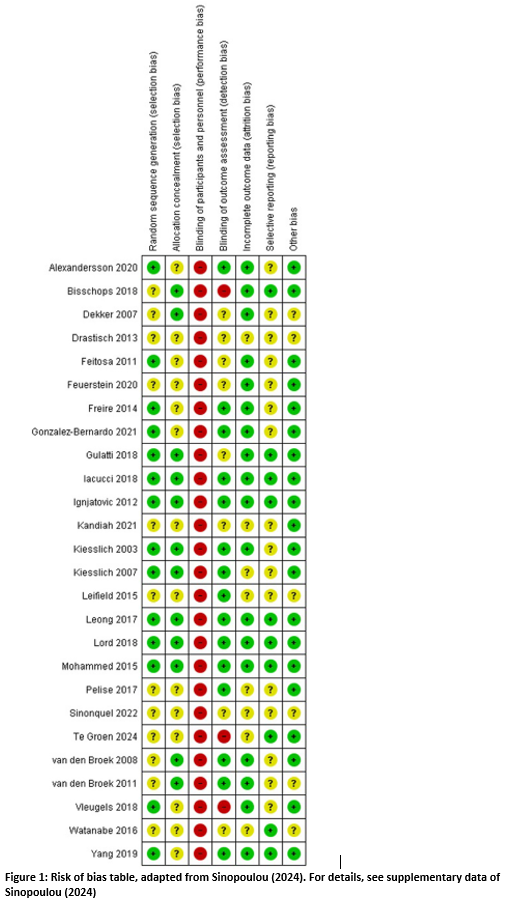
Table of excluded studies
|
Reference |
Reason for exclusion |
|
Huang CW, Yen HH, Chen YY. Endoscopic Techniques for Colorectal Neoplasia Surveillance in Inflammatory Bowel Disease: A Systematic Review and Network Meta-Analysis. United European Gastroenterol J. 2025 Mar 27. doi: 10.1002/ueg2.70017. Epub ahead of print. PMID: 40145876. |
Incomplete search strategy |
Beoordelingsdatum en geldigheid
Publicatiedatum : 03-09-2026
Beoordeeld op geldigheid : 03-09-2026
Samenstelling werkgroep
Voor het ontwikkelen van de richtlijnmodule is in 2023 een multidisciplinair cluster ingesteld. Het cluster Benigne Darmaandoeningen bestaat uit meerdere richtlijnen (zie hier de actuele clusterindeling). De stuurgroep bewaakt het proces van modulair onderhoud binnen het cluster. De expertisegroepsleden brengen hun expertise in, indien nodig. De volgende personen uit het cluster zijn betrokken geweest bij de herziening van deze module:
Clusterstuurgroepleden
- Prof. dr. A.A.M. (Ad) Masclee, MDL-arts, MUMC+, NVMDL (voorzitter)
- Prof. dr. G. (Gerd) Bouma, MDL-arts, AUMC, NVMDL
- Dr. C.P. (Charlotte) Peters, MDL-arts, Diakonessenhuis, NVMDL
- Dr. W. (Willemien) de Vries, kinderarts, Rijnstate, NVK
- Dr. E.J.A. (Ernst) Steller, gastro-enteraal chirurg, Isala, NVvH
- Dr. C.EJ. (Pim) Sloots, kinderchirurg, Erasmus MC (Sophia Kinderziekenhuis), NVvK
- Drs. M.P (Menne) Scherpenzeel, patiëntvertegenwoordiger, Crohn & Colitis NL
Betrokken clusterexpertisegroepleden
- Prof. Dr. B (Bas) Oldenburg, MDL-arts, UMCU, NVMDL
- Dr. A. (Ankie) Reumkens, MDL-arts, Elkerliek ziekenhuis, NVMDL
- Dr. A.S.L.P (Stijn) Crohnbach, patholoog, LUMC, NVVP (pathologie)
Met ondersteuning van
- Drs. H. (Hanneke) Olthuis, adviseur, Kennisinstituut van de Federatie Medisch Specialisten (tot 1 februari 2025)
- Drs. J.M.H. (Harm-Jan) van der Hart, adviseur, Kennisinstituut van de Federatie Medisch Specialisten
- Drs. A. (Anne-Wil) Valk, junior adviseur, Kennisinstituut van de Federatie Medisch Specialisten
- Drs. E. (Esther) van der Bijl, medisch informatiespecialist, Kennisinstituut van de Federatie Medisch Specialisten
Belangenverklaringen
Een overzicht van de belangen van de clusterleden en het oordeel over het omgaan met eventuele belangen vindt u in onderstaande tabel. De ondertekende belangenverklaringen zijn op te vragen bij het secretariaat van het Kennisinstituut van de Federatie Medisch Specialisten via secretariaat@kennisinstituut.nl.
Gemelde (neven)functies en belangen stuurgroepleden
|
Naam |
Hoofdfunctie |
Nevenwerkzaam-heden |
Persoonlijke financiële belangen |
Extern gefinancierd onderzoek |
Intellectuele belangen en reputatie, overige belangen |
Restrictie |
|
Prof. dr. A.A.M. (Ad) Masclee |
Voorzitter Medisch Ethische Toetsingscommissie Maastricht UMC (betaald, 0,3 FTE) Gepensioneerd MDL arts sedert okt '21, voormalig hoofd MDL ziekten Maastricht UMC |
Geen |
Geen |
Ja, Standardizing Training for endoscopic Resection of Large Non-Pedunculated Colorectal polyps, financier: KWF
|
Geen |
Geen restricties |
|
Prof. dr. G. (Gerd) Bouma |
MDL-arts |
Geen |
Geen |
Klinische trial naar effect van anti-IL15 in behandeling coeliakie, financier: Calypso, rol als projectleider.
Klinische trial naar effect van anti-IL15 in behandeling coeliakie, financier: Provention, geen PI;
klinisch onderzoek naar behandeling refractaire coeliakie, financier: Pfizer, geen PI;
wetenschappelijk/fundamenteel onderzoek naar lymfomagenese coeliakie, financier MLDS, geen PI |
Geen |
Restricties t.a.v. besluitvorming voor modules over behandeling met anti-IL15 bij patiënten met coeliakie. |
|
Dr. C.P. (Charlotte) Peters |
MDL-arts |
Geen |
Geen |
Geen |
Geen |
Geen restricties |
|
Dr. W. (Willemien) de Vries |
Kinderarts |
Bestuurslid sectie kinder-MDL van de NVK, onbetaald. |
Geen |
Geen |
Geen |
Geen restricties |
|
Dr. E.J.A. (Ernst) Steller |
Chirurg |
Geen |
Geen |
Geen |
Geen |
Geen restricties |
|
Dr. C.EJ. (Pim) Sloots |
Kinderchirurg |
Geen |
Geen |
Geen |
Geen |
Geen restricties |
|
Drs. M.P (Menne) Scherpenzeel |
Directeur Crohn & Colitis NL |
Partner adviesbureau Blauwe Noordzee (0,1), bezoldigd Voorzitter adviescommissie Fonds Gehandicaptensport, onbezoldigd Lid RvT Q en C Support, bezoldigd (komt ten goede aan Crohn & Colitis NL) Lid van adviesraden Pfizer en Jassen, bezoldigd (komt ten goede aan Crohn & Colitis NL) |
Geen |
Divers onderzoek (ZonMW en MDL Fonds, geen rol als projectleider, focus op inbreng patientenperspectief) |
Het werk van Crohn & Colitis NL wordt mede mogelijk gemaakt door pharma (multisponsoring; geen invloed op de invulling van activiteiten).. |
Geen restricties |
Gemelde (neven)functies en belangen betrokken expertisegroepleden
|
Naam |
Hoofdfunctie |
Nevenwerkzaam-heden |
Persoonlijke financiële belangen |
Extern gefinancierd onderzoek |
Intellectuele belangen en reputatie, overige belangen |
Restrictie |
|
Prof. Dr. B (Bas) Oldenburg |
MDL-arts |
Voorzitter IBD commissie van de NVMDL |
Geen |
1. Takeda - identificatie biomarkers voor vedolizumab (projectleider) 2. Alpha Sigma - identificatie biomarkers voor filgotinib (projectleider) 3. Abbvie - Pathogenese IBD (projectleider) |
In de richtlijn zal een nieuw predictiemodel gebruikt worden dat in het UMC Utrecht ontwikkeld is. |
Restrictie t.a.v. besluitvorming over 1) gebruik van predictiemodel(len) voor 'advanced colerectal neoplasia' bij IBD en 2) voorspellen van non-response van monoklonale antilichamen en JAK-remmers. |
|
Dr. A. (Ankie) Reumkens |
MDL-arts |
Geen |
Geen |
Geen |
Geen |
Geen restricties |
|
Dr. A.S.L.P (Stijn) Crohnbach |
Patholoog |
Geen |
Geen |
Geen |
Geen |
Geen restricties |
Inbreng patiëntenperspectief
Er werd aandacht besteed aan het patiëntenperspectief door afvaardiging van Crohn & Colitis NL in het cluster. De verkregen input is meegenomen bij het opstellen van de uitgangsvragen, de keuze voor de uitkomstmaten en bij het opstellen van de overwegingen (zie kopje waarden en voorkeuren van patiënten). De conceptrichtlijn is tevens voor commentaar voorgelegd aan Crohn & Colitis NL en de eventueel aangeleverde commentaren zijn bekeken en verwerkt.
Kwalitatieve raming van mogelijke financiële gevolgen in het kader van de Wkkgz
geschillen zorg (Wkkgz) een kwalitatieve raming uit om te beoordelen of de aanbevelingen mogelijk leiden tot substantiële financiële gevolgen. Bij het uitvoeren van deze beoordeling is de richtlijnmodule op verschillende domeinen getoetst (zie het stroomschema bij Werkwijze).
|
Module |
Uitkomst raming |
Toelichting |
|
Surveillancebeleid |
Geen financiële gevolgen |
Hoewel uit de toetsing volgt dat de aanbeveling(en) breed toepasbaar zijn (5.000-40.000 patiënten per jaar), volgt uit de toetsing dat het geen nieuwe manier van zorgverlening of andere organisatie van zorgverlening betreft. Er worden daarom geen financiële gevolgen verwacht. |
Werkwijze
Voor meer details over de gebruikte richtlijnmethodologie verwijzen wij u naar de Werkwijze.
Zoekverantwoording
Algemene informatie
|
Cluster/richtlijn: Benigne Darmziekte - Inflammatoire darmziekten - Module surveillance IBD |
|
|
Uitgangsvraag/modules: Hoe dient de surveillance op colorectaal carcinoom er uit te zien? |
|
|
Database(s): Embase.com, Ovid/Medline |
Datum: 28 april 2025 |
|
Periode: vanaf 2010 |
Talen: geen restrictie |
|
Literatuurspecialist: Esther van der Bijl |
Rayyan review: https://new.rayyan.ai/reviews/1431025/overview |
|
BMI-zoekblokken: voor verschillende opdrachten wordt (deels) gebruik gemaakt van de zoekblokken van BMI-Online https://blocks.bmi-online.nl/ Deduplication: voor het ontdubbelen is gebruik gemaakt van http://dedupendnote.nl/ |
|
|
Toelichting:
De sleutelartikelen worden gevonden met deze search. |
|
|
Te gebruiken voor richtlijntekst: A systematic literature search was performed by a medical information specialist using the following bibliographic databases: Embase.com and Ovid/Medline. Both databases were searched from 2010 to 28th of April 2025 for systematic reviews and RCTs. Systematic searches were completed using a combination of controlled vocabulary/subject headings (e.g., Emtree-terms, MeSH) wherever they were available and natural language keywords. The overall search strategy was derived from four primary search concepts: (1) inflammatory bowel disease; (2) colorectal tumor; (3) surveillance; (4) dye based chromoendoscopy. Duplicates were removed using EndNote software. After deduplication a total of 157 records were imported for title/abstract screening. |
|
Zoekopbrenst - 28 april 2025
|
|
EMBASE |
OVID/MEDLINE |
Ontdubbeld |
|
SR |
52 |
45 |
|
|
RCT |
76 |
76 |
|
|
Totaal |
128 |
121 |
157* |
*in Rayyan
Zoekstrategie - 28 april 2025
Embase.com
|
No. |
Query |
Results |
|
#1 |
'inflammatory bowel disease'/exp OR 'crohn disease'/exp OR 'enterocolitis'/exp OR 'experimental inflammatory bowel disease'/exp OR 'ulcerative colitis'/exp OR 'pancolitis'/exp OR (('colon'/exp OR 'colon disease'/de) AND 'inflammation'/de) OR (inflammator*:ti,ab,kw AND bowel:ti,ab,kw AND disease*:ti,ab,kw) OR (((inflam* OR inflam*) NEAR/8 bowel*):ti,ab,kw) OR (((ulcer* OR histiocytic* OR mucosa* OR idiopathic* OR 'procto col*' OR granuloma* OR terminal OR region*) NEAR/3 (coli* OR colli* OR colon* OR colorectit* OR proctocol* OR proctit* OR enterit* OR ileit*)):ti,ab,kw) OR crohn*:ti,ab,kw OR 'cronh*':ti,ab,kw OR colienterit*:ti,ab,kw OR collienteriti*:ti,ab,kw OR enterocolit*:ti,ab,kw OR enterocollit*:ti,ab,kw OR pancolit*:ti,ab,kw OR pancollit*:ti,ab,kw OR ibd:ti,ab,kw OR pibd:ti,ab,kw OR 'ulcerati* col*':ti,ab,kw OR 'coliti* gravis':ti,ab,kw OR 'colliti* gravis':ti,ab,kw OR ileocolit*:ti,ab,kw OR ileocollit*:ti,ab,kw |
344335 |
|
#2 |
'colorectal tumor'/exp OR (('colon'/exp OR 'rectum'/exp) AND ('neoplasm'/exp OR adenoma*:ti,ab,kw OR cancer*:ti,ab,kw OR carcinogen*:ti,ab,kw OR carcinom*:ti,ab,kw OR malign*:ti,ab,kw OR metasta*:ti,ab,kw OR neoplas*:ti,ab,kw OR oncogen*:ti,ab,kw OR oncolog*:ti,ab,kw OR precancer*:ti,ab,kw OR tumor*:ti,ab,kw OR tumour*:ti,ab,kw)) OR (((colorectal* OR 'colo* rectal*' OR colon* OR mesocolon* OR rectum OR rectal OR rectocolon* OR recti OR pararectal OR retrorectal) NEAR/3 (neoplas* OR tumor* OR tumour* OR mass OR masses OR villous OR adenoma* OR lesion OR cancer* OR carcinogen* OR malign* OR cancerogen* OR precancer* OR paraneoplas*)):ti,ab,kw) OR crc:ti,ab,kw |
616372 |
|
#3 |
'monitoring'/exp OR 'screening'/de OR 'screening test'/exp OR 'follow up'/exp OR 'follow* up':ti,ab,kw OR 'followup':ti,ab,kw OR screening:ti,ab,kw OR monitor*:ti,ab,kw OR surveillanc*:ti,ab,kw |
6211507 |
|
#4 |
#2 OR #3 |
6677567 |
|
#5 |
'dye based chromoendoscopy'/exp OR (('chromoendoscopy'/exp OR 'endoscopy'/exp OR 'endoscope'/exp OR 'chromoendoscop*':ti,ab,kw OR 'chromoscop*':ti,ab,kw OR endoscop*:ti,ab,kw) AND ('indigo carmine'/exp OR 'indicarmin*':ti,ab,kw OR 'indigocarmin*':ti,ab,kw OR 'indigotin*':ti,ab,kw OR 'indigo carmine':ti,ab,kw OR dye*:ti,ab,kw OR spray*:ti,ab,kw OR 'high definition':ti,ab,kw)) OR dbc:ti,ab,kw OR dce:ti,ab,kw |
26145 |
|
#6 |
#1 AND #4 AND #5 |
799 |
|
#7 |
#6 AND [2010-2025]/py NOT ('conference abstract'/it OR 'editorial'/it OR 'letter'/it OR 'note'/it) NOT (('animal'/exp OR 'animal experiment'/exp OR 'animal model'/exp OR 'nonhuman'/exp) NOT 'human'/exp) |
276 |
|
#8 |
'meta analysis'/exp OR 'systematic review'/exp OR 'scoping review'/exp OR 'rapid review'/exp OR 'umbrella review'/exp OR 'cochrane database of systematic reviews'/jt OR 'network meta-analysis'/exp OR 'networkmeta analy*':ti,ab,kw OR 'networkmetaanaly*':ti,ab,kw OR metaanaly*:ti,ab,kw OR 'meta analy*':ti,ab,kw OR metanaly*:ti,ab,kw OR prisma:ti,ab,kw OR prospero:ti,ab,kw OR metaanali*:ti,ab,kw OR 'meta anali*':ti,ab,kw OR metanali*:ti,ab,kw OR (((systemati* OR scoping OR umbrella OR 'structured literature') NEAR/3 (review* OR overview*)):ti,ab,kw) OR (((structured OR systemic*) NEAR/3 (review* OR overview* OR synth*) NEAR/3 literature):ti,ab,kw) OR ((systemic* NEAR/1 review*):ti,ab,kw) OR (((systemati* OR literature OR database* OR 'data base*') NEAR/10 search*):ti,ab,kw) OR (((structured OR comprehensive* OR systemic*) NEAR/3 search*):ti,ab,kw) OR (((literature NEAR/3 (review* OR overview*)):ti,ab,kw) AND (search*:ti,ab,kw OR database*:ti,ab,kw OR 'data base*':ti,ab,kw)) OR (('data extraction*':ti,ab,kw OR 'data source*':ti,ab,kw) AND ('study selection*':ti,ab,kw OR 'studies selection*':ti,ab,kw)) OR ('search strateg*':ti,ab,kw AND 'selection criteria*':ti,ab,kw) OR ('data source*':ti,ab,kw AND 'data synth*':ti,ab,kw) OR medline*:ti,ab,kw OR pubmed*:ti,ab,kw OR 'pub med*':ti,ab,kw OR embase:ti,ab,kw OR cochrane*:ti,ab,kw OR (((critical* OR rapid*) NEAR/2 (review* OR overview* OR synth*)):ti) OR ((((critical* OR rapid*) NEAR/3 (review* OR overview* OR synth*)):ab) AND (search*:ab OR database*:ab OR 'data base*':ab)) OR metasynth*:ti,ab,kw OR 'meta synth*':ti,ab,kw OR 'review* of review*':ti,ab,kw |
1103713 |
|
#9 |
'clinical trial'/exp OR 'randomization'/exp OR 'single blind procedure'/exp OR 'double blind procedure'/exp OR 'crossover procedure'/exp OR 'placebo'/exp OR 'prospective study'/exp OR rct:ab,ti OR random*:ab,ti OR 'single blind':ab,ti OR 'randomized controlled trial'/exp OR placebo*:ab,ti |
4259809 |
|
#10 |
#7 AND #8 - SR |
52 |
|
#11 |
#7 AND #9 NOT #10 - RCT |
76 |
|
#12 |
#10 OR #11 - Totaal |
128 |
Ovid/Medline
|
# |
Searches |
Results |
|
1 |
exp Inflammatory Bowel Diseases/ or exp Colitis, Ulcerative/ or exp Crohn Disease/ or exp Enterocolitis/ or (exp Colon/ and Inflammation/) or (inflammator* and bowel and disease*).ti,ab,kf. or ((inflam* or inflam*) adj8 bowel*).ti,ab,kf. or ((ulcer* or histiocytic* or mucosa* or idiopathic* or procto col* or granuloma* or terminal or region*) adj3 (coli* or colli* or colon* or colorectit* or proctocol* or proctit* or enterit* or ileit*)).ti,ab,kf. or crohn*.ti,ab,kf. or cronh*.ti,ab,kf. or colienterit*.ti,ab,kf. or collienteriti*.ti,ab,kf. or enterocolit*.ti,ab,kf. or enterocollit*.ti,ab,kf. or pancolit*.ti,ab,kf. or pancollit*.ti,ab,kf. or ibd.ti,ab,kf. or pibd.ti,ab,kf. or ulcerati* col*.ti,ab,kf. or coliti* gravis.ti,ab,kf. or colliti* gravis.ti,ab,kf. or ileocolit*.ti,ab,kf. or ileocollit*.ti,ab,kf. |
206150 |
|
2 |
exp "Early Detection of Cancer"/ or exp Colorectal Neoplasms/ or ((exp Colon/ or exp Rectum/) and (exp Neoplasms/ or adenoma*.ti,ab,kf. or cancer*.ti,ab,kf. or carcinogen*.ti,ab,kf. or carcinom*.ti,ab,kf. or malign*.ti,ab,kf. or metasta*.ti,ab,kf. or neoplas*.ti,ab,kf. or oncogen*.ti,ab,kf. or oncolog*.ti,ab,kf. or precancer*.ti,ab,kf. or tumor*.ti,ab,kf. or tumour*.ti,ab,kf.)) or ((colorectal* or colo* rectal* or colon* or mesocolon* or rectum or rectal or rectocolon* or recti or pararectal or retrorectal) adj3 (neoplas* or tumor* or tumour* or mass or masses or villous or adenoma* or lesion or cancer* or carcinogen* or malign* or cancerogen* or precancer* or paraneoplas*)).ti,ab,kf. or crc.ti,ab,kf. |
400259 |
|
3 |
(monitor* or surveillanc* or follow* up or followup or screening).ti,ab,kf. |
3380901 |
|
4 |
2 or 3 |
3686765 |
|
5 |
((exp Colonoscopy/ or Endoscopy/ or Endoscopy, Digestive System/ or Endoscopes/ or Endoscopes, Gastrointestinal/ or 'chromoendoscop*'.ti,ab,kf. or 'chromoscop*'.ti,ab,kf. or endoscop*.ti,ab,kf.) and (exp Coloring Agents/ or exp Indigo Carmine/ or 'indicarmin*'.ti,ab,kf. or 'indigocarmin*'.ti,ab,kf. or 'indigotin*'.ti,ab,kf. or 'indigo carmine'.ti,ab,kf. or dye*.ti,ab,kf. or spray*.ti,ab,kf. or 'high definition'.ti,ab,kf.)) or dbc.ti,ab,kf. or dce.ti,ab,kf. |
15391 |
|
6 |
1 and 4 and 5 |
340 |
|
7 |
limit 6 to yr="2010 -Current" |
269 |
|
8 |
7 not (comment/ or editorial/ or letter/) not ((exp animals/ or exp models, animal/) not humans/) |
255 |
|
9 |
exp Meta-Analysis/ or exp Network Meta-Analysis/ or exp Systematic Review/ or (networkmeta analy* or networkmetaanaly* or metaanaly* or meta analy* or metanaly* or prisma or prospero or metaanali* or meta anali* or metanali*).ti,ab,kf. or ((systemati* or scoping or umbrella or structured literature) adj3 (review* or overview*)).ti,ab,kf. or ((structured or systemic*) adj3 (review* or overview* or synth*) adj3 literature).ti,ab,kf. or (systemic* adj1 review*).ti,ab,kf. or ((systemati* or literature or database* or data base*) adj10 search*).ti,ab,kf. or ((structured or comprehensive* or systemic*) adj3 search*).ti,ab,kf. or ((literature adj3 (review* or overview*)) and (search* or database* or data base*)).ti,ab,kf. or ((data extraction* or data source*) and (study selection* or studies selection*)).ti,ab,kf. or (search strateg* and selection criteria*).ti,ab,kf. or (data source* and data synth*).ti,ab,kf. or (medline* or pubmed* or pub med* or embase or cochrane*).ti,ab,kf. or cochrane.jw. or ((critical* or rapid*) adj2 (review* or overview* or synth*)).ti. or (((critical* or rapid*) adj3 (review* or overview* or synth*)) and (search* or database* or data base*)).ab. or metasynth*.ti,ab,kf. or meta synth*.ti,ab,kf. |
825866 |
|
10 |
exp clinical trial/ or randomized controlled trial/ or exp clinical trials as topic/ or randomized controlled trials as topic/ or Random Allocation/ or Double-Blind Method/ or Single-Blind Method/ or (clinical trial, phase i or clinical trial, phase ii or clinical trial, phase iii or clinical trial, phase iv or controlled clinical trial or randomized controlled trial or multicenter study or clinical trial).pt. or random*.ti,ab. or (clinic* adj trial*).tw. or ((singl* or doubl* or treb* or tripl*) adj (blind$3 or mask$3)).tw. or Placebos/ or placebo*.tw. |
2881316 |
|
11 |
8 and 9 - SR |
45 |
|
12 |
(8 and 10) not 11 - RCT |
76 |
|
13 |
11 or 12 - Totaal |
121 |