
Generiek of spécialité
Uitgangsvraag
Hoe kan omgegaan worden met (de noodzaak tot) wisselen tussen generieke en spécialité anti-aanvalsmedicatie bij volwassenen en kinderen met epilepsie?
Aanbeveling
Aanbeveling-1
Schrijf bij de start van een nieuw anti-aanvalsmedicijn voor op stofnaam (initiële monotherapie, omschakelen naar alternatieve monotherapie, of start van add-on therapie).
Aanbeveling-2
Verander niet van spécialité naar generiek bij gebruik van anti-aanvalsmedicatie, behalve indien er van een spécialité een generieke variant op de markt komt of als er sprake is van leveringsproblemen.
Aanbeveling-3
Verander niet van fabrikant bij gebruik van een generiek middel, tenzij er sprake is van leveringsproblemen.
Aanbeveling-4
Vermeld op het recept dat er een medische noodzaak is voor het niet substitueren van het spécialité wanneer substitutie niet wenselijk is.
Overwegingen
Waarom deze aanbeveling?
De werkgroep constateert dat het beschikbare wetenschappelijke bewijs over het wisselen van anti-aanvalsmedicatie overwegend van zeer lage kwaliteit is volgens de GRADE-methodiek. Hoewel de meeste studies geen statistisch significant of gemiddeld klinisch relevant effect laten zien, zijn de resultaten onzeker en beperkt door methodologische tekortkomingen en heterogene populaties. Daarnaast tonen subgroep analyses bij patiënten met goed gecontroleerde aanvallen aanwijzingen voor een potentieel klinisch relevant effect, ondanks gebrek aan statistische significantie.
Gezien de mogelijke ernstige gevolgen van een aanval en in lijn met internationale en nationale richtlijnen, heeft de werkgroep ervoor gekozen klinische relevantie en patiëntveiligheid zwaarder te laten wegen dan statistische significantie alleen.
Aanbeveling-1
Het beschikbare bewijs toont geen overtuigend klinisch relevant verschil in effectiviteit of veiligheid tussen merkgeneesmiddelen en generieke varianten van anti-aanvalsmedicatie. Door bij de start van een nieuw anti-aanvalsmedicijn voor te schrijven op stofnaam wordt een consistente en doelmatige keuze mogelijk gemaakt. Deze benadering sluit aan bij internationale richtlijnen en beperkt onnodige discussies over wisselingen tijdens een later stadium van de behandeling.
Eindoordeel:
Sterke aanbeveling voor.
Aanbeveling-2
Hoewel het beschikbare wetenschappelijke bewijs geen eenduidig klinisch relevant risico aantoont bij het wisselen tussen merken anti-aanvalsmedicatie, is de kwaliteit van dit bewijs laag volgens de GRADE-methodiek. Gezien de mogelijke ernstige gevolgen van een aanval en de consistentie die nodig is bij een stabiele instelling, adviseert de werkgroep wisselen tussen merken in het algemeen te vermijden. Uitzonderingen worden alleen gemaakt bij introductie van een generieke variant of bij leveringsproblemen, waarbij uniforme regionale afstemming en duidelijke afspraken over (terug)wisseling bijdragen aan patiëntveiligheid en uitvoerbaarheid in de praktijk.
Eindoordeel:
Conditionele aanbeveling voor.
Aanbeveling-3
Hoewel het beschikbare wetenschappelijke bewijs geen eenduidig klinisch relevant risico aantoont bij het wisselen tussen merken anti-aanvalsmedicatie, is de kwaliteit van dit bewijs laag volgens de GRADE-methodiek. Gezien de mogelijke ernstige gevolgen van een aanval, bekende variatie in bio-equivalentie tussen preparaten en de consistentie die nodig is bij een stabiele instelling, adviseert de werkgroep wisselen tussen merken in het algemeen te vermijden. Uitzonderingen worden alleen gemaakt bij leveringsproblemen, waarbij uniforme regionale afstemming en duidelijke afspraken over (terug)wisseling bijdragen aan patiëntveiligheid en uitvoerbaarheid in de praktijk.
Eindoordeel:
Conditionele aanbeveling voor.
Aanbeveling-4
Bij een patiënt die stabiel is ingesteld op een specifiek preparaat kan wisselen tussen merken of generieke varianten leiden tot onzekerheid over effectiviteit en tolerantie, met mogelijk klinisch relevante gevolgen. Het expliciet vermelden van medische noodzaak op het recept draagt bij aan consistentie in de behandeling en duidelijke communicatie tussen voorschrijver en apotheek.
Eindoordeel:
Sterke aanbeveling voor.
Balans tussen voor- en nadelen van de interventie
Bij het switchen tussen verschillende merken geneesmiddelen kunnen in sommige gevallen medicatiefouten/vergissingen optreden. In 2022 verscheen de 'Leidraad Verantwoord Wisselen' van de FMS, Patiëntenfederatie Nederland, het Nederlands Huisartsen Genootschap (NHG), de Landelijke Huisartsen Vereniging (LHV), KNMP en Zorgverzekeraars Nederland (ZN). (herziening 2024). In deze Leidraad vallen de klassieke anti-epileptica nog onder de rode categorie (in afwachting van herevaluatie), de overige anti-epilepsie middelen vallen onder de oranje categorie. Voor al deze anti-aanvalsmedicatie wordt geadviseerd om bij anti-aanvalsmedicatie vanwege de indicatie epilepsie niet te substitueren. Volgens de Leidraad hebben geneesmiddelen in de oranje categorie in combinatie met de vermelde indicaties, het risico dat door onjuist gebruik en/of foutieve toediening, ernstige klinische problemen voor de patiënt kunnen optreden. Hiervoor zijn de volgende criteria gebruikt: verminderde werking bij stoppen van inname langer dan 60 uur, toxiciteit bij inname dubbele dosis en/of verminderde werking door fout gebruik hulpmiddel.
Deze Leidraad is onder andere gebaseerd op de KNMP-handleiding Geneesmiddelsubstitutie (2018). Hierin staat dat middelen als bio-equivalent worden beschouwd wanneer het 90%-betrouwbaarheidsinterval van de AUC en Cmax tussen 80% en 125% van het referentieproduct ligt.
Voor geneesmiddelen met een smalle therapeutische breedte, zoals veel klassieke anti-epileptica, geldt een striktere marge van 90% tot 111%, omdat kleine verschillen in blootstelling al klinisch merkbaar kunnen zijn. Volgens de Leidraad Verantwoord Wisselen vallen de volgende middelen onder de rode categorie: carbamazepine, oxcarbazepine, fenobarbital, primidon en valproïnezuur.
Wetenschappelijk bewijs en kwaliteit
In 2025 werden twee studies (Lang, 2021; Tharavichitkun, 2022) aan de literatuursamenvatting toegevoegd. Lang (2021) voerde een retrospectieve cohortstudie uit onder kinderen en adolescenten in Duitsland, waarbij verschillende specialité- en generieke anti-aanvalsmedicatie werden vergeleken. Tharavichitkun (2022) deed een retrospectieve pre-post studie in Thailand, gericht op de overstap van spécialité levetiracetam naar een generieke variant bij volwassen patiënten met epilepsie.
In beide studies werd de uitkomstmaat 'aanvalsincidentie' onderzocht. Lang (2021) vond dat overstappen van spécialité naar generiek geassocieerd was met lagere kans op terugkerende aanvallen. Tharavichitkun (2022) rapporteerde geen significant verschil in aanvalsfrequentie na overstap van spécialité naar generiek levetiracetam. In een subgroep met gecontroleerde epilepsie nam het aantal aanvallen na overstap van spécialité naar generiek licht toe. Voor beide studies geldt dat de kwaliteit van het bewijs als zeer laag wordt beoordeeld op basis van de GRADE methode. De werkgroep is van mening dat in lijn met internationale richtlijnen en eigen eerdere aanbevelingen het advies is om niet te switchen tussen fabrikanten van anti-aanvalsmedicatie, tenzij dit om logistieke redenen niet anders kan.
In de literatuursamenvatting opgesteld vóór 2025 wordt besproken dat twee systematische reviews (Kesselheim, 2010; Yamada & Welty, 2011) geen statistisch of klinisch relevant verschil in effectiviteit vonden tussen spécialité en generieke anti-aanvalsmedicatie. De RCTs waren klein en de duur van follow-up was kort, maar een meta-analyse bevestigde het ontbreken van verschil. Ook werden geen ernstige bijwerkingen gemeld bij generieke middelen. Daarnaast toont een case-crossover studie (Kesselheim, 2016) onder ruim 83.000 patiënten dat zowel het herhalen van hetzelfde generieke middel als het wisselen van fabrikant geassocieerd is met een lichte toename in het risico op aanvalsgerelateerde gebeurtenissen, maar het blijft onduidelijk of dit wijst op een verandering in aanvalsfrequentie.
In beide systematische reviews geïncludeerd in de literatuursamenvatting van vóór 2025 worden naast RCTs ook observationele studies geanalyseerd (Kesselheim, 2010; Yamada & Welty, 2011). Hierin wordt gekeken naar niet-gevalideerde indirecte uitkomstmaten, zoals de frequentie waarmee de medicatie van patiënten wordt aangepast (‘switchback rates’), of de mate waarin epilepsiepatiënten aanspraak maken op de gezondheidszorg, voor en na introductie van een generiek alternatief. De relatie tussen deze indirecte uitkomstmaten en de effectiviteit van anti-aanvalsmedicatie in het reduceren van de aanvalsfrequentie is onduidelijk. Een hoge switchback frequentie na de introductie van een generiek anti-aanvalsmedicijn kan het gevolg zijn van een sterke voorkeur van patiënten mede ingegeven door berichtgeving in de media en anekdotisch bewijs. Een toename in het aantal doktersbezoeken na introductie van een generiek anti-aanvalsmedicijn kan het gevolg zijn van een meer intensieve begeleiding van de arts of angsten bij de patiënt zoals gebruikelijk bij de overgang op een nieuw middel. Geen van de observationele studies houdt voldoende rekening met bovenstaande en overige potentiële confounders, en de resultaten kunnen niet zonder meer gebruikt worden ter ondersteuning van de stelling dat er een verschil in effectiviteit zou bestaan tussen spécialité en generieke middelen.
Duh (2009) heeft een literatuurreview verricht naar de medische kosten die gepaard gaan met generieke substitutie (gebaseerd op gegevens uit verzekeringsdatabases) en concludeert dat de lagere kosten van de middelen niet opwegen tegen de stijging van de overige medische kosten (meer opnames en doktersbezoek, meer gebruik van andere geneesmiddelen).
Straka (2017) onderzochten de potentiële klinische en economische impact van het wisselen van merkgeneesmiddelen naar generieke alternatieven in het algemeen. Ze vonden dat generieke substitutie vaak resulteerde in aanzienlijke besparingen op medicijnkosten, maar dat de totale zorgkosten moeilijk te kwantificeren zijn vanwege variabele effecten op therapietrouw en zorggebruik. Het onderzoek benadrukt dat hoewel generieke middelen goedkoper zijn, wisselen mogelijk kan leiden tot hogere zorgkosten door extra medische consulten of ziekenhuisopnames bij bepaalde patiëntengroepen. De auteurs stellen dat generieke substitutie een kostenbesparende strategie is, mits zorgvuldig gemonitord.
Tromboli (2018) vonden geen verandering in aanvalsfrequentie of bijwerkingen bij switchen van Keppra naar generieke levetiracetam.
Holtkamp (2018) evalueerden studies die de veiligheid van generieke anti-aanvalsmedicatie onderzochten. Er werd geen toename in aanvalsfrequentie of bijwerkingen bij wijziging van merk naar generiek preparaat of tussen generieke preparaten gevonden. De auteurs veronderstellen wel dat er weerstand kan zijn tegen variatie in vorm en kleur van gebruikte anti-aanvalsmedicatie waardoor de therapietrouw af kan nemen.
Kwaliteit van bewijs
De overall kwaliteit van bewijs is laag tot zeer laag. Dit betekent dat we (zeer) onzeker zijn over het gevonden geschatte effect van de cruciale uitkomstmaten.
Er is bij de studies geïncludeerd in 2025 afgewaardeerd vanwege:
- Ernstige risk of Bias: methodologische beperkingen, onder andere vanwege het niet afwaarderen voor confounding of het niet transparant rapporteren van de confounding variabelen.
- Zeer ernstige imprecisie: onnauwkeurigheid, omdat het betrouwbaarheidsinterval beide grenzen van klinische relevantie overschrijdt of zeer breed is.
Bij de studies geïncludeerd vóór 2025 werd de bewijskracht voor de vergelijking tussen Tegretol en generiek carbamazepine als matig beoordeeld, met één niveau afwaardering vanwege imprecisie (laag aantal gebeurtenissen). Voor de vergelijkingen tussen Dilantin en generieke fenytoïne, en tussen Depakine en generiek valproaat, werd tweemaal afgewaardeerd: één niveau vanwege indirectheid (slechts één directe vergelijking) en één niveau vanwege imprecisie. Hierdoor werd de bewijskracht voor deze vergelijkingen als laag beoordeeld.
Aanvullende argumentatie
Kostenaspecten
Generieke anti-epileptica zijn doorgaans aanzienlijk goedkoper dan spécialités, wat kan leiden tot lagere zorgkosten. Dit is echter geen gegeven. Straka (2017) onderzochten de potentiële klinische en economische impact van het wisselen van merkgeneesmiddelen naar generieke alternatieven. Ze vonden dat generieke substitutie vaak resulteerde in aanzienlijke besparingen op medicijnkosten, maar dat de totale zorgkosten moeilijk te kwantificeren zijn vanwege variabele effecten op therapietrouw en zorggebruik. Het onderzoek benadrukt dat hoewel generieke middelen goedkoper zijn, wisselen mogelijk kan leiden tot hogere zorgkosten door extra medische consulten of ziekenhuisopnames bij bepaalde patiëntengroepen. De auteurs stellen dat generieke substitutie een kostenbesparende strategie is, mits zorgvuldig gemonitord.
Adviezen Andere Richtlijnen/handreikingen
In 2013 verscheen de 'Handleiding geneesmiddelensubstitutie' van de Koninklijke Nederlandse Maatschappij ter bevordering der Pharmacie (KNMP, herziening 2018). In deze handleiding wordt expliciet geadviseerd om bij anti-aanvalsmedicatie vanwege de indicatie epilepsie niet te substitueren. Uitgezonderd van deze substitutie-afspraken zijn dranken en preparaten met een gereguleerd afgiftesysteem.
Eén van de problemen bij substitutie is dat er geen garantie is dat steeds hetzelfde generieke middel (zelfde fabrikant) wordt afgeleverd. Als de apotheek deze garantie wel kan bieden, is het volgens de werkgroep verantwoord om één keer te wisselen naar een generiek middel. Dit is ook het geval indien er sprake is van leveringsproblemen. De apotheker beoordeelt of substitutie noodzakelijk is en overlegd dit met de oorspronkelijke voorschrijver. Als substitutie niet wenselijk is moet op het recept vermeld worden dat er een medische noodzaak is voor het voorschrijven van het spécialité, de apotheker kan beoordelen of dit verzekeringstechnisch is toegestaan. De leidraad ‘Verantwoord Wisselen Medicijnen (2024)’ is gebaseerd op bovenstaande handleiding en heeft de klassieke anti-aanvalsmedicatie toegevoegd aan de rode categorie wat aangeeft dat medicijnen niet mogen worden gewisseld, tenzij het medicijn (tijdelijk) door tekorten niet (meer) verkrijgbaar is in Nederland. Overige aanvalsmedicatie is toegevoegd aan de oranje categorie wat aangeeft dat met de toevoeging ‘medische noodzaak’ niet gewisseld mag worden.
Hoewel de recente NICE-richtlijn over epilepsie (NG217, 2022) geen expliciete aanbevelingen geeft met betrekking tot generieke substitutie, blijft het advies bestaan om een consistente levering van het preparaat van dezelfde fabrikant te waarborgen. Dit is met name relevant voor anti-aanvalsmedicatie Derhalve dient men alert te blijven op mogelijke veranderingen in effectiviteit of een verhoogd risico op bijwerkingen bij het wisselen van preparaten, tenzij in overleg met de voorschrijvende arts en de patiënt wordt vastgesteld dat dit geen klinische impact heeft.
De Italian League Against Epilepsy (Roberti, 2021) accepteert dat generieke anti-aanvalsmedicijnen die voldoen aan de EU/VS bio‑equivalentiecriteria klinisch vergelijkbaar zijn met merkpreparaten en kosteneffectief zijn voor behandeling bij aanvang of als add‑on. Generieke substitutie kan veilig zijn, maar onverwachte switches tijdens een aanvalsvrije periode worden niet aanbevolen. Bij het switchen moet men letten op adequate therapeutische monitoring en vermijden dat verschillende formuleringen worden gebruikt. Patiënten moeten adequaat geïnformeerd worden over het nut en de mogelijke implicaties van generieke medicatie.
Waarden en voorkeuren van patiënten (en eventueel hun naasten/verzorgers)
Patiënten met epilepsie hechten groot belang aan continuïteit van merk en fabrikant, vooral wanneer zij langdurig aanvalsvrij zijn. Zowel internationale literatuur (Lang, 2021) als signalen van patiëntenorganisaties tonen dat angst voor terugkeer van aanvallen of bijwerkingen een rol speelt bij een mogelijke wisseling. Een duidelijke uitleg door apotheker en arts over gelijkwaardige werkzaamheid en veiligheid van generieke middelen kan onrust verminderen en is dan essentieel (zie ook werkafspraak 5 en 6 uit de Leidraad Verantwoord Wisselen). Schrijf bij nieuwe patiënten voor op stofnaam zodat de leverende apotheker aan de hand van verzekeringsgegeven het juist merk kan afleveren.
Gezondheidsgelijkheid ((health) equity/equitable)
Er zijn geen aanwijzingen dat specifieke patiëntengroepen ongelijk worden beïnvloed door het beleid rondom substitutie. Dit aspect heeft daarom geen directe invloed op de aanbeveling.
Aanvaardbaarheid:
Ethische aanvaardbaarheid
Het wisselen tussen fabrikanten is ethisch aanvaardbaar wanneer dit noodzakelijk of onvermijdelijk is, bijvoorbeeld bij tekorten of vergoedingsbeperkingen. In dergelijke situaties is het voortzetten van behandeling belangrijker dan het risico op geringe variatie in blootstelling. Goede begeleiding moeten worden geboden. Het starten met een generiek middel blijft ethisch verantwoord, mits therapeutische gelijkwaardigheid is aangetoond.
Duurzaamheid
Generieke geneesmiddelen zijn doorgaans minder milieubelastend in productie en distributie vanwege schaalvoordelen en lagere kosten per eenheid. Dit aspect ondersteunt het gebruik van generieken bij nieuwe patiënten.
Haalbaarheid
Het beleid om niet te wisselen bij stabiele patiënten en generiek te starten bij nieuwe patiënten is praktisch uitvoerbaar binnen de Nederlandse farmaceutische zorg. De Leidraad Veranwoord Wisselen (2024) biedt hiervoor een helder kader, en lokale FTO-afspraken kunnen dit beleid ondersteunen. Het advies blijft zoals het eerder was, dus implementatie is niet nodig. In het kader van vergoedingstechnische aspecten is het van belang dat de voorschrijver op het recept ‘medisch noodzaak’ vermeld.
Onderbouwing
When a drug loses its patent protection, generic alternatives typically enter the market. To be admitted to the European market generic anti-seizure medications must be equal to brand-name products (EMA, 2018). For this purpose, among other requirements, e.g. that the quality requirements of generic medicines should be equal to brand-name drugs, bioequivalence should be demonstrated. It is considered that when the exposure-in-time profile of the generic is the same as that of the brand-name drug, therapeutic equivalence can be considered in case the drug is taken in line with the posology. However, it is known that mistakes in this switching process, e.g., missed doses, double doses, may happen. Dependent on the therapeutic window of the drug involved, the consequences of such mistakes can be mild or severe. For anti-epileptic drugs, it cannot be excluded that such mistakes may lead to seizure recurrence or adverse effects. Randomized clinical trials (RTCs) on this topic are rare.
Another important driver for switching originates from drug shortages, which have become increasingly more common in recent years. When the brand-name product is temporarily unavailable, switching to a generic formulation is often not a matter of preference but of necessity to maintain continuity of care. In such situations, clinicians must balance the urgency of preventing treatment interruption against the potential risk of altered serum concentrations or breakthrough seizures.
This module focuses on the comparison between generic drugs and their brand-name counterparts, exploring both clinical outcomes and, if possible, economic implications.
Summary of Findings
Observational studies included in 2025
Generic anti-seizure medication versus brand-name (specialty) anti-seizure medication with outcomes seizure incidence (seizure freedom, 50% seizure reduction), time to seizure recurrence, adverse events, retention/discontinuation rate
Population: Adults and children with epilepsy
Intervention: Generic anti-seizure medication
Comparator: Brand-name (specialty) anti-seizure medication
|
Outcome
|
Study results and measurements |
Absolute effect estimates
|
Certainty of the Evidence (Quality of evidence) |
Summary |
|
|
|
|
Generic anti-seizure medication
|
Brand-name (specialty) anti-seizure medication |
|
|
|
Seizure incidence (critical) |
Lang, 2021: Odds ratio: 0.56 (95% CI 0.23 to 1.37)
Based on data from 678 participants in one study |
NR |
NR |
Very low Due to serious risk of bias, due to very serious imprecision1 |
The evidence is very uncertain regarding the effect of generic anti-seizure medication on seizure incidence when compared to brand-name (specialty) anti-seizure medication in children with epilepsy.
(Lang, 2021) |
|
Difference: not calculable |
|||||
|
Tharavichitkun, 2022: Mean change after 3 months: 0.47 seizures per month (95% CI -3.70 to 4.64) Mean change after 6 months: 0.38 seizures per month (95% CI -3.27 to 4.03)
Based on data from 75 participants in one study Follow-up: 6 months |
3 months: 3.24 seizures per month (SD 14.49)
6 months: 3.15 seizures per month (SD 14.47) |
Baseline: 2.77 seizures per month (SD 11.41) |
Very low Due to serious risk of bias, due to very serious imprecision2 |
The evidence is very uncertain regarding the effect of generic levetiracetam on seizure incidence when compared to brand-name levetiracetam in pediatric and adult patients with epilepsy.
(Tharavichitkun, 2022) |
|
|
Change: (95% CI -3.70 to 4.64)
6 months: 0.38 seizures per month (95% CI -3.27 to 4.03) |
|||||
|
Time to seizure recurrence (critical) |
- |
- |
No GRADE |
No evidence was found regarding the effect of generic anti-seizure medication compared to brand-name (specialty) anti-seizure medication on time to seizure recurrence in adults and children with epilepsy. |
|
|
Retention/discontinuation rate (important) |
Tharavichitkun, 2022: Discontinuation rate: 6.7% (5 patients)
Based on data from 75 participants in one study Follow-up: 6 months |
6.7% |
NR/not applicable |
No GRADE3 |
The evidence regarding the effect of generic anti-seizure medication compared to brand-name (specialty) anti-seizure medication on retention/discontinuation rate in adults and children with epilepsy could not be graded, as no between group-comparison was available for this outcome measure.
|
|
Not calculable (retention/discontinuation rate was only reported/applicable for post-switch period) |
|||||
|
Adverse events (important) |
Tharavichitkun, 2022: Patients experiencing adverse events: 8.0% (6 patients)
Based on data from 75 participants in one study Follow-up: 6 months |
8.0% |
NR |
No GRADE3 |
The evidence regarding the effect of generic anti-seizure medication compared to brand-name (specialty) anti-seizure medication on adverse events in adults and children with epilepsy could not be graded, as no between group-comparison was available for this outcome measure.
|
|
Not calculable (adverse events were only reported for post-switch period) |
|||||
1. Risk of bias: serious (-1 level). It is not clear for which specific confounding variables the multivariate analysis adjusted. Imprecision: very serious (-2 levels). The confidence interval crosses both borders of clinical relevance.
2. Risk of bias: serious (-1 level). The study did not adjust for confounding variables and there was a lack of objective measurements to assess seizure frequency and adverse events. Imprecision: very serious (-2 levels). The confidence interval was very wide.
3. The evidence could not be graded as no between-group comparison was available.
Studies included in previous summary of literature
When assessing the studies using the GRADE approach, the strength of evidence is considered moderate for the comparison between Tegretol and generic carbamazepine. Points were deducted due to imprecision (low number of events). For the comparisons between Dilantin and generic phenytoin (Epsolin, Eptoin, Epileptin), and between Depakine and generic valproate, additional points were deducted due to indirectness. In these cases, the strength of evidence is low because only one study provides a direct comparison between these drugs. Due to the small sample sizes of the RCTs, a minor difference in effectiveness between brand-name and generic drugs cannot be ruled out. Furthermore, the short duration of the RCTs prevents any conclusions about potential long-term differences in effectiveness. Lastly, studies on recently marketed anti-seizure medications are lacking.
Conclusions
|
Low Grade |
No relevant difference was found in the odds of seizure-related events when the same generic anti-seizure medication was continued, compared to switching to a different manufacturer of the same generic drug.
Source: (Kesselheim, 2016) |
|
Moderate GRADE |
There is no evidence of a clinically relevant difference in the effectiveness of anti-seizure medication between brand-name drugs and their corresponding generic versions. However, this remains unknown for long-term outcomes and for newer anti-seizure medications.
Sources: (Kesselheim, 2010; Yamada & Welty, 2011) |
Description of studies
In the analysis of the literature conducted previously, which was updated until 2020, a total of three studies were included. These were two systematic reviews (Kesselheim, 2010; Yamada, 2011) and one crossover study (Kesselheim, 2016). In 2025, a total of two studies were added to the summary of the literature.
Important study characteristics and results are summarized in the evidence tables (see Tables 2, 3 and the Appendix). The assessment of the risk of bias is summarized in the risk of bias tables (under the tab ‘Evidence tabellen’).
Lang (2021) conducted a retrospective cohort study comparing branded anti-seizure medication (ASM) and generic drugs in children and adolescents with epilepsy. The study data were derived from a database consisting of children who visited one of the 236 pediatricians in Germany between January 2011 and December 2018. Included patients had one of the following diagnoses: localization-related epilepsy, generalized epilepsy, as well as special epileptic syndromes, unspecified ‘‘grand mal”, ‘‘petit mal” seizures, and other unspecified epilepsies. Patients had to have at least one documented seizure during the complete study period, but no seizure within 180 days prior to the index date (the day of the first seizure after a preceding period of 180 seizure-free days). Additionally, at least two prescriptions from the same pediatrician within 360 days and at least one prescription within 180 days prior to the index date were required. Furthermore, individuals needed to be able to be matched 1:1 on an individual level according to age, gender, insurance status, and treating pediatrician to seizure-free patients serving as a control group. The same inclusion criteria applied for the controls, except that their index dates consisted of a randomly selected visit at their treating pediatrician’s office within the study period, since they did not suffer seizures.
Tharavichitkun (2022) conducted a retrospective pre-post observational study, comparing the change from the original levetiracetam (Keppra®, UCB Pharma S.A., Braine-l’Alleud, Belgium) to the equivalent generic drug (Lecetam®, Unison Laboratories Co., Ltd., Chachoengsao, Thailand). The study was conducted at the outpatient department of the Neurological Institute of Thailand in Bangkok. Inclusion criteria included being diagnosed with epilepsy at least six months before the transition, stable seizure frequency (within ±25% of their mean seizure frequency), and have been taking a stable dose of the original levetiracetam to maintain a steady-state concentration during the 72 h before the transition. In addition, the patients have abruptly received a generic levetiracetam dose equivalent to that of the brand-name levetiracetam at the transition visit. The dosing regimen of concomitant AEDs was also not modified within 72 h before and after the substitution. Exclusion criteria were an absence seizure, therapy with levetiracetam formulations other than tablets before the substitution, a record of poor compliance or >80% missed doses in the medical chart, death, or loss to follow-up.
Table 2. Characteristics of included studies
|
Study |
Participants |
Comparison |
Follow-up |
Outcome measures |
Comments |
Risk of bias (per outcome measure)* |
|
Individual studies |
||||||
|
Lang, 2021 |
N at baseline1 Patients with recurrent seizures: 339 Seizure-free matched controls: 339
Age (mean, SD)1 Patients with recurrent seizures: 9.6 (4.4) years Seizure-free matched controls: 9.6 (4.4) years
Sex1 Patients with recurrent seizures: 46.0% female Seizure-free matched controls: 46.0% female
Generic anti-seizure medication as last prescription before index date Patients with recurrent seizures: 61.1% Seizure-free matched controls: 58.4%
Brand-name (specialty) anti-seizure medication as last prescription before index date Patients with recurrent seizures: 38.9% Seizure-free matched controls: 41.6% |
Intervention: Switch from brand-name (specialty) to generic anti-seizure medication
Control: |
180 days (prior to index date due to retrospective nature of the study) |
|
|
Some concerns (for outcome seizure incidence) |
|
Tharavichitkun, 2022 |
N at baseline2 75
Uncontrolled/Controlled seizures (N, %) 25 (33%) /50 (66%)
Age (mean, SD)2 40.3 (17.9) years
Sex2 53.3% women
|
Intervention: generic version of levetiracetam (Lecetam®, Unison Laboratories Co., Ltd., Chachoengsao, Thailand)
Control: brand-name levetiracetam (Keppra®, UCB Pharma S.A., Braine-l’Alleud, Belgium) |
3 months and 6 months |
|
|
High (for all outcomes) |
*For further details, see risk of bias table in the appendix
1Study characteristics not described separately for intervention and control group (only for mentioned subgroups).
2Study characteristics not described separately for intervention and control group. Due to the pre-post design of the study, both groups consist of the same patients.
Results
1. Seizure incidence
Observational studies included in 2025
Two studies (Lang, 2021; Tharavichitkun, 2022) reported seizure incidence as an outcome measure.
Comparison of several generic anti-seizure drugs with brand-name original
Lang (2021) reported that a switch from specialty to generic anti-seizure medication was associated with lower odds of recurrent seizures compared to continued use of specialty anti-seizure medication, with OR = 0.56 (95% CI 0.23 to 1.37). This was considered a clinically relevant difference between the groups.
Comparison of generic version of levetiracetam with brand-name levetiracetam
Tharavichitkun (2022) did not show a significant increase in seizure frequency after switching from brand-name to generic anti-seizure medication. Mean seizure frequency was 2.77 (± SD 11.41) per month at baseline, 3.24 (± SD 14.49) per month three months after the switch, and 3.15 (± SD 14.47) per month six months after the switch. After three months, the mean difference compared to baseline was 0.47 (95% CI -3.70 to 4.64) seizures per month, and after six months, this was 0.38 (95% CI -3.27 to 4.03) seizures per month.
The authors also report a subgroup analysis for patients with controlled seizures and patients with uncontrolled seizures. They show that, from baseline to six months, the number of seizures per month in patients with controlled seizures increases from 0.03 (± SD 0.16) to 0.56 (± SD 1.83), which corresponds to a mean difference of 0.53 (95% CI 0.02 to 1.04) seizures per month. As the baseline frequency was close to zero, this likely reflects a clinically relevant change. The change in the subgroup of patients with uncontrolled seizures was not clinically relevant and/or statistically significant.
Studies included in previous summary of literature
The two systematic reviews (Kesselheim, 2010; Yamada & Welty, 2011) analyze both randomized controlled trials (RCTs) and observational studies. Only the RCTs use a direct outcome measure: reduction in seizure frequency. Yamada and Welty (2011) include four RCTs that use seizure frequency as the outcome measure. In Kesselheim (2010), these four RCTs are supplemented by three additional RCTs, and a meta-analysis is conducted (Figure 1). All studies involve patients aged 10 and older, predominantly with treatment-responsive stable epilepsy. Six of the seven RCTs are crossover studies in which patients undergo both the intervention and control treatment in successive periods. Brand-name drugs are compared with their corresponding generic equivalents: Tegretol versus carbamazepine (four studies), Dilantin versus phenytoin (Epsolin, Eptoin, and Epileptin; one study), Depakine versus valproate (one study), and a brand-name versus a generic formulation of sustained-release carbamazepine (one study). These are small studies (10–64 participants), published between 1986 and 1997, with relatively short study durations ranging from 3 days per study arm (one study), to 3–6 weeks (four studies), and 3 months (two studies).
None of the RCTs showed a statistically significant difference in effectiveness between the brand-name drug and its corresponding generic counterpart. A meta-analysis of the seven RCTs (see Table 1) also revealed no difference in effectiveness (OR: 1.0; 95% CI: 0.7–1.4) among patients who had at least one seizure. This finding remained unchanged after excluding RCTs with low study quality (OR: 1.2; 95% CI: 0.6–2.2), or after excluding studies with a follow-up duration of less than four weeks (OR: 0.8; 95% CI: 0.5–1.2). None of the studies reported safety concerns or serious adverse effects associated with the use of generic drugs.
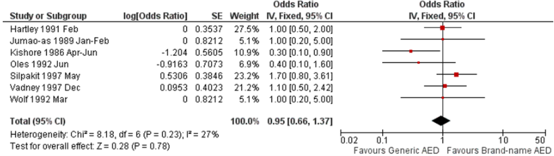
Figure 1. Effectiveness of generic versus brand-name anti-seizure medication
A case-crossover study investigated the risk of seizure-related events associated with continuing the same generic anti-seizure medication versus switching manufacturers of that same generic drug (Kesselheim, 2016). Data from two large U.S. databases were used, involving 83,001 epilepsy patients who were using a generic anti-seizure medication and visited the emergency department or were hospitalized due to a seizure. In this study design, patients served as their own control group.
Continuing the same generic anti-seizure medication was associated with an 8% increase in the odds of a seizure-related event (odds ratio [OR]: 1.08; 95% confidence interval [CI]: 1.06–1.11). Switching to a different manufacturer of the same generic drug was associated with a 9% increase in the odds of such an event (OR: 1.09; 95% CI: 1.03–1.15). It remains questionable whether emergency department visits or hospitalizations alone are sufficient to conclude whether seizure frequency has increased or decreased (Kesselheim, 2016).
2. Time to seizure recurrence
None of the studies reported time to seizure recurrence as an outcome measure.
3. Retention/discontinuation rate
One study (Tharavichitkun, 2022) reported the retention/discontinuation rate. Five patients (6.7%) switched back from generic levetiracetam to brand-name levetiracetam.
In 22 patients (29.3%) therapy adjustments were needed (increasing the dose of generic levetiracetam, increasing the dose of concomitant anti-seizure medication, adding another anti-seizure medication). In this study, the retention/discontinuation rate was not reported/applicable for (specialty) brand-name levetiracetam.
4. Adverse events
One study (Tharavichitkun, 2022) reported adverse events. Six patients (8.0%) experienced adverse events during the six months of follow-up. These included aggression (n = 2), somnolence (n = 1), dizziness (n = 2), and loss of appetite (n = 1). No information was available regarding adverse events before the medication switch.
A systematic review of the literature was performed to answer the following question(s):
To what extent do generic drugs differ from brand-name drugs in terms of effectiveness and side effects?
Table 1. PICO
| Patients | Adults and children with epilepsy |
| Intervention | Generic anti-seizure medication |
| Control | Brand-name (specialty) anti-seizure medication |
| Outcomes | Seizure incidence (seizure freedom, 50% seizure reduction), time to seizure recurrence, retention/discontinuation rate, adverse events |
| Other selection criteria | Study design: systematic reviews and randomized controlled trials |
Relevant outcome measures
The guideline panel considered seizure incidence and time to seizure recurrence as critical outcome measures for decision making; and retention/discontinuation rate and adverse events as important outcome measures for decision making.
The working group did not define the outcome measures listed above but used the definitions used in the studies. For instance, for seizure freedom this could mean number of patients being seizure free at a certain time point during follow-up or for a certain duration during follow-up.
The working group defined HR/RR ≤0.8 or ≥1.25 (dichotomous variables) and 0.5 SD (continuous variables) as minimal clinically (patient) important difference, and HR/RR between 0.8 and 0.9 or 1.10 and 1.25 as small effects for all outcomes.
Search and select (Methods)
The first version of this module was based on a literature search, which was conducted to compare the effectiveness of generic drugs and brand-name drugs in both adults and children. Seizure frequency and side effects were used as outcome measures. The search covered studies published from January 1, 1999, in the databases Medline, Embase, and the Cochrane Library.
For the current revision, we searched the databases Medline/Pubmed and Embase with relevant search terms from 01-01-2019 (last search) until 5-2-2025. The detailed search strategy is depicted under the tab Methods. The search was limited to systematic reviews and randomized controlled trials. The systematic literature search resulted in 374 articles.
Studies were included based on the following criteria:
- Systematic review or RCT.
- Full-text English language publication.
- Studies according to PICO.
In the revision, 9 studies were selected based on title and abstract screening. After reading the full text, 7 studies were excluded (see the exclusion table under the tab ‘Evidence tabellen’), and two studies were included.
- Duh MS, Cahill KE, Paradis PE, Cremieux PY, Greenberg PE. The economic implications of generic substitution of antiepileptic drugs: a review of recent evidence. Expert Opin Pharmacother. 2009 Oct;10(14):2317-28. doi: 10.1517/14656560903140525. PMID: 19663636.
- EMA [Internet]. Quality Review of Documents general principles regarding the summary-of-product-characteristics information for a generic / hybrid / biosimilar product [cited 2026 Jan 6]. Available from: https://www.ema.europa.eu/en/human-regulatory-overview/marketing-authorisation/generic-hybrid-medicines.
- Holtkamp M, Theodore WH. Generic antiepileptic drugs-Safe or harmful in patients with epilepsy? Epilepsia. 2018 Jul;59(7):1273-1281. doi: 10.1111/epi.14439. Epub 2018 Jun 12. PMID: 29894004.
- Kesselheim AS, Stedman MR, Bubrick EJ, Gagne JJ, Misono AS, Lee JL, Brookhart MA, Avorn J, Shrank WH. Seizure outcomes following the use of generic versus brand-name antiepileptic drugs: a systematic review and meta-analysis. Drugs. 2010 Mar 26;70(5):605-21. doi: 10.2165/10898530-000000000-00000. PMID: 20329806; PMCID: PMC3056509.
- Kesselheim AS, Bykov K, Gagne JJ, Wang SV, Choudhry NK. Switching generic antiepileptic drug manufacturer not linked to seizures: A case-crossover study. Neurology. 2016 Oct 25;87(17):1796-1801. doi: 10.1212/WNL.0000000000003259. Epub 2016 Sep 28. PMID: 27683844; PMCID: PMC5089522.
- Koninklijke Nederlandse Maatschappij ter bevordering der Pharmacie (KNMP). Handleiding geneesmiddelsubstitutie. Den Haag: KNMP Geneesmiddel Informatie Centrum; 2018. Available from: https://www.knmp.nl/patientenzorg/geneesmiddelen/handleiding-geneesmiddelsubstitutie.
- Patiëntenfederatie Nederland, het Nederlands Huisartsen Genootschap (NHG), de Landelijke Huisartsen Vereniging (LHV), de Federatie Medisch Specialisten (FMS), de Koninklijke Maatschappij ter bevordering der Pharmacie (KNMP) en Zorgverzekeraars Nederland (ZN). Leidraad Verantwoord Wisselen Medicijnen versie 2024. Available from:https://demedischspecialist.nl/sites/default/files/2022-11/Leidraad_Verantwoord_Wisselen_Medicijnen_versie15nov2022.pdf.
- Lang JD, Kostev K, Reindl C, Mueller TM, Stritzelberger J, Gollwitzer S, Westermayer V, Trollmann R, Hamer HM. Manufacturer switch of anti-seizure drugs may not increase the risk of seizure recurrence in Children: A nationwide study of prescription data in Germany. Epilepsy Behav. 2021 Feb;115:107705. doi: 10.1016/j.yebeh.2020.107705. Epub 2021 Jan 11. PMID: 33444987.
- Liow K, Barkley GL, Pollard JR, Harden CL, Bazil CW; American Academy of Neurology. Position statement on the coverage of anticonvulsant drugs for the treatment of epilepsy. Neurology. 2007 Apr 17;68(16):1249-50. doi: 10.1212/01.wnl.0000259400.30539.cc. PMID: 17438213.
- National Institute for Health and Clinical Excellence (NICE). [Internet] (2022). Epilepsies in children, young people and adults Available from: https://www.nice.org.uk/guidance/ng217/resources/epilepsies-in-children-young-people-and-adults-pdf-66143780239813London: National Institute for Health and Clinical Excellence.
- Perucca E, Albani F, Capovilla G, Bernardina BD, Michelucci R, Zaccara G. Recommendations of the Italian League against Epilepsy working group on generic products of antiepileptic drugs. Epilepsia. 2006;47 Suppl 5:16-20. doi: 10.1111/j.1528-1167.2006.00871.x. PMID: 17239100.
- Straka RJ, Keohane DJ, Liu LZ. Potential Clinical and Economic Impact of Switching Branded Medications to Generics. Am J Ther. 2017 May;24(3):e278-e289. doi: 10.1097/MJT.0000000000000282. PMID: 26099048.
- Tharavichitkun J, Yadee T, Angkaow P, Suansanae T. Evaluating Therapeutic Equivalence of Generic and Original Levetiracetam in Patients with Epilepsy: A Retrospective Study. Neurol Int. 2022 Mar 15;14(1):271-283. doi: 10.3390/neurolint14010022. PMID: 35324578; PMCID: PMC8953522.
- Trimboli M, Russo E, Mumoli L, Tripepi G, Fortunato F, Mastroianni G, Abate F, De Sarro G, Gambardella A, Labate A. Brand-to-generic levetiracetam switching: a 4-year prospective observational real-life study. Eur J Neurol. 2018 Apr;25(4):666-671. doi: 10.1111/ene.13568. Epub 2018 Feb 1. PMID: 29322654.
- Yamada M, Welty TE. Generic substitution of antiepileptic drugs: a systematic review of prospective and retrospective studies. Ann Pharmacother. 2011 Nov;45(11):1406-15. doi: 10.1345/aph.1Q349. Epub 2011 Oct 25. PMID: 22028417.
Evidence tables for studies included in summary of literature conducted previously (updated until 2020)
Evidence table for intervention research (trials and cohort)
|
Study reference |
Study characteristics |
Patient characteristics |
Intervention (I) |
Comparison / control (C) |
Follow-up |
Outcome measures and effect size |
Comments |
|
Kesselheim et al., 2016 |
Population-based case-crossover study Setting: Generic AED users who experienced a seizure-related hospital admission or emergency room visit between 2000 and 2013. Medicaid Analytic eXtract and a US commercial health insurance database were used to analyze data. Country: USA Source of funding: No targeted funding reported. |
Inclusion criteria: Cases were identified as patients with an emergency room (ER) visit or hospitalization for seizures using ICD-9-CM codes 345.xx (epilepsy), 333.2x (myoclonus), or 780.3x (convulsions) as the primary discharge diagnosis.20 Exclusion criteria: - Another ER visit/hospitalization for seizure in the prior 6 months - No dispensing of an eligible AED during the prior 6 months - No dispensing of an eligible AED during at least 1 of the study periods - excluded subsequent episodes within the same patients N= 83,001 generic AED users Intervention group: N= 83,001 generic AED users Mean age ± SD: 34.12 ± 17.61 Sex: 46,3% M / 53,7% F Other important characteristics: Hospitalization primary diagnosis: - Epilepsy: 68,12% - Myoclonus: 0,25% - Convulsions: 18,21% |
Describe intervention (treatment/procedure/test): Exposure to a refill during days 2-36 preceding the seizure-related event was compared to exposure during days 51-85 (control period). |
Describe control (treatment/procedure/test): Patients served as their own controls. |
Endpoint of follow-up: 85 days after seizure-event For how many participants were no complete outcome data available: none Significant differences between groups?: No, patients served as their own controls |
Generic AED refilling was associated with an 8% increase in the odds of seizure-related events (odds ratio [OR] 1.08; 95%confidence interval [CI] 1.06–1.11). The OR following a switch to a different manufacturer of the same AED was 1.09 (95% CI 1.03–1.15); however, after adjusting for the process of refilling, there was no association between switching and seizure related hospital visits (OR 1.00; 95% CI 0.94–1.07). |
Case-crossover study |
Evidence table for systematic reviews
|
Study reference |
Design |
Inclusion criteria |
Quality |
Results |
Comments |
|
Kesselheim, 2010 |
Systematic review and meta-analysis |
Inclusion criteria: Randomized controlled trial, or randomized cross-over trial of a brand-name drug versus a generic equivalent looking at frequency of seizures or seizure-freedom.
Exclusion criteria: none |
Search: adequate
Selection: adequate
Quality assessment of individual studies: adequate
|
Seven RCT’s were included with a total of 204 patients. In addition seven observational studies were included.
Overall OR (95% CI) for seizure control brand-name medication versus generic mediaction
All studies 1.0 (0.7-1.4)
Studies w Jadad score >3 1.2 (0.6-2.2)
Studies w followup >3 weeks 0.8 (0.5-1.2)
|
|
|
Yamada, 2011 |
Systematic review |
Inclusion criteria: Randomized controlled trial of a brand-name drug versus a generic equivalent looking at seizure-freedom as direct outcome measure. |
Search: adequate
Selection: adequate
Quality assessment of individual studies: adequate
|
Four RCT’s were included, which were also included in Kesselheim, 2010. For results, see Kesselheim, 2010 |
|
Risk of Bias tables
Risk of bias table for studies included in summary of literature conducted in 2025
|
Author, year |
Selection of participants
Was selection of exposed and non-exposed cohorts drawn from the same population?
|
Exposure
Can we be confident in the assessment of exposure?
|
Outcome of interest
Can we be confident that the outcome of interest was not present at start of study?
|
Confounding-assessment
Can we be confident in the assessment of confounding factors?
|
Confounding-analysis
Did the study match exposed and unexposed for all variables that are associated with the outcome of interest or did the statistical analysis adjust for these confounding variables?
|
Assessment of outcome
Can we be confident in the assessment of outcome?
|
Follow up
Was the follow up of cohorts adequate? In particular, was outcome data complete or imputed?
|
Co-interventions
Were co-interventions similar between groups?
|
Overall Risk of bias
|
|
Definitely yes, probably yes, probably no, definitely no |
Definitely yes, probably yes, probably no, definitely no |
Definitely yes, probably yes, probably no, definitely no |
Definitely yes, probably yes, probably no, definitely no |
Definitely yes, probably yes, probably no, definitely no |
Definitely yes, probably yes, probably no, definitely no |
Definitely yes, probably yes, probably no, definitely no |
Definitely yes, probably yes, probably no, definitely no |
Low, Some concerns, High |
|
|
Lang, 2021 |
Definitely yes
Reason: |
Definitely yes
Reason: |
Definitely yes
Reason: |
Definitely yes
Reason: |
Probably yes
Reason: |
Probably yes
Reason: |
Definitely yes
Reason: Adequate follow-up and data completeness appears sufficient. |
Probably no
Reason: Co-interventions were not compared between individuals treated with generic anti-seizure medication and those receiving brand-name anti-seizure medication. |
Some concerns (for outcome seizure incidence)
Reason: |
|
Tharavichitkun, 2022 |
Definitely yes
Reason: All patients were drawn from the same outpatient department at the Neurological Institute of Thailand. |
Definitely yes
Reason: The switch in medication (from brand-name (specialty) to generic anti-seizure medication) was documented and policy driven. |
Definitely yes
Reason: Patients had a stable seizure frequency for ≥3 months before the switch, ensuring seizure exacerbation was new. |
Definitely yes
Reason: Detailed baseline data were collected. |
Definitely no
Reason: No matching or statistical confounding adjustment was conducted. |
Probably yes
Reason: Seizure frequency was extracted from medical charts and electronic databases. However, objective measures like EEG or serum drug levels were lacking. The same holds true for the assessment of adverse events. |
Definitely yes
Reason: Adequate follow-up, no issues regarding loss to follow-up noted. |
Probably yes
Reason: The study ensured that concomitant AED regimens were stable within 72 hours before and after the switch. However, some patients underwent epilepsy surgery or had dose adjustments during follow-up, which may have influenced outcomes |
High (for all outcomes)
Reason: the study did not adjust for confounding variables and there was a lack of objective measurements to assess seizure frequency and adverse events. |
Risk of bias tables for studies included in summary of literature conducted previously (updated until 2020)
Methodology checklist – intervention studies
|
Study reference |
There was adequate allocation concealment |
Participants receiving care were kept 'blind' to treatment allocation |
Care providers were kept 'blind' to treatment allocation |
Outcome assessors were kept 'blind' to participants’ exposure to the intervention |
Use of unvalidated or intermediate
|
Selective outcome reporting on basis of the results |
Loss to follow-up/incomplete outcome data described and acceptable |
Analysis by intention to treat |
Other limitations |
Comments |
|
Kesselheim et al., 2016 |
Yes |
no |
no |
no |
|
no |
yes |
yes |
no |
Case-crossover study |
Table of excluded studies
|
Reference |
Reason for exclusion |
|
Gaïes E, Jebabli N, Zerei S, Charfi R, Salouage I, Ben Sassi M, El Jebari H, Daghfous R, Trabelsi S. Comparing real-life carbamazepine exposure between innovator and generic formulation. Therapie. 2022 Sep-Oct;77(5):523-526. doi: 10.1016/j.therap.2022.01.017. Epub 2022 Feb 1. PMID: 35184882.
|
Full-text article not available |
|
Roberti R, Casarella A, Iudice A, La Neve A, Beghi E, Capovilla G, Di Bonaventura C, Giorgi FS, Grosso S, Iannone LF, Romigi A, Specchio LM, Zaccara G, Mecarelli O, Russo E; Antiseizure Medications Commission of the Italian League against Epilepsy LICE. Appropriate use of generic and branded antiseizure medications in epilepsy: Updated recommendations from the Italian League Against Epilepsy (LICE). Epilepsy Behav. 2021 Mar;116:107804. doi: 10.1016/j.yebeh.2021.107804. Epub 2021 Feb 10. PMID: 33581599.
|
Statement, screened for relevant publications. |
|
Liang MJ, Qiu WF, Zhang JW, Li XP, Shi GA, Zhai QX, Zhang YX, Chen ZH. Efficacy and safety of switching from brand-name to domestic generic levetiracetam in children with epilepsy. Zhongguo Dang Dai Er Ke Za Zhi. 2022 Mar 15;24(3):285-289. English, Chinese. doi: 10.7499/j.issn.1008-8830.2111033. PMID: 35351259; PMCID: PMC8974645.doi: 10.3889/oamjms.2022.8837.
|
Full text in Chinese |
|
Tiamkao S, Kanchanauthai N, Sawannyawisuth K, Tiamkao S. Brand-to-generic Levetiracetam Switch in Patients with Epilepsy: Seizure Control and its Predictors in a Real-world Setting Open Acces Mac. Journal of Medical Scienses.2022 Apr 6; 10(B):1068-71. .doi: 10.3889/oamjms.2022.8837. |
Describes two different groups – not a cohort study. |
|
Bosak M, Woźniak M, Kasprzycki M, Słowik A. Safety of brand name to generic substitution of lacosamide in patients with epilepsy - A prospective single-center observational study. Seizure. 2023 Oct;111:203-205. doi: 10.1016/j.seizure.2023.09.001. Epub 2023 Sep 4. PMID: 37683453. |
No absolute numbers reported |
|
Weitzel J, Erzkamp S, Langer K, Rose O. Effects of generic exchange of solid oral dosage forms in neurological disorders: a systematic review. Int J Clin Pharm. 2020 Apr;42(2):393-417. doi: 10.1007/s11096-020-01023-2. Epub 2020 Apr 9. PMID: 32274633. |
Wrong outcome |
|
Wongjirattikarn R, Sawanyawisuth K, Pranboon S, Tiamkao S, Tiamkao S. Can Generic Intravenous Levetiracetam Be Used for Acute Repetitive Convulsive Seizure or Status Epilepticus? A Randomized Controlled Trial. Neurol Ther. 2019 Dec;8(2):425-431. doi: 10.1007/s40120-019-00150-x. Epub 2019 Aug 12. PMID: 31407191; PMCID: PMC6858918.
|
Intravenous medication, not according to PICO |
Beoordelingsdatum en geldigheid
Publicatiedatum : 12-11-2026
Beoordeeld op geldigheid : 12-11-2026
Samenstelling werkgroep
Voor het ontwikkelen van de richtlijnmodule is in 2020 een multidisciplinair cluster ingesteld. Het cluster Epilepsie bestaat uit meerdere richtlijnen (zie hier de actuele clusterindeling). De stuurgroep bewaakt het proces van modulair onderhoud binnen het cluster. De expertisegroepsleden brengen hun expertise in, indien nodig. De volgende personen uit het cluster zijn betrokken geweest bij de herziening van deze module:
Cluster- stuurgroepleden
- Prof. dr. H.J.M. Majoie (voorzitter), neuroloog, Academisch Centrum voor Epileptologie Kempenhaeghe/ Maastricht UMC+, Heeze en Maastricht
- Dr. P. Klarenbeek, neuroloog, Zuyderland Medisch Centrum, Heerlen/ Sittard
- Drs. M.H.G. Dremmen, radioloog, Erasmus MC Rotterdam
- Dr. C.M. Delsman-van Gelder, kinderneuroloog, MMC Veldhoven, Veldhoven
- Dr. P. van Vliet, intensivist, Haaglanden Medisch Centrum, Den Haag
- Dr. L. M’Rabet, patiëntvertegenwoordiger, EpilepsieNL, Houten
Betrokken cluster- expertisegroepleden
- Drs. J. Masselink, Ziekenhuisapotheker, Medisch Spectrum Twente, Enschede
- Dr. P. Klarenbeek, neuroloog, Zuyderland Medisch Centrum, Heerlen
- Dr. F.N.G. van 't Hof, neuroloog, SEIN, Heemstede en Amsterdam
- Drs. T. Balvers, neuroloog, SEIN, Heemstede
Met ondersteuning van
- Dr. I. Blokland, adviseur Kennisinstituut van de Federatie Medisch Specialisten, Utrecht
- Dr. M. Wassenaar, adviseur Kennisinstituut van de Federatie Medisch Specialisten, Utrecht
- Mw. I. Gijselhart, medisch informatiespecialist, Academisch Centrum voor Epileptologie Kempenhaeghe, Heeze
Belangenverklaringen
Een overzicht van de belangen van de clusterleden en het oordeel over het omgaan met eventuele belangen vindt u in onderstaande tabel. De ondertekende belangenverklaringen zijn op te vragen bij het secretariaat van het Kennisinstituut van de Federatie Medisch Specialisten via secretariaat@kennisinstituut.nl.
Tabel Gemelde (neven)functies en belangen stuurgroepleden
|
Naam |
Hoofdfunctie |
Nevenwerkzaamheden |
Persoonlijke financiële belangen |
Persoonlijke relaties |
Extern gefinancierd onderzoek |
Intellectuele belangen en reputatie |
Overige belangen |
Datum |
Restrictie |
|
Majoie |
Staflid neurologie Academisch Centrum voor Epileptologie Kempenhaeghe Maastricht UMC+ Voorzitter werkgroep |
- Coördinator landelijk research-, en opleidingsnetwerk epilepsie. - Lid commissie richtlijnen van de Nederlandse Vereniging voor Neurologie. - Voorzitter landelijke werkgroep richtlijn Epilepsie van de Nederlandse Vereniging voor Neurologie. - Lid commissie Zorgevaluatie van de Nederlandse Vereniging voor Neurologie en van de Commissie wetenschap van de Nederlandse Vereniging voor Neurologie. - Lid kernredactie kwartaalblad "Epilepsie, periodiek voor Professionals" van de Nederlandse Liga tegen Epilepsie. - Voorzitter bestuur van de Nederlandse Liga tegen Epilepsie/ Voorzitter bestuur werkgroep Epilepsie van de Nederlandse Vereniging voor Neurologie. - Voorzitter bestuur landelijke scholing aios kindergeneeskunde & neurologie SepiON. - Initiator en coördinator van het 'European partnership on high value cost conscious care and guideline development training program' en initiator en coördinator van eenzelfde project op nationale basis. - Lid stuurgroep van het Landelijke Leerhuis Epilepsie (Kempenhaeghe Maastricht UMC+ & SEIN). - Lid wetenschappelijke adviesraad (WAR) epilepsiefonds EpilepsieNL. - Extern adviseur College ter Beoordeling van Geneesmiddelen. |
Geen |
Geen |
ZonMW dossiernummer 10310012210006 (2024-2028) Kosteneffectieve toepassing van aanvalsdetectie hulpmiddelen voor risicovolle nachtelijke epileptische aanvallen. Rol: aanvrager en mede-projectlid.
ZonMW transnational research: dossiernummer 04460162210008 (2023-2024). Titel: Aanvalsdetectie, op weg naar betere bekendheid en veiligere zorg. Rol: aanvrager en mede-projectlid.
Kwaliteitsgelden ZonMW: dossiernummer 859002001 ( 2021-2025). Titel: Leerplatform richtlijnontwikkeling. Rol: aanvrager en project coördinator.
Stichting vrienden van Kempenhaeghe (2022-2023). Titel: Leerplatform Epilepsie en slaap scholingen. Rol: aanvrager en project coördinator.
Kempenhaeghe, SEIN en Epilepsiefonds EpilesieNL (2024-2028) Titel: Impact van epilepsie, een value based healthcare project Rol: aanvrager en project coördinator
ZonMW Projectnummer: HMM2019020 (2020-2024) Project titel: Brain@home: real-world clinical neurophysiological and neurobehavioral markers as novel human measurement models for personalised treatment in epilepsy and migraine. Rol: mede aanvrager
Erasmus +. Projectnummer: 2018- 1-NL0 1-KA203-O39O7O (2018-2023). Projecttitel: European Partnership on Competencies for High Value COst COnscious CARE. Rol: aanvrager en project coördinator
Top ZonMW Dossier nr: 40-00812-98-17055 (2018-2023). Brain on a dish: development of innovative stem cell technologies for personalized medicine in epilepsy. Rol: mede aanvrager
Nationaal Epilepsiefonds (2018-2023). Towards personalized treatment of genetically classified refractory epilepsies using Human Induced Pluripotent Stem Cells (hIPSCs) as an ex-vivo tool. Rol: projectlid
|
Geen |
Geen |
20-08-2025 |
Geen |
|
Klarenbeek |
Neuroloog Zuyderland MC Heerlen/Sittard, vrijgevestigd |
Ik heb afgelopen jaar een eenmalige speaker fee ontvangen van Angelini Pharma (Cenobamaat) voor een geaccrediteerde nascholing |
Geen |
Geen |
Geen |
Geen |
Geen |
20-08-2025 |
Geen |
|
Van Vliet |
Intensivist, Haaglanden Medisch Centrum te Den Haag |
Docent regionale opleiding ic-verpleegkundigen, LUMC (betaald) Docent Care Training Group, Ridderkerk (betaald) Bestuursvoorzitter MuzIC (onbetaald) |
Geen |
Geen |
Geen |
Geen |
Geen |
04-12-2025 |
Geen |
|
Dremmen |
Kinderradioloog met subspecialisatie kinderneuroradiologie Erasmus MC |
Een van de voorzitters van de richtlijn Radiologische diagnostiek acute trauma-opvang bij kinderen Expertisegroep richtlijn Traumatologie Uitgenodigd spreker op meerdere nationale en internationale cursussen en congressen |
Geen |
Geen |
Geen |
Geen |
Geen |
04-09-2025 |
Geen |
|
Delsman |
Kinderneuroloog/kinderarts MMC Veldhoven |
Geen |
Geen |
Geen |
Geen |
Geen |
Geen |
09-12-2025 |
Geen |
|
M’rabet |
MT Kennis & Innovatie, EpilepsieNL |
-Int. Stuurgroep lid in 2025, emergency care UCB -Int. Stuurgroep lid, Seizure Freedom, Angelini Pharmaceuticals -Adviesraad St Medmij -Adviesraad Angelini Pahrmaceuticals Benelux -lid Epilepsy Alliance Europe |
geen |
zoon |
Prelude, Epicentrum, Slimme camera, TONI Jazz Pharmaceuricals; Prelude, Epilepsie en een verstandelijke beperking, PL nee ZonMW voor elkaar; Epicentrum: ontwikkeling vrijwilligers platform, PL nee Epicentrum: ontwikkeling vrijwilligers platform; Slimme Camera, video aanvalsdetectie Vriendenloterij; TONI, video aanvalsdetectie, PL Ja |
geen |
geen |
27-3-2025 |
Geen |
Tabel Gemelde (neven)functies en belangen betrokken expertisegroepleden
|
Naam |
Hoofdfunctie |
Nevenwerkzaamheden |
Persoonlijke financiële belangen |
Persoonlijke relaties |
Extern gefinancierd onderzoek |
Intellectuele belangen en reputatie |
Overige belangen |
Datum |
Restrictie |
|
Masselink |
Ziekenhuisapotheker Medisch Spectrum Twente |
Lid werkgroep Neurologische aandoeningen (inclusief gedrag) Horizonscan Geneesmiddelen, Zorginstituut Nederland onbetaald |
Geen |
Geen |
Geen |
Geen |
Geen |
20-8-2025 |
Geen |
|
Klarenbeek |
Neuroloog Zuyderland MC Heerlen/Sittard, vrijgevestigd |
Ik heb afgelopen jaar een eenmalige speaker fee ontvangen van Angelini Pharma (Cenobamaat) voor een geaccrediteerde nascholing |
Geen |
Geen |
Geen |
Geen |
Geen |
20-08-2025 |
Geen |
|
Van ’t hof |
Neuroloog - SEIN (Stichting Epilepsie Instellingen Nederland) |
Voorzitter interne werkgroep epilepsie en genetica SEIN (onbetaald) |
Geen |
Geen |
Geen |
Geen |
Geen |
22-12-2025 |
Geen |
|
Balvers |
Neuroloog Behandeling van patiënten met epilepsie; klinisch, poliklinisch en in woonzorg. Stichting Epilepsie Instellingen Nederland (SEIN) 0,6 FTE
Neuroloog Behandeling van patiënten met hoofdpijn; poliklinisch The Migraine Clinic, Amsterdam |
Bestuurslid Anglo Dutch Migraine Association (ADMA) (onbetaald)
|
Geen |
Geen |
Geen |
Geen |
Vergoeding gastvrijheid: TEVA, Novartis Speaker Lecture fees: Novartis Allen vanuit hoofdpijnexpertise |
26-8-2025 |
Geen |
Inbreng patiëntenperspectief
Kwalitatieve raming van mogelijke financiële gevolgen in het kader van de Wkkgz
Bij de richtlijnmodule voerden de clusterleden conform de Wet kwaliteit, klachten en geschillen zorg (Wkkgz) een kwalitatieve raming uit om te beoordelen of de aanbevelingen mogelijk leiden tot substantiële financiële gevolgen. Bij het uitvoeren van deze beoordeling is de richtlijnmodule op verschillende domeinen getoetst (zie het stroomschema bij Werkwijze).
|
Module |
Uitkomst raming |
Toelichting |
|
Anti-aanvalsmedicatie: generiek of spécialité |
Geen financiële gevolgen |
Hoewel uit de toetsing volgt dat de aanbeveling(en) breed toepasbaar zijn (>40.000 patiënten), volgt uit de toetsing dat het overgrote deel (±90%) van de zorgaanbieders en zorgverleners al aan de norm voldoet. Er worden daarom geen financiële gevolgen verwacht. |
Werkwijze
Voor meer details over de gebruikte richtlijnmethodologie verwijzen wij u naar de Werkwijze. Relevante informatie voor de ontwikkeling/herziening van deze richtlijnmodule is hieronder weergegeven.
Zoekverantwoording
Algemene informatie
|
Richtlijn: Epilepsie |
|
|
Uitgangsvraag: Anti-epileptica Generiek |
|
|
Database(s): Pubmed/Medline, Embase (Ovid) |
Datum: 05-02-2025 |
|
Periode: 2024 |
Talen: Engels |
|
Literatuurspecialist: Irene Gijselhart |
|
|
Toelichting:
|
|
|
Te gebruiken voor richtlijnen tekst: In de databases Embase (Ovid) en Pubmed/Medline is op 05-02-2025 met relevante zoektermen gezocht naar systematische reviews, RCTs en observationele studies over Anti-epileptica Generiek. De literatuurzoekactie leverde 7 unieke treffers op. |
|
Zoekopbrengst
|
|
EMBASE |
Pubmed/MEDLINE |
Ontdubbeld |
|
SRs |
0 |
0 |
0 |
|
RCTs |
2 |
1 |
0 |
|
Observationele studies |
7 |
8 |
7 |
|
Overig |
|
|
|
|
Totaal |
9 |
9 |
7 |
Zoekstrategie
Embase (Ovid)
Database: Embase <1974 to 2025 Week 05>
Search Strategy:
1 ((exp Epilepsy/ or Landau Kleffner Syndrome/ or severe myoclonic epilepsy in infancy/ or Infantile Spasm/ or (epilep* or seizure* or convulsion* or (continuous spikes and waves during sleep) or csws or landau-kleffner syndrome or lennox-gastaut syndrome or infant* spasm* or dravet* or "severe myoclonic epilepsy" or SMEI).ab,ti,kf.) not (pre eclampsia or preeclampsia or eclampsia).ab,ti,kf.) and (exp Acetazolamide/ or (acetazolamide or diamox).ab,ti,kf. or exp corticotropin/ or (acth or adrenocorticotrophin or corticotropin).ab,ti,kf. or anakinra/ or anakinra.ti,ab,kw. or exp brivaracetam/ or (brivaracetam or briviact).ab,ti,kf. or exp Carbamazepine/ or (carbamazepine or tegretol).ab,ti,kf. or cenobamate/ or cenobamate.ab,ti,kf. or exp clobazam/ or (clobazam or frisium).ab,ti,kf. or exp clonazepam/ or (clonazepam or ritrovil).ab,ti,kf. or cvl-865.ab,ti,kf. or exp Diazepam/ or (diazepam or stesolid or valium).ab,ti,kf. or exp eslicarbazepine acetate/ or (eslicarbazepine or zebinix).ab,ti,kf. or exp ethosuximide/ or (ethosuximide or ethymal or zarontin).ab,ti,kf. or exp ezogabine/ or exp felbamate/ or (felba* or taloxa or FBM).ab,ti,kf. or exp fenfluramine/ or (fenfluramine or fintepla).ab,ti,kf. or exp gabapentin/ or (gabapentin or neurontin).ab,ti,kf. or exp Ganaxolone/ or ganaxolone.ab,ti,kf. or exp lacosamide/ or (lacosamide or vimpat).ab,ti,kf. or exp etiracetam/ or (etiracetam or levetiracetam or keppra).ab,ti,kf. or exp lamotrigine/ or (lamotrigine or lamictal).ab,ti,kf. or exp lorazepam/ or (lorazepam or temesta).ab,ti,kf. or exp midazolam/ or (midazolam or dormicum).ab,ti,kf. or exp nitrazepam/ or (nitrazepam or mogadon).ab,ti,kf. or exp oxcarbazepine/ or (oxcarbazepine or trileptal).ab,ti,kf. or exp paraldehyde/ or paraldehyde.ab,ti,kf. or exp perampanel/ or (perampanel or fycompa).ab,ti,kf. or exp pregabalin/ or (pregabalin or lyrica).ab,ti,kf. or exp phenytoin/ or (phenytoin or diphantoine).ab,ti,kf. or exp phenobarbital/ or phenobarbital.ab,ti,kf. or exp rufinamide/ or (rufinamide or inovelon).ab,ti,kf. or exp sulthiame/ or (sulthiame or ospolot).ab,ti,kf. or exp stiripentol/ or (stiripentol or diacomit).ab,ti,kf. or exp topiramate/ or (topiramate or topamax).ab,ti,kf. or exp vigabatrin/ or (vigabatrin or sabril).ab,ti,kf. or exp valproic acid/ or ("valproic acid" or valproate or depakine or depakene or orfiril).ab,ti,kf. or exp zonisamide/ or (zonisamide or zonegran).ab,ti,kf. or exp anticonvulsants/ or exp barbituric acid derivative/ or exp anticonvulsive agent/ or (anticonvulsant* or antiseizure or anti-seizure or antiepileptic* or anti-epileptic).ab,ti,kf.) and (exp *generic drug/ or (drug replament or drug substitut* or drug switch* or medication replacement or medication switch*).ab,ti. or (generic adj drug*).ab,ti,kf.) (322)
2 1 not ((exp animal/ or exp animal experiment/ or exp animal model/ or exp nonhuman/) not exp human/) not (conference abstract or conference review or editorial or letter or note).pt. (221)
3 limit 2 to yr="2023 -Current" (11)
4 limit 3 to english language (11)
5 exp Meta-Analysis/ or exp "Meta-Analysis as Topic"/ or exp Network Meta-Analysis/ or exp Systematic Review/ or exp "Systematic Reviews as Topic"/ or (networkmeta analy* or networkmetaanaly* or metaanaly* or meta analy* or metanaly* or prisma or prospero or metaanali* or meta anali* or metanali*).ti,ab,kf. or ((systemati* or scoping or umbrella or structured literature) adj3 (review* or overview*)).ti,ab,kf. or ((structured or systemic*) adj3 (review* or overview* or synth*) adj3 literature).ti,ab,kf. or (systemic* adj1 review*).ti,ab,kf. or ((systemati* or literature or database* or data base*) adj10 search*).ti,ab,kf. or ((structured or comprehensive* or systemic*) adj3 search*).ti,ab,kf. or ((literature adj3 (review* or overview*)) and (search* or database* or data base*)).ti,ab,kf. or ((data extraction* or data source*) and (study selection* or studies selection*)).ti,ab,kf. or (search strateg* and selection criteria*).ti,ab,kf. or (data source* and data synth*).ti,ab,kf. or (medline* or pubmed* or pub med* or embase or cochrane*).ti,ab,kf. or cochrane.jw. or ((critical* or rapid*) adj2 (review* or overview* or synth*)).ti. or (((critical* or rapid*) adj3 (review* or overview* or synth*)) and (search* or database* or data base*)).ab. or metasynth*.ti,ab,kf. or meta synth*.ti,ab,kf. (1113857)
6 4 and 5 (0)
7 exp randomized controlled trial/ or random*.ti,ab. or ((pragmatic or practical) adj clinical trial*).ti,ab. or ((non-inferiority or noninferiority or superiority or equivalence) adj3 trial*).ti,ab. (2275609)
8 (4 and 7) not 5 (2)
9 major clinical study/ or clinical study/ or case control study/ or family study/ or longitudinal study/ or retrospective study/ or prospective study/ or cohort analysis/ or cohort*.ab,ti. or (case control adj1 (study or studies)).ab,ti. or (follow up adj1 (study or studies)).ab,ti. or (observational adj1 (study or studies)).mp. or (epidemiologic adj1 (study or studies)).ab,ti. or (cross sectional adj1 (study or studies)).ab,ti. (8020477)
10 case control study/ or exp comparative study/ or control group/ or controlled study/ or controlled clinical trial/ or crossover procedure/ or double blind procedure/ or phase 2 clinical trial/ or phase 3 clinical trial/ or phase 4 clinical trial/ or pretest posttest design/ or pretest posttest control group design/ or quasi experimental study/ or single blind procedure/ or triple blind procedure/ or (((control or controlled) adj6 trial) or ((control or controlled) adj6 (study or studies)) or ((control or controlled) adj1 active) or open label* or ((double or two or three or multi or trial) adj1 (arm or arms)) or (allocat* adj10 (arm or arms)) or placebo* or sham-control* or ((single or double or triple or assessor) adj1 (blind* or masked))).ti,ab,kw. or nonrandom*.ti,ab,kw. or non-random*.ti,ab,kw. or quasi-experiment*.ti,ab,kw. or crossover.ti,ab,kw. or cross over.ti,ab,kw. or parallel group*.ti,ab,kw. or factorial trial.ti,ab,kw. or (phase adj5 (study or trial)).ti,ab,kw. or (case* adj6 (matched or control*)).ti,ab,kw. or (match* adj6 (pair or pairs or cohort* or control* or group* or healthy or age or sex or gender or patient* or subject* or participant*)).ti,ab,kw. or (propensity adj6 (scor* or match*)).ti,ab,kw. or versus.ti. or vs.ti. or compar*.ti. or (compar* adj1 study).ti,ab,kw. or ((major clinical study/ or clinical study/ or cohort analysis/ or observational study/ or cross-sectional study/ or multicenter study/ or correlational study/ or follow up/ or cohort*.ti,ab,kw. or follow up.ti,ab,kw. or followup.ti,ab,kw. or longitudinal*.ti,ab,kw. or prospective*.ti,ab,kw. or retrospective*.ti,ab,kw. or observational*.ti,ab,kw. or cross sectional*.ti,ab,kw. or cross?ectional*.ti,ab,kw. or multicent*.ti,ab,kw. or multi-cent*.ti,ab,kw. or consecutive*.ti,ab,kw.) and ((group or groups or subgroup* or versus or vs or compar*).ti,ab,kw. or odds ratio*.ab. or relative odds.ab. or risk ratio*.ab. or relative risk*.ab. or rate ratio.ab. or aor.ab. or arr.ab. or rrr.ab. or (rr adj6 ci).ab.)) (15576304)
11 9 or 10 (17610561)
12 (4 and 11) not (5 or 7) (7)
Pubmed/Medline
|
#10 |
|
|
|
|
|
|
|
|
|
|
|
||||||||||||
|
Search: #4 AND #9 NOT (#5 OR #7) Sort by: Most Recent |
03:06:33 |
|
|
|
|
|
|
|
|||||||||||||||
|
#9 |
|
|
|
|
|
|
|
|
|
||||||||||||||
|
Search: ("Epidemiologic studies"[Mesh] OR "Case control studies"[Mesh] OR "Cohort studies"[Mesh] OR "Controlled Before-After Studies"[Mesh] OR case control*[TIAB] OR cohort*[TIAB] OR (Follow up[TIAB] AND (study[TIAB] OR studies[TIAB])) OR (observational[TIAB] AND (study[TIAB] OR studies[TIAB])) OR Longitudinal[TIAB] OR Retrospective*[TIAB] OR prospective*[TIAB] OR cross sectional[TIAB] OR "Cross-sectional studies"[Mesh] OR "Historically controlled study"[Mesh] OR "Interrupted time series analysis"[Mesh]) Sort by: Most Recent |
03:05:21 |
||||||||||||||||||||||
|
#8 |
|
|
|||||||||||||||||||||
|
Search: #4 AND #7 NOT #5 Sort by: Most Recent |
03:04:17 |
|
|
|
|
|
|
|
|
|
|
|
|
||||||||||
|
#7 |
|
|
|
|
|
|
|
|
|
|
|
|
|
|
|||||||||
|
Search: ("Randomized Controlled Trial" [Publication Type] OR random*[tiab] OR pragmatic clinical trial*[tiab] OR practical clinical trial*[tiab] OR non-inferiority trial*[tiab] OR noninferiority trial*[tiab] OR superiority trial*[tiab] OR equivalence clinical trial*[tiab]) Sort by: Most Recent |
03:04:08 |
||||||||||||||||||||||
|
#6 |
|
|
|||||||||||||||||||||
|
Search: #4 AND #5 Sort by: Most Recent |
0 |
03:03:55 |
|
|
|
|
|
|
|
|
|
|
|
|
|
|
|
|
|
|
|
|
|
|
#5 |
|
|
|
|
|
|
|
|
|
|
|
|
|
|
|
|
|
|
|
|
|
|
|
|
Search: "Meta-Analysis" [Publication Type] OR "Meta-Analysis as Topic"[Mesh] OR "Network Meta-Analysis" [Publication Type] OR "Systematic Review" [Publication Type] OR "Systematic Reviews as Topic"[Mesh] OR networkmeta analy*[tiab] OR networkmetaanaly*[tiab] OR metaanaly*[tiab] OR meta analy*[tiab] OR metanaly*[tiab] OR prisma[tiab] OR prospero[tiab] OR metaanali*[tiab] OR meta anali*[tiab] OR metanali*[tiab] OR "systematic review"[tiab:~3] OR "systematic overview"[tiab:~3] OR "scoping review"[tiab:~3] OR "scoping overview"[tiab:~3] OR "umbrella review"[tiab:~3] OR "umbrella overview"[tiab:~3] OR "structured literature review"[tiab:~3] OR "structured literature overview"[tiab:~3] OR ("structured review"[tiab:~3] AND literature[tiab]) OR ("structured overview"[tiab:~3] AND literature[tiab]) OR ("structured synthesis"[tiab:~3] AND literature[tiab]) OR "systemic overview"[tiab:~3] OR ("systemic synthesis"[tiab:~3] AND literature[tiab]) OR "systemic review"[tiab:~1] OR "systematic literature search"[tiab:~10] OR ("systematical search"[tiab:~10] AND literature[tiab]) OR ("systematically searched"[tiab:~10] AND literature[tiab]) OR "literature search"[tiab:~10] OR "literature searched"[tiab:~10] OR "data bases searched"[tiab:~10] OR "databases searched"[tiab:~10] OR ("structured search"[tiab:~3] AND (database*[tiab] OR literature[tiab])) OR ("structured searches"[tiab:~3] AND (database*[tiab] OR literature[tiab])) OR "comprehensive search"[tiab:~3] OR "comprehensive searches"[tiab:~3] OR ("systemic search"[tiab] AND (database*[tiab] OR literature[tiab])) OR ("systemic searches"[tiab] AND (database*[tiab] OR literature[tiab])) OR "systemically search"[tiab:~3] OR "systemically searches"[tiab:~3] OR (data extraction*[tiab] AND (study selection*[tiab] OR studies selection*[tiab])) OR (data source*[tiab] AND (study selection*[tiab] OR studies selection*[tiab])) OR (search strategy*[tiab] AND selection criteria*[tiab]) OR (data source*[tiab] AND data synth*[tiab]) OR (medline*[tiab] OR pubmed[tiab] OR "pub med"[tiab] OR embase*[tiab] OR cochrane[tiab]) OR "Cochrane Database Syst Rev"[Journal] OR (("critical review"[tiab:~3] OR "critical overview"[tiab:~3] OR "critical synthesis"[tiab:~3] OR "rapid review"[tiab:~3] OR "rapid overview"[tiab:~3] OR "rapid synthesis"[tiab:~3]) AND (search*[tiab] OR database*[tiab] OR "data base"[tiab] OR "data bases"[tiab])) OR metasynth*[tiab] OR meta synth*[tiab] Sort by: Most Recent |
03:03:51 |
||||||||||||||||||||||
|
#4 |
|
|
|||||||||||||||||||||
|
Search: #3 AND (2023[pdat]:2024[pdat]) Sort by: Most Recent |
03:03:37 |
|
|
|
|
|
|
|
|
|
|
|
|
|
|||||||||
|
#3 |
|
|
|
|
|
|
|
|
|
|
|
|
|
|
|
||||||||
|
Search: #2 AND English[Language] Sort by: Most Recent |
03:03:20 |
|
|
|
|
|
|
|
|
|
|
|
|
|
|
||||||||
|
#2 |
|
|
|
|
|
|
|
|
|
|
|
|
|
|
|
|
|||||||
|
Search: #1 NOT (("Animals"[Mesh] OR "Animal Experimentation"[Mesh] OR "Models, Animal"[Mesh]) NOT "Humans"[Mesh]) NOT (letter[pt] OR comment[pt] OR editorial[pt]) Sort by: Most Recent |
03:03:06 |
||||||||||||||||||||||
|
#1 |
|
|
|||||||||||||||||||||
|
Search: ((("Acetazolamide"[Mesh] OR acetazolamide[TW] OR diamox[TW]) OR ("Adrenocorticotropic Hormone"[Mesh] OR acth[TW] OR adrenocorticotrophin[TW] OR corticotropin[TW]) OR ("brivaracetam" [Supplementary Concept] OR brivaracetam[TW] OR Briviact[TW]) OR ("Carbamazepine"[Mesh] OR carbamazepine[TW] OR Tegretol[TW]) OR ("Cenobamate" [Supplementary Concept] OR cenobamate[TW]) OR ("Clobazam"[Mesh] OR clobazam[TW] OR frisium[TW]) OR ("Clonazepam"[Mesh] OR clonazepam[TW] OR ritrovil[TW]) OR "CVL-865"[TW] OR ("Diazepam"[Mesh] OR diazepam[TW] OR stesolid[TW] OR valium[TW]) OR ("eslicarbazepine acetate"[Supplementary Concept] OR eslicarbazepine[TW] OR zebinix[TW]) OR ("ethosuximide"[Mesh] OR ethosuximide[TW] OR ethymal[TW] OR zarontin[TW]) OR ("Felbamate"[Mesh] OR felba*[TW] OR taloxa[TW] OR FBM[TW]) OR ("Fenfluramine"[Mesh] OR fenfluramine[TW] OR fintepla[TW]) OR ("gabapentin"[Mesh] OR gabapentin[TW] OR neurontin[TW]) OR ("ganaxolone"[Supplementary Concept] OR ganaxolone[TW] OR "CCD 1042"[TW]) OR ("Interleukin 1 Receptor Antagonist Protein"[Mesh] OR "Interleukin 1 Receptor Antagonist Protein"[TW] OR anakinra[TW]) OR ("lacosamide"[Mesh] OR lacosamide[TW] OR vimpat[TW]) OR ("Levetiracetam"[Mesh] OR etiracetam [TW] OR levetiracetam[TW] OR keppra[TW]) OR ("lamotrigine"[Mesh] OR lamotrigine[TW] OR lamictal[TW]) OR ("lorazepam"[Mesh] OR lorazepam[TW] OR temesta[TW]) OR ("midazolam"[Mesh] OR midazolam[TW] OR dormicum[TW]) OR ("nitrazepam"[Mesh] OR nitrazepam[TW] OR mogadon[TW]) OR ("oxcarbazepine"[Mesh] OR oxcarbazepine[TW] OR trileptal[TW]) OR ("paraldehyde"[Mesh] OR paraldehyde[TW]) OR ("perampanel"[Supplementary Concept] OR perampanel[TW] OR fycompa[TW]) OR ("pregabalin"[Mesh] OR pregabalin[TW] OR lyrica[TW]) OR ("phenytoin"[Mesh] OR phenytoin[TW] OR diphantoine[TW]) OR ("phenobarbital"[Mesh] OR phenobarbital[TW]) OR ("rufinamide"[Supplementary Concept] OR rufinamide[TW] OR inovelon[TW]) OR ("sulthiame"[Supplementary Concept] OR sulthiame[TW] OR ospolot[TW]) OR ("stiripentol"[Supplementary Concept] OR stiripentol[TW] OR diacomit[TW]) OR ("Topiramate"[Mesh] OR topiramate[TW] OR topamax[TW]) OR ("vigabatrin"[Mesh] OR vigabatrin[TW] OR sabril[TW]) OR ("valproic acid"[Mesh] OR valproic acid[TW] OR valproate[TW] OR depakine[TW] OR depakene[TW] OR orfiril[TW]) OR ("Zonisamide"[Mesh] OR zonisamide[TW] OR zonegran[TW]) OR "anticonvulsants"[Pharmacological Action] OR "Anticonvulsants"[Mesh] OR anticonvulsant*[TW] OR antiseizure[TW] OR "anti-seizure"[TW] OR antiepileptic*[TW] OR anti-epileptic*[TW]) AND ("Drug Substitution"[Mesh]OR drug substitution*[TW] OR "Drugs, Generic"[Mesh] OR "generic drug"[TIAB:~1] OR "generic drugs"[TIAB:~1] OR (generic[TW] AND substitution*[TW])) AND ("Epilepsy"[MeSH] OR epilep*[TW] OR (continuous[TW] AND spike*[TW] AND wave*[TW] AND sleep[TW]) OR "Landau-Kleffner Syndrome"[Mesh] OR "landau-kleffner syndrome"[TW] OR "Lennox Gastaut Syndrome"[Mesh] OR "lennox-gastaut syndrome"[TW] OR "Spasms, Infantile"[Mesh] OR infantile spasm*[TW] OR dravet*[TW] OR "severe myoclonic epilepsy"[TW] OR SMEI[TW] OR seizure*[TW] OR convulsion[TW] OR convulsions[TW]) NOT ("pre eclampsia"[Mesh] OR "pre eclampsia"[TW] OR "preeclampsia"[TW] OR "Eclampsia"[Mesh] OR "eclampsia*"[TW])) Sort by: Most Recent |
03:02: |
||||||||||||||||||||||