
Revalidatiegeneeskundige behandeling
Uitgangsvraag
Hoe dient de revalidatiegeneeskundige behandeling voor volwassenen met cerebellaire ataxie ter verbetering van activiteiten en participatie er uit te zien?
Aanbeveling
Fysieke training
Bied personen met ataxie fysieke training aan, gericht op het verbeteren van loopvaardigheid wanneer zij:
- Een zelfstandige sta- en/of loopfunctie hebben (al dan niet met hulpmiddelen) én
- Een hulpvraag hebben op het gebied van loopvaardigheid.
De training bestaat uit loop- en balanstraining, in combinatie met kracht- en conditietraining. Bij voorkeur 3-5 keer per week, 60 minuten trainen. Bij voorkeur is dit een individueel trainingsprogramma voor thuis, waarbij de fysiotherapeut in de eerste lijn de rol van coach op zich neemt en 1 keer per week balansoefeningen onder supervisie geeft en daarnaast het trainingsprogramma kan bijsturen.
Houd bij de specifieke invulling van de training rekening met mogelijk beperkte energie en pas de frequentie en intensiteit indien nodig aan. Kies een vorm die aansluit bij de voorkeuren en mogelijkheden van de persoon met ataxie zodat het (levens)lang toegepast kan worden.
Overige behandelmogelijkheden
Naast fysieke training kunnen volwassenen met ataxie baat hebben bij fysiotherapie, logopedie, ergotherapie en/of psychologische behandeling. Zie voor adviezen hieromtrent de overwegingen.
Overwegingen
Waarom deze aanbeveling?
Er is lage kwaliteit bewijs dat fysieke training loopvaardigheid en ernst van de ataxie kan verbeteren bij personen met ataxie die mild zijn aangedaan. Op basis van het type interventies in de geselecteerde studies, zou de training moeten bestaan uit loop- en balanstraining in combinatie met kracht- en conditietraining.
Eindoordeel:
Conditionele aanbeveling voor fysieke training voor loopvaardigheid.
Balans tussen gewenste en ongewenste effecten
Fysieke training.
Er is een systematische review uitgevoerd naar studies die rapporteerden over het effect van fysieke training bij volwassenen met cerebellaire ataxie. In deze review werd fysieke training gedefinieerd als: fysieke training ter verbetering van activiteiten en participatie binnen de revalidatiebehandeling (dit kan ook door begeleiding op afstand zijn).
De cruciale uitkomstmaat activiteiten en participatie is op verschillende domeinen gerapporteerd: balans, loopfunctie en zelfstandigheid in activiteiten van dagelijks leven (ADL). De literatuurreview toonde aan dat fysieke training resulteert in betere loopfunctie gemeten met de dynamic gait index en loopsnelheid. De kwaliteit van het bewijs was laag. Daarentegen werd er geen effect gevonden voor balans en activiteiten van het dagelijks leven, respectievelijk gemeten met de berg balance scale en de FIM. Ook voor deze bevinding was de kwaliteit van het bewijs laag. Er zijn geen studies gevonden die specifiek rapporteren over participatie.
De belangrijke uitkomstmaat ernst van de ataxie werd door alle studies gerapporteerd. De studies tonen dat fysieke training leidt tot een verminderde ernst van de ataxie in vergelijking met gangbare zorg of geen therapie. Er is geen verschil gevonden in kwaliteit van leven in vergelijking met standaardzorg of geen therapie. Voor deze bevindingen was de bewijskracht laag. Er zijn geen studies gevonden die rapporteerden over de cruciale uitkomstmaat patiënt gerapporteerde behaalde doelen en tevredenheid.
Samenvattend liet deze systematische review zien dat fysieke training mogelijk gunstige effecten heeft op loopfunctie en de ernst van ataxie bij volwassenen met cerebellaire ataxie. Fysieke training lijkt echter geen effect te hebben op balans, functionele onafhankelijkheid en kwaliteit van leven. Bij de search zijn geen studies gevonden die het effect van verschillende typen training met elkaar vergelijken. Een recent gepubliceerde studie (Barbuto 2025), laat een mogelijke superioriteit zien van aerobe training boven balanstraining. Echter zijn de groepen niet gelijk bij baseline en is er geen klinisch relevant verschil gevonden. Bij de keus voor het type training is het van belang om de verschillende modaliteiten uit de gevonden studies te combineren, gericht op het verbeteren van een functioneel behandeldoel.
Advies op basis van deze literatuur is een interventie bestaande uit loop- en balanstraining, in combinatie met kracht- en conditietraining. Met een intensiteit van 3-5 keer per week 60 minuten om de loopvaardigheid te verbeteren. Dit kan een individueel trainingsprogramma voor thuis zijn, waarbij de fysiotherapeut in de eerste lijn de rol van coach op zich neemt en 1 keer per week balansoefeningen onder supervisie geeft en daarnaast het trainingsprogramma kan bijsturen. Binnen dit thuis oefenprogramma wordt aangeraden tevens rekoefeningen op te nemen, bij verkorting van spieren of pezen en/of spasticiteit.
Bij het opstellen van het trainingsprogramma (en dan vooral de vorm, de intensiteit en frequentie) moet rekening gehouden worden met eventuele beperkte energie en de mogelijkheden tot fysieke inspanning van de individuele persoon met ataxie. In de geïncludeerde studies zijn met name mild aangedane personen met ataxie geïncludeerd (gemiddelde SARA range 5 - 18.6 punten). De gevonden resultaten zijn dan ook minder of niet van toepassing bij mensen met hogere SARA scores, waarbij de hulpvragen over het algemeen gericht zijn op verbeteren/behouden van zit- en stabalans en verplaatsen binnen huis. Bij deze groep adviseren we beweegadviezen te geven die zoveel mogelijk voldoen aan de beweegrichtlijnen binnen de fysieke mogelijkheden van persoon met ataxie.
Overige behandelmogelijkheden
Gebaseerd op klinische ervaringen van de werkgroep en paramedici betrokken bij de zorg voor ataxie van het Radboudumc expertisecentrum voor zeldzame en erfelijke bewegingsstoornissen. Therapeuten die een trainingsmodule Ataxie doorlopen hebben zijn te vinden op de zorgkaart van de patiëntenvereniging: ADCA/Ataxie Paramedische Zorgkaart - Ataxie.
Ergotherapie
Ergotherapie is geïndiceerd bij hulpvragen rondom dagelijkse activiteiten, werk en (sociale) participatie. Cerebellaire ataxie kan leiden tot beperkingen in functionele mobiliteit (zowel binnen- als buitenshuis) en arm- en handvaardigheid, vermoeidheid, veranderingen in functionele cognitie en visuele problemen. Afhankelijk van de hulpvraag en de persoons-, activiteit- en omgevingsgebonden factoren die het dagelijks functioneren beïnvloeden, kunnen ergotherapeutische interventies bestaan uit:
- Psycho-educatie aan persoon met ataxie en naasten over de impact van ataxie op het dagelijks handelen, gericht op het bevorderen van zelfmanagement.
- Coaching bij het aanpassen van het activiteitenpatroon, inclusief het verdelen van energie over de dag/week en het inbouwen van rustmomenten.
- Functioneel trainen van compensatiestrategieën in houding en beweging tijdens activiteiten, gebaseerd op principes van veiligheid, stabiliteit en ergonomie.
- Functioneel trainen van cognitieve strategieën ter ondersteuning van het dagelijks handelen.
- Vereenvoudigen van activiteiten, zodat deze cognitief, motorisch of energetisch minder belastend worden en beter aansluiten bij de mogelijkheden van de persoon met ataxie.
- Advies over hulpmiddelen, voorzieningen en herinrichting van de omgeving, gericht op het vergroten van veiligheid, zelfstandigheid en comfort.
- Begeleiding van naasten bij vragen over het ondersteunen van dagelijks handelen.
- Begeleiding/ ondersteuning bij werk gerelateerde vragen gericht op blijven werken, aanpassen van werk of goed afbouwen van werk.
Voor het omgaan met vermoeidheid zijn diverse generieke mono- en multidisciplinaire programma’s beschikbaar, die ook toepasbaar zijn bij cerebellaire ataxie. De onderbouwing en aanbevelingen voor deze interventies worden opgenomen in de Ergotherapierichtlijn Vermoeidheid (verwacht eind 2026).
Psychologie
Psychologie wordt ingeschakeld bij beperkingen in het dagelijks leven ten gevolge van het cerebellair cognitief affectief syndroom (CCAS). De neuropsycholoog brengt cognitieve stoornissen in kaart met neuropsychologisch onderzoek.
Op basis van dit onderzoek kan psycho-educatie worden gegeven voor persoon met ataxie, familie/mantelzorgers en betrokken zorgprofessionals. Aanvullend kan nog gekozen worden voor aanleren van cognitieve compensatiestrategieën (in samenwerking met ergotherapie) of behandeling van stemmingsproblemen.
Logopedie
Logopedie kan worden ingeschakeld bij spraak- (dysartrie) en slikproblemen (dysfagie).
Dysartrie wordt vaak veroorzaakt door coördinatieproblemen. Deze coördinatieproblemen zijn veelal hoorbaar in de articulatie, maar kunnen ook in de stemgeving of adem-stemkoppeling hoorbaar zijn. Ook taalproblemen kunnen voorkomen. De dysfagie wordt vaak gekenmerkt door verslikken in dun vloeibaar of bemoeilijkt faryngeaal transport van vaste voeding.
Logopedische therapie bestaat ten eerste uit educatie, waarbij uitleg wordt gegeven over het spreken en slikken en de invloed van ataxie hierop. Ten tweede wordt gezocht naar adequate compensaties. Wat betreft het spreken kan gedacht worden aan een passend spreektempo of het omgaan met woordvindingsproblemen, wat betreft het slikken aan aangepaste consistenties. Indien nodig is de logopedist betrokken bij het aanvragen van communicatiehulpmiddelen. In het geval van consistentieaanpassingen is samenwerking met een diëtist gewenst. Tot slot is logopedische training mogelijk waarbij spreek- of sliktechnieken worden aangeleerd. Uit de literatuur blijkt dat er bij een atactische dysartrie positieve effecten kunnen zijn van intensieve training (Lowit, 2020; Vogel, 2022; Vogel, 2019; Knuijt, 2024).
Fysiotherapie
Fysiotherapie bij cerebellaire ataxie richt zich, naast oefentherapie, op het zorgen voor een zo veilig en zelfstandig mogelijk functioneren in het dagelijks leven. Zo denkt de fysiotherapeut mee over de inzet van loophulpmiddelen om het valrisico te verminderen en kan deze meedenken over valpreventiestrategieen in de thuissituatie. Hierbij kan een verbrede en licht verzwaarde rollator helpend zijn om de stabiliteit in het lopen te verbeteren en het slingeren (ook van de rollator als gevolg van ataxie) tegen te gaan. Daarnaast denkt de fysiotherapeut mee en adviseert deze bij het veilig en zelfstandig uitvoeren van transfers. Verder stimuleert de fysiotherapeut zelfstandig sporten en bewegen en denkt hierbij mee ten aanzien van voorkeuren in bewegen en (aangepaste) mogelijkheden. Tot slot adviseert de fysiotherapeut bij problemen op het gebied van vermoeidheid, pijn, ademhaling en houding.
Kwaliteit van bewijs
De overall kwaliteit van bewijs is laag. Dit betekent dat we zeer onzeker zijn over het gevonden geschatte effect van de cruciale uitkomstmaten.
Er is afgewaardeerd vanwege ernstige risk of bias en imprecisie:
- Risk of Bias: methodologische beperkingen door inconsistente blindering, deviaties van de gewenste interventies, missende uitkomstmaten, metingen van de uitkomstmaten en selectieve rapportage van de resultaten.
- Imprecisie: onnauwkeurigheid, omdat het betrouwbaarheidsinterval de grens van klinische relevantie overschrijdt of vanwege het niet bereiken van de optimale steekproefgrootte.
Waarden en voorkeuren van patiënten (en eventueel hun naasten/verzorgers)
Bij het adviseren van fysieke training is het van belang om te bespreken of er een hulpvraag op de balans en de loopvaardigheid bestaat, welke vorm van training het meest aanspreekt, welke mogelijkheden er zijn in combinatie met andere dagelijkse activiteiten en of er vormen van training of bewegen zijn die plezier geven, zodat het op langere termijn vol te houden is. Houd daarbij ook rekening met de waarden en voorkeuren van de persoon met ataxie rondom fysieke activiteit. Dit is dus in alle gevallen maatwerk in samenspraak met de persoon met ataxie. Het advies zal dan ook per persoon met ataxie verschillen.
Kostenaspecten
De interventie levert meer directe kosten ten opzichte van geen of de controle behandeling. De kosten wegen wel op tegen het verschil in effectiviteit.
Therapie leidt tot het langer kunnen volhouden van bepaalde activiteiten, waardoor de participatie waarschijnlijk langer op een beter niveau blijft. Therapie heeft een relatief laag kostenaspect, met mogelijk relatief hogere opbrengst op maatschappelijk niveau (o.a. langer zelfstandig kunnen blijven, langer blijven werken).
De therapie kan grotendeels thuis of in de directe omgeving plaatsvinden wat de kosten kan beperken, zowel voor de maatschappij als voor de individuele persoon met ataxie.
Gelijkheid ((health) equity/equitable)
Training in de thuissituatie met begeleiding van een fysiotherapeut in de eerste lijn kan leiden tot een afname van gezondheidsgelijkheid; fysiotherapie in de eerste lijn wordt voor chronische aandoeningen (waaronder ataxie valt) vanuit de basisverzekering vergoed, maar de eerste 20 behandelingen moeten door persoon met ataxie zelf betaald worden. Dit leidt tot een verschil in toegankelijkheid tot de zorg.
Ook kan de interventie ertoe leiden dat loophulpmiddelen geadviseerd worden; niet alle loophulpmiddelen worden vergoed.
Aanvaardbaarheid:
Ethische aanvaardbaarheid
Er zijn geen ethische bezwaren.
Duurzaamheid
Trainen kan veelal in de thuissituatie of in de directe omgeving, waarmee reisbewegingen worden uitgespaard. Indien een revalidatiebehandeling in de tweede of derde lijn moet plaatsvinden dan streeft men naar een zo kort mogelijk traject om de reisbewegingen te beperken.
Haalbaarheid
De interventie lijkt haalbaar. De interventie is over het algemeen al standaardzorg in de praktijk.
Onderbouwing
To improve the functioning of people with cerebellar ataxia, rehabilitation treatments such as physiotherapy, occupational therapy and speech therapy are regularly performed. Exercise therapy is an important part of the treatment, but it is still insufficiently clear which types of interventions can lead to a reduction of cerebellar ataxia and an improvement in functioning.
Summary of Findings
PICO (1.1)
Population: People with cerebellar ataxia
Intervention: Exercise therapy
Comparator: No exercise therapy, care as usual, other forms of exercise therapy
|
Outcome Timeframe |
Study results and measurements |
Absolute effect estimates |
Certainty of the evidence (Quality of evidence) |
Summary |
|
|
No exercise therapy, care as usual, other forms of exercise the |
Exercise therapy |
||||
|
Activities and Participation (crucial)
|
Measured by: Berg Balance Scale Scale: 0 - 56 High better Based on data from 138 participants in 4 studies
|
|
|
Low GRADE Due to serious risk of bias and serious imprecision1 |
The evidence suggests that exercise therapy results in little to no difference in function (BBS) when compared with no exercise therapy or care as usual in patients with cerebellar ataxia. (Winser, 2022; Winser 2023; Bunn 2015; Milne, 2024) |
|
Difference: MD 2.35 higher (CI 95% 1.35 lower - 6.06 higher) |
|||||
|
Measured by: Gait Speed Scale: - High better Based on data from 122 participants in 5 studies
|
|
|
Low GRADE Due to serious risk of bias and serious imprecision2 |
Exercise might result in better function (gait speed) when compared with no exercise therapy or active control in patients with cerebellar ataxia. |
|
|
Difference: MD 0.12 m/s higher (CI 95% 0.04 lower - 0.28 higher) |
|||||
|
Measured by: Dynamic Gait Index Scale: 0 - 24 High better Based on data from 71 participants in 3 studies Follow up Follow up differs between 4 weeks and 6 months |
|
|
Low GRADE Due to serious risk of bias and serious imprecision3 |
Exercise might result in better function (DGI) when compared with no exercise therapy or active control in patients with cerebellar ataxia. |
|
|
Difference: MD 2.41 higher (CI 95% 2.85 lower - 7.68 higher) |
|||||
|
Measured by: Functional Independence Measure (FIM) Scale: 18 - 126 Higher better Based on data from 148 participants in 4 studies Follow up Follow up varied between 4 weeks and 30 weeks |
|
|
Low GRADE Due to very serious risk of bias4 |
The evidence suggests that exercise therapy results in little to no difference in activities and participation when compared with no exercise therapy in patients with cerebellar ataxia. (Miyai, 2012; Bunn 2015; Milne, 2018; Milne, 2024) |
|
|
Difference: MD 1.43 higher (CI 95% 1.05 higher - 1.81 higher) |
|||||
|
Patient Goal Attainment and Satisfaction (crucial) |
|
|
|
NO GRADE |
No evidence was found regarding the effect of exercise therapy on patient goal attainment and satisfaction when compared with no exercise therapy in patients with cerebellar ataxia. |
|
Ataxia Severity (important)
|
Measured by: Scale for Assessment and Rating of Ataxia (SARA) Scale: 0 - 40 Lower better Based on data from 346 participants in 12 studies
|
|
|
Low GRADE Due to serious risk of bias, and serious imprecision5 |
The evidence suggests that exercise therapy might result in a decrease of ataxia severity when compared with no exercise therapy or care as usual in patients with cerebellar ataxia. (Winser, 2022; Winser 2023; Bunn 2015; Milne, 2024; Miyai, 2012; Rodriguez-Diaz, 2018; Tercero-Perez, 2019; Wang, 2018; Barbuto, 2020; Barbuto, 2021; Barbuto, 2023; Canabas-Valdés, 2024) |
|
Difference: MD 1.81 lower (CI 95% 2.11 lower - 1.5 lower) |
|||||
|
Quality of Life (important)
|
Measured by: EQ-VAS Scale: 0 - 100 High better Based on data from 62 participants in 3 studies
|
|
|
Low GRADE Due to serious risk of bias, and serious imprecision6 |
Exercise therapy may result in little to no difference in quality of life when compared with no exercise therapy or care in patients with cerebellar ataxia. |
|
Difference: MD 7.67 lower (CI 95% 16.08 lower - 0.75 higher) |
|||||
|
Complications |
Defined |
See result section for more details |
|
|
|
1. Risk of Bias: serious. Deviations from the intended interventions and measurement of the outcome; Imprecision: serious. Due to overlap of the upper limit of the 95% confidence interval with the minimal clinically important difference.
2. Risk of Bias: serious. Inadequate randomization and selection of the reported result; Imprecision: serious. Due to overlap of the upper limit of the 95% confidence interval with the minimal clinically important difference.
3. Risk of Bias: serious. Due to lack of selection of the reported results; Imprecision: serious. Due to overlap of the upper limit of the 95% confidence interval with the minimal clinically important difference.
4. Risk of Bias: very serious. Deviations from the intended interventions, measurement of outcome, selection of reported results; Imprecision: serious. Due to overlap of the upper limit of the 95% confidence interval with the minimal clinically important difference.
5. Risk of Bias: serious. Randomization process, deviations from the intended interventions, missing outcome data, measurement of the outcome, selection of reported result; Imprecision: serious. Due to the small studypopulation.
6. Risk of Bias: serious. Intended interventions, measurement of the outcome; Imprecision: serious. Due to overlap of the upper limit of the 95% confidence interval with the minimal clinically important difference.
Description of studies
A total of 3 studies were included in the analysis of the literature. Important study characteristics and results are summarized in table 3. The assessment of the risk of bias is summarized in the risk of bias tables (under the tab ‘Evidence tabellen’).
Matsugi (2024) performed at systematic review and meta-analysis on eighteen RCTs comparing effectiveness of physical therapy such as muscle strength training, coordination training, aerobic exercise, cycling regimen, balance training, gait training and activity of daily life training in patients with degenerative cerebellar ataxia. All papers were published before March 8, 2024. Eleven of the eighteen studies were included in the analysis of this module. Other studies were excluded based on whole body vibration (Kaut, 2014; Ayvat, 2021; Ozvar, 2021), vibrotactile sensory augmentation (Jabri, 2022), observational set up (Seco, 2014), it included no relevant outcome measure (Chang, 2015) or solely including preclinical carriers of SCA2 (Velasquez-Perez, 2019).
Two RCT’s published after the search date of Matsugi (2024) were added tot the review in this module. They are described below.
Canabas-Valdés (2024) compared the effectiveness of a 5-week home-based core stability exercises in addition to standard care to solely standard care in a RCT design. They included adults over 18 years diagnosed with spinocerebellar ataxia, Friedreich’s ataxia, idiopathic sporadic cerebellar ataxia and specific neurodegenerative disorders with ataxia as the dominant symptom. Exclusion criteria were neurologic disorders, major orthopedic problems or physical disorders other than ataxia or psychiatric disorders that could prevent him/her from performing allocated exercises.
Milne (2024) compared the effectiveness of rehabilitation (6 weeks of outpatient physiotherapy followed by a 24-week home exercise program) to continuation of usual activity in a RCT design. They included individuals with an autosomal dominant or recessive ataxia with the age of 15 years or older. Key exclusion criteria were participating in another treatment trial, having another medical condition that impacted mobility and already completing greater than 3 hours/week of lower body exercise.
Table 3. Characteristics of included studies
|
Study |
Participants |
Comparison |
Follow-up |
Outcome measures |
Comments |
Risk of bias (per outcome measure)* |
|
Included in systematic review Matsugi, 2025 |
||||||
|
Miyai, 2012 |
N at baseline Intervention: 21 Control: 21
Ataxia type (n, %) SCA6: 20 (48%) SCA31: 6 (14%) Idiopathic DCA: 16 (38%)
Age (mean, SD) Intervention: 63.5 ± 11 Control: 61.5 ± 11
Sex– Not reported
SARA (mean, SD) Intervention: 12.2 ± 3.2 Control: 11 ± 3.7
FIM (mean, SD) Intervention: 1.2 ± 1.37 Control: -0.2 ±1.37
Gait speed (m/s) Intervention: 0.137 ± 0.137 Control: 0.027 ± 0.137 |
Intervention: Intensive Physical Rehabilitation including general conditioning, ROM ex., muscle strengthening, balance tr., walking, stair climbing, OT for improving ADLs. 4 weeks, 5x/week 1 hour occupational therapy (OT) AND 2x/week 1 hour OT or physical therapy
Control: No intervention |
4 weeks |
SARA, FIM, Gait speed (m/s), Falls (per week)
|
|
SARA = high risk
FIM = high risk
Gait speed = high risk
Overall RoB = High Risk |
|
Bunn, 2015 |
Amount of participants: Intervention: 5 Control: 6
Ataxia type (n, %) SCA6 n= 11 (100%)
Age (mean, SD) Intervention: 60.2 ± 10.5 Control: 58.3 ± 14.5
Sex– Not reported
SARA Intervention: 11.8 ± 6.7 Control: 12.3 ± 8.5
FIM (mean, SD) Intervention: -1.8 ± 2.4 Control: -2.5 ± 7.9
BBS: Not reported
EQ-VAS: Intervention: -5.3 ± 14 Control: 6.2 ± 32.5 |
Intervention: Home-based balance exercises including balance control engagement under functionally relevant daily scenarios while looking at projected images (optokinetic stimuli) 4-8 weeks, 5x/week, 15 min per session
Control: no intervention |
No data |
SARA, FIM, BBS, EQ-VAS
|
|
SARA = High risk
FIM = High risk
BBS = High risk
EQ-VAS = High risk
Overall RoB = High Risk |
|
Milne, 2018 |
N at baseline n=19 Intervention: NR Control: NR
Ataxia type (n, %) FA: 19 (100%)
Age (mean, SD) Intervention: 37.73 ± 9.81 Control: 35.94 ± 15.11
Sex– Not reported
FIM: Intervention: 2 ± 3.16 Control: 0.56 ± 4.06 |
Intervention: outpatient rehabilitation program, including strengthening, postural control, coordination and control, functional mobility, balance training, stretching and mobilizing, and cardiovascular fitness 6 weeks, 3x/week, 2 -3 hours
Control: no intervention |
6 weeks |
FIM
|
|
FIM = Low risk
|
|
Wang, 2018 |
N at baseline n=9 Intervention: NR Control: NR
Ataxia type (n, %) SCA3: 9 (100%)
Age (mean, SD) Intervention: 57 [44-61] Control: 54 [51-60]
Sex – Not reported Intervention: Control:
SARA Intervention: 5 [3.5-10] Control: 7.5 [5.5-13] |
Intervention: Exergames enhancing balance training 4 weeks, 3x/week, 40 min per session
Control: conventional balance and coordination training |
4 weeks |
SARA, gait speed
|
|
SARA = Low Risk
Gait speed = Some concerns |
|
Rodriguez-Diaz, 2018 |
N at baseline n=38 Intervention: NR Control: NR
Ataxia type (n, %) SCA: 38 (100%)
Age (mean, SD) Intervention: 39.52 ± 10.72 Control: 38.78 ± 10.53
Sex– Not reported Intervention: Control:
SARA Intervention: 15.8 ± 9.7 Control: 15.9 ± 9.4 (numerical data was not reported, and estimated from graph) |
Intervention: Neurorehabilitation therapy, PT: emphasizing on balance, coordination, and muscle strengthening 5x/week: 1 hour of occupational therapy, 0.5 hours of motor control, 3 hours of physical therapy (4, 45 min sessions), and 0.5 hours of psychotherapy.
Control: no intervention |
24 weeks |
SARA
|
|
SARA = high risk |
|
Tercero-Perez, 2019 |
N at baseline n=18 Intervention: NR Control: NR
Ataxia type (n, %) SCA7:18 (100%)
Age (mean, SD) Intervention (intensive) : 38.6 ± 14.22 Intervention (moderate): 41.33 ± 16.17 Control: 39.71 ± 18.17
Sex– Not reported
SARA Intervention (intensive): 16.4 ± 6.39 Intervention (moderate): 18.58 ± 3.64 Control: 15.64 ± 5.33 |
Intervention: Strengthening, coordination tr., Balance tr., Gait tr.
Intensive = 24 weeks, 5x/week, 2 hours
Moderate = 24 weeks, 3x/week, 2 hours
Control: no intervention |
24 weeks |
SARA
|
|
High risk |
|
Barbuto, 2020 |
N at baseline Intervention: 10 Control: 10
Ataxia type (n, %) SCA: 6 (30%) Idiopathic ataxia: 7 (35%) MSA-C: 7 (35%)
Age (mean, SD) Intervention: 53.8 ± 17.4 Control: 46.1 ± 13.3
Sex– NR Intervention: Control:
SARA Intervention: 9.1 ± 2.9 Control: 10.35 ± 3.5
Gait speed: Intervention: 0.99 ± 0.28 Control: 0.80 ± 0.35
DGI: Intervention: 17.5 ± 3.5 Control: 14.5 ± 5.4 |
Intervention: Aerobic training with cycling regimen at home 4 weeks, 5x/week, 30 min per session
Control: No training |
4 weeks |
SARA, Gait speed (m/s), DGI
|
|
SARA = Low risk
Gait speed = Low risk
DGI = Some Concerns
Overall RoB = Some Concerns |
|
Barbuto, 2021 |
N at baseline Intervention: 10 Control: 10
Ataxia type (n, %) DCA: 20 (100%)
Age (years) = 20 to 70 (not reported in each group)
Sex– NR
SARA Intervention: 9.1 ± 2.9 Control: 10.6 ± 3.5 |
Intervention: Aerobic training with cycling regimen at home 4 weeks, 5x/week, 30 min per session
Control: Balance training at home |
4 weeks |
SARA, DGI, gait speed (m/s) |
|
SARA = Some concern
Overall RoB = Some Concern
Gait speed = Some concerns |
|
Winser, 2022 |
Number of participants Intervention: 10 Control: 10
Ataxia type (n, %) SCA1: 4 (20%) SCA2: 1 (5%) SCA3: 9 (45%) SCA6: 3 (15%) SCA11: 1 (5%) undetected SCA: 2 (10%)
Age (mean, SD) Intervention: 48.67 ± 11.3 Control: 46.89 ± 12.56
Sex– NR
SARA Intervention: 9.58 ± 3.63 Control: 10.5 ± 3.99
BBS: (Change scores) Intervention: 3.83 ± 7.7 Control: -2.67 ± 3.7
EQ-VAS (Change scores) Intervention: -2.02 ± 14.1 Control: 7.27 ± 11.7 |
Intervention: Tai-Chi as balance training. 12 weeks, 3x/week, 60 min sessions
Control: Usual care (did not receive Tai Chi) |
12 weeks |
SARA, BBS, EQ-VAS
|
|
SARA = Low Risk
BBS = Low Risk
EQ-VAS = Low Risk
Overall RoB = Low Risk |
|
Barbuto, 2023 |
N at baseline Intervention: 19 Control: 17
Ataxia type (n, %) MSA-C: 6 (17%) SCA: 10 (28%) Idiopathic: 20 (55%)
Age (mean, SD) Intervention: 54.9 ± 16.4 Control: 51.1 ± 13.3
Sex– NR
SARA Intervention: 11.7 ± 5.5 Control: 11.3 ± 3.7
Gait speed Intervention:0.12 ± 0.14 Control: 0.07 ± 0.10
DGI Intervention: 1.1 ± 1.7505 Control: 2.6 ± 1.73 |
Intervention: Aerobic training at home. 6 months, 5x/week, 30 min per session
Control: Balance training at home |
6 months |
SARA, Gait speed (m/s), DGI |
|
SARA = Some Concerns
Gait speed = Some Concerns
DGI = Some concerns
Overall RoB = Some Concerns |
|
Winser, 2023 |
N at baseline Intervention: 16 Control: 16
Ataxia type (n, %) SCA1: 2 (6%) SCA3: 15 (47%) SCA11: 2 (6%) post-infectious cerebellar degeneration: 2 (6%) unknown cause for ataxia: 11 (35%)
Age (mean, SD) Intervention: 50.2 ± 14.41 Control: 46 ± 14.05
Sex– NR
SARA No reported numerical value in baseline of either groups
BBS (mean, SD)) Intervention: 33.88 ± 15.60 Control: 32.53 ± 6.38
EQ-VAS Intervention: 4.12 ± 14.57 Control: 8 ± 16.51 |
Intervention: Dual-task training (balance training with cognitive task) 4 weeks, 3x/week, 60 min sessions
Control: Single-task training (conventional balance, coordination, and cognition training delivered separately; active control group) |
4 weeks |
SARA, BBS, EQ-VAS |
|
SARA = Low Risk
BBS = Low Risk
EQ-VAS = Low Risk
Overall RoB = Low Risk |
|
Individual studies |
||||||
|
Canabas-Valdés, 2024 |
N at baseline Intervention: 11 Control: 12
Ataxia type (n, %) SCA 1: 5 (22%) SCA3: 9 (39%) SCA4: 1 (4%) SCA7: 1 (4%) SCA18: 1 (4%) CANVAS: 1 (4%) FA: 5 (22%)
Age (mean, SD) Intervention: 53.2 ± 13.8 Control: 50.8 ± 8.7
Sex (M:F) Intervention: 6:5 Control: 5:7
SARA Intervention: 11.91 ± 7.37 Control: 17.25 ± 11.59 |
Intervention: Core stability exercise program plus stander care 5 weeks, 2x/day, 5x/week, 30 min sessions
Control: Only standard care |
5 weeks |
SARA, EQ questionnaire
(5Q5D-5L, EQ-5D) |
|
Some Concerns |
|
Milne, 2024 |
N at baseline Intervention: 39 Control: 37
Ataxia type (n, %) SCA1: 3 (4%) SCA2: 4 (5%) SCA3: 20 (26%) SCA6: 8 (10%) SCA10: 1 (1.3%) SCA14: 1 (1.3%) SCA15: 1 (1.3%) SCA17: 1 (1.3%) SCA36: 1 (1.3%) FRDA: 19 (25%) AOA2: 4 (5%) ARSACS: 2 (2.5%) CANVAS: 2 (2.5%) ANO10: 1 (1.3%) SPG7: 2 (2.5%) Perrault Syndrome: 1 (1.3%) Family history: 3 (4%) Unknown diagnosis: 1 (1.3%) Age (mean, SD) Intervention: 44 ± 16.0 Control: 46 ± 17.1
Sex(M:F) Intervention: 20:19 Control: 15:22
SARA (median, IQR) Intervention: 14 [8–20] Control: 17 [8-22]
BBS (Median, IQR) Intervention: 42 [27-49] Control: 31 [13-47]
FIM (Median, IQR) Intervention: 78 [73-86] Control: 74 [66-82] |
Intervention: Rehabilitation program consisting of an intensive 6-week outpatient program 3x/week, 2 hours (50% hydrotherapy)
followed by 24 weeks of home exercise program. 24 weeks, 5x/day, 1 hour session
Goal specified and exercises selected from 6 domains: strength, postural control, functional mobility, balance training, coordination and control and sensory stimulation, vestibular rehabilitation, mobilization and stretching.
Control: Usual activity |
30 weeks |
SARA, BBS, mFIM, Falls
(SF-36v2, PGIC NRS, PGIC-LS)
|
|
Some concerns |
|
Abbreviations: SCA = Spinocerebellar ataxia, DCA = Degenerative cerebellar ataxia, FA = Friedreich’s ataxia, MSA-C = multiple system atrophy-cerebellar subtype, SARA = Scale for assessment and rating of ataxia, CANVAS = Cerebellar Ataxia, Neuropathy and Vestibular Areflexia. , INAS = Inventory of Non-Ataxia Signs, 9HPT = 9 hole peg test , TUG = Timed up and go test, DGI = Dynamic gait index, ICARS = International Cooperative Ataxia Rating Scale, 4-MWT = 4 meter walk test, TIS = Trunk Impairment Scale, BBS = Berg Balance Scale, EQ-VAS = EuroQol visual analog scale, EQ5D-5L = EuroQol 5 Dimensions – 5 Levels , EQ-5D = EuroQol 5 Dimensions , FIM = Functional Independence Measure, FIST = Function in Sitting Test, FAC = Functional Ambulation Category, SF-36v2 = Medical Outcomes Study 36-item Short Form health survey version 2, PGIC NRS = Patient global impression of change 7-point numerical scale, PGIC-LS = Patient global impression of change Likert Scale, IQR = Inter quartile range |
||||||
*For further details, see risk of bias table in the appendix and Matsugi (2025)
Results
1. Activities and Participation (crucial)
Nine studies reported on activities (Miyai, 2012; Bunn, 2015; Milne, 2018; Barbuto 2020; Barbuto, 2021; Winser, 2022; Barbuto, 2023; Winser, 2023; Milne, 2024). Activities were measured in various domains, preventing the pooling of all data. Below the results are reported per domain of functioning. No studies reported on the domain of participation.
1.1 Balance
Bunn, 2015; Winser, 2022; Winser, 2023; Milne, 2024 assessed balance with the Berg Balance Scale (BBS). The BBS scoring ranges from 0 to 56 with 56 indicating excellent balance and a score of 0 being the lowest. The results are displayed in Figure 1.The pooled difference was not clinically relevant.
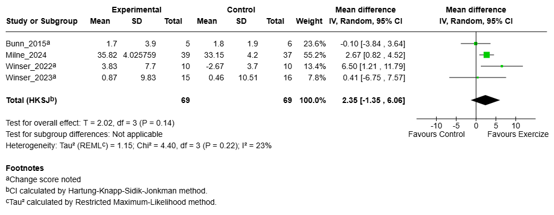
Figure 1. BBS
1.2 Gait
Miyai, 2012; Barbuto 2020; Barbuto, 2021; Barbuto, 2023; assessed gait with gait speed. The gait speed test reflecting the functional mobility with a fast pace indicating a higher functional mobility. The results are displayed in Figure 2. The pooled difference was clinically significant.
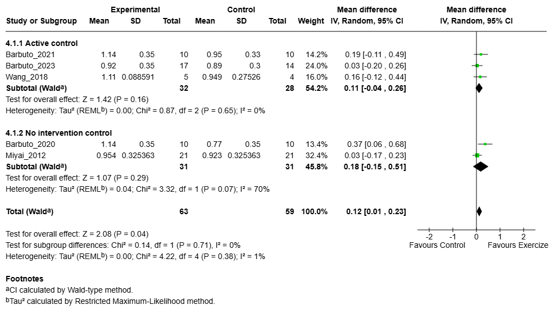
Figure 2. Gait speed
Barbuto, 2020; Barbuto, 2021; Barbuto, 2023; assessed gait with the Dynamic Gait Index (DGI). Participants were asked to maintain walking balance while responding to different tasks such as changing speeds, head turns and stairs. The DGI scoring ranges from 0 to 24 with 24 indicating normal performance and 0 representing severe impairment. The results are displayed in Figure 3. Clinically relevant differences in DGI were reported between interventions.
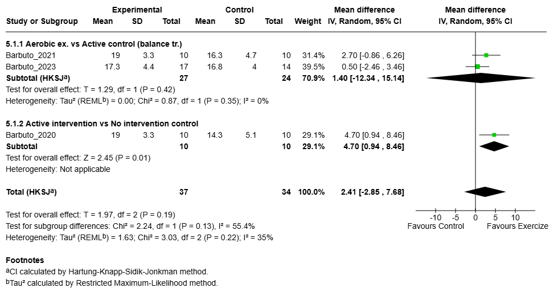
Figure 3. DGI
1.3 Activities of daily living
Four papers (Miyai, 2012; Bunn, 2015; Milne, 2018; Milne 2024) assessed activities of daily living with the Functional Independence Measure (FIM). The FIM ranges from 18 to 126 with 18 representing complete dependence and 126 indicating complete independence. In Bunn,2015 the traditional FIM scale was modified on advice of people with SCA6 to include a category titled ‘independent but difficulties incurred’, with an associated score of 7 (preceding the existing ‘independent’ category, subsequently scored with an 8). The results are displayed in Figure 4. The pooled difference is not clinically significant.
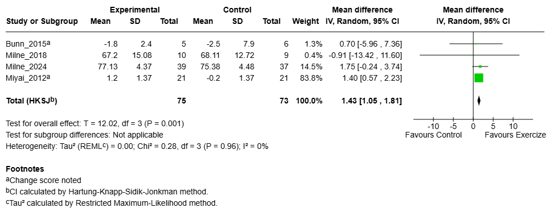
Figure 4. FIM
2. Patient Goal Attainment and Satisfaction (crucial)
No paper reported on patient goal attainment and satisfaction.
3. Ataxia Severity (important)
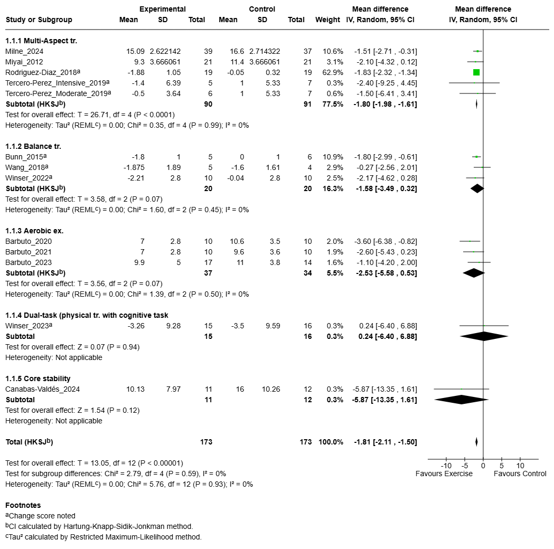
Thirteen studies reported on ataxia severity (Miyai, 2012; Bunn, 2015; Wang, 2018; Rodriguez-Diaz, 2018; Tercero-Perez, 2019; Barbuto 2020; Barbuto, 2021; Winser, 2022; Barbuto, 2023; Winser, 2023; Canabas-Valdes, 2024; Milne, 2024). Ataxia severity was measured with the Scale for assessment and rating of ataxia (SARA). The SARA has a score ranging from 0 (no ataxia) to 40 (most severe ataxia). Figure 5 displays the results. The overall difference in SARA was -1.81 points(95% CI: -2.11 to -1.5] in favor of exercise therapy. This difference is clinically relevant.
4. Quality of life (important)
Four papers reported on quality of life (Bunn, 2015; Winser, 2022; Winser, 2023; Canabas-Valdes, 2024). Quality of life was measured with the EuroQol Visiual Analog Scale (EQ-VAS) questionnaire, scoring from 0 to 100 with a higher score indicating a better quality of life. The results are displayed in Figure 6. No clinically relevant differences in EQ-VAS were reported between interventions.
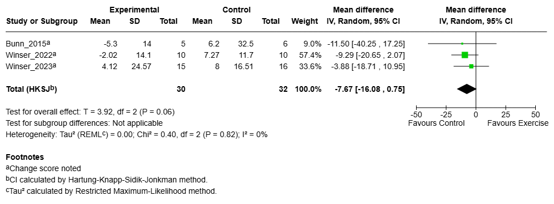
Figure 6. EQ-VAS 1
5. Complications (important)
Complications were reported in two studies (Miyai, 2012, Milne, 2024). Milne (2024) described complications as falls, fatigue and pain as is shown in table 4.
Table 4. Falls, Fatigue and pain (Milne,2024)
|
Adverse event |
Exercise |
Control (standard care) |
|
Injurious falls (% of total falls) |
55 (26.2%) |
22 (14.8%) |
|
Episodes of fatigue impacting on function |
65 |
112 |
|
Episodes of pain impacting on function or present > 72h |
65 |
100 |
Miyai (2012) reported on the amount of falls per week. The exercise group reported 0.3 ±0.4 falls per week. The control group reported 1.7±0.4 falls per week.
A systematic review of the literature was performed to answer the following question:
What are the benefits and risk of exercise therapy (within rehabilitation treatment) in adults with cerebellar ataxia?
Table 1. PICO
| Patients | People with cerebellar ataxia |
| Intervention | Exercise therapy |
| Control | No exercise therapy, care as usual, other forms of (exercise) therapy |
| Outcomes | Critical: Activities (balance, gait and functional independence) and participation, Patient goal attainment and satisfaction Important: Ataxia severity (SARA/ICAR), QoL, Complications |
| Other selection criteria | Study design: systematic reviews and randomized controlled trials |
Relevant outcome measures
The guideline panel considered function, activities and participation and patient goal attainment and satisfaction as critical outcome measures for decision making; and ataxia severity, quality of life, and complications as important outcome measures for decision making.
A priori, the guideline panel did not define the outcome measures listed above but used the definitions used in the studies.
The guideline panel defined the following thresholds as a minimal clinically (patient) important difference (Table 2).
Table 2. Clinically important difference
|
Concept |
Outcome measure |
Minimal clinically important difference |
Source |
|
Ataxie severity |
SARA |
1.0 (of 1.1) between group 2.0 within group |
Park 2024 (Schmitz-Hübsch) ESMI/EUROSCA |
|
Activities and participation
|
Utrecht Scale of Evauation of Rehabilitaiton (USER- P) |
See ‘all other outcome measures’ |
|
|
Berg Balance Scale (BBS) (0-56 – higher better) |
5 or 6 points |
Donoghue et al., 2009 (sralab) |
|
|
Gait Speed (m/s) |
0.1 m/s |
Perera, Mody, Woodman, & Studenski, 2006; n = 692 (sralab) |
|
|
Dynamic Gait Index (DGI) (0-24, higher better) |
1.9 |
Pardasaney et al, 2012; n = 111 (sralab) |
|
|
Functional independence measurement (18-126) higher better) |
22
|
(Beninato et al, 2006;) (sralab) |
|
|
Quality of Life |
EQ-VAS/SF-36 |
See ‘all other outcome measures’ |
|
|
Adverse events |
|
0.91>RR>1.1 or 10% |
|
|
Other |
All other outcome measures |
The guideline panel defined 25% (0.8 ≥ RR ≥ 1.25) for dichotomous outcomes, 0.5 SD for continuous outcomes and standardized mean difference (0.5 ≥ SMD ≥ 0.5) as minimal clinically (patient) important differences. |
|
Search and select (Methods)
A systematic literature search was performed by a medical information specialist using the following bibliographic databases: Embase.com and Ovid/Medline. Both databases were searched from 2005 to March 21, 2025 for systematic reviews, RCTs and observational studies. Systematic searches were completed using a combination of controlled vocabulary and natural language keywords. The overall search strategy was derived from the following primary search concepts: (1) cerebellar ataxia; (2) exercise therapy. Duplicates were removed using EndNote software. After deduplication a total of 882 records were imported for title/abstract screening. Initially, 31 studies were selected based on title and abstract screening. After reading the full text, 28 studies were excluded (see the exclusion table under the tab ‘Evidence tabellen’), and 3 studies were included.
- Barbuto S, Lee S, Stein J, Kuo SH, Quinn L, Spinner M, Stern Y. Home training for cerebellar ataxias: a randomized clinical trial. JAMA Neurol. 2025 Nov 1;82(11):1162-1170. doi: 10.1001/jamaneurol.2025.3421. PMID: 40946705; PMCID: PMC12434599.
- Cabanas-Valdés R, Fernández-Lago H, Peláez-Hervás S, Serra-Rusiñol L, López-de-Celis C, Masbernat-Almenara M. Effect of a home-based core stability exercises in hereditary ataxia: a pilot randomized controlled trial. Mov Disord Clin Pract. 2024 Jun;11(6):666-675. doi: 10.1002/mdc3.14036. Epub 2024 Apr 2. PMID: 38563436; PMCID: PMC11145153.
- Knuijt S, Nonnekes J, van de Warrenburg BPC, Nijkamp M, Scholten S, de Swart BJM, Kalf JG. The use of the Voice Trainer app for vocal control in people with a degenerative ataxia: a pilot intervention study. Cerebellum. 2024 Jan 29.
- Lowit A, Egan A, Hadjivassiliou M. Feasibility and acceptability of Lee Silverman Voice Treatment in progressive ataxias. Cerebellum. 2020 Oct;19(5):701-714.
- Matsugi A, Bando K, Kondo Y, Kikuchi Y, Miyata K, Hiramatsu Y, Yamanaka Y, Tanaka H, Okuda Y, Haruyama K, Yamasaki Y. Effects of physiotherapy on degenerative cerebellar ataxia: a systematic review and meta-analysis. Front Neurol. 2025 Jan 10;15:1491142. doi: 10.3389/fneur.2024.1491142. PMID: 39866519; PMCID: PMC11757114.
- Milne SC, Roberts M, Williams S, Chua J, Grootendorst AC, Agostinelli G, Grobler AC, Ross HL, Robinson A, Grove K, Modderman G, Price A, Thomson M, Massey L, Liang C, Kumar KR, Dalziel K, Burns J, Sue CM, Pathirana PN, Horne M, Gelfand N, Curd H, Szmulewicz D, Corben LA, Delatycki MB. Goal-directed rehabilitation versus standard care for individuals with hereditary cerebellar ataxia: a multicenter, single-blind, randomized controlled superiority trial. Ann Neurol. 2025 Mar;97(3):409-424. doi: 10.1002/ana.27130. Epub 2024 Nov 9. PMID: 39520242.
- Vogel AP, Graf LH, Magee M, Schöls L, Rommel N, Synofzik M. Home-based biofeedback speech treatment improves dysarthria in repeat-expansion SCAs. Ann Clin Transl Neurol. 2022 Aug;9(8):1310-1315.
- Vogel AP, Stoll LH, Oettinger A, Rommel N, Kraus EM, Timmann D, Scott D, Atay C, Storey E, Schöls L, Synofzik M. Speech treatment improves dysarthria in multisystemic ataxia: a rater-blinded, controlled pilot study in ARSACS. J Neurol. 2019 May;266(5):1260-1266.
Risk of Bias tables
|
Study reference
(first author, publication year) |
Was the allocation sequence adequately generated?
Definitely yes Probably yes Probably no Definitely no |
Was the allocation adequately concealed?
Definitely yes Probably yes Probably no Definitely no |
Blinding: Was knowledge of the allocated interventions adequately prevented?
Were patients blinded?
Were healthcare providers blinded?
Were data collectors blinded?
Were outcome assessors blinded?
Were data analysts blinded?
Definitely yes Probably yes Probably no Definitely no |
Was loss to follow-up (missing outcome data) infrequent?
Definitely yes Probably yes Probably no Definitely no |
Are reports of the study free of selective outcome reporting?
Definitely yes Probably yes Probably no Definitely no |
Was the study apparently free of other problems that could put it at a risk of bias?
Definitely yes Probably yes Probably no Definitely no |
Overall risk of bias If applicable/necessary, per outcome measure
LOW Some concerns HIGH
|
|
Cabanas Vales, 2024 |
Probably yes;
Reason: CONSORT guidelines were followed. |
No information.
Reason: |
Definitely no
Reason: Patients knew if they were in the exercise group or in the control group. Assessors were blinded. |
Probably yes
Reason: Loss to follow up was infrequent. Exercise n=1 en control n=2. Op korte termijn was er geen verlies. Op lange termijn wel. Duidelijke redenen waarom ze uitvielen. |
Definitely yes
Reason: Alles is weergegeven. |
Definitely yes;
Reason: No other problems noted
|
Some Concerns → Reason: patients could not be blinded. But assessors were masked to treatment.
|
|
Milne, 2024 |
Definitely yes:
Reason: The randomization was done using a central randomization tool linked to the Murdoch Children’s Research Institute’s instance of the Research Electronic Data Capture (REDCap, http://project-redcap.org/) database using random block sizes of 2 and 4. An independent statistician created the random allocation tables that were uploaded to the randomization tool. |
Definitely yes:
Reason: Enrolling investigators (principal investigators at each site) remained masked to the allocation until after randomization of the participants. Once enrolment was completed, the randomization tool disclosed the group allocation to the enrolling investigator. |
Definitely no:
Reason: outcome assessors were masked to treatment allocation. Patients and healthcare providers were aware in which group patients were in.
Blinding of data analysists was not described.
|
Probably yes:
Reason: Intervention group (n=39) lost 2 patients à 37 patients analysed. Control group (n=37) lost 3 patients à 34 patients analysed.
|
Definitely no
Reason: The following were measured: mFIM, SARA, BBS, FIST, SF-36v2, PGIC-LS, PGIC NRS, daily step count, daily distance walked, static standing and sitting balance, falls, fatigue, pain, Adverse events. But Static standing and sitting balance was not published in this paper: ‘Given the volume of data received from these devices the analysis was beyond the scope of this article and will be subsequently published. |
Definitely yes;
Reason: No other problems noted |
Some concerns Physical Function → SARA, FIST, BBS. Reason: patients could not be blinded. But assessors were masked to treatment.
Some Concerns Patient goal attainment and satisfaction → Goal Attainment Scale + mFIM=Functional independence + PGIC Reason: Patients could not be blinded to treatment.
Some Concern:QoL → 36-item Short-Form health survey version 2. Reason: Patients could not be blinded to treatment.
|
Table of excluded studies
|
Reference |
Reason for exclusion |
|
Ahmed H, Riaz U, Sadia H, Khalil R, Javed Z, Ayub I. A Randomized Clinical Trial Comparing the Effectiveness of Aerobic Training and Circuit Training on Balance in Ataxic Patients. Physiother Res Int. 2025 Jul;30(3):e70068. doi: 10.1002/pri.70068. PMID: 40653445. |
Unclear what type of ataxia was researched. |
|
Barbuto S, Kuo SH, Stein J. Investigating the Clinical Significance and Research Discrepancies of Balance Training in Degenerative Cerebellar Disease: A Systematic Review. Am J Phys Med Rehabil. 2020 Nov;99(11):989-998. doi: 10.1097/PHM.0000000000001476. PMID: 32467491; PMCID: PMC8260091. |
A more recent systematic review was available. |
|
Chang YJ, Chou CC, Huang WT, Lu CS, Wong AM, Hsu MJ. Cycling regimen induces spinal circuitry plasticity and improves leg muscle coordination in individuals with spinocerebellar ataxia. Arch Phys Med Rehabil. 2015 Jun;96(6):1006-13. doi: 10.1016/j.apmr.2015.01.021. Epub 2015 Feb 7. PMID: 25668777. |
|
|
Chartier C, Godard J, Durand S, Humeau-Heurtier A, Menetrier E, Allain P, Besnard J. Combinations of physical and cognitive training for subcortical neurodegenerative diseases with physical, cognitive and behavioral symptoms: a systematic review. Neurol Sci. 2024 Dec;45(12):5571-5589. doi: 10.1007/s10072-024-07808-x. Epub 2024 Oct 19. PMID: 39424648; PMCID: PMC11554706. |
A more recent systematic review was available. |
|
Fonteyn EM, Keus SH, Verstappen CC, Schöls L, de Groot IJ, van de Warrenburg BP. The effectiveness of allied health care in patients with ataxia: a systematic review. J Neurol. 2014 Feb;261(2):251-8. doi: 10.1007/s00415-013-6910-6. Epub 2013 Apr 16. PMID: 23589192. |
A more recent systematic review was available. |
|
He M, Zhang HN, Tang ZC, Gao SG. Balance and coordination training for patients with genetic degenerative ataxia: a systematic review. J Neurol. 2021 Oct;268(10):3690-3705. doi: 10.1007/s00415-020-09938-6. Epub 2020 Jun 24. PMID: 32583055. |
A more recent systematic review was available. |
|
Marquer A, Barbieri G, Pérennou D. The assessment and treatment of postural disorders in cerebellar ataxia: a systematic review. Ann Phys Rehabil Med. 2014 Mar;57(2):67-78. doi: 10.1016/j.rehab.2014.01.002. Epub 2014 Feb 6. PMID: 24582474. |
A more recent systematic review was available. |
|
Matsushima A, Maruyama Y, Mizukami N, Tetsuya M, Hashimoto M, Yoshida K. Gait training with a wearable curara® robot for cerebellar ataxia: a single-arm study. Biomed Eng Online. 2021 Sep 8;20(1):90. doi: 10.1186/s12938-021-00929-w. PMID: 34496863; PMCID: PMC8424896. |
Observational study. |
|
Milne SC, Corben LA, Georgiou-Karistianis N, Delatycki MB, Yiu EM. Rehabilitation for Individuals With Genetic Degenerative Ataxia: A Systematic Review. Neurorehabil Neural Repair. 2017 Jul;31(7):609-622. doi: 10.1177/1545968317712469. Epub 2017 Jun 9. PMID: 28595509. |
A more recent systematic review was available. |
|
Schatton C, Synofzik M, Fleszar Z, Giese MA, Schöls L, Ilg W. Individualized exergame training improves postural control in advanced degenerative spinocerebellar ataxia: A rater-blinded, intra-individually controlled trial. Parkinsonism Relat Disord. 2017 Jun;39:80-84. doi: 10.1016/j.parkreldis.2017.03.016. Epub 2017 Mar 28. PMID: 28365204. |
Patients’ age was too young. |
|
Velázquez-Pérez L, Rodríguez-Diaz JC, Rodríguez-Labrada R, Medrano-Montero J, Aguilera Cruz AB, Reynaldo-Cejas L, Góngora-Marrero M, Estupiñán-Rodríguez A, Vázquez-Mojena Y, Torres-Vega R. Neurorehabilitation Improves the Motor Features in Prodromal SCA2: A Randomized, Controlled Trial. Mov Disord. 2019 Jul;34(7):1060-1068. doi: 10.1002/mds.27676. Epub 2019 Apr 8. PMID: 30958572. |
|
|
Vogel AP, Folker J, Poole ML. Treatment for speech disorder in Friedreich ataxia and other hereditary ataxia syndromes. Cochrane Database Syst Rev. 2014 Oct 28;2014(10):CD008953. doi: 10.1002/14651858.CD008953.pub2. PMID: 25348587; PMCID: PMC11214034. |
A more recent systematic review was available. |
|
Winser S, Chan HK, Chen WK, Hau CY, Leung SH, Leung YH, Bello UM. Effects of therapeutic exercise on disease severity, balance, and functional Independence among individuals with cerebellar ataxia: A systematic review with meta-analysis. Physiother Theory Pract. 2023 Jul 3;39(7):1355-1375. doi: 10.1080/09593985.2022.2037115. Epub 2022 Feb 25. PMID: 35212247. |
A more recent systematic review was available. |
|
Yamashita H, Yamaoka T, Shimomura R, Ichimura S, Murata Y, Itoh A, Mima T, Koganemaru S. Therapeutic Intervention for Trunk Control Impairments in Central Nervous System Disorders: A Comprehensive Review of Methods and Efficacy. Prog Rehabil Med. 2025 Jan 16;10:20250002. doi: 10.2490/prm.20250002. PMID: 39822314; PMCID: PMC11732755. |
A more recent systematic review was available. |
|
Yap KH, Azmin S, Che Hamzah J, Ahmad N, van de Warrenburg B, Mohamed Ibrahim N. Pharmacological and non-pharmacological management of spinocerebellar ataxia: A systematic review. J Neurol. 2022 May;269(5):2315-2337. doi: 10.1007/s00415-021-10874-2. Epub 2021 Nov 6. PMID: 34743220. |
A more recent systematic review was available. |
|
Yigit S, Usgu S, Albayrak HM, Yücel PP, Yakut Y. Effectiveness of functional trunk training on trunk control and upper limb functions in patients with autosomal recessive hereditary ataxia. NeuroRehabilitation. 2022;51(1):41-50. doi: 10.3233/NRE-210320. PMID: 35311719. |
Patients’ age was too young. |
Beoordelingsdatum en geldigheid
Publicatiedatum : 23-09-2026
Beoordeeld op geldigheid : 23-09-2026
Algemene gegevens
De herziening van deze richtlijnmodule werd ondersteund door het Kennisinstituut van de Federatie Medisch Specialisten (www.demedischspecialist.nl/kennisinstituut) en werd gefinancierd door de Stichting Kwaliteitsgelden Medisch Specialisten (SKMS). De financier heeft geen enkele invloed gehad op de inhoud van de richtlijnmodule.
Samenstelling werkgroep
Voor het ontwikkelen van de richtlijnmodule is in 2024 een multidisciplinaire werkgroep ingesteld, bestaande uit vertegenwoordigers van alle relevante specialismen (zie hiervoor de Samenstelling van de werkgroep) die betrokken zijn bij de zorg voor volwassenen met cerebellaire ataxie.
Werkgroep
- Prof. dr. B.P.C. (Bart) van de Warrenburg, Neuroloog, werkzaam bij het Radboudumc, NVN (voorzitter)
- Drs. J.J. (Jeroen) de Vries, Neuroloog, werkzaam bij het UMC Groningen en het Universitair Centrum Ouderengeneeskunde, NVN
- Dr. M.J.(Maarten) Titualaer, Neuroloog, werkzaam bij het ErasmusMC Rotterdam, NVN
- Drs. J. (Judith) van Gaalen, Neuroloog, werkzaam bij Rijnstate en Radboudumc, NVN
- Drs. T.H. (Teije) van Prooije, werkzaam bij het Radboudumc, NVN
- Dr. L.I. (Lennard) Boon, AIOS-neurologie, werkzaam bij het Amsterdam UMC, NVN
- Dr. H.J.R. (Hanneke) Duijnhoven, Revalidatiearts, werkzaam bij het Radboudumc, VRA
- Dr. J. (Jetty) van Meeteren, Revalidatiearts, werkzaam bij het ErasmusMC Rijndam, VRA
- Drs. M (Meyke) Schouten, Klinisch geneticus, werkzaam bij het Radboudumc Nijmegen, VKGN
- Dr. L. (Laura) Donker Kaat, Klinisch geneticus, werkzaam bij het ErasmusMC Rotterdam, VKGN
- Dr. E.J. (Erik-Jan) Kamsteeg, Laboratoriumspecialist klinische genetica, werkzaam bij het Radboudumc, VKGL
- Drs. J. (Jolien) Visser, Vertegenwoordiger wetenschapscommissie, Ataxie Vereniging Nederland
Met ondersteuning van
- Dr. M. (Merel) Wassenaar, adviseur, Kennisinstituut van de Federatie Medisch Specialisten
- Dr. I.J. (Ilse) Blokland, adviseur, Kennisinstituut van de Federatie Medisch Specialisten
- Drs. A. (Astrid) Dorhout, junior adviseur, Kennisinstituut van de Federatie Medisch Specialisten
- Drs. D.A.M. (Danique) Middelhuis, adviseur, Kennisinstituut van de Federatie Medisch Specialisten
- A. (Alies) Oost, informatiespecialist, Kennisinstituut van de Federatie Medisch Specialisten
Belangenverklaringen
Een overzicht van de belangen van werkgroepleden en het oordeel over het omgaan met eventuele belangen vindt u in onderstaande tabel. De ondertekende belangenverklaringen zijn op te vragen bij het secretariaat van het Kennisinstituut van de Federatie Medisch Specialisten via secretariaat@kennisinstituut.nl.
Gemelde (neven)functies en belangen werkgroep
|
Naam |
Hoofdfunctie |
Nevenwerkzaamheden |
Persoonlijke financiële belangen |
Persoonlijke relaties |
Extern gefinancierd onderzoek |
Intellectuele belangen en reputatie |
Overige belangen |
Datum |
Restrictie |
|
Bart van de Warrenburg (voorzitter) |
Neuroloog Radboudumc |
Onbezoldigd: Medisch Adviseur Ataxievereniging Medisch Adviseur Spierziekten Nederland Voorzitter MDS Ataxia Study Group Board member ERN-RND Member Scientific Advisory Board Cure Rare Disease Member Ataxia Global initiative (AGI) Voorzitter Advisory Committee Therapeutics (ACT) Ataxia (deel AGI)
Consultancy (betaald aan Radboudumc) voor Biogen, Vico, Servier, Biohaven Pharmaceuticals |
Geen |
Geen |
Ja ZonMw; Projecten SCA1, VIMP-project, ACT-MD project, projectleider Ja Hersenstichting;Projecten drug repurposing CACNA1A, SCA7, cerebellaire tDCS, projectleider Ja Vico Therapeutics; Klinische trials AON,projectleider Klinische trials AON FARA; Projecten rond Friedreich, projectleider Ja Servier; ESMI/SCA3 project, projectleider Nee |
Het betreft hier een richtlijn die voor een deel gaat over een groep zeldzame aandoening (de erfelijke ataxieën) waarvoor ik wel een KOL ben / boegbeeldfunctie heb |
Geen |
02-10-2024 |
Geen restricties |
|
Erik-Jan Kamsteeg |
Laboratoriumspecialist klinische genetica |
Geen |
Geen |
Geen |
Geen |
Geen |
Geen |
01-08-2024 |
Geen restricties |
|
Meyke Schouten |
Klinisch geneticus, Radboudumc, Nijmegen |
Geen |
Geen |
Geen |
Geen |
Geen |
Geen |
19-09-2024 |
Geen restricties |
|
Jetty van Meeteren |
Revalidatiearts Rijndam, locatie Erasmus MC |
Voorzitter Medische adviesraad ataxievereniging (niet betaald) Medisch advies commissie MSVN (niet betaald) |
Geen |
Geen |
Geen |
Positief effect voor voorzitter MAR ataxievereniging |
Geen |
19-09-2024 |
Geen restricties |
|
Laura Donker Kaat |
Klinisch geneticus bij Erasmus MC Rotterdam |
Geen |
Geen |
Geen |
Geen |
Geen |
Geen |
02-10-2024 |
Geen restricties |
|
Jeroen de vries |
UMC Groningen - Afdeling Neurologie - Neuroloog 0,5 fte (betaald) UMC Groningen - Afdeling Interne Geneeskunde/ Universitair Centrum Ouderengeneeskunde - Neuroloog 0,5 fte (betaald) |
RvC-lid Goedemorgen (Zorghuis voor mensen met dementie) (betaald) |
Adviesraad Biogen (tweemaal sessie) maar alle gelden zijn naar de algemene rekening van de afdeling Neurologie van het UMC Groningen gegaan, zodat ik er geen persoonlijk gewin uithaal ook niet qua onderzoek. |
Geen |
Geen |
Het Expertisecentrum Bewegingsstoornissen Groningen van het UMC Groningen kan baat hebben door bestendiging van lokaal aanwezige expertise. Persoonlijk baten kunnen zijn de betrokkenheid bij patiëntenorganisatie. |
Geen |
02-10-2024 |
Geen restricties |
|
Judith van Gaalen |
Neuroloog Rijnstate 0.8 fte Neuroloog Radboudumc 0.08 fte |
Diagnosewerkgroep Friedreich Ataxie Vereniging Spierziekten Nederland. Redacteur Nervus Medisch adviseur diagnose werkgroep Friedreich Ataxie VSN - onbetaald Redacteur Nervus - honorarium Eenmalige deelname adviesraad Biogen tav nieuw Friedreich medicijn - Consultancy. |
Geen |
Geen |
FARA - Friedreich |
Geen |
Geen |
14-10-2024 |
Geen restricties |
|
Lennard Boon |
AIOS-neurologie, Amsterdam UMC |
Geen. |
Geen. |
Geen |
Geen |
Geen |
Geen |
07-10-2024 |
Geen restricties |
|
Teije van Prooije |
AIOS-neurologie, Radboudumc |
Promovendus onderzoeksgroep zeldzame erfelijke bewegingstoornissen, afdeling Neurologie, Radboudumc |
Geen |
Geen |
grant van ZonMw- Natuurlijke beloop studie bij SCA1-geen projectleider |
Geen |
Geen |
14-10-2024 |
Geen restricties |
|
Jolien Visser |
Vertegenwoordiger wetenschapscommissie van de Ataxie Vereniging Nederland |
Fysiotherapeut en patiënt |
Geen |
Geen |
Geen |
Geen |
Geen |
23-10-2024 |
Geen restricties |
|
Hanneke van Duijnhoven |
Revalidatiearts Radboudumc |
Medisch adviseur diagnosegebonden werkgroep Friedreichse Ataxie van Spierziekte Nederland - onbetaald Lid werkgroep neurorevalidatie VRA - onbetaald Docent scholing gespecialiseerde paramedische eerstelijnszorg voor mensen met ataxie – betaald aan werkgever Expert advies Skyclarys op basis van consultancy - betaald aan mijn werkgever |
Geen |
Geen |
Geen |
hoofd multidisciplinaire polikliniek revalidatie binnen Radboudumc expertisecentrum voor zeldzame en erfelijke bewegingsstoornissen waaronder cerebellaire ataxie en friedreichse ataxie |
Geen |
12-11-2024 |
Geen restricties |
|
Maarten Titulaer |
Neuroloog, Erasmus MC Rotterdam |
- vice-voorzitter Hoofdredactieraad TNN (tijdschrift voor Neurologie en Neurochirurgie) - editorial board Neurology Neuroimmunology & Neurinflammation (onbezoldigd) - lid medische adviesraad ItsME (patientenorganisatie, charity, onbezoldigd) - lid medische adviesraad Encephalitis International (patientenorganisatie, charity, onbezoldigd) - lid medisch-wtenschappelijke adviesraad Autoimmune Encephalitis Alliance (patientenorganisatie, charity, onbezoldigd) - schrijver artikel UpToDate (royalties) - consultant Guidepoint Global LLC (kan gevraagd worden voor consulten met een initieel onbekende partner, ataxie niet genoemd als expertise; al enkele jaren geen consult meer via hun uitgevoerd, ondanks meerdere uitnodigingen) |
Consultancy voor opstarten trials in autoimmuun encefalitis (gelden betaald aan onderzoeksrekening Erasmus MC, niet persoonlijk): - AmGEN (anti-CD19 therapie) - UCB (FcRN blokkers) - ArgenX (FcRn blokkers; PROSE-vragenlijst) |
Geen |
ZonMW;ACT MD (autoimmuniteit en ataxie);PL nee ZonMW (2x)UltraAIE: single cell in AIE; PARADE-VIMP: antistoffen in (snelprogressieve) dementie;PL Ja EpilepsieNL & CSL Behring;AMICE: IVIg Dioraphte; PROMISE;PROMISE: patient-gerapporteerde uitkomsten in AIE; PL Ja NIH/NINDS/Univ of Utah; ExTINGUISH: fase 2b RCT Inebilizumab in NMDAR encephalitis;PJ Ja |
- copyright PROSE, patient reported outcome measure voor autoimmuun encefalitis, niet gericht op ataxie - patent over KCTD8/12/16 antistoffen icm GABAbR antistoffen ("filed a patent for methods for typing neurologic disorders and cancer, and devices for use therein"); potentieel profit zou zijn geweest voor Erasmus MC, maar niet verlengd. |
verricht antineuronale antistoftesten die niet commercieel beschikbaar of gevalideerd zijn voor diagnostiek van patienten in Nederland; de vergoeding vanuit de diagnostiek wordt gebruikt voor de antistoftesten en de tijd en inzet van analisten en raters (geen winstoogmerk, noch winst). Dit betreft ook antistoffen die voor ataxie relevant kunnen zijn. |
22-01-2025 |
Geen restricties |
Inbreng patiëntenperspectief
De werkgroep besteedde aandacht aan het patiëntenperspectief door de Ataxie Vereniging Nederland uit te nodigen voor de schriftelijke knelpuntenanalyse en een patiëntvertegenwoordiger namens Ataxie Vereniging Nederland was betrokken bij de ontwikkeling van de modules. De verkregen input is meegenomen bij het opstellen van de uitgangsvragen, de keuze voor de uitkomstmaten en bij het opstellen van de overwegingen. De conceptrichtlijn is tevens voor commentaar voorgelegd aan de Ataxie Vereniging Nederland en de eventueel aangeleverde commentaren zijn bekeken en verwerkt.
Kwalitatieve raming van mogelijke financiële gevolgen in het kader van de Wkkgz
Bij de richtlijnmodule voerde de werkgroep conform de Wet kwaliteit, klachten en geschillen zorg (Wkkgz) een kwalitatieve raming uit om te beoordelen of de aanbevelingen mogelijk leiden tot substantiële financiële gevolgen. Bij het uitvoeren van deze beoordeling is de richtlijnmodule op verschillende domeinen getoetst (zie het stroomschema bij Werkwijze).
|
Module |
Uitkomst raming |
Toelichting |
|
Revalidatiegeneeskundige behandeling |
Geen financiële gevolgen |
Uit de toetsing volgt dat de aanbeveling(en) niet breed toepasbaar zijn (<5.000 patiënten) en daarom naar verwachting geen substantiële financiële gevolgen zal hebben voor de collectieve uitgaven. |
Werkwijze
Voor meer details over de gebruikte richtlijnmethodologie verwijzen wij u naar de Werkwijze. Relevante informatie voor de herziening van deze richtlijn is hieronder weergegeven.
Zoekverantwoording
Algemene informatie
A systematic literature search was performed by a medical information specialist using the following bibliographic databases: Embase.com and Ovid/Medline all. Both databases were searched from 2005 to March 21, 2025 for systematic reviews, RCTs and observational studies. Systematic searches were completed using a combination of controlled vocabulary and natural language keywords. The overall search strategy was derived from the following primary search concepts: (1) cerebellar ataxia; (2) exercise therapy. Duplicates were removed using EndNote software. After deduplication a total of 882 records were imported for title/abstract screening.
Zoekstrategie
Embase.com
|
No. |
Query |
Results |
|
#1 |
'cerebellar ataxia'/de OR 'ataxia telangiectasia'/exp OR 'ataxia-telangiectasia-like disorder'/exp OR 'boucher neuhauser syndrome'/exp OR 'canvas syndrome'/exp OR 'friedreich ataxia'/exp OR 'hereditary ataxia'/exp OR 'marinesco sjogren syndrome'/exp OR 'multiple system atrophy cerebellar type'/exp OR 'refsum disease'/exp OR 'ataxic gait'/exp OR 'machado joseph disease'/exp OR 'narp syndrome'/exp OR 'olivopontocerebellar atrophy'/exp OR 'spinocerebellar degeneration'/exp OR 'cerebellum degeneration'/exp OR 'cerebellum atrophy'/exp OR 'sporadic ataxia'/exp OR ((ataxia* NEAR/4 (cerebell* OR cerebral OR spinocerebell* OR 'spino cerebell*' OR spinocerebral* OR 'spino cerebral*' OR friedreich* OR friedrich* OR fgf* OR sporadic OR hereditary OR inherited OR congenital* OR familial OR degenerative OR genetic OR msa OR telangiectatica OR teleangiectasia OR telangiectasia)):ti,ab,kw) OR ((spinal NEAR/2 ataxia*):ti,ab,kw) OR heredataxia*:ti,ab,kw OR heredoataxia*:ti,ab,kw OR (((spinocerebell* OR cerebell*) NEAR/3 (atroph* OR degeneration* OR msa)):ti,ab,kw) OR 'msa c':ti,ab,kw OR (((canvas OR cabv) NEAR/2 syndrome*):ti,ab,kw) OR (((machado OR joseph OR azorean OR dejerine OR refsum* OR narp) NEAR/2 (disease* OR syndrome*)):ti,ab,kw) OR (((olivopontocerebell* OR 'olivo ponto cerebell*' OR olivocerebell* OR 'olivo cerebell*') NEAR/3 (atroph* OR degenerat*)):ti,ab,kw) OR 'bar syndrome*':ti,ab,kw OR (('boucher neuhauser' NEAR/3 syndrome*):ti,ab,kw) OR ((marinesco NEAR/2 (sjoegren OR sjogren)):ti,ab,kw) OR iloca:ti,ab,kw OR sloca:ti,ab,kw |
58198 |
|
#2 |
'exercise'/exp OR 'training'/exp OR 'functional training'/exp OR 'fitness'/exp OR 'physical activity'/exp OR 'sport'/exp OR (('physical*' NEAR/3 (activit* OR 'effort*' OR 'exertion*' OR 'fitness*' OR training OR exercis*)):ti,ab,kw) OR (((training OR exercis*) NEAR/3 (therap* OR program* OR protocol* OR muscle* OR strength OR 'upper extremit*' OR aerobic* OR cardiopulmonary OR gait OR walk* OR balance OR stability OR locomotor OR motion OR functional OR tredmill OR treadmill)):ti,ab,kw) OR 'work-out':ti,ab,kw OR 'workout':ti,ab,kw OR 'work-outs':ti,ab,kw OR 'workouts':ti,ab,kw OR sport*:ti,ab,kw OR walking:ti,ab,kw OR jogging:ti,ab,kw OR cycling:ti,ab,kw OR bicycling:ti,ab,kw OR swimming:ti,ab,kw OR yoga:ti,ab,kw OR 'physical rehabilitation':ti,ab,kw OR 'physiotherapy'/exp OR physiotherap*:ti,ab,kw OR 'physio therap*':ti,ab,kw OR 'physical therap*':ti,ab,kw OR 'kinesiotherapy'/exp OR kinesiotherap*:ti,ab,kw OR kinesitherap*:ti,ab,kw OR 'occupational therapy'/exp OR 'occupation* therap*':ti,ab,kw OR ergotherap*:ti,ab,kw |
1726609 |
|
#3 |
#1 AND #2 NOT ('conference abstract'/it OR 'editorial'/it OR 'letter'/it OR 'note'/it) NOT (('animal'/exp OR 'animal experiment'/exp OR 'animal model'/exp OR 'nonhuman'/exp) NOT 'human'/exp) |
2122 |
|
#4 |
#3 AND [2005-2025]/py |
1816 |
|
#5 |
'meta analysis'/exp OR 'systematic review'/exp OR 'scoping review'/exp OR 'rapid review'/exp OR 'umbrella review'/exp OR 'cochrane database of systematic reviews'/jt OR 'network meta-analysis'/exp OR 'networkmeta analy*':ti,ab,kw OR 'networkmetaanaly*':ti,ab,kw OR metaanaly*:ti,ab,kw OR 'meta analy*':ti,ab,kw OR metanaly*:ti,ab,kw OR prisma:ti,ab,kw OR prospero:ti,ab,kw OR metaanali*:ti,ab,kw OR 'meta anali*':ti,ab,kw OR metanali*:ti,ab,kw OR (((systemati* OR scoping OR umbrella OR 'structured literature') NEAR/3 (review* OR overview*)):ti,ab,kw) OR (((structured OR systemic*) NEAR/3 (review* OR overview* OR synth*) NEAR/3 literature):ti,ab,kw) OR ((systemic* NEAR/1 review*):ti,ab,kw) OR (((systemati* OR literature OR database* OR 'data base*') NEAR/10 search*):ti,ab,kw) OR (((structured OR comprehensive* OR systemic*) NEAR/3 search*):ti,ab,kw) OR (((literature NEAR/3 (review* OR overview*)):ti,ab,kw) AND (search*:ti,ab,kw OR database*:ti,ab,kw OR 'data base*':ti,ab,kw)) OR (('data extraction*':ti,ab,kw OR 'data source*':ti,ab,kw) AND ('study selection*':ti,ab,kw OR 'studies selection*':ti,ab,kw)) OR ('search strateg*':ti,ab,kw AND 'selection criteria*':ti,ab,kw) OR ('data source*':ti,ab,kw AND 'data synth*':ti,ab,kw) OR medline*:ti,ab,kw OR pubmed*:ti,ab,kw OR 'pub med*':ti,ab,kw OR embase:ti,ab,kw OR cochrane*:ti,ab,kw OR (((critical* OR rapid*) NEAR/2 (review* OR overview* OR synth*)):ti) OR ((((critical* OR rapid*) NEAR/3 (review* OR overview* OR synth*)):ab) AND (search*:ab OR database*:ab OR 'data base*':ab)) OR metasynth*:ti,ab,kw OR 'meta synth*':ti,ab,kw OR 'review* of review*':ti,ab,kw |
1092426 |
|
#6 |
'clinical trial'/exp OR 'randomization'/exp OR 'single blind procedure'/exp OR 'double blind procedure'/exp OR 'crossover procedure'/exp OR 'placebo'/exp OR 'prospective study'/exp OR rct:ab,ti OR random*:ab,ti OR 'single blind':ab,ti OR 'randomized controlled trial'/exp OR placebo*:ab,ti |
4234190 |
|
#7 |
'major clinical study'/de OR 'clinical study'/de OR 'family study'/de OR 'longitudinal study'/de OR 'retrospective study'/de OR 'prospective study'/de OR 'cohort analysis'/de OR 'case control study'/de OR 'comparative study'/exp OR 'control group'/de OR 'controlled study'/de OR 'controlled clinical trial'/de OR 'crossover procedure'/de OR 'double blind procedure'/de OR 'phase 2 clinical trial'/de OR 'phase 3 clinical trial'/de OR 'phase 4 clinical trial'/de OR 'pretest posttest design'/de OR 'pretest posttest control group design'/de OR 'quasi experimental study'/de OR 'single blind procedure'/de OR 'triple blind procedure'/de OR ((cohort NEAR/1 (study OR studies)):ab,ti) OR (('case control' NEAR/1 (study OR studies)):ab,ti) OR (('follow up' NEAR/1 (study OR studies)):ab,ti) OR (observational NEAR/1 (study OR studies)) OR ((epidemiologic NEAR/1 (study OR studies)):ab,ti) OR (('cross sectional' NEAR/1 (study OR studies)):ab,ti) OR (((control OR controlled) NEAR/6 trial):ti,ab,kw) OR (((control OR controlled) NEAR/6 (study OR studies)):ti,ab,kw) OR (((control OR controlled) NEAR/1 active):ti,ab,kw) OR 'open label*':ti,ab,kw OR (((double OR two OR three OR multi OR trial) NEAR/1 (arm OR arms)):ti,ab,kw) OR ((allocat* NEAR/10 (arm OR arms)):ti,ab,kw) OR placebo*:ti,ab,kw OR 'sham-control*':ti,ab,kw OR (((single OR double OR triple OR assessor) NEAR/1 (blind* OR masked)):ti,ab,kw) OR nonrandom*:ti,ab,kw OR 'non-random*':ti,ab,kw OR 'quasi-experiment*':ti,ab,kw OR crossover:ti,ab,kw OR 'cross over':ti,ab,kw OR 'parallel group*':ti,ab,kw OR 'factorial trial':ti,ab,kw OR ((phase NEAR/5 (study OR trial)):ti,ab,kw) OR ((case* NEAR/6 (matched OR control*)):ti,ab,kw) OR ((match* NEAR/6 (pair OR pairs OR cohort* OR control* OR group* OR healthy OR age OR sex OR gender OR patient* OR subject* OR participant*)):ti,ab,kw) OR ((propensity NEAR/6 (scor* OR match*)):ti,ab,kw) OR versus:ti OR vs:ti OR compar*:ti OR ((compar* NEAR/1 study):ti,ab,kw) OR (('observational study'/de OR 'cross-sectional study'/de OR 'multicenter study'/de OR 'correlational study'/de OR 'follow up'/de OR cohort*:ti,ab,kw OR 'follow up':ti,ab,kw OR followup:ti,ab,kw OR longitudinal*:ti,ab,kw OR prospective*:ti,ab,kw OR retrospective*:ti,ab,kw OR observational*:ti,ab,kw OR 'cross sectional*':ti,ab,kw OR cross?ectional*:ti,ab,kw OR multicent*:ti,ab,kw OR 'multi-cent*':ti,ab,kw OR consecutive*:ti,ab,kw) AND (group:ti,ab,kw OR groups:ti,ab,kw OR subgroup*:ti,ab,kw OR versus:ti,ab,kw OR vs:ti,ab,kw OR compar*:ti,ab,kw OR 'odds ratio*':ab OR 'relative odds':ab OR 'risk ratio*':ab OR 'relative risk*':ab OR 'rate ratio':ab OR aor:ab OR arr:ab OR rrr:ab OR ((('or' OR 'rr') NEAR/6 ci):ab))) |
17919553 |
|
#8 |
#4 AND #5 |
117 |
|
#9 |
#4 AND #6 NOT #8 |
192 |
|
#10 |
#4 AND #7 NOT (#8 OR #9) |
488 |
|
#11 |
#8 OR #9 OR #10 |
797 |
Ovid/Medline
|
# |
Searches |
Results |
|
1 |
exp Cerebellar Ataxia/ or exp Spinocerebellar Degenerations/ or exp Gait Ataxia/ or Multiple System Atrophy/ or Olivopontocerebellar Atrophies/ or (ataxia* adj4 (cerebell* or cerebral or spinocerebell* or 'spino cerebell*' or spinocerebral* or 'spino cerebral*' or friedreich* or friedrich* or fgf* or sporadic or hereditary or inherited or congenital* or familial or degenerative or genetic or msa or telangiectatica or teleangiectasia or telangiectasia)).ti,ab,kf. or (spinal adj2 ataxia*).ti,ab,kf. or heredataxia*.ti,ab,kf. or heredoataxia*.ti,ab,kf. or ((spinocerebell* or cerebell*) adj3 (atroph* or degeneration* or msa)).ti,ab,kf. or 'msa c'.ti,ab,kf. or ((canvas or cabv) adj2 syndrome*).ti,ab,kf. or ((machado or joseph or azorean or dejerine or refsum* or narp) adj2 (disease* or syndrome*)).ti,ab,kf. or ((olivopontocerebell* or 'olivo ponto cerebell*' or olivocerebell* or ' olivo cerebell*') adj3 (atroph* or degenerat*)).ti,ab,kf. or 'bar syndrome*'.ti,ab,kf. or ('boucher neuhauser' adj3 syndrome*).ti,ab,kf. or (Marinesco adj2 (Sjoegren or Sjogren)).ti,ab,kf. or ILOCA.ti,ab,kf. or SLOCA.ti,ab,kf. |
39159 |
|
2 |
exp Exercise/ or exp Exercise Therapy/ or exp Sports/ or (physical* adj3 (activit* or effort* or exertion* or fitness* or training or exercis*)).ti,ab,kf. or ((training or exercis*) adj3 (therap* or program* or protocol* or muscle* or strength or 'upper extremit*' or aerobic* or cardiopulmonary or gait or walk* or balance or stability or locomotor or motion or functional or tredmill or treadmill)).ti,ab,kf. or work-out.ti,ab,kf. or workout.ti,ab,kf. or work-outs.ti,ab,kf. or workouts.ti,ab,kf. or sport*.ti,ab,kf. or walking.ti,ab,kf. or jogging.ti,ab,kf. or cycling.ti,ab,kf. or bicycling.ti,ab,kf. or swimming.ti,ab,kf. or yoga.ti,ab,kf. or 'physical rehabilitation'.ti,ab,kf. or exp Physical Therapy Modalities/ or exp Occupational Therapy/ or physiotherap*.ti,ab,kf. or 'physio therap*'.ti,ab,kf. or 'physical therap*'.ti,ab,kf. or kinesiotherap*.ti,ab,kf. or kinesitherap*.ti,ab,kf. or 'occupation* therap*'.ti,ab,kf. or ergotherap*.ti,ab,kf. |
1025465 |
|
3 |
(1 and 2) not (comment/ or editorial/ or letter/) not ((exp animals/ or exp models, animal/) not humans/) |
979 |
|
4 |
limit 3 to yr="2005 -Current" |
753 |
|
5 |
exp Meta-Analysis/ or exp Network Meta-Analysis/ or exp Systematic Review/ or (networkmeta analy* or networkmetaanaly* or metaanaly* or meta analy* or metanaly* or prisma or prospero or metaanali* or meta anali* or metanali*).ti,ab,kf. or ((systemati* or scoping or umbrella or structured literature) adj3 (review* or overview*)).ti,ab,kf. or ((structured or systemic*) adj3 (review* or overview* or synth*) adj3 literature).ti,ab,kf. or (systemic* adj1 review*).ti,ab,kf. or ((systemati* or literature or database* or data base*) adj10 search*).ti,ab,kf. or ((structured or comprehensive* or systemic*) adj3 search*).ti,ab,kf. or ((literature adj3 (review* or overview*)) and (search* or database* or data base*)).ti,ab,kf. or ((data extraction* or data source*) and (study selection* or studies selection*)).ti,ab,kf. or (search strateg* and selection criteria*).ti,ab,kf. or (data source* and data synth*).ti,ab,kf. or (medline* or pubmed* or pub med* or embase or cochrane*).ti,ab,kf. or cochrane.jw. or ((critical* or rapid*) adj2 (review* or overview* or synth*)).ti. or (((critical* or rapid*) adj3 (review* or overview* or synth*)) and (search* or database* or data base*)).ab. or metasynth*.ti,ab,kf. or meta synth*.ti,ab,kf. |
820144 |
|
6 |
exp clinical trial/ or randomized controlled trial/ or exp clinical trials as topic/ or randomized controlled trials as topic/ or Random Allocation/ or Double-Blind Method/ or Single-Blind Method/ or (clinical trial, phase i or clinical trial, phase ii or clinical trial, phase iii or clinical trial, phase iv or controlled clinical trial or randomized controlled trial or multicenter study or clinical trial).pt. or random*.ti,ab. or (clinic* adj trial*).tw. or ((singl* or doubl* or treb* or tripl*) adj (blind$3 or mask$3)).tw. or Placebos/ or placebo*.tw. |
2868871 |
|
7 |
Case-control Studies/ or clinical trial, phase ii/ or clinical trial, phase iii/ or clinical trial, phase iv/ or comparative study/ or control groups/ or controlled before-after studies/ or controlled clinical trial/ or double-blind method/ or historically controlled study/ or matched-pair analysis/ or single-blind method/ or (((control or controlled) adj6 (study or studies or trial)) or (compar* adj (study or studies)) or ((control or controlled) adj1 active) or "open label*" or ((double or two or three or multi or trial) adj (arm or arms)) or (allocat* adj10 (arm or arms)) or placebo* or "sham-control*" or ((single or double or triple or assessor) adj1 (blind* or masked)) or nonrandom* or "non-random*" or "quasi-experiment*" or "parallel group*" or "factorial trial" or "pretest posttest" or (phase adj5 (study or trial)) or (case* adj6 (matched or control*)) or (match* adj6 (pair or pairs or cohort* or control* or group* or healthy or age or sex or gender or patient* or subject* or participant*)) or (propensity adj6 (scor* or match*))).ti,ab,kf. or (confounding adj6 adjust*).ti,ab. or (versus or vs or compar*).ti. or exp cohort studies/ or epidemiologic studies/ or ((multicenter study/ or observational study/ or seroepidemiologic studies/ or (cohort* or 'follow up' or followup or longitudinal* or prospective* or retrospective* or observational* or multicent* or 'multi-cent*' or consecutive*).ti,ab,kf.) and ((group or groups or subgroup* or versus or vs or compar*).ti,ab,kf. or ('odds ratio*' or 'relative odds' or 'risk ratio*' or 'relative risk*' or aor or arr or rrr).ab. or (("OR" or "RR") adj6 CI).ab.)) or Case control.tw. or cohort.tw. or Cohort analy$.tw. or (Follow up adj (study or studies)).tw. or (observational adj (study or studies)).tw. or Longitudinal.tw. or Retrospective*.tw. or prospective*.tw. or consecutive*.tw. or Cross sectional.tw. or Cross-sectional studies/ or historically controlled study/ or interrupted time series analysis/ |
7984491 |
|
8 |
4 and 5 |
38 |
|
9 |
(4 and 6) not 8 |
139 |
|
10 |
(4 and 7) not (8 or 9) |
165 |
|
11 |
8 or 9 or 10 |
342 |