
Tijd tot operatie proximale femurfractuur
Uitgangsvraag
Wat is de aanbevolen tijd tussen opname en operatie voor een proximale femurfractuur?
Aanbeveling
Aanbeveling 1
Opereer een patiënt met een proximale femurfractuur binnen 24 uur na opname.
Aanbeveling 2
Maak als ziekenhuis werkafspraken, zodat uitstel van operatie langer dan 24 uur alleen plaatsvindt door patiëntfactoren (niet zijnde DOAC).
Aanbeveling 3
Voor de subgroep patiënten met een proximale femurfractuur die een DOAC gebruiken wordt verwezen naar module Periprocedureel beleid bij DOAC's, inclusief lage dosis DOAC's en module Bloeding of spoedingreep bij DOAC's van de richtlijn Antitrombotisch beleid.
Overwegingen
Balans tussen gewenste en ongewenste effecten
Er is literatuuronderzoek gedaan naar de gunstige en ongunstige effecten van een operatie binnen 24 uur ten opzichte van langer dan 24 uur na presentatie op de SEH, bij patiënten met een proximale femurfractuur. Mortaliteit was gedefinieerd als cruciale uitkomstmaat en complicaties, fysieke functie, kwaliteit van leven, opnameduur, implantaat falen en revisie als belangrijke uitkomstmaten. Op basis van vijftien observationele studies leken mortaliteit en complicaties te verminderen bij behandeling binnen 24 uur. Fysieke functie en opnameduur leken niet te veranderen. De andere uitkomstmaten werden niet gerapporteerd in de geïncludeerde literatuur.
De gepubliceerde literatuur kan onvoldoende richting geven aan de besluitvorming door de zeer lage bewijskracht. Daarom zijn aanvullend data geanalyseerd van de Dutch Hip Fracture Audit (DHFA). In deze kwaliteitsregistratie worden patiëntkarakteristieken, behandeling en uitkomsten geregistreerd van patiënten die in het ziekenhuis terechtkomen met een gebroken heup. Voordeel van het gebruik van deze data is dat het Nederlandse data betreft en dat er geen selectie is van patiënten zoals in RCT’s. Men moet zich wel realiseren dat het retrospectieve analyse van de data betreft.
Uitwerking van de cijfers van de patiënten geregistreerd in de DHFA tussen 2018-2024 (N=121.620) laat zien dat van de intracapsulaire fracturen (N=63240) 64% binnen 24 uur werd geopereerd. Bij de extracapsulaire fracturen (N=46.689) was dat 69%. Zowel bij de intra- als extracapsulaire fracturen is er een significante toename van de mortaliteit te zien na zeven, 30, 60 en 90 dagen als de operatie na 24 uur plaats vond. Deze verschillen zijn tevens klinisch relevant want liggen boven de vooraf gedefinieerde minimal clinically (patiënt) important difference van 10% (0.91<RR<1.10) voor mortaliteit.
Ongecorrigeerde en analyses gecorrigeerd voor leeftijd, geslacht, mobiliteit, ADL score, risico op ondervoeding, dementie, woonsituatie en ASA-score lieten HR ratio > 1.10 zien (volledige analyse in bijlage).
De mediane opnameduur was voor de groep die binnen 24 uur werd geopereerd mediaan twee dagen korter voor de intracapsulaire fracturen en één dag voor de extracapsulaire fracturen. Dit is voor de intracapsulaire fracturen een klinisch relevant verschil.
Complicaties en de kans op re-operatie waren in beide groepen significant hoger wanneer de operatie na 24 uur plaatsvond. Het percentage retour herkomst, retour mobiliteit en retour ADL waren lager wanneer de operatie na 24 uur plaatsvond. Hierbij moet worden opgemerkt dat optimalisatie van de patiënt reden kan zijn geweest van uitstel, en dat het hier dus om patiënten met een kwetsbare gezondheid gaat. Daarnaast is deze analyse niet gecorrigeerd voor potentiële confounders, zoals leeftijd en ASA-score.
Voor patiënten met een proximale femurfractuur die een DOAC gebruiken blijkt uit de literatuur en de DHFA dat er geen voordeel is voor het uitstellen van een operatie. Uitstel van de operatie na 24 uur leidt daarentegen tot significante en klinisch relevante toenames van mortaliteit, complicaties en opnameduur.
Uitstel bij behandeling met DOAC’s
De opkomst van de DOAC's heeft geleid tot uitstel van operaties, met als doel bloedingen te voorkomen. Er zijn inmiddels theoretische onderbouwingen en praktijkervaringen, dat uitstel van operatie niet nodig is, mits gekozen wordt voor algehele anesthesie. In een review van literatuur over farmacokinetiek en -dynamiek van DOAC's (Shah, 2021) wordt geconcludeerd dat bij een eGFR > 50ml/min er geopereerd kan worden 24 uur na laatste inname van een DOAC. Peroperatief wordt één milligram tranexamine zuur intraveneus geadviseerd. In een retrospectieve cohort studie (Kolodychuk, 2023) van 535 patiënten, waarvan 41 DOAC gebruikers, wordt geconcludeerd dat 20 uur na presentatie opereren veilig lijkt. Een andere retrospectieve studie (Devlieger, 2024) onderzocht 340 patiënten waarvan 59 patiënten DOAC gebruikers. Zeventien van hen werden < 24 uur geopereerd, de 42 anderen tussen 24 en 48 uur. De uitkomsten ondersteunen eerdere literatuur dat vroeg opereren veilig kan zijn.
In de analyse van de DHFA werd specifiek gekeken naar DOAC gebruik. Onderstaande analyses zijn echter niet gecorrigeerd voor mogelijke confounders zoals leeftijd en ASA score. In de subgroep analyse van de groep waarvan het gebruik van een DOAC bekend was (N=6800) werd van de DOAC-gebruikers 44% binnen 24 uur geopereerd.
Qua mortaliteit was er geen significant verschil zichtbaar tussen de groep DOAC-gebruikers die binnen 24 uur en na 24 uur werden geopereerd na respectievelijk 7, 30, 60 of 90 dagen. De mortaliteit van de groep DOAC gebruikers die binnen 24 uur werd geopereerd was interessant genoeg vergelijkbaar met de mortaliteit van niet DOAC gebruikers die pas na 24 uur werd geopereerd. Met andere woorden; DOAC gebruikers die binnen 24 uur worden geopereerd lijken een slechtere mortaliteit te hebben dan niet DOAC gebruikers die binnen 24 uur worden geopereerd. Bij ongecorrigeerde en gecorrigeerde analyses resulteerde dit in een HR voor mortaliteit tussen 0.81-0.91 (95% CI 0.65 – 1.24) voor DOAC gebruikers bij operatie na 24 uur.
In de DOAC groep leidde een operatie na 24 uur logischerwijs tot één dag meer mediane opnameduur. Bij een ruwe analyse van patiënten met een proximale femurfractuur die een DOAC gebruiken was in de DHFA-data geen significant verschil aantoonbaar in het percentage overlijdens tot 180 dagen bij een operatie binnen of na 24 uur. Een operatie binnen 24 uur lijkt daarmee dus veilig en biedt andere voordelen voor de patiënt zoals een verminderd risico op complicaties en een kortere opnameduur. Dit komt overeen met het advies in de richtlijn Antitrombotisch beleid, welke stelt dat bij DOAC gebruik, indien de medische noodzaak het toelaat, de operatie of ingreep twaalf uur en bij voorkeur 24 uur na de laatste DOAC tablet worden uitgesteld. Elders in de richtlijn wordt genoemd bij patiënten die DOAC’s gebruiken de ingreep tenminste één halfwaardetijd van het desbetreffende middel uit te stellen. De halfwaarde tijden van DOAC’s ligt tussen acht en achttien uur, afhankelijk van het middel en de nierfunctie.
Er is een internationale consensus opgesteld middels een Delphi studie (Mitchell, 2024), waarin voorzichtig is geconcludeerd dat een heupoperatie binnen 36 uur na laatste inname kan plaatsvinden bij een eGFR van > 60ml/min. Er is geen consensus bereikt over timing van spinale anesthesie. Maegele (2024) stelt in een narratieve review dat er in de meerderheid van de gevallen geen reden is de operatie uit te stellen, nadat patiënt medisch is vrijgegeven. De studie geeft aan dat extra stollingsonderzoek beperkt zal moeten blijven tot patiënten met nier- of leverfunctiestoornissen. Een prospectieve studie (Anazor, 2022) 131 patiënten, waarvan 22 DOAC gebruikers (apixaban of rivaroxaban). Geopereerd werd 24 uur na laatste inname, indien de eGFR >50ml/min was en tranexaminezuur werd perioperatief gegeven. Geconcludeerd werd dat dit een veilige manier van werken was. In een prospectieve cohortstudie werden 69 patiënten binnen 24 uur geopereerd (mediane tijd tot operatie twaalf uur, intramedullaire pen), zij werden vergeleken met een retrospectieve controle groep (N=69). Er was geen toename van postoperatief bloed verlies of transfusie behoefte. Er was een significant kortere opname duur (Weihs, 2025).
In de richtlijn antitrombotisch beleid, betreffende vooral electieve ingrepen, wordt heupchirurgie ingedeeld als een ingreep met een hoog bloedingsrisico. Daarbij wordt geadviseerd één tot twee dagen te wachten. De halfwaardetijden voor verschillende middelen worden gegeven in de overwegingen van deze module. In dezelfde richtlijn (Bloeding of ingreep bij DOAC’s) wordt voor spoedingrepen uitgegaan van opereren na één keer de halfwaarde tijd van de DOAC (rekening houdend met nierfunctie stoornissen). In de laatst genoemde studies en uit praktijkervaring uit Nederland (in een ziekenhuis waar rekening met nierfunctie wordt gehouden) blijkt dat eerder opereren niet leidt tot meer transfusies.
Concluderend zijn er veel aanwijzingen dat het optimale moment van opereren van een proximale femurfractuur onder algehele anesthesie ligt tussen één de halfwaarde tijd van de gebruikte DOAC en 24 uur na presentatie. Toekomstige studies zullen het optimale window hopelijk verder en concreter onderbouwen.
Kwaliteit van bewijs
De overall kwaliteit van bewijs van de literatuuranalyse is zeer laag. Dit betekent dat we zeer onzeker zijn over het gevonden geschatte effect van de cruciale uitkomstmaten.
Er is afgewaardeerd vanwege ernstige:
- Risk of Bias: methodologische beperkingen door gebrek aan correctie voor confounding en onduidelijkheid over de criteria voor toewijzing aan de groepen.
- Imprecisie: onnauwkeurigheid, omdat het betrouwbaarheidsinterval de grens van klinische relevantie overschrijdt.
Bij interpretatie van de registratiedata is het belangrijk te realiseren dat het observationele data betreft, met een risico op vertekening, omdat onbekend is waarom operaties eerder of later plaatsvonden. Bovendien betrof het een sample studie waarbij er niet op populatieniveau gekeken kon worden naar de uitkomsten, en werd er niet altijd gecorrigeerd voor mogelijke confounders.
Waarden en voorkeuren van patiënten (en eventueel hun naasten/verzorgers)
Voor patiënten zijn de afname in mortaliteit en complicaties belangrijk. Voor naasten/verzorgers kan de een kortere opnameduur en daarmee reistijd en -kosten van waarde zijn. Voor een oudere patiënt met een kwetsbare gezondheid gaat de aandacht vooral naar terugwinnen van het dagelijks functioneren, de zelfredzaamheid en leefstijl (naar NVKG beleidsplan Kwaliteit 3.0 2023-2028). In de DHFA-data lijken er geen verschil in uitkomst op deze criteria (terug naar eigen woonomgeving, ADL en mobiliteit).
Kostenaspecten
Een operatie binnen 24 uur lijkt te leiden tot minder complicaties en een kortere opnameduur. Daarmee is het kostenbesparend.
Gelijkheid ((health) equity/equitable)
Een operatie binnen 24 uur leidt tot toename van gelijkheid. Een langere opnameduur zorgt voor meer reistijd en kosten voor naasten. Een kortere opnameduur zal daardoor voor hen de kwaliteit van leven kunnen verbeteren.
Aanvaardbaarheid:
Ethische aanvaardbaarheid
De interventie lijkt aanvaardbaar voor de betrokkenen. Er zijn geen ethische bezwaren.
Duurzaamheid
Bij een operatie binnen 24 uur spelen de volgende duurzaamheidsaspecten een rol.
Minder pijnbestrijding preoperatief. Korter gebruik van ziekenhuisfaciliteiten. Minder reisbewegingen van bezoek.
Haalbaarheid
De interventie is in de meeste ziekenhuizen al standaardzorg in de praktijk. In de DHFA data is wel zichtbaar dat er een aantal ziekenhuizen ruim onder het gemiddelde presteren wat betreft patiënten die binnen 24 uur geopereerd worden. Belangrijk is dat deze ziekenhuizen de oorzaak hiervan onderzoeken, een plan van aanpak opstellen en verbetering van de resultaten in de komende jaren laten zien. In het kader van duurzame inzetbaarheid van personeel en de mogelijkheid van monitoring van instabiele hemodynamiek bij patiënten moeten operaties in de avonduren worden vermeden. Er zijn consequenties van opereren binnen 24 uur voor de anesthesie in het geval van DOACs, want als je binnen 24 uur moet opereren kun je geen spinale anesthesie geven, dan kom je uit op algehele anesthesie. Als dit onwenselijk is voor de patiënt, dan is uitstel gerechtvaardigd.
Rationale van aanbeveling 1: weging van argumenten voor en tegen de interventies
Op basis van vijftien observationele studies leken mortaliteit en complicaties te verminderen bij behandeling binnen 24 uur. Op basis van de gecorrigeerde survival analyse van de totale populatie in Nederland, lijkt er een toename van de hazard ratio voor overlijden bij patiënten die ná 24 uur zijn geopereerd. Bovendien is er een klinisch relevante langere opnameduur. De werkgroep beveelt dan ook sterk aan om de zorg in het ziekenhuis zo te organiseren dat dit haalbaar is.
Rationale van aanbeveling 2: weging van argumenten voor en tegen de interventies
Tussen 2022-2024 werd ruim 30% van de patiënten met een proximale femurfractuur niet binnen 24 uur geopereerd. Dit vond plaats zowel plaats in ziekenhuizen waar lage of hoge volumes femurfracturen werden geopereerd. De werkgroep beveelt dan ook sterk aan dat deze onder het gemiddelde presterende ziekenhuizen zo snel mogelijk hun praktijk aanpassen zodat er meer patiënten binnen 24 uur worden geopereerd.
Rationale van aanbeveling 3: weging van argumenten voor en tegen de interventies voor subgroep DOAC
De groep patiënten die een DOAC gebruikt heeft meer co-morbiditeiten en daarmee al een slechter uitgangssituatie preoperatief. Net zoals alle patiënten dienen zij geoptimaliseerd te worden voor operatie. Uitstel van de operatie alleen vanwege het DOAC-gebruik weegt wat betreft de werkgroep qua voordeel niet op tegen de nadelige effecten van uitstel voor de patiënt. Er is echter nog weinig bewijs. Daarom conformeren wij ons aan de richtlijn Antitrombotisch beleid. Daarin wordt geadviseerd (indien mogelijk) bij een spoedingreep te wachten met opereren tot één de halfwaardetijd van de DOAC. De werkgroep is in afwachting van meer bewijs voor een veiligere, kortere tijd tot operatie (<24 uur) van een heupfractuur bij DOAC-gebruikers.
Onderbouwing
Surgical treatment of proximal femoral fractures is currently performed within 24-48 hours. There are indications in recent literature that earlier treatment reduces mortality, but the risk of bleeding due to anticoagulation medication is unclear.
Summary of Findings
|
Outcome
|
Study results and measurements |
Absolute effect estimates |
Certainty of the evidence (Quality of evidence) |
Summary |
|
|
surgery after 24h |
surgery within 24h |
||||
|
Mortality - in-hospital mortality
|
Relative risk: 0.89 (CI 95% 0.84 - 0.94) Based on data from 417572 participants in 9 studies1
|
23 per 1000 |
20 per 1000 |
Very low Due to serious risk of bias and serious imprecision2 |
We are uncertain whether operation within 24 hours decreases in-hospital mortality |
|
Difference: 3 fewer per 1000 (CI 95% 4 fewer - 1 fewer) |
|||||
|
Mortality - 30-day mortality
|
Relative risk: 0.77 (CI 95% 0.63 - 0.94) Based on data from 107547 participants in 9 studies3
|
23 per 1000 |
18 per 1000 |
Very low Due to serious risk of bias and serious imprecision4 |
We are uncertain whether operation within 24 hours decreases 30-day mortality |
|
Difference: 5 fewer per 1000 (CI 95% 9 fewer - 1 fewer) |
|||||
|
Mortality - 1-year mortality
|
Relative risk: 0.69 (CI 95% 0.46 - 1.02) Based on data from 4059 participants in 5 studies5
|
23 per 1000 |
16 per 1000 |
Very low Due to serious risk of bias and serious imprecision6 |
We are uncertain whether operation within 24 hours decreases 1-year mortality |
|
Difference: 7 fewer per 1000 (CI 95% 12 fewer - 0 fewer) |
|||||
|
Complications - All complications
|
Relative risk: 0.8 (CI 95% 0.47 - 1.35) Based on data from 1549 participants in 3 studies7
|
84 per 1000 |
67 per 1000 |
Very low Due to serious risk of bias and serious imprecision8 |
We are uncertain whether operation within 24 hours increases or decreases complications |
|
Difference: 17 fewer per 1000 (CI 95% 45 fewer - 29 more) |
|||||
|
Complications - Major complications
|
Relative risk 0.89 (CI 95% 0.80 — 0.99) Based on data from 474480 participants in 4 studies9 |
84 per 1000 |
75 per 1000 |
Very low Due to serious risk of bias and serious imprecision10 |
We are uncertain whether operation within 24 hours increases or decreases major complications |
|
Difference: 9 fewer per 1000 (CI 95% 17 fewer - 1 fewer) |
|||||
|
Complications - Wound infection
|
Relative risk: 0.77 (CI 95% 0.59 - 1.01) Based on data from 27058 participants in 3 studies11
|
84 per 1000 |
65 per 1000 |
Very low Due to serious risk of bias and serious imprecision12 |
We are uncertain whether operation within 24 hours increases or decreases wound infection |
|
Difference: 19 fewer per 1000 (CI 95% 34 fewer - 1 more) |
|||||
|
Complications - Urinary tract infections
|
Relative risk: 0.88 (CI 95% 0.7 - 1.1) Based on data from 29664 participants in 5 studies13
|
84 per 1000 |
74 per 1000 |
Very low Due to serious risk of bias and serious imprecision14 |
We are uncertain whether operation within 24 hours increases or decreases urinary tract infections |
|
Difference: 10 fewer per 1000 (CI 95% 25 fewer - 8 more) |
|||||
|
Functional ability
|
Based on data from 167 participants in 1 studies Follow up 2 years |
Postoperative Lawson and Brody score was 3.8 in patients operated within 24 hours after admission, versus 3.5 in patients operated between 24 and 48 hours. Postoperative Barthel score was 78 in both groups. The authors did not report the data distribution. |
Very low Due to serious risk of bias and serious imprecision15 |
We are uncertain whether operation within 24 hours improves or worsens functional ability |
|
|
Hospital length of stay
|
Based on data from 413589 participants in 4 studies
|
Results could not be pooled. The differences were not considered clinically relevant. |
Very low Due to serious risk of bias16 |
We are uncertain whether operation within 24 hours increases or decreases hospital length of stay |
|
|
Quality of life
|
|
The included publications did not report quality of life. |
|
|
|
|
Surgical revision
|
|
The included publications did not report surgical revision. |
|
|
|
|
Implant failure
|
|
The included publications did not report implant failure. |
|
|
|
1. Systematic review with included studies: Zhong, 2023, Unnanuntana, 2024, van Rijckevorsel, 2022, Ortíz-Martiníz, 2024, Seckel, 2023, Ganta, 2025, Lieten, 2021, Couto, 2018, Checa-Betegón, 2024. Baseline/comparator Control arm of reference used for intervention.
2. Risk of Bias: serious. Inadequate/lack of correction for confounding; Imprecision: serious. Confidence interval overlaps with limit for clinical decision-making;
3. Systematic review with included studies: Greve, 2023, Liu, 2023, Fu, 2017, Ganta, 2025, Checa-Betegón, 2024, van Rijckevorsel, 2022, Warren, 2024, Nia, 2021, Unnanuntana, 2024. Baseline/comparator Control arm of reference used for intervention.
4. Risk of Bias: serious. Inadequate/lack of correction for confounding; Imprecision: serious. Confidence interval overlaps with limit for clinical decision-making;
5. Systematic review with included studies: Unnanuntana, 2024, Liu, 2023, Maheswari, 2017, Checa-Betegón, 2024, Ganta, 2025. Baseline/comparator Control arm of reference used for intervention.
6. Risk of Bias: serious. Inadequate/lack of correction for confounding; Imprecision: serious. Confidence interval overlaps with limit for clinical decision-making;
7. Systematic review with included studies: Seckel, 2023, Unnanuntana, 2024, Ortíz-Martiníz, 2024. Baseline/comparator Control arm of reference used for intervention.
8. Risk of Bias: serious. Inadequate/lack of correction for confounding; Imprecision: serious. Confidence interval overlaps with limit for clinical decision-making;
9. Systematic review with included studies: Zhong, 2023, Ganta, 2025, Greve, 2023. Baseline/comparator Control arm of reference used for intervention.
10. Risk of Bias: serious. Inadequate/lack of correction for confounding; Imprecision: serious. Confidence interval overlaps with limit for clinical decision-making;
11. Systematic review with included studies: Checa-Betegón, 2024, Fu, 2017, Lieten, 2021. Baseline/comparator Control arm of reference used for intervention.
12. Risk of Bias: serious. Inadequate/lack of correction for confounding; Imprecision: serious. Confidence interval overlaps with limit for clinical decision-making;
13. Systematic review with included studies: van Rijckevorsel, 2022, Lieten, 2021, Liu, 2023, Checa-Betegón, 2024, Fu, 2017. Baseline/comparator Control arm of reference used for intervention.
14. Risk of Bias: serious. Inadequate/lack of correction for confounding; Imprecision: serious. Confidence interval overlaps with limit for clinical decision-making;
15. Risk of Bias: serious. Inadequate/lack of correction for confounding; Imprecision: serious. Low number of patients;
16. Risk of Bias: serious. Inadequate/lack of correction for confounding.
Description of studies
One systematic review and nine additional observational studies were included in the analysis of the literature. Important study characteristics and results are summarized in table 2. The assessment of the risk of bias is summarized in the risk of bias tables (under the tab ‘Evidence tabellen’).
Table 2. Characteristics of included studies
|
Study |
Participants |
Comparison |
Follow-up |
Outcome measures |
Comments |
Risk of bias (per outcome measure)* |
|
Fu, 2017 |
N at baseline Intervention: 5,921 Control: 20,130
Age (mean, SD): NR in SR
Sex: NR in SR |
Intervention: surgery within 24 hours
Control: surgery after 24 hours |
30 days |
30-day mortality, in-hospital complications |
Country: USA |
7 (NOS) |
|
Lieten, 2021 |
N at baseline Intervention: 517 Control: 288
Age (mean, SD): NR in SR
Sex: NR in SR |
Intervention: surgery within 24 hours
Control: surgery after 24 hours |
>2 years |
In-hospital mortality, 30-day mortality, in-hospital complications |
Country: Belgium |
6 (NOS) |
|
Liu, 2023 |
N at baseline Intervention: 136 Control: 657
Age (mean, SD): NR in SR
Sex: NR in SR |
Intervention: surgery within 24 hours
Control: surgery after 24 hours |
>2 years |
30-day mortality, 3-month mortality, 6 months mortality, in-hospital complications |
Country: China |
5 (NOS) |
|
Maheshwari, 2017 |
N at baseline Intervention: 284 Control: 436
Age (mean, SD): NR in SR
Sex: NR in SR
|
Intervention: surgery within 24 hours
Control: surgery after 24 hours |
1 year |
1-year mortality |
Country: USA |
6 (NOS) |
|
Nia, 2021 |
N at baseline Intervention: 611 Control: 189
Age (mean, SD): NR in SR
Sex: NR in SR |
Intervention: surgery within 24 hours
Control: surgery after 24 hours |
180 days |
30-day mortality, 180-day mortality |
Country: Austria |
8 (NOS) |
|
Van Rijckevorsel, 2022 |
N at baseline Intervention: 1386 Control: 362
Age (mean, SD): NR in SR
Sex: NR in SR |
Intervention: surgery within 24 hours
Control: surgery after 24 hours |
30 days |
In-hospital mortality, 30-day mortality, in-hospital complications |
Country: the Netherlands |
8 (NOS) |
|
Individual studies |
||||||
|
Checa-Betagón, 2024 |
Patients over 70 years old with a primary hip fracture in need of surgical management
N at baseline Intervention: 79 Control: 88
Age (mean, SD) Intervention: 87, 6 Control: 88, 6
Sex (% F) Intervention: 81 Control: 78 |
Intervention: surgery within 24 hours
Control: surgery after 24-48 hours
Surgery >48 hours was not included in the current analysis |
2 years |
In-hospital mortality, 30-day mortality, 1-year mortality, complications, length of stay, functional results |
Country: Spain |
High |
|
Daginnus, 2023 |
All patients who were admitted to the Department of Trauma and Orthopaedic Surgery of an academic teaching hospital for hip fracture surgery
N at baseline Intervention: 569 Control: 60
Age (mean, SD) Intervention: N/A Control: N/A Total: 79.29, 11.94
Sex (% F) Intervention: N/A Control: N/A Total: 71.38 |
Intervention: surgery within 24 hours
Control: surgery after more than 24 hours
|
In-hospital |
Complications |
Country: Germany |
Some concerns |
|
Ganta, 2025 |
Patients ≥55 years old with a hip fracture treated operatively
N at baseline Intervention: 1600 Control: 611
Age (mean, SD) Intervention: 80.4, 10.4 Control: 80.9, 10.1
Sex (% F) Intervention: 71 Control: 70 |
Intervention: surgery within 24 hours
Control: surgery after 24-48 hours
Surgery >48 hours was not included in the current analysis |
1 years |
In-hospital mortality, 30-day mortality, 1-year mortality, major and minor complications, length of stay |
Country: USA |
High |
|
Greve, 2023 |
Individuals ≥ 65 years of age with hip fracture admitted to a hospital and treated surgically.
N at baseline Intervention: 45,380 Control: 18,618
Age (mean, SD) Intervention: 83, 8 Control: 83, 8
Sex Intervention: 70 Control: 67 |
Intervention: surgery within 12 hours, 12-24 hours
Control: surgery after 24 hours |
4 months |
30-day survival, 4-month survival |
Country: Sweden |
Low |
|
Ortíz Martínez, 2024 |
Patients who were admitted to a tertiary care university clinic with femur fractures.
N at baseline Intervention: 32 Control: 91
Age (mean, SD) Intervention: N/A Control: N/A Total: 82.09, 9
Sex (% F) Intervention: N/A Control: N/A Total: 70.6 |
Intervention: surgery within 24 hours
Control: surgery after 24-48 hours
Surgery >48 hours was not included in the current analysis |
In-hospital |
In-hospital mortality, postoperative complications |
Country: Colombia |
Some concerns |
|
Seckel, 2023 |
Patients ≥65 years old with isolated hip fracture
N at baseline Intervention: 779 Control: 371
Age (mean, SD) Intervention: N/A Control: N/A
Sex Intervention: N/A Control: N/A |
Intervention: surgery within 24 hours
Control: surgery after 24 hours |
In-hospital |
In-hospital mortality, postoperative complications |
Country: USA |
Some concerns |
|
Unnanuntana, 2024 |
Hip fracture patients who underwent urgent surgical fixation or hip arthroplasty.
N at baseline Intervention: 215 Control: 61
Age (mean, SD) Intervention: 79.5 ± 9.4 Control: 78.0 ± 10.8
Sex (% F) Intervention: 81.4 Control: 68.3 |
Intervention: surgery within 24 hours
Control: surgery after 24 hours |
1 year |
In-hospital mortality, 30-day mortality, 1-year mortality, length of stay, postoperative complications |
Country: Thailand |
High |
|
Warren, 2024
|
Patients over 60 years old that had sustained a hip fracture requiring operative management.
N at baseline Intervention: 6,418 Control: 3,311
Age (mean, SD) Intervention: 82, 9 Control: 82, 8
Sex (% F) Intervention: 77 Control: 74 |
Intervention: surgery within 24 hours (<12, 12-23)
Control: surgery after 24-48 hours
48-72 hours and >72 hours were not included in the current analysis. |
12 months |
30-day mortality |
Country: UK |
Low |
|
Zhong, 2023 |
Patients who had a primary diagnosis of hip fracture, and underwent surgical procedures
N at baseline Intervention: 130,107 Control: 280,613
Age (median [IQR]) Intervention: 83 [77, 89] Control: 84 [77, 89]
Sex (% F) Intervention: 73.3 Control: 72.2 |
Intervention: surgery on day 0-1 after admission
Control: surgery on the second day after admission
Surgery on the third day was not included in the current analysis |
In-hospital |
In-hospital mortality, Major complications, length of stay |
Country: USA |
Some concerns |
*For further details, see risk of bias table in the appendix. NOS: Newcastle-Ottawa Scale
NR: not reported; SR: systematic review
Results
Mortality
Mortality was reported in fifteen studies. Figure 1 depicts the pooled results at different follow-up. Based on nine studies, the risk ratio (RR) of in-hospital mortality was 0.89 in favor of operation within 24 hours, with a 95% confidence interval (CI) from 0.84 to 0.94. Mortality at thirty days had a RR of 0.77 (95% CI 0.63 to 0.94) in favor of operation withing 24 hours, based on nine studies. Finally, the RR of one-year mortality was 0.69 (95% CI 0.46 to 1.02) in favor of operation within 24 hours (five studies). The differences were considered clinically relevant.
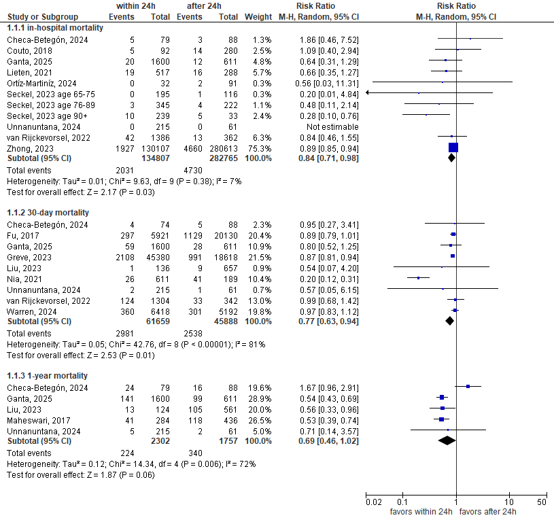
Figure 1. Mortality
Z: p-value of overall effect; df: degrees of freedom; I2: statistical heterogeneity; CI: confidence interval
Complications
Ten studies reported complications. Reported complications differed between studies, ranging from specific complications to postoperative complications, minor and major complications, and all complications. Figure 2 depicts the pooled results per category.
Based on three studies, the RR of complications was 0.80 (95% CI 0.47 to 1.35) in favor of operation within 24 hours. In addition, based on three publications, the RR of major complications was 0.93 (95% CI 0.91 to 0.95) in favor of operation within 24 hours. The RR of wound infection was 0.77 (95% CI 0.59 to 1.01; 3 studies) and the RR of urinary tract infections was 0.88 (95% CI 0.70 to 1.10; 4 studies), both in favor of operation within 24 hours.
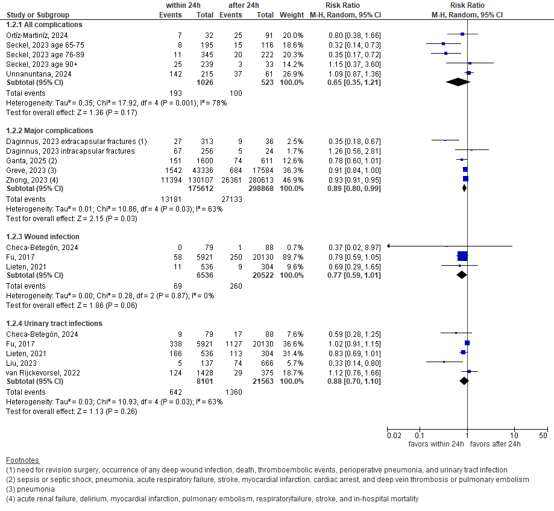
Figure 2. Complications
Z: p-value of overall effect; df: degrees of freedom; I2: statistical heterogeneity; CI: confidence interval
Hospital length of stay
Four publications reported hospital length of stay. Table 3 presents the results. The differences were not considered clinically relevant.
Table 3. Hospital length of stay
|
Study |
Surgery within 24 hours |
Surgery after 24 hours |
|
Checa-Betagón, 2024 |
7 [5, 10] |
7 [5, 10] |
|
Ganta, 2025 |
5.9 ± 4.2 |
7 ± 3.9 |
|
Unnanuntana, 2024 |
6 [4, 9] |
8 [7, 13] |
|
Zhong, 2023 |
4 [3, 5] |
4.2 [4, 6] |
Data are presented as median [IQR] or mean ± SD
Functional results
Only one study reported functional results. Checa-Betegón (2024) measured Barthel score and Lawton and Brody score for functional ability. Postoperative Lawton and Brody score was 3.8 in patients operated within 24 hours after admission, versus 3.5 in patients operated between 24 and 48 hours. Postoperative Barthel score was 78 in both groups. The authors did not report the data distribution. The differences were not considered clinically relevant.
Other outcome measures
The included publications did not report implant failure, surgical revision or quality of life.
A systematic review of the literature was performed to answer the following question(s):
What are the benefits and harms of surgical treatment of proximal femoral fractures within 24 hours compared with surgical treatment later than 24 hours?
Table 1. PICO
| Patients | Patients with proximal femoral fractures |
| Intervention | Surgical treatment within 24 hours |
| Control | Surgical treatment after more than 24 hours |
| Outcomes | Mortality, complications, functional ability, length of stay, implant failure, surgical revision, quality of life |
| Other selection criteria | Study design: randomized controlled trials, observational studies and systematic reviews |
Relevant outcome measures
The guideline panel considered mortality (all timepoints) as a critical outcome measure for decision making; and complications, functional ability, length of stay, implant failure, surgical revision, quality of life as an important outcome measure for decision making.
The guideline panel did not define the outcome measures listed above a priori, but followed the definitions used in the studies.
The guideline panel defined as a minimal clinically (patient) important difference:
- 10% (0.91<RR<1.10) for mortality.
- 25% (0.80<RR<1.25) for complications, implant failure and surgical revisions.
- 10% of the maximum score for quality of life scores, Barthel index, Lawton and Brody score.
- 2 days for hospital length of stay, 1 day for postoperative length of stay.
Search and select (Methods)
A systematic literature search was performed by a medical information specialist using the following bibliographic databases: Embase.com and Ovid/Medline. Both databases were searched from 2005 to January 24, 2025 for systematic reviews, RCTs and observational studies. Systematic searches were completed using a combination of controlled vocabulary/subject headings (e.g., Emtree-terms, MeSH) wherever they were available and natural language keywords. The overall search strategy was derived from two primary search concepts: (1) proximal femoral fracture and (2) timing of surgery. Duplicates were removed using EndNote software. After deduplication a total of 2288 records were imported for title/abstract screening. Initially, 85 studies were selected based on title and abstract screening. After reading the full text of twelve systematic reviews, an appropriate and recent systematic review was identified. Eleven systematic reviews were excluded. Twenty relevant studies published after the search of the review were subsequently read in full text. Eleven studies were excluded (see the exclusion table under the tab ‘Evidence tabellen’), and nine observational studies were included.
- Anazor F, Kulkarni A, Barnard K, Lancaster S, Pollard T. Timing and safety of hip fracture surgery in patients on direct-acting oral anticoagulants. J Clin Orthop Trauma. 2022 Nov 24;36:102080. doi: 10.1016/j.jcot.2022.102080. PMID: 36465496; PMCID: PMC9712983.
- Checa-Betegón P, Ramos-Fernández A, Martínez-García A, García-Coiradas J, Valle-Cruz J. Does surgical delay time affect mortality and functional outcomes in elderly patients with hip fractures? Injury. 2024 Oct;55 Suppl 5:111672. doi: 10.1016/j.injury.2024.111672. PMID: 39581653.
- Daginnus A, Schmitt J, Graw JA, Soost C, Burchard R. Rate of Complications after Hip Fractures Caused by Prolonged Time-to-Surgery Depends on the Patient's Individual Type of Fracture and Its Treatment. J Pers Med. 2023 Oct 8;13(10):1470. doi: 10.3390/jpm13101470. PMID: 37888081; PMCID: PMC10608594.
- Devlieger BK, Rommens PM, Baranowski A, Wagner D. Early Hip Fracture Surgery in Patients Taking Direct Oral Anticoagulants Improves Outcome. J Clin Med. 2024 Aug 11;13(16):4707. doi: 10.3390/jcm13164707. PMID: 39200849; PMCID: PMC11355663.
- Ganta A, Merrell LA, Herbosa C, Egol KA, Konda SR. Benefit of Expedited Time to Hip Fracture Surgery Differs Based on Patient Risk Profile. J Orthop Trauma. 2025 Feb 1;39(2):68-74. doi: 10.1097/BOT.0000000000002934. PMID: 39601534.
- Greve K, Ek S, Bartha E, Modig K, Hedström M. Waiting more than 24 hours for hip fracture surgery is associated with increased risk of adverse outcomes for sicker patients: a nationwide cohort study of 63,998 patients using the Swedish Hip Fracture Register. Acta Orthop. 2023 Feb 27;94:87-96. doi: 10.2340/17453674.2023.9595. PMID: 36847752; PMCID: PMC9972166.
- Kolodychuk NL, Godshaw B, Nammour M, Starring H, Mautner J. Early hip fracture surgery is safe for patients on direct oral anticoagulants. OTA Int. 2023 Apr 5;6(2):e252. doi: 10.1097/OI9.0000000000000252. PMID: 37034428; PMCID: PMC10079331.
- Maegele M. Management of patients with proximal femur fractures under DOACs. Eur J Trauma Emerg Surg. 2024 Apr;50(2):359-366. doi: 10.1007/s00068-024-02472-4. Epub 2024 Feb 24. PMID: 38400927; PMCID: PMC11035399.
- Mitchell RJ, Wijekulasuriya S, Mayor A, Borges FK, Tonelli AC, Ahn J, Seymour H; Fragility Fracture Network Hip Fracture Audit Special Interest Group. Principles for management of hip fracture for older adults taking direct oral anticoagulants: an international consensus statement. Anaesthesia. 2024 Jun;79(6):627-637. doi: 10.1111/anae.16226. Epub 2024 Feb 6. PMID: 38319797.
- Ortíz Martínez JG, Bodu Lamberti EM, Karduss Preciado C, Polo Miranda MF. Experience of a centre of excellence in hip fractures of the elderly in Colombia: influence of time-to-surgery on inpatient mortality and complications. Int Orthop. 2024 Oct;48(10):2499-2504. doi: 10.1007/s00264-024-06249-7. Epub 2024 Aug 7. PMID: 39107627.
- Pincus D, Ravi B, Wasserstein D, Huang A, Paterson JM, Nathens AB, Kreder HJ, Jenkinson RJ, Wodchis WP. Association Between Wait Time and 30-Day Mortality in Adults Undergoing Hip Fracture Surgery. JAMA. 2017 Nov 28;318(20):1994-2003. doi: 10.1001/jama.2017.17606. PMID: 29183076; PMCID: PMC5820694.
- Rădulescu M, Necula BR, Mironescu SA, Roman MD, Schuh A, Necula RD. Is the Timing of Surgery a Sufficient Predictive Factor for Outcomes in Patients with Proximal Femur Fractures? A Systematic Review. J Pers Med. 2024 Jul 21;14(7):773. doi: 10.3390/jpm14070773. PMID: 39064027; PMCID: PMC11277622.
- Seckel T, Mahoney K, Hewitt C, Liu H, Ang D. Outcomes After Definitive Surgery for Nonagenarians with Isolated Hip Fractures within 24 hours of Admission. Am Surg. 2023 May;89(5):1821-1828. doi: 10.1177/00031348211067994. Epub 2022 Mar 14. PMID: 35282709.
- Shah R, Sheikh N, Mangwani J, Morgan N, Khairandish H. Direct oral anticoagulants (DOACs) and neck of femur fractures: Standardising the perioperative management and time to surgery. J Clin Orthop Trauma. 2021 Jan;12(1):138-147. doi: 10.1016/j.jcot.2020.08.005. Epub 2020 Aug 23. PMID: 33716439; PMCID: PMC7920209.
- Unnanuntana A, Anusitviwat C, Lertsiripatarajit V, Riawraengsattha P, Raksakietisak M. Early Hip Fracture Surgery Within 24 hours did not Reduce the Mortality Rate but Resulted in Less Postoperative Opioid use and a Shorter Length of Stay: A Retrospective Study of 276 Patients From a Tertiary Private Hospital in Thailand. Geriatr Orthop Surg Rehabil. 2024 May 17;15:21514593241250150. doi: 10.1177/21514593241250150. PMID: 38766276; PMCID: PMC11102701.
- Warren M, Bretherton C, Parker M. Delay to surgery beyond 12 hours is associated with increased hip fracture mortality. Eur J Orthop Surg Traumatol. 2024 Aug;34(6):2973-2980. doi: 10.1007/s00590-024-03997-5. Epub 2024 Jun 7. PMID: 38844565; PMCID: PMC11377486.
- Weihs V, Humenberger M, Sturz G, Martin C, Pausch A, Duma A, Frossard M, Hajdu S. Early surgical fixation of proximal femur fractures under active direct oral anticoagulation (DOAC) therapy does not increase the postoperative blood loss. Results from a prospective cohort study with a matched-pair analysis. Arch Orthop Trauma Surg. 2025 Apr 12;145(1):243. doi: 10.1007/s00402-025-05870-4. PMID: 40221597; PMCID: PMC11993469.
- Zhong H, Poeran J, Illescas A, Reisinger L, Cozowicz C, Memtsoudis SG, Liu J. Time to surgical treatment for hip fracture care. J Am Geriatr Soc. 2024 Nov;72(11):3492-3500. doi: 10.1111/jgs.19063. Epub 2024 Jul 4. PMID: 38963068.
Risk of bias table
|
Author, year
|
Selection of participants
Was selection of exposed and non-exposed cohorts drawn from the same population?
|
Exposure
Can we be confident in the assessment of exposure?
|
Outcome of interest
Can we be confident that the outcome of interest was not present at start of study?
|
Confounding-assessment
Can we be confident in the assessment of confounding factors?
|
Confounding-analysis
Did the study match exposed and unexposed for all variables that are associated with the outcome of interest or did the statistical analysis adjust for these confounding variables? |
Assessment of outcome
Can we be confident in the assessment of outcome?
|
Follow up
Was the follow up of cohorts adequate? In particular, was outcome data complete or imputed?
|
Co-interventions
Were co-interventions similar between groups?
|
Overall Risk of bias
|
|
Checa-Betegón, 2024 |
Definitely no
Reason: Patients operated on more than 24 h after admission were medically optimized preoperatively by an orthogeriatric team. The team of geriatricians performed a medical assessment of the patient, focusing primarily on coagulation, renal function, glycaemia and regular medication adjustment. |
Definitely yes
Reason: The exposure was clearly defined |
Probably yes
Reason: data were collected from each patient´s medical record. |
Definitely no
Reason: not mentioned |
Definitely no
Reason: only corrected for sex and age |
Definitely yes
Reason: The outcomes are objective and defined |
Probably yes
Reason: No problems noted |
Definitely yes
Reason: Additional interventions were similar between groups |
High due to possible confounding |
|
Daginnus, 2023 |
Probably yes
All patients admitted to the Department of Trauma and Orthopaedic Surgery of a 595-bed-academic teaching hospital of the University of Marburg for hip fracture surgery (n = 650) in the years 2010 to 2014 were included in the study. |
Definitely yes
Reason: The exposure was clearly defined. |
Probably yes
Reason: data were collected from the hospital patient data management system |
Probably yes
Reason: Confounding factors were defined. |
Probably yes
Reason: multivariate analysis was performed using logistic regression and stepwise integration of patient characteristics of age, sex, place of residence, comorbidities, and hospital length of stay. |
Definitely no
Reason: The outcome of interest is not clearly defined. |
Probably yes
Reason: No problems noted |
Probably yes
Reason: No problems noted |
Some concerns due to unclear definition of outcome |
|
Ganta, 2025 |
Probably yes
From October 2014 to October 2023, a consecutive series of hip fractures (AO/OTA 31 A, 31 B, 32 A– C) presented at 1 of 4 hospitals within 1 academic medical center and were enrolled into a prospective hip fracture database. |
Definitely yes
Reason: The exposure was clearly defined |
Probably yes
Reason: Demographics, radiographs, injury characteristics, and operative details were collected from the Electronic Medical Record. In addition, hospital quality measures such as length of stay, complication rates, readmission, and mortality rates during admission, at 30 days, and through 1-year post-op were queried from outpatient charts. |
Probably no
Reason: the academic medical system where this study was conducted has established standardized postoperative practices, so the authors hope that any confounding factors can be minimized. |
Definitely no
Reason: only stratified by risk profile |
Definitely yes
Reason: The outcomes are objective and defined |
Probably yes
Reason: No problems noted |
Probably yes
Reason: No problems noted |
High due to possible confounding |
|
Greve, 2023 |
Definitely yes
Reason: This is a nationwide cohort study of the exposure waiting time to surgery, as registered in the Swedish Hip Fracture Register RIKSHÖFT (SHR) |
Definitely yes
Reason: The exposure was clearly defined |
Definitely yes
Reason: patients with the outcome diagnosis during the index hospitalization were excluded to reduce the risk of reverse causality |
Probably yes
Reason: Confounding factors were defined. |
Probably yes
Reason: The outcome data is presented for the whole cohort as well as stratified for sex and ASA category and adjusted for potential confounders in 3 different models. One unaddressed potential confounder is the reason for surgical delay (administrative vs. medical). |
Probably yes
Reason: The outcomes for specific diagnoses were defined as ICD-10 codes registered in NPR or CDR. We selected diagnoses that are common postoperatively and can reasonably be attributed to the wait for hip fracture surgery |
Probably yes
Reason: No problems noted |
Definitely yes
Reason: Type of surgery was divided into 2 groups, group 1 (intramedullary nail, hemiarthroplasty, and total hip replacement, which are all intramedullary procedures), group 2 (internal fixation other than intramedullary procedures). |
Low |
|
Otríz Martínez, 2024 |
Probably no
Reason: there is a confounding bias subject to the availability of the operating room and the time of medical optimization required by highly comorbid patients, thus overestimating the time-to-surgery. |
Definitely yes
Reason: The exposure was clearly defined |
Probably yes
Reason: data were collected from each patient´s medical record. |
Definitely no
Reason: not mentioned |
Definitely no
Reason: not corrected |
Definitely yes
Reason: The outcomes are objective and defined |
Probably yes
Reason: No problems noted |
Not reported |
High due to possible confounding |
|
Seckel, 2023 |
Probably no
Reason: Our medical center screens all patients with isolated hip fractures for arrhythmias or congestive heart failure using our isolated hip fracture protocol. If the echocardiogram is positive for cardiac disease or the patient continues to have cardiac symptoms, then cardiology is consulted for preoperative optimization. This may delay surgery, but on average not by more than 24 hours. |
Definitely yes
Reason: The exposure was clearly defined |
Probably yes
Reason: Comorbidities were established before the intervention |
Probably yes
Reason: confounders were selected based on if there was a real possibility that they would have an independent effect on the exposure and outcome of interest |
Probably yes
Reason: Multivariable logistic regression was used to account for confounders |
Definitely yes
Reason: The outcomes are objective and defined |
Probably yes
Reason: No problems noted |
Not reported
|
Some concerns due to patient selection |
|
Unnanuntana, 2024 |
Probably no
Reason: Cardiologists/general medicine/geriatricians were consulted on age-related or cardiovascul ar issues, and additional investigations were performed if warranted. Any other medical problems were optimally treated before the operation. |
Definitely yes
Reason: All outcome measures were compared between early and late hip fracture surgery, using 24 hours as a cutoff point. |
Definitely yes
Reason: clear distinction between preoperative, peroperative and postoperative data. |
Definitely no
Reason: Not reported. |
Definitely no
Reason: not corrected. The proportion of patients using anticoagulants was lower in the surgery within 24 hours group. |
Definitely yes
Reason: The outcomes are objective and defined |
Probably yes
Reason: No problems noted |
Probably yes
Reason: no indications otherwise |
High due to possible confounding |
|
Warren, 2024 |
Probably yes
Reason: patients who were delayed for medical reasons were excluded. |
Definitely yes
Reason: Patients were then divided into time categories where time from admission to surgery was under 12 h, 12–24 h, 24–72 h and over 72 h. |
Probably yes
Reason: daa were prospectively collected on a hip fracture database using a standardised proforma. |
Probably yes
Reason: many relevant factors considered |
Definitely yes
Reason: multivariate analysis |
Definitely yes
Reason: The outcomes are objective and defined |
Probably yes
Reason: No problems noted. Missing data acceptable. |
Probably yes
Reason: no indications otherwise |
Low |
|
Zhong, 2024 |
Definitely no
Reason: Patients with longer wait time to surgery carried more comorbidity. Additionally, compared with those who had the surgery on day 2, patients who had surgery within 0–1 day after admission were younger, more likely to be admitted emergently, and more frequently to have hemiarthroplasty surgery |
Probably yes
Reason: The Premier dataset does not provide exact timing, instead, timing is provided by day. Therefore, this was categorized as 0–1 day, 2 days, and 3 days. |
Probably yes
Reason: clear distinction between preoperative, peroperative and postoperative data. |
Probably yes.
Reason: Based on an a priori established analysis plan, a number of baseline variables were investigated as potential modifiers of outcome, including patient-, procedure-, and healthcare-related characteristics. |
Probably yes.
Reason: Mixed-effects models were applied to compare the outcomes between all three groups in a pair-wise way. Models were adjusted for all covariates mentioned above. |
Definitely yes
Reason: The outcomes are objective and defined |
Probably yes
Reason: No problems noted |
Probably yes
Reason: no indications otherwise |
Some concerns due to patient selection |
Table of excluded studies
|
Reference |
Reason for exclusion |
|
Chen P, Shen X, Xu W, Yao W, Ma N. Comparative assessment of early versus delayed surgery to treat proximal femoral fractures in elderly patients: A systematic review and meta-analysis. Int J Surg. 2019 Aug;68:63-71. doi: 10.1016/j.ijsu.2019.06.013. Epub 2019 Jun 20. PMID: 31229698. |
More recent systematic review used |
|
Clinkenbeard K, Bossle K, Pape T, Woltenberg LN, Saha S. Time to Hip Fracture Surgery and Mortality. South Med J. 2023 Mar;116(3):274-278. doi: 10.14423/SMJ.0000000000001520. PMID: 36863047; PMCID: PMC9991070. |
No comparative data |
|
Doleman B, Moppett IK. Is early hip fracture surgery safe for patients on clopidogrel? Systematic review, meta-analysis and meta-regression. Injury. 2015;46(6):954-62. doi: 10.1016/j.injury.2015.03.024. Epub 2015 Mar 16. PMID: 25818054. |
More recent systematic review used |
|
Fenwick A, Pfann M, Antonovska I, Mayr J, Lisitano L, Nuber S, Förch S, Mayr E. Early surgery? In-house mortality after proximal femoral fractures does not increase for surgery up to 48 h after admission. Aging Clin Exp Res. 2023 Jun;35(6):1231-1239. doi: 10.1007/s40520-023-02406-x. Epub 2023 May 4. PMID: 37138145; PMCID: PMC10156577. |
Group allocation based on DOAC |
|
Gilmore C, Mayne A, Goodland C, Cassidy R, MacDonnell L, Mogey P, Murphy L, Diamond O. Early surgery improves survival after femoral fractures in the elderly: A retrospective review of 502 fragility fractures. Injury. 2024 Feb;55(2):111275. doi: 10.1016/j.injury.2023.111275. Epub 2023 Dec 9. PMID: 38134490. |
Wrong comparison (48 hours) |
|
George J, Sharma V, Farooque K, Mittal S, Trikha V, Malhotra R. The Impact of Surgical Timing of Hip Fracture on Mortality: Do the Cause and Duration of Delay Matter? Hip Pelvis. 2023 Sep;35(3):206-215. doi: 10.5371/hp.2023.35.3.206. Epub 2023 Sep 6. PMID: 37727296; PMCID: PMC10505843. |
Wrong comparison (48 hours) |
|
Iida H, Takegami Y, Sakai Y, Watanabe T, Osawa Y, Imagama S. Early surgery within 48 hours of admission for hip fracture did not improve 1-year mortality in Japan: a single-institution cohort study. Hip Int. 2024 Sep;34(5):660-667. doi: 10.1177/11207000241248836. Epub 2024 May 21. PMID: 38770922. |
Wrong comparison (48 hours) |
|
Khan SK, Kalra S, Khanna A, Thiruvengada MM, Parker MJ. Timing of surgery for hip fractures: a systematic review of 52 published studies involving 291,413 patients. Injury. 2009 Jul;40(7):692-7. doi: 10.1016/j.injury.2009.01.010. Epub 2009 May 18. PMID: 19450802. |
More recent systematic review used |
|
Klestil T, Röder C, Stotter C, Winkler B, Nehrer S, Lutz M, Klerings I, Wagner G, Gartlehner G, Nussbaumer-Streit B. Impact of timing of surgery in elderly hip fracture patients: a systematic review and meta-analysis. Sci Rep. 2018 Sep 17;8(1):13933. doi: 10.1038/s41598-018-32098-7. PMID: 30224765; PMCID: PMC6141544. |
More recent systematic review used |
|
Liu Z, Du Z, Lu H, Fu Z, Xu H. Delay between admission and surgery as a potential risk factor for postoperative morbidity and mortality in elderly patients with hip fractures: A retrospective study. J Orthop Sci. 2023 Sep;28(5):1124-1130. doi: 10.1016/j.jos.2022.07.010. Epub 2022 Aug 26. PMID: 36031534. |
Study reported in systematic review |
|
Lu W, Yon DK, Lee SW, Koyanagi A, Smith L, Shin JI, Rahmati M, Xiao W, Li Y. Safety of Early Surgery in Hip Fracture Patients Taking Clopidogrel and/or Aspirin: A Systematic Review and Meta-Analysis. J Arthroplasty. 2024 May;39(5):1374-1383.e3. doi: 10.1016/j.arth.2023.11.012. Epub 2023 Nov 14. PMID: 37972664. |
More recent systematic review used |
|
Moja L, Piatti A, Pecoraro V, Ricci C, Virgili G, Salanti G, Germagnoli L, Liberati A, Banfi G. Timing matters in hip fracture surgery: patients operated within 48 hours have better outcomes. A meta-analysis and meta-regression of over 190,000 patients. PLoS One. 2012;7(10):e46175. doi: 10.1371/journal.pone.0046175. Epub 2012 Oct 3. PMID: 23056256; PMCID: PMC3463569. |
More recent systematic review used |
|
Muscat K. Hip Fractures in Malta: Does Delay in Surgery Affect Clinical Outcomes? Cureus. 2024 Dec 10;16(12):e75467. doi: 10.7759/cureus.75467. PMID: 39791036; PMCID: PMC11717063. |
Wrong comparison (36 hours) |
|
Panth S, Wilson E, Chen B, Clement ND. Accelerated Care of Patients with Hip Fractures is Associated with Lower Risk of Delirium and Infection, and a Shorter Length of Hospital Stay: Systematic Review and Meta-analysis of Level One Evidence. Indian J Orthop. 2023 Nov 16;58(1):1-10. doi: 10.1007/s43465-023-01026-x. Erratum in: Indian J Orthop. 2024 Feb 22;58(4):456. doi: 10.1007/s43465-024-01120-8. PMID: 38161403; PMCID: PMC10754779. |
More recent systematic review used |
|
Prakash U, Kumar N. Predictors of Long-Term Survival after-Hip Fracture: A Five-Year Retrospective Study. Int J Pharm Clin Res 2024; 16(5); 1615-1618. |
No comparative data |
|
Shiga T, Wajima Z, Ohe Y. Is operative delay associated with increased mortality of hip fracture patients? Systematic review, meta-analysis, and meta-regression. Can J Anaesth. 2008 Mar;55(3):146-54. doi: 10.1007/BF03016088. PMID: 18310624. |
More recent systematic review used |
|
Simunovic N, Devereaux PJ, Sprague S, Guyatt GH, Schemitsch E, Debeer J, Bhandari M. Effect of early surgery after hip fracture on mortality and complications: systematic review and meta-analysis. CMAJ. 2010 Oct 19;182(15):1609-16. doi: 10.1503/cmaj.092220. Epub 2010 Sep 13. PMID: 20837683; PMCID: PMC2952007. |
More recent systematic review used |
|
Sun L, Wang C, Zhang M, Li X, Zhao B. The Surgical Timing and Prognoses of Elderly Patients with Hip Fractures: A Retrospective Analysis. Clin Interv Aging. 2023 Jun 2;18:891-899. doi: 10.2147/CIA.S408903. PMID: 37287528; PMCID: PMC10243344. |
Wrong comparison (48 hours) |
|
Tribe HC, Docherty S, Kelsall N, Harvey A. The influence of the patient's health-state compared with time to surgery on the outcomes following hip fracture surgery: a longitudinal study of 4,791 patients. Ann R Coll Surg Engl. 2023 Jul;105(6):572-578. doi: 10.1308/rcsann.2022.0090. Epub 2022 Oct 14. PMID: 36239963; PMCID: PMC10313448. |
Wrong comparison (36 hours) |
|
Tud AR, Claudio RS. A Comparison of Complication Rates between Early and Delayed Surgery among Filipino Patients with Fragility Fractures of the Hip. Acta Med Philipp. 2024 Feb 28;58(3):34-39. doi: 10.47895/amp.vi0.6799. PMID: 38966840; PMCID: PMC11219548. |
Wrong comparison (72 hours) |
|
Welford P, Jones CS, Davies G, Kunutsor SK, Costa ML, Sayers A, Whitehouse MR. The association between surgical fixation of hip fractures within 24 hours and mortality : a systematic review and meta-analysis. Bone Joint J. 2021 Jul;103-B(7):1176-1186. doi: 10.1302/0301-620X.103B7.BJJ-2020-2582.R1. PMID: 34192937. |
More recent systematic review used |
|
Yang Z, Ni J, Long Z, Kuang L, Gao Y, Tao S. Is hip fracture surgery safe for patients on antiplatelet drugs and is it necessary to delay surgery? A systematic review and meta-analysis. J Orthop Surg Res. 2020 Mar 12;15(1):105. doi: 10.1186/s13018-020-01624-7. PMID: 32164755; PMCID: PMC7068917. |
More recent systematic review used |
Beoordelingsdatum en geldigheid
Publicatiedatum : 15-09-2026
Beoordeeld op geldigheid : 15-09-2026
Samenstelling werkgroep
Voor het ontwikkelen van de richtlijnmodule is in 2023 een multidisciplinair cluster ingesteld. Het cluster Letsel na ongeval bestaat uit meerdere richtlijnen (zie hier de actuele clusterindeling). De stuurgroep bewaakt het proces van modulair onderhoud binnen het cluster. De expertisegroepsleden brengen hun expertise in, indien nodig. De volgende personen uit het cluster zijn betrokken geweest bij de herziening van deze modules:
Clusterstuurgroepleden
- Dr. M.F. (Frank) Termaat, Nederlandse Vereniging voor Heelkunde
- Dr. E.M. (Eelco) Fennema, Nederlandse Vereniging voor Heelkunde
- Drs. R.P.T.C.G. (René) Groetelaers, Nederlandse Vereniging voor Heelkunde
- Prof. dr. V.A. (Victor) de Ridder, Nederlandse Vereniging voor Heelkunde
- Dr. S. (Sarah) Woltz, Nederlandse Vereniging voor Heelkunde
- Dr. J. (Jakob) van Oldenrijk, Nederlandse Orthopaedische Vereniging
- Dhr. dr. C.L.P. (Marc) van de Ree, Nederlandse Orthopaedische Vereniging
- Drs. H.H. (Hugo) Wijnen, Nederlandse Vereniging voor Klinische Geriatrie
- Dr. T. (Tim) de Jong, Nederlandse Vereniging voor Plastische Chirurgie
- Drs. H. (Hassan) Amghar, Nederlandse Vereniging voor Radiologie
- Dhr. dr. H.R. (Herman) Holtslag, Nederlandse Vereniging voor Revalidatieartsen
- Dhr. Prof. dr. W.C. (Wilco) Peul, Nederlandse Vereniging voor Neurochirurgie
Betrokken clusterexpertisegroepleden
- Dr. S.M. (Sander) Verhage, Nederlandse Vereniging voor Heelkunde
- Dhr. Drs. M.V. (Matthijs) Nijenhuis, Nederlandse Vereniging voor Heelkunde
- Dhr. Dr. M.H. (Matthijs) van Gool, Nederlandse Vereniging voor Heelkunde
- Dhr. Dr. R.C. (Robert) Dettmers, Nederlandse Vereniging voor Heelkunde
- Dhr. dr. M.P. (Matthijs) Somford, Nederlandse Orthopaedische Vereniging
- Mevr. drs. M.R. (Mariëlle) Hofman, Nederlandse Vereniging voor Klinische Geriatrie
- Dhr. drs. D. (Dawi) van der Stap, Nederlandse Vereniging voor Klinische Geriatrie
- Mevr. drs. M. (Matthea) Dijkshoorn, Nederlandse Vereniging voor Klinische Geriatrie
- Mevr. I.C. (Isabelle) Huig, Nederlandse Vereniging voor Anesthesiologie
- Dr. J. (Jorgos) Alexandridis, Nederlandse Vereniging voor Spoedeisende Hulp Artsen
- Dhr. Drs. Ö.(Özcan) Sir, Nederlandse Vereniging voor Spoedeisende Hulp Artsen
Met ondersteuning van
- Dr. M.S. (Matthijs) Ruiter, senior adviseur, Kennisinstituut van de Federatie Medisch Specialisten
- M. (Mitchel) Griekspoor, adviseur, Kennisinstituut van de Federatie Medisch Specialisten
- E. (Esther) van der Bijl, medisch informatiespecialist, Kennisinstituut van de Federatie Medisch Specialisten
Belangenverklaringen
Een overzicht van de belangen van de clusterleden en het oordeel over het omgaan met eventuele belangen vindt u in onderstaande tabel. De ondertekende belangenverklaringen zijn op te vragen bij het secretariaat van het Kennisinstituut van de Federatie Medisch Specialisten via secretariaat@kennisinstituut.nl.
Gemelde (neven)functies en belangen stuurgroepleden
|
Naam |
Hoofdfunctie |
Nevenwerkzaamheden |
Persoonlijke financiële belangen |
Persoonlijke relaties |
Extern gefinancierd onderzoek |
Intellectuele belangen en reputatie |
Overige belangen |
Restrictie |
|
Dr. M.F. (Frank) Termaat |
LUMC Leiden; Traumachirurg (betaald dienstverband) |
|
Geen. |
Geen. |
Geen. |
Geen. |
Geen. |
Geen. |
|
Dr. E.M. (Eelco) Fennema |
Traumachirurg, Heelkunde Friesland, Nijsmellinghe Drachten |
Geen. |
Geen. |
Geen. |
Geen. |
Geen. |
Geen. |
Geen. |
|
Drs. R.P.T.C. (René) Groetelaers |
Traumachirurg Máxima Medisch Centrum Veldhoven - Eindhoven (0,8 FTE) Traumachirurg St Jans Gasthuis Weert (0,2 FTE) |
|
Geen. |
Geen. |
Geen. |
Geen. |
Geen. |
Geen. |
|
Prof. dr. V.A. (Victor) de Ridder |
Prof. Dr. V.A. de Ridder MBA BA LLB FRCS Professor Emergency Care and Logistics, Trauma and Pediatric Trauma Acad Zh Utrecht UMCU |
(Alle bovengenoemde nevenwerkzaamheden zijn onbetaald.) |
Geen. |
Geen. |
Geen. |
Geen. |
Geen. |
Geen. |
|
Dr. S. (Sarah) Woltz |
Traumachrirug Spaarne Gasthuis |
|
Geen. |
Geen. |
Geen. |
Geen. |
Geen. |
Geen. |
|
Dr. J. (Jakob) van Oldenrijk |
Orthopedisch chirurg - Traumatoloog, Erasmus Medisch Centrum Rotterdam |
|
Geen. |
Geen. |
Geen. |
Geen. |
Geen. |
Geen. |
|
Dhr. dr. C.L.P. (Marc) van de Ree |
Orthopedisch chirurg Erasmus MC |
Voorzitter CORE (Kennisagenda NOV) |
Geen. |
Geen. |
Geen. |
Geen. |
Geen. |
Geen. |
|
Drs. H.H. (Hugo) Wijnen |
Klinisch geriater |
Klinisch geriater, ziekenhuis Arnhem |
Geen. |
Geen. |
Geen. |
Geen. |
Rijnstate heeft via Hugo Wijnen een educational grant van Vifor ontvangen t.w.v. 4000 euro Rijnstate heeft via Hugo Wijnen transformatiegelden (120.000 euro) ontvangen van de zorgverzekeraar wat door het ziekenhuis wordt ingezet voor de verbetering van de transmurale samenwerking en uitplaatsing van patiënten uit het ziekenhuis in de regio. Een deel van deze gelden worden gebruikt voor de uitbreiding van het arbeidscontract van Hugo Wijnen (0,1 fte gedurende 2 jaar). Deze tijd gebruikt hij om de transmurale samenwerking te optimaliseren (0,1 fte gedurende 2 jaar) |
Geen. |
|
Dr. T. (Tim) de Jong |
Plastisch chirurg |
Richtlijncommissie NVPC; onbetaald. |
Geen. |
Geen. |
Geen. |
Geen. |
Geen. |
Geen. |
|
Drs. H. (Hassan) Amghar |
Radioloog |
Waarnemend radioloog - Jeroen Bosch Ziekenhuis |
Geen. |
Geen. |
Geen. |
Geen. |
Geen. |
Geen. |
|
Dhr. dr. H.R. (Herman) Holtslag |
Revalidatiearts, Amsterdam UMC |
|
Geen. |
Geen. |
Geen. |
Geen. |
Geen. |
Geen. |
|
Dhr. Prof. dr. W.C. (Wilco) Peul |
Prof. dr. Neurochirurg te LUMC |
|
|
|
|
Geen. |
Geen. |
Geen. |
Gemelde (neven)functies en belangen betrokken expertisegroepleden
|
Naam |
Hoofdfunctie |
Nevenwerkzaamheden |
Persoonlijke financiële belangen |
Persoonlijke relaties |
Extern gefinancierd onderzoek |
Intellectuele belangen en reputatie |
Overige belangen |
Restrictie |
|
Dr. S.M. (Sander) Verhage |
Chirurg Haaglanden Medisch Centrum |
Geen. |
Geen. |
Geen. |
Geen. |
Geen. |
Geen. |
Geen. |
|
Dhr. Drs. M.V. (Matthijs) Nijenhuis |
Traumachirurg, Amsterdam UMC |
Cursuscoordinator CASH NTS |
Geen. |
Geen. |
Geen. |
Geen. |
Geen. |
Geen. |
|
Dhr. Dr. M.H. (Matthijs) van Gool |
Traumachirurg, Maasstad ziekenhuis |
Geen. |
Geen. |
Geen. |
Geen. |
Geen. |
Geen. |
Geen. |
|
Dhr. Dr. R.C. (Robert) Dettmers |
Traumachirurg isala ziekenhuis zwolle |
Atls instructeur |
Geen. |
Geen. |
Geen. |
Geen. |
Geen. |
Geen. |
|
Dhr. dr. M.P. (Matthijs) Somford |
Orthopedisch chirurg, zelfstandige |
Geen. |
Geen. |
Geen. |
Geen. |
Geen. |
Geen. |
Geen. |
|
Mevr. drs. M.R. (Mariëlle) Hofman |
Klinisch geriater Elisabeth tweestedenziekenhuis |
Geen. |
Geen. |
Geen. |
Adfice it Studie, Financier: ZonMW, Inhoud onderzoek: RCT, effectiviteit beslisondersteuning medicatie afbouw valrisico verhogende medicatie, Projectleidersrol: nee. |
Geen. |
Geen. |
Geen. |
|
Dhr. drs. D. (Dawi) van der Stap |
Klinisch Geriater Maasstad Ziekenhuis |
Geen. |
Geen. |
Geen. |
Aanleveren patiënt inclusie,Financier: ZonMW, Inhoud onderz. 1:Frail-hip implementatie, Inhoud onderz. 2: PENG-studie, Inhoud onderz. 3: Frail Hip studie. Geen projectleidersrol |
Geen. |
Geen. |
Geen. |
|
Mevr. drs. M. (Matthea) Dijkshoorn |
Klinisch geriater, Tjongerschans (na fusie, vanaf 1-1-25: Frisiusmc) |
Geen. |
Geen. |
Kortere tijd tot operatie bij heupfractuur en DOAC, indien naasten of wellicht kennissen weer een femur breken. |
Geen. |
Geen. |
Geen. |
Geen. |
|
Mevr. I.C. (Isabelle) Huig |
(urgentie)-anesthesioloog in het Erasmus MC |
Geen. |
Geen. |
Geen. |
Geen. |
Geen. |
Geen. |
Geen. |
|
Dr. J. (Jorgos) Alexandridis |
SEH-arts KNMG te CWZ, Nijmegen |
APLS instructeur voorzitter wetenschapscommissie NVSHA |
Geen. |
Geen. |
Geen. |
Geen. |
Geen. |
Geen. |
|
Dhr. Drs. Ö.(Özcan) Sir |
dr. Ozcan Sir, SEH-arts Radboudumc |
Geen. |
Geen. |
Geen. |
Geen. |
Geen. |
Geen. |
Geen. |
Inbreng patiëntenperspectief
Kwalitatieve raming van mogelijke financiële gevolgen in het kader van de Wkkgz
Bij de richtlijnmodule voerden de clusterleden conform de Wet kwaliteit, klachten en geschillen zorg (Wkkgz) een kwalitatieve raming uit om te beoordelen of de aanbevelingen mogelijk leiden tot substantiële financiële gevolgen. Bij het uitvoeren van deze beoordeling is de richtlijnmodule op verschillende domeinen getoetst (zie het stroomschema bij Werkwijze).
|
Module |
Uitkomst raming |
Toelichting |
|
Tijd tot operatie proximale femurfractuur |
Geen substantiële financiële gevolgen. |
Hoewel uit de toetsing volgt dat de aanbeveling(en) breed toepasbaar zijn (5.000-40.000 patiënten), volgt ook uit de toetsing dat het geen nieuwe manier van zorgverlening of andere organisatie van zorgverlening betreft. Er worden daarom geen substantiële financiële gevolgen verwacht.
|
Werkwijze
Voor meer details over de gebruikte richtlijnmethodologie verwijzen wij u naar de Werkwijze. Relevante informatie voor de ontwikkeling/herziening van deze richtlijnmodule is hieronder weergegeven.
Zoekverantwoording
Algemene informatie
|
Cluster/richtlijn: Letsel na ongeval/ Proximale femurfracturen |
|
|
Uitgangsvraag/modules: Module 12 Wat is de optimale tijd tussen opname en operatie voor een proximale femurfractuur? |
|
|
Database(s): Embase.com, Ovid/Medline all |
Datum: 24 januari 2025 |
|
Periode: vanaf 2005 |
Talen: geen restrictie |
|
Literatuurspecialist: Alies Oost |
|
|
BMI-zoekblokken: voor verschillende opdrachten wordt (deels) gebruik gemaakt van de zoekblokken van BMI-Online https://blocks.bmi-online.nl/ |
|
|
Toelichting: Voor deze vraag is gezocht op de elementen:
De sleutelartikelen worden gevonden met deze search maar “Time to Surgery and Outcome in the Treatment of Proximal Femoral Fractures/ Leicht H (2021)” komt niet door de filters voor studydesign. |
|
|
Te gebruiken voor richtlijntekst: A systematic literature search was performed by a medical information specialist using the following bibliographic databases: Embase.com and Ovid/Medline all. Both databases were searched from 2005 to January 24, 2025 for systematic reviews, RCTs and observational studies. Systematic searches were completed using a combination of controlled vocabulary/subject headings (e.g., Emtree-terms, MeSH) wherever they were available and natural language keywords. The overall search strategy was derived from two primary search concepts: (1) proximal femoral fracture; (2) timing surgery. Duplicates were removed using dedupendnote.nl. After deduplication a total of 2288 records were imported for title/abstract screening. Initially, XX studies were selected based on title and abstract screening. After reading the full text, XXX studies were excluded (see the exclusion table under the tab ‘Evidence tabellen’), and XXX studies were included. |
|
Zoekopbrengst
|
|
EMBASE |
OVID/MEDLINE |
Ontdubbeld |
|
SR |
156 |
98 |
|
|
RCT |
448 |
166 |
|
|
Observationeel |
1414 |
1108 |
|
|
Totaal |
2018 |
1372 |
2288* |
*in ASreview
Zoekstrategie
Embase.com
|
No. |
Query |
Results |
|
#1 |
'proximal femur fracture'/exp OR 'hip fracture'/exp OR 'intracapsular hip fracture'/exp OR 'intracapsular femoral neck fracture'/exp OR (((femoral OR femur OR femoris OR hip* OR trochanter* OR intertrochanter* OR intratrochanter* OR pertrochanter* OR subtrochanter*) NEAR/3 (fractur* OR broke* OR break*)):ti,ab,kw) OR (((femoral OR femur OR femoris OR hip*) NEAR/4 (neck OR collum OR proximal) NEAR/4 fractur*):ti,ab,kw) OR (((intracapsular OR 'intra capsular') NEAR/4 (femoral OR femur OR femoris OR hip) NEAR/4 fractur*):ti,ab,kw) |
90742 |
|
#2 |
'time to treatment'/exp OR 'therapy delay'/exp OR (((timely OR 'wait time' OR delay* OR postpon* OR 'as early as possible') NEAR/2 (treat* OR surg* OR operat* OR therap* OR intervention* OR arthroplast* OR 'hip arthroplast*')):ti,ab,kw) OR ((('24 hour*' OR '24hour*' OR 24h OR '24 h') NEAR/4 (before OR within OR exceed* OR injur*) NEAR/3 (treat* OR surg* OR operat* OR therap* OR intervention*)):ti,ab,kw) OR 'preoperative delay*':ti,ab,kw OR 'pre operative delay*':ti,ab,kw OR 'hospital delay*':ti,ab,kw OR 'early surger*':ti,ab,kw OR 'early surgical*':ti,ab,kw OR 'early reduction*':ti,ab,kw OR 'early intervention*':ti,ab,kw OR 'early operat*':ti,ab,kw OR (('time to' NEAR/2 surg*):ti,ab,kw) OR 'time to treat*':ti,ab,kw OR 'time to operat*':ti,ab,kw OR ((time NEAR/3 injur* NEAR/4 surg*):ti,ab,kw) |
212971 |
|
#3 |
#1 AND #2 NOT ('conference abstract'/it OR 'editorial'/it OR 'letter'/it OR 'note'/it) NOT (('animal'/exp OR 'animal experiment'/exp OR 'animal model'/exp OR 'nonhuman'/exp) NOT 'human'/exp) |
2664 |
|
#4 |
#3 AND [2005-2025]/py |
2380 |
|
#5 |
'meta analysis'/exp OR 'meta analysis (topic)'/exp OR 'systematic review'/exp OR 'systematic review (topic)'/exp OR 'scoping review'/exp OR 'rapid review'/exp OR 'umbrella review'/exp OR 'cochrane database of systematic reviews'/jt OR 'network meta-analysis'/exp OR 'networkmeta analy*':ti,ab,kw OR 'networkmetaanaly*':ti,ab,kw OR metaanaly*:ti,ab,kw OR 'meta analy*':ti,ab,kw OR metanaly*:ti,ab,kw OR prisma:ti,ab,kw OR prospero:ti,ab,kw OR metaanali*:ti,ab,kw OR 'meta anali*':ti,ab,kw OR metanali*:ti,ab,kw OR (((systemati* OR scoping OR umbrella OR 'structured literature') NEAR/3 (review* OR overview*)):ti,ab,kw) OR (((structured OR systemic*) NEAR/3 (review* OR overview* OR synth*) NEAR/3 literature):ti,ab,kw) OR ((systemic* NEAR/1 review*):ti,ab,kw) OR (((systemati* OR literature OR database* OR 'data base*') NEAR/10 search*):ti,ab,kw) OR (((structured OR comprehensive* OR systemic*) NEAR/3 search*):ti,ab,kw) OR (((literature NEAR/3 (review* OR overview*)):ti,ab,kw) AND (search*:ti,ab,kw OR database*:ti,ab,kw OR 'data base*':ti,ab,kw)) OR (('data extraction*':ti,ab,kw OR 'data source*':ti,ab,kw) AND ('study selection*':ti,ab,kw OR 'studies selection*':ti,ab,kw)) OR ('search strateg*':ti,ab,kw AND 'selection criteria*':ti,ab,kw) OR ('data source*':ti,ab,kw AND 'data synth*':ti,ab,kw) OR medline*:ti,ab,kw OR pubmed*:ti,ab,kw OR 'pub med*':ti,ab,kw OR embase:ti,ab,kw OR cochrane*:ti,ab,kw OR (((critical* OR rapid*) NEAR/2 (review* OR overview* OR synth*)):ti) OR ((((critical* OR rapid*) NEAR/3 (review* OR overview* OR synth*)):ab) AND (search*:ab OR database*:ab OR 'data base*':ab)) OR metasynth*:ti,ab,kw OR 'meta synth*':ti,ab,kw OR 'review* of review*':ti,ab,kw |
1115808 |
|
#6 |
'clinical trial'/exp OR 'randomization'/exp OR 'single blind procedure'/exp OR 'double blind procedure'/exp OR 'crossover procedure'/exp OR 'placebo'/exp OR 'prospective study'/exp OR rct:ab,ti OR random*:ab,ti OR 'single blind':ab,ti OR 'randomised controlled trial':ab,ti OR 'randomized controlled trial'/exp OR placebo*:ab,ti |
4192477 |
|
#7 |
'major clinical study'/de OR 'clinical study'/de OR 'family study'/de OR 'longitudinal study'/de OR 'retrospective study'/de OR 'prospective study'/de OR 'cohort analysis'/de OR 'case control study'/de OR 'comparative study'/exp OR 'control group'/de OR 'controlled study'/de OR 'controlled clinical trial'/de OR 'crossover procedure'/de OR 'double blind procedure'/de OR 'phase 2 clinical trial'/de OR 'phase 3 clinical trial'/de OR 'phase 4 clinical trial'/de OR 'pretest posttest design'/de OR 'pretest posttest control group design'/de OR 'quasi experimental study'/de OR 'single blind procedure'/de OR 'triple blind procedure'/de OR ((cohort NEAR/1 (study OR studies)):ab,ti) OR (('case control' NEAR/1 (study OR studies)):ab,ti) OR (('follow up' NEAR/1 (study OR studies)):ab,ti) OR (observational NEAR/1 (study OR studies)) OR ((epidemiologic NEAR/1 (study OR studies)):ab,ti) OR (('cross sectional' NEAR/1 (study OR studies)):ab,ti) OR (((control OR controlled) NEAR/6 trial):ti,ab,kw) OR (((control OR controlled) NEAR/6 (study OR studies)):ti,ab,kw) OR (((control OR controlled) NEAR/1 active):ti,ab,kw) OR 'open label*':ti,ab,kw OR (((double OR two OR three OR multi OR trial) NEAR/1 (arm OR arms)):ti,ab,kw) OR ((allocat* NEAR/10 (arm OR arms)):ti,ab,kw) OR placebo*:ti,ab,kw OR 'sham-control*':ti,ab,kw OR (((single OR double OR triple OR assessor) NEAR/1 (blind* OR masked)):ti,ab,kw) OR nonrandom*:ti,ab,kw OR 'non-random*':ti,ab,kw OR 'quasi-experiment*':ti,ab,kw OR crossover:ti,ab,kw OR 'cross over':ti,ab,kw OR 'parallel group*':ti,ab,kw OR 'factorial trial':ti,ab,kw OR ((phase NEAR/5 (study OR trial)):ti,ab,kw) OR ((case* NEAR/6 (matched OR control*)):ti,ab,kw) OR ((match* NEAR/6 (pair OR pairs OR cohort* OR control* OR group* OR healthy OR age OR sex OR gender OR patient* OR subject* OR participant*)):ti,ab,kw) OR ((propensity NEAR/6 (scor* OR match*)):ti,ab,kw) OR versus:ti OR vs:ti OR compar*:ti OR ((compar* NEAR/1 study):ti,ab,kw) OR (('observational study'/de OR 'cross-sectional study'/de OR 'multicenter study'/de OR 'correlational study'/de OR 'follow up'/de OR cohort*:ti,ab,kw OR 'follow up':ti,ab,kw OR followup:ti,ab,kw OR longitudinal*:ti,ab,kw OR prospective*:ti,ab,kw OR retrospective*:ti,ab,kw OR observational*:ti,ab,kw OR 'cross sectional*':ti,ab,kw OR cross?ectional*:ti,ab,kw OR multicent*:ti,ab,kw OR 'multi-cent*':ti,ab,kw OR consecutive*:ti,ab,kw) AND (group:ti,ab,kw OR groups:ti,ab,kw OR subgroup*:ti,ab,kw OR versus:ti,ab,kw OR vs:ti,ab,kw OR compar*:ti,ab,kw OR 'odds ratio*':ab OR 'relative odds':ab OR 'risk ratio*':ab OR 'relative risk*':ab OR 'rate ratio':ab OR aor:ab OR arr:ab OR rrr:ab OR ((('or' OR 'rr') NEAR/6 ci):ab))) |
17723479 |
|
#8 |
#4 AND #5 |
156 |
|
#9 |
#4 AND #6 NOT #8 |
448 |
|
#10 |
#4 AND #7 NOT (#8 OR #9) |
1414 |
|
#11 |
#8 OR #9 OR #10 |
2018 |
Ovid/Medline
|
# |
Searches |
Results |
|
1 |
exp Hip Fractures/ or ((femoral or femur or femoris or hip* or trochanter* or intertrochanter* or intratrochanter* or pertrochanter* or subtrochanter*) adj3 (fractur* or broke* or break*)).ti,ab,kf. or ((femoral or femur or femoris or hip*) adj4 (neck or collum or proximal) adj4 fractur*).ti,ab,kf. or ((intracapsular or 'intra capsular') adj4 (femoral or femur or femoris or hip) adj4 fractur*).ti,ab,kf. |
60969 |
|
2 |
exp Time-to-Treatment/ or ((timely or 'wait time' or delay* or postpon* or 'as early as possible') adj2 (treat* or surg* or operat* or therap* or intervention* or arthroplast* or 'hip arthroplast*')).ti,ab,kf. or (('24 hour*' or '24hour*' or 24h or '24 h') adj4 (before or within or exceed* or injur*) adj3 (treat* or surg* or operat* or therap* or intervention*)).ti,ab,kf. or 'preoperative delay*'.ti,ab,kf. or 'pre operative delay*'.ti,ab,kf. or 'hospital delay*'.ti,ab,kf. or 'early surger*'.ti,ab,kf. or 'early surgical*'.ti,ab,kf. or 'early reduction*'.ti,ab,kf. or 'early intervention*'.ti,ab,kf. or 'early operat*'.ti,ab,kf. or (time adj1 to adj1 (surg* or treat* or operat*)).ti,ab,kf. or tts.ti,ab,kf. or (time adj3 injur* adj4 surg*).ti,ab,kf. |
127136 |
|
3 |
(1 and 2) not (comment/ or editorial/ or letter/) not ((exp animals/ or exp models, animal/) not humans/) |
1953 |
|
4 |
limit 3 to yr="2005 -Current" |
1729 |
|
5 |
exp Meta-Analysis/ or exp "Meta-Analysis as Topic"/ or exp Network Meta-Analysis/ or exp Systematic Review/ or exp "Systematic Reviews as Topic"/ or (networkmeta analy* or networkmetaanaly* or metaanaly* or meta analy* or metanaly* or prisma or prospero or metaanali* or meta anali* or metanali*).ti,ab,kf. or ((systemati* or scoping or umbrella or structured literature) adj3 (review* or overview*)).ti,ab,kf. or ((structured or systemic*) adj3 (review* or overview* or synth*) adj3 literature).ti,ab,kf. or (systemic* adj1 review*).ti,ab,kf. or ((systemati* or literature or database* or data base*) adj10 search*).ti,ab,kf. or ((structured or comprehensive* or systemic*) adj3 search*).ti,ab,kf. or ((literature adj3 (review* or overview*)) and (search* or database* or data base*)).ti,ab,kf. or ((data extraction* or data source*) and (study selection* or studies selection*)).ti,ab,kf. or (search strateg* and selection criteria*).ti,ab,kf. or (data source* and data synth*).ti,ab,kf. or (medline* or pubmed* or pub med* or embase or cochrane*).ti,ab,kf. or cochrane.jw. or ((critical* or rapid*) adj2 (review* or overview* or synth*)).ti. or (((critical* or rapid*) adj3 (review* or overview* or synth*)) and (search* or database* or data base*)).ab. or metasynth*.ti,ab,kf. or meta synth*.ti,ab,kf. |
808349 |
|
6 |
exp clinical trial/ or randomized controlled trial/ or exp clinical trials as topic/ or randomized controlled trials as topic/ or Random Allocation/ or Double-Blind Method/ or Single-Blind Method/ or (clinical trial, phase i or clinical trial, phase ii or clinical trial, phase iii or clinical trial, phase iv or controlled clinical trial or randomized controlled trial or multicenter study or clinical trial).pt. or random*.ti,ab. or (clinic* adj trial*).tw. or ((singl* or doubl* or treb* or tripl*) adj (blind$3 or mask$3)).tw. or Placebos/ or placebo*.tw. |
2834724 |
|
7 |
Epidemiologic studies/ or case control studies/ or exp cohort studies/ or Controlled Before-After Studies/ or Case control.tw. or cohort.tw. or Cohort analy$.tw. or (Follow up adj (study or studies)).tw. or (observational adj (study or studies)).tw. or Longitudinal.tw. or Retrospective*.tw. or prospective*.tw. or consecutive*.tw. or Cross sectional.tw. or Cross-sectional studies/ or historically controlled study/ or interrupted time series analysis/ [Onder exp cohort studies vallen ook longitudinale, prospectieve en retrospectieve studies] |
4940440 |
|
8 |
Case-control Studies/ or clinical trial, phase ii/ or clinical trial, phase iii/ or clinical trial, phase iv/ or comparative study/ or control groups/ or controlled before-after studies/ or controlled clinical trial/ or double-blind method/ or historically controlled study/ or matched-pair analysis/ or single-blind method/ or (((control or controlled) adj6 (study or studies or trial)) or (compar* adj (study or studies)) or ((control or controlled) adj1 active) or "open label*" or ((double or two or three or multi or trial) adj (arm or arms)) or (allocat* adj10 (arm or arms)) or placebo* or "sham-control*" or ((single or double or triple or assessor) adj1 (blind* or masked)) or nonrandom* or "non-random*" or "quasi-experiment*" or "parallel group*" or "factorial trial" or "pretest posttest" or (phase adj5 (study or trial)) or (case* adj6 (matched or control*)) or (match* adj6 (pair or pairs or cohort* or control* or group* or healthy or age or sex or gender or patient* or subject* or participant*)) or (propensity adj6 (scor* or match*))).ti,ab,kf. or (confounding adj6 adjust*).ti,ab. or (versus or vs or compar*).ti. or ((exp cohort studies/ or epidemiologic studies/ or multicenter study/ or observational study/ or seroepidemiologic studies/ or (cohort* or 'follow up' or followup or longitudinal* or prospective* or retrospective* or observational* or multicent* or 'multi-cent*' or consecutive*).ti,ab,kf.) and ((group or groups or subgroup* or versus or vs or compar*).ti,ab,kf. or ('odds ratio*' or 'relative odds' or 'risk ratio*' or 'relative risk*' or aor or arr or rrr).ab. or (("OR" or "RR") adj6 CI).ab.)) |
5889055 |
|
9 |
4 and 5 |
98 |
|
10 |
(4 and 6) not 9 |
166 |
|
11 |
(4 and (7 or 8)) not (9 or 10) |
1108 |
|
12 |
9 or 10 or 11 |
1372 |