
Immunomodulatoren in combinatie met anti-TNF-therapie bij de ziekte van Crohn
Uitgangsvraag
Wat is de effectiviteit en veiligheid van het gebruik van immuunmodulatoren in combinatie met anti-TNF therapie bij kinderen met de ziekte van Crohn?
Aanbeveling
Overweeg in ieder geval bij infliximab het gebruik van een immuunmodulator (methotrexaat of een thiopurine) om de kans op vorming van anti-drug antilichamen te verminderen en remissieduur te verlengen. Overweeg adalimumab te combineren met een immuunmodulator bij kinderen met een hoog risico op een ongunstig ziektebeloop (zoals zoals perianale fisteling, stricturen en een darmresectie in de voorgeschiedenis).
Controleer dat de anti-TNF-dalspiegel in het therapeutische gebied ligt, ongeacht of het middel als monotherapie of in combinatie met een immuunmodulator wordt gegeven (zie ook module Therapeutic drug monitoring).
Bepaal voorafgaand aan de introductie van combinatietherapie de EBV-serostatus. Bij EBV-seronegatieve kinderen heeft methotrexaat de voorkeur boven een thiopurine.
Overweeg de immuunmodulator te stoppen na 6 tot 12 maanden als de anti-TNF dalspiegel in het therapeutische gebied ligt en stabiele biochemische en transmurale remissie een feit zijn, om het risico op maligniteit te beperken.
Wees terughoudend met het stoppen van combinatietherapie bij kinderen met een hoog risico op een ongunstig ziektebeloop.
Maak, wanneer is gekozen voor een tweede anti-TNF-middel na falen van het eerste, langdurig gebruik van een immuunmodulator.
Overwegingen
Balans tussen gewenste en ongewenste effecten
Voor deze literatuursamenvatting zijn drie RCT’s gebruikt om de uitkomsten m.b.t. de effectiviteit en veiligheid van combinatietherapie (anti-TNF + een immuunmodulator (thiopurine of methotrexaat)) te kunnen vergelijken met monotherapie (anti-TNF) bij kinderen met de ziekte van Crohn. In de studie van Kappelman (2024) werd methotrexaat als immuunmodulator gebruikt. In de studies van Matar (2019) en Kierkus (2015) werd methotrexaat of een thiopurine gebruikt. Het anti-TNF middel in de studie van Matar (2019) betrof adalimumab, in de studie van Kierkus (2015) infliximab, en in de studie van Kappelman (2024) werden zowel adalimumab als infliximab gegeven.
Daarnaast werden twee observationele studies geïncludeerd (Dupont-Lucas, 2023; Atia, 2022) om het risico op kanker bij combinatietherapie versus monotherapie te kunnen evalueren. In beide studies werden zowel methotrexaat als een thiopurine als immuunmodulator ingezet.
Voor het bereiken en vasthouden van remissie is combinatietherapie mogelijk gunstiger dan monotherapie. Verder verkleint combinatietherapie mogelijk de kans op anti-drug antilichamen. Het aantal ernstige bijwerkingen is mogelijk minder bij patiënten die combinatietherapie gebruiken. Laatstgenoemde lijkt op het eerste gezicht contra-intuïtief, maar een mogelijke verklaring is dat combinatietherapie effectiever is in het behouden van remissie, waardoor ziektegerelateerde ernstige bijwerkingen minder vaak optreden. Omdat de algehele kwaliteit van het bewijs voor alle uitkomstmaten als zeer laag wordt beoordeeld, is er grote onzekerheid of combinatietherapie gunstiger is dan monotherapie voor het bereiken en vasthouden van remissie. Ook is het onvoldoende duidelijk of combinatietherapie leidt tot minder anti-drug antilichamen. In de begintijd van de anti-TNF-medicatie werd de behandeling regelmatig “on demand” of voor beperkte tijd gegeven, hetgeen anti-drug antilichaamvorming in de hand werkte. Tegenwoordig maakt Therapeutic drug monitoring (TDM) het mogelijk om adequate medicatiespiegels na te streven waardoor er minder antilichaamvorming is en het beschermende effect van combinatietherapie verdund kan zijn in recentere studies.
Colman et al (2024) vergeleek een cohort dat infliximab als monotherapie kreeg in combinatie met proactieve TDM, en een cohort dat infliximab in combinatie met een immunomodulator kreeg. Deze cohorten waren afkomstig uit twee verschillende studies (REFINE en TISKids) en dus niet gerandomiseerd binnen één studieopzet. De belangrijkste bevinding was dat er geen relevante verschillen waren in farmacokinetiek (trough levels en klaring) tussen beide groepen. Wel werden hogere klinische respons- en remissiepercentages gezien in de combinatiegroep, met name in de post-inductiefase. Vanwege de studieopzet is de betrouwbaarheid van deze bevindingen beperkt. Het betrof een vergelijking van twee heterogene cohorten met verschillen in baselinekenmerken en timing van therapie. Daarnaast ontbraken uniforme klinische en objectieve uitkomstmaten.
Kwaliteit van bewijs
De bewijskracht is afgewaardeerd vanwege ernstige of zeer ernstige
- Risk of Bias: methodologische beperkingen (waaronder (gedeeltelijk) gebruik van open-label designs, te korte follow-up m.b.t. het risico op kanker en remissie en verschil in PCDAI scores op baseline)
- Imprecisie: onnauwkeurigheid, omdat het betrouwbaarheidsinterval een of beide grenzen van klinische relevantie overschrijdt of vanwege het niet bereiken van de optimale steekproefgrootte.
Gewenste effecten
Pediatrische studies naar het effect van de combinatie van anti-TNF en een immuunmodulator laten wisselende resultaten zien. Matar (2019) vond geen voordeel van combinatie met adalimumab, terwijl Kappelman (2024) juist langere remissie zag bij adalimumab + methotrexaat, maar niet bij infliximab. Een studie naar de duur van combinatie met infliximab (26 vs. 52 weken) liet geen verschil zien (Kierkus 2015). Bij deze resultaten dient benadrukt te worden dat de bewijskracht erg laag is.
Ondanks deze tegenstrijdige bevindingen adviseert de werkgroep om in ieder geval infliximab te combineren met een immuunmodulator voor het behoud van effectiviteit in de onderhoudsfase door vermindering van antistofvorming. Ofschoon het risico op antistofvorming bij adalimumab lager is dan bij infliximab, dient ook bij adalimumab combinatie met een immuunmodulator overwogen te worden, in het bijzonder bij kinderen met perianale ziekte, stricturen, een darmresectie of eerder falen van een anti-TNF middel, ook wel predictors of poor outcome (Popo’s) genoemd. Er zijn aanwijzingen dat combinatie van een anti-TNF middel met een immuunmodulator geassocieerd is met een verhoogd risico op bijwerkingen, zoals infecties en (zelden) maligniteiten. Het valt te overwegen om de immuunmodulator te stoppen na 6 tot 12 maanden als de anti-TNF dalspiegel in het therapeutische gebied ligt en biochemische en transmurale remissie een feit zijn. Bij aanwezigheid van Popo’s verdient het aanbeveling de combinatietherapie langdurig voort te zetten om het risico op late antistofvorming te verminderen en gebruik te kunnen maken van het potentiërende effect van de immuunmodulator. Na het stoppen van de immuunmodulator is het belangrijk om de patiënt regelmatig (bijvoorbeeld elke 3 tot 6 maanden) te blijven volgen met objectieve metingen (zoals het fecaal calprotectine en de medicatiespiegel), omdat veranderingen in deze markers vaak voorafgaan aan een klinische terugval.
Bovenstaande adviezen betreffen intraveneuze infliximab-toedieningen. Een recente meta-analyse van studies bij volwassenen met IBD (Anjie, 2026) suggereert dat het risico op antistofvorming bij subcutane infliximab-toedieningen ook aanwezig is en door combinatietherapie verminderd kan worden.
Ongewenste effecten
Lymfoomrisico
Atia en collega’s (2022) koppelden epidemiologische IBD-gegevens uit Israël aan het nationale kankerregister en vonden dat het absolute risico op maligniteit bij kinderen met IBD extreem laag was (zie samenvatting van de literatuur). Het risico op kanker bedroeg 11,1 per 10.000 persoonsjaren bij uitsluitend anti-TNF-gebruik, 15,6 bij uitsluitend azathioprinegebruik en 23,1 bij gecombineerd gebruik; het betrof hierbij vooral lymfomen. Het lymfoomrisico daalt nadat het thiopurine gestopt is.
Er werd geen verschil gevonden in lymfoomrisico tussen EBV-seronegatieve en EBV-seropositieve kinderen.
Fulminante acute EBV-infectie
Thiopurinegebruik (waaronder azathioprine en 6-mercaptopurine) kan de T-celgemedieerde antivirale afweer sterk onderdrukken. Daardoor kan een acute EBV-infectie bij EBV-seronegatieve (= EBV-naïeve) patiënten een fulminant beloop hebben met de vorming van ulceraties in de orofaryngeale mucosa, het maag-darmkanaal en de huid. Het tijdelijk staken van het thiopurine is de primaire therapeutische interventie en leidt bij een groot deel van de patiënten tot herstel. Methotrexaat heeft een ander werkingsmechanisme met minder impact op antivirale T-celcontrole.
Waarden en voorkeuren van patiënten (en eventueel hun naasten/verzorgers)
In de spreekkamer dient besproken te worden dat er op groepsniveau geen onderling verschil in effectiviteit aantoonbaar lijkt tussen de anti-TNF-middelen (infliximab of adalimumab) als monotherapie en de combinatie van deze middelen met immuunmodulatoren (methotrexaat of thiopurines). Het is belangrijk om samen met kind en ouders stil te staan bij hun persoonlijke voorkeuren, alsmede de mogelijke impact op het dagelijkse leven (o.a. ziekenhuisbezoeken, psychosociale belasting). De afweging kan per gezin verschillen en wordt beïnvloed door factoren als eerdere ervaringen met bloedafnames en infuusplaatsingen, toediening van anti-TNF medicatie thuis of in het ziekenhuis, de kans op misselijkheid en het eventueel gebruik van extra medicatie om bijwerkingen te beperken.
Het gebruik van samen-beslisinstrumenten wordt hierbij nadrukkelijk aanbevolen om o.a. de voor- en nadelen van het staken van combinatietherapie te bespreken.
Kostenaspecten
Vanzelfsprekend brengt het toevoegen van een immuunmodulator extra kosten met zich mee. Daar staat tegenover dat een langer aanhoudende effectiviteit juist kan leiden tot kostenbesparing. Er zijn echter geen kosteneffectiviteitsstudies beschikbaar waarin combinatietherapie en anti-TNF-monotherapie rechtstreeks zijn vergeleken.
Gelijkheid ((health) equity/equitable)
De interventie leidt tot geen (belangrijk) verschil in gezondheidsgelijkheid.
Aanvaardbaarheid:
Ethische aanvaardbaarheid
De interventie lijkt aanvaardbaar voor de betrokkenen. Er zijn geen ethische bezwaren.
Duurzaamheid
Bij zowel de interventie als controle spelen duurzaamheidsaspecten geen belangrijke rol.
Haalbaarheid
De interventie is over het algemeen al standaardzorg in de praktijk en lijkt daarmee haalbaar.
Rationale van de aanbeveling: weging van argumenten voor en tegen de interventies
Ondanks de zeer lage bewijskracht suggereren de beschikbare studies dat combinatietherapie van anti-TNF met een immuunmodulator de kans op antistofvorming verkleint en de remissieduur verlengt. Daar staat een mogelijk verhoogd risico op maligniteit tegenover, al blijft het absolute risico laag. Omdat veel gezinnen waarde hechten aan langdurige effectiviteit en het beperken van ziekenhuisopnames, en bereid zijn dit af te wegen tegen de kans op bijwerkingen, is de werkgroep tot het volgende eindoordeel gekomen. Hoewel het absolute risico zeer laag is, wordt geadviseerd om vóór start van een immuunmodulator de EBV-serostatus te bepalen. Bij EBV-seronegatieve patiënten moet de bewezen meerwaarde van een combinatiebehandeling met anti-TNF en thiopurine zorgvuldig worden afgewogen tegen het risico op een ernstig verlopende primaire EBV-infectie en het tijdelijk verhoogde risico op maligniteit, dat overigens afneemt na het staken van de thiopurine. Omdat tot op heden geen verband is aangetoond tussen methotrexaatgebruik en lymfomen, geldt methotrexaat als de immuunmodulator van voorkeur bij EBV-seronegatieve patiënten. Ook bij deze adviezen dient benadrukt te worden dat de onderliggende bewijskracht erg laag is.
Eindoordeel:
Zwakke aanbeveling voor (Doen).
Onderbouwing
In children with active Crohn’s disease, the use of an immunomodulator can enhance or prolong the effect of anti-TNF medication. However, this combination therapy is also associated with an increased risk of cancer, particularly after long-term exposure. The aim is to evaluate whether anti-TNF medication combined with an immunomodulator leads to better outcomes than monotherapy.
Summary of Findings
|
Outcome Timeframe |
Study results and measurements |
Absolute effect estimates |
Certainty of the evidence (Quality of evidence) |
Summary |
||
|
Monotherapy |
Combination therapy |
|||||
|
Failed remission |
Hazard ratio: 0.69 (CI 95% 0.45 - 1.07) Based on data from 297 participants in 1 study Follow up 104 weeks |
34 per 100 |
24 per 100 |
Very low Due to very serious risk of bias, Due to serious imprecision1 |
The evidence is very uncertain about the effect of combination therapy on sustaining remission when compared with monotherapy in children with Crohn’s disease.
(Kappelman, 2024) |
|
|
Difference: 10 fewer per 100 for combination therapy compared to monotherapy (CI 95% 19 fewer - 2 more) |
||||||
|
Sustained remission (Matar, 2019)(% of patients) |
Relative risk: 1.16 (CI 95% 0.86 - 1.56) Based on data from 78 participants in 1 study Follow up 72 weeks |
63 per 100 |
73 per 100 |
Very low Due to serious risk of bias, Due to very serious imprecision2 |
The evidence is very uncertain about the effect of combination therapy on sustaining remission when compared with monotherapy in children with Crohn’s disease.
(Matar, 2019) |
|
|
Difference: 10 more per 100 for combination therapy compared to monotherapy (CI 95% 9 fewer - 35 more) |
||||||
|
Sustained remission (Kierkus, 2015) (% of patients) |
Relative risk: 1.04 (CI 95% 0.76 - 1.42) Based on data from 84 participants in 1 study Follow up 54 weeks |
64 per 100 |
67 per 100 |
Very low Due to serious risk of bias, Due to very serious imprecision3 |
The evidence is very uncertain about the effect of combination therapy on sustaining remission when compared with monotherapy in children with Crohn’s disease.
(Kierkus, 2015) |
|
|
Difference: 3 more per 100 for combination therapy compared to monotherapy (CI 95% 15 fewer - 27 more) |
||||||
|
Sustained remission (Kierkus, 2015)(PCDAI scores) |
Measured by: PCDAI score Scale: - Lower better Based on data from 84 participants in 1 study Follow up 54 weeks |
8.31 Mean |
8.48 Mean |
Very low Due to serious risk of bias, Due to very serious imprecision4 |
The evidence is very uncertain about the effect of combination therapy on sustained remission when compared with monotherapy in children with Crohn’s disease.
(Kierkus, 2015) |
|
|
Difference: MD 0.17 higher for combination therapy compared to monotherapy |
||||||
|
Severe adverse events
|
Relative risk: 0.36 (CI 95% 0.09 - 1.37) Based on data from 459 participants in 3 studies |
15 per 100 |
5 per 100 |
Very low Due to very serious imprecision, Due to serious risk of bias5 |
The evidence is very uncertain about the effect of combination therapy on severe adverse events when compared with monotherapy in children with Crohn’s disease.
(Kappelman, 2024; Matar, 2019; Kierkus, 2015) |
|
|
Difference: 10 fewer per 100 for combination therapy compared to monotherapy (CI 95% 14 fewer - 6 more) |
||||||
|
PROM Pain
|
Measured by: PROMIS score Scale: - Lower better Based on data from 297 participants in 1 study Follow up 104 weeks |
Difference: MD 0.70 lower for combination therapy compared to monotherapy |
Very low Due to very serious imprecision, Due to serious risk of bias6 |
The evidence is very uncertain about the effect of combination therapy on patient reported pain when compared with monotherapy in children with Crohn’s disease.
|
||
|
PROM Fatigue
|
Measured by: PROMIS score Scale: - Lower better Based on data from 297 participants in 1 study Follow up 104 weeks |
Difference: MD 0.59 higher for combination therapy compared to monotherapy |
Very low Due to serious risk of bias, Due to very serious imprecision7 |
The evidence is very uncertain about the effect of combination therapy on patient reported fatigue when compared with monotherapy in children with Crohn’s disease.
|
||
|
Anti-drug antibody formation |
Scale: - Lower better Based on data from 290 participants in 2 studies |
31 per 100
|
38 per 100 |
Very low Due to very serious imprecision, Due to serious risk of bias5 |
The evidence is very uncertain about the effect of combination therapy on anti-drug antibody formation when compared with monotherapy in children with Crohn’s disease.
|
|
|
Difference: 7 more per 100 for combination therapy compared to monotherapy (CI 95% 5 fewer - 24 more) |
||||||
|
Risk of cancer |
|
|
No GRADE |
Due to inconsistent evidence, no GRADE conclusion could be drawn.
(Dupont-Lucas, 2023; Atia, 2022) |
||
|
Drug durability
Need for bowel resection
Quality of life |
|
|
No GRADE |
No evidence was found regarding the effects of combination therapy on drug durability, need for bowel resection, quality of life |
||
1. Risk of Bias: serious. Trial stopped enrolling participants before reaching estimated necessary sample size; Imprecision: Serious. Only data from one study; Overlap of the 95% CI with the minimal clinically important difference, i.e. boundary of CI includes possibility of benefit or harm and no effect
2. Risk of Bias: serious. Inadequate/lack of blinding of participants and personnel, resulting in potential for performance bias, Inadequate/lack of blinding of outcome assessors, resulting in potential for detection bias; Imprecision: very serious. Only data from one study; Overlap of the 95% CI with the minimal clinically important difference, i.e. boundary of CI includes possibility of benefit or harm and no effect
3. Risk of Bias: serious. Inadequate/lack of blinding of participants and personnel, resulting in potential for performance bias, Inadequate/lack of blinding of outcome assessors, resulting in potential for detection bias; Imprecision: very serious. Only data from one study; Overlap of the 95% CI with the minimal clinically important difference, i.e. boundary of CI includes possibility of benefit or harm and no effect
4. Risk of Bias: very serious. Inadequate/lack of blinding of participants and personnel, resulting in potential for performance bias, Inadequate/lack of blinding of outcome assessors, resulting in potential for detection bias, Different baseline PCDAI scores between the groups; Imprecision: very serious. Only data from one study; No clinical important difference
5. Risk of Bias: serious. Adverse events might not directly be related to the intervention; Imprecision: very serious. Overlap of the 95% CI with the minimal clinically important difference, i.e. boundary of CI includes possibility of benefit or harm and no effect
6. Risk of Bias: serious. Incomplete data and/or large loss to follow up; Trial stopped enrolling participants before reaching estimated necessary sample size; Imprecision: very serious. Only data from one study; No clinical important difference
7. Risk of Bias: serious. Incomplete data and/or large loss to follow up; Trial stopped enrolling participants before reaching estimated necessary sample size; Imprecision: very serious. Only data from one study; No clinical important difference
Description of studies
A total of 5 studies were included in the analysis of the literature, of which 3 RCTs and 2 cohort studies.
Kappelman (2024) performed a randomized, double-blinded, placebo-controlled trial. The study aimed to compare combination therapy (anti-TNF with oral methotrexate) to anti-TNF monotherapy. Participants were recruited from 35 different U.S. centers between October 2018 and December 2021. Participants enrolled when they were under 21 years old, weighed at least 20 kilograms, had a confirmed diagnosis of pediatric Crohn’s disease, and were starting treatment with infliximab or adalimumab. Participants were excluded if (1) they received prior anti-TNF treatment for pediatric CD, (2) used anti-TNF solely for post-operative prophylaxis without active disease, (3) there was presence of an abdominal or pelvic abscess, (4) contraindications to methotrexate, (5) unstable housing/no fixed address, (6) expected limited follow-up or (7) inability to provide informed assent/consent. Therapeutic drug monitoring (at least one standard TDM test in the first year) was used in 40% (adalimumab) to 45% (infliximab) users. More than 1 dose and/or interval adjustment was performed in 33% (adalimumab) to 53% (infliximab) users, although it is not reported if this was (partially) due to TDM. The study defined failing to achieve or maintain remission (treatment failure) as: Short Pediatric Crohn’s Disease Activity Index (SPCDAI) ≥15 by week 26, uncompleted steroid taper by week 26, sPCDAI ≥15 beyond week 26 (at 2 or more consecutive visits), hospitalization/surgery for CD after week 26, corticosteroids use for CD for ≥10 weeks after week 16, and discontinuation of anti-TNF and/or drug of the study for toxicity/lack of effectiveness. Pain and fatigue were assessed with items from the NIH Patient Reported Outcome Measurement and Information System (PROMIS), with higher scores implying worse outcome.
Matar (2019) performed a post hoc analysis of the PAILOT trial (Assa, 2019). The PAILOT trial was a randomized controlled trial comparing proactive versus reactive therapeutic drug monitoring in children with CD who were treated with adalimumab. The post hoc analysis by Matar (2019) aimed to evaluate the efficacy and safety of combination therapy (adalimumab and thiopurines/methotrexate) compared to monotherapy. Participants were recruited from 9 pediatric centers in Israel between July 2015 to December 2018. Participants were children with moderate to severe CD who had a response to adalimumab induction at week 4. Exclusion criteria consisted of (1) patients with fibro-stenotic or penetrating complications, (2) active perianal disease, or (3) history of intestinal resection. Matar (2019) defined sustained remission as a Pediatric Crohn’s Disease Activity Index (PCDAI) score lower than 10 at all visits from week 8 to week 72.
The RCT by Kierkus (2015) aimed to compare the efficacy and safety of two different protocols of maintenance therapy. The two protocols compared were combination therapy (infliximab (IFX) and immunomodulatory agent azathioprine or methotrexate) or monotherapy (IFX) in children with CD. An additional objective was to evaluate the effectiveness of IFX in inducing remission in children with CD. Kierkus (2015) reported that there was no difference between the combination therapy group and monotherapy group regarding IFX dose escalation (resp. 1/45 and 1/39) or intensification of IFX dosage regimen (resp. 7/45 vs 7/39). It is a randomized open-label trial involving 15 pediatric gastroenterology centers in Poland. The study enrolled participants when they had a confirmed diagnosis of CD by endoscopy and biopsy, had a history of moderate to severely active CD, and had an inadequate or lost response to prior pharmacotherapy other than biological therapy. Participants were excluded if they used any biologic agent within 8 weeks prior to or during the study period. The study does not report if TDM was used to alter the treatment. Kierkus (2015) defined sustained remission as a PCDAI score lower or equal to 10 after one year of maintenance therapy.
The study of Dupont-Lucas (2023) is a retrospective cohort study using data of the EPIMAD registry. This population-based registry covers all diagnosed Inflammatory Bowel Disease (IBD) cases in northern France. One of the aims of the study was to compare cancer risk among pediatric IBD patients with different treatment exposures. Cancer incidence was presented for CD patients who received combination therapy or monotherapy (anti-TNF). The study included all CD patients from the EPIMAD registry who were diagnosed between January 1988 and December 2011 and were under 17 years of age at time of diagnosis. The study does not report if TDM was used to alter the treatment.
Atia (2022) explored the association between cancer risk and different medical treatments related to IBD, including CD. Cancer incidence was presented for CD patients by treatment, including combination therapy and monotherapy. The study used the Israeli IBD Research Nucleus [epi-IIRN] cohort. This population-based database covers 98% of the Israeli population and includes all insured IBD patients. Patients diagnosed with IBD before the age of 18 were included in the study. Individuals with a cancer diagnosis prior to the ‘index date’ were excluded. The study does not report if TDM was used to alter the treatment.
Important study characteristics are summarized in table 2. The assessment of the risk of bias is summarized in the risk of bias tables (under the tab ‘Evidence tables’).
Table 2. Characteristics of included studies
|
Study |
Participants |
Comparison |
Follow-up |
Outcome measures |
Comments |
Risk of bias* |
|
Individual studies |
||||||
|
Kappelman (2023)
RCT |
N at baseline
Age (mean, SD): Intervention: 13.8 (2.5) Control: 14.0 (2.8)
Sex – male (n,%) Control: 90 (64)
|
Intervention: oral methotrexate and anti-TNF, of which 71% infliximab and 29% adalimumab.
Control: identically matched placebo of methotrexate and anti-TNF, of which 72% infliximab and 29% adalimumab. |
104 weeks |
Failure to achieve remission (sPCDAI, primary outcome)
Pain and fatigue (PROMIS score, secondary outcome)
Safety (adverse events) |
Study was funded by Patient Centered Outcomes Research Institute, Helmsley Charitable Trust, and National Institute of Arthritis and Musculoskeletal and Skin Diseases. Progenika Biopharma (Grifols Company) and Esoterix Specialty Laboratory (Labcorp) provided in kind supplies, testing and shipping costs.
Declaration of interest is reported by the authors.
Study reports that randomization occurred within 42 days of anti-TNF initiation, which indicated that methotrexate was started after six weeks. As outcomes were analyzed a week 26, this may be a too early timepoint for measuring remission.
Therapeutic drug monitoring (TMD, at least one standard TDM test in the first year) was used in 40% (adalimumab) to 45% (infliximab) users. |
Some concerns (pain and fatigue, adverse events) |
|
Matar (2019)
Post-hoc analysis of RCT |
N at baseline
Age (mean, SD) 14.3 (2.6)
Sex – male (n,%) |
Intervention: combination therapy (adalimumab with an immunomodulator, either thiopurines (79%) or methotrexate (21%))
Control: monotherapy (adalimumab alone) |
66 weeks |
Sustained remission (PCDAI)
Safety (adverse events) |
Study was supported by an unrestricted grant from AbbVie.
Conflict of interest reported by some authors, including research grants, consultations fees, lecture fees, royalties, and honoraria from different industries.
Age did not differ between the intervention and control group at time of enrollment.
TDM was used in all patients, with a ratio of 1:1 of proactive vs. reactive TDM in the original study of Assa (2019). Unclear whether the ratio was maintained in the study of Matar (2019). |
Some concerns (sustained remission, adverse events) |
|
Kierkus (2015)
RCT |
N at baseline
Age (mean, SD)
Sex – male (n,%) 62 (62.6) |
Intervention:
Control:
1It was not reported which proportion of patients with treatment of an immunomodulatory agent received either azathioprine or methotrexate. |
54 weeks |
Sustained remission (PCDAI)
Safety (adverse events) |
Authors state no conflict of interest. No funding source reported.
The study does not report if TDM was used to alter the treatment. |
High Some concerns (adverse events) |
|
Dupont-Lucas (2023)
Retrospective cohort |
N at baseline
Age at diagnosis (median, IQR):
Sex – male (n, %): 556 (55.2)
|
Intervention: Combination therapy ((anti-TNF (infliximab, adalimumab, golimumab, certolizumab) with azathioprine, 6-mercaptopurine, methotrexate)2
Control: anti-TNF agents (infliximab, adalimumab, golimumab, certolizumab)
2 The type of anti-TNF by proportion of the study population was not reported. It was not reported which proportion of patients with treatment of an immunomodulatory agent received either azathioprine or methotrexate for the combination group only. For all patients receiving an immunomodulatory agent (both monotherapy and in combination with anti-TNF), 99% received azathioprine at some timepoint and 30% received methotrexate). The number of patients on 6-mercaptopurine was not reported. |
Median follow-up of 7.2 years for overall cancer incidence |
Risk of cancer |
The study was supported by the Programme Hospitalier de Recherche Clinique interregional and the Regional Council of Northern France. The EPIMAD registry receives financial support from the François Aupetit Association and from different hospitals.
Authors state no conflict of interest regarding this study but have previously received consultant/lecture fees from different parties.
The study does not report if TDM was used to alter the treatment. Outcome was not corrected for confounders. |
High (risk of cancer) |
|
Atia (2022)
Retrospective cohort |
N at baseline Control: 918 (23%) The rest of the study population received no or other medication
Age at diagnosis CD (mean, SD): 13.5 (3.5)
Sex – male (n,%): |
Intervention: combination therapy (anti-TNF and thiopurines/methotrexate)3
Control: anti-TNF agents
3The type of anti-TNF used was not reported. Regarding immunomodulatory agents in the combination group, 80% received a thiopurine and 20% received methotrexate. |
Overall median follow-up is 5.8 years in CD patients. |
Risk of cancer |
No funding sources were conducted for this study.
Authors have received consultation fees, research grants or honorarium from different parties.
The study does not report if TDM was used to alter the treatment. Outcome was not corrected for confounders.
|
High (risk of cancer) |
*For further details, see risk of bias table in the appendix.
Results
Results are described per outcome measure. All results are summarized and presented in the Summary of Findings table, including the level of evidence, using GRADE.
Sustained remission (critical outcome measure)
Matar (2019) defined sustained remission as a PCDAI score lower than 10 from week 8 up to week 72. Sustained remission was reported in 25 (73%) participants in the combination therapy group and 28 (63%) in the monotherapy group. This resulted in a relative risk (RR) of 1.16 (0.86 to 1.56) in favor of the combination therapy group.
Kierkus (2015) defined sustained remission as a PCDAI score lower or equal to 10 after one year of maintenance therapy. Sustained remission was reported in 30 (66.7%) participants in the intervention group and 25 (64.1%) in the control group. This resulted in a RR of 1.04 (0.76 to 1.42) in favor of the combination group. The mean PCDAI score for the intervention group was 12 at the start of the maintenance phase and declined to 8 at week 54. For the control group, the mean PCDAI scores at the start of the maintenance phase and at week 54 were 9 and 8, respectively. At the endpoint of the study, the mean difference in PCDAI score was 0.17 higher in the combination therapy group. Important to note is the higher PCDAI score at baseline for the combination therapy group.
Failed remission (important outcome measure)
Kappelman (2024) reported failure to achieve or maintain remission (treatment failure) at the end of follow-up in 88/297 (30%) participants, of which 40/156 (26%) in the combination therapy group and 48/141 (34%) in the monotherapy group. For the overall population, this resulted in a HR of 0.69 (0.45 to 1.05) in favor of combination therapy. After stratification by infliximab and adalimumab, treatment failure presented in 57 (27%) patients in the infliximab group and in 31 (36%) patients in the adalimumab group. Combination therapy with infliximab initiators compared to monotherapy resulted in a HR of 0.93 (0.55 to 1.56). Combination therapy with adalimumab compared to monotherapy showed a HR of 0.40 (0.19 to 0.81).
PROM’s (pain and fatigue) (important outcome measure)
Kappelman (2024) described the differences in pain and fatigue between combination therapy and monotherapy, measured from the Patient-Reported Outcomes Measurement Information System (PROMIS). The study estimated the mean difference in PROMIS scores, with higher scores indicating more pain and fatigue. For pain, participants treated with combination therapy showed a mean difference of -1.36 compared to the placebo group at week 52. At week 104, the mean difference between the two groups was -0.70. Participants treated with combination therapy compared to monotherapy showed a mean difference for fatigue of 0.59 at week 52 and 0.88 at week 104.
Drug durability (important outcome measure)
No results were reported regarding drug durability.
Need for bowel resection (important outcome measure)
No results were reported regarding need for bowel resection.
Probability of cancer (critical outcome measure)
Probability of cancer was reported in the two included retrospective cohort studies (Dupont-Lucas, 2023; Atia, 2022). Dupont-Lucas (2023) described cancer incidence for combination therapy (314, 31.2%) and monotherapy (167, 16.6%) in CD children. For combination therapy, 4 cancer diagnoses were reported in CD children compared to 1 cancer diagnosis in the monotherapy group. Out of the 4 cancer diagnoses, one patient started combination therapy after cancer diagnosis and another patient shortly switched from combination therapy to just methotrexate. The one cancer diagnosis in the monotherapy group started anti-TNF therapy after their diagnosis.
Atia (2022) reported cancer incidence in CD patients receiving combination therapy (anti-TNF with thiopurine or methotrexate) or monotherapy (anti-TNF). In the intervention group, two patients developed cancer (non-Hodgkin’s lymphoma). In the control group, two patients also developed cancer (type not specified).
Toxicity (safety/adverse effects) (important outcome measure)
All three RCTs reported on severe adverse events (SAEs).
Kappelman (2024) reported SAEs in 18/156 (11.5%) patients on combination therapy and in 22/141 (15.6%) patients on anti-TNF monotherapy.
The breakdown by type of SAE was not categorized. We focus here on the events most likely related to toxicity. Among the 18 patients with SAEs on combination therapy, 6 infectious SAEs were observed, whereas among the 22 patients with SAEs on monotherapy, 3 infectious SAE were reported. Nausea/vomiting occurred 3 times in the 18 patients with SAEs on combination therapy and once in the 22 patients with SAEs on monotherapy.
Matar (2019) reported SAEs in 1/34 (3%) patients on combination therapy and in 7/44 (16%) patients on monotherapy. The patient on combination therapy had bacterial pharyngitis, and among the seven patients on monotherapy were two with pilonidal abscess formation.
Kierkus (2015) recorded 5 SAEs in the maintenance phase, which was considered to start 10 weeks after the initiation of infliximab. All SAEs were observed in the group who were on monotherapy from week 26 onwards (5/39=13%). Activation of Epstein-Barr virus was observed three times.
In total, SAEs were reported in 19/235 participants on combination therapy group and in 34/224 participants on monotherapy (Figure 1). This resulted in a RR of 0.37 (0.09 to 1.55) in favor of the combination therapy group.
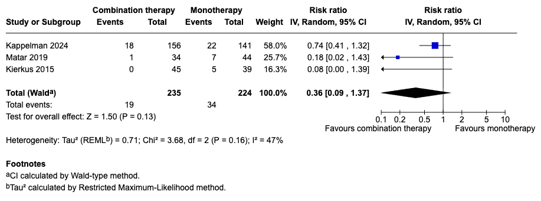
Figuur 1. Number of patients with SAEs in pediatric patients with Crohn’s disease under combination therapy (anti-TNF and thiopurines/methotrexate) or monotherapy (anti-TNF alone)
Anti-drug antibody (ADA) formation (important outcome measure)
Kappelman (2024) reported ADA formation separately for treatment with infliximab and adalimumab. A total of 34/72 (47%) patients on infliximab monotherapy tested positive for ADA formation, compared to 27/79 (34%) patients on infliximab combination therapy. This resulted in a RR (95%) of 0.72 (0.49 to 1.07). Regarding treatment with adalimumab, the respective numbers were 6/28 (21%), 5/33 (15%) and a RR (95%CI) of 0.71 (0.24 to 2.07).
Matar (2019) reported that ADA formation, with a cut-off of ≥2 μg/mL, was present in 4 patients of both the monotherapy group (n = 44) and the combination therapy group (n = 34). The corresponding risk ratio is 1.29 (0.35 to 4.80).
Quality of life (IMPACT III) (important outcome measure)
No results were reported the outcome quality of life, using the IMPACT III.
A systematic review of the literature was performed to answer the following question(s):
In children with active Crohn’s disease, does combination therapy with an immunomodulator and anti-TNF drugs, as compared to anti-TNF monotherapy, lead to better outcomes?
Table 1. PICO
Relevant outcome measures
The guideline panel considered sustained remission and cancer risk as critical outcomes for decision making; and remission (clinical, biochemical, endoscopic) drug durability, need for bowel resection, PROM’s, toxicity, anti-drug antibody formation and quality of life as important outcome measures for decision making.
A priori, the guideline panel did not define the outcome measures listed above but used the definitions used in the studies.
The guideline panel defined the following thresholds as a minimal clinically (patient) important differences.
Remission (clinical, biochemical, endoscopic): 10% difference in proportion of children (between groups) with Crohn’s disease who have reached remission three months after the initiation of anti-TNF therapy:
- Clinical remission: weighted Pediatric Crohn’s Disease Activity Index (wPCDAI) <10 or short (sh)PCDAI <15
- Biochemical remission: fecal calprotectin <250 µg/g
- Endoscopic remission: Simple endoscopic score (SES-CD) <3
Sustained remission: 10% difference in proportion of children with Crohn’s disease who maintained remission 1 year after the initiation of anti-TNF therapy:
- Biochemical sustained remission: fecal calprotectin <250 µg/g at all visits between the 6th and 12th month after initiation of anti-TNF therapy
- Endoscopic sustained remission: SES-CD <3 at 1 year
Drug durability: 10% difference in proportion of children with Crohn’s disease who are still on the same anti-TNF drug 1 year after initiation.
Need for bowel resection: 10% difference in proportion of children with Crohn’s disease who required bowel resection in the first 5 years after initiation of anti-TNF therapy.
Probability of cancer: 10% difference in 5 or 10-years probability in a time-to-event curve.
Quality of life (IMPACT-III): 5 points difference in the IMPACT-III score.
PROM’s: PROMIS score of ≥ 3 (Kappelman, 2024; based on studies in other populations).
Anti-drug antibody formation: 10% difference in proportion of children with Crohn’s disease who developed anti-drug antibodies within the first two years after the initiation of anti-TNF medication.
Search and select (Methods)
A systematic literature search was performed by a medical information specialist using the following bibliographic databases: Embase.com and Ovid/Medline. Both databases were searched from 2000 to 20 February 2025 for systematic reviews, RCTs and observational studies. Systematic searches were completed using a combination of controlled vocabulary/subject headings (e.g., Emtree-terms, MeSH) wherever they were available and natural language keywords. The overall search strategy was derived from five primary search concepts: (1) children; (2) IBD/Crohn; (3) anti-TNF therapy; (4) immunomodulators; (5) combination therapy. Duplicates were removed using EndNote software. After deduplication a total of 4106 records were imported for title/abstract screening. For the outcome measure probability of cancer, the search was defined/narrowed to search for systematic reviews and observational studies. Titles and abstracts were screened using the ASReview software. The settings ELAS u4 (TF-IDF and SVM) were used. Selection of relevant studies was performed in three subselections:
- Systematic reviews (415 records): Komaki, 2021; Corica, 2017 and Chen, 2024 were used as prior knowledge for inclusion.
- Randomized controlled trials (1244 records): Kappelman, 2023 and Colman, 2024 were used as prior knowledge for inclusion.
- Observational studies regarding risk of cancer (1200 records): Ehrström, 2024; El-Matary, 2020 and Peneau, 2013 were used as prior knowledge for inclusion.
The articles were subsequently screened by the guideline methodologist, using the following stopping rule: stop after 10% of the total set subsequent exclusions (indicating all relevant articles have been screened). Initially, 33 studies were selected based on title and abstract screening. After reading the full text, 28 studies were excluded (see the exclusion table under the tab ‘Evidence tabellen’), and five studies were included (three RCT’s and two observational studies).
- Anjie, S. I., Gecse, K. B., Meloni, C. M., Vidal-Itriago, A., löwenberg, M., & D'Haens, G. R. (2026). Immunogenicity and Efficacy of Subcutaneous Infliximab Monotherapy vs Combination Therapy in Inflammatory Bowel Disease: A Systematic Review and Meta-analysis. Clinical gastroenterology and hepatology, 24(1), 57-68.e5. https://doi.org/10.1016/j.cgh.2025.03.021
- Assa A, Matar M, Turner D, Broide E, Weiss B, Ledder O, Guz-Mark A, Rinawi F, Cohen S, Topf-Olivestone C, Shaoul R, Yerushalmi B, Shamir R. Proactive Monitoring of Adalimumab Trough Concentration Associated With Increased Clinical Remission in Children With Crohn's Disease Compared With Reactive Monitoring. Gastroenterology. 2019 Oct;157(4):985-996.e2. doi: 10.1053/j.gastro.2019.06.003. Epub 2019 Jun 10. PMID: 31194979.
- Atia O, Harel S, Ledderman N, Greenfeld S, Kariv R, Dotan I, Balicer R, Silverman B, Matz E, Levi Z, Waterman M, Fried I, Rowe JM, Turner D. Risk of Cancer in Paediatric onset Inflammatory Bowel Diseases: A Nation-wide Study From the epi-IIRN. J Crohns Colitis. 2022 Jun 24;16(5):786-795. doi: 10.1093/ecco-jcc/jjab205. PMID: 34791097.
- Colman RJ, Vuijk SA, Mathôt RAA, Van Limbergen J, Jongsma MME, Schreurs MWJ, Minar P, de Ridder L, D'Haens GRAM. Infliximab Monotherapy vs Combination Therapy for Pediatric Crohn's Disease Exhibit Similar Pharmacokinetics. Inflamm Bowel Dis. 2024 Oct 3;30(10):1678-1685. doi: 10.1093/ibd/izad307. PMID: 38167922; PMCID: PMC12102478.
- Dupont-Lucas C, Leroyer A, Ley D, Spyckerelle C, Bertrand V, Turck D, Savoye G, Maunoury V, Guillon N, Fumery M, Sarter H, Gower-Rousseau C; EPIMAD Study Group. Increased Risk of Cancer and Mortality in a Large French Population-Based Paediatric-Onset Inflammatory Bowel Disease Retrospective Cohort. J Crohns Colitis. 2023 Apr 19;17(4):524-534. doi: 10.1093/ecco-jcc/jjac166. PMID: 36316987.
- Kappelman MD, Wohl DA, Herfarth HH, Firestine AM, Adler J, Ammoury RF, Aronow JE, Bass DM, Bass JA, Benkov K, Tobi CB, Boccieri ME, Boyle BM, Brinkman WB, Cabera JM, Chun K, Colletti RB, Dodds CM, Dorsey JM, Ebach DR, Entrena E, Forrest CB, Galanko JA, Grunow JE, Gulati AS, Ivanova A, Jester TW, Kaplan JL, Kugathasan S, Kusek ME, Leibowitz IH, Linville TM, Lipstein EA, Margolis PA, Minar P, Molle-Rios Z, Moses J, Olano KK, Osaba L, Palomo PJ, Pappa H, Park KT, Pashankar DS, Pitch L, Robinson M, Samson CM, Sandberg KC, Schuchard JR, Seid M, Shelly KA, Steiner SJ, Strople JA, Sullivan JS, Tung J, Wali P, Zikry M, Weinberger M, Saeed SA, Bousvaros A. Comparative Effectiveness of Anti-TNF in Combination With Low-Dose Methotrexate vs Anti-TNF Monotherapy in Pediatric Crohn's Disease: A Pragmatic Randomized Trial. Gastroenterology. 2023 Jul;165(1):149-161.e7. doi: 10.1053/j.gastro.2023.03.224. Epub 2023 Mar 31. PMID: 37004887; PMCID: PMC10330864.
- Kierkuś J, Iwańczak B, Wegner A, Dadalski M, Grzybowska-Chlebowczyk U, Łazowska I, Maślana J, Toporowska-Kowalska E, Czaja-Bulsa G, Mierzwa G, Korczowski B, Czkwianianc E, Żabka A, Szymańska E, Krzesiek E, Więcek S, Sładek M. Monotherapy with infliximab versus combination therapy in the maintenance of clinical remission in children with moderate to severe Crohn disease. J Pediatr Gastroenterol Nutr. 2015 May;60(5):580-5. doi: 10.1097/MPG.0000000000000684. PMID: 25564804.
- Matar M, Shamir R, Turner D, Broide E, Weiss B, Ledder O, Guz-Mark A, Rinawi F, Cohen S, Topf-Olivestone C, Shaoul R, Yerushalmi B, Ben-Horin S, Assa A. Combination Therapy of Adalimumab With an Immunomodulator Is Not More Effective Than Adalimumab Monotherapy in Children With Crohn's Disease: A Post Hoc Analysis of the PAILOT Randomized Controlled Trial. Inflamm Bowel Dis. 2020 Oct 23;26(11):1627-1635. doi: 10.1093/ibd/izz294. PMID: 31793630.
Risk of Bias tables
Risk of bias table for intervention studies (randomized controlled trials; based on Cochrane risk of bias tool and suggestions by the CLARITY Group at Mc Master University)
|
Study reference
(first author, publication year) |
Was the allocation sequence adequately generated?
|
Was the allocation adequately concealed?
|
Blinding: Was knowledge of the allocated interventions adequately prevented?
Were patients blinded?
Were healthcare providers blinded?
Were data collectors blinded?
Were outcome assessors blinded?
Were data analysts blinded? |
Was loss to follow-up (missing outcome data) infrequent?
|
Are reports of the study free of selective outcome reporting?
|
Was the study apparently free of other problems that could put it at a risk of bias?
|
Overall risk of bias If applicable/necessary, per outcome measure
|
|
Kappelman, 2024 |
Definitely yes
Reason: computer generated 1:1 allocation ratio with the use of constrained block sequences (max. imbalance of 3) |
Probably yes
Reason: The assignment of treatment was directly digitally sent to the central investigational pharmacy to send out study medications to participants. |
Probably yes
Reason: it was not possible for the central investigational pharmacy to be blinded. However, they did not participate any further in the study. The participants, caregivers, study teams/study principle investigator and lead statistician were blinded up to completion of analysis. |
Probably no
Reason: there was no missing data on indication of failure of remission (primary outcome). There was missing data regarding the PROMIS outcomes (pain and fatigue, secondary outcome) and the outcome anti-drug antibody formation. Missing data was similar for the intervention and the control group. |
Definitely yes
Reason: all outcome measures mentioned in study protocol are described in the results |
Definitely no
Reason: Two parents of participants were co-investigators and were compensated. ICN Parent Working Group served as a study advisory board. Key design decisions were informed by stakeholder input.
Study estimated a necessary sample size of 353 participants, but were only able to fully enroll 297 participants before the study was discontinued.
Study reports that randomization occurred within 42 days of anti-TNF initiation, which indicated that methotrexate was started after six weeks. As outcomes were analyzed a week 26, this indicates a too short period for measuring remission. |
Some concerns (remission, fatigue and pain, adverse events) |
|
Matar, 2019 |
Probably yes
Reason: randomization and coding was performed by a dedicated assistant at a medical centre for all different centres in blocks of 4 (1:1 ratio) |
Probably no
Reason: no information provided on allocation |
Definitely no
Reason: open-label trial |
Probably no
Reason: no meaningful difference in dropout rate between the groups. Reason for dropout is reported in the original study. |
Probably yes
Reason: All relevant outcome measures were reported, but it is a post-hoc analysis of the PAILOT trail. |
Probably no
Reason: Post hoc analysis of a previous study, thus randomization was based on the main aim of the primary study. |
Some concerns (sustained remission, adverse events) |
|
Kierkus, 2015 |
Probably yes
Reason: central off-site randomization service by envelope system |
Probably yes
Reason: envelops prepared with subsequent numbers |
Definitely no
Reason: open-label trial |
Definitely yes
Reason: all participants completed the study |
Definitely yes
Reason: all pre-specified outcome measures in the study protocol are reported in the results |
Probably no
Reason: the intervention and control group had a different mean PCDAI score at the start of the maintenance phase (12.38 versus 9.36). |
HIGH (sustained remission)
Some concerns (adverse events) |
Risk of bias table for interventions studies (cohort studies based on risk of bias tool by the CLARITY Group at McMaster University)
|
Author, year |
Selection of participants
Was selection of exposed and non-exposed cohorts drawn from the same population?
|
Exposure
Can we be confident in the assessment of exposure? |
Outcome of interest
Can we be confident that the outcome of interest was not present at start of study?
|
Confounding-assessment
Can we be confident in the assessment of confounding factors? |
Confounding-analysis
Did the study match exposed and unexposed for all variables that are associated with the outcome of interest or did the statistical analysis adjust for these confounding variables? |
Assessment of outcome
Can we be confident in the assessment of outcome?
|
Follow up
Was the follow up of cohorts adequate? In particular, was outcome data complete or imputed?
|
Co-interventions
Were co-interventions similar between groups?
|
Overall Risk of bias
|
|
Dupont-Lucas, 2023 |
Definitely yes
Reason: all participants from a registry were included in the study |
Definitely yes
Reason: medication use was retrieved from medical records |
Probably yes
Reason: all cancer diagnosis occurring after IBS diagnosis were included |
Probably yes
Reason: confounding factors are assessed |
Definitely no
Reason: only univariate analysis (because small number of observed events) |
Definitely yes
Reason: linkage to medical records |
Probably no
Reason: Follow-up between start treatment and cancer diagnosis is generally short and in some cases treatment is started after cancer diagnosis. Follow-up is not adequate for risk of cancer. As a result of separately analyzing the effect of each class of drugs (and censoring patients at introduction of the second class of drug), the follow-up was reduced. |
Probably no
Reason: not specifically reported |
HIGH (risk of cancer) |
|
Atia, 2022 |
Definitely yes
Reason: all participants were included from a validated national database with coverage of 98% of the population |
Definitely yes
Reason: medication use is retrieved from the validated national database |
Probably yes
Reason: If a participant had more than one case of cancer, the first was selected. Participants with a cancer diagnosis prior to ‘index date’ were excluded. |
Probably no
Reason: some confounding factors are assessed, but missing a few as these factors were not available in the national database. |
Definitely no
Reason: did not mention correction for confounding when comparing the combination therapy and monotherapy group. |
Definitely yes
Reason: registry with all cancer diagnosis since 1960 were linked to the data. |
Probably no
Reason: follow-up is not adequate for risk of cancer. |
Probably no
Reason: not specifically reported |
HIGH (risk of cancer) |
Table of excluded studies
|
Reference |
Reason for exclusion |
|
Colman RJ, Lawton RC, Dubinsky MC, Rubin DT. Methotrexate for the Treatment of Pediatric Crohn's Disease: A Systematic Review and Meta-analysis. Inflamm Bowel Dis. 2018 Sep 15;24(10):2135-2141. doi: 10.1093/ibd/izy078. PMID: 29688409; PMCID: PMC6994018. |
No studies of interest included (no control group) |
|
Komaki Y, Komaki F, Yamada A, Micic D, Ido A, Sakuraba A. Risk of Cancers in Patients with Pediatric Inflammatory Bowel Diseases: A Systematic Review and Meta-Analysis. J Pediatr. 2021 Feb;229:102-117.e36. doi: 10.1016/j.jpeds.2020.08.087. Epub 2020 Sep 6. PMID: 32898579. |
No separate data for TNFi + thiopurine versus TNFi alone |
|
Corica D, Romano C. Biological Therapy in Pediatric Inflammatory Bowel Disease: A Systematic Review. J Clin Gastroenterol. 2017 Feb;51(2):100-110. doi: 10.1097/MCG.0000000000000696. PMID: 27636407. |
Broad review, not according to PICO. Performed search not complete. |
|
Chen B, Zou Z, Zhang X, Xiao D, Li X. Efficacy and safety of adalimumab in pediatric patients with Crohn's disease: A systematic review and meta-analysis. Eur J Clin Pharmacol. 2024 Mar;80(3):395-407. doi: 10.1007/s00228-023-03613-1. Epub 2023 Dec 29. PMID: 38157000; PMCID: PMC10873464. |
No analyses on combination therapy |
|
van Rheenen H, van Rheenen PF. Long-Term Efficacy of Anti-Tumor Necrosis Factor Agents in Pediatric Luminal Crohn's Disease: A Systematic Review of Real-World Evidence Studies. Pediatr Gastroenterol Hepatol Nutr. 2020 Mar;23(2):121-131. doi: 10.5223/pghn.2020.23.2.121. Epub 2020 Mar 4. PMID: 32206624; PMCID: PMC7073369. |
Broad review on pediatric Crohn’s disease, five studies on IFX and concomitant immunomodulators but observational. |
|
Veres G, Baldassano RN, Mamula P. Infliximab therapy in children and adolescents with inflammatory bowel disease. Drugs. 2007;67(12):1703-23. doi: 10.2165/00003495-200767120-00005. PMID: 17683171. |
Narrative review |
|
Gonzalez-Lama Y, Fernandez-Blanco I, Lopez-SanRoman A, Taxonera C, Casis B, Tabernero S, Bermejo F, Martinez-Silva F, Mendoza JL, Martinez-Montiel P, Carneros JA, Sanchez F, Maté J, Gisbert JP; Group for the Study of Inflammatory Bowel Diseases from Madrid. Open-label infliximab therapy in ulcerative colitis: a multicenter survey of results and predictors of response. Hepatogastroenterology. 2008 Sep-Oct;55(86-87):1609-14. PMID: 19102352. |
Study on adults |
|
Kerur B, Fiedler K, Stahl M, Hyams J, Stephens M, Lu Y, Pfefferkorn M, Alkhouri R, Strople J, Kelsen J, Siebold L, Goyal A, Rosh JR, LeLeiko N, Van Limbergen J, Guerrerio AL, Maltz RM, Karam L, Crowley E, Griffiths AM, Heyman MB, Deneau M, Benkov K, Noe J, Moulton D, Pappa H, Galanko J, Snapper S, Muise AM, Kappelman MD, Benchimol EI. Utilization of Antitumor Necrosis Factor Biologics in Very Early Onset Inflammatory Bowel Disease: A Multicenter Retrospective Cohort Study From North America. J Pediatr Gastroenterol Nutr. 2022 Jul 1;75(1):64-69. doi: 10.1097/MPG.0000000000003464. Epub 2022 May 27. PMID: 35622080. |
Observational study |
|
Baert F, Noman M, Vermeire S, Van Assche G, D' Haens G, Carbonez A, Rutgeerts P. Influence of immunogenicity on the long-term efficacy of infliximab in Crohn's disease. N Engl J Med. 2003 Feb 13;348(7):601-8. doi: 10.1056/NEJMoa020888. PMID: 12584368. |
Study on adults |
|
Grossi V, Lerer T, Griffiths A, LeLeiko N, Cabrera J, Otley A, Rick J, Mack D, Bousvaros A, Rosh J, Grossman A, Saeed S, Kay M, Boyle B, Oliva-Hemker M, Keljo D, Pfefferkorn M, Faubion W, Kappelman MD, Sudel B, Markowitz J, Hyams JS. Concomitant Use of Immunomodulators Affects the Durability of Infliximab Therapy in Children With Crohn's Disease. Clin Gastroenterol Hepatol. 2015 Oct;13(10):1748-56. doi: 10.1016/j.cgh.2015.04.010. Epub 2015 Apr 21. PMID: 25911120. |
Observational study |
|
van Hoeve K, Seyed Tabib NS, Dreesen E, Tops S, Hoffman I, Gils A, Ferrante M, Vermeire S. Infliximab Concentrations during Induction Are Predictive for Endoscopic Remission in Pediatric Patients with Inflammatory Bowel Disease under Combination Therapy. J Pediatr. 2022 Jan;240:150-157.e4. doi: 10.1016/j.jpeds.2021.08.079. Epub 2021 Sep 3. PMID: 34481805. |
No relevant data on immunomodulator combination therapy |
|
Russell RK, Wilson ML, Loganathan S, Bourke B, Kiparissi F, Mahdi G, Torrente F, Rodrigues A, Davies I, Thomas A, Akobeng AK, Fagbemi A, Hyer W, Spray C, Vaish S, Rogers P, McGrogan P, Heuschkel RB, Ayub N, Fell JM, Afzal NA, Green M, Murphy MS, Rao P, Shah N, Ho GT, Naik S, Wilson DC. A British Society of Paediatric Gastroenterology, Hepatology and Nutrition survey of the effectiveness and safety of adalimumab in children with inflammatory bowel disease. Aliment Pharmacol Ther. 2011 Apr;33(8):946-53. doi: 10.1111/j.1365-2036.2011.04603.x. Epub 2011 Feb 22. PMID: 21342211. |
Very limited data on combination therapy, not complete for inclusion |
|
Watanabe K, Matsumoto T, Hisamatsu T, Nakase H, Motoya S, Yoshimura N, Ishida T, Kato S, Nakagawa T, Esaki M, Nagahori M, Matsui T, Naito Y, Kanai T, Suzuki Y, Nojima M, Watanabe M, Hibi T; DIAMOND study group. Clinical and Pharmacokinetic Factors Associated With Adalimumab-Induced Mucosal Healing in Patients With Crohn's Disease. Clin Gastroenterol Hepatol. 2018 Apr;16(4):542-549.e1. doi: 10.1016/j.cgh.2017.10.036. Epub 2017 Nov 11. PMID: 29104132. |
Subanalysis of other study |
|
Matsumoto T, Motoya S, Watanabe K, Hisamatsu T, Nakase H, Yoshimura N, Ishida T, Kato S, Nakagawa T, Esaki M, Nagahori M, Matsui T, Naito Y, Kanai T, Suzuki Y, Nojima M, Watanabe M, Hibi T; DIAMOND study group. Adalimumab Monotherapy and a Combination with Azathioprine for Crohn's Disease: A Prospective, Randomized Trial. J Crohns Colitis. 2016 Nov;10(11):1259-1266. doi: 10.1093/ecco-jcc/jjw152. Epub 2016 Aug 26. PMID: 27566367. |
Almost exclusively adult patients included; no details or subgroup analyses for children |
|
Hyams JS, Dubinsky M, Rosh J, Ruemmele FM, Eichner SF, Maa JF, Lazar A, Alperovich G, Mostafa NM, Robinson AM. The effects of concomitant immunomodulators on the pharmacokinetics, efficacy and safety of adalimumab in paediatric patients with Crohn's disease: a post hoc analysis. Aliment Pharmacol Ther. 2019 Jan;49(2):155-164. doi: 10.1111/apt.15054. Epub 2018 Dec 2. PMID: 30506693. |
No RCT |
|
Moses J, Adler J, Saeed SA, Firestine AM, Galanko JA, Ammoury RF, Bass DM, Bass JA, Bastidas M, Benkov KJ, Bousvaros A, Cabrera JM, Chun KY, Dorsey JM, Ebach DR, Gulati AS, Herfarth HH, Ivanova A, Jester TW, Kaplan JL, Kusek ME, Leibowitz IH, Linville TM, Margolis PA, Minar P, Molle-Rios Z, Niklinska-Schirtz BJ, Olano KK, Osaba L, Palomo PJ, Pashankar DS, Pitch L, Samson CM, Sandberg KC, Steiner SJ, Strople JA, Sullivan JS, Tung J, Wali P, Wohl DA, Zikry M, Boyle BM, Kappelman MD. Low Anti-Tumor Necrosis Factor Levels During Maintenance Phase Are Associated With Treatment Failure in Children With Crohn's Disease. Inflamm Bowel Dis. 2024 Oct 17:izae239. doi: 10.1093/ibd/izae239. Epub ahead of print. PMID: 39418336. |
Post-hoc analysis of Kappelman, included trial participants who entered the maintenance phase of treatment |
|
Kappelman MD, Wohl DA, Herfarth HH, Firestine AM, Adler J, Ammoury RF, Aronow JE, Bass DM, Bass JA, Benkov K, Tobi CB, Boccieri ME, Boyle BM, Brinkman WB, Cabera JM, Chun K, Colletti RB, Dodds CM, Dorsey JM, Ebach DR, Entrena E, Forrest CB, Galanko JA, Grunow JE, Gulati AS, Ivanova A, Jester TW, Kaplan JL, Kugathasan S, Kusek ME, Leibowitz IH, Linville TM, Lipstein EA, Margolis PA, Minar P, Molle-Rios Z, Moses J, Olano KK, Osaba L, Palomo PJ, Pappa H, Park KT, Pashankar DS, Pitch L, Robinson M, Samson CM, Sandberg KC, Schuchard JR, Seid M, Shelly KA, Steiner SJ, Strople JA, Sullivan JS, Tung J, Wali P, Zikry M, Weinberger M, Saeed SA, Bousvaros A. Comparative Effectiveness of Anti-TNF in Combination With Low-Dose Methotrexate vs Anti-TNF Monotherapy in Pediatric Crohn's Disease: A Pragmatic Randomized Trial. Gastroenterology. 2023 Jul;165(1):149-161.e7. doi: 10.1053/j.gastro.2023.03.224. Epub 2023 Mar 31. PMID: 37004887; PMCID: PMC10330864. |
Observational study |
|
Beukelman T, Xie F, Chen L, Horton DB, Lewis JD, Mamtani R, Mannion MM, Saag KG, Curtis JR. Risk of malignancy associated with paediatric use of tumour necrosis factor inhibitors. Ann Rheum Dis. 2018 Jul;77(7):1012-1016. doi: 10.1136/annrheumdis-2017-212613. Epub 2018 Feb 9. PMID: 29440001; PMCID: PMC6094159. |
Very limited data with no information about number of patients on TNFi + thiopurine or TNFi without thiopurine |
|
Dulai PS, Thompson KD, Blunt HB, Dubinsky MC, Siegel CA. Risks of serious infection or lymphoma with anti-tumor necrosis factor therapy for pediatric inflammatory bowel disease: a systematic review. Clin Gastroenterol Hepatol. 2014 Sep;12(9):1443-51; quiz e88-9. doi: 10.1016/j.cgh.2014.01.021. Epub 2014 Jan 22. PMID: 24462626. |
Only data on lymphoma with no separate data for TNFi + thiopurine versus thiopurine alone |
|
Herrinton LJ, Liu L, Weng X, Lewis JD, Hutfless S, Allison JE. Role of thiopurine and anti-TNF therapy in lymphoma in inflammatory bowel disease. Am J Gastroenterol. 2011 Dec;106(12):2146-53. doi: 10.1038/ajg.2011.283. Epub 2011 Oct 25. PMID: 22031357. |
Broad study, only data on lymphoma with no separate data for TNFi + thiopurine versus TNFi alone |
|
Clowry J, Sheridan J, Healy R, Deady S, Keegan D, Byrne K, Cullen G, Mulcahy H, Comber H, Parnell AC, Doherty G, Lally A. Increased non-melanoma skin cancer risk in young patients with inflammatory bowel disease on immunomodulatory therapy: a retrospective single-centre cohort study. J Eur Acad Dermatol Venereol. 2017 Jun;31(6):978-985. doi: 10.1111/jdv.14105. Epub 2017 Feb 17. PMID: 28045204. |
Specific on non-melanoma skin cancer with mostly UC patients included. No separate analysis for Crohn. Difference in group size is large (TNFi alone = 43, no cases of skin cancer, TNFi+thiopurine = 421, six cases) |
|
Biancone L, Zuzzi S, Ranieri M, Petruzziello C, Calabrese E, Onali S, Ascolani M, Zorzi F, Condino G, Iacobelli S, Pallone F. Fistulizing pattern in Crohn's disease and pancolitis in ulcerative colitis are independent risk factors for cancer: a single-center cohort study. J Crohns Colitis. 2012 Jun;6(5):578-87. doi: 10.1016/j.crohns.2011.11.005. Epub 2011 Dec 20. PMID: 22398047. |
Study in mostly adults (at diagnosis), no separate analysis for pediatric patients |
|
Malham M, Jansson S, Malmborg P, Olén O, Paerregaard A, Virta LJ, Jakobsen C, Kolho KL, Wewer V. Risk Factors of Cancer in Pediatric-Onset Inflammatory Bowel Disease in Denmark and Finland. J Pediatr Gastroenterol Nutr. 2023 Jul 1;77(1):55-61. doi: 10.1097/MPG.0000000000003781. Epub 2023 Mar 24. PMID: 36961906. |
Incorrect comparison (not TNFi + immunomodulator versus TNFi alone) |
|
Pasternak B, Svanström H, Schmiegelow K, Jess T, Hviid A. Use of azathioprine and the risk of cancer in inflammatory bowel disease. Am J Epidemiol. 2013 Jun 1;177(11):1296-305. doi: 10.1093/aje/kws375. Epub 2013 Mar 20. PMID: 23514635. |
Study in mostly adults (at diagnosis) |
|
Jess T, Horváth-Puhó E, Fallingborg J, Rasmussen HH, Jacobsen BA. Cancer risk in inflammatory bowel disease according to patient phenotype and treatment: a Danish population-based cohort study. Am J Gastroenterol. 2013 Dec;108(12):1869-76. doi: 10.1038/ajg.2013.249. Epub 2013 Aug 27. PMID: 23978954. |
No data on biologicals |
|
Ehrström A, Jansson S, Jørgensen MH, Wewer V, Malham M. The risk of cancer in pediatric-onset immune-mediated inflammatory diseases - A nationwide study. J Autoimmun. 2024 Dec;149:103321. doi: 10.1016/j.jaut.2024.103321. Epub 2024 Sep 26. PMID: 39332234. |
No numbers of cancer cases per group. Incorrect comparison (TNFi + immunomodulator versus monotherapy (not thiopurine or TNFI alone)) |
|
El-Matary W, Nugent Z, Bernstein CN, Singh H. Long-term Cancer Risk in Patients With Pediatric-Onset Inflammatory Bowel Diseases in the Canadian Population. Gastroenterology. 2020 Jul;159(1):386-387. doi: 10.1053/j.gastro.2020.03.048. Epub 2020 Mar 29. PMID: 32234537. |
No information on combination therapy |
|
Peneau A, Savoye G, Turck D, Dauchet L, Fumery M, Salleron J, Lerebours E, Ligier K, Vasseur F, Dupas JL, Mouterde O, Spyckerelle C, Djeddi D, Peyrin-Biroulet L, Colombel JF, Gower-Rousseau C. Mortality and cancer in pediatric-onset inflammatory bowel disease: a population-based study. Am J Gastroenterol. 2013 Oct;108(10):1647-53. doi: 10.1038/ajg.2013.242. Epub 2013 Aug 13. PMID: 23939626. |
Table 1 not complete, detailed data on number of patients (at start and end of follow-up) on TNFi or combination therapy not extractable |
Beoordelingsdatum en geldigheid
Publicatiedatum : 03-09-2026
Beoordeeld op geldigheid : 03-09-2026
Samenstelling werkgroep
Voor het ontwikkelen van de richtlijnmodule is in 2023 een multidisciplinair cluster ingesteld. Het cluster Benigne Darmaandoeningen bestaat uit meerdere richtlijnen (zie hier de actuele clusterindeling). De stuurgroep bewaakt het proces van modulair onderhoud binnen het cluster. De expertisegroepsleden brengen hun expertise in, indien nodig. De volgende personen uit het cluster zijn betrokken geweest bij de herziening van deze module:
Clusterstuurgroepleden
- Prof. dr. A.A.M. (Ad) Masclee, MDL-arts, MUMC+, NVMDL (voorzitter)
- Prof. dr. G. (Gerd) Bouma, MDL-arts, AUMC, NVMDL
- Dr. C.P. (Charlotte) Peters, MDL-arts, Diakonessenhuis, NVMDL
- Dr. W. (Willemien) de Vries, kinderarts, Rijnstate, NVK
- Dr. E.J.A. (Ernst) Steller, gastro-enteraal chirurg, Isala, NVvH
- Dr. C.EJ. (Pim) Sloots, kinderchirurg, Erasmus MC (Sophia Kinderziekenhuis), NVvK
- Drs. M.P (Menne) Scherpenzeel, patiëntvertegenwoordiger, Crohn & Colitis NL
Betrokken clusterexpertisegroepleden
- Dr. P.F. (Patrick) van Rheenen, kinderarts MDL, UMCG, NVK
- Dr. G.M. (Gerard) Damen, kinderarts MDL, RadboudUMC, NVK
- Dr. L.J.J. (Luc) Derijks, ziekenhuisapotheker-farmacoloog, Máxima MC, NVZA
Met ondersteuning van
- Drs. H. (Hanneke) Olthuis, adviseur, Kennisinstituut van de Federatie Medisch Specialisten (tot 1 februari 2025)
- Drs. J.M.H. (Harm-Jan) van der Hart, adviseur, Kennisinstituut van de Federatie Medisch Specialisten
- Drs. A. (Anne-Wil) Valk, junior adviseur, Kennisinstituut van de Federatie Medisch Specialisten
- Drs. E. (Esther) van der Bijl, medisch informatiespecialist, Kennisinstituut van de Federatie Medisch Specialisten
Belangenverklaringen
Een overzicht van de belangen van de clusterleden en het oordeel over het omgaan met eventuele belangen vindt u in onderstaande tabel. De ondertekende belangenverklaringen zijn op te vragen bij het secretariaat van het Kennisinstituut van de Federatie Medisch Specialisten via secretariaat@kennisinstituut.nl.
Gemelde (neven)functies en belangen stuurgroepleden
|
Naam |
Hoofdfunctie |
Nevenwerkzaam-heden |
Persoonlijke financiële belangen |
Extern gefinancierd onderzoek |
Intellectuele belangen en reputatie, overige belangen |
Restrictie |
|
Prof. dr. A.A.M. (Ad) Masclee |
Voorzitter Medisch Ethische Toetsingscommissie Maastricht UMC (betaald, 0,3 FTE) Gepensioneerd MDL arts sedert okt '21, voormalig hoofd MDL ziekten Maastricht UMC |
Geen |
Geen |
Ja, Standardizing Training for endoscopic Resection of Large Non-Pedunculated Colorectal polyps, financier: KWF
|
Geen |
Geen restricties |
|
Prof. dr. G. (Gerd) Bouma |
MDL-arts |
Geen |
Geen |
Klinische trial naar effect van anti-IL15 in behandeling coeliakie, financier: Calypso, rol als projectleider.
Klinische trial naar effect van anti-IL15 in behandeling coeliakie, financier: Provention, geen PI;
klinisch onderzoek naar behandeling refractaire coeliakie, financier: Pfizer, geen PI;
wetenschappelijk/fundamenteel onderzoek naar lymfomagenese coeliakie, financier MLDS, geen PI |
Geen |
Restricties t.a.v. besluitvorming voor modules over behandeling met anti-IL15 bij patiënten met coeliakie. |
|
Dr. C.P. (Charlotte) Peters |
MDL-arts |
Geen |
Geen |
Geen |
Geen |
Geen restricties |
|
Dr. W. (Willemien) de Vries |
Kinderarts |
Bestuurslid sectie kinder-MDL van de NVK, onbetaald. |
Geen |
Geen |
Geen |
Geen restricties |
|
Dr. E.J.A. (Ernst) Steller |
Chirurg |
Geen |
Geen |
Geen |
Geen |
Geen restricties |
|
Dr. C.EJ. (Pim) Sloots |
Kinderchirurg |
Geen |
Geen |
Geen |
Geen |
Geen restricties |
|
Drs. M.P (Menne) Scherpenzeel |
Directeur Crohn & Colitis NL |
Partner adviesbureau Blauwe Noordzee (0,1), bezoldigd Voorzitter adviescommissie Fonds Gehandicaptensport, onbezoldigd Lid RvT Q en C Support, bezoldigd (komt ten goede aan Crohn & Colitis NL) Lid van adviesraden Pfizer en Jassen, bezoldigd (komt ten goede aan Crohn & Colitis NL) |
Geen |
Divers onderzoek (ZonMW en MDL Fonds, geen rol als projectleider, focus op inbreng patientenperspectief) |
Het werk van Crohn & Colitis NL wordt mede mogelijk gemaakt door pharma (multisponsoring; geen invloed op de invulling van activiteiten).. |
Geen restricties |
Gemelde (neven)functies en belangen betrokken expertisegroepleden
|
Naam |
Hoofdfunctie |
Nevenwerkzaam-heden |
Persoonlijke financiële belangen |
Extern gefinancierd onderzoek |
Intellectuele belangen en reputatie, overige belangen |
Restrictie |
|
Dr. P.F. (Patrick) van Rheenen |
Kinderarts MDL |
Geen |
Geen |
FREE-study, gefinancierd door de European Crohn's and Colitis Organisation (ECCO-grant 2021). Materialen voor calprotectine en anti-TNF spiegelbepalingen worden gedoneerd door BÜHLMANN Laboratories AG (Schönenbuch, Zwitserland) 1. European Crohn's and Colitis Organisation (ECCO-grant 2021) - Efficacy of anti-TNF dosing interval lengthening (projectleider) 2. BÜHLMANN Laboratories AG - Efficacy of anti-TNF dosing interval lengthening (projectleider) |
Geen |
Geen restricties |
|
Dr. G.M. (Gerard) Damen |
Kinderarts MDL |
Geen |
Geen |
Develop studie (geen projectleider en geen actieve rol, Janssen), 20 jaar follow-up van kinderen met IBD die behandeld werden met remicade (dit was een vereiste van de EMEA). Bij de initiatie van de studie PI binnen het Radboudumc Amalia; patiënten zijn reeds volwassen, |
Geen |
Geen restricties |
|
Dr. L.J.J. (Luc) Derijks |
Ziekenhuisapotheker-farmacoloog, senior onderzoeker |
Hoorcolleges IBD op de UU (onbetaald); webinar/podcast over personalized medicine bij IBD voor Takeda (betaald); E-learning TDM bij IBD voor Ferring (betaald)
Eenmalige deelname aan advisory board voor UCB Pharma (betaald, 2023); eenmalige deelname aan advisory board voor Pfizer (betaald, 2023) |
Geen |
Geen |
Geen |
Geen restricties |
Inbreng patiëntenperspectief
Er werd aandacht besteed aan het patiëntenperspectief door afvaardiging van Crohn & Colitis NL en stichting Kind en Zorg in het cluster. De conceptrichtlijn is voor commentaar voorgelegd aan de genoemde partijen en de eventueel aangeleverde commentaren zijn bekeken en verwerkt.
Kwalitatieve raming van mogelijke financiële gevolgen in het kader van de Wkkgz
Bij de richtlijnmodule voerden de clusterleden conform de Wet kwaliteit, klachten en geschillen zorg (Wkkgz) een kwalitatieve raming uit om te beoordelen of de aanbevelingen mogelijk leiden tot substantiële financiële gevolgen. Bij het uitvoeren van deze beoordeling is de richtlijnmodule op verschillende domeinen getoetst (zie het stroomschema bij Werkwijze).
|
Module |
Uitkomst raming |
Toelichting |
|
Immuunmodulatoren in combinatie met anti-TNF therapie bij de ziekte van Crohn |
Geen financiële gevolgen |
Uit de toetsing volgt dat de aanbevelingen niet breed toepasbaar zijn (<5.000 patiënten) en daarom naar verwachting geen substantiële financiële gevolgen zullen hebben voor de collectieve uitgaven. |
Werkwijze
Voor meer details over de gebruikte richtlijnmethodologie verwijzen wij u naar de Werkwijze.
Zoekverantwoording
Algemene informatie
|
Cluster/richtlijn: Benigne Darmaandoeningen - Inflammatoire darmziekten (IBD) bij kinderen - Module Immuunmodulatoren bij de ziekte van Crohn |
|
|
Uitgangsvraag/modules: Op welk moment dient bij kinderen met de ZvC te worden gestart met een steroïdsparend middel, zoals azathioprine? |
|
|
Database(s): Embase.com, Ovid/Medline |
Datum: 20 februari 2025 |
|
Periode: vanaf 2000 |
Talen: geen restrictie |
|
Literatuurspecialist: Esther van der Bijl |
Rayyan review: https://new.rayyan.ai/reviews/1334295/overview |
|
BMI-zoekblokken: voor verschillende opdrachten wordt (deels) gebruik gemaakt van de zoekblokken van BMI-Online https://blocks.bmi-online.nl/ Deduplication: voor het ontdubbelen is gebruik gemaakt van http://dedupendnote.nl/ |
|
|
Toelichting: Voor deze vraag is gezocht op de elementen children AND IBD/Crohn AND anti-TNF therapy AND (de opgegeven immunomodulators OR combination therapy).
Zoals afgesproken worden, vanwege de grote opbrengst, in eerste instantie alleen de systematic reviews aangeboden in Rayyan.
De sleutelartikelen worden gevonden met deze search. |
|
Zoekopbrengst
|
|
EMBASE |
OVID/MEDLINE |
Ontdubbeld |
|
SR |
383 |
117 |
415 |
|
RCT |
1121 |
232 |
1244 |
|
Observationele studies |
2374 |
449 |
2447 |
|
Totaal |
|
|
4106* |
*in Rayyan
Zoekstrategie - 20 februari 2025
Embase.com
|
No. |
Query |
Results |
|
#1 |
'adolescent'/exp OR 'baby'/exp OR 'boy'/exp OR 'child'/exp OR 'minors'/exp/mj OR 'pediatric patient'/exp OR 'pediatrics'/exp OR 'schoolchild'/exp OR infan*:ti,ab OR newborn*:ti,ab OR 'new born*':ti,ab OR perinat*:ti,ab OR neonat*:ti,ab OR baby*:ti,ab OR babies:ti,ab OR toddler*:ti,ab OR minors*:ti,ab OR boy:ti,ab OR boys:ti,ab OR boyfriend:ti,ab OR boyhood:ti,ab OR girl*:ti,ab OR kid:ti,ab OR kids:ti,ab OR child*:ti,ab OR children*:ti,ab OR schoolchild*:ti,ab OR adolescen*:ti,ab OR juvenil*:ti,ab OR youth*:ti,ab OR teen*:ti,ab OR pubescen*:ti,ab OR pediatric*:ti,ab OR paediatric*:ti,ab OR peadiatric*:ti,ab OR school:ti,ab OR school*:ti,ab OR prematur*:ti,ab OR preterm*:ti,ab |
6151065 |
|
#2 |
'inflammatory bowel disease'/exp OR 'crohn disease'/exp OR 'enterocolitis'/exp OR 'experimental inflammatory bowel disease'/exp OR 'ulcerative colitis'/exp OR 'pancolitis'/exp OR (('colon'/exp OR 'colon disease'/de) AND 'inflammation'/de) OR (inflammator*:ti,ab,kw AND bowel:ti,ab,kw AND disease*:ti,ab,kw) OR (((inflam* OR inflam*) NEAR/8 bowel*):ti,ab,kw) OR (((ulcer* OR histiocytic* OR mucosa* OR idiopathic* OR 'procto col*' OR granuloma* OR terminal OR region*) NEAR/3 (coli* OR colli* OR colon* OR colorectit* OR proctocol* OR proctit* OR enterit* OR ileit*)):ti,ab,kw) OR crohn*:ti,ab,kw OR 'cronh*':ti,ab,kw OR colienterit*:ti,ab,kw OR collienteriti*:ti,ab,kw OR enterocolit*:ti,ab,kw OR enterocollit*:ti,ab,kw OR pancolit*:ti,ab,kw OR pancollit*:ti,ab,kw OR ibd:ti,ab,kw OR pibd:ti,ab,kw OR 'ulcerati* col*':ti,ab,kw OR 'coliti* gravis':ti,ab,kw OR 'colliti* gravis':ti,ab,kw OR ileocolit*:ti,ab,kw OR ileocollit*:ti,ab,kw |
337958 |
|
#3 |
'tumor necrosis factor inhibitor'/exp OR 'tnf alpha inhibitor*':ti,ab,kw OR 'tnf α inhibitor*':ti,ab,kw OR 'tnf-alpha blocker*':ti,ab,kw OR 'tnf α blocker*':ti,ab,kw OR 'tnf inhibitor*':ti,ab,kw OR 'anti tnf':ti,ab,kw OR 'tnf antagonist':ti,ab,kw OR 'tnf blocker*':ti,ab,kw OR (((tumour OR tumor) NEAR/3 necro* NEAR/3 factor* NEAR/3 (inhibitor* OR agent* OR blocker* OR antagonist*)):ti,ab,kw) OR ((anti NEAR/3 (tumour OR tumor) NEAR/3 necro* NEAR/3 factor*):ti,ab,kw) OR 'adalimumab'/exp OR 'abrilada':ti,ab,kw OR 'adalimumab':ti,ab,kw OR 'adaly':ti,ab,kw OR 'amgevita':ti,ab,kw OR 'amjevita':ti,ab,kw OR 'amsparity':ti,ab,kw OR 'cinnora':ti,ab,kw OR cyltezo:ti,ab,kw OR 'exemptia':ti,ab,kw OR 'fyzoclad':ti,ab,kw OR 'hadlima':ti,ab,kw OR 'halimatoz':ti,ab,kw OR 'hefiya':ti,ab,kw OR 'hukyndra':ti,ab,kw OR 'hulio':ti,ab,kw OR 'humira':ti,ab,kw OR 'hyrimoz':ti,ab,kw OR 'idacio':ti,ab,kw OR 'imraldi':ti,ab,kw OR 'kromeya':ti,ab,kw OR 'libmyris':ti,ab,kw OR 'mabura':ti,ab,kw OR 'qletli':ti,ab,kw OR 'raheara':ti,ab,kw OR 'solymbic':ti,ab,kw OR 'sulinno':ti,ab,kw OR 'trudexa':ti,ab,kw OR 'yuflyma':ti,ab,kw OR 'yusimry':ti,ab,kw OR 'infliximab'/exp OR 'avakine':ti,ab,kw OR 'avsola':ti,ab,kw OR 'flixabi':ti,ab,kw OR 'inflectra':ti,ab,kw OR 'infliximab':ti,ab,kw OR 'ixifi':ti,ab,kw OR 'remicade':ti,ab,kw OR 'remsima':ti,ab,kw OR 'renflexis':ti,ab,kw OR 'revellex':ti,ab,kw OR 'zessly':ti,ab,kw OR 'biological therapy'/exp OR 'biologic therap*':ti,ab,kw OR biotherap*:ti,ab,kw OR 'cell- and tissue-based therap*':ti,ab,kw OR 'tissue therap*':ti,ab,kw OR 'immunomodulating agent'/exp OR 'immunomodulating agent*':ti,ab,kw OR 'immunomodulant agent*':ti,ab,kw OR 'immunomodulating drug*':ti,ab,kw OR 'immunomodulator*':ti,ab,kw OR 'immunotherapeutic agent*':ti,ab,kw OR 'biological product'/exp OR ((biologic* NEAR/2 (agent* OR therap* OR treatment* OR medic* OR drug* OR product* OR pharmaceutic*)):ti,ab,kw) OR 'biologicals':ti,ab,kw OR biologics:ti,ab,kw |
5052017 |
|
#4 |
'immunologic factor'/exp OR 'azathioprine'/exp OR 'mercaptopurine'/exp OR 'tioguanine'/exp OR 'methotrexate'/exp OR 'arathioprin':ti,ab,kw OR 'arathioprine':ti,ab,kw OR 'aza-q':ti,ab,kw OR 'azafalk':ti,ab,kw OR 'azafor':ti,ab,kw OR 'azahexal':ti,ab,kw OR 'azamedac':ti,ab,kw OR 'azamun':ti,ab,kw OR 'azamune':ti,ab,kw OR 'azanin':ti,ab,kw OR 'azapin':ti,ab,kw OR 'azapress':ti,ab,kw OR 'azaprine':ti,ab,kw OR 'azarex':ti,ab,kw OR 'azasan':ti,ab,kw OR 'azathiodura':ti,ab,kw OR 'azathiopine':ti,ab,kw OR 'azathioprim':ti,ab,kw OR 'azathioprin':ti,ab,kw OR 'azathioprine':ti,ab,kw OR 'azathiopurine':ti,ab,kw OR 'azathropsin':ti,ab,kw OR 'azatioprina':ti,ab,kw OR 'azatox':ti,ab,kw OR 'azatrilem':ti,ab,kw OR 'azopi':ti,ab,kw OR 'azoran':ti,ab,kw OR 'azothioprin':ti,ab,kw OR 'azothioprine':ti,ab,kw OR 'bw 57 322':ti,ab,kw OR 'bw 57322':ti,ab,kw OR 'bw57-322':ti,ab,kw OR 'bw57322':ti,ab,kw OR 'colinsan':ti,ab,kw OR 'immuran':ti,ab,kw OR 'immurel':ti,ab,kw OR 'immuthera':ti,ab,kw OR 'imunen':ti,ab,kw OR 'imuprin':ti,ab,kw OR 'imuran':ti,ab,kw OR 'imurane':ti,ab,kw OR 'imurek':ti,ab,kw OR 'imurel':ti,ab,kw OR 'imuren':ti,ab,kw OR 'jayempi':ti,ab,kw OR 'methylnitroimidazolylmercaptopurine':ti,ab,kw OR 'nsc 39084':ti,ab,kw OR 'nsc39084':ti,ab,kw OR 'oraprine':ti,ab,kw OR 'ozathuia':ti,ab,kw OR 'thioazeprine':ti,ab,kw OR 'thioprine':ti,ab,kw OR 'transimune':ti,ab,kw OR 'zytrim':ti,ab,kw OR '6 mercapto purine':ti,ab,kw OR '6 mercaptopurin':ti,ab,kw OR '6 mercaptopurine':ti,ab,kw OR '6 mercaptopurine monohydrate':ti,ab,kw OR '6 mp':ti,ab,kw OR '6 purinethiol':ti,ab,kw OR '6 purinethiol hydrate':ti,ab,kw OR '6 thiohypoxanthine':ti,ab,kw OR '6 thiopurine':ti,ab,kw OR '6-mercaptopurine':ti,ab,kw OR '9h purine 6 thiol':ti,ab,kw OR 'allmercap':ti,ab,kw OR 'bw 57 323h':ti,ab,kw OR 'bw 57323h':ti,ab,kw OR 'bw57323h':ti,ab,kw OR 'classen':ti,ab,kw OR 'dr 6mp':ti,ab,kw OR 'dr6mp':ti,ab,kw OR 'empurine':ti,ab,kw OR 'hanixol':ti,ab,kw OR 'ismipur':ti,ab,kw OR 'leukerin':ti,ab,kw OR 'leupurin':ti,ab,kw OR 'leupurine':ti,ab,kw OR 'loulla':ti,ab,kw OR 'medipurin':ti,ab,kw OR 'mercaleukin':ti,ab,kw OR 'mercaptopurin':ti,ab,kw OR 'mercaptopurina':ti,ab,kw OR 'mercaptopurine':ti,ab,kw OR 'mercapurene':ti,ab,kw OR 'mern':ti,ab,kw OR 'mycaptine':ti,ab,kw OR 'nsc 755':ti,ab,kw OR 'nsc755':ti,ab,kw OR 'puri nethol':ti,ab,kw OR 'puri-nethol':ti,ab,kw OR 'purimmun':ti,ab,kw OR 'purine 6 thiol':ti,ab,kw OR 'purinethiol':ti,ab,kw OR 'purinethol':ti,ab,kw OR 'purixan':ti,ab,kw OR 'thiohypoxanthine':ti,ab,kw OR 'thiopurine':ti,ab,kw OR 'u 4748':ti,ab,kw OR 'u4748':ti,ab,kw OR 'xaluprine':ti,ab,kw OR '2 amino 6 mercaptopurine':ti,ab,kw OR '2 amino 6 purinethiol':ti,ab,kw OR '2 amino purine 6 thiol':ti,ab,kw OR '2 aminopurine 6 thiol':ti,ab,kw OR '6 mercaptoguanine':ti,ab,kw OR '6 thioguanine':ti,ab,kw OR '6 thioquanine':ti,ab,kw OR 'lanvis':ti,ab,kw OR 'nsc 752':ti,ab,kw OR 'nsc752':ti,ab,kw OR 'thioguanidine':ti,ab,kw OR 'thioguanine':ti,ab,kw OR 'thiosix':ti,ab,kw OR 'tioguanine':ti,ab,kw OR 'mtx':ti,ab,kw OR 'a methopterine':ti,ab,kw OR 'abitextrate':ti,ab,kw OR 'abitrexate':ti,ab,kw OR 'adx 2191':ti,ab,kw OR 'adx2191':ti,ab,kw OR 'amethopterin':ti,ab,kw OR 'amethopterine':ti,ab,kw OR 'ametopterine':ti,ab,kw OR 'antifolan':ti,ab,kw OR 'biotrexate':ti,ab,kw OR 'brimexate':ti,ab,kw OR 'canceren':ti,ab,kw OR 'cl 14377':ti,ab,kw OR 'cl14377':ti,ab,kw OR 'emt 25299':ti,ab,kw OR 'emt25299':ti,ab,kw OR 'emtexate':ti,ab,kw OR 'emthexat':ti,ab,kw OR 'emthexate':ti,ab,kw OR 'emtrexate':ti,ab,kw OR 'enthexate':ti,ab,kw OR 'farmitrexat':ti,ab,kw OR 'farmitrexate':ti,ab,kw OR 'farmotrex':ti,ab,kw OR 'folex':ti,ab,kw OR 'folex pfs':ti,ab,kw OR 'ifamet':ti,ab,kw OR 'imeth':ti,ab,kw OR 'intradose mtx':ti,ab,kw OR 'jylamvo':ti,ab,kw OR 'lantarel':ti,ab,kw OR 'ledertrexate':ti,ab,kw OR 'lumexon':ti,ab,kw OR 'maxtrex':ti,ab,kw OR 'metatrexan':ti,ab,kw OR 'metex':ti,ab,kw OR 'methoblastin':ti,ab,kw OR 'methohexate':ti,ab,kw OR 'methotrate':ti,ab,kw OR 'methotrexat':ti,ab,kw OR 'methotrexat ebewe':ti,ab,kw OR 'methotrexate':ti,ab,kw OR 'methotrexato':ti,ab,kw OR 'methoxtrexate':ti,ab,kw OR 'methrotrexate':ti,ab,kw OR 'methylaminopterin':ti,ab,kw OR 'methylaminopterine':ti,ab,kw OR 'meticil':ti,ab,kw OR 'metoject':ti,ab,kw OR 'metoject pen':ti,ab,kw OR 'metothrexate':ti,ab,kw OR 'metotrexat':ti,ab,kw OR 'metotrexate':ti,ab,kw OR 'metotrexin':ti,ab,kw OR 'metrex':ti,ab,kw OR 'metrotex':ti,ab,kw OR 'mexate':ti,ab,kw OR 'mpi 2505':ti,ab,kw OR 'mpi 5004':ti,ab,kw OR 'mpi2505':ti,ab,kw OR 'mpi5004':ti,ab,kw OR 'neotrexate':ti,ab,kw OR 'nordimet':ti,ab,kw OR 'novatrex':ti,ab,kw OR 'nsc 740':ti,ab,kw OR 'nsc740':ti,ab,kw OR 'otrexup':ti,ab,kw OR 'otrexup pfs':ti,ab,kw OR 'r 9985':ti,ab,kw OR 'r9985':ti,ab,kw OR 'rasuvo':ti,ab,kw OR 'reditrex':ti,ab,kw OR 'reumatrex':ti,ab,kw OR 'rheumatrex':ti,ab,kw OR 'texate':ti,ab,kw OR 'texorate':ti,ab,kw OR 'tremetex':ti,ab,kw OR 'trexall':ti,ab,kw OR 'trexeron':ti,ab,kw OR 'wr 19039':ti,ab,kw OR 'wr19039':ti,ab,kw OR 'xaken':ti,ab,kw OR 'xatmep':ti,ab,kw OR 'zexate':ti,ab,kw OR 'zlatal':ti,ab,kw |
348824 |
|
#5 |
'drug combination'/exp OR 'concomitant therapy'/exp OR 'combination drug therapy'/exp OR combina*:ti,ab,kw OR combine*:ti,ab,kw OR combini*:ti,ab,kw OR concomitant:ti,ab,kw OR simultan*:ti,ab,kw OR parallel*:ti,ab,kw OR dual:ti,ab,kw OR 'concurrent us*':ti,ab,kw OR combotherap*:ti,ab,kw OR 'combo therap*':ti,ab,kw |
5054915 |
|
#6 |
#4 OR #5 |
5320895 |
|
#7 |
#1 AND #2 AND #3 AND #6 |
9260 |
|
#8 |
#7 AND [2000-2025]/py NOT ('conference abstract'/it OR 'editorial'/it OR 'letter'/it OR 'note'/it) NOT (('animal'/exp OR 'animal experiment'/exp OR 'animal model'/exp OR 'nonhuman'/exp) NOT 'human'/exp) |
5612 |
|
#9 |
'meta analysis'/exp OR 'systematic review'/exp OR 'scoping review'/exp OR 'rapid review'/exp OR 'umbrella review'/exp OR 'cochrane database of systematic reviews'/jt OR 'network meta-analysis'/exp OR 'networkmeta analy*':ti,ab,kw OR 'networkmetaanaly*':ti,ab,kw OR metaanaly*:ti,ab,kw OR 'meta analy*':ti,ab,kw OR metanaly*:ti,ab,kw OR prisma:ti,ab,kw OR prospero:ti,ab,kw OR metaanali*:ti,ab,kw OR 'meta anali*':ti,ab,kw OR metanali*:ti,ab,kw OR (((systemati* OR scoping OR umbrella OR 'structured literature') NEAR/3 (review* OR overview*)):ti,ab,kw) OR (((structured OR systemic*) NEAR/3 (review* OR overview* OR synth*) NEAR/3 literature):ti,ab,kw) OR ((systemic* NEAR/1 review*):ti,ab,kw) OR (((systemati* OR literature OR database* OR 'data base*') NEAR/10 search*):ti,ab,kw) OR (((structured OR comprehensive* OR systemic*) NEAR/3 search*):ti,ab,kw) OR (((literature NEAR/3 (review* OR overview*)):ti,ab,kw) AND (search*:ti,ab,kw OR database*:ti,ab,kw OR 'data base*':ti,ab,kw)) OR (('data extraction*':ti,ab,kw OR 'data source*':ti,ab,kw) AND ('study selection*':ti,ab,kw OR 'studies selection*':ti,ab,kw)) OR ('search strateg*':ti,ab,kw AND 'selection criteria*':ti,ab,kw) OR ('data source*':ti,ab,kw AND 'data synth*':ti,ab,kw) OR medline*:ti,ab,kw OR pubmed*:ti,ab,kw OR 'pub med*':ti,ab,kw OR embase:ti,ab,kw OR cochrane*:ti,ab,kw OR (((critical* OR rapid*) NEAR/2 (review* OR overview* OR synth*)):ti) OR ((((critical* OR rapid*) NEAR/3 (review* OR overview* OR synth*)):ab) AND (search*:ab OR database*:ab OR 'data base*':ab)) OR metasynth*:ti,ab,kw OR 'meta synth*':ti,ab,kw OR 'review* of review*':ti,ab,kw |
1081493 |
|
#10 |
'clinical trial'/exp OR 'randomization'/exp OR 'single blind procedure'/exp OR 'double blind procedure'/exp OR 'crossover procedure'/exp OR 'placebo'/exp OR 'prospective study'/exp OR rct:ab,ti OR random*:ab,ti OR 'single blind':ab,ti OR 'randomised controlled trial':ab,ti OR 'randomized controlled trial'/exp OR placebo*:ab,ti |
4210585 |
|
#11 |
'major clinical study'/de OR 'clinical study'/de OR 'family study'/de OR 'longitudinal study'/de OR 'retrospective study'/de OR 'prospective study'/de OR 'cohort analysis'/de OR 'case control study'/de OR 'comparative study'/exp OR 'control group'/de OR 'controlled study'/de OR 'controlled clinical trial'/de OR 'crossover procedure'/de OR 'double blind procedure'/de OR 'phase 2 clinical trial'/de OR 'phase 3 clinical trial'/de OR 'phase 4 clinical trial'/de OR 'pretest posttest design'/de OR 'pretest posttest control group design'/de OR 'quasi experimental study'/de OR 'single blind procedure'/de OR 'triple blind procedure'/de OR ((cohort NEAR/1 (study OR studies)):ab,ti) OR (('case control' NEAR/1 (study OR studies)):ab,ti) OR (('follow up' NEAR/1 (study OR studies)):ab,ti) OR (observational NEAR/1 (study OR studies)) OR ((epidemiologic NEAR/1 (study OR studies)):ab,ti) OR (('cross sectional' NEAR/1 (study OR studies)):ab,ti) OR (((control OR controlled) NEAR/6 trial):ti,ab,kw) OR (((control OR controlled) NEAR/6 (study OR studies)):ti,ab,kw) OR (((control OR controlled) NEAR/1 active):ti,ab,kw) OR 'open label*':ti,ab,kw OR (((double OR two OR three OR multi OR trial) NEAR/1 (arm OR arms)):ti,ab,kw) OR ((allocat* NEAR/10 (arm OR arms)):ti,ab,kw) OR placebo*:ti,ab,kw OR 'sham-control*':ti,ab,kw OR (((single OR double OR triple OR assessor) NEAR/1 (blind* OR masked)):ti,ab,kw) OR nonrandom*:ti,ab,kw OR 'non-random*':ti,ab,kw OR 'quasi-experiment*':ti,ab,kw OR crossover:ti,ab,kw OR 'cross over':ti,ab,kw OR 'parallel group*':ti,ab,kw OR 'factorial trial':ti,ab,kw OR ((phase NEAR/5 (study OR trial)):ti,ab,kw) OR ((case* NEAR/6 (matched OR control*)):ti,ab,kw) OR ((match* NEAR/6 (pair OR pairs OR cohort* OR control* OR group* OR healthy OR age OR sex OR gender OR patient* OR subject* OR participant*)):ti,ab,kw) OR ((propensity NEAR/6 (scor* OR match*)):ti,ab,kw) OR versus:ti OR vs:ti OR compar*:ti OR ((compar* NEAR/1 study):ti,ab,kw) OR (('observational study'/de OR 'cross-sectional study'/de OR 'multicenter study'/de OR 'correlational study'/de OR 'follow up'/de OR cohort*:ti,ab,kw OR 'follow up':ti,ab,kw OR followup:ti,ab,kw OR longitudinal*:ti,ab,kw OR prospective*:ti,ab,kw OR retrospective*:ti,ab,kw OR observational*:ti,ab,kw OR 'cross sectional*':ti,ab,kw OR cross?ectional*:ti,ab,kw OR multicent*:ti,ab,kw OR 'multi-cent*':ti,ab,kw OR consecutive*:ti,ab,kw) AND (group:ti,ab,kw OR groups:ti,ab,kw OR subgroup*:ti,ab,kw OR versus:ti,ab,kw OR vs:ti,ab,kw OR compar*:ti,ab,kw OR 'odds ratio*':ab OR 'relative odds':ab OR 'risk ratio*':ab OR 'relative risk*':ab OR 'rate ratio':ab OR aor:ab OR arr:ab OR rrr:ab OR ((('or' OR 'rr') NEAR/6 ci):ab))) |
17810104 |
|
#12 |
#8 AND #9 - SR |
383 |
|
#13 |
#8 AND #10 NOT #12 |
1121 |
|
#14 |
#8 AND #11 NOT (#12 OR #13) |
2374 |
|
#15 |
#12 OR #13 OR #14 |
3878 |
Ovid/Medline
|
# |
Searches |
Results |
|
1 |
(child* or schoolchild* or infan* or adolescen* or pediatri* or paediatr* or neonat* or boy or boys or boyhood or girl or girls or girlhood or youth or youths or baby or babies or toddler* or childhood or teen or teens or teenager* or newborn* or postneonat* or postnat* or puberty or preschool* or suckling* or picu or nicu or juvenile?).tw. |
3140536 |
|
2 |
exp Inflammatory Bowel Diseases/ or exp Colitis, Ulcerative/ or exp Crohn Disease/ or exp Enterocolitis/ or (exp Colon/ and Inflammation/) or (inflammator* and bowel and disease*).ti,ab,kf. or ((inflam* or inflam*) adj8 bowel*).ti,ab,kf. or ((ulcer* or histiocytic* or mucosa* or idiopathic* or procto col* or granuloma* or terminal or region*) adj3 (coli* or colli* or colon* or colorectit* or proctocol* or proctit* or enterit* or ileit*)).ti,ab,kf. or crohn*.ti,ab,kf. or cronh*.ti,ab,kf. or colienterit*.ti,ab,kf. or collienteriti*.ti,ab,kf. or enterocolit*.ti,ab,kf. or enterocollit*.ti,ab,kf. or pancolit*.ti,ab,kf. or pancollit*.ti,ab,kf. or ibd.ti,ab,kf. or pibd.ti,ab,kf. or ulcerati* col*.ti,ab,kf. or coliti* gravis.ti,ab,kf. or colliti* gravis.ti,ab,kf. or ileocolit*.ti,ab,kf. or ileocollit*.ti,ab,kf. |
203824 |
|
3 |
exp Tumor Necrosis Factor Inhibitors/ or 'tnf alpha inhibitor*'.ti,ab,kf. or 'TNF-alpha blocker*'.ti,ab,kf. or 'tnf inhibitor*'.ti,ab,kf. or 'anti tnf'.ti,ab,kf. or 'tnf antagonist'.ti,ab,kf. or 'tnf blocker*'.ti,ab,kf. or ((tumour or tumor) adj3 necro* adj3 factor* adj3 (inhibitor* or agent* or blocker* or antagonist*)).ti,ab,kf. or (anti adj3 (tumour or tumor) adj3 necro* adj3 factor*).ti,ab,kf. or Adalimumab/ or 'abrilada'.ti,ab,kf. or 'adalimumab'.ti,ab,kf. or 'adaly'.ti,ab,kf. or 'amgevita'.ti,ab,kf. or 'amjevita'.ti,ab,kf. or 'amsparity'.ti,ab,kf. or 'cinnora'.ti,ab,kf. or cyltezo.ti,ab,kf. or 'exemptia'.ti,ab,kf. or 'fyzoclad'.ti,ab,kf. or 'hadlima'.ti,ab,kf. or 'halimatoz'.ti,ab,kf. or 'hefiya'.ti,ab,kf. or 'hukyndra'.ti,ab,kf. or 'hulio'.ti,ab,kf. or 'humira'.ti,ab,kf. or 'hyrimoz'.ti,ab,kf. or 'idacio'.ti,ab,kf. or 'imraldi'.ti,ab,kf. or 'kromeya'.ti,ab,kf. or 'libmyris'.ti,ab,kf. or 'mabura'.ti,ab,kf. or 'qletli'.ti,ab,kf. or 'raheara'.ti,ab,kf. or 'solymbic'.ti,ab,kf. or 'sulinno'.ti,ab,kf. or 'trudexa'.ti,ab,kf. or 'yuflyma'.ti,ab,kf. or 'yusimry'.ti,ab,kf. or Infliximab/ or 'avakine'.ti,ab,kf. or 'avsola'.ti,ab,kf. or 'flixabi'.ti,ab,kf. or 'inflectra'.ti,ab,kf. or 'infliximab'.ti,ab,kf. or 'ixifi'.ti,ab,kf. or 'remicade'.ti,ab,kf. or 'remsima'.ti,ab,kf. or 'renflexis'.ti,ab,kf. or 'revellex'.ti,ab,kf. or 'zessly'.ti,ab,kf. or Biological Therapy/ or 'biological therap*'.ti,ab,kf. or 'biologic therap*'.ti,ab,kf. or biotherap*.ti,ab,kf. or 'cell-and-tissue-based-therap*'.ti,ab,kf. or 'tissue therapy'.ti,ab,kf. or Immunomodulating Agents/ or 'immunomodulating agent*'.ti,ab,kf. or 'immunomodulant agent*'.ti,ab,kf. or 'immunomodulating drug*'.ti,ab,kf. or 'immunomodulator*'.ti,ab,kf. or 'immunotherapeutic agent*'.ti,ab,kf. or (biologic* adj2 (agent* or therap* or treatment* or medic* or drug* or product* or pharmaceutic*)).ti,ab,kf. or 'biologicals'.ti,ab,kf. or biologics.ti,ab,kf. |
197181 |
|
4 |
exp Immunologic Factors/ or exp Azathioprine/ or exp Mercaptopurine/ or exp Thioguanine/ or exp Methotrexate/ or arathioprin.ti,ab,kf. or arathioprine.ti,ab,kf. or aza-q.ti,ab,kf. or azafalk.ti,ab,kf. or azafor.ti,ab,kf. or azahexal.ti,ab,kf. or azamedac.ti,ab,kf. or azamun.ti,ab,kf. or azamune.ti,ab,kf. or azanin.ti,ab,kf. or azapin.ti,ab,kf. or azapress.ti,ab,kf. or azaprine.ti,ab,kf. or azarex.ti,ab,kf. or azasan.ti,ab,kf. or azathiodura.ti,ab,kf. or azathiopine.ti,ab,kf. or azathioprim.ti,ab,kf. or azathioprin.ti,ab,kf. or azathioprine.ti,ab,kf. or azathiopurine.ti,ab,kf. or azathropsin.ti,ab,kf. or azatioprina.ti,ab,kf. or azatox.ti,ab,kf. or azatrilem.ti,ab,kf. or azopi.ti,ab,kf. or azoran.ti,ab,kf. or azothioprin.ti,ab,kf. or azothioprine.ti,ab,kf. or bw 57 322.ti,ab,kf. or bw 57322.ti,ab,kf. or bw57-322.ti,ab,kf. or bw57322.ti,ab,kf. or colinsan.ti,ab,kf. or immuran.ti,ab,kf. or immurel.ti,ab,kf. or immuthera.ti,ab,kf. or imunen.ti,ab,kf. or imuprin.ti,ab,kf. or imuran.ti,ab,kf. or imurane.ti,ab,kf. or imurek.ti,ab,kf. or imurel.ti,ab,kf. or imuren.ti,ab,kf. or jayempi.ti,ab,kf. or methylnitroimidazolylmercaptopurine.ti,ab,kf. or nsc 39084.ti,ab,kf. or nsc39084.ti,ab,kf. or oraprine.ti,ab,kf. or ozathuia.ti,ab,kf. or thioazeprine.ti,ab,kf. or thioprine.ti,ab,kf. or transimune.ti,ab,kf. or zytrim.ti,ab,kf. or 6 mercapto purine.ti,ab,kf. or 6 mercaptopurin.ti,ab,kf. or 6 mercaptopurine.ti,ab,kf. or 6 mercaptopurine monohydrate.ti,ab,kf. or 6 mp.ti,ab,kf. or 6 purinethiol.ti,ab,kf. or 6 purinethiol hydrate.ti,ab,kf. or 6 thiohypoxanthine.ti,ab,kf. or 6 thiopurine.ti,ab,kf. or 6-mercaptopurine.ti,ab,kf. or 9h purine 6 thiol.ti,ab,kf. or allmercap.ti,ab,kf. or bw 57 323h.ti,ab,kf. or bw 57323h.ti,ab,kf. or bw57323h.ti,ab,kf. or classen.ti,ab,kf. or dr 6mp.ti,ab,kf. or dr6mp.ti,ab,kf. or empurine.ti,ab,kf. or hanixol.ti,ab,kf. or ismipur.ti,ab,kf. or leukerin.ti,ab,kf. or leupurin.ti,ab,kf. or leupurine.ti,ab,kf. or loulla.ti,ab,kf. or medipurin.ti,ab,kf. or mercaleukin.ti,ab,kf. or mercaptopurin.ti,ab,kf. or mercaptopurina.ti,ab,kf. or mercaptopurine.ti,ab,kf. or mercapurene.ti,ab,kf. or mern.ti,ab,kf. or mycaptine.ti,ab,kf. or nsc 755.ti,ab,kf. or nsc755.ti,ab,kf. or puri nethol.ti,ab,kf. or puri-nethol.ti,ab,kf. or purimmun.ti,ab,kf. or purine 6 thiol.ti,ab,kf. or purinethiol.ti,ab,kf. or purinethol.ti,ab,kf. or purixan.ti,ab,kf. or thiohypoxanthine.ti,ab,kf. or thiopurine.ti,ab,kf. or u 4748.ti,ab,kf. or u4748.ti,ab,kf. or xaluprine.ti,ab,kf. or 2 amino 6 mercaptopurine.ti,ab,kf. or 2 amino 6 purinethiol.ti,ab,kf. or 2 amino purine 6 thiol.ti,ab,kf. or 2 aminopurine 6 thiol.ti,ab,kf. or 6 mercaptoguanine.ti,ab,kf. or 6 thioguanine.ti,ab,kf. or 6 thioquanine.ti,ab,kf. or lanvis.ti,ab,kf. or nsc 752.ti,ab,kf. or nsc752.ti,ab,kf. or thioguanidine.ti,ab,kf. or thioguanine.ti,ab,kf. or thiosix.ti,ab,kf. or tioguanine.ti,ab,kf. or mtx.ti,ab,kf. or a methopterine.ti,ab,kf. or abitextrate.ti,ab,kf. or abitrexate.ti,ab,kf. or adx 2191.ti,ab,kf. or adx2191.ti,ab,kf. or amethopterin.ti,ab,kf. or amethopterine.ti,ab,kf. or ametopterine.ti,ab,kf. or antifolan.ti,ab,kf. or biotrexate.ti,ab,kf. or brimexate.ti,ab,kf. or canceren.ti,ab,kf. or cl 14377.ti,ab,kf. or cl14377.ti,ab,kf. or emt 25299.ti,ab,kf. or emt25299.ti,ab,kf. or emtexate.ti,ab,kf. or emthexat.ti,ab,kf. or emthexate.ti,ab,kf. or emtrexate.ti,ab,kf. or enthexate.ti,ab,kf. or farmitrexat.ti,ab,kf. or farmitrexate.ti,ab,kf. or farmotrex.ti,ab,kf. or folex.ti,ab,kf. or folex pfs.ti,ab,kf. or ifamet.ti,ab,kf. or imeth.ti,ab,kf. or intradose mtx.ti,ab,kf. or jylamvo.ti,ab,kf. or lantarel.ti,ab,kf. or ledertrexate.ti,ab,kf. or lumexon.ti,ab,kf. or maxtrex.ti,ab,kf. or metatrexan.ti,ab,kf. or metex.ti,ab,kf. or methoblastin.ti,ab,kf. or methohexate.ti,ab,kf. or methotrate.ti,ab,kf. or methotrexat.ti,ab,kf. or methotrexat ebewe.ti,ab,kf. or methotrexate.ti,ab,kf. or methotrexato.ti,ab,kf. or methoxtrexate.ti,ab,kf. or methrotrexate.ti,ab,kf. or methylaminopterin.ti,ab,kf. or methylaminopterine.ti,ab,kf. or meticil.ti,ab,kf. or metoject.ti,ab,kf. or metoject pen.ti,ab,kf. or metothrexate.ti,ab,kf. or metotrexat.ti,ab,kf. or metotrexate.ti,ab,kf. or metotrexin.ti,ab,kf. or metrex.ti,ab,kf. or metrotex.ti,ab,kf. or mexate.ti,ab,kf. or mpi 2505.ti,ab,kf. or mpi 5004.ti,ab,kf. or mpi2505.ti,ab,kf. or mpi5004.ti,ab,kf. or neotrexate.ti,ab,kf. or nordimet.ti,ab,kf. or novatrex.ti,ab,kf. or nsc 740.ti,ab,kf. or nsc740.ti,ab,kf. or otrexup.ti,ab,kf. or otrexup pfs.ti,ab,kf. or r 9985.ti,ab,kf. or r9985.ti,ab,kf. or rasuvo.ti,ab,kf. or reditrex.ti,ab,kf. or reumatrex.ti,ab,kf. or rheumatrex.ti,ab,kf. or texate.ti,ab,kf. or texorate.ti,ab,kf. or tremetex.ti,ab,kf. or trexall.ti,ab,kf. or trexeron.ti,ab,kf. or wr 19039.ti,ab,kf. or wr19039.ti,ab,kf. or xaken.ti,ab,kf. or xatmep.ti,ab,kf. or zexate.ti,ab,kf. or zlatal.ti,ab,kf. |
1594828 |
|
5 |
exp Drug Therapy, Combination/ or combina*.ti,ab,kf. or combine*.ti,ab,kf. or combini*.ti,ab,kf. or concomitant.ti,ab,kf. or simultan*.ti,ab,kf. or parallel*.ti,ab,kf. or dual.ti,ab,kf. or concurrent us*.ti,ab,kf. or combotherap*.ti,ab,kf. or combo therap*'.ti,ab,kf. |
3987397 |
|
6 |
4 or 5 |
5308483 |
|
7 |
1 and 2 and 3 and 6 |
1320 |
|
8 |
limit 7 to yr="2000 -Current" |
1306 |
|
9 |
8 not (comment/ or editorial/ or letter/) not ((exp animals/ or exp models, animal/) not humans/) |
1255 |
|
10 |
exp Meta-Analysis/ or exp Network Meta-Analysis/ or exp Systematic Review/ or (networkmeta analy* or networkmetaanaly* or metaanaly* or meta analy* or metanaly* or prisma or prospero or metaanali* or meta anali* or metanali*).ti,ab,kf. or ((systemati* or scoping or umbrella or structured literature) adj3 (review* or overview*)).ti,ab,kf. or ((structured or systemic*) adj3 (review* or overview* or synth*) adj3 literature).ti,ab,kf. or (systemic* adj1 review*).ti,ab,kf. or ((systemati* or literature or database* or data base*) adj10 search*).ti,ab,kf. or ((structured or comprehensive* or systemic*) adj3 search*).ti,ab,kf. or ((literature adj3 (review* or overview*)) and (search* or database* or data base*)).ti,ab,kf. or ((data extraction* or data source*) and (study selection* or studies selection*)).ti,ab,kf. or (search strateg* and selection criteria*).ti,ab,kf. or (data source* and data synth*).ti,ab,kf. or (medline* or pubmed* or pub med* or embase or cochrane*).ti,ab,kf. or cochrane.jw. or ((critical* or rapid*) adj2 (review* or overview* or synth*)).ti. or (((critical* or rapid*) adj3 (review* or overview* or synth*)) and (search* or database* or data base*)).ab. or metasynth*.ti,ab,kf. or meta synth*.ti,ab,kf. |
807348 |
|
11 |
exp clinical trial/ or randomized controlled trial/ or exp clinical trials as topic/ or randomized controlled trials as topic/ or Random Allocation/ or Double-Blind Method/ or Single-Blind Method/ or (clinical trial, phase i or clinical trial, phase ii or clinical trial, phase iii or clinical trial, phase iv or controlled clinical trial or randomized controlled trial or multicenter study or clinical trial).pt. or random*.ti,ab. or (clinic* adj trial*).tw. or ((singl* or doubl* or treb* or tripl*) adj (blind$3 or mask$3)).tw. or Placebos/ or placebo*.tw. |
2845877 |
|
12 |
Case-control Studies/ or clinical trial, phase ii/ or clinical trial, phase iii/ or clinical trial, phase iv/ or comparative study/ or control groups/ or controlled before-after studies/ or controlled clinical trial/ or double-blind method/ or historically controlled study/ or matched-pair analysis/ or single-blind method/ or (((control or controlled) adj6 (study or studies or trial)) or (compar* adj (study or studies)) or ((control or controlled) adj1 active) or "open label*" or ((double or two or three or multi or trial) adj (arm or arms)) or (allocat* adj10 (arm or arms)) or placebo* or "sham-control*" or ((single or double or triple or assessor) adj1 (blind* or masked)) or nonrandom* or "non-random*" or "quasi-experiment*" or "parallel group*" or "factorial trial" or "pretest posttest" or (phase adj5 (study or trial)) or (case* adj6 (matched or control*)) or (match* adj6 (pair or pairs or cohort* or control* or group* or healthy or age or sex or gender or patient* or subject* or participant*)) or (propensity adj6 (scor* or match*))).ti,ab,kf. or (confounding adj6 adjust*).ti,ab. or (versus or vs or compar*).ti. or exp cohort studies/ or epidemiologic studies/ or ((multicenter study/ or observational study/ or seroepidemiologic studies/ or (cohort* or 'follow up' or followup or longitudinal* or prospective* or retrospective* or observational* or multicent* or 'multi-cent*' or consecutive*).ti,ab,kf.) and ((group or groups or subgroup* or versus or vs or compar*).ti,ab,kf. or ('odds ratio*' or 'relative odds' or 'risk ratio*' or 'relative risk*' or aor or arr or rrr).ab. or (("OR" or "RR") adj6 CI).ab.)) or Case control.tw. or cohort.tw. or Cohort analy$.tw. or (Follow up adj (study or studies)).tw. or (observational adj (study or studies)).tw. or Longitudinal.tw. or Retrospective*.tw. or prospective*.tw. or consecutive*.tw. or Cross sectional.tw. or Cross-sectional studies/ or historically controlled study/ or interrupted time series analysis/ |
7920592 |
|
13 |
9 and 10 - SR |
117 |
|
14 |
(9 and 11) not 13 |
232 |
|
15 |
(9 and 12) not (13 or 14) |
449 |
|
16 |
13 or 14 or 15 |
798 |
Search strategy for the outcome measure ‘probability of cancer’
This search strategy is a narrowed version of the search strategy described above (no additional hits), with specific search terms added for he risk of cancer.
|
No. |
Query |
Results |
|
#1 |
'adolescent'/exp OR 'baby'/exp OR 'boy'/exp OR 'child'/exp OR 'minors'/exp/mj OR 'pediatric patient'/exp OR 'pediatrics'/exp OR 'schoolchild'/exp OR infan*:ti,ab OR newborn*:ti,ab OR 'new born*':ti,ab OR perinat*:ti,ab OR neonat*:ti,ab OR baby*:ti,ab OR babies:ti,ab OR toddler*:ti,ab OR minors*:ti,ab OR boy:ti,ab OR boys:ti,ab OR boyfriend:ti,ab OR boyhood:ti,ab OR girl*:ti,ab OR kid:ti,ab OR kids:ti,ab OR child*:ti,ab OR children*:ti,ab OR schoolchild*:ti,ab OR adolescen*:ti,ab OR juvenil*:ti,ab OR youth*:ti,ab OR teen*:ti,ab OR pubescen*:ti,ab OR pediatric*:ti,ab OR paediatric*:ti,ab OR peadiatric*:ti,ab OR school:ti,ab OR school*:ti,ab OR prematur*:ti,ab OR preterm*:ti,ab |
6180990 |
|
#2 |
'inflammatory bowel disease'/exp OR 'crohn disease'/exp OR 'enterocolitis'/exp OR 'experimental inflammatory bowel disease'/exp OR 'ulcerative colitis'/exp OR 'pancolitis'/exp OR (('colon'/exp OR 'colon disease'/de) AND 'inflammation'/de) OR (inflammator*:ti,ab,kw AND bowel:ti,ab,kw AND disease*:ti,ab,kw) OR (((inflam* OR inflam*) NEAR/8 bowel*):ti,ab,kw) OR (((ulcer* OR histiocytic* OR mucosa* OR idiopathic* OR 'procto col*' OR granuloma* OR terminal OR region*) NEAR/3 (coli* OR colli* OR colon* OR colorectit* OR proctocol* OR proctit* OR enterit* OR ileit*)):ti,ab,kw) OR crohn*:ti,ab,kw OR 'cronh*':ti,ab,kw OR colienterit*:ti,ab,kw OR collienteriti*:ti,ab,kw OR enterocolit*:ti,ab,kw OR enterocollit*:ti,ab,kw OR pancolit*:ti,ab,kw OR pancollit*:ti,ab,kw OR ibd:ti,ab,kw OR pibd:ti,ab,kw OR 'ulcerati* col*':ti,ab,kw OR 'coliti* gravis':ti,ab,kw OR 'colliti* gravis':ti,ab,kw OR ileocolit*:ti,ab,kw OR ileocollit*:ti,ab,kw |
341763 |
|
#3 |
'tumor necrosis factor inhibitor'/exp OR 'tnf alpha inhibitor*':ti,ab,kw OR 'tnf α inhibitor*':ti,ab,kw OR 'tnf-alpha blocker*':ti,ab,kw OR 'tnf α blocker*':ti,ab,kw OR 'tnf inhibitor*':ti,ab,kw OR 'anti tnf':ti,ab,kw OR 'tnf antagonist':ti,ab,kw OR 'tnf blocker*':ti,ab,kw OR (((tumour OR tumor) NEAR/3 necro* NEAR/3 factor* NEAR/3 (inhibitor* OR agent* OR blocker* OR antagonist*)):ti,ab,kw) OR ((anti NEAR/3 (tumour OR tumor) NEAR/3 necro* NEAR/3 factor*):ti,ab,kw) OR 'adalimumab'/exp OR 'abrilada':ti,ab,kw OR 'adalimumab':ti,ab,kw OR 'adaly':ti,ab,kw OR 'amgevita':ti,ab,kw OR 'amjevita':ti,ab,kw OR 'amsparity':ti,ab,kw OR 'cinnora':ti,ab,kw OR cyltezo:ti,ab,kw OR 'exemptia':ti,ab,kw OR 'fyzoclad':ti,ab,kw OR 'hadlima':ti,ab,kw OR 'halimatoz':ti,ab,kw OR 'hefiya':ti,ab,kw OR 'hukyndra':ti,ab,kw OR 'hulio':ti,ab,kw OR 'humira':ti,ab,kw OR 'hyrimoz':ti,ab,kw OR 'idacio':ti,ab,kw OR 'imraldi':ti,ab,kw OR 'kromeya':ti,ab,kw OR 'libmyris':ti,ab,kw OR 'mabura':ti,ab,kw OR 'qletli':ti,ab,kw OR 'raheara':ti,ab,kw OR 'solymbic':ti,ab,kw OR 'sulinno':ti,ab,kw OR 'trudexa':ti,ab,kw OR 'yuflyma':ti,ab,kw OR 'yusimry':ti,ab,kw OR 'infliximab'/exp OR 'avakine':ti,ab,kw OR 'avsola':ti,ab,kw OR 'flixabi':ti,ab,kw OR 'inflectra':ti,ab,kw OR 'infliximab':ti,ab,kw OR 'ixifi':ti,ab,kw OR 'remicade':ti,ab,kw OR 'remsima':ti,ab,kw OR 'renflexis':ti,ab,kw OR 'revellex':ti,ab,kw OR 'zessly':ti,ab,kw OR 'biological therapy'/exp OR 'biologic therap*':ti,ab,kw OR biotherap*:ti,ab,kw OR 'cell- and tissue-based therap*':ti,ab,kw OR 'tissue therap*':ti,ab,kw OR 'immunomodulating agent'/exp OR 'immunomodulating agent*':ti,ab,kw OR 'immunomodulant agent*':ti,ab,kw OR 'immunomodulating drug*':ti,ab,kw OR 'immunomodulator*':ti,ab,kw OR 'immunotherapeutic agent*':ti,ab,kw OR 'biological product'/exp OR ((biologic* NEAR/2 (agent* OR therap* OR treatment* OR medic* OR drug* OR product* OR pharmaceutic*)):ti,ab,kw) OR 'biologicals':ti,ab,kw OR biologics:ti,ab,kw |
5081462 |
|
#4 |
'immunologic factor'/exp OR 'azathioprine'/exp OR 'mercaptopurine'/exp OR 'tioguanine'/exp OR 'methotrexate'/exp OR 'arathioprin':ti,ab,kw OR 'arathioprine':ti,ab,kw OR 'aza-q':ti,ab,kw OR 'azafalk':ti,ab,kw OR 'azafor':ti,ab,kw OR 'azahexal':ti,ab,kw OR 'azamedac':ti,ab,kw OR 'azamun':ti,ab,kw OR 'azamune':ti,ab,kw OR 'azanin':ti,ab,kw OR 'azapin':ti,ab,kw OR 'azapress':ti,ab,kw OR 'azaprine':ti,ab,kw OR 'azarex':ti,ab,kw OR 'azasan':ti,ab,kw OR 'azathiodura':ti,ab,kw OR 'azathiopine':ti,ab,kw OR 'azathioprim':ti,ab,kw OR 'azathioprin':ti,ab,kw OR 'azathioprine':ti,ab,kw OR 'azathiopurine':ti,ab,kw OR 'azathropsin':ti,ab,kw OR 'azatioprina':ti,ab,kw OR 'azatox':ti,ab,kw OR 'azatrilem':ti,ab,kw OR 'azopi':ti,ab,kw OR 'azoran':ti,ab,kw OR 'azothioprin':ti,ab,kw OR 'azothioprine':ti,ab,kw OR 'bw 57 322':ti,ab,kw OR 'bw 57322':ti,ab,kw OR 'bw57-322':ti,ab,kw OR 'bw57322':ti,ab,kw OR 'colinsan':ti,ab,kw OR 'immuran':ti,ab,kw OR 'immurel':ti,ab,kw OR 'immuthera':ti,ab,kw OR 'imunen':ti,ab,kw OR 'imuprin':ti,ab,kw OR 'imuran':ti,ab,kw OR 'imurane':ti,ab,kw OR 'imurek':ti,ab,kw OR 'imurel':ti,ab,kw OR 'imuren':ti,ab,kw OR 'jayempi':ti,ab,kw OR 'methylnitroimidazolylmercaptopurine':ti,ab,kw OR 'nsc 39084':ti,ab,kw OR 'nsc39084':ti,ab,kw OR 'oraprine':ti,ab,kw OR 'ozathuia':ti,ab,kw OR 'thioazeprine':ti,ab,kw OR 'thioprine':ti,ab,kw OR 'transimune':ti,ab,kw OR 'zytrim':ti,ab,kw OR '6 mercapto purine':ti,ab,kw OR '6 mercaptopurin':ti,ab,kw OR '6 mercaptopurine':ti,ab,kw OR '6 mercaptopurine monohydrate':ti,ab,kw OR '6 mp':ti,ab,kw OR '6 purinethiol':ti,ab,kw OR '6 purinethiol hydrate':ti,ab,kw OR '6 thiohypoxanthine':ti,ab,kw OR '6 thiopurine':ti,ab,kw OR '6-mercaptopurine':ti,ab,kw OR '9h purine 6 thiol':ti,ab,kw OR 'allmercap':ti,ab,kw OR 'bw 57 323h':ti,ab,kw OR 'bw 57323h':ti,ab,kw OR 'bw57323h':ti,ab,kw OR 'classen':ti,ab,kw OR 'dr 6mp':ti,ab,kw OR 'dr6mp':ti,ab,kw OR 'empurine':ti,ab,kw OR 'hanixol':ti,ab,kw OR 'ismipur':ti,ab,kw OR 'leukerin':ti,ab,kw OR 'leupurin':ti,ab,kw OR 'leupurine':ti,ab,kw OR 'loulla':ti,ab,kw OR 'medipurin':ti,ab,kw OR 'mercaleukin':ti,ab,kw OR 'mercaptopurin':ti,ab,kw OR 'mercaptopurina':ti,ab,kw OR 'mercaptopurine':ti,ab,kw OR 'mercapurene':ti,ab,kw OR 'mern':ti,ab,kw OR 'mycaptine':ti,ab,kw OR 'nsc 755':ti,ab,kw OR 'nsc755':ti,ab,kw OR 'puri nethol':ti,ab,kw OR 'puri-nethol':ti,ab,kw OR 'purimmun':ti,ab,kw OR 'purine 6 thiol':ti,ab,kw OR 'purinethiol':ti,ab,kw OR 'purinethol':ti,ab,kw OR 'purixan':ti,ab,kw OR 'thiohypoxanthine':ti,ab,kw OR 'thiopurine':ti,ab,kw OR 'u 4748':ti,ab,kw OR 'u4748':ti,ab,kw OR 'xaluprine':ti,ab,kw OR '2 amino 6 mercaptopurine':ti,ab,kw OR '2 amino 6 purinethiol':ti,ab,kw OR '2 amino purine 6 thiol':ti,ab,kw OR '2 aminopurine 6 thiol':ti,ab,kw OR '6 mercaptoguanine':ti,ab,kw OR '6 thioguanine':ti,ab,kw OR '6 thioquanine':ti,ab,kw OR 'lanvis':ti,ab,kw OR 'nsc 752':ti,ab,kw OR 'nsc752':ti,ab,kw OR 'thioguanidine':ti,ab,kw OR 'thioguanine':ti,ab,kw OR 'thiosix':ti,ab,kw OR 'tioguanine':ti,ab,kw OR 'mtx':ti,ab,kw OR 'a methopterine':ti,ab,kw OR 'abitextrate':ti,ab,kw OR 'abitrexate':ti,ab,kw OR 'adx 2191':ti,ab,kw OR 'adx2191':ti,ab,kw OR 'amethopterin':ti,ab,kw OR 'amethopterine':ti,ab,kw OR 'ametopterine':ti,ab,kw OR 'antifolan':ti,ab,kw OR 'biotrexate':ti,ab,kw OR 'brimexate':ti,ab,kw OR 'canceren':ti,ab,kw OR 'cl 14377':ti,ab,kw OR 'cl14377':ti,ab,kw OR 'emt 25299':ti,ab,kw OR 'emt25299':ti,ab,kw OR 'emtexate':ti,ab,kw OR 'emthexat':ti,ab,kw OR 'emthexate':ti,ab,kw OR 'emtrexate':ti,ab,kw OR 'enthexate':ti,ab,kw OR 'farmitrexat':ti,ab,kw OR 'farmitrexate':ti,ab,kw OR 'farmotrex':ti,ab,kw OR 'folex':ti,ab,kw OR 'folex pfs':ti,ab,kw OR 'ifamet':ti,ab,kw OR 'imeth':ti,ab,kw OR 'intradose mtx':ti,ab,kw OR 'jylamvo':ti,ab,kw OR 'lantarel':ti,ab,kw OR 'ledertrexate':ti,ab,kw OR 'lumexon':ti,ab,kw OR 'maxtrex':ti,ab,kw OR 'metatrexan':ti,ab,kw OR 'metex':ti,ab,kw OR 'methoblastin':ti,ab,kw OR 'methohexate':ti,ab,kw OR 'methotrate':ti,ab,kw OR 'methotrexat':ti,ab,kw OR 'methotrexat ebewe':ti,ab,kw OR 'methotrexate':ti,ab,kw OR 'methotrexato':ti,ab,kw OR 'methoxtrexate':ti,ab,kw OR 'methrotrexate':ti,ab,kw OR 'methylaminopterin':ti,ab,kw OR 'methylaminopterine':ti,ab,kw OR 'meticil':ti,ab,kw OR 'metoject':ti,ab,kw OR 'metoject pen':ti,ab,kw OR 'metothrexate':ti,ab,kw OR 'metotrexat':ti,ab,kw OR 'metotrexate':ti,ab,kw OR 'metotrexin':ti,ab,kw OR 'metrex':ti,ab,kw OR 'metrotex':ti,ab,kw OR 'mexate':ti,ab,kw OR 'mpi 2505':ti,ab,kw OR 'mpi 5004':ti,ab,kw OR 'mpi2505':ti,ab,kw OR 'mpi5004':ti,ab,kw OR 'neotrexate':ti,ab,kw OR 'nordimet':ti,ab,kw OR 'novatrex':ti,ab,kw OR 'nsc 740':ti,ab,kw OR 'nsc740':ti,ab,kw OR 'otrexup':ti,ab,kw OR 'otrexup pfs':ti,ab,kw OR 'r 9985':ti,ab,kw OR 'r9985':ti,ab,kw OR 'rasuvo':ti,ab,kw OR 'reditrex':ti,ab,kw OR 'reumatrex':ti,ab,kw OR 'rheumatrex':ti,ab,kw OR 'texate':ti,ab,kw OR 'texorate':ti,ab,kw OR 'tremetex':ti,ab,kw OR 'trexall':ti,ab,kw OR 'trexeron':ti,ab,kw OR 'wr 19039':ti,ab,kw OR 'wr19039':ti,ab,kw OR 'xaken':ti,ab,kw OR 'xatmep':ti,ab,kw OR 'zexate':ti,ab,kw OR 'zlatal':ti,ab,kw |
350674 |
|
#5 |
'drug combination'/exp OR 'concomitant therapy'/exp OR 'combination drug therapy'/exp OR combina*:ti,ab,kw OR combine*:ti,ab,kw OR combini*:ti,ab,kw OR concomitant:ti,ab,kw OR simultan*:ti,ab,kw OR parallel*:ti,ab,kw OR dual:ti,ab,kw OR 'concurrent us*':ti,ab,kw OR combotherap*:ti,ab,kw OR 'combo therap*':ti,ab,kw |
5089921 |
|
#6 |
#4 OR #5 |
5357273 |
|
#7 |
#1 AND #2 AND #3 AND #6 |
9343 |
|
#8 |
#7 NOT ('conference abstract'/it OR 'editorial'/it OR 'letter'/it OR 'note'/it) NOT (('animal'/exp OR 'animal experiment'/exp OR 'animal model'/exp OR 'nonhuman'/exp) NOT 'human'/exp) |
6039 |
|
#9 |
'meta analysis'/exp OR 'systematic review'/exp OR 'scoping review'/exp OR 'rapid review'/exp OR 'umbrella review'/exp OR 'cochrane database of systematic reviews'/jt OR 'network meta-analysis'/exp OR 'networkmeta analy*':ti,ab,kw OR 'networkmetaanaly*':ti,ab,kw OR metaanaly*:ti,ab,kw OR 'meta analy*':ti,ab,kw OR metanaly*:ti,ab,kw OR prisma:ti,ab,kw OR prospero:ti,ab,kw OR metaanali*:ti,ab,kw OR 'meta anali*':ti,ab,kw OR metanali*:ti,ab,kw OR (((systemati* OR scoping OR umbrella OR 'structured literature') NEAR/3 (review* OR overview*)):ti,ab,kw) OR (((structured OR systemic*) NEAR/3 (review* OR overview* OR synth*) NEAR/3 literature):ti,ab,kw) OR ((systemic* NEAR/1 review*):ti,ab,kw) OR (((systemati* OR literature OR database* OR 'data base*') NEAR/10 search*):ti,ab,kw) OR (((structured OR comprehensive* OR systemic*) NEAR/3 search*):ti,ab,kw) OR (((literature NEAR/3 (review* OR overview*)):ti,ab,kw) AND (search*:ti,ab,kw OR database*:ti,ab,kw OR 'data base*':ti,ab,kw)) OR (('data extraction*':ti,ab,kw OR 'data source*':ti,ab,kw) AND ('study selection*':ti,ab,kw OR 'studies selection*':ti,ab,kw)) OR ('search strateg*':ti,ab,kw AND 'selection criteria*':ti,ab,kw) OR ('data source*':ti,ab,kw AND 'data synth*':ti,ab,kw) OR medline*:ti,ab,kw OR pubmed*:ti,ab,kw OR 'pub med*':ti,ab,kw OR embase:ti,ab,kw OR cochrane*:ti,ab,kw OR (((critical* OR rapid*) NEAR/2 (review* OR overview* OR synth*)):ti) OR ((((critical* OR rapid*) NEAR/3 (review* OR overview* OR synth*)):ab) AND (search*:ab OR database*:ab OR 'data base*':ab)) OR metasynth*:ti,ab,kw OR 'meta synth*':ti,ab,kw OR 'review* of review*':ti,ab,kw |
1093584 |
|
#10 |
'clinical trial'/exp OR 'randomization'/exp OR 'single blind procedure'/exp OR 'double blind procedure'/exp OR 'crossover procedure'/exp OR 'placebo'/exp OR 'prospective study'/exp OR rct:ab,ti OR random*:ab,ti OR 'single blind':ab,ti OR 'randomised controlled trial':ab,ti OR 'randomized controlled trial'/exp OR placebo*:ab,ti |
4236944 |
|
#11 |
'major clinical study'/de OR 'clinical study'/de OR 'family study'/de OR 'longitudinal study'/de OR 'retrospective study'/de OR 'prospective study'/de OR 'cohort analysis'/de OR 'case control study'/de OR 'comparative study'/exp OR 'control group'/de OR 'controlled study'/de OR 'controlled clinical trial'/de OR 'crossover procedure'/de OR 'double blind procedure'/de OR 'phase 2 clinical trial'/de OR 'phase 3 clinical trial'/de OR 'phase 4 clinical trial'/de OR 'pretest posttest design'/de OR 'pretest posttest control group design'/de OR 'quasi experimental study'/de OR 'single blind procedure'/de OR 'triple blind procedure'/de OR ((cohort NEAR/1 (study OR studies)):ab,ti) OR (('case control' NEAR/1 (study OR studies)):ab,ti) OR (('follow up' NEAR/1 (study OR studies)):ab,ti) OR (observational NEAR/1 (study OR studies)) OR ((epidemiologic NEAR/1 (study OR studies)):ab,ti) OR (('cross sectional' NEAR/1 (study OR studies)):ab,ti) OR (((control OR controlled) NEAR/6 trial):ti,ab,kw) OR (((control OR controlled) NEAR/6 (study OR studies)):ti,ab,kw) OR (((control OR controlled) NEAR/1 active):ti,ab,kw) OR 'open label*':ti,ab,kw OR (((double OR two OR three OR multi OR trial) NEAR/1 (arm OR arms)):ti,ab,kw) OR ((allocat* NEAR/10 (arm OR arms)):ti,ab,kw) OR placebo*:ti,ab,kw OR 'sham-control*':ti,ab,kw OR (((single OR double OR triple OR assessor) NEAR/1 (blind* OR masked)):ti,ab,kw) OR nonrandom*:ti,ab,kw OR 'non-random*':ti,ab,kw OR 'quasi-experiment*':ti,ab,kw OR crossover:ti,ab,kw OR 'cross over':ti,ab,kw OR 'parallel group*':ti,ab,kw OR 'factorial trial':ti,ab,kw OR ((phase NEAR/5 (study OR trial)):ti,ab,kw) OR ((case* NEAR/6 (matched OR control*)):ti,ab,kw) OR ((match* NEAR/6 (pair OR pairs OR cohort* OR control* OR group* OR healthy OR age OR sex OR gender OR patient* OR subject* OR participant*)):ti,ab,kw) OR ((propensity NEAR/6 (scor* OR match*)):ti,ab,kw) OR versus:ti OR vs:ti OR compar*:ti OR ((compar* NEAR/1 study):ti,ab,kw) OR (('observational study'/de OR 'cross-sectional study'/de OR 'multicenter study'/de OR 'correlational study'/de OR 'follow up'/de OR cohort*:ti,ab,kw OR 'follow up':ti,ab,kw OR followup:ti,ab,kw OR longitudinal*:ti,ab,kw OR prospective*:ti,ab,kw OR retrospective*:ti,ab,kw OR observational*:ti,ab,kw OR 'cross sectional*':ti,ab,kw OR cross?ectional*:ti,ab,kw OR multicent*:ti,ab,kw OR 'multi-cent*':ti,ab,kw OR consecutive*:ti,ab,kw) AND (group:ti,ab,kw OR groups:ti,ab,kw OR subgroup*:ti,ab,kw OR versus:ti,ab,kw OR vs:ti,ab,kw OR compar*:ti,ab,kw OR 'odds ratio*':ab OR 'relative odds':ab OR 'risk ratio*':ab OR 'relative risk*':ab OR 'rate ratio':ab OR aor:ab OR arr:ab OR rrr:ab OR ((('or' OR 'rr') NEAR/6 ci):ab))) |
17932163 |
|
#12 |
#8 AND #9 - SR |
389 |
|
#13 |
#8 AND #10 NOT #12 - RCT |
1166 |
|
#14 |
#8 AND #11 NOT (#12 OR #13) - Observationeel |
2500 |
|
#15 |
'neoplasm'/exp OR adenoma*:ti,ab,kw OR anticarcinogen*:ti,ab,kw OR blastoma*:ti,ab,kw OR cancer*:ti,ab,kw OR carcinogen*:ti,ab,kw OR carcinom*:ti,ab,kw OR carcinosarcom*:ti,ab,kw OR chordoma*:ti,ab,kw OR germinoma*:ti,ab,kw OR gonadoblastom*:ti,ab,kw OR hepatoblastom*:ti,ab,kw OR ((hodgkin* NEXT/1 disease*):ti,ab,kw) OR leukemi*:ti,ab,kw OR lymphangioma*:ti,ab,kw OR lymphangiomyoma*:ti,ab,kw OR lymphangiosarcom*:ti,ab,kw OR lymphom*:ti,ab,kw OR malign*:ti,ab,kw OR melanom*:ti,ab,kw OR meningiom*:ti,ab,kw OR mesenchymom*:ti,ab,kw OR mesonephrom*:ti,ab,kw OR metasta*:ti,ab,kw OR neoplas*:ti,ab,kw OR neuroma*:ti,ab,kw OR nsclc:ti,ab,kw OR oncogen*:ti,ab,kw OR oncolog*:ti,ab,kw OR paraneoplastic*:ti,ab,kw OR plasmacytom*:ti,ab,kw OR precancer*:ti,ab,kw OR sarcoma*:ti,ab,kw OR teratocarcinom*:ti,ab,kw OR teratom*:ti,ab,kw OR tumor*:ti,ab,kw OR tumour*:ti,ab,kw |
8008407 |
|
#16 |
#14 AND #15 - Observationeel met zoekblok voor kanker |
728 |