
Myopie remmende zachte contactlenzen
Uitgangsvraag
Wat is het effect van de myopieprogressie remmende zachte contactlenzen ten opzichte van reguliere lenzen of brillenglazen op progressieve myopie?
Aanbeveling
Bespreek de impact van leefstijl voordat je start met een farmacologische of optische interventie om de progressie van myopie te vertragen.
Bespreek met het kind en de ouders de mogelijke opties ter beperking van progressieve myopie bij een indicatie voor progressieve myopie, waaronder optische en medicamenteuze interventies.
Leg de voor- en nadelen van deze opties uit en bepaal samen met het kind en de ouders welke interventie de voorkeur heeft. Bespreek hygiënevoorschriften en bied de interventie alleen aan als ouders en kind deze zorgvuldig kunnen naleven ter preventie van keratitis.
Bied kinderen die de voorkeur geven aan het dragen van contactlenzen de mogelijkheid aan tot een interventie met myopieremmende contactlenzen (Orthokeratologie of myopieremmende zachte lenzen) in plaats van reguliere contactlenzen om de progressie van myopie te verminderen.
Overwegingen
Waarom deze aanbeveling?
Myopie remmende zachte contactlenzen zijn effectief gebleken in het verminderen van de progressie van myopie bij kinderen, met een klinisch relevante afname in groei van de aslengte zoals aangetoond in de geïncludeerde literatuur. De veiligheid van deze interventie is vergelijkbaar met die van reguliere contactlenzen. Voor contactlenzen in het algemeen geldt dat goede hygiëne en ouderlijk toezicht moeten worden gewaarborgd.
De interventie biedt praktische voordelen, zoals scherp zicht overdag zonder gebruik van een bril, maar vraagt om zorgvuldige therapietrouw en monitoring. De kosten vormen echter een aandachtspunt. Deze overwegingen vormen de basis voor het overwegen van myopie remmende zachte contactlenzen als een mogelijke optie voor myopie management, afhankelijk van individuele omstandigheden en een goed geïnformeerd besluit van ouders en kind.
Het blijft belangrijk om transparant te zijn over de onzekerheid van het huidige bewijs, en om deze interventies bij voorkeur aan te bieden binnen een onderzoeks- of registratiekader, zodat toekomstige richtlijnontwikkeling gebaseerd kan worden op robuustere data.
Eindoordeel: conditionele aanbeveling voor.
Balans tussen gewenste en ongewenste effecten
Er is literatuuronderzoek verricht naar het effect van myopie remmende zachte contactlenzen ten opzichte van reguliere lenzen of brillen bij kinderen met progressieve myopie. Er werden twee systematische reviews en vier losse RCT`s geïncludeerd in de analyse waarbij de langste follow-up duur van de RCT drie jaar was. Voor de uitkomstmaat verandering in aslengte werd een klinisch relevant verschil gevonden in voordeel van de patiënten die myopie remmende zachte contactlenzen droegen, met een lage kwaliteit van bewijs. Voor de uitkomstmaat verandering in refractie werd een verschil gevonden in voordeel van de patiënten die myopie remmende zachte contactlenzen droegen, met een lage kwaliteit van bewijs van de artikelen waarbij deze beoordeeld zijn op de uitvoer van het onderzoek. Het effect in alle studies is echter consistent in het voordeel van de myopie remmende contactlenzen. Voor de uitkomstmaat bijwerkingen werden geen significante verschillen gevonden en waren beschreven bijwerkingen mild en omkeerbaar. De kwaliteit van deze studies voor dit bewijs was echter zeer laag. De uitkomstmaat therapietrouw werd niet gerapporteerd in de studies, maar kan worden afgeleid uit de proportie personen die de studie volbrachten; deze lag op 65-88%. De meeste studies includeerden kinderen vanaf de leeftijd van 8 jaar.
Observationele studies
De systematische review van Fan (2024) includeerde ook observationele studies. Door de opzet van observationele studies zijn deze niet meegenomen in eerder benoemde literatuursamenvatting. Deze studies vergeleken myopie remmende zachte lenzen voornamelijk met orthokeratologie. Twee observationele studies vergeleken ook met reguliere brillenglazen of lenzen (Pauné, 2015; Walline, 2013). Beide studies lieten een grotere verandering in aslengte zien in de groep patiënten die brillen droeg. Pauné (2015) rapporteerde een verandering in aslengte van 0,18 mm (SD ± 0,09 mm) in de groep patiënten die myopie remmende zachte lenzen droeg, vergeleken met een verandering in aslengte van 0,26 mm (SD ± 0,13 mm) in de groep patiënten die reguliere brillen droegen. Walline (2013) rapporteerde een verandering in aslengte van 0,15 mm (SD ± 0,17 mm) in de groep patienten die myopie remmende zachte lenzen droegen, vergeleken met een verandering in aslengte van 0,22 mm (SD ± 0,17 mm) in de groep patiënten die regulierenlenzen droegen. Beide studies rapporteren dus een verschil in aslengte in het voordeel van de patiënten die myopie remmende zachte lenzen droegen. Deze verschillen komen overeen met de resultaten uit de gerandomiseerde studies.
Veiligheid
De veiligheid van zachte contactlenzen bij kinderen werd onderzocht in een systematische review van Bullimore (2017). In deze review werden gegevens geanalyseerd van in totaal ruim 1800 patiëntjaren uit negen prospectieve studies, waarbij kinderen tussen de 7 en 19 jaar zachte contactlenzen droegen. Daarnaast werden retrospectieve gegevens meegenomen uit de CLAY-studie (Contact Lens Assessment in Youth), met nog eens ruim 1700 patiëntjaren. De belangrijkste complicaties die in deze studies werden gemeld, zijn corneale infiltratieve events (CIE's) en, in mindere mate, microbiële keratitis (MK).
De review concludeert dat de incidentie van CIE's bij kinderen niet hoger is dan bij volwassenen, en mogelijk zelfs lager in de jongste leeftijdsgroep (8–12 jaar). Zo werd in deze groep een incidentie van 97 per 10.000 patiëntjaren gevonden, tegenover 335 per 10.000 bij 13- tot 17-jarigen. Risicofactoren waren leeftijd, slechte lenshygiëne en slapen met lenzen. Gedrag dat doorgaans minder voorkomt bij jongere kinderen met ouderlijk toezicht.
Wat betreft ernstige complicaties zoals microbiële keratitis, werden in de prospectieve studies geen gevallen gerapporteerd bij kinderen onder de 18 jaar. In de CLAY-studie werden slechts twee gevallen van microbiële keratitis gezien in de groep van 13–17 jaar, wat overeenkomt met een incidentie van 15 per 10.000 patiëntjaren. Voor de jongste leeftijdsgroep (8–12 jaar) werden geen gevallen van microbiële keratitis gevonden.
De meest recente review van Bullimore (2023) rapporteerde één geval van microbiële keratitis in de zeven prospectieve studies (totaal 3752 patiëntjaren met een incidentie 2.7 per 10.000 patiëntjaren). In twee retrospectieve studies kwamen totaal twee gevallen van microbiële keratitis voor bij 1025 kinderen (totaal 2545 patiëntjaren met een incidentie van 9.4 per 10.000 patiëntjaren). De studie van Young (2013) heeft enkel patiënten met keratitis geïncludeerd en uit deze populatie blijkt als er een keratitis optreedt dit een adverse event is met risico op onomkeerbare visusdaling. Er waren 4 van de 17 patiënten met een visus < 0,5 aan het aangedane oog als gevolg van resterende centrale hoornvlies opaciteiten door de keratitis tijdens een follow-up periode van 10 jaar.
Met de komst van de hoog zuurstofdoorlaatbare (silicone hydrogel) materialen eind jaren 90 is het risico op hypoxie op lange termijn vrijwel verdwenen (Sweeney, 2013). Langetermijneffecten (15-20 jaar) van silicone hydrogel materialen zijn in grote klinische studies nog niet aangetoond. Wel is bekend dat het risico op een meer ernstige complicatie met de komst van silicone hydrogels niet lager is geworden (Stapleton, 2008). Zie hiervoor ook de module orthokeratologie. In een studie van Lam uit 2024 is aangetoond dat het dragen van hydrogel daglenzen (de voorganger van silicone hydrogel) geen significante invloed heeft op het endotheel van kinderen. Kinderen droegen deze lenzen gedurende 10 jaar, vanaf hun 8ste levensjaar.
Op basis van deze grote en methodologisch sterke reviews van Bullimore (2017 en 2023) kan geconcludeerd worden dat zachte contactlenzen, met name daglenzen, een veilig correctiemiddel vormen voor kinderen, mits ze correct worden gebruikt en kinderen onder adequate begeleiding staan. De lage incidentie van complicaties in deze populatie wordt mede toegeschreven aan betere therapietrouw en ouderlijk toezicht. Klinische ervaring leert dat goede begeleiding, ouderlijk toezicht en regelmatige controles essentieel zijn voor succesvolle toepassing. De noodzaak voor dagelijkse lensverzorging vraagt om motivatie en medewerking van zowel ouder(s)/verzorger(s) als het kind.
Er zijn geen studies bekend die het verschil hebben onderzocht tussen de kans op een adverse event door een reguliere zachte contactlens of een myopie remmende zachte contactlens van precies hetzelfde materiaal en dezelfde vervangtermijn.
Stoppen
Indien wordt gestopt met het dragen van myopie remmende zachte contactlenzen, moet rekening worden gehouden met het risico dat de aslengte opnieuw kan toenemen.
In de systematic review van Sánchez-Tena (2024) en Chiu (2024) worden vier studies beschreven waar het effect is onderzocht van het onderbreken en later hervatten van myopie remmende zachte contactlenzen (Anstice, 2011; Cheng, 2016; Ruiz-Pomeda, 2021; Weng, 2022). In totaal werd er een aslengte groei van 0 tot 0,09 mm/jaar boven op de normale groei van de interventiefase gevonden bij een variërende stopperiode van zes tot achttien maanden. In de studie van Chamberlain (2022) werd een jaar na het stoppen van het dragen van de myopie remmende zachte lenzen geen grotere toename van de aslengte waargenomen dan bij leeftijdsgenoten die geen myopie interventie hadden gekregen. Er werd dus geen reboundeffect vastgesteld in deze groep.
Dit suggereert dat de ogen na het stoppen van het dragen van de contactlenzen mogelijk weer doorgroeien volgens het verwachte fysiologische patroon van myopen die geen interventie ontvangen, zonder versnelde progressie. Op basis van de beschikbare literatuur ,waar een relatief korte interventieduur is, kunnen er geen definitieve uitspraken gedaan worden over het optreden van rebound bij optische interventie zoals het dragen van myopie remmende zachte contactlenzen. Bullimore (2024) benadrukt dat rebound vaak een artefact van studiedesign is. In de klinische praktijk, waar interventie over het algemeen jarenlang wordt voortgezet en meestal geleidelijk wordt afgebouwd op een leeftijd waarop de fysiologische progressie al vertraagt, wordt over het algemeen geen klinisch relevante rebound gezien.
Non-responders
Indien de patiënt niet het te verwachten resultaat behaalt is het raadzaam om na te denken over een alternatieve interventie of een multi-modale myopieremming. Voor de mogelijkheden rondom het combineren van modaliteiten, zie de module multi-modale myopieremming.
Design
Er zijn verschillende designs op de markt waarvan een overzicht is te vinden in Figuur 5 en Figuur 6. Onduidelijk is nog welk design de beste resultaten geeft gezien er geen studies zijn die verschillende designs met elkaar vergelijken. Daarnaast zijn veel studies niet volledig onafhankelijk van invloed vanuit de industrie. Zie ook “haalbaarheid”.
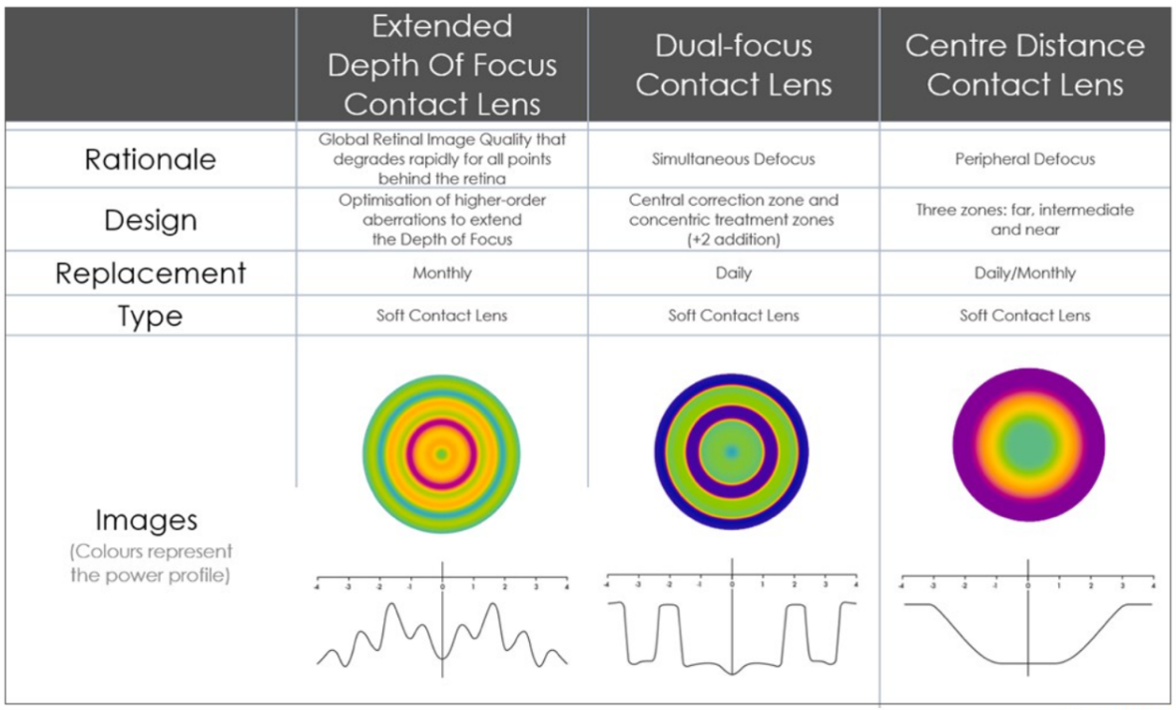
Figuur 5. Verschillende designs van myopie remmende zachte contactlenzen
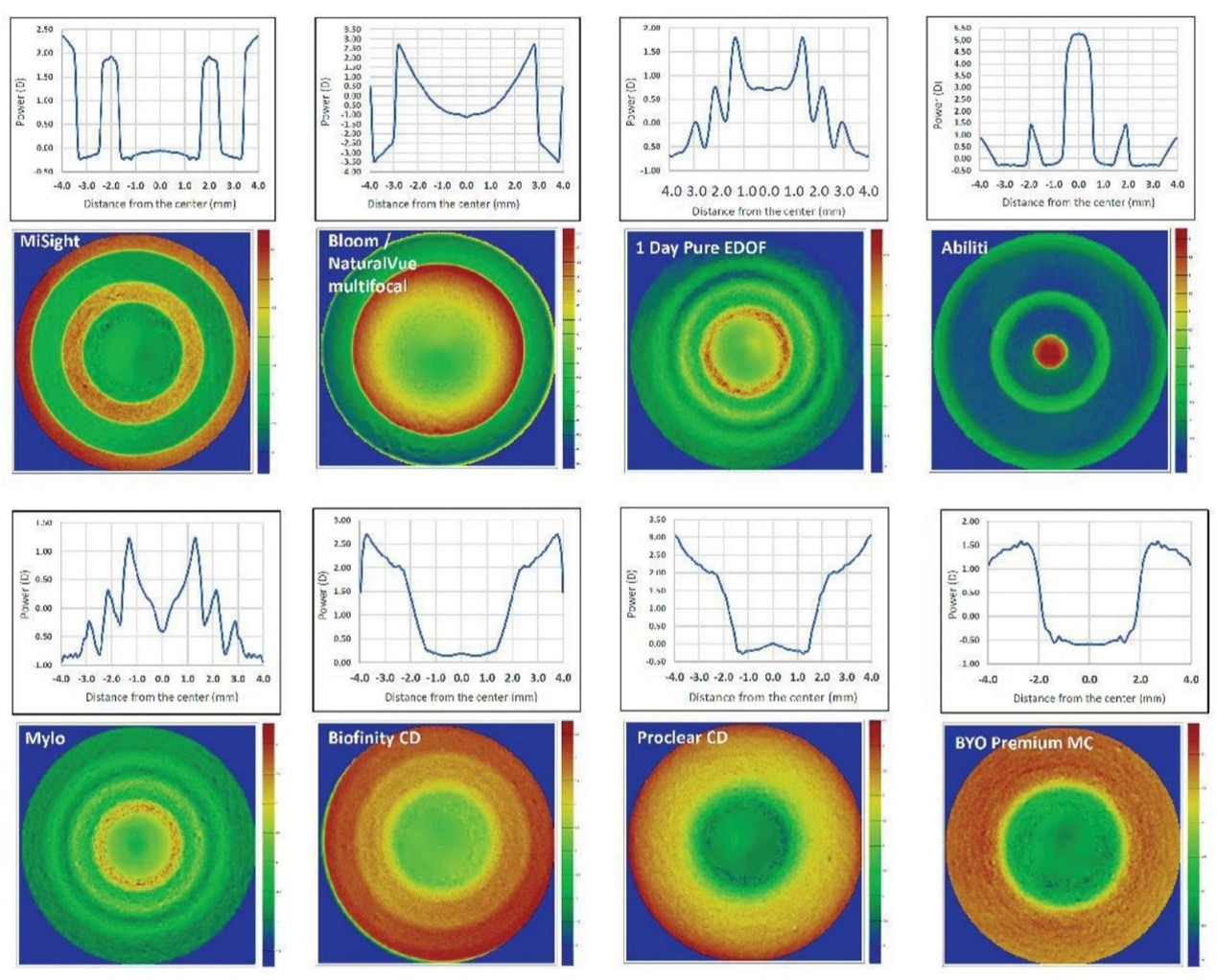
Figuur 6. Radiaal vermogensprofiel van acht verschillende lenzen (van der Worp, 2023)
Kwaliteit van bewijs
De overall kwaliteit van bewijs is laag. Dit betekent dat we onzeker zijn over het gevonden geschatte effect van de cruciale uitkomstmaten. Vanuit klinisch oogpunt betekent een lage bewijskracht niet dat er geen effect is, maar wel dat we voorzichtig moeten zijn in de interpretatie, transparantie naar patiënten en ouders, en bereid moeten zijn om onze keuzes bij te stellen zodra sterker bewijs beschikbaar komt.
Er is afgewaardeerd vanwege:
- Risk of bias: mogelijke inmenging van de industrie.
- Imprecisie: onnauwkeurigheid, omdat het betrouwbaarheidsinterval de grens van klinische relevantie overschrijdt.
Hoewel de kwaliteit van het bewijs volgens de GRADE-methodiek als laag wordt beoordeeld, blijkt uit de samenvatting van de literatuur dat de effectgroottes voor aslengte groei consequent in dezelfde richting wijzen: een vertraging van de groei tussen -0,03 en –0,19 mm per jaar bij gebruik van myopie remmende contactlenzen. Ondanks de methodologische beperkingen (zoals imprecisie en publicatie bias, en de veelal beperkte studieduur van een jaar), suggereert deze consistente trend dat de interventie klinisch relevant kan zijn. Voor de dagelijkse praktijk betekent dit dat myopie remmende contactlenzen een zinvolle optie kunnen zijn binnen gedeelde besluitvorming met ouders en kinderen.
Het aanbod van myopie remmende contactlenzen groeit snel, met voortdurende introducties van nieuwe ontwerpen die variëren in optische principes en andere wetenschappelijke onderbouwingen. Dit benadrukt het belang dat de behandelaar zich continue blijft verdiepen in de meest recente inzichten en innovaties op dit gebied. Door de snelle technologische en wetenschappelijke ontwikkelingen is er sprake van voortdurende verandering, hierdoor dient er rekening gehouden te worden dat deze informatie door de tijd heen kan veranderen en geüpdatet dient te worden.
Waarden en voorkeuren van patiënten (en eventueel hun naasten/verzorgers)
Het is belangrijk om de verschillende opties voor het remmen van de progressie van de myopie met zowel de ouders als het kind te bespreken. Hierbij dienen leefstijl interventies altijd terug te blijven komen naast het starten van andere interventies. Of alle interventies haalbaar zijn hangt af van de persoonlijke voorkeur van de ouders en het kind, de financiële haalbaarheid, de uitgangswaarden en de coöperativiteit.
Een voordeel van het dragen van een bril is dat deze gemakkelijk op en af gaat en de hygiëne alleen met betrekking tot de bril gaat en niet over het plaatsen van de contactlenzen op de ogen. Het wordt geadviseerd om bij de start van de interventie met zachte contactlenzen alle voor- en nadelen met de ouders en het kind te bespreken en gedurende de interventieperiode strikte controle momenten aan te houden bij de optometrist.
Het vergt vaardigheid om deze lenzen in- en uit te kunnen zetten en discipline om er hygiënisch mee om te kunnen gaan. Er is zelfstandigheid van de kinderen nodig en een proactieve houding van ouders jegens het kind om verantwoording voor de lenzen te nemen. Er zijn kosten aan verbonden waardoor het niet voor iedereen financieel haalbaar zal zijn. Tevens brengt het dragen van contactlenzen altijd het risico op complicaties met zich mee.
Het nadeel zijn de hogere kosten van de lenzen en het ontbreken van vergoedingen uit de (basis) zorgverzekering. Dit kan een belangrijk bezwaar zijn voor ouders. Het is dan ook essentieel om samen met ouders en kinderen een weloverwogen beslissing te maken, waarbij rekening wordt gehouden met hun voorkeuren, motivatie en financiële mogelijkheden.
Kostenaspecten
De interventie levert meer kosten ten opzichte van geen interventie. Dit weegt wel op tegen het verschil in effectiviteit. Het dragen van myopie remmende zachte contactlenzen is duurder dan het dragen van een enkelvoudige bril of contactlenzen en vergelijkbaar met de kosten van andere myopie remmende interventies. De kosten van myopie remmende zachte contactlenzen worden niet vergoed vanuit de basisverzekering. Daardoor is het van belang in gesprek te gaan met ouders of de kosten gedragen kunnen worden van de interventie.
Gelijkheid ((health) equity/equitable)
De interventie leidt tot een mogelijke afname van gezondheidsgelijkheid, omdat myopie remmende contactlenzen momenteel niet worden vergoed vanuit de basisverzekering. Dit betekent dat de toegang tot deze interventie afhankelijk is van de financiële situatie van ouder(s)/verzorger(s). In gezinnen met een lagere sociaaleconomische status of zonder aanvullende verzekering kan dit leiden tot het niet kunnen kiezen voor deze optie, ondanks de klinisch relevante gezondheidswinst. Atropine is de enige vergoede optie op dit moment. Het is belangrijk om in de spreekkamer bewust stil te staan bij deze ongelijkheid en samen met ouders te bespreken welke opties haalbaar zijn binnen hun context.
Aanvaardbaarheid:
Ethische aanvaardbaarheid
De interventie lijkt aanvaardbaar voor de betrokkenen mits alle voor- en nadelen zijn afgewogen. Er zijn geen ethische bezwaren. De studies benadrukken de relatieve veiligheid van myopie remmende zachte contactlenzen. Het is een ethisch verantwoorde interventie als de nadruk ligt op veiligheid, geïnformeerde toestemming en bij het naleven van de richtlijnen. Er zijn geen statistisch significante verschillen in bijwerkingen tussen myopie remmende zachte contactlenzen en controlegroepen gevonden. De enkele bijwerkingen die werden gemeld waren over het algemeen mild en omkeerbaar.
Kwaliteit van leven
Er werd één studie gevonden die de uitkomstmaat kwaliteit van leven rapporteerde (Ticak, 2023). In deze studie (BLINK studie) werden drie groepen patiënten met myopie van zeven tot elf jaar oud vergeleken: één groep patiënten (n=98) ontving multifocale zachte contactlenzen met +1.50 D, één groep patiënten ontving multifocale zachte contact lezen met +2.50 D en de controlegroep (n=98) ontving reguliere enkelvoudige contactlenzen. De studie gebruikte de Pediatric Refractive Error Profile 2 (PREP2) vragenlijst om de kwaliteit van leven bij de patiënten te meten. De vragenlijst omvatte onder andere vragen over zicht, comfort en activiteiten. De studie vond geen significante verschillen in gemiddelde PREP2 scores tussen de drie groepen. Het dragen van myopie remmende zachte contactlenzen zorgt bij kinderen met myopie tussen de zeven en elf jaar dus niet voor significant lagere kwaliteit van leven dan het dragen van reguliere contactlezen.
Duurzaamheid
Het dragen van myopie remmende zachte contactlenzen is niet specifiek meer of minder duurzaam dan reguliere contactlenzen of brillenglazen. Zachte contactlenzen voor myopie management worden over het algemeen dagelijks of maandelijks vervangen, doorgaans is dit dezelfde vervangtermijn als voor reguliere zachte contactlenzen. De geadviseerde vervangtermijn van ortho-k lenzen zit op 6-maandelijks tot jaarlijks. Bij zowel ortho-k als zachte maandlenzen zijn contactlensvloeistoffen nodig. Bij daglenzen heb je meer (verpakkings)materiaal nodig voor de lenzen zelf, maar geen vloeistoffen die verpakt zitten in een plastic fles. Brillenglazen en monturen gaan bij kinderen gemiddeld 1-2 jaar mee, ook afhankelijk van hoe snel de sterkte aangepast moet worden en er dus nieuwe glazen nodig zijn.
Haalbaarheid
Deze interventie vergt discipline wat betreft het schoonhouden, in- en uitdoen van de lenzen en regelmatige controle. Indien er slordig wordt omgegaan met de hygiëne of er geen regelmatige controle plaatsvindt, kan dit de kans op complicaties vergroten (zoals corneale epitheeldefecten en microbiële keratitis). Echter weten we hoe jonger je de interventie start, hoe effectiever deze over het algemeen is. Hoewel er altijd bezorgdheid is over de veiligheid als het gaat om kinderen die contactlenzen dragen, hebben zachte lenzen aangetoond een veilige contactlensmodaliteit te zijn en is de veiligheid van het correctiemiddel veelvuldig aangetoond (Stapleton, 2008).
De interventie lijkt deels haalbaar met mogelijke belemmeringen op met name financieel vlak. Hoewel het voorschrijven van myopie remmende zachte lenzen in toenemende mate wordt toegepast in de praktijk, vormt het ontbreken van vergoeding via de (basis) zorgverzekering een belangrijke barrière. Dit kan ertoe leiden dat niet alle zorgverleners de interventie actief aanbieden en dat ouder(s)/verzorger(s) afhaken vanwege de hoge kosten. Daarnaast vraagt het goed toepassen van deze interventie om voldoende kennis bij aanpassers (optometristen en contactlensspecialisten) over de verschillende typen contactlenzen die beschikbaar zijn en hun effectiviteit.
In de dagelijkse praktijk zal niet iedere behandelaar het volledige assortiment aan optische interventies mogelijk kunnen aanbieden. Praktijken moeten vaak afspraken maken met leveranciers waardoor er voorkeuren ontstaan. Er is behoefte aan meer wetenschappelijk onderzoek naar de effectiviteit van de verschillende producten in dezelfde productcategorie.
Onderbouwing
There are several products on the market with some regulatory approval especially for myopia management. Myopia progression inhibiting soft contact lenses are one example of these products. These lenses, designed specifically to slow axial elongation and myopia progression, offer an alternative to traditional vision correction methods such as single-vision spectacles or single-vision contact lenses. There are daily, monthly and 3-monthly disposable products available. These can be subdivided into bifocal lenses (two optical power zones), progressive addition lenses (continuous addition of optical power towards periphery) also called peripheral defocus lenses, and EDOF (Extended Depth Of Focus) lenses. All these designs create a myopic shift on the peripheral retina by adding plus power in the periphery of the lens. With several custom made products on the market almost every myopic refraction, including high torics, can be fit. In the Netherlands, contact lens specialists and optometrists prescribe these lenses as a method to correct and slow down myopia progression.
Summary of Findings
Population: Children (aged 18 years and under) with progressive myopia
Intervention: Myopia control soft contact lenses
Comparison: Single vision contact lenses or spectacles
|
Outcome Timeframe |
Study results and measurements |
Absolute effect estimates |
Certainty of the evidence (Quality of evidence) |
Summary |
|
|
Myopia control soft contact lenses |
Single vision lenses |
||||
|
Adverse events (important)
|
Based on data from 173 participants in 2 studies
|
Manoharan (2024) reported no adverse events in the two groups. Liu (2023) reported mild, treatable adverse events, no significant difference. Also reported a RR of 1.42 (95% CI 0.75 to 2.66), in favour of single-vision lenses. |
Very low Due to serious risk of bias, due to very serious imprecision1 |
The evidence is very uncertain about the effect of myopia control soft contact lenses on adverse events when compared with single-vision lenses in children with progressive myopia. (Liu, 2023; Manoharan, 2024) |
|
|
Compliance (important) |
- |
- |
No GRADE |
No evidence was found regarding the effect of myopia control soft contact lenses on compliance when compared with single-vision lenses in children with progressive myopia. |
|
|
Efficacy on axial length (critical) |
Scale: Lower better Based on data from 1629 participants in 16 studies Follow up 1 year |
Difference: 0.10 mm lower (95% CI -0.13 to -0.08)
|
Low Due to serious risk of bias4, due to serious imprecision2 |
Myopia control soft contact lenses likely reduce change in axial length when compared with single-vision lenses in children with progressive myopia. (Fan, 2024; Li, 2023; Liu, 2023; Manoharan, 2024; Mutti, 2022; Walline, 2020) |
|
|
Efficacy on refractive error (critical) |
Scale: Lower better Based on data from 1550 participants in 15 studies Follow up 1 year |
Difference: MD 0.22 lower (95% CI 0.15 – 0.30 lower) |
Low Due to serious risk of bias4, due to serious imprecision3 |
Myopia control soft contact lenses may result in little to no difference in refractive error when compared with single-vision lenses in children with progressive myopia. (Fan, 2024; Liu, 2023; Manoharan, 2024; Walline, 2020) |
|
1. Risk of bias: serious. Due to lack of information on allocation concealment, lack of blinding, frequent loss-to-follow-up and possible interference of industry. Imprecision: very serious. Due to overlap of both limits of the 95% confidence interval with the minimal clinically important difference.
2. Imprecision: serious. Due to overlap of the lower limit of the 95% confidence interval with the minimal clinically important difference.
3. Imprecision: serious. Due to overlap of the lower limit of the 95% confidence interval with the minimal clinically important difference.
4. Risk of bias: serious. Due to possible interference of industry.
Description of studies
A total of two systematic reviews and three randomized controlled trials were included in the analysis of the literature. Important study characteristics and results are summarized in table 2. The assessment of the risk of bias is summarized in the risk of bias tables (under the tab ‘Evidence tabellen’).
Walline (2020) performed a systematic review of randomized controlled trials to assess the effects of different interventions in slowing myopia progression in children. Trials in which any of the following interventions for slowing the progression of myopia were compared with a control treatment of single vision spectacle lenses, single vision soft contact lenses (SVSCLs), or placebo treatment, or with each other: undercorrection of myopia, bifocal lenses (spectacles), progressive addition lenses (PALs), and other modifications to spectacle lenses; bifocal soft contact lenses (BSCLs), RGPCLs, and corneal reshaping (orthokeratology) contact lenses; pharmaceutical agents (e.g. atropine, pirenzepine). Trials in which most participants were older than eighteen, and trials that included participants with less than -0.25 D spherical equivalent myopia at baseline were excluded. The following databases were searched up to February 2018: Cochrane Central Register of Controlled Trials, MEDLINE Ovid, Embase, PubMed, Latin American and Caribbean Health Science Information Database, International Standard Randomized Controlled Trials Number registry, US National Institutes of Health Ongoing Trials Register, World Health Organization International Clinical Trials Registry Platform. In total, the systematic review included 41 studies. This analysis included two of the thirteen comparisons that were taken into account in the review: multifocal lenses vs. single vision lenses and bifocal soft contact lenses vs. single vision soft contact lenses (four studies).
Fan (2024) performed a systematic review of randomized controlled trials and cohort studies to compare the effects of peripheral defocus soft contact lenses (PDSCLs), ortho-k lenses, and single vision lenses in children and adolescents with myopia. The inclusion criteria were: randomized controlled trials and cohort studies, children between eight and eighteen years old with myopia ranges from -8.0 to 0D and astigmatism ranges ≤-1.00 D, intervention PDSCLs, control Ortho-k lenses, single-vision spectacles or single-vision contact lenses. Republished literature, literature in other languages than English or Chinese, and literature that was unavailable was excluded. The following databases were searched up to July 31, 2023: PubMed, the Cochrane Library, Medline, CNKI, CBM, VIP, and Wan Fang Data. In total, the systematic review included 21 studies, of which thirteen were RCTs and eight were observational studies. This analysis only included the thirteen RCTs.
Liu (2024) performed a 1-year prospective, randomized, double-blind, controlled trial to assess the effectiveness and safety of a multifocal soft contact lens with a high peripheral add power design for myopia control in schoolchildren, aged six to fifteen years. 52/59 (88%) participants completed the protocol; one eye was the treatment eye, the other eye was corrected with a single vision lens. The inclusion criteria were: a minimum visual acuity of 0.8 with contact lenses in each eye, astigmatism ≤ 1.50 D, anisometropia ≤ 1.00 D, and willingness to adhere to the assigned contact lens usage and study protocol. Exclusion criteria were: amblyopia, strabismus, pathologically dry eyes, aphakia, ongoing ocular infections or inflammation, severe ocular allergies, anterior segment abnormalities, corneal vascularization exceeding 1 mm, or a history of herpetic keratitis; the use of atropine, orthokeratology or other myopia control treatments in the previous month, presence of systemic diseases affecting vision or contact lens wear, surgically altered eyes, and long-term use of medication that might disrupt contact lens wear, tear production or refractive state. The trial was performed at three sites at two medical centers.
Manoharan (2024) performed a 1-year prospective, randomized, parallel-arm clinical trial at Prasad Eye Institute in India to determine the efficacy of extended depth of focus contact (EDOF) lenses up to +1.50 D contact lens in controlling myopia progression and axial elongation. 31/48 (65%) children completed the intervention protocol; 38/56 (67%) completed the single vision lens comparison group. The inclusion criteria were: myopia between -10.0 and -0.5 D, astigmatism <0.75 D, anisometropia <1.00 D, age between seven and fifteen years, neophyte/existing soft contact lens wearer, best corrected visual acuity ≥20/20, and willing to wear contact lenses every day during the study period. Exclusion criteria were: any ocular or systemic condition that could influence the refractive error, current or prior use of orthokeratology lenses, bifocal, myopia control intervention and the use of any medication or eye-drops that could influence the refractive error.
Mutti (2022) performed an analysis of the randomized controlled BLINK trial to compare axial and peripheral eye elongation during 3-year myopia control with 2 designs (+2.5 and +1.5 addition) of bifocal soft contact lenses versus single vision contact lenses in children aged seven to eleven years old. Inclusion criteria were: +0.10 logMAR or better best-corrected high contrast distance visual acuity in each eye, -5.0 to -0.75 D of myopic refractive error in the most hyperopic meridian, 1.00 D or less astigmatism in each eye, and 2.00 D or less anisometropia by cycloplegic autorefraction. Exclusion criteria were more than one month of any myopia control treatment or wear of gas permeable, soft bifocal, or orthokeratology contact lenses, and chronic use of medication that might affect immunity. The trial took place at two sites.
Table 2. Characteristics of included studies
|
Study |
Participants |
Comparison |
Follow-up |
Outcome measures |
Comments |
Risk of bias (per outcome measure)1 |
|
Included in systematic review of Walline (2020) |
||||||
|
DISC Study (2011) |
Design: RCT
N at baseline Intervention: 111 (222 eyes) Control: 110 (220 eyes)
Age (mean, SD) 13 years (range 8 to 18) |
Intervention: Bifocal soft contact lenses (DISC)
Control: Single vision soft contact lenses. |
12 months |
Diopter change / change in refractive error BDSCLs: -0.4 (0.5) n=65 SVSCLs: -0.5 (0.6) n=63
Change in axial length BDSCLs: 0.1 (0.2) n=65 SVSCLs: 0.2 (0.2) n=63
|
Conflict of interest: No competing interests, no commercial relationships. A patent ‘Method of Optical Treatment in USA and Australia were issued on 24 Mar 2009 and 29 July 2010.
|
Some concerns (allocation concealment, masking of participants, masking of data analyzers, incomplete outcome data) |
|
Fujikado (2014)2 |
Design: RCT
N at baseline Intervention: 11 (22 eyes) Control: 13 (26 eyes)
Age (mean, SD) PDSCLs: 14.3 (1.3) SVSCLs: 13.1 (1.9) |
Intervention: Bifocal soft contact lenses
Control: Single vision soft contact lenses. |
12 months |
Diopter change / change in refractive error BDSCLs: -0.8 (0.4) n=11 SVSCLs: -0.6 (0.4) n=13
Change in axial length BDSCLs: 0.2 (0.1) n=11 SVSCLs: 0.2 (0.1) n=13
|
Conflict of interest: AS and MN are employees of Menicon, the authors report no other conflicts of interest. |
HIGH (allocation concealment, masking of participants, masking of data analyzers, selective reporting, other bias) |
|
Included in systematic review of Fan (2024) |
||||||
|
Aller (2016) |
Design: RCT
N at baseline Intervention: 38 (76 eyes) Control: 40 (80 eyes)
Age (mean, SD) PDSCLs: 13.0 (2.5) SVLs: No information.
PDSCLs design: Vistakon Acuvue Bifocal Concentric rings
SVLs design: Vistakon Acuvue 2 |
Intervention: Vistakon Acuvue Bifocal
Control: Single vision lenses. |
6 and 12 months. |
Diopter change / change in refractive error PDSCLs: -0.22 (0.34) n=38 SVLs: -0.79 (0.43) n=40
Change in axial length PDSCLs: 0.05 (0.14) n=38 SVLs: 0.24 (0.17) n=40
|
Conflict of interest: The first author has less than 50 shares of stock in Johnson and Johnson, a manufacturer of some of the bifocal and standard lenses used in the study, purchased in 1983. The first author has received a patent on the use of bifocal contact lenses for myopia progression control and he is a coauthor of several other patents in the area of myopia control. |
LOW |
|
Anstice (2011) |
Design: RCT
N at baseline Intervention: 35 (70 eyes) Control: 35 (70 eyes)
Age (mean, SD) PDSCLs: 11.0 (14.0) SVLs: No information.
PDSCLs design: Dual-Focus Concentric rings
SVLs design: Single Vision spectacles |
Intervention: Dual-Focus
Control: Single vision lenses. |
10 months. |
Diopter change / change in refractive error period I PDSCLs: -0.44 (0.33) n=35 SVLs: -0.69 (0.38) n=35
Diopter change / change in refractive error period II PDSCLs: -0.17 (0.35) n=35 SVLs: -0.38 (0.38) n=35
Change in axial length period I PDSCLs: 0.11 (0.09) n=35 SVLs: 0.22 (0.1) n=35
Change in axial length period II PDSCLs: 0.03 (0.1) n=35 SVLs: 0.14 (0.09) n=35
|
Conflict of interest: Author Phillips has made the following disclosure: inventor (P) patent WO 2006/004440 relating to contact lens design: assigned to UniServices, The University of Auckland. |
Some concerns (allocation concealment, masking of participants, masking of data analyzers, other bias) |
|
Chamberlain (2019) |
Design: RCT
N at baseline Intervention: 116 (232 eyes) Control: 120 (240 eyes)
Age (mean, SD) PDSCLs: 10.1 (1.3) SVLs: 10.1 (1.4)
PDSCLs design: MiSight Concentric rings
SVLs design: Proclear I-day |
Intervention: Misight
Control: Single vision lenses. |
12, 24, and 36 months. |
Diopter change / change in refractive error 12 months PDSCLs: -0.18 (0.39) n=116 SVLs: -0.58 (0.41) n=120
Change in axial length 12 months PDSCLs: 0.09 (0.13) n=116 SVLs: 0.24 (0.15) n=120
|
Conflict of interest: PC is an employee of the sponsor (Cooper Vision Inc.). The sponsor participated in study design, analysis and interpretation. The authors were responsible for preparation of this article and the decision to submit this article for publication. The contract research organization had full access to the study data; the investigators had partial access to the study data and take full responsibility for their presentation in this article. |
LOW |
|
Cheng (2016) |
Design: RCT
N at baseline Intervention: 52 (104 eyes) Control: 57 (114 eyes)
Age (mean, SD) PDSCLs: 9.7 (1.11) SVLs: 9.7 (1.05)
PDSCLs design: Positive spherical aberration progressive design
SVLs design: I-Day Acuvue single vision contact lenses |
Intervention: Positive spherical aberration
Control: Single vision lenses. |
6, 12, 18, and 24 months. |
Diopter change / change in refractive error PDSCLs: -0.54 (0.4) n=52 SVLs: -0.68 (0.53) n=57
Change in axial length PDSCLs: 0.23 (0.15) n=52 SVLs: 0.37 (0.16) n=57
|
Conflict of interest: Cheng, Xu, Chehab, and Brennan are paid employees of Johnson and Johnson Vision Care. |
LOW |
|
Fang (2022) |
Design: RCT
N at baseline Intervention: 26 (52 eyes) Control: 29 (58 eyes)
Age (mean, SD) PDSCLs: 12.8 (0.2) SVLs: 12.5 (0.3)
PDSCLs design: BioThin Progressive design
SVLs design: Single vision spectacles |
Intervention: BioThin
Control: Single vision lenses. |
6 and 12 months. |
Diopter change / change in refractive error PDSCLs: -0.59 (0.11) n=26 SVLs: -0.94 (0.12) n=26
Change in axial length PDSCLs: 0.3 (0.03) n=26 SVLs: 0.41 (0.04) n=26
|
Conflict of interest: The authors have no conflicts of interest to disclose. |
Some concerns (allocation concealment, blinding of participants and personnel, other bias) |
|
Fujikado (2014)2 |
Design: RCT
N at baseline Intervention: 11 (22 eyes) Control: 13 (26 eyes)
Age (mean, SD) PDSCLs: 14.3 (1.3) SVLs: 13.1 (1.9)
PDSCLs design: Progressive-addition Progressive design
SVLs design: Single vision contact lenses |
Intervention: Progressive addition
Control: Single vision lenses. |
12 months |
Diopter change / change in refractive error PDSCLs: -0.37 (0.33) n=11 SVLs: -0.5 (0.18) n=13
Change in axial length PDSCLs: 0.09 (0.18) n=11 SVLs: 0.17 (0.18) n=13
|
Conflict of interest: AS and MN are employees of Menicon, the authors report no other conflicts of interest. |
Some concerns (allocation concealment, blinding of participants and personnel) |
|
Lam (2013) |
Design: RCT
N at baseline Intervention: 65 (130 eyes) Control: 63 (126 eyes)
Age (mean, SD) PDSCLs: 11.06 (1.55) SVLs: 10.87 (1.67)
PDSCLs design: DISC Concentric rings design
SVLs design: Single vision contact lenses |
Intervention: DISC
Control: Single vision lenses. |
3, 6, 9, and 12 months. |
Diopter change / change in refractive error PDSCLs: -0.36 (0.55) n=65 SVLs: -0.48 (0.54) n=63
Change in axial length PDSCLs: 0.13 (0.19) n=65 SVLs: 0.21 (0.19) n=63
|
Conflict of interest: No competing interest. |
LOW |
|
Ruiz-Pomeda (2018) |
Design: RCT
N at baseline Intervention: 41 (82 eyes) Control: 33 (66 eyes)
Age (mean, SD) PDSCLs: 11.01 (1.23) SVLs: 10.12 (1.38)
PDSCLs design: MiSight Concentric rings design
SVLs design: Single vision spectacles |
Intervention: MiSight
Control: Single vision lenses. |
12 and 24 months. |
Diopter change / change in refractive error PDSCLs: -0.18 (0.65) n=41 SVLs: -0.44 (0.58) n=33
Change in axial length PDSCLs: 0.12 (0.33) n=41 SVLs: 0.24 (0.3) n=33
|
Conflict of interest: All authors certify that they have no affiliations with or involvement in any organization or entity with any financial interest or non-financial interest in the subject matter or materials discussed. |
Some concerns (blinding of participants and personnel) |
|
Sankaridurg (2011) |
Design: RCT
N at baseline Intervention: 43 (86 eyes) Control: 39 (78 eyes)
Age (mean, SD) PDSCLs: 11.6 (1.5) SVLs: 10.8 (1.9)
PDSCLs design: Progressive-addition Concentric rings design
SVLs design: Single vision spectacles |
Intervention: Progressive addition
Control: Single vision lenses. |
6 and 12 months. |
Diopter change / change in refractive error PDSCLs: -0.54 (0.37) n=43 SVLs: -0.84 (0.47) n=39
Change in axial length PDSCLs: 0.24 (0.17) n=43 SVLs: 0.39 (0.19) n=39
|
Conflict of interest: Disclosure: CIBA Vision Corporation. |
Some concerns (allocation concealment, blinding of participants and personnel, other bias) |
|
Sankaridurg (2019) |
Design: RCT
N at baseline Intervention: 58 (116 eyes) Control: 68 (136 eyes)
Age (mean, SD) PDSCLs: 10.4 (1.3) SVLs: 10.4 (1.3)
PDSCLs design: I. Progressive-addition Progressive design
II. EDOF
SVLs design: CooperVision clarity I day |
Intervention: Progressive addition (test I/II), EDOF (test III/IV)
Control: Single vision lenses. |
6, 12, 18, and 24 months. |
Diopter change / change in refractive error Test I PDSCLs: -0.5 (0.35) n=58 SVLs: -0.66 (0.33) n=68
Diopter change / change in refractive error Test II PDSCLs: -0.53 (0.43) n=60 SVLs: -0.66 (0.33) n=68
Change in axial length Test I PDSCLs: 0.21 (0.17) n=58 SVLs: 0.33 (0.14) n=68
Change in axial length Test II PDSCLs: 0.24 (0.17) n=60 SVLs: 0.33 (0.14) n=68
Change in axial length Test III PDSCLs: 0.22 (0.16) n=57 SVLs: 0.33 (0.14) n=68
Change in axial length Test IV PDSCLs: 0.22 (0.14) n=61 SVLs: 0.33 (0.14) n=68
|
Conflict of interest: Brien Holden Vision Institute has commercial interests in myopia control products. |
LOW |
|
Valle (2021) |
Design: RCT
N at baseline Intervention: 32 (64 eyes) Control: 26 (52 eyes)
Age (mean, SD) PDSCLs: 12.20 (2.22) SVLs: 11.90 (2.13)
PDSCLs design: Esencia Progressive design
SVLs design: Single vision contact lenses |
Intervention: Esencia
Control: Single vision lenses. |
6 and 12 months. |
Diopter change / change in refractive error PDSCLs: -0.28 (0.35) n=32 SVLs: -0.57 (0.52) n=26
Change in axial length PDSCLs: 0.13 (0.12) n=32 SVLs: 0.22 (0.14) n=26
|
Conflict of interest: Tiedra Farmacéutica S.L. was the sponsor for the study. Tiedra Farmacéutica S.L. is the owner of the patent for Esencia design and provided the study contact lenses and maintenance solutions. |
LOW |
|
Walline (2020) |
Design: RCT
N at baseline MAP (+1.50) Intervention: 98 (196 eyes) Control: 97 (194 eyes)
N at baseline HAP (+2.00) Intervention: 97 (194 eyes) Control: 97 (194 eyes)
Age (mean, SD) MAP (+1.50) PDSCLs: 10.3 (1.2) SVLs: 10.3 (1.1)
Age (mean, SD) HAP (+2.00) PDSCLs: 10.3 (1.2) SVLs: 10.3 (1.1)
PDSCLs design: Multifocal Concentric design
SVLs design: Single vision contact lenses |
Intervention: Multifocal soft contact lenses
Control: Single vision lenses. |
12 and 24 months. |
Diopter change / change in refractive error MAP (+1.50) PDSCLs: -0.35 (0.37) n=98 SVLs: -0.43 (0.37) n=97
Diopter change / change in refractive error HAP (+2.00) PDSCLs: -0.2 (0.37) n=97 SVLs: -0.43 (0.37) n=97
Change in axial length MAP (+1.50) PDSCLs: 0.26 (0.12) n=98 SVLs: 0.29 (0.12) n=97
Change in axial length HAP (+2.00) PDSCLs: 0.16 (0.12) n=97 SVLs: 0.29 (0.12) n=97
|
Conflict of interest: Disclosures: non-financial support from Bausch + Lomb, grants from NEI, personal fees from Welch Allyn, grants from NIH, receiving study materials from Bausch + Lomb, personal fees from Visioneering Technologies and Contact Lens Spectrum. |
LOW |
|
Weng (2022) |
Design: RCT
N at baseline MiSight Intervention: 42 (84 eyes) Control: 42 (84 eyes)
N at baseline EDOF Intervention: 38 (76 eyes) Control: 42 (84 eyes)
Age (mean, SD) MiSight PDSCLs: 11.2 (1.7) SVLs: 11.0 (1.5)
Age (mean, SD) EDOF PDSCLs: 10.7 (1.4) SVLs: 11.0 (1.5)
PDSCLs design: I. EDOF II. MiSight Concentric design
SVLs design: Single vision contact lenses |
Intervention: EDOF (1), MiSight (2)
Control: Single vision lenses. |
6 and 12 months. |
Diopter change / change in refractive error MiSight PDSCLs: -0.21 (0.27) n=42 SVLs: -0.34 (0.16) n=42
Diopter change / change in refractive error EDOF PDSCLs: -0.17 (0.26) n=38 SVLs: -0.34 (0.16) n=42
Change in axial length MiSight PDSCLs: 0.08 (0.08) n=42 SVLs: 0.15 (0.06) n=42
Change in axial length EDOF PDSCLs: 0.05 (0.09) n=38 SVLs: 0.15 (0.06) n=42
|
Conflict of interest: This work was supported by the Brien Holden Vision Institute; Sydney NSW, Australia |
Some concerns (allocation concealment, blinding of participants and personnel) |
|
Individual studies |
||||||
|
Liu (2023) |
Design: RCT
N at baseline Intervention: 52 (52 eyes) Control: 52 (52 eyes)
Age (mean, SD) 11.1 (1.96) years |
Intervention: Multifocal soft contact lens in one eye.
Control: Single-vision soft contact lens in the other eye. |
48 weeks |
Change in refractive error I: -0.73 (0.40) D C: -0.85 (0.51) D
Change in axial length I: 0.25 (0.14) mm C: 0.33 (0.17) mm
Compliance No difference due to paired eye design.
Number of adverse events I: 17 C: 12 |
Conflict of interest: Li-Sheng Cheng serves as a medical consultant for Largan Medical Co., Ltd. Other authors declare no competing interests. |
Some concerns (missing outcome data, other bias) |
|
Manoharan (2024) |
Design: RCT
N at baseline Intervention: 31 (62 eyes) Control: 38 (76 eyes)
Age (mean, SD) Intervention: 11.31 ± 2.58 years Control: 11.06 ± 2.45 years |
Intervention: SEED 1 dayPure EDOF Mid (+1.50D) contact lenses
Control: Single-vision spectacle lenses |
12 months |
ITT analysis Diopter change / change in refractive error (mean ±SEM) I: -0.18 ± 0.06 D C: -0.49 ± 0.06 D
Change in axial length (mean ±SEM) I: 0.12 ± 0.02 mm C: 0.22 ± 0.02 mm
Adverse effects: I: 0 C: 0 |
Conflict of interest: No competing interests. |
HIGH (allocation concealment, blinding, missing outcome data, other bias) |
|
Mutti (2022) BLINK study |
Design: RCT
N at baseline Intervention 1: 98 Intervention 2: 98 Control: 98
Age (mean, SD) 10.3 ± 1.2 years |
Intervention: 1.Multifocal soft contact lenses +1.50 D 2.Multifocal soft contact lenses +2.50 D
Control: Single vision contact lenses |
36 months |
Change in axial length I1: 0.55 mm I2: 0.39 mm C: 0.63 mm
|
Conflict of interest: Disclosure: Bausch & Lomb, Vyluma, Visioneering Technologies (advisory board) |
HIGH (allocation generation, allocation concealment, missing outcome data, other bias) |
1 = for further details, see risk of bias table in the appendix; 2 = Fujikado (2014) is included in the systematic review of Walline (2020) and Fan (2024)
Results
Efficacy on axial length (critical)
Two systematic reviews and three individual studies reported the outcome axial length at (approximately) one year (Fan, 2024; Liu, 2023; Manoharan, 2024; Mutti, 2022; Walline, 2020). In total, 850 patients received myopia control soft contact lenses, and 851 patients received single-vision lenses (Figure 1). The mean difference was -0.10 mm (95% CI -0.13 to -0.08), in favour of the patients who received myopia control soft contact lenses. This difference is considered clinically relevant.
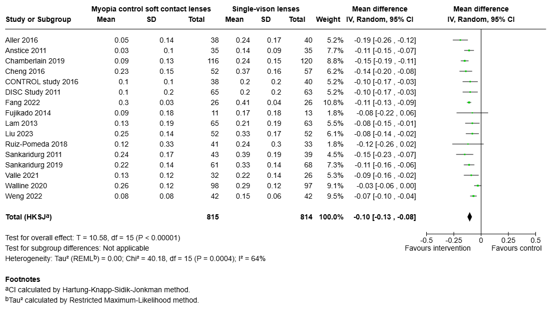
Figure 1. Efficacy on axial length in patients receiving myopia control soft contact lenses vs. single vision lenses at 12 months
Z: p-value of overall effect; df: degrees of freedom; I2: statistical heterogeneity; CI: confidence interval
The studies below did not report enough detail to be included in the meta-analysis. The results are therefore described individually.
Manoharan (2024) reported a change in axial length during the 1-year trial. The patients who received EDOF contact lenses (n=31) had a mean change in axial length of 0.11 mm (SEM ± 0.03 mm), compared with a mean change in axial length of 0.22 mm (SEM ± 0.03 mm) in the patients who received single-vision spectacle lenses (n=38). The mean difference was -0.11 mm, in favour of the patients who received EDOF contact lenses (P 0.007). This difference is considered clinically relevant and is consistent with the findings in the meta-analysis.
Mutti (2022) reported a change in axial length during the 3-year trial. The patients who received bifocal soft contact lenses with addition +1.50 D (n=98) had a change in axial length of 0.55 mm, the patients who received multifocal soft contact lenses +2.50 D (n=98) had a change in axial length of 0.39 mm, compared with a change in axial length of 0.63 mm for the patients who received single vision contact lenses (n=98). The mean difference between multifocal soft contact lenses +1.50 D and single vision contact lenses was -0.08, in favour of the patients who received multifocal soft contact lenses +1.50 D. This difference is not considered clinically relevant. The mean difference between multifocal soft contact lenses +2.50 D and single vision soft contact lenses was -0.24, in favour of the patients who received multifocal soft contact lenses +2.50 D. This difference is considered clinically relevant and is consistent with the findings in the meta-analysis.
Subgroup analysis for type of contact lens
A subgroup analysis for type of myopia control soft contact lens was performed (Figure 2). The mean differences for all types of lenses were in favour of the patients who received myopia control soft contact lenses. Except for Esencia (Valle, 2021), all mean differences were considered clinically relevant.
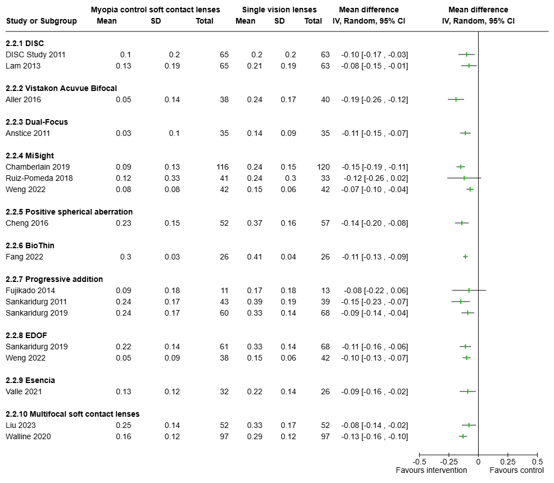
Figure 2. Efficacy on axial length in patients receiving myopia control soft contact lenses vs. single vision lenses – subgroup analysis
Z: p-value of overall effect; df: degrees of freedom; I2: statistical heterogeneity; CI: confidence interval
Efficacy on refractive error (critical)
Two systematic reviews and two individual studies reported the outcome measure refractive error at (approximately) one year in diopter (Fan, 2024; Liu, 2023; Manoharan, 2024; Walline, 2020). In total, 776 patients received myopia control soft contact lenses, and 774 patients received single-vision lenses (Figure 3). The mean difference was 0.22 diopter (95% CI 0.15 to 0.30), in favour of the patients who received myopia control soft contact lenses. This difference is not considered clinically relevant.
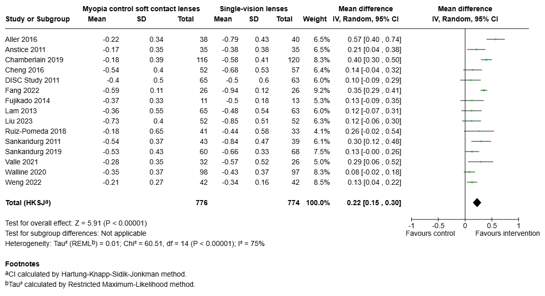
Figure 3. Efficacy on refractive error in patients receiving myopia control soft contact lenses vs. single vision lenses
Z: p-value of overall effect; df: degrees of freedom; I2: statistical heterogeneity; CI: confidence interval
The study below did not report enough detail to be included in the meta-analysis. The results are therefore described separately.
Manoharan (2024) reported change in refractive error in the 1-year trial. The patients who received EDOF contact lenses (n=31) had a mean change in refractive error of -0.20 diopter (±SEM 0.08 D), compared with a mean change in refractive error of -0.48 diopter (±SEM 0.07 D) for the patients received single-vision spectacle lenses (n=38). The mean difference was 0.28 diopter, in favour of the patients who received EDOF contact lenses (P 0.01). This difference is considered clinically relevant.
Subgroup analysis for type of contact lens
A subgroup analysis for type of myopia control soft contact lens was performed (Figure 4). The mean differences for the different types of lenses ranged from 0.11 to 0.57 diopter. The mean differences for all types of lenses were in favour of the patients who received myopia control soft contact lenses. The difference in refractive error was not clinically relevant, except for Vistakon Acuvue Bifocal lenses, BioThin lenses, and Esencia lenses.
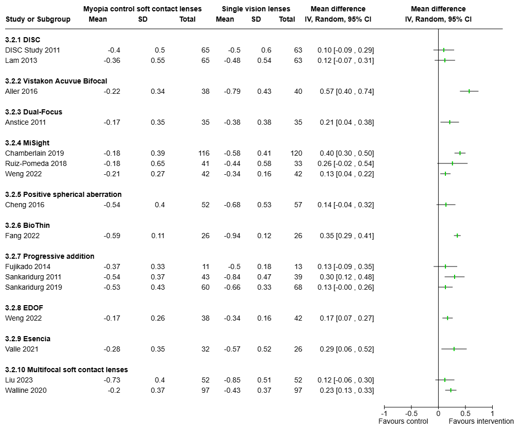
Figure 4. Efficacy on refractive error in patients receiving myopia control soft contact lenses vs. single vision lenses – subgroup analysis
Z: p-value of overall effect; df: degrees of freedom; I2: statistical heterogeneity; CI: confidence interval
Adverse events (important)
The outcome measure adverse events was reported by two studies (Liu, 2023; Manoharan, 2024). Since only two studies reported the outcome measure, the results were not pooled. No serious (vision-threatening) adverse events occurred in the RCTs included in the analysis.
Manoharan (2024) reported no adverse events in both groups of patients who received EDOF lenses (n=31) and the group of patients who received single-vision spectacle lenses (n=38). Liu (2023) reported the number of mild adverse events (Table 3.). In total, the eyes that received multifocal soft contact lenses (n=52) had seventeen (32.7%) adverse events, compared with twelve (23.1%) adverse events for the eyes that received single vision contact lenses (n=52) P=0.38. The lesions were mild and disappeared after treatment with or without discontinuation of the lens.
Table 3. Adverse events in patients receiving myopia control soft contact lenses vs. single vision lenses
|
Adverse event |
Intervention group |
Control group |
|
Mild adverse events |
|
|
|
Corneal epithelial defect |
N=2 (3.4%) |
N=2 (3.4%) |
|
Hordeolum |
N=5 (8.5%) |
N=1 (1.7%) |
|
Allergic conjunctivitis |
N=4 (6.8%) |
N=3 (5.1%) |
|
Acute conjunctivitis |
N=4 (6.8%) |
N=4 (6.8%) |
|
Chalazion |
N=1 (1.7%) |
N=1 (1.7%) |
|
Subjectively-reported unstable vision |
N=1 (1.7%) |
N=1 (1.7%) |
N= number of patients
Compliance (important)
None of the studies reported the outcome measure compliance.
A systematic review of the literature was performed to answer the following question(s):
What is the effect of myopia progression inhibiting soft contact lenses compared to regular contact lenses and/or spectacles on the inhibition of progressive myopia in children aged eighteen years and under?
Table 1. PICO
| Patients | Children (aged 18 years and under) with progressive myopia |
| Intervention | Myopia progression inhibiting soft contact lenses |
| Control | Regular contact lenses or spectacles |
| Outcomes | Short term and long term: efficacy on axial length, spherical equivalent refraction, adverse events (for example keratitis, reduced accommodation, reduced reading vision), compliance/adherence to therapy |
| Other selection criteria | Study design: systematic reviews and randomized controlled trials |
Relevant outcome measures
The guideline panel considered efficacy on axial length and spherical equivalent refraction as critical outcome measures for decision making; and adverse events and compliance/adherence to therapy as important outcome measures for decision making.
A priori, the guideline panel did not define the outcome measures listed above but used the definitions used in the studies.
The guideline panel defined the following differences as minimal clinically (patient) important differences:
- Axial length: 0.1 mm (first year).
- Refraction: 0,25D myopie progression per year.
- Adverse events: 10% (RR < 0.9 and RR > 1.1).
- Compliance/adherence: 10% (RR < 0.9 and RR > 1.1).
Search and select (Methods)
A systematic literature search was performed by a medical information specialist using the following bibliographic databases: Embase.com and Ovid/Medline. Both databases were searched until the 16th of July 2024 for systematic reviews, RCTs and observational studies. Systematic searches were completed using a combination of controlled vocabulary/subject headings (e.g., Emtree-terms, MeSH) wherever they were available and natural language keywords. The overall search strategy was derived from two primary search concepts: (1) children with progressive myopia; and (2) multifocal soft contact lenses. Duplicates were removed using EndNote software. After deduplication a total of 2635 records were imported for title/abstract screening. Studies were selected based on the criteria described in Table 1. Titles and abstracts were screened using the ASReview software version 1.6.2. The settings TF-IDF and Naïve Bayes were used. One study was used as prior knowledge for inclusion (Tang, 2024), and one study was used as prior knowledge for exclusion (Liu, 2020).
The first 10% of references were screened by the working group and the guideline methodologist. The remaining articles were subsequently screened by the guideline methodologist, using the following stopping rule: stop after 47 subsequent exclusions (approximately 10% of the total number of references).
Initially, 55 studies were selected based on title and abstract screening using ASreview software. After reading the full text, 50 studies were excluded (see the exclusion table under the tab ‘Evidence tabellen’), and five studies were included.
- Agyekum, S., Chan, P. P., Zhang, Y., Huo, Z., Yip, B. H., Ip, P., ... & Yam, J. C. (2023). Cost-effectiveness analysis of myopia management: A systematic review. Frontiers in Public Health, 11, 1093836.
- Aller TA, Liu M, Wildsoet CF. Myopia Control with Bifocal Contact Lenses: A Randomized Clinical Trial. Optom Vis Sci. 2016 Apr;93(4):344-52. doi: 10.1097/OPX.0000000000000808. PMID: 26784710.
- Anstice NS, Phillips JR. Effect of dual-focus soft contact lens wear on axial myopia progression in children. Ophthalmology. 2011 Jun;118(6):1152-61. doi: 10.1016/j.ophtha.2010.10.035. Epub 2011 Jan 26. PMID: 21276616.
- Bullimore MA. The Safety of Soft Contact Lenses in Children. Optom Vis Sci. 2017 Jun;94(6):638-646. doi: 10.1097/OPX.0000000000001078. PMID: 28514244; PMCID: PMC5457812.
- Bullimore MA, Richdale K. Incidence of Corneal Adverse Events in Children Wearing Soft Contact Lenses. Eye Contact Lens. 2023 May 1;49(5):204-211. doi: 10.1097/ICL.0000000000000976. Epub 2023 Mar 6. PMID: 36877990; PMCID: PMC10503544.
- Bullimore MA, Brennan NA. Efficacy in myopia control-The impact of rebound. Ophthalmic Physiol Opt. 2025 Jan;45(1):100-110. doi: 10.1111/opo.13403. Epub 2024 Oct 8. PMID: 39377894.
- Chamberlain, P., Hammond, D. S., Bradley, A., Arumugam, B., Richdale, K., McNally, J., ... & Young, G. (2022). Eye growth and myopia progression following cessation of myopia control therapy with a dual-focus soft contact lens. Optometry and Vision Science, 10-1097.
- Chamberlain P, Peixoto-de-Matos SC, Logan NS, Ngo C, Jones D, Young G. A 3-year Randomized Clinical Trial of MiSight Lenses for Myopia Control. Optom Vis Sci. 2019 Aug;96(8):556-567. doi: 10.1097/OPX.0000000000001410. PMID: 31343513.
- Cheng X, Xu J, Chehab K, Exford J, Brennan N. Soft Contact Lenses with Positive Spherical Aberration for Myopia Control. Optom Vis Sci. 2016 Apr;93(4):353-66. doi: 10.1097/OPX.0000000000000773. PMID: 26704144.
- Fan H, Zhang X, Wei Q, Zhong Q, Liu M, Li B, Li S, Zhang R, Xie A. Myopia control efficacy of peripheral defocus soft contact lenses in children and adolescents: A meta-analysis. Eur J Ophthalmol. 2024 Sep;34(5):1408-1423. doi: 10.1177/11206721241229474. Epub 2024 Jan 31. PMID: 38298013.
- Fang J, Huang Z, Long Y, Zhu M, Wu Q, Chen X, Xv W, Du C. Retardation of Myopia by Multifocal Soft Contact Lens and Orthokeratology: A 1-Year Randomized Clinical Trial. Eye Contact Lens. 2022 Aug 1;48(8):328-334. doi: 10.1097/ICL.0000000000000911. Epub 2022 Jun 3. PMID: 35877183; PMCID: PMC9298149.
- Fujikado T, Ninomiya S, Kobayashi T, Suzaki A, Nakada M, Nishida K. Effect of low-addition soft contact lenses with decentered optical design on myopia progression in children: a pilot study. Clin Ophthalmol. 2014 Sep 23;8:1947-56. doi: 10.2147/OPTH.S66884. PMID: 25284981; PMCID: PMC4181743.
- Garcia-Del Valle AM, Blázquez V, Gros-Otero J, Infante M, Culebras A, Verdejo A, Sebastián J, García M, Bueno S, Piñero DP. Efficacy and safety of a soft contact lens to control myopia progression. Clin Exp Optom. 2021 Jan;104(1):14-21. doi: 10.1111/cxo.13077. PMID: 32342559.
- Hemert van, D.J., Sehayian, A., Polling, J.R., Tideman, J.W.L., Kievit, W., & Klaver, C.C.W. (2025). Evaluating costs and utilities of myopia across treatment scenarios in The Netherlands. Acta Opthalmologica
- Hiu Yan Lam, Susie Jones, Nicola S Logan; Long-term impact of daily disposable hydrogel soft contact lens wear on corneal endothelium in children. Invest. Ophthalmol. Vis. Sci. 2024;65(7):6607.
- Lam CSY, Tang WC, Tang YY. Randomised clinical trial of myopia control in myopic schoolchildren using the defocus incorporated soF contact (DISC) lens. Optometry and Vision Science 2011;88(3):444-5.
- Lam CS, Tang WC, Tse DY, Tang YY, To CH. Defocus Incorporated Soft Contact (DISC) lens slows myopia progression in Hong Kong Chinese schoolchildren: a 2-year randomised clinical trial. Br J Ophthalmol. 2014 Jan;98(1):40-5. doi: 10.1136/bjophthalmol-2013-303914. Epub 2013 Oct 29. PMID: 24169657; PMCID: PMC3888618.
- Liu YL, Lin KK, Cheng LS, Lin CW, Lee JS, Hou CH, Tsai TH. Efficacy of Multifocal Soft Contact Lenses in Reducing Myopia Progression Among Taiwanese Schoolchildren: A Randomized Paired-Eye Clinical Trial. Ophthalmol Ther. 2024 Feb;13(2):541-552. doi: 10.1007/s40123-023-00859-x. Epub 2023 Dec 21. PMID: 38127196; PMCID: PMC10787710.
- Manoharan MK, Verkicharla PK. Randomised clinical trial of extended depth of focus lenses for controlling myopia progression: Outcomes from SEED LVPEI Indian Myopia Study. Br J Ophthalmol. 2024 Aug 22;108(9):1292-1298. doi: 10.1136/bjo-2023-323651. PMID: 38604622; PMCID: PMC11347265.
- Mutti DO, Sinnott LT, Berntsen DA, Jones-Jordan LA, Orr DJ, Walline JJ; BLINK Study Group. The Effect of Multifocal Soft Contact Lens Wear on Axial and Peripheral Eye Elongation in the BLINK Study. Invest Ophthalmol Vis Sci. 2022 Sep 1;63(10):17. doi: 10.1167/iovs.63.10.17. PMID: 36169949; PMCID: PMC9526360.
- Pauné J, Morales H, Armengol J, Quevedo L, Faria-Ribeiro M, González-Méijome JM. Myopia Control with a Novel Peripheral Gradient Soft Lens and Orthokeratology: A 2-Year Clinical Trial. Biomed Res Int. 2015;2015:507572. doi: 10.1155/2015/507572. Epub 2015 Oct 28. PMID: 26605331; PMCID: PMC4641166.
- Ruiz-Pomeda A, Pérez-Sánchez B, Valls I, Prieto-Garrido FL, Gutiérrez-Ortega R, Villa-Collar C. MiSight Assessment Study Spain (MASS). A 2-year randomized clinical trial. Graefes Arch Clin Exp Ophthalmol. 2018 May;256(5):1011-1021. doi: 10.1007/s00417-018-3906-z. Epub 2018 Feb 3. PMID: 29396662.
- Ruiz-Pomeda A, Prieto-Garrido FL, Hernández Verdejo JL, Villa-Collar C. Rebound Effect in the Misight Assessment Study Spain (Mass). Curr Eye Res. 2021 Aug;46(8):1223-1226. doi: 10.1080/02713683.2021.1878227. Epub 2021 Jan 24. PMID: 33460537.
- Sánchez-Tena MÁ, Ballesteros-Sánchez A, Martinez-Perez C, Alvarez-Peregrina C, De-Hita-Cantalejo C, Sánchez-González MC, Sánchez-González JM. Assessing the rebound phenomenon in different myopia control treatments: A systematic review. Ophthalmic Physiol Opt. 2024 Mar;44(2):270-279. doi: 10.1111/opo.13277. Epub 2024 Jan 9. PMID: 38193312.
- Sankaridurg P, Bakaraju RC, Naduvilath T, Chen X, Weng R, Tilia D, Xu P, Li W, Conrad F, Smith EL 3rd, Ehrmann K. Myopia control with novel central and peripheral plus contact lenses and extended depth of focus contact lenses: 2 year results from a randomised clinical trial. Ophthalmic Physiol Opt. 2019 Jul;39(4):294-307. doi: 10.1111/opo.12621. Epub 2019 Jun 10. PMID: 31180155; PMCID: PMC6851825.
- Sankaridurg P, Holden B, Smith E 3rd, Naduvilath T, Chen X, de la Jara PL, Martinez A, Kwan J, Ho A, Frick K, Ge J. Decrease in rate of myopia progression with a contact lens designed to reduce relative peripheral hyperopia: one-year results. Invest Ophthalmol Vis Sci. 2011 Dec 9;52(13):9362-7. doi: 10.1167/iovs.11-7260. PMID: 22039230.
- Stapleton F, Keay L, Edwards K, Naduvilath T, Dart JK, Brian G, Holden BA. The incidence of contact lens-related microbial keratitis in Australia. Ophthalmology. 2008 Oct;115(10):1655-62. doi: 10.1016/j.ophtha.2008.04.002. Epub 2008 Jun 5. PMID: 18538404.
- Sweeney DF. Have silicone hydrogel lenses eliminated hypoxia? Eye Contact Lens. 2013 Jan;39(1):53-60. doi: 10.1097/ICL.0b013e31827c7899. PMID: 23271474.
- Ticak A, Walline JJ, Berntsen DA, Mutti DO, Jones-Jordan LA, Cardenas L, Day E, Dougherty BE; BLINK Study Group. Quality of life after wearing multifocal contact lenses for myopia control for 2 weeks in the BLINK Study. Ophthalmic Physiol Opt. 2023 Nov;43(6):1491-1499. doi: 10.1111/opo.13216. Epub 2023 Aug 23. PMID: 37609711; PMCID: PMC10592163.
- Walline JJ, Greiner KL, McVey ME, Jones-Jordan LA. Multifocal contact lens myopia control. Optom Vis Sci. 2013 Nov;90(11):1207-14. doi: 10.1097/OPX.0000000000000036. PMID: 24061152.
- Walline JJ, Lindsley KB, Vedula SS, Cotter SA, Mutti DO, Ng SM, Twelker JD. Interventions to slow progression of myopia in children. Cochrane Database Syst Rev. 2020 Jan 13;1(1):CD004916. doi: 10.1002/14651858.CD004916.pub4. PMID: 31930781; PMCID: PMC6984636.
- Weng, R.; Lan, W.; Bakaraju, R.; Conrad, F.; Naduvilath, T.; Yang, Z.; Sankaridurg, P. Efficacy of contact lenses for myopia control: Insights from a randomised, contralateral study design. Ophthalmic Physiol. Opt. 2022, 42, 1253–1263.
- Van der Worp, E., & MONTANI, G. (2023). Powerful Profiles. Contact Lens Spectrum, 38, 38-42.
- Young AL, Leung KS, Tsim N, Hui M, Jhanji V. Risk factors, microbiological profile, and treatment outcomes of pediatric microbial keratitis in a tertiary care hospital in Hong Kong. Am J Ophthalmol. 2013 Nov;156(5):1040-1044.e2. doi: 10.1016/j.ajo.2013.06.019. Epub 2013 Aug 20. PMID: 23972308.
Risk of bias tabel
|
Study reference
(first author, publication year) |
Was the allocation sequence adequately generated?
Definitely yes Probably yes Probably no Definitely no |
Was the allocation adequately concealed?
Definitely yes Probably yes Probably no Definitely no |
Blinding: Was knowledge of the allocated interventions adequately prevented?
Were patients/healthcare providers/data collectors/outcome assessors/data analysts blinded?
Definitely yes Probably yes Probably no Definitely no |
Was loss to follow-up (missing outcome data) infrequent?
Definitely yes Probably yes Probably no Definitely no |
Are reports of the study free of selective outcome reporting?
Definitely yes Probably yes Probably no Definitely no |
Was the study apparently free of other problems that could put it at a risk of bias?
Definitely yes Probably yes Probably no Definitely no |
Overall risk of bias If applicable/necessary, per outcome measure
LOW Some concerns HIGH
|
|
Liu, 2023 |
Definitely yes
Reason: Software was used to produce randomization code lists at each study site by an independent code programmer. |
Definitely yes
Reason: The randomized data remained inaccessible to all study personnel. The corresponding study group for each participant was securely documented within sealed envelopes. |
Probably yes
Reason: Double-blind study, study personnel was blinded. |
Definitely no
Reason: Loss to follow-up was more than 10% in the intervention group and control group. |
Definitely yes
Reason: All relevant outcomes were reported. |
Definitely no
Reason: Short study duration, pre- and postintervention accommodation lag, corrected peripheral refraction and contrast sensitivity were not assessed, primary population consisted of East Asian children. |
Some concerns |
|
Manoharan, 2024 |
Definitely yes
Reason: The sequence of allocation was generated through Microsoft Excel 2016. |
Probably no
Reason: No information. |
Definitely no
Reason: Neither the participants nor the investigator was masked during the study duration. |
Definitely no
Reason: Loss to follow-up was more than 10% in the intervention group and control group. |
Definitely yes
Reason: All relevant outcomes were reported. |
Definitely no
Reason: Lack of masking, high loss to follow-up, pupil size was not measured, findings are limited to low myopes. |
HIGH |
|
Mutti, 2022 |
No information
Reason: Not reported. |
Probably no
Reason: No information. |
Probably yes
Reason: Double-masked study. |
No information
Reason: Not reported. |
Definitely yes
Reason: All relevant outcomes were reported. |
Probably no
Reason: elongation should be evaluated at locations more peripheral than 30 degrees. |
HIGH |
Exclusietabel
|
Reference |
Reason for exclusion |
|
Aller TA, Liu M, Wildsoet CF. Myopia Control with Bifocal Contact Lenses: A Randomized Clinical Trial. Optom Vis Sci. 2016 Apr;93(4):344-52. doi: 10.1097/OPX.0000000000000808. PMID: 26784710. |
Included in SR Fan (2024) |
|
Anstice NS, Phillips JR. Effect of dual-focus soft contact lens wear on axial myopia progression in children. Ophthalmology. 2011 Jun;118(6):1152-61. doi: 10.1016/j.ophtha.2010.10.035. Epub 2011 Jan 26. PMID: 21276616. |
Included in SR Fan (2024) |
|
Berntsen DA, Ticak A, Sinnott LT, Chandler MA, Jones JH, Morrison A, Jones-Jordan LA, Walline JJ, Mutti DO; BLINK Study Group. Peripheral Defocus, Pupil Size, and Axial Eye Growth in Children Wearing Soft Multifocal Contact Lenses in the BLINK Study. Invest Ophthalmol Vis Sci. 2023 Nov 1;64(14):3. doi: 10.1167/iovs.64.14.3. PMID: 37910092; PMCID: PMC10627291. |
? |
|
Cabanes-Martí E, García-Ayuso D. Myopia control with dual-focus soft contact lenses during the first year of measures to contain the COVID-19 pandemic. Ophthalmic Physiol Opt. 2022 Nov;42(6):1227-1231. doi: 10.1111/opo.13031. Epub 2022 Jul 27. PMID: 35894156; PMCID: PMC9796312. |
Wrong study design: observational study |
|
Chamberlain P, Bradley A, Arumugam B, Hammond D, McNally J, Logan NS, Jones D, Ngo C, Peixoto-de-Matos SC, Hunt C, Young G. Long-term Effect of Dual-focus Contact Lenses on Myopia Progression in Children: A 6-year Multicenter Clinical Trial. Optom Vis Sci. 2022 Mar 1;99(3):204-212. doi: 10.1097/OPX.0000000000001873. PMID: 35086120. |
Included in SR Lanca (2023) |
|
Chamberlain P, Hammond DS, Arumugam B, Bradley A. Six-year cumulative treatment effect and treatment efficacy of a dual focus myopia control contact lens. Ophthalmic Physiol Opt. 2024 Jan;44(1):199-205. doi: 10.1111/opo.13240. Epub 2023 Oct 27. PMID: 37897105. |
Wrong study design: observational study |
|
Chamberlain P, Peixoto-de-Matos SC, Logan NS, Ngo C, Jones D, Young G. A 3-year Randomized Clinical Trial of MiSight Lenses for Myopia Control. Optom Vis Sci. 2019 Aug;96(8):556-567. doi: 10.1097/OPX.0000000000001410. PMID: 31343513. |
Included in SR Fan (2024) |
|
Cheng X, Xu J, Brennan NA. Accommodation and its role in myopia progression and control with soft contact lenses. Ophthalmic Physiol Opt. 2019 May;39(3):162-171. doi: 10.1111/opo.12614. PMID: 30994197. |
Included in SR Fan (2024) |
|
Chiu YC, Tsai PC, Lee SH, Wang JH, Chiu CJ. Systematic Review of Myopia Progression after Cessation of Optical Interventions for Myopia Control. J Clin Med. 2023 Dec 21;13(1):53. doi: 10.3390/jcm13010053. PMID: 38202060; PMCID: PMC10779574. |
All included studies are included in SR Fan (2024), SR Fan is more recent |
|
Corpus G, Molina-Martin A, Piñero DP. Efficacy of Soft Contact Lenses for Myopia Control: A Systematic Review. Semin Ophthalmol. 2024 Apr;39(3):185-192. doi: 10.1080/08820538.2023.2271063. Epub 2023 Oct 18. PMID: 37853677. |
All included studies are included in SR Fan (2024) or SR Walline (2020) |
|
Díaz-Gómez S, Burgos-Martínez M, Sankaridurg P, Urkia-Solorzano A, Carballo-Álvarez J. Two-Year Myopia Management Efficacy of Extended Depth of Focus Soft Contact Lenses (MYLO) in Caucasian Children. Am J Ophthalmol. 2024 Apr;260:122-131. doi: 10.1016/j.ajo.2023.11.025. Epub 2023 Dec 5. PMID: 38056608. |
Wrong study design: observational study |
|
Eppenberger LS, Grzybowski A, Schmetterer L, Ang M. Myopia Control: Are We Ready for an Evidence Based Approach? Ophthalmol Ther. 2024 Jun;13(6):1453-1477. doi: 10.1007/s40123-024-00951-w. Epub 2024 May 7. PMID: 38710983; PMCID: PMC11109072. |
Wrong study design: narrative review |
|
Erdinest N, Atar-Vardi M, London N, Landau D, Smadja D, Pras E, Lavy I, Morad Y. Treatment of Rapid Progression of Myopia: Topical Atropine 0.05% and MF60 Contact Lenses. Vision (Basel). 2024 Jan 19;8(1):3. doi: 10.3390/vision8010003. PMID: 38391084; PMCID: PMC10885127. |
Not conform PICO: wrong comparison |
|
Fan H, Zhang X, Wei Q, Zhong Q, Liu M, Li B, Li S, Zhang R, Xie A. Myopia control efficacy of peripheral defocus soft contact lenses in children and adolescents: A meta-analysis. Eur J Ophthalmol. 2024 Sep;34(5):1408-1423. doi: 10.1177/11206721241229474. Epub 2024 Jan 31. PMID: 38298013. |
All included studies are included in SR Fan (2024) or SR Walline (2020) |
|
Fang J, Huang Z, Long Y, Zhu M, Wu Q, Chen X, Xv W, Du C. Retardation of Myopia by Multifocal Soft Contact Lens and Orthokeratology: A 1-Year Randomized Clinical Trial. Eye Contact Lens. 2022 Aug 1;48(8):328-334. doi: 10.1097/ICL.0000000000000911. Epub 2022 Jun 3. PMID: 35877183; PMCID: PMC9298149. |
Included in SR Song (2024) |
|
Fujikado T, Ninomiya S, Kobayashi T, Suzaki A, Nakada M, Nishida K. Effect of low-addition soft contact lenses with decentered optical design on myopia progression in children: a pilot study. Clin Ophthalmol. 2014 Sep 23;8:1947-56. doi: 10.2147/OPTH.S66884. PMID: 25284981; PMCID: PMC4181743. |
Included in SR Fan (2024) |
|
Garcia-Del Valle AM, Blázquez V, Gros-Otero J, Infante M, Culebras A, Verdejo A, Sebastián J, García M, Bueno S, Piñero DP. Efficacy and safety of a soft contact lens to control myopia progression. Clin Exp Optom. 2021 Jan;104(1):14-21. doi: 10.1111/cxo.13077. PMID: 32342559. |
Included in SR Fan (2024) |
|
Gong CR, Troilo D, Richdale K. Accommodation and Phoria in Children Wearing Multifocal Contact Lenses. Optom Vis Sci. 2017 Mar;94(3):353-360. doi: 10.1097/OPX.0000000000001044. PMID: 28027276; PMCID: PMC5402339. |
Results were not suitable for this analysis |
|
Han D, Zhang Z, Du B, Liu L, He M, Liu Z, Wei R. A comparison of vision-related quality of life between Defocus Incorporated Soft Contact (DISC) lenses and single-vision spectacles in Chinese children. Cont Lens Anterior Eye. 2023 Feb;46(1):101748. doi: 10.1016/j.clae.2022.101748. Epub 2022 Aug 19. PMID: 35989141. |
Wrong study design: observational study |
|
Hongge, W. A. N. G., Xia, W. A. N., Yaling, W. A. N. G., Xuehua, S. U. N., Xiaoyan, L. A. N., & Jie, Z. H. A. N. G. (2015). A randomized controlled clinical trial of the effectiveness and safety between aspherical and NUV soft hydrophilic contact lenses for myopia patients. Chinese Journal of Experimental Ophthalmology, 537-540. |
Study in Chinese |
|
Huang J, Wen D, Wang Q, McAlinden C, Flitcroft I, Chen H, Saw SM, Chen H, Bao F, Zhao Y, Hu L, Li X, Gao R, Lu W, Du Y, Jinag Z, Yu A, Lian H, Jiang Q, Yu Y, Qu J. Efficacy Comparison of 16 Interventions for Myopia Control in Children: A Network Meta-analysis. Ophthalmology. 2016 Apr;123(4):697-708. doi: 10.1016/j.ophtha.2015.11.010. Epub 2016 Jan 27. PMID: 26826749. |
Wrong study design: network meta-analysis |
|
Kanpolat, A., & Oral, D. (2000). Types of contact lenses applied in astigmatic cases. Contactologia, 22(1), 42-45. |
Wrong study design: observational study |
|
Lanca C, Pang CP, Grzybowski A. Effectiveness of myopia control interventions: A systematic review of 12 randomized control trials published between 2019 and 2021. Front Public Health. 2023 Mar 23;11:1125000. doi: 10.3389/fpubh.2023.1125000. Erratum in: Front Public Health. 2024 Sep 25;12:1460156. doi: 10.3389/fpubh.2024.1460156. PMID: 37033047; PMCID: PMC10076805. |
All included studies are included in SR Fan (2024) or SR Walline (2020) |
|
Lawrenson JG, Shah R, Huntjens B, Downie LE, Virgili G, Dhakal R, Verkicharla PK, Li D, Mavi S, Kernohan A, Li T, Walline JJ. Interventions for myopia control in children: a living systematic review and network meta-analysis. Cochrane Database Syst Rev. 2023 Feb 16;2(2):CD014758. doi: 10.1002/14651858.CD014758.pub2. PMID: 36809645; PMCID: PMC9933422. |
Network meta-analysis: cannot be used to answer the question |
|
Lopes-Ferreira D, Ruiz-Pomeda A, Peréz-Sanchéz B, Queirós A, Villa-Collar C. Ocular and corneal aberrations changes in controlled randomized clinical trial MiSight® Assessment Study Spain (MASS). BMC Ophthalmol. 2021 Mar 1;21(1):112. doi: 10.1186/s12886-021-01865-y. PMID: 33648464; PMCID: PMC7919067. |
Included in SR Corpus (2024) |
|
Lu W, Ji R, Jiang D, Shi L, Ding W, Tian Y, Zhao C, Leng L. Different efficacy in myopia control: Comparison between orthokeratology and defocus-incorporated multiple segment lenses. Cont Lens Anterior Eye. 2024 Apr;47(2):102122. doi: 10.1016/j.clae.2024.102122. Epub 2024 Jan 13. PMID: 38220497. |
Wrong study design: observational study |
|
Lumb E, Sulley A, Logan NS, Jones D, Chamberlain P. Six years of wearer experience in children participating in a myopia control study of MiSight® 1 day. Cont Lens Anterior Eye. 2023 Aug;46(4):101849. doi: 10.1016/j.clae.2023.101849. Epub 2023 May 6. PMID: 37156658. |
Not conform PICO: wrong outcome measures |
|
Malinowski A, Mrugacz M, Stopa M, Filipek E, Moniuszko-Malinowska A, Czupryna P. A Clinical Study of the Impact of Soft Contact Lenses on the Progression of Myopia in Young Patients. Clin Ophthalmol. 2022 Jan 11;16:51-62. doi: 10.2147/OPTH.S338199. PMID: 35058685; PMCID: PMC8765077. |
Wrong study design: observational study |
|
Pauné J, Morales H, Armengol J, Quevedo L, Faria-Ribeiro M, González-Méijome JM. Myopia Control with a Novel Peripheral Gradient Soft Lens and Orthokeratology: A 2-Year Clinical Trial. Biomed Res Int. 2015;2015:507572. doi: 10.1155/2015/507572. Epub 2015 Oct 28. PMID: 26605331; PMCID: PMC4641166. |
Wrong study design: non-randomized trial |
|
Prousali E, Haidich AB, Fontalis A, Ziakas N, Brazitikos P, Mataftsi A. Efficacy and safety of interventions to control myopia progression in children: an overview of systematic reviews and meta-analyses. BMC Ophthalmol. 2019 May 9;19(1):106. doi: 10.1186/s12886-019-1112-3. PMID: 31072389; PMCID: PMC6506938. |
Wrong study design |
|
Queirós A, Lopes-Ferreira D, González-Méijome JM. Astigmatic Peripheral Defocus with Different Contact Lenses: Review and Meta-Analysis. Curr Eye Res. 2016 Aug;41(8):1005-1015. doi: 10.3109/02713683.2015.1116585. Epub 2016 Feb 2. PMID: 26835871. |
Not conform PICO: wrong outcome measures |
|
Raffa LH, Allinjawi K, Sharanjeet-Kaur, Akhir SM, Mutalib HA. Myopia control with soft multifocal contact lenses: 18-month follow-up. Saudi J Ophthalmol. 2022 Jun 13;35(4):325-331. doi: 10.4103/1319-4534.347305. PMID: 35814985; PMCID: PMC9266467. |
Included in SR Song (2024) |
|
Ruiz-Pomeda A, Pérez-Sánchez B, Cañadas P, Prieto-Garrido FL, Gutiérrez-Ortega R, Villa-Collar C. Binocular and accommodative function in the controlled randomized clinical trial MiSight® Assessment Study Spain (MASS). Graefes Arch Clin Exp Ophthalmol. 2019 Jan;257(1):207-215. doi: 10.1007/s00417-018-4115-5. Epub 2018 Sep 8. PMID: 30196481. |
Secondary analysis of study included in SR |
|
Ruiz-Pomeda A, Pérez-Sánchez B, Prieto-Garrido FL, Gutiérrez-Ortega R, Villa-Collar C. MiSight Assessment Study Spain: Adverse Events, Tear Film Osmolarity, and Discontinuations. Eye Contact Lens. 2018 Nov;44 Suppl 2:S180-S186. doi: 10.1097/ICL.0000000000000484. PMID: 29438120. |
Secondary analysis of study included in SR |
|
Ruiz-Pomeda A, Pérez-Sánchez B, Valls I, Prieto-Garrido FL, Gutiérrez-Ortega R, Villa-Collar C. MiSight Assessment Study Spain (MASS). A 2-year randomized clinical trial. Graefes Arch Clin Exp Ophthalmol. 2018 May;256(5):1011-1021. doi: 10.1007/s00417-018-3906-z. Epub 2018 Feb 3. PMID: 29396662. |
Included in SR Fan (2024) |
|
Ruiz-Pomeda A, Prieto-Garrido FL, Hernández Verdejo JL, Villa-Collar C. Rebound Effect in the Misight Assessment Study Spain (Mass). Curr Eye Res. 2021 Aug;46(8):1223-1226. doi: 10.1080/02713683.2021.1878227. Epub 2021 Jan 24. PMID: 33460537. |
Not conform PICO |
|
Sánchez-Tena MÁ, Ballesteros-Sánchez A, Martinez-Perez C, Alvarez-Peregrina C, De-Hita-Cantalejo C, Sánchez-González MC, Sánchez-González JM. Assessing the rebound phenomenon in different myopia control treatments: A systematic review. Ophthalmic Physiol Opt. 2024 Mar;44(2):270-279. doi: 10.1111/opo.13277. Epub 2024 Jan 9. PMID: 38193312. |
Included in SR Fan (2024) |
|
Sankaridurg P, Bakaraju RC, Naduvilath T, Chen X, Weng R, Tilia D, Xu P, Li W, Conrad F, Smith EL 3rd, Ehrmann K. Myopia control with novel central and peripheral plus contact lenses and extended depth of focus contact lenses: 2 year results from a randomised clinical trial. Ophthalmic Physiol Opt. 2019 Jul;39(4):294-307. doi: 10.1111/opo.12621. Epub 2019 Jun 10. PMID: 31180155; PMCID: PMC6851825. |
Included in SR Fan (2024) |
|
Sarkar S, Khuu S, Kang P. A systematic review and meta-analysis of the efficacy of different optical interventions on the control of myopia in children. Acta Ophthalmol. 2024 May;102(3):e229-e244. doi: 10.1111/aos.15746. Epub 2023 Aug 14. PMID: 37578349. |
Not conform PICO: wrong comparison |
|
Shen EP, Chu HS, Cheng HC, Tsai TH. Center-for-Near Extended-Depth-of-Focus Soft Contact Lens for Myopia Control in Children: 1-Year Results of a Randomized Controlled Trial. Ophthalmol Ther. 2022 Aug;11(4):1577-1588. doi: 10.1007/s40123-022-00536-5. Epub 2022 Jun 23. PMID: 35737291; PMCID: PMC9253228. |
Included in SR Corpus (2024) |
|
Song D, Qiu W, Jiang T, Chen Z, Chen J. Efficacy and adverse reactions of peripheral add multifocal soft contact lenses in childhood myopia: a meta-analysis. BMC Ophthalmol. 2024 Apr 16;24(1):173. doi: 10.1186/s12886-024-03408-7. PMID: 38627653; PMCID: PMC11020872. |
All included studies are included in SR Fan (2024) or SR Walline (2020) |
|
Tilia D, Sha J, Thomas V, Bakaraju RC. Vision Performance and Accommodative/Binocular Function in Children Wearing Prototype Extended Depth-of-Focus Contact Lenses. Eye Contact Lens. 2019 Jul;45(4):260-270. doi: 10.1097/ICL.0000000000000570. PMID: 30601291. |
Wrong study design: one patient group using three interventions. Patients are compared with themselves. |
|
Walline JJ, Greiner KL, McVey ME, Jones-Jordan LA. Multifocal contact lens myopia control. Optom Vis Sci. 2013 Nov;90(11):1207-14. doi: 10.1097/OPX.0000000000000036. PMID: 24061152. |
Wrong study design: observational study |
|
Walline JJ, Lindsley K, Vedula SS, Cotter SA, Mutti DO, Twelker JD. Interventions to slow progression of myopia in children. Cochrane Database Syst Rev. 2011 Dec 7;(12):CD004916. doi: 10.1002/14651858.CD004916.pub3. Update in: Cochrane Database Syst Rev. 2020 Jan 13;1:CD004916. doi: 10.1002/14651858.CD004916.pub4. PMID: 22161388; PMCID: PMC4270373. |
New version of this SR is included |
|
Walline JJ, Walker MK, Mutti DO, Jones-Jordan LA, Sinnott LT, Giannoni AG, Bickle KM, Schulle KL, Nixon A, Pierce GE, Berntsen DA; BLINK Study Group. Effect of High Add Power, Medium Add Power, or Single-Vision Contact Lenses on Myopia Progression in Children: The BLINK Randomized Clinical Trial. JAMA. 2020 Aug 11;324(6):571-580. doi: 10.1001/jama.2020.10834. PMID: 32780139; PMCID: PMC7420158. |
Included in SR Fan (2024) |
|
Weng R, Lan W, Bakaraju R, Conrad F, Naduvilath T, Yang ZK, Sankaridurg P. Efficacy of contact lenses for myopia control: Insights from a randomised, contralateral study design. Ophthalmic Physiol Opt. 2022 Nov;42(6):1253-1263. doi: 10.1111/opo.13042. Epub 2022 Aug 25. PMID: 36006761; PMCID: PMC9805073. |
Included in SR Fan (2024) |
|
Weng R, Naduvilath T, Philip K, Chen X, Sankaridurg P. Exploring non-adherence to contact lens wear schedule: Subjective assessments and patient related factors in children wearing single vision and myopia control contact lenses. Cont Lens Anterior Eye. 2021 Feb;44(1):94-101. doi: 10.1016/j.clae.2020.11.015. Epub 2020 Dec 4. PMID: 33288408. |
Not conform PICO: wrong outcome measures |
|
Yu Z, Zhong A, Zhao X, Li D, Duan J. Efficacy and Safety of Different Add Power Soft Contact Lenses on Myopia Progression in Children: A Systematic Review and Meta-Analysis. Ophthalmic Res. 2022;65(4):398-416. doi: 10.1159/000523675. Epub 2022 Feb 28. PMID: 35226916. |
All included studies are included in SR Fan (2024), SR Fan is more recent |
|
Zhang G, Jiang J, Qu C. Myopia prevention and control in children: a systematic review and network meta-analysis. Eye (Lond). 2023 Nov;37(16):3461-3469. doi: 10.1038/s41433-023-02534-8. Epub 2023 Apr 27. PMID: 37106147; PMCID: PMC10630522. |
Wrong study design: network meta-analysis |
Beoordelingsdatum en geldigheid
Publicatiedatum : 26-08-2026
Beoordeeld op geldigheid : 26-08-2026
Het cluster Oog is als houder van deze richtlijn de eerstverantwoordelijke voor de actualiteit van deze richtlijn.
Algemene gegevens
De ontwikkeling van deze richtlijn werd ondersteund door het Kennisinstituut van de Federatie Medisch Specialisten (www.demedischspecialist.nl/kennisinstituut) en werd gefinancierd door de Stichting Kwaliteitsgelden Medisch Specialisten (SKMS). Patiëntenparticipatie bij deze richtlijn werd medegefinancierd uit de Kwaliteitsgelden Patiënten Consumenten (SKPC) binnen het programma Kwaliteit, Inzicht en Doelmatigheid in de medisch specialistische Zorg (KIDZ). De financier heeft geen enkele invloed gehad op de inhoud van de richtlijnmodule.
Samenstelling werkgroep
Voor het ontwikkelen van de richtlijnmodule is in 2023 een multidisciplinaire werkgroep ingesteld, bestaande uit vertegenwoordigers van alle relevante specialismen (zie hiervoor de Samenstelling van de werkgroep) die betrokken zijn bij de zorg voor patiënten met kinderen met progressieve myopie.
Werkgroep
Dr. M. (Martha) Tjon-Fo-Sang, oogarts, Het Oogziekenhuis Rotterdam, Rotterdam (voorzitter), NOG
Prof. Dr. C.C.W. (Caroline) Klaver, oogarts, Erasmusmc, Rotterdam & Radboudumc, Nijmegen, NOG
Dr. J.W.L. (Willem) Tideman, oogarts, Martini Ziekenhuis Groningen; Post-doc, Erasmusmc, Rotterdam, NOG
Prof. Dr. M.M. (Mies) van Genderen, oogarts, Bartiméus, Zeist & UMC Utrecht, Utrecht, NOG,
Dhr. G.J. (Gerlof) du Bois, patiëntvertegenwoordiger, Voorzitter patiëntengroep
Hoge Myopie (Oogvereniging)
Mevr. K.E.M. (Karin) van Hees – Teuben, optometrist, Lens Optiek, OVN
Drs. D. (Daisy) Laan, orthoptist en optometrist, Flevoziekenhuis, Almere, NVVO
Drs. H. (Marieke) Schut, gedragskundige, Bartimeus, Utrecht, NVO
Klankbordgroep
Drs. V. (Vasanthi) Iyer, arts M+G/jeugdarts, AJN Jeugdartsen Nederland, AJN
Mevr. E. (Esmee) Bennen, optometrist, Visser Contactlenzen, OVN
Mevr. C.W.M. (Corlien) Stoop, orthoptist, Catharina ziekenhuis, Eindhoven, NVVO
Met ondersteuning van
Dr. R. (Romy) Zwarts-van de Putte, adviseur, Kennisinstituut van de Federatie Medisch Specialisten
Drs. E.R.L. (Evie) Verweg, junior adviseur, Kennisinstituut van de Federatie Medisch Specialisten
Drs. B.L. (Babette) Gal-de Geest, adviseur, Kennisinstituut van de Federatie Medisch Specialisten
A. (Alies) Oost, medisch informatiespecialist, Kennisinstituut van de Federatie Medisch Specialisten
Belangenverklaringen
Een overzicht van de belangen van werkgroepleden en het oordeel over het omgaan met eventuele belangen vindt u in onderstaande tabel. De ondertekende belangenverklaringen zijn op te vragen bij het secretariaat van het Kennisinstituut van de Federatie Medisch Specialisten via secretariaat@kennisinstituut.nl.
Gemelde (neven)functies en belangen werkgroep
|
Naam |
Hoofdfunctie |
Nevenwerkzaamheden |
Persoonlijke financiële belangen |
Persoonlijke relaties |
Extern gefinancierd onderzoek |
Intellectuele belangen en reputatie |
Overige belangen |
Datum |
Restrictie |
|
Tjon Fo Sang |
Oogarts, Oogziekenhuis Rotterdam |
Geen |
nvt |
nvt |
nvt |
nvt |
nvt |
29-10-2023 |
Geen restricties |
|
Van Genderen |
Oogarts, hoogleraar oogheelkunde, Stichting Bartiméus, o,6 FTE, betaald |
Adviescomissies: |
nvt |
nvt |
ja, gefinancierd door Bartiméus Fonds, ZonMW, Wishdom Foundation) |
nvt |
nvt |
17-10-2023 |
Geen restricties |
|
Laan |
Optometrist en Orthoptist bij het Flevoziekenhuis in Almere |
Bestuurslid Nederlandse Vereniging van Orthoptisten |
nvt |
nvt |
nvt |
nvt |
nvt |
4-10-2023 |
Geen restricties |
|
Du Bois |
Voorzitter patiëntengroep Hoge Myopie - Oogvereniging |
Geen |
nvt |
nvt |
nvt |
nvt |
nvt |
28-10-2023 |
Geen restricties |
|
Tideman |
Oogarts martini ziekenhuis Groningen |
Geen andere werkzaamheden |
nvt |
nvt |
Topcon heeft Generation R gesponsord om de groeicurve te kunnen gebruiken |
We hebben de groeicurve ontwikkeld voor goed myopie management. Deze zijn open source beschikbaar in Acta Ophthalmologica |
nvt |
31-10-2023 |
Geen restricties |
|
Van Hees-Teuben |
Optometrist, Lens Optiek |
Auteur voor een aantal vakbladen (tegen auteursvergoeding) |
nvt |
nvt |
nvt |
nvt |
nvt |
7-11-2023 |
Geen restricties |
|
Schut |
Gedragsdeskundige bij Bartiméus (gedragsdeskundige kind & jeugd, 24 uur per week, betaald) |
Supervisor en docent bij RINO Utrecht bij OG-opleiding en GZ-opleiding (opleidingsinstelling, gemiddeld 2 uur per week, betaald) |
nvt |
nvt |
nvt |
nvt |
nvt |
5-12-2023 |
Geen restricties |
|
Klaver |
Hoogleraar OHK Erasmus MC 0,6 fte |
Sporadisch advies functies farmaceutische industrie t.b.v. (maculadegeneratie) |
nvt |
nvt |
Epidemiologie myopie |
Word regelmating uitgenodigd voor internationale congressen als Key Opinion Leader in het myopie veld. |
nvt |
16-7-2026 |
Geen restricties |
Gemelde (neven)functies en belangen klankbordgroep
|
Naam |
Hoofdfunctie |
Nevenwerkzaamheden |
Persoonlijke financiële belangen |
Persoonlijke relaties |
Extern gefinancierd onderzoek |
Intellectuele belangen en reputatie |
Overige belangen |
Datum |
Restrictie |
|
Iyer |
AJN Ambassadeur Visus Inzicht (onbetaald) Officieel werkzaam als instituutsopleider bij TNO 0,5 fte |
Lobbywerkzaamheden in huidige rol van voorzitter Stichting Netwerk Zicht op Buiten;; het netwerk houdt zich bezig met de gevolgen voor de fysieke gezondheid vanwege o.a. leefstijl/de toegenomen schermgebruik bij de jeugd. |
Geen financieel voordeel |
nee |
Publicatiekosten beschikbaar gesteld; verder niet gefinancierd |
Boegbeeldfunctie bij beroepsvereniging, AJN ambassadeur Visus Inzicht en voorzitter van de Stichting Netwerk Zicht op Buiten |
nee |
24-10-2025 |
Geen restricties |
|
Stoop |
Orthopist, Catharina ziekenhuis Eindhoven |
Per september 2025 (na het afronden van de module myopie remmende glazen) toegetreden tot de medical advice board van Hoya (brillenglazen fabrikant). Tot op heden is er een bijeenkomst geweest, De bedoeling van de bijeenkomst (maximaal 2 á 3) is om de kennis van het behandelen van de myopie tot een hoger niveau te brengen in Nederland. En hoe zorg je dat alle spelers op de markt (orthoptist, optometrist, opticien, contactlensspecilialist en oogarts) beter samenwerken tbv de patienten. Onkosten vergoeding 75 euro per uur en reiskosten 0.21 euro/km.
|
nvt |
nvt |
nvt |
nvt |
nvt |
13-7-2026 |
Geen restricties |
|
Bennen |
Optometrist, Visser Contactlenzen |
Geen |
nvt |
nvt |
nvt |
nvt |
nvt |
13-1-2025 |
Geen restricties |
Inbreng patiëntenperspectief
Inbreng patiëntenperspectief
De werkgroep besteedde aandacht aan het patiëntenperspectief door het uitnodigen van de Oogvereniging voor de invitational conference en een afgevaardigde vanuit deze patiëntenorganisatie in de werkgroep. De verkregen input is meegenomen bij het opstellen van de uitgangsvragen, de keuze voor de uitkomstmaten en bij het opstellen van de overwegingen van de verschillende richtlijnmodules. De conceptrichtlijn is tevens voor commentaar voorgelegd aan de Oogvereniging en de eventueel aangeleverde commentaren zijn bekeken en verwerkt.
Kwalitatieve raming van mogelijke financiële gevolgen in het kader van de Wkkgz
Bij de richtlijnmodule voerde de werkgroep conform de Wet kwaliteit, klachten en geschillen zorg (Wkkgz) een kwalitatieve raming uit om te beoordelen of de aanbevelingen mogelijk leiden tot substantiële financiële gevolgen. Bij het uitvoeren van deze beoordeling is de richtlijnmodule op verschillende domeinen getoetst (zie het stroomschema bij Werkwijze).
|
Module |
Uitkomst raming |
Toelichting |
|
geen financiële gevolgen |
Hoewel uit de toetsing volgt dat de aanbeveling(en) breed toepasbaar zijn (>40.000 patiënten), volgt uit de toetsing dat [het overgrote deel (±90%) van de zorgaanbieders en zorgverleners al aan de norm voldoet OF het geen nieuwe manier van zorgverlening of andere organisatie van zorgverlening betreft, het geen toename in het aantal in te zetten voltijdsequivalenten aan zorgverleners betreft en het geen wijziging in het opleidingsniveau van zorgpersoneel betreft]. Er worden daarom geen financiële gevolgen verwacht. |
Werkwijze
Voor meer details over de gebruikte richtlijnmethodologie (GRADE) verwijzen wij u naar de Werkwijze. Relevante informatie voor de ontwikkeling van deze richtlijn is hieronder weergegeven.
Zoekverantwoording
Algemene informatie
|
Cluster/richtlijn: NOG De behandeling van progressieve myopie op kinderleeftijd |
|
|
Uitgangsvraag/modules: Module 6 Wat is het effect van de myopie progressie remmende zachte contactlenzen ten opzichte van reguliere lenzen of brillenglazen op de remming van progressieve myopie |
|
|
Database(s): Embase.com, Ovid/Medline |
Datum: 16 juli 2024 |
|
Periode: geen restrictie |
Talen: geen restrictie |
|
Literatuurspecialist: Alies Oost |
|
|
BMI-zoekblokken: voor verschillende opdrachten wordt (deels) gebruik gemaakt van de zoekblokken van BMI-Online https://blocks.bmi-online.nl/ Deduplication: voor het ontdubbelen is gebruik gemaakt van http://dedupendnote.nl/ |
|
|
Toelichting: Voor deze vraag is gezocht op de elementen:
à De sleutelartikelen worden gevonden met deze search. à In overleg met de adviseur is ervoor gekozen om geen limitering toe te passen voor studies m.b.t. kinderen. à Er zal worden gescreend met behulp van ASreview. |
|
|
Te gebruiken voor richtlijntekst: In de databases Embase.com en Ovid/Medline is op 16 juli 2024 systematisch gezocht naar systematische reviews, RCTs en observationele studies over contactlenzen bij myopie. De literatuurzoekactie leverde 2635 unieke treffers op. |
|
Zoekopbrengst
|
|
EMBASE |
OVID/MEDLINE |
Ontdubbeld |
|
SR |
101 |
77 |
|
|
RCT |
729 |
553 |
|
|
Observationele studies |
1256 |
976 |
|
|
Totaal |
2086 |
1606 |
2635 |
Zoekstrategie
Embase.com
|
No. |
Query |
Results |
|
#1 |
'myopia'/exp OR 'high myopia'/exp OR myopia*:ti,ab,kw OR myopy:ti,ab,kw OR myopic:ti,ab,kw OR nearsight*:ti,ab,kw OR shortsight*:ti,ab,kw OR (((near OR short) NEAR/3 sight*):ti,ab,kw) OR 'refraction error'/de OR (((refraction OR refractive) NEAR/3 (error* OR disorder*)):ti,ab,kw) |
60637 |
|
#2 |
'soft contact lens'/exp OR 'multifocal contact lens'/exp OR 'bifocal contact lens'/exp OR 'hydrophilic contact lens'/exp OR 'contact lens'/de OR (((multifocal OR bifocal OR 'dual focus' OR dualfocus OR defocus OR correct* OR hydrophil* OR 'ring focus*') NEAR/4 ('contact lens*' OR contactlens* OR cl OR cls OR scl OR scls OR softlens* OR 'soft contact*')):ti,ab,kw) OR misight:ti,ab,kw OR (((myopia OR myopy OR myopic*) NEAR/3 (lens* OR contactlens* OR cl OR cls OR scl OR scls OR softlens* OR 'soft contact*')):ti,ab,kw) OR mfscl*:ti,ab,kw |
29146 |
|
#3 |
#1 AND #2 NOT ('conference abstract'/it OR 'editorial'/it OR 'letter'/it OR 'note'/it) NOT (('animal'/exp OR 'animal experiment'/exp OR 'animal model'/exp OR 'nonhuman'/exp) NOT 'human'/exp) |
3694 |
|
#4 |
'meta analysis'/exp OR 'meta analysis (topic)'/exp OR metaanaly*:ti,ab OR 'meta analy*':ti,ab OR metanaly*:ti,ab OR 'systematic review'/de OR 'cochrane database of systematic reviews'/jt OR prisma:ti,ab OR prospero:ti,ab OR (((systemati* OR scoping OR umbrella OR 'structured literature') NEAR/3 (review* OR overview*)):ti,ab) OR ((systemic* NEAR/1 review*):ti,ab) OR (((systemati* OR literature OR database* OR 'data base*') NEAR/10 search*):ti,ab) OR (((structured OR comprehensive* OR systemic*) NEAR/3 search*):ti,ab) OR (((literature NEAR/3 review*):ti,ab) AND (search*:ti,ab OR database*:ti,ab OR 'data base*':ti,ab)) OR (('data extraction':ti,ab OR 'data source*':ti,ab) AND 'study selection':ti,ab) OR ('search strategy':ti,ab AND 'selection criteria':ti,ab) OR ('data source*':ti,ab AND 'data synthesis':ti,ab) OR medline:ab OR pubmed:ab OR embase:ab OR cochrane:ab OR (((critical OR rapid) NEAR/2 (review* OR overview* OR synthes*)):ti) OR ((((critical* OR rapid*) NEAR/3 (review* OR overview* OR synthes*)):ab) AND (search*:ab OR database*:ab OR 'data base*':ab)) OR metasynthes*:ti,ab OR 'meta synthes*':ti,ab |
1045576 |
|
#5 |
'clinical trial'/exp OR 'randomization'/exp OR 'single blind procedure'/exp OR 'double blind procedure'/exp OR 'crossover procedure'/exp OR 'placebo'/exp OR 'prospective study'/exp OR rct:ab,ti OR random*:ab,ti OR 'single blind':ab,ti OR 'randomised controlled trial':ab,ti OR 'randomized controlled trial'/exp OR placebo*:ab,ti |
4069542 |
|
#6 |
'major clinical study'/de OR 'clinical study'/de OR 'case control study'/de OR 'family study'/de OR 'longitudinal study'/de OR 'retrospective study'/de OR 'prospective study'/de OR 'comparative study'/de OR 'cohort analysis'/de OR ((cohort NEAR/1 (study OR studies)):ab,ti) OR (('case control' NEAR/1 (study OR studies)):ab,ti) OR (('follow up' NEAR/1 (study OR studies)):ab,ti) OR (observational NEAR/1 (study OR studies)) OR ((epidemiologic NEAR/1 (study OR studies)):ab,ti) OR (('cross sectional' NEAR/1 (study OR studies)):ab,ti) |
8318599 |
|
#7 |
'case control study'/de OR 'comparative study'/exp OR 'control group'/de OR 'controlled study'/de OR 'controlled clinical trial'/de OR 'crossover procedure'/de OR 'double blind procedure'/de OR 'phase 2 clinical trial'/de OR 'phase 3 clinical trial'/de OR 'phase 4 clinical trial'/de OR 'pretest posttest design'/de OR 'pretest posttest control group design'/de OR 'quasi experimental study'/de OR 'single blind procedure'/de OR 'triple blind procedure'/de OR (((control OR controlled) NEAR/6 trial):ti,ab,kw) OR (((control OR controlled) NEAR/6 (study OR studies)):ti,ab,kw) OR (((control OR controlled) NEAR/1 active):ti,ab,kw) OR 'open label*':ti,ab,kw OR (((double OR two OR three OR multi OR trial) NEAR/1 (arm OR arms)):ti,ab,kw) OR ((allocat* NEAR/10 (arm OR arms)):ti,ab,kw) OR placebo*:ti,ab,kw OR 'sham-control*':ti,ab,kw OR (((single OR double OR triple OR assessor) NEAR/1 (blind* OR masked)):ti,ab,kw) OR nonrandom*:ti,ab,kw OR 'non-random*':ti,ab,kw OR 'quasi-experiment*':ti,ab,kw OR crossover:ti,ab,kw OR 'cross over':ti,ab,kw OR 'parallel group*':ti,ab,kw OR 'factorial trial':ti,ab,kw OR ((phase NEAR/5 (study OR trial)):ti,ab,kw) OR ((case* NEAR/6 (matched OR control*)):ti,ab,kw) OR ((match* NEAR/6 (pair OR pairs OR cohort* OR control* OR group* OR healthy OR age OR sex OR gender OR patient* OR subject* OR participant*)):ti,ab,kw) OR ((propensity NEAR/6 (scor* OR match*)):ti,ab,kw) OR versus:ti OR vs:ti OR compar*:ti OR ((compar* NEAR/1 study):ti,ab,kw) OR (('major clinical study'/de OR 'clinical study'/de OR 'cohort analysis'/de OR 'observational study'/de OR 'cross-sectional study'/de OR 'multicenter study'/de OR 'correlational study'/de OR 'follow up'/de OR cohort*:ti,ab,kw OR 'follow up':ti,ab,kw OR followup:ti,ab,kw OR longitudinal*:ti,ab,kw OR prospective*:ti,ab,kw OR retrospective*:ti,ab,kw OR observational*:ti,ab,kw OR 'cross sectional*':ti,ab,kw OR cross?ectional*:ti,ab,kw OR multicent*:ti,ab,kw OR 'multi-cent*':ti,ab,kw OR consecutive*:ti,ab,kw) AND (group:ti,ab,kw OR groups:ti,ab,kw OR subgroup*:ti,ab,kw OR versus:ti,ab,kw OR vs:ti,ab,kw OR compar*:ti,ab,kw OR 'odds ratio*':ab OR 'relative odds':ab OR 'risk ratio*':ab OR 'relative risk*':ab OR 'rate ratio':ab OR aor:ab OR arr:ab OR rrr:ab OR ((('or' OR 'rr') NEAR/6 ci):ab))) |
15242050 |
|
#8 |
#3 AND #4 - SR |
101 |
|
#9 |
#3 AND #5 NOT #8 - RCT |
729 |
|
#10 |
#3 AND (#6 OR #7) NOT (#8 OR #9) - observationeel |
1256 |
|
#11 |
#8 OR #9 OR #10 |
2086 |
Ovid/Medline
|
# |
Searches |
Results |
|
1 |
exp Myopia/ or myopia*.ti,ab,kf. or myopy.ti,ab,kf. or myopic.ti,ab,kf. or nearsight*.ti,ab,kf. or shortsight*.ti,ab,kf. or ((near or short) adj3 sight*).ti,ab,kf. or Refractive Errors/ or ((refraction or refractive) adj3 (error* or disorder*)).ti,ab,kf. |
44394 |
|
2 |
exp Contact Lenses/ or ((multifocal or bifocal or 'dual focus' or dualfocus or defocus or correct* or hydrophil* or 'Ring Focus*') adj4 ('contact lens*' or contactlens* or cl or cls or scl or scls or softlens* or 'soft contact*')).ti,ab,kf. or misight.ti,ab,kf. or ((myopia or myopy or myopic*) adj3 (lens* or contactlens* or cl or cls or scl or scls or softlens* or 'soft contact*')).ti,ab,kf. or mfscl*.ti,ab,kf. |
15823 |
|
3 |
(1 and 2) not (comment/ or editorial/ or letter/) not ((exp animals/ or exp models, animal/) not humans/) |
2915 |
|
4 |
meta-analysis/ or meta-analysis as topic/ or (metaanaly* or meta-analy* or metanaly*).ti,ab,kf. or systematic review/ or cochrane.jw. or (prisma or prospero).ti,ab,kf. or ((systemati* or scoping or umbrella or "structured literature") adj3 (review* or overview*)).ti,ab,kf. or (systemic* adj1 review*).ti,ab,kf. or ((systemati* or literature or database* or data-base*) adj10 search*).ti,ab,kf. or ((structured or comprehensive* or systemic*) adj3 search*).ti,ab,kf. or ((literature adj3 review*) and (search* or database* or data-base*)).ti,ab,kf. or (("data extraction" or "data source*") and "study selection").ti,ab,kf. or ("search strategy" and "selection criteria").ti,ab,kf. or ("data source*" and "data synthesis").ti,ab,kf. or (medline or pubmed or embase or cochrane).ab. or ((critical or rapid) adj2 (review* or overview* or synthes*)).ti. or (((critical* or rapid*) adj3 (review* or overview* or synthes*)) and (search* or database* or data-base*)).ab. or (metasynthes* or meta-synthes*).ti,ab,kf. |
760293 |
|
5 |
exp clinical trial/ or randomized controlled trial/ or exp clinical trials as topic/ or randomized controlled trials as topic/ or Random Allocation/ or Double-Blind Method/ or Single-Blind Method/ or (clinical trial, phase i or clinical trial, phase ii or clinical trial, phase iii or clinical trial, phase iv or controlled clinical trial or randomized controlled trial or multicenter study or clinical trial).pt. or random*.ti,ab. or (clinic* adj trial*).tw. or ((singl* or doubl* or treb* or tripl*) adj (blind$3 or mask$3)).tw. or Placebos/ or placebo*.tw. |
2752155 |
|
6 |
Epidemiologic studies/ or case control studies/ or exp cohort studies/ or Controlled Before-After Studies/ or Case control.tw. or cohort.tw. or Cohort analy$.tw. or (Follow up adj (study or studies)).tw. or (observational adj (study or studies)).tw. or Longitudinal.tw. or Retrospective*.tw. or prospective*.tw. or consecutive*.tw. or Cross sectional.tw. or Cross-sectional studies/ or historically controlled study/ or interrupted time series analysis/ [Onder exp cohort studies vallen ook longitudinale, prospectieve en retrospectieve studies] |
4778227 |
|
7 |
Case-control Studies/ or clinical trial, phase ii/ or clinical trial, phase iii/ or clinical trial, phase iv/ or comparative study/ or control groups/ or controlled before-after studies/ or controlled clinical trial/ or double-blind method/ or historically controlled study/ or matched-pair analysis/ or single-blind method/ or (((control or controlled) adj6 (study or studies or trial)) or (compar* adj (study or studies)) or ((control or controlled) adj1 active) or "open label*" or ((double or two or three or multi or trial) adj (arm or arms)) or (allocat* adj10 (arm or arms)) or placebo* or "sham-control*" or ((single or double or triple or assessor) adj1 (blind* or masked)) or nonrandom* or "non-random*" or "quasi-experiment*" or "parallel group*" or "factorial trial" or "pretest posttest" or (phase adj5 (study or trial)) or (case* adj6 (matched or control*)) or (match* adj6 (pair or pairs or cohort* or control* or group* or healthy or age or sex or gender or patient* or subject* or participant*)) or (propensity adj6 (scor* or match*))).ti,ab,kf. or (confounding adj6 adjust*).ti,ab. or (versus or vs or compar*).ti. or ((exp cohort studies/ or epidemiologic studies/ or multicenter study/ or observational study/ or seroepidemiologic studies/ or (cohort* or 'follow up' or followup or longitudinal* or prospective* or retrospective* or observational* or multicent* or 'multi-cent*' or consecutive*).ti,ab,kf.) and ((group or groups or subgroup* or versus or vs or compar*).ti,ab,kf. or ('odds ratio*' or 'relative odds' or 'risk ratio*' or 'relative risk*' or aor or arr or rrr).ab. or (("OR" or "RR") adj6 CI).ab.)) |
5738806 |
|
8 |
3 and 4 - SR |
77 |
|
9 |
(3 and 5) not 8 - RCT |
553 |
|
10 |
(3 and (6 or 7)) not (8 or 9) - observationeel |
976 |
|
11 |
8 or 9 or 10 |
1606 |