
Myopie remmende brillenglazen
Uitgangsvraag
Wat is het effect van de myopieprogressie remmende brillenglazen ten opzichte van reguliere brillenglazen op de remming van progressieve myopie?
Aanbeveling
Bespreek de impact van leefstijl voordat je start met een farmacologische of optische interventie om de progressie van myopie te vertragen.
Bespreek met het kind en de ouders de mogelijke opties ter beperking van progressieve myopie bij een indicatie voor progressieve myopie, waaronder optische en medicamenteuze interventies.
Leg de voor- en nadelen van deze opties uit en bepaal samen met het kind en de ouders welke interventie de voorkeur heeft.
Bied kinderen die de voorkeur geven aan een bril een interventie met myopieremmende brillenglazen aan in plaats van reguliere brillenglazen om de progressie van myopie te verminderen. Houd rekening met de voorkeuren en mogelijkheden van het kind en de ouders.
Overwegingen
Waarom deze aanbeveling?
Voor de cruciale uitkomstmaat aslengte werd een klinisch relevant verschil gevonden in het voordeel van de patiënten met myopie remmende brillenglazen ten opzichte van gewone brillenglazen. Dit geldt in de periode van 6 tot 24 maanden. De kwaliteit van het bewijs is zeer laag. Voor de cruciale uitkomstmaat refractie werd alleen bij 24 maanden een klinisch significant verschil gevonden. Ook hier is het bewijs zeer laag. De veiligheid is vergelijkbaar met de reguliere brillenglazen. Een voordeel van de interventie is dat het niet invasief is. De kosten vormen het grootste aandachtspunt bij deze interventie. Daarnaast kan vroegtijdig stoppen met de interventie rebound tot gevolg hebben.
Ondanks dat het gevonden kwaliteit van bewijs zeer laag is blijkt de interventie effectief en alle studies in dezelfde richting te duiden wat klinisch als relevant beschouwd kan worden.
Myopieremmende glazen is voor de dagelijkse praktijk een zinvolle optie om in te zetten als middel op de myopie/aslengte progressie te remmen. Deze keuze zal onder gedeelde besluitvorming afhankelijk van individuele omstandigheden met ouder(s)/verzorger(s) en het kind besproken moeten worden.
Het blijft belangrijk om transparant te zijn over de onzekerheid van het huidige bewijs, en om deze interventies bij voorkeur aan te bieden binnen een onderzoeks- of registratiekader, zodat toekomstige richtlijnontwikkeling gebaseerd kan worden op robuustere data.
Eindoordeel: conditionele aanbeveling voor.
Balans tussen gewenste en ongewenste effecten
Er is literatuuronderzoek verricht naar het effect van myopie remmende brillenglazen ten opzichte van reguliere brillenglazen bij kinderen met progressieve myopie. Er werden acht losse studies geïncludeerd in de analyse waarvan de langste follow-up duur van de geïncludeerde RCT twee jaar was. Voor de cruciale uitkomstmaat aslengte werd een klinisch relevant verschil gevonden in het voordeel van de patiënten die myopieprogressie remmende brillenglazen droegen. Dit geldt voor de gehele follow-up duur, van zes maanden tot 24 maanden, waarbij het effect het grootst is in het eerste jaar. De kwaliteit van het bewijs van de geïncludeerde artikelen voor de cruciale uitkomstmaat aslengte was zeer laag met name op de verschillende vormen van opzet van de studies. Voor de cruciale uitkomstmaat refractie werden er op 12, 18 en 24 maanden klinisch relevante verschillen gevonden in het voordeel van de patiënten die myopieprogressie remmende brillenglazen droegen. De kwaliteit van het bewijs van de geïncludeerde artikelen voor de cruciale uitkomstmaat refractie was zeer laag met name beoordeeld op de verschillende vormen van opzet van de studies. Voor de belangrijke uitkomstmaat therapietrouw werd geen klinisch relevant verschil gevonden in het voordeel van de patiënten die reguliere brillen droegen. De kwaliteit van het bewijs van de geïncludeerde artikelen was echter zeer laag. Voor de belangrijke uitkomstmaat bijwerkingen kon geen verschil worden berekend, aangezien deze onvolledig was gerapporteerd.
Veiligheid
Het gewenste effect voor het remmen van de progressie van myopie is in de geïncludeerde studies aangetoond. Dit effect lijkt klinisch relevant voor het voorkomen van de toename van myopie en de bijbehorende risico’s op visusbedreigende aandoeningen op latere leeftijd. Er dient echter wel rekening gehouden te worden met verschillen tussen patiëntgroepen. De meeste studies zijn uitgevoerd bij Aziatische kinderen; het is onzeker of het effect in dezelfde mate geldt voor kinderen met andere etniciteit (zoals de Kaukasische populatie). Ook de sociaaleconomische omstandigheden kunnen verschillen. Daarom geldt het verwachte gewenste effect niet automatisch voor iedereen in gelijke mate, en moet dit steeds individueel worden besloten met de ouder(s)/verzorger(s) en het kind.
De ongewenste effecten van myopie remmende brillenglazen zijn beperkt en in de literatuur slechts summier gerapporteerd. In één studie (Rappon, 2023) werden enkele milde bijwerkingen gemeld, zoals hoofdpijn. Ernstige bijwerkingen of complicaties zijn niet beschreven. Wel werd er in sommige studies een iets lagere therapietrouw waargenomen bij kinderen met myopie remmende brillenglazen ten opzichte van de kinderen die enkelvoudige brillenglazen droegen, mogelijk door comfortklachten. De ongewenste effecten zijn bekend en worden als heel klein tot klein ingeschat. Deze effecten lijken niet sterk te variëren tussen subgroepen, al kan de tolerantie voor visuele bijwerkingen per kind verschillen op basis van leeftijd, visuele eisen of sensitiviteit.
Stoppen
Indien wordt gestopt met het dragen van myopie remmende brillenglazen en overgestapt wordt op een reguliere brilcorrectie, moet rekening worden gehouden met het risico dat de aslengte opnieuw kan toenemen. In de systematic review van Sánchez-Tena (2024) en Chiu (2023) werden twee studies beschreven waar het effect is onderzocht van het onderbreken en later hervatten van myopie remmende brillenglazen (Sankaridurg 2022, Lam 2023). Zes maanden werd de interventie gedragen en na zes maanden gestopt te zijn met de interventie bleek de groei 0,11 mm boven op de normale groei te zijn (Sankaridurg 2022). Wanneer de myopie remmende brillenglazen 3.5 jaar werden gedragen met daarna een stopperiode van 2.5 jaar bleek er 0,01 mm boven op de normale groei te zijn en is er geen sprake van versnelling van de myopieprogressie te zijn (Lam, 2023).
Dit suggereert dat de ogen na het stoppen van het dragen van de myopie remmende brillenglazen mogelijk weer doorgroeien volgens het verwachte fysiologische patroon van myopen die geen interventie ontvangen, zonder versnelde progressie. Op basis van de beschikbare literatuur ,waar een relatief korte interventieduur is, kunnen er geen definitieve uitspraken gedaan worden over het optreden van rebound bij optische interventie zoals het dragen van myopie remmende zachte contactlenzen. Bullimore (2024,) benadrukt dat rebound vaak een artefact van studiedesign is. In de klinische praktijk, waar interventie over het algemeen jarenlang wordt voortgezet en meestal geleidelijk wordt afgebouwd op een leeftijd waarop de fysiologische progressie al vertraagt, wordt over het algemeen geen klinisch relevante rebound gezien.
Non-responders
Indien de patiënt niet het te verwachten resultaat behaalt is het raadzaam om na te denken over een alternatieve interventie of een combinatie van modaliteiten. Voor de mogelijkheden rondom de combinatie van modaliteiten, zie de module multi-modale myopieremming.
Kwaliteit van bewijs
De algehele kwaliteit van bewijs van de geïncludeerde studies is zeer laag gebaseerd op de manier van uitvoeren van de onderzoeken. Dit betekent dat we onzeker zijn over het gevonden geschatte effect van de cruciale uitkomstmaten. Vanuit klinisch oogpunt betekent een lage bewijskracht niet dat er geen effect is, maar wel dat we voorzichtig moeten zijn in de interpretatie, transparantie naar patiënten en ouders, en bereid moeten zijn om onze keuzes bij te stellen zodra sterker bewijs beschikbaar komt.
Er is afgewaardeerd vanwege (zeer) ernstige:
- Risk of Bias: methodologische beperkingen [Inadequaat verbergen van allocatie tijdens het randomisatieproces,].
- Inconsistentie: inconsistentie van de resultaten (voor de uitkomstmaat aslengte op 6 maanden).
- Indirectheid: indirectheid van het bewijs, door verschillen in populatie. De resultaten van de studies zijn het grootste gedeelte gebaseerd op een Aziatische populatie.
- Imprecisie: onnauwkeurigheid, vanwege het niet bereiken van de optimale steekproefgrootte voor de uitkomstmaten op 18 en 24 maanden.
- Publicatie bias: de meeste studies zijn commercieel gefinancierd.
Hoewel de kwaliteit van het bewijs volgens de GRADE-methodiek als zeer laag wordt beoordeeld, blijkt uit de samenvatting van de literatuur dat de effectgroottes voor aslengte groei consequent wijzen in dezelfde richting: een vertraging van de groei tussen -0,10 mm na 6 maanden (Bao, 2022; Lam, 2020; Liu X, 2023; Sankaridurg, 2022; Sánchez-Tena, 2024; Su, 2024; Yuval, 2024), -0,16 mm na een jaar (Bao, 2022; Lam, 2020; Liu X, 2023; Rappon, 2023; Sánchez-Tena, 2024; Sankaridurg, 2022; Su, 2024; Yuval, 2024) en -0,32 mm na 2 jaar (Lam, 2020) bij gebruik van myopie-remmende brillenglazen. Ondanks de methodologische beperkingen (zoals risico op bias, indirectheid en publicatiebias) en in afwachting van meer lange termijn resultaten, suggereert deze consistente trend dat de interventie klinisch relevant kan zijn. Voor de dagelijkse praktijk betekent dit dat myopie remmende brillenglazen een zinvolle optie kunnen zijn binnen gedeelde besluitvorming met ouders en kinderen. Wel is het belangrijk om transparant te zijn over de onzekerheid van het huidige bewijs, en om deze interventies bij voorkeur aan te bieden binnen een onderzoeks- of registratiekader, zodat toekomstige richtlijnontwikkeling gebaseerd kan worden op robuustere data.
In de dagelijkse praktijk worden veel verschillende generieke en merknamen gebruikt. De geïncludeerde studies verwijzen naar de generieke namen. Om voor oogzorgprofessionals de vertaalslag te maken is figuur 8 toegevoegd met daarin de koppeling tussen deze (Lanca, 2024).

Figuur 8. Informatie over verschillende type generieke glasnamen en fabrikant soorten
Door een gebrek aan productvergelijkende studies is in de richtlijn gekozen om alle myopie remmende brillenglazen als één interventie te zien, ondanks dat er onderling verschil in design is en mogelijk een verschil in effectiviteit kan zijn. Het aanbod van myopie remmende brillenglazen groeit snel, met voortdurende introducties van nieuwe ontwerpen die variëren in optische principes en andere wetenschappelijke onderbouwingen. Toekomstige studies kunnen mogelijk leiden tot meer gedetailleerde vergelijkingen. Dit benadrukt het belang dat de oogzorgprofessional zich continue blijft verdiepen in de meest recente inzichten en innovaties op dit gebied. Waar mogelijk dient daarbij ook de te verwachten effectiviteit van de verschillende brillenglazen continue meegewogen te worden, zodat een weloverwogen en individuele keuze kan worden gemaakt voor de meest geschikte interventie voor het kind.
Een deel van de studies is uitgevoerd tijdens of vlak na de COVID-19-pandemie, een periode waarin kinderen mogelijk minder buiten waren en meer nabij werk deden. Deze context beïnvloedt mogelijk de mate van myopieprogressie doordat er externe factoren anders van invloed zijn vergeleken met voor, tijdens en na COVID-19 (Laan, 2024; Wang, 2021). De waargenomen effectiviteit van interventies daardoor kunnen verschillen van de werkelijke effectiviteit.
Waarden en voorkeuren van patiënten (en eventueel hun naasten/verzorgers)
Het is belangrijk om de verschillende opties voor het remmen van de progressieve myopie/aslengte met zowel de ouder(s)/verzorger(s) en het kind te bespreken. Hierbij dienen leefstijl interventies altijd terug te blijven komen naast het starten van andere interventies. Bij de keuze voor myopie remmende brillenglazen is het van belang om in de spreekkamer zorgvuldig af te wegen of de verwachte gewenste effecten, zoals remming van de groei van de aslengte, opwegen tegen mogelijke nadelen, zoals hogere kosten. Het gewenste remmend effect van de myopieremmende glazen is klinisch relevant en laat op groepsniveau uit de studies een consistent effect op aslengte reductie zien van 0,16 mm per jaar. Echter, de kwaliteit van het bewijs is nog zeer laag. Het voordeel van myopieremmende glazen is dat het een niet invasieve interventie is en goed te integreren is in het dagelijks leven, wat door veel ouders als positief wordt ervaren. Een nadeel zijn de hogere kosten van de glazen en het ontbreken van vergoedingen uit de (basis) zorgverzekering een belangrijk bezwaar voor ouders. Ook kunnen sommige (vaak jongere) kinderen moeilijker om gaan met deze glazen. Het is van belang dat de bril altijd recht en goed afgepast op het gezicht zit en ze recht door het centrum van de glazen kijken.
Interventies met deze brillenglazen is een keuze voor de lange termijn. Vroegtijdig stoppen kan opnieuw toename van de aslengte in de hand werken. Het is dan ook essentieel om samen met ouders en kinderen een weloverwogen beslissing te maken, waarbij rekening wordt gehouden met hun voorkeuren, motivatie en financiële mogelijkheden.
Kostenaspecten
De interventie levert meer kosten ten opzichte van de controle. Dit weegt wel op tegen het verschil in effectiviteit. Het dragen van myopie remmende brillenglazen is duurder dan het dragen van een enkelvoudige bril en mogelijk iets goedkoper dan de kosten van andere myopie remmende interventies. De kosten van myopie remmende brillenglazen worden niet vergoed vanuit de basisverzekering. Daardoor is het van belang in gesprek te gaan met ouders of de kosten gedragen kunnen worden van de interventie.
Gelijkheid ((health) equity/equitable)
De interventie leidt tot een mogelijke afname van gezondheidsgelijkheid, omdat myopie remmende brillenglazen momenteel niet worden vergoed vanuit de (basis) zorgverzekering. Dit betekent dat de toegang tot deze interventie afhankelijk is van de financiële situatie van ouder(s)/verzorger(s). In gezinnen met een lagere sociaaleconomische status of zonder aanvullende verzekering kan dit leiden tot het niet kunnen kiezen voor deze optie, ondanks de klinisch relevante gezondheidswinst. Atropine is de enige vergoede optie op dit moment. Het is belangrijk om in de spreekkamer bewust stil te staan bij de keus van interventie en samen te beslissen welke opties haalbaar zijn binnen hun context.
Aanvaardbaarheid:
Ethische aanvaardbaarheid
De interventie lijkt aanvaardbaar voor de betrokkenen mits alle voor- en nadelen zijn afgewogen. Er zijn geen ethische bezwaren. Myopie remmende brillenglazen vormen een niet-invasieve optie die in de dagelijkse praktijk eenvoudig toe te passen is en doorgaans goed wordt geaccepteerd door kinderen en ouders. De beperkte bijwerkingen die in de literatuur zijn gerapporteerd (zoals lichte huidirritatie of hoofdpijn) zijn mild en tijdelijk van aard. Indien er visuele klachten ontstaan, ondanks dat deze niet gemeld staan in de studies, dienen deze met de ouder(s) / verzorger(s) besproken te worden.
Duurzaamheid
Bij deze interventie kan een remmend effect op de myopieprogressie ertoe leiden dat kinderen minder vaak een sterkere correctie nodig hebben, wat op lange termijn het aantal brillen vervangingen zou kunnen verminderen. Bij de reguliere enkelvoudige brillenglazen is het productieproces doorgaans eenvoudiger en minder materiaalintensief, maar omdat deze glazen geen remmend effect hebben kan bij progressieve myopie vaker vervanging van glazen nodig zijn. Het is daardoor onzeker of dit uiteindelijk resulteert in een lagere milieubelasting of hogere kosten.
Haalbaarheid
De interventie lijkt deels haalbaar met mogelijke belemmeringen op met name financieel vlak. Hoewel het voorschrijven van myopie remmende brillenglazen in toenemende mate wordt toegepast in de praktijk en technisch eenvoudig te implementeren is, vormt het ontbreken van vergoeding via de (basis) zorgverzekering een belangrijke barrière. Dit kan ertoe leiden dat niet alle zorgverleners de interventie actief aanbieden en dat ouder(s)/verzorger(s) afhaken vanwege de hoge kosten. Daarnaast vraagt het goed toepassen van deze interventie om voldoende kennis bij voorschrijvers over de verschillende typen brillenglazen die beschikbaar zijn en hun effectiviteit.
In de dagelijkse praktijk zal niet iedere behandelaar het volledige assortiment aan optische interventies mogelijk kunnen aanbieden. Praktijken moeten vaak afspraken maken met leveranciers waardoor er voorkeuren ontstaan. Er is behoefte aan meer wetenschappelijk onderzoek naar de effectiviteit van de verschillende producten in dezelfde productcategorie.
Onderbouwing
Over the past decade, various types of spectacle lenses have been developed with the goal of slowing myopia progression in children. These lenses, designed to alter peripheral defocus or light distribution on the retina, are now increasingly used in clinical practice. In this module, the current literature on the effect of myopia inhibiting spectacle lenses on refractive error and axial length in progressive myopia is examined.
Summary of Findings
Population: Children with progressive myopia
Intervention: Myopia progression inhibiting spectacles
Comparator: Single vision spectacles
|
Outcome Timeframe |
Study results and measurements |
Absolute effect estimates |
Certainty of the evidence (Quality of evidence) |
Summary |
|
|
Single vision spectacles |
Myopia progression inhibiting spectacles |
||||
|
Adverse events
|
Relative risk (CI 95% - ) Based on data from 0 participants in 0 studies1
|
|
|
-
|
There are no studies found from which a GRADE conclusion could be drawn for the outcome measure adverse events. |
|
Difference: fewer
|
|||||
|
Change in axial length at 6 months
|
Measured by: Scale: - Based on data from 1106 participants in 7 studies2
|
|
|
Very low Severe risk of bias due to serious inconsistency and indirect evidence, and due to very serious publication bias. 3 |
We are uncertain whether myopia progression inhibiting spectacles will improve or worsen the change in axial length at 6 months. |
|
Difference: MD 0.10 lower (CI 95% 0.13 lower - 0.07 lower) |
|||||
|
Change in axial length at 12 months
|
Measured by: Scale: - Based on data from 1347 participants in 7 studies4
|
|
|
Very low Severe risk of bias due to indirect evidence, and due to very serious publication bias5 |
We are uncertain whether myopia progression inhibiting spectacles will improve or worsen the change in axial length at 12 months. |
|
Difference: MD 0.16 lower (CI 95% 0.19 lower - 0.13 lower) |
|||||
|
Change in axial length at 18 months
|
Measured by: Scale: - Based on data from 160 participants in 1 studies6
|
|
|
Very low Severe risk of bias due to indirect evidence and imprecision, and due to very serious publication bias 7 |
We are uncertain whether myopia progression inhibiting spectacles will improve or worsen the change in axial length at 18 months. |
|
Difference: MD 0.28 lower (CI 95% 0.34 lower - 0.22 lower) |
|||||
|
Change in axial length at 24 months
|
Measured by: Scale: - Based on data from 367 participants in 2 studies8
|
|
|
Very low Severe risk of bias due to indirect evidence and imprecision, and due to very serious publication bias 9 |
We are uncertain whether myopia progression inhibiting spectacles will improve or worsen the change in axial length at 24 months. |
|
Difference: MD 0.32 lower (CI 95% 0.41 lower - 0.23 lower) |
|||||
|
Change in refractive error at 6 months
|
Measured by: Scale: - Based on data from 1023 participants in 6 studies10
|
|
|
Very low Severe risk of bias due to indirect evidence, and due to very serious publication bias 11 |
We are uncertain whether myopia progression inhibiting spectacles will improve or worsen the change in refractive error at 6 months. |
|
Difference: MD 0.23 higher (CI 95% 0.17 higher - 0.28 higher) |
|||||
|
Change in refractive error at 12 months
|
Measured by: Scale: - Based on data from 1264 participants in 6 studies12
|
|
|
Very low Severe risk of bias due to indirect evidence, and due to very serious publication bias 13 |
We are uncertain whether myopia progression inhibiting spectacles will improve or worsen the change in refractive error at 12 months. |
|
Difference: MD 0.37 higher (CI 95% 0.31 higher - 0.43 higher) |
|||||
|
Change in refractive error at 18 months
|
Measured by: Scale: - Based on data from 160 participants in 1 studies14
|
|
|
Very low Severe risk of bias due to indirect evidence and imprecision, and due to very serious publication bias 15 |
We are uncertain whether myopia progression inhibiting spectacles will improve or worsen the change in refractive error at 18 months. |
|
Difference: MD 0.41 higher (CI 95% 0.26 higher - 0.56 higher) |
|||||
|
Change in refractive error at 24 months
|
Measured by: Scale: - High better Based on data from 367 participants in 2 studies
|
Mean |
Mean |
Very low Severe risk of bias due to indirect evidence and imprecision, and due to very serious publication bias 16 |
We are uncertain whether myopia progression inhibiting spectacles will improve or worsen the change in refractive error at 24 months. |
|
Difference: MD 0.65 lower (CI 95% 0.40 lower - 0.91 lower) |
|||||
|
Compliance
|
Measured by: Scale: - Based on data from 829 participants in 3 studies17
|
|
|
Very low Severe risk of bias due to inconsistency and indirect evidence, and due to very serious publication bias18 |
We are uncertain whether myopia progression inhibiting spectacles will improve or worsen the compliance. |
|
Difference: MD 0.40 lower (CI 95% 0.69 lower - 0.11 lower) |
|||||
1. Systematic review [1]. Baseline/comparator Control arm of reference used for intervention.
2. Systematic review [1] with included studies: Su, 2024, Su, 2024, Yuval, 2024, , Sánchez-Tena, 2024, Lam, 2020, Liu X, 2023, Bao, 2022, Sankaridurg, 2022, Bao, 2022 Baseline/comparator Control arm of reference used for intervention .
3. Risk of Bias: serious. Inadequate concealment of allocation during the randomization process, leading to selection bias; Inconsistency: serious. The statistical heterogeneity (I^2) was high (>60%); Indirectness: serious. Differences between the target population and the group being studied; Publication bias: very serious. Mostly commercially funded studies.
4. Systematic review [1] with included studies: Lam, 2020, Liu X, 2023, Bao, 2022, Bao, 2022, Rappon, 2023, Rappon, 2023, Su, 2024, Su, 2024, Yuval, 2024, Sánchez-Tena, 2024 Baseline/comparator Control arm of reference used for intervention.
5. Risk of Bias: serious. Inadequate concealment of allocation during the randomization process, leading to selection bias; Indirectness: serious. Differences between the target population and the group being studied; Publication bias: very serious. Mostly commercially funded studies.
6. Systematic review [1] with included studies: Lam, 2020 Baseline/comparator Control arm of reference used for intervention.
7. Risk of Bias: serious. Inadequate concealment of allocation during the randomization process, leading to selection bias; Indirectness: serious. Differences between the target population and the group being studied; Imprecision: serious. Data from only one study, average number of patients (100-300); Publication bias: very serious. Mostly commercially funded studies.
8. Systematic review [1] with included studies: Bao, 2022, Lam, 2020 Baseline/comparator Control arm of reference used for intervention.
9. Risk of Bias: serious. Inadequate concealment of allocation during the randomization process, leading to selection bias; Indirectness: serious. Differences between the target population and the group being studied; Imprecision: serious. Data from only one study, average number of patients (100-300); Publication bias: very serious. Mostly commercially funded studies.
10. Systematic review [1] with included studies: Su, 2024, Su, 2024, Yuval, 2024, Lam, 2020, Liu X, 2023, Bao, 2022, Sankaridurg, 2022, Bao, 2022 Baseline/comparator Control arm of reference used for intervention.
11. Risk of Bias: serious. Inadequate concealment of allocation during the randomization process, leading to selection bias; Indirectness: serious. Differences between the target population and the group being studied; Publication bias: very serious. Mostly commercially funded studies;
12. Systematic review [1] with included studies: Rappon, 2023, Rappon, 2023, Su, 2024, Su, 2024, Yuval, 2024, Lam, 2020, Liu X, 2023, Bao, 2022, Bao, 2022 Baseline/comparator Control arm of reference used for intervention.
13. Risk of Bias: serious. Inadequate concealment of allocation during the randomization process, leading to selection bias; Indirectness: serious. Differences between the target population and the group being studied; Publication bias: very serious. Mostly commercially funded studies;
14. Systematic review [1] with included studies: Lam, 2020 Baseline/comparator Control arm of reference used for intervention.
15. Risk of Bias: serious. Inadequate concealment of allocation during the randomization process, leading to selection bias; Indirectness: serious. Differences between the target population and the group being studied; Imprecision: serious. Data from only one study, average number of patients (100-300); Publication bias: very serious. very serious. Mostly commercially funded studies.
16. Risk of Bias: serious. Inadequate concealment of allocation during the randomization process, leading to selection bias; Indirectness: serious. Differences between the target population and the group being studied; Imprecision: serious. Data from only one study, average number of patients (100-300); Publication bias: very serious. very serious. Mostly commercially funded studies.
17. Systematic review [1] with included studies: Su, 2024, Su, 2024, Lam, 2020, Rappon, 2023, Rappon, 2023 Baseline/comparator Control arm of reference used for intervention.
18. Risk of Bias: serious. Inadequate concealment of allocation during the randomization process, leading to selection bias; Inconsistency: serious. De richting van het effect is niet consistent; Indirectness: serious. Differences between the target population and the group being studied; Publication bias: very serious. Mostly commercially funded studies.
Description of studies
A total of 8 studies were included in the analysis of the literature. Important study characteristics and results are summarized in table 2. The assessment of the risk of bias is summarized in the risk of bias tables (under the tab ‘Evidence tabellen’).
Rappon (2023) performed a 3-year multicenter, randomised, controlled, double-masked trial evaluating two types of Diffusion Optics Technology (DOT) spectacles with single vision spectacles among 256 children. The inclusion criteria were children ages 6-10 years with SER between -4.50 and -0.75 D and best corrected visual acuity of +0.10 logMAR, or better in each eye, with no more than 1.50 D anisometropia. The study was conducted at 14 sites in North America. The 2023 publication reports only the results of a planned interim analysis at 1 year.
Sankaridurg (2022) performed a 1-year multicenter, randomised, double-masked cross-over trial. The inclusion criteria were children aged 7-13 years with SER between -4.75 D and -0.75 D, astigmatism no more than -1.50D, anisometropia of -1.00D and best corrected visual acuity of 0.05 logMAR. 119 children were randomized to wear highly aspherical lenslet (HAL) or single vision spectacles; they crossed over to the other lens after 6 months. After the trial, children were observed while wearing HAL. The study was conducted at Haiyen Eye Care, Ho Chi Minh City, Vietnam.
Bao (2021 and 2022) performed a randomised, controlled, double-masked study with 1 year follow-up (2021) and 2-year follow-up (2022). The inclusion criteria were children aged 8-13 years with cycloplegic SER between −4.75 and -0.75 D, astigmatism of cycloplegic autorefraction not exceeding 1.50 D, anisometropia not exceeding 1.00 D based on SER, monocular BCVA of 0.05 logMAR or better at distance for both eyes, absence of ocular pathology, absence of binocular vision issues and no history of ocular surgery or use of myopia control measures. 170 children were randomized to spectacle lenses with highly aspherical lenslets (HAL), or with slightly aspherical lenslets (SAL), or single-vision spectacle lenses. The study was conducted at the Eye Hospital of Wenzhou Medical University, China.
Liu X (2023) performed a 1-year randomised, controlled, single-masked study comparing cylindrical annular refractive element (CARE) with single vision spectacles among 118 children. The inclusion criteria were 8–12 years old; cycloplegic SER of −4.00 to -1.00 D, astigmatism <1.50 D cylinder, anisometropia <1.00 D based on SER, best- corrected visual acuity of +0.1logMAR or better in each eye, binocular visual acuity of 0.00 logMAR or better, absence of ocular pathology, no history of ocular surgery, no use of myopia control measures in the past 6 months (including progressive multifocal lens, orthokeratology lens, etc.), no systemic diseases such as respiratory and cardiovascular diseases. The study was conducted at the Eye Hospital of Wenzhou Medical University, China.
Lam (2020) performed a 2-year double-masked randomised controlled trial comparing Defocus Incorporated Multiple Segments (DIMS) spectacle lenses with single vision spectacles among 183 children. The inclusion criteria were Hong Kong Chinese, 8–13 years old, SER: −5.00 to -1.00 D, astigmatism and anisometropia of 1.50 D or less, monocular best corrected visual acuity (VA) of 0.00 logMAR (6/6) or better, acceptance of random group allocation and the masked study design. Data collection and eye examinations were carried out in the Centre for Myopia Research at the Hong Kong Polytechnic University, Hong Kong.
Sánchez-Tena (2024a) performed a 1-year prospective, double-blind, randomised clinical trial comparing asymmetric myopic peripheral defocus (MPDL) spectacles with single vision spectacles among 92 children. The inclusion criteria were children aged between 5 to 12 years old, cycloplegic spherical equivalent (SE) had to be lower than −0.50 D, astigmatism had to be less than 1.50 D, anisometropia had to be less than 1.50 D, and visual acuity had to be equal to or greater than 20/20. The study was carried out at the Novovision Clinic in Madrid, Spain.
Yuval (2024) performed a 1-year prospective, randomised, double-blind clinical trial comparing Shamir Myopia Control spectacle lenses with single vision spectacle lenses in 126 children. The inclusion criteria were the parent or legal representative comprehended and signed the informed consent form, were aged between 6 and 13 years, had cycloplegic objective spherical equivalent refractive error ranging from –6.00 to -0.50 D in at least 1 eye, had astigmatism not exceeding –1.50 D, had corrected visual acuity of 20/25 or better, and expressed willingness to wear the trial spectacles according to the protocol plan. The study was conducted in Israel.
Su (2024) performed a 1-year randomised, double-masked, controlled clinical trial comparing Lenslet-ARray-Integrated (LARI) spectacle lenses with positive power lenslets and negative power lenslets with single vision spectacle lenses among 240 children. The inclusion criteria were Children 6 to 12 years of age with SER between –4.00 and -1.00 D, astigmatism of 1.50 D, anisometropia of 1.00 D, intraocular pressure of 10 to 21 mmHg, and best corrected visual acuity of 0.0 logarithm of the minimum angle of resolution or better in both eyes. The clinical trials were conducted at the Eye Hospital of Wenzhou Medical University, China.
Table 2. Characteristics of included studies
|
Study |
Participants |
Comparison |
Follow-up |
Outcome measures |
Comments |
Risk of bias (per outcome measure)* |
|
Individual studies |
||||||
|
Rappon, 2023 |
N at baseline I (test 1): 88 I (test 2): 75 C: 93
Age (mean ± SD) I (test 1): 8.0 ± 1.2 I (test 2): 8.2 ± 1.2 C: 8.2 ± 1.2
Gender (boys/girls) I (test 1): 39/49 I (test 2): 29/46 C: 39/54 |
Intervention: DOT
Control: SVL |
1 year |
Axial length
spherical equivalent refraction
Adverse events
Compliance |
This study received support from SightGlass Vision, Palo Alto, California, United States, which produced and provided the investigational products and provided funding for medical writing and editorial support.
Competing interests JR is former Chief Medical Officer at SightGlass Vision, and in this role has received meeting and/or travel support, participated in data safety monitoring/advisory boards, and owns stock in the company. CC reports consulting fees from SightGlass Vision and has a pending patent application (17/259,779). GY reports grants from Johnson & Johnson Vision, CooperVision, and Essilor. JN and MN report royalties/licenses, consulting fees and meeting and/or travel support from SightGlass Vision. JN and MN are cofounders and have stock ownership in SightGlass Vision, and are listed as Inventors on patents issued for DOT lens, owned by the University of Washington. TC reports consulting fees, meeting and/or travel support, patents and stock ownership in his role as employee, officer and board member for SightGlass Vision. |
LOW |
|
Sankaridurg, 2022 |
N at baseline I: 54 C: 65
Age (mean ± SD) I: 11.2 ± 1.6 C: 10.9 ± 1.7
Gender (boys/girls) I: 31/23 C: 34/31 |
Intervention: HAL
Control: SVL |
6 months (cross-over study) |
Axial length
Spherical equivalent refraction
adverse events
|
The trial was supported in part by Essilor International, Brien Holden Vision Institute and HaiYen Eye Care. Trial materials (ie,lenses) were provided by Essilor.
P.S. has received part travel support to present trial findings at International Myopia Conference, Rotterdam, 2022. D.S. is an employee of Essilor. B.D. is an employee of Essilor International and inventor on patents related to highly aspherical lenslet designs. |
LOW |
|
Bao, 2022 |
N at baseline I (HAL): 58 I (SAL): 57 C: 55
Age (mean ± SD) I (HAL): 10.7[0.2] I (SAL): 10.1 [0.2] C: 10.4 [0.2]
Gender (boys/girls) I (HAL): 26/28 I (SAL): 18/37 C: 29/23 |
Intervention: HAL, SAL
Control: SVL |
6, 12 and 24 months |
Axial length
Spherical equivalent refraction
Adverse events
Compliance |
This work was supported by the International S&T Cooperation Program of China (grant number 2014DFA30940) and the collaborative research project with Essilor International (Wenzhou Medical University grant numbers 95013006 and 95016010).
Competing interests Jinhua Bao is an Associate Director of Wenzhou Medical University–Essilor International Research Centre. Adeline Yang, Ee Woon Lim, Daniel P. Spiegel and Björn Drobe are employees of Essilor International. This company supplied the study devices and holds the following patent applications related to this work: WO2019166653, WO2019166654, and WO2019166655. No conflicts of interest exists for the remaining authors. |
Some concerns (allocations concealment, role of the funding body) |
|
Liu X, 2023 |
N at baseline I: 61 C: 57
Age (mean ± SD) I: 10.1 ± 1.0 C: 10.0 ± 1.1
Gender (boys/girls) I: 23/29 C: 24/20 |
Intervention: CARE
Control: SVL |
6 months and 1 year |
Axial length
Spherical equivalent refraction
Adverse events |
This study was supported by the National Natural Science Foundation of China (82101176), Key Research and Development Plan in Zhejiang Province (2021C03102), and Health Technology Plan Project in Zhejiang Province (2021KY808).
No declarations of interest reported. |
Some concerns (allocations concealment and high loss to follow-up) |
|
Lam, 2020 |
N at baseline I: 93 C: 90
Age (mean ± SD) I: 10.19 ± 1.46 C: 10.01 ± 1.44
Gender (boys/girls) I: 55/38 C: 50/40 |
Intervention: DIMS
Control: SVL |
6, 12, 18 and 24 months |
Axial length
Spherical equivalent refraction
Compliance |
This was a collaborative research supported by HOYA, Tokyo, Japan (PolyU grant numbers H- ZG3B and 1- 87LK). In addition to the financial support, the sponsor also provided manufacturing spectacle lenses and frames. It was a joint collaboration in the design of the DIMS lens.
Competing interests None. |
Some concerns (allocation concealment and role of funding body) |
|
Sánchez-Tena, 2024 |
N at baseline I: 46 C: 46
Age (median [Q1, Q3]) I: 11.7 [9.97–11.98] C: 10.49 [8.76–11.32]
Gender (boys/girls) I: 14/27 C: 20/22 |
Intervention: MPDL
Control: SVL |
6 months and 1 year |
Axial length
|
All expenses associated with the study were funded by Indizen Optical Technologies (IOT).
Indizen Optical Technologies (IOT) serves as the driving force behind this research study. Authors J.M.C., M.Á., E.C., were employed by the company Indizen Optical Tech- nologies (IOT). The remaining authors declare that the research was conducted in the absence of any commercial or financial relationships that could be construed as a potential conflict of interest. |
LOW |
|
Yuval, 2024 |
N at baseline I: 65 C: 61
Age (mean ± SD) I: 9.87 ± 1.71 C: 9.97 ± 1.72
Gender (boys/girls) I: 27/38 C: 33/28 |
Intervention: SMC
Control: SVL |
6 months and 1 year |
Axial length
Spherical equivalent refraction
Adverse events
Compliance |
The study was funded by Shamir Optical Industries. Financial Disclosures: Atalia Weiss is an employee of Shamir Optical Industries and has patent pending (ILPANo.300554) in the name of Shamir Optical Industry Ltd. The remaining authors indicate no financial support or conflicts of interest.
|
Some concerns (drop-outs and role of funding body) |
|
Su, 2024 |
N at baseline I (PLARI): 80 I (NLARI): 80 C: 80
Age (mean ± SD) I (PLARI): 9.4 ± 1.6 I (NLARI): 9.7 ± 1.5 C: 9.9 ± 1.7
Gender (boys/girls) I (PLARI): 37/39 I (NLARI): 40/37 C: 45/33 |
Intervention: PLARI, NLARI
Control: SVL
|
1 month, 6 months and 1 year |
Axial length
Spherical equivalent refraction
Adverse events
Compliance |
Obtained funding: Eye Hospital, Wenzhou Medical University grant no.: KJZX0263
No declarations of interest reported.
|
LOW |
*For further details, see risk of bias table in the appendix
Abbreviations: CARE, Cylindrical Annular Refractive Element spectacle lenses; SVL, single-vision spectacle lenses; DOT, Diffusion Optics Technology; HAL, Highly aspherical lenslet; SAL, Sligthly aspherical lenslet; DIMS, Defocus Incorporated Multiple Segments; MPDL, myopic peripheral defocus; SMC, Shamir Myopia Control; PLARI, Positive Lenslet-ARray-Integrated; NLARI, Negative Lenslet-ARray-Integrated. See figure 6 for generic and marketing names.
Results
Efficacy on axial length (critical)
Eighth studies reported the outcome measure axial length at different follow-up durations (Rappon, 2023; Sankaridurg, 2022; Bao, 2022; Liu X, 2023; Lam, 2020; Sánchez-Tena, 2024; Yuval, 2024; Su, 2024).
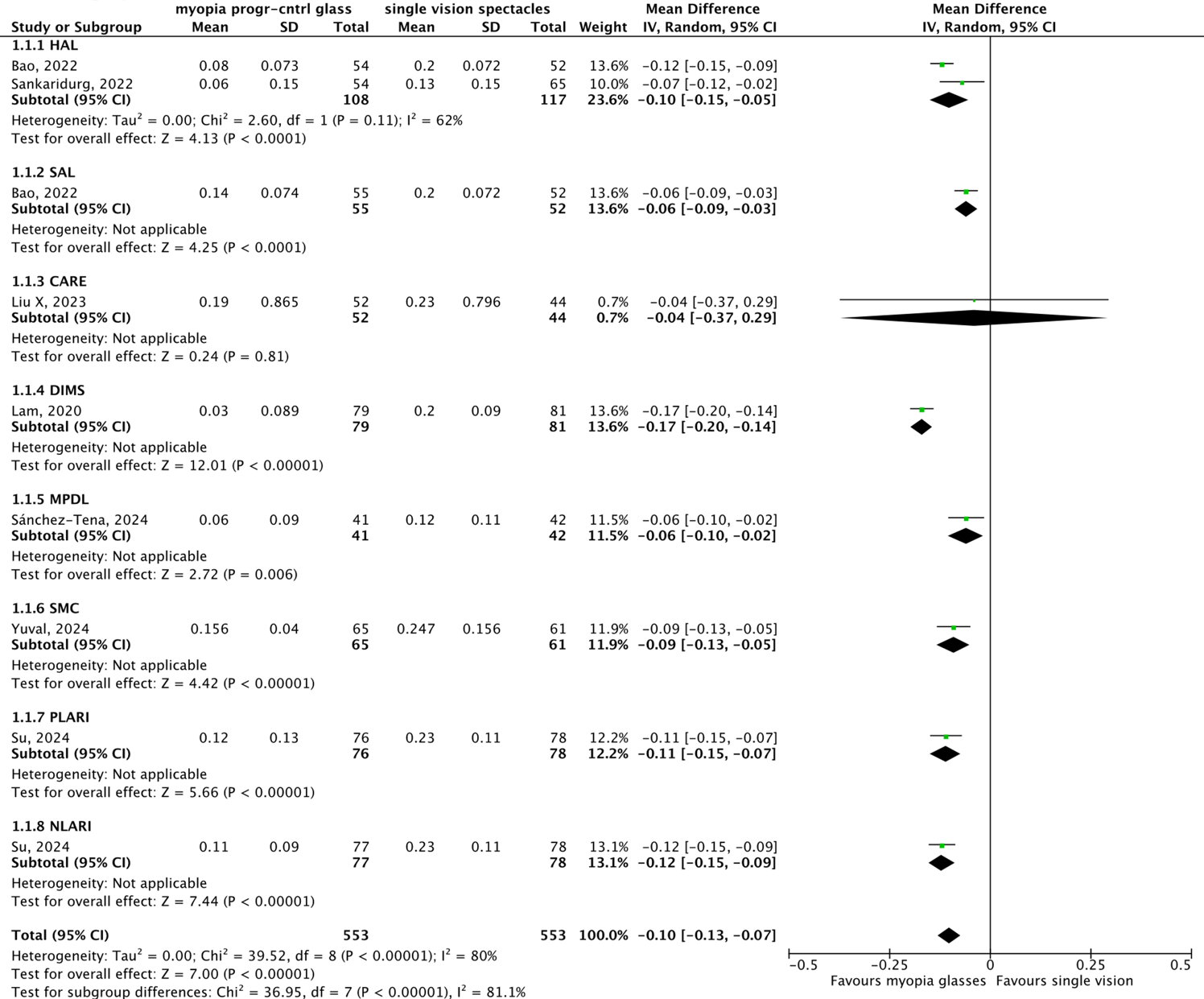
Figure 1. Efficacy on axial length in patients receiving myopia progression inhibiting spectacle lenses versus single vision spectacle lenses at six months
Six months
Axial length elongation/change in axial length was reported at six months by Bao (2022), Sankaridurg (2022), Liu X (2023), Lam (2020), Sánchez-Tena (2024), Yuval (2024) and Su (2024). In total 553 patients received myopia progression inhibiting spectacles, and 553 patients received single vision spectacles (Figure 1). The mean difference was -0.10 mm (95% CI -0.13 to -0.07 mm), in favour of the patients receiving myopia progression inhibiting spectacles. This difference is considered clinically relevant.
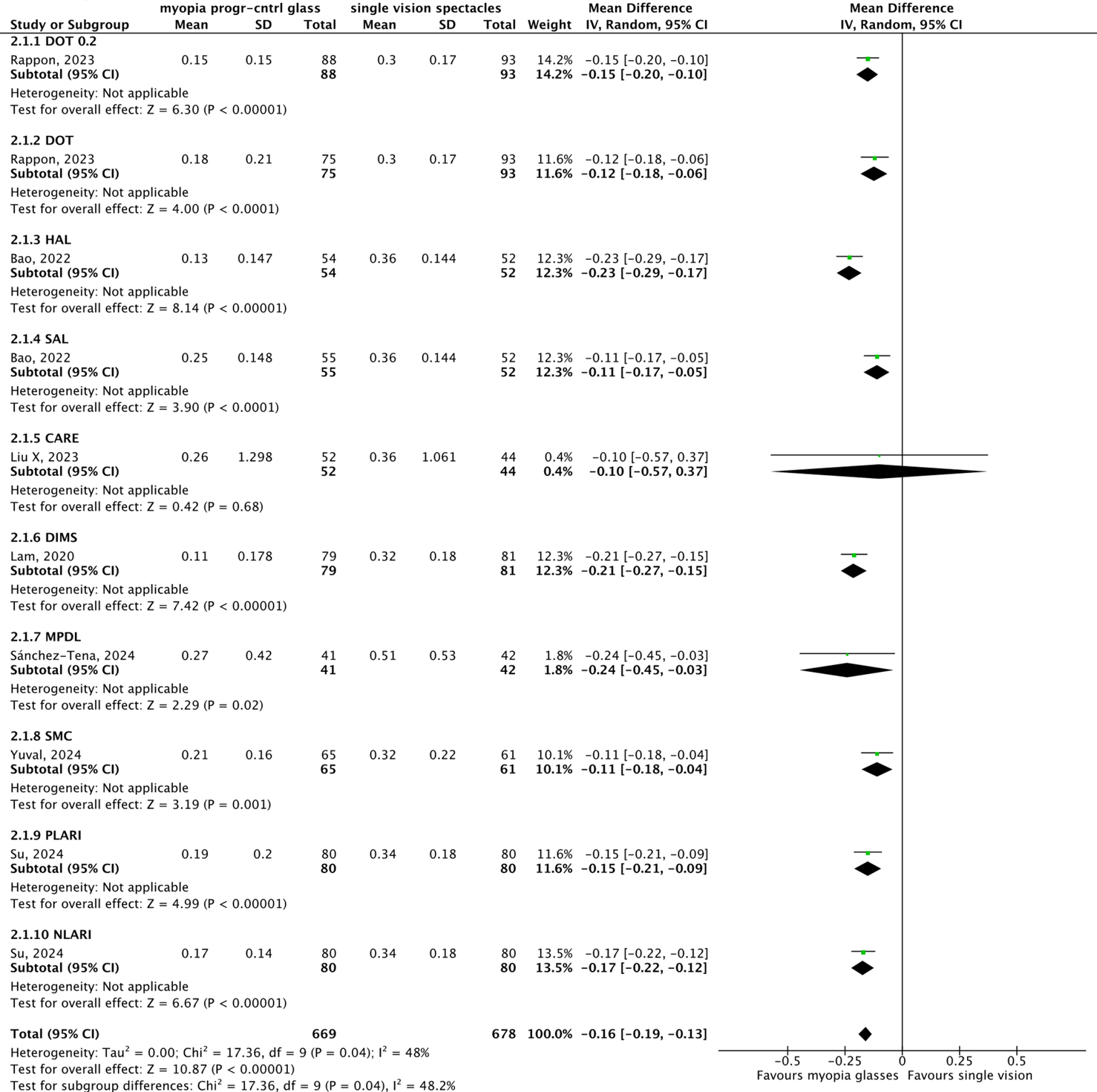
Figure 2. Efficacy on axial length in patients receiving myopia progression inhibiting spectacle lenses versus single vision spectacle lenses at twelve months
Twelve months
Axial length elongation/change in axial length was reported at twelve months by Rappon (2023), Bao (2022), Sankaridurg (2022), Liu X (2023), Lam (2020), Sánchez-Tena (2024), Yuval (2024) and Su (2024). In total 669 patients received myopia progression inhibiting spectacles, and 678 patients received single vision spectacles (Figure 2). The mean difference was -0.16 mm (95% CI -0.19 to -0.13 mm), in favour of the patients receiving myopia progression inhibiting spectacles. This difference is considered clinically relevant.
Eighteen months
Axial length elongation/change in axial length was reported at eighteen months by Lam (2020). In total 79 patients received myopia progression inhibiting spectacles (DIMS) and 81 patients received single vision spectacles. The mean difference was -0.28 mm (95% CI -0.34 to -0.22 mm), in favour of the patients receiving myopia progression inhibiting spectacles. This difference is considered clinically relevant.
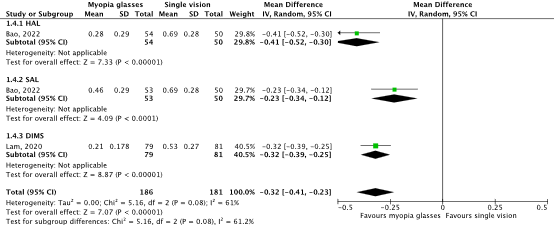
Figure 3. Efficacy on axial length in patients receiving myopia progression inhibiting spectacle lenses versus single vision spectacle lenses at twenty-four months
Twenty-four months
Axial length elongation/change in axial length was reported at twenty-four months by Bao (2022) and Lam (2020). In total 186 patients received myopia progression inhibiting spectacles (HAL, SAL, DIMS) and 181 patients received single vision spectacles (Figure 3). The mean difference was -0.32 mm (95% CI -0.41 to -0.23 mm), in favour of the patients receiving myopia progression inhibiting spectacles. This difference is considered clinically relevant.
Efficacy on refractive error (critical)
Seven studies reported the outcome measure refractive error at different follow-up durations (Bao, 2022; Sankaridurg, 2022; Liu X, 2023; Lam, 2020; Yuval, 2024; Su, 2024).
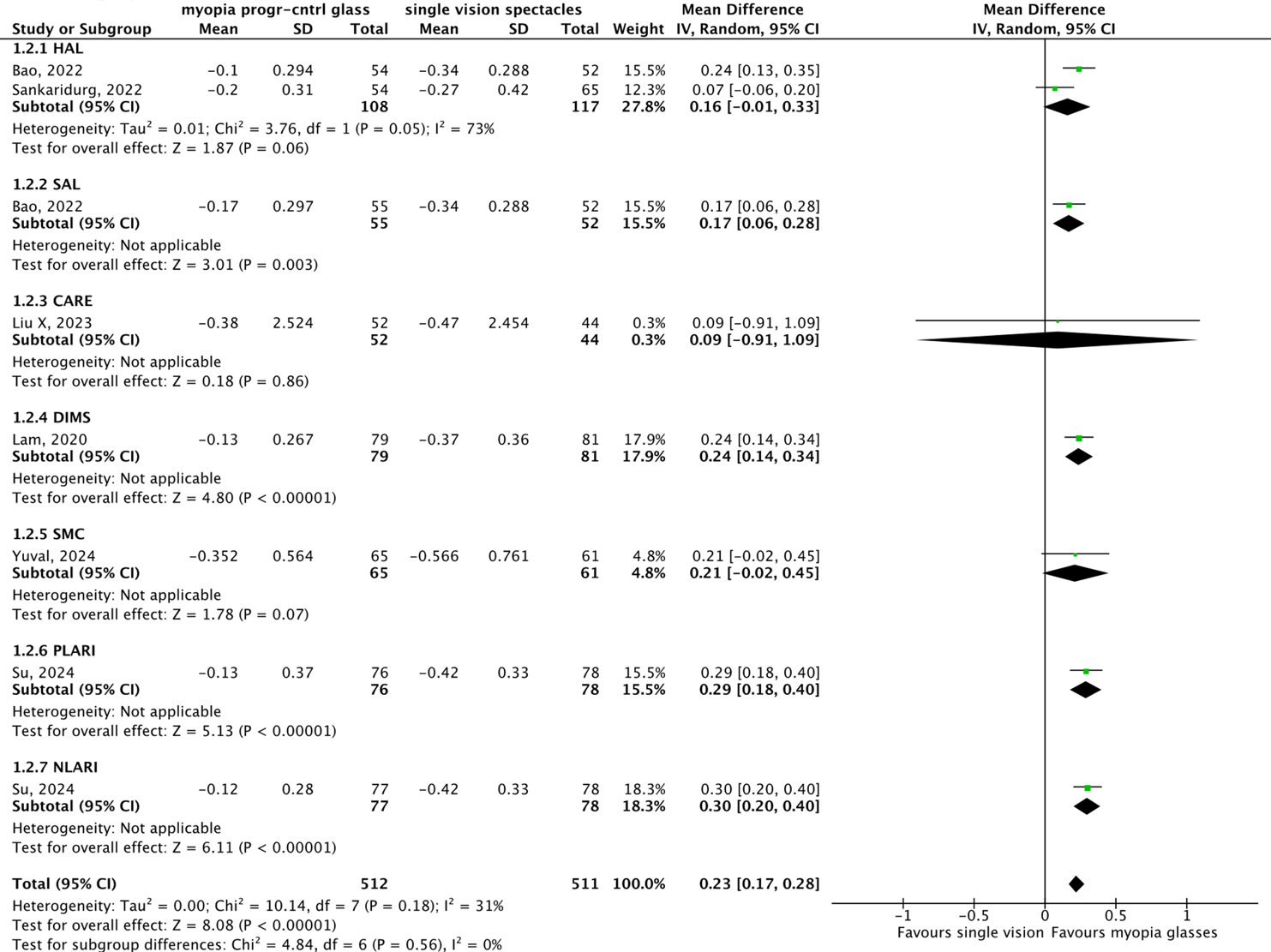
Figure 4. Efficacy on refractive error in patients receiving myopia progression-controlling spectacle lenses versus single vision spectacle lenses at six months
Six months
Change in refraction error was reported at six months by Bao (2022), Sankaridurg (2022), Liu X (2023), Lam (2020), Sánchez-Tena (2024), Yuval (2024) and Su (2024). In total 512 patients received myopia progression inhibiting spectacles, and 511 patients received single vision spectacles (Figure 4). The mean difference was 0.23 (95% CI 0.17 to 0.28 D), in favour of the patients receiving myopia progression inhibiting spectacles. This difference is not considered clinically relevant.
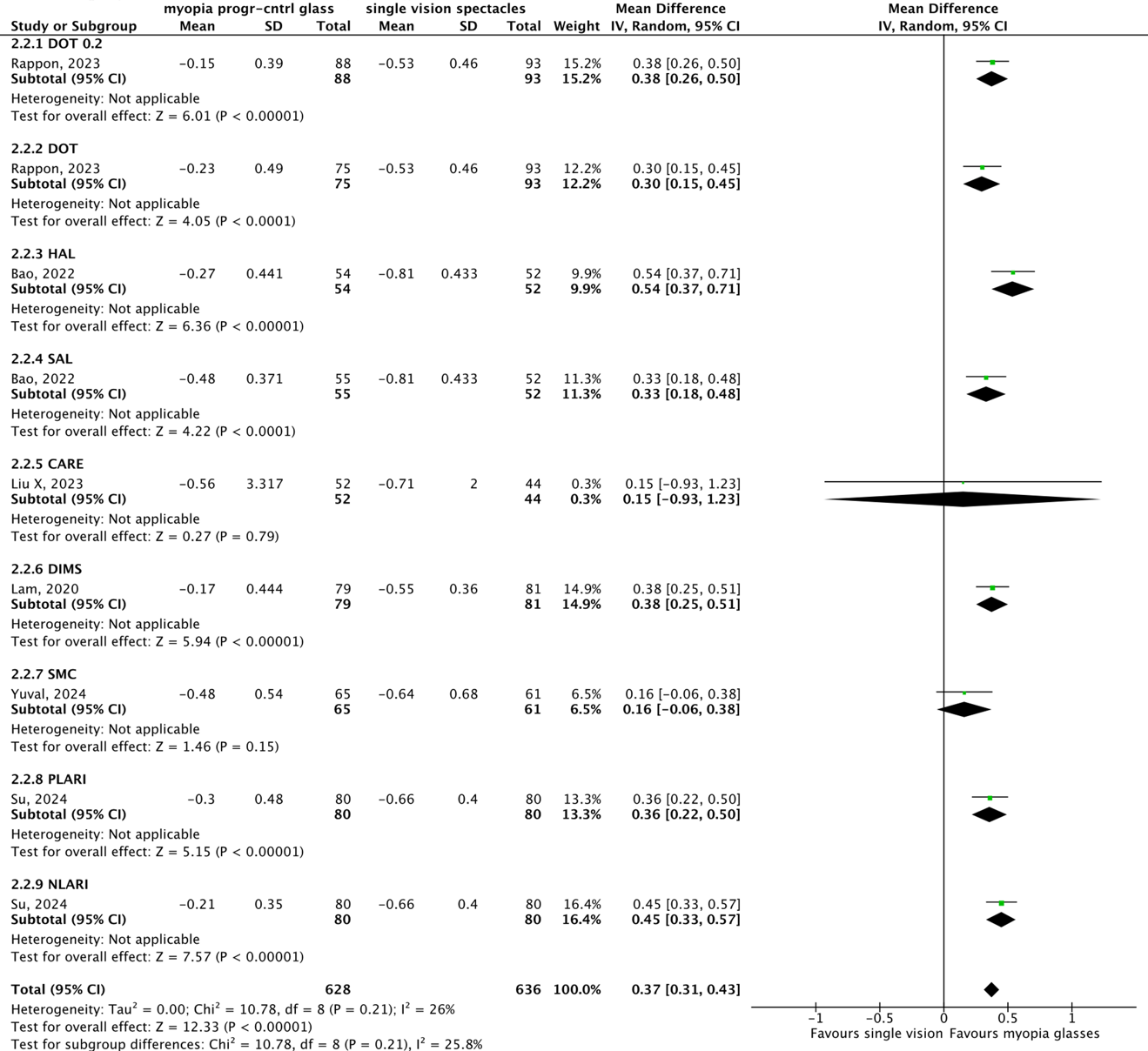
Figure 5. Efficacy on refractive error in patients receiving myopia progression inhibiting spectacle lenses versus single vision spectacle lenses at twelve months
Twelve months
Change in refraction error was reported at twelve months by Rappon (2023), Bao (2022), Liu X (2023), Lam (2020), Yuval (2024) and Su (2024). In total 628 patients received myopia progression inhibiting spectacles, and 636 patients received single vision spectacles (Figure 5). The mean difference was 0.37 (95% CI 0.31 to 0.43 D), in favour of the patients receiving myopia progression inhibiting spectacles. This difference is considered clinically relevant.
Eighteen months
Change in refraction error was reported at eighteen months by Lam (2020). In total 79 patients received myopia progression inhibiting spectacles (DIMS) and 81 patients received single vision spectacles. The mean difference was 0.41 (95% CI 0.26 to 0.56 D), in favour of the patients receiving myopia progression inhibiting spectacles. This difference is considered clinically relevant.
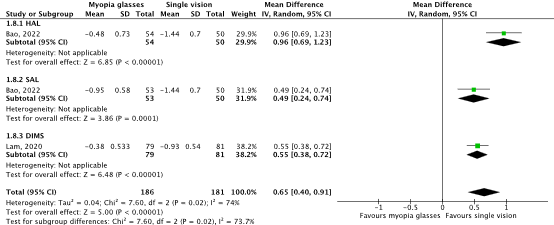
Figure 6. Efficacy on refractive error in patients receiving myopia progression inhibiting spectacle lenses versus single vision spectacle lenses at twenty-four months
Twenty-four months
Change in refraction error was reported at twenty-four months by Bao (2022) and Lam (2020). In total 186 patients received myopia progression inhibiting spectacles (HAL, SAL, DIMS) and 811 patients received single vision spectacles (Figure 6). The mean difference was 0.65 (95% CI 0.40 to 0.91D), in favour of the patients receiving myopia progression inhibiting spectacles. This difference is considered clinically relevant.
Adverse events (important)
The outcome measure adverse events was reported by one study (Rappon, 2023). Rappon (2023) reported during the initial 12 months of the 36-month trial, 16 ocular adverse events (AEs) in 11 subjects, none of which was serious, or device related. Forty- four AEs were classified as non-ocular AEs, four of which were classified as device related. These included three cases of headache in one control subject and one case of skin irritation from the spectacle frame nose pad in a DOT 0.2 lens user.
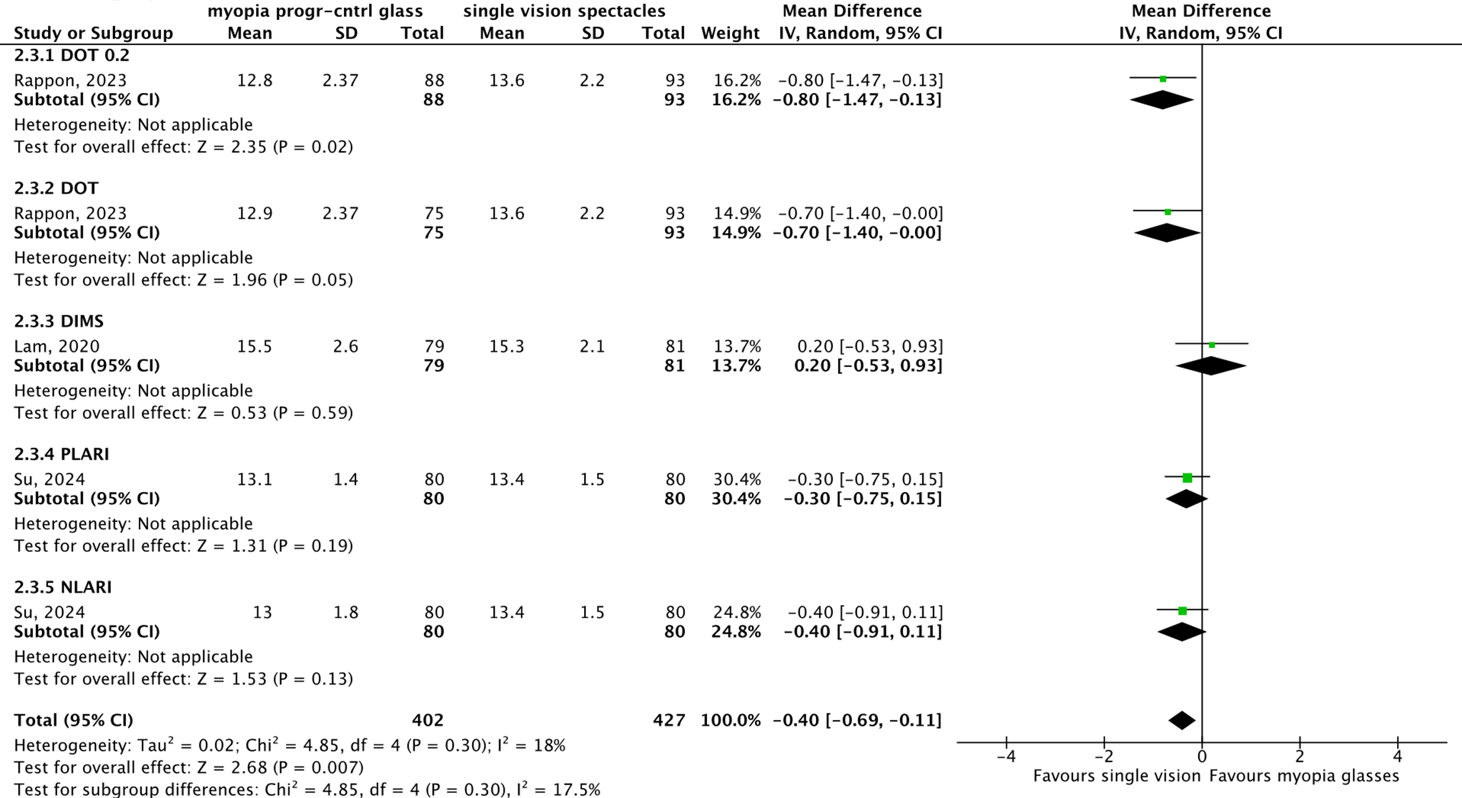
Figure 7. Compliance
Compliance (important)
The outcome measure compliance expressed in daily wearing time was reported by three studies (Lam, 2020; Rappon, 2023; Su, 2024). In total 402 patients received myopia progression inhibiting spectacles, and 427 patients received single vision spectacles (Figure 7). The mean difference was -0.40 hours per day (95% CI -0.69 to -0.11), in favour of the patients receiving single vision spectacles. This difference is considered not clinically relevant.
A systematic review of the literature was performed to answer the following question(s):
What is the effect of myopia progression inhibiting spectacle lenses compared to single vision spectacles on the inhibition of progressive myopia in children with progressive myopia?
Table 1. PICO
| Patients | Children (aged 18 years and under) with progressive myopia |
| Intervention | Myopia progression inhibiting spectacle lenses |
| Control | Single vision spectacles |
| Outcomes | Short term and long term: efficacy on axial length, efficacy on refraction, adverse events (e.g., eye strain, headaches, dizziness, diplopia, nausea, limited visual field, metamorphopsia, reduced accommodation, reduced reading vision), compliance/adherence to therapy |
| Other selection criteria | Study design: systematic reviews and randomized controlled trials |
Relevant outcome measures
The guideline panel considered efficacy on axial length and refraction as a critical outcome measure for decision making; and adverse events and compliance/adherence to therapy as important outcome measures for decision making.
A priori, the guideline panel did not define the outcome measures listed above but used the definitions used in the studies.
The guideline panel defined the following differences as a minimal clinically (patient) important difference:
- Axial length: 0.1 mm (first year).
- Refraction: 0,25D myopie progression per year.
- Adverse events: 10% (RR < 0.9 and RR > 1.1).
- Compliance/adherence: 10% (RR < 0.9 and RR > 1.1) or one week.
Search and select (Methods)
A systematic literature search was performed by a medical information specialist using the following bibliographic databases: Embase.com and Ovid/Medline. Both databases were searched from 2010 to August 20th 2024 for systematic reviews and RCTs. Systematic searches were completed using a combination of controlled vocabulary/subject headings (e.g., Emtree-terms, MeSH) wherever they were available and natural language keywords. The overall search strategy was derived from 1538 primary search concepts: (1) children with progressive myopia; (2) myopia progression inhibiting spectacles; (3) single vision spectacles. Duplicates were removed using EndNote software. After deduplication a total of 1030 records were imported for title/abstract screening. Studies were selected based on the criteria described in Table 1. Titles and abstracts were screened using the ASReview software version 1.6.2. The settings TF-IDF and Naïve bayes were used. Fifteen studies were used as prior knowledge for inclusion (Sankaridurg, 2010; Cheng, 2013; Kanda, 2018; Lam, 2020a; Lam, 2020b; Rappon, 2021; Lam, 2022; Bao, 2022; Lanca, 2023; Liu X, 2023; Li, 2023; Lupon, 2024; Sánchez-Tena, 2024a; Sánchez-Tena, 2024b; Yuval, 2024). Two studies were used as prior knowledge for exclusions (Elliott, 2012; Ntodie, 2017).
The first 10% of references were screened by the working group and the guideline methodologist. The remaining articles were subsequently screened by the guideline methodologist, using the following stopping rule: stop after 200 subsequent exclusions.
Initially, 35 studies were selected based on title and abstract screening using ASreview software. After reading the full text, 27 studies were excluded (see the exclusion table under the tab ‘Evidence tabellen’), and 8 studies were included.
- Agyekum S, Chan PP, Zhang Y, Huo Z, Yip BHK, Ip P, Tham CC, Chen LJ, Zhang XJ, Pang CP, Yam JC. Cost-effectiveness analysis of myopia management: A systematic review. Front Public Health. 2023 Feb 27;11:1093836. doi: 10.3389/fpubh.2023.1093836. PMID: 36923029; PMCID: PMC10008871.
- Bao J, Yang A, Huang Y, Li X, Pan Y, Ding C, Lim EW, Zheng J, Spiegel DP, Drobe B, Lu F, Chen H. One-year myopia control efficacy of spectacle lenses with aspherical lenslets. Br J Ophthalmol. 2022 Aug;106(8):1171-1176. doi: 10.1136/bjophthalmol-2020-318367. Epub 2021 Apr 2. PMID: 33811039; PMCID: PMC9340037.
- Bao J, Huang Y, Li X, Yang A, Zhou F, Wu J, Wang C, Li Y, Lim EW, Spiegel DP, Drobe B, Chen H. Spectacle Lenses With Aspherical Lenslets for Myopia Control vs Single-Vision Spectacle Lenses: A Randomized Clinical Trial. JAMA Ophthalmol. 2022 May 1;140(5):472-478. doi: 10.1001/jamaophthalmol.2022.0401. PMID: 35357402; PMCID: PMC8972151.
- Bullimore MA, Brennan NA. Efficacy in myopia control-The impact of rebound. Ophthalmic Physiol Opt. 2025 Jan;45(1):100-110. doi: 10.1111/opo.13403. Epub 2024 Oct 8. PMID: 39377894.
- Cheng D, Woo GC, Drobe B, Schmid KL. Effect of bifocal and prismatic bifocal spectacles on myopia progression in children: three-year results of a randomized clinical trial. JAMA Ophthalmol. 2014 Mar;132(3):258-64. doi: 10.1001/jamaophthalmol.2013.7623. PMID: 24435660.
- Chiu YC, Tsai PC, Lee SH, Wang JH, Chiu CJ. Systematic Review of Myopia Progression after Cessation of Optical Interventions for Myopia Control. J Clin Med. 2023 Dec 21;13(1):53. doi: 10.3390/jcm13010053. PMID: 38202060; PMCID: PMC10779574.
- Elliott DB, Green A. Many ready-made reading spectacles fail the required standards. Optom Vis Sci. 2012 Apr;89(4):E446-51. doi: 10.1097/OPX.0b013e318249d608. PMID: 22327798.
- Hemert van, D.J., Sehayian, A., Polling, J.R., Tideman, J.W.L., Kievit, W., & Klaver, C.C.W. (2025). Evaluating costs and utilities of myopia across treatment scenarios in The Netherlands. Acta Opthalmologica.
- Kanda H, Oshika T, Hiraoka T, Hasebe S, Ohno-Matsui K, Ishiko S, Hieda O, Torii H, Varnas SR, Fujikado T. Effect of spectacle lenses designed to reduce relative peripheral hyperopia on myopia progression in Japanese children: a 2-year multicenter randomized controlled trial. Jpn J Ophthalmol. 2018 Sep;62(5):537-543. doi: 10.1007/s10384-018-0616-3. Epub 2018 Aug 6. PMID: 30083910.
- Laan D, Tan ETC, Huis In Het Veld PI, Jellema HM, Jenniskens K. Myopia progression in children during home confinement in the COVID-19 pandemic: A systematic review and meta-analysis. J Optom. 2024 Jan-Mar;17(1):100493. doi: 10.1016/j.optom.2023.100493. Epub 2023 Oct 23. PMID: 37879184; PMCID: PMC10618773.
- Lam CS, Tang WC, Lee PH, Zhang HY, Qi H, Hasegawa K, To CH. Myopia control effect of defocus incorporated multiple segments (DIMS) spectacle lens in Chinese children: results of a 3-year follow-up study. Br J Ophthalmol. 2022 Aug;106(8):1110-1114. doi: 10.1136/bjophthalmol-2020-317664. Epub 2021 Mar 17. PMID: 33731364; PMCID: PMC9340033.
- Lam CSY, Tang WC, Tse DY, Lee RPK, Chun RKM, Hasegawa K, Qi H, Hatanaka T, To CH. Defocus Incorporated Multiple Segments (DIMS) spectacle lenses slow myopia progression: a 2-year randomised clinical trial. Br J Ophthalmol. 2020a Mar;104(3):363-368. doi: 10.1136/bjophthalmol-2018-313739. Epub 2019 May 29. PMID: 31142465; PMCID: PMC7041503.
- Lam CSY, Tang WC, Qi H, Radhakrishnan H, Hasegawa K, To CH, Charman WN. Effect of Defocus Incorporated Multiple Segments Spectacle Lens Wear on Visual Function in Myopic Chinese Children. Transl Vis Sci Technol. 2020b Aug 5;9(9):11. doi: 10.1167/tvst.9.9.11. PMID: 32879767; PMCID: PMC7442864.
- Lam CSY, Tang WC, Zhang HY, Lee PH, Tse DYY, Qi H, Vlasak N, To CH. Long-term myopia control effect and safety in children wearing DIMS spectacle lenses for 6 years. Sci Rep. 2023 Apr 4;13(1):5475. doi: 10.1038/s41598-023-32700-7. PMID: 37015996; PMCID: PMC10073092.
- Lanca C, Pang CP, Grzybowski A. Effectiveness of myopia control interventions: A systematic review of 12 randomized control trials published between 2019 and 2021. Front Public Health. 2023 Mar 23;11:1125000. doi: 10.3389/fpubh.2023.1125000. Erratum in: Front Public Health. 2024 Sep 25;12:1460156. doi: 10.3389/fpubh.2024.1460156. PMID: 37033047; PMCID: PMC10076805.
- Lanca C, Pan CW, Grzybowski A. Anti-myopia Spectacles: The Standard of Care in the Future? Am J Ophthalmol. 2024 Jul;263:xi-xiii. doi: 10.1016/j.ajo.2024.02.027. Epub 2024 Feb 27. PMID: 38423201.
- Li X, Huang Y, Yin Z, Liu C, Zhang S, Yang A, Drobe B, Chen H, Bao J. Myopia Control Efficacy of Spectacle Lenses With Aspherical Lenslets: Results of a 3-Year Follow-Up Study. Am J Ophthalmol. 2023 Sep;253:160-168. doi: 10.1016/j.ajo.2023.03.030. Epub 2023 Apr 10. PMID: 37040846.
- Liu X, Wang P, Xie Z, Sun M, Chen M, Wang J, Huang J, Chen S, Chen Z, Wang Y, Li Y, Qu J, Mao X. One-year myopia control efficacy of cylindrical annular refractive element spectacle lenses. Acta Ophthalmol. 2023 Sep;101(6):651-657. doi: 10.1111/aos.15649. Epub 2023 Feb 13. PMID: 36779428.
- Lupon M, Nolla C, Cardona G. New Designs of Spectacle Lenses for the Control of Myopia Progression: A Scoping Review. J Clin Med. 2024 Feb 19;13(4):1157. doi: 10.3390/jcm13041157. PMID: 38398469; PMCID: PMC10888677.
- Ntodie M, Abu SL, Kyei S, Abokyi S, Abu EK. Near vision spectacle coverage and barriers to near vision correction among adults in the Cape Coast Metropolis of Ghana. Afr Health Sci. 2017 Jun;17(2):549-555. doi: 10.4314/ahs.v17i2.31. PMID: 29062352; PMCID: PMC5637042.
- Rappon J, Chung C, Young G, Hunt C, Neitz J, Neitz M, Chalberg T. Control of myopia using diffusion optics spectacle lenses: 12-month results of a randomised controlled, efficacy and safety study (CYPRESS). Br J Ophthalmol. 2023 Nov;107(11):1709-1715. doi: 10.1136/bjo-2021-321005. Epub 2022 Sep 1. PMID: 36126105; PMCID: PMC10646852.
- Sánchez-Tena MÁ, Ballesteros-Sánchez A, Martinez-Perez C, Alvarez-Peregrina C, De-Hita-Cantalejo C, Sánchez-González MC, Sánchez-González JM. Assessing the rebound phenomenon in different myopia control treatments: A systematic review. Ophthalmic Physiol Opt. 2024b Mar;44(2):270-279. doi: 10.1111/opo.13277. Epub 2024 Jan 9. PMID: 38193312.
- Sánchez-Tena MÁ, Cleva JM, Villa-Collar C, Álvarez M, Ruiz-Pomeda A, Martinez-Perez C, Andreu-Vazquez C, Chamorro E, Alvarez-Peregrina C. Effectiveness of a Spectacle Lens with a Specific Asymmetric Myopic Peripheral Defocus: 12-Month Results in a Spanish Population. Children (Basel). 2024a Feb 1;11(2):177. doi: 10.3390/children11020177. PMID: 38397289; PMCID: PMC10887607.
- Sankaridurg P, Donovan L, Varnas S, Ho A, Chen X, Martinez A, Fisher S, Lin Z, Smith EL 3rd, Ge J, Holden B. Spectacle lenses designed to reduce progression of myopia: 12-month results. Optom Vis Sci. 2010 Sep;87(9):631-41. doi: 10.1097/OPX.0b013e3181ea19c7. Erratum in: Optom Vis Sci. 2010 Oct;87(10):802. PMID: 20622703; PMCID: PMC4696394.
- Sankaridurg P, Weng R, Tran H, Spiegel DP, Drobe B, Ha T, Tran YH, Naduvilath T. Spectacle Lenses With Highly Aspherical Lenslets for Slowing Myopia: A Randomized, Double-Blind, Cross-Over Clinical Trial: Parts of these data were presented as a poster at the Annual Research in Vision and Ophthalmology meeting, 2022. Am J Ophthalmol. 2023 Mar;247:18-24. doi: 10.1016/j.ajo.2022.10.021. Epub 2022 Nov 5. PMID: 36347276.
- Su B, Cho P, Vincent SJ, Zheng J, Chen J, Ye C, Wang T, Zhang J, Zhang K, Lu F, Jiang J. Novel Lenslet-ARray-Integrated Spectacle Lenses for Myopia Control: A 1-Year Randomized, Double-Masked, Controlled Trial. Ophthalmology. 2024 Dec;131(12):1389-1397. doi: 10.1016/j.ophtha.2024.07.002. Epub 2024 Jul 6. PMID: 38972357.
- Yuval C, Otzem C, Laura BS, Shirel R, Dana GN, Atalia W, Noam B, Nir E, Yair M. Evaluating the Effect of a Myopia Control Spectacle Lens Among Children in Israel: 12-Month Results. Am J Ophthalmol. 2024 Jan;257:103-112. doi: 10.1016/j.ajo.2023.08.019. Epub 2023 Sep 9. Erratum in: Am J Ophthalmol. 2024 Mar;259:197. doi: 10.1016/j.ajo.2023.12.015. PMID: 37690499.
Risk of bias tabel
|
Study reference
(first author, publication year) |
Was the allocation sequence adequately generated?
Definitely yes Probably yes Probably no Definitely no |
Was the allocation adequately concealed?
Definitely yes Probably yes Probably no Definitely no |
Blinding: Was knowledge of the allocated interventions adequately prevented?
Were patients/healthcare providers/data collectors/outcome assessors/data analysts blinded?
Definitely yes Probably yes Probably no Definitely no |
Was loss to follow-up (missing outcome data) infrequent?
Definitely yes Probably yes Probably no Definitely no |
Are reports of the study free of selective outcome reporting?
Definitely yes Probably yes Probably no Definitely no |
Was the study apparently free of other problems that could put it at a risk of bias?
Definitely yes Probably yes Probably no Definitely no |
Overall risk of bias If applicable/necessary, per outcome measure
LOW Some concerns HIGH
|
|
Rappon, 2023 |
Definitely yes;
Reason: The random allocation sequence was generated using Microsoft Excel.
|
Definitely yes;
Reason: Randomisation was concealed and interventions were assigned by Electronic Data Capture.
|
Probably yes;
Reason: subject- and observer-masked (blinding of data collectors and analysts not reported) |
Probably yes;
Reason: Loss to follow-up was infrequent in intervention and control group. |
Definitely yes;
Reason: All relevant outcomes were reported |
Probably no;
Reason: the role of the funding body |
LOW
|
|
Sankaridurg, 2022 |
Definitely yes;
Reason: uses the Wichman-Hill Random Number Generator that incorporates balanced permutations of treatments whereby each subject receives both lens types in random order. Block randomization of block size 6 was used to generate the plan.
|
Definitely yes;
Reason: The randomization plan was applied through the Clinic Data Management system, and the system sequentially allocated each enrolled participant according to the plan.
|
Probably yes;
Reason: Both the participant and the clinician were blinded to the assigned lens type throughout the study period. (blinding of data collectors and analysts not reported) |
Probably yes
Reason: Loss to follow-up was infrequent in intervention and control group. Adequate imputation methods (multiple imputation) were used |
Definitely yes
Reason: All relevant outcomes were reported; |
Probably no;
Reason: the role of the funding body |
LOW
|
|
Bao, 2022 |
Definitely yes;
Reason: using adap- tive randomisation with online software (www.rando.la) to balance treatment groups
|
Probably no;
Reason: not reported |
Probably yes;
Reason: Both the participant and the clinician were blinded to the assigned lens type throughout the study period. (blinding of data collectors and analysts not reported) |
Probably yes
Reason: Loss to follow-up was infrequent in intervention and control group. |
Definitely yes
Reason: All relevant outcomes were reported; |
Probably no;
Reason: the role of the funding body |
Some concern |
|
Liu X, 2023 |
Probably yes;
Reason: Eligible subjects enrolled in the study were randomly assigned |
Probably no;
Reason: not reported |
Probably yes;
Reason: Masked examiners performed cycloplegic autorefraction and AL measurements. |
Probably no;
Reason: only 81.4% of participants were included in the analyses |
Definitely yes
Reason: All relevant outcomes were reported; |
Probably yes;
Reason: No other problems noted |
Some concern |
|
Lam, 2020 |
Probably yes;
Reason: Simple randomisation was implemented by the unmasked investigator (UI) by putting subject file numbers (1–200) in a spreadsheet of Excel (Microsoft Office) and creating a column of random numbers for the group allocation. Eligible subjects were then assigned to either group by following a random software sequence generated from Excel.
|
Probably no;
Reason: not reported |
Probably yes;
Reason: Both the children and their parents were masked to group Allocation. Clinician was masked. Analyst not masked |
Probably yes
Reason: Loss to follow-up was infrequent in intervention and control group. |
Definitely yes
Reason: All relevant outcomes were reported; |
Probably no;
Reason: the role of the funding body |
Some concern |
|
Sánchez-Tena, 2024 |
Probably yes;
Reason: Not specified |
Probably yes;
Reason: Not specified |
Probably yes;
Reason: Both the participant and the clinician were blinded. (blinding of data collectors and analysts not reported) |
Probably yes;
Reason: Loss to follow-up was infrequent in intervention and control group. |
Definitely yes
Reason: All relevant outcomes were reported; |
Probably no;
Reason: the role of the funding body |
LOW
|
|
Yuval, 2024 |
Probably yes;
Reason: Random allo- cation assigned half of the participants to the SMC group and the other half to the control group. |
Probably yes;
Reason: Not specified |
Probably yes;
Reason: Both the participant and the clinician were blinded. (blinding of data collectors and analysts not reported) |
Probably no;
Reason: both groups had different reasons to drop-out. Could influence the results. |
Definitely yes
Reason: All relevant outcomes were reported; |
Probably no;
Reason: the role of the funding body |
Some concern |
|
Su, 2024 |
Definitely yes;
Reason: assigned randomly using a spreadsheet generator (Excel; Microsoft) to the SV group, PLARI group, or NLARI group in a ratio of 1:1:1 |
Probably yes;
Reason: Participants and parents were masked to the group allocation. Not further specified |
Probably yes;
Reason: Both the participant and the clinician were blinded. (blinding of data collectors and analysts not reported) |
Probably yes;
Reason: Loss to follow-up was infrequent in intervention and control group. |
Definitely yes
Reason: All relevant outcomes were reported; |
Probably yes;
Reason: No other problems noted |
LOW
|
Exclusietabel
|
Reference |
Reason for exclusion |
|
Lanca C, Pang CP, Grzybowski A. Effectiveness of myopia control interventions: A systematic review of 12 randomized control trials published between 2019 and 2021. Front Public Health. 2023 Mar 23;11:1125000. doi: 10.3389/fpubh.2023.1125000. Erratum in: Front Public Health. 2024 Sep 25;12:1460156. doi: 10.3389/fpubh.2024.1460156. PMID: 37033047; PMCID: PMC10076805. |
Included individual studies |
|
Lupon M, Nolla C, Cardona G. New Designs of Spectacle Lenses for the Control of Myopia Progression: A Scoping Review. J Clin Med. 2024 Feb 19;13(4):1157. doi: 10.3390/jcm13041157. PMID: 38398469; PMCID: PMC10888677. |
Included individual studies |
|
Sánchez-Tena MÁ, Ballesteros-Sánchez A, Martinez-Perez C, Alvarez-Peregrina C, De-Hita-Cantalejo C, Sánchez-González MC, Sánchez-González JM. Assessing the rebound phenomenon in different myopia control treatments: A systematic review. Ophthalmic Physiol Opt. 2024 Mar;44(2):270-279. doi: 10.1111/opo.13277. Epub 2024 Jan 9. PMID: 38193312. |
Not conform PICO |
|
Sankaridurg P, Donovan L, Varnas S, Ho A, Chen X, Martinez A, Fisher S, Lin Z, Smith EL 3rd, Ge J, Holden B. Spectacle lenses designed to reduce progression of myopia: 12-month results. Optom Vis Sci. 2010 Sep;87(9):631-41. doi: 10.1097/OPX.0b013e3181ea19c7. Erratum in: Optom Vis Sci. 2010 Oct;87(10):802. PMID: 20622703; PMCID: PMC4696394. |
The literature analysis is based on the scoping review by Lupon (2024) |
|
Lam CS, Tang WC, Lee PH, Zhang HY, Qi H, Hasegawa K, To CH. Myopia control effect of defocus incorporated multiple segments (DIMS) spectacle lens in Chinese children: results of a 3-year follow-up study. Br J Ophthalmol. 2022 Aug;106(8):1110-1114. doi: 10.1136/bjophthalmol-2020-317664. Epub 2021 Mar 17. PMID: 33731364; PMCID: PMC9340033. |
Included the most recent study by Lam (Lam, 2023) |
|
Lam CSY, Tang WC, Qi H, Radhakrishnan H, Hasegawa K, To CH, Charman WN. Effect of Defocus Incorporated Multiple Segments Spectacle Lens Wear on Visual Function in Myopic Chinese Children. Transl Vis Sci Technol. 2020 Aug 5;9(9):11. doi: 10.1167/tvst.9.9.11. PMID: 32879767; PMCID: PMC7442864. |
Included the most recent study by Lam (Lam, 2023) |
|
Lam CSY, Tang WC, Tse DY, Lee RPK, Chun RKM, Hasegawa K, Qi H, Hatanaka T, To CH. Defocus Incorporated Multiple Segments (DIMS) spectacle lenses slow myopia progression: a 2-year randomised clinical trial. Br J Ophthalmol. 2020 Mar;104(3):363-368. doi: 10.1136/bjophthalmol-2018-313739. Epub 2019 May 29. PMID: 31142465; PMCID: PMC7041503. |
Included the most recent study by Lam (Lam, 2023) |
|
Cheng D, Woo GC, Drobe B, Schmid KL. Effect of bifocal and prismatic bifocal spectacles on myopia progression in children: three-year results of a randomized clinical trial. JAMA Ophthalmol. 2014 Mar;132(3):258-64. doi: 10.1001/jamaophthalmol.2013.7623. PMID: 24435660. |
Not conform PICO: different intervention (bifocal and prismatic) |
|
Kanda H, Oshika T, Hiraoka T, Hasebe S, Ohno-Matsui K, Ishiko S, Hieda O, Torii H, Varnas SR, Fujikado T. Effect of spectacle lenses designed to reduce relative peripheral hyperopia on myopia progression in Japanese children: a 2-year multicenter randomized controlled trial. Jpn J Ophthalmol. 2018 Sep;62(5):537-543. doi: 10.1007/s10384-018-0616-3. Epub 2018 Aug 6. PMID: 30083910. |
The literature analysis is based on the scoping review by Lupon (2024) |
|
Control effect of defocus incorporated multiple segments spectacle lenses in children and adolescents’ myopia, Li, X 2023 |
Full text not available. |
|
Lam CSY, Tang WC, Qi H, Radhakrishnan H, Hasegawa K, To CH, Charman WN. Effect of Defocus Incorporated Multiple Segments Spectacle Lens Wear on Visual Function in Myopic Chinese Children. Transl Vis Sci Technol. 2020 Aug 5;9(9):11. doi: 10.1167/tvst.9.9.11. PMID: 32879767; PMCID: PMC7442864. |
Double, Included the most recent study by Lam (Lam, 2023) |
|
Lai W, Diao C, Li H, Zhang Y, Jia Y, Wu X. Three optical intervention methods for low myopia control in children: a one-year follow-up study. BMC Ophthalmol. 2024 Jul 31;24(1):319. doi: 10.1186/s12886-024-03598-0. Erratum in: BMC Ophthalmol. 2024 Aug 27;24(1):377. doi: 10.1186/s12886-024-03638-9. PMID: 39085810; PMCID: PMC11293150. |
Wrong study design: cohort |
|
Huang Y, Li X, Wang C, Zhou F, Yang A, Chen H, Bao J. Visual acuity, near phoria and accommodation in myopic children using spectacle lenses with aspherical lenslets: results from a randomized clinical trial. Eye Vis (Lond). 2022 Sep 1;9(1):33. doi: 10.1186/s40662-022-00304-3. PMID: 36045391; PMCID: PMC9434851. |
Not conform PICO: wrong outcome measures |
|
Chen J, Zhuo R, Chen J, Yang A, Lim EW, Bao J, Drobe B, Spiegel DP, Chen H, Hou L. Spectacle lenses with slightly aspherical lenslets for myopia control: clinical trial design and baseline data. BMC Ophthalmol. 2022 Aug 16;22(1):345. doi: 10.1186/s12886-022-02562-0. PMID: 35974312; PMCID: PMC9382742. |
Clinical trial design and baseline data |
|
Liu J, Lu Y, Huang D, Yang J, Fan C, Chen C, Li J, Wang Q, Li S, Jiang B, Jiang H, Li X, Yang Z, Lan W. The Efficacy of Defocus Incorporated Multiple Segments Lenses in Slowing Myopia Progression: Results from Diverse Clinical Circumstances. Ophthalmology. 2023 May;130(5):542-550. doi: 10.1016/j.ophtha.2023.01.007. Epub 2023 Jan 13. PMID: 36642334. |
Wrong study design: retrospective study |
|
Lu Y, Lin Z, Wen L, Gao W, Pan L, Li X, Yang Z, Lan W. The Adaptation and Acceptance of Defocus Incorporated Multiple Segment Lens for Chinese Children. Am J Ophthalmol. 2020 Mar;211:207-216. doi: 10.1016/j.ajo.2019.12.002. Epub 2019 Dec 13. PMID: 31837317. |
Wrong study design: prospective, cross-over study |
|
Zhang HY, Lam CSY, Tang WC, Leung M, To CH. Defocus Incorporated Multiple Segments Spectacle Lenses Changed the Relative Peripheral Refraction: A 2-Year Randomized Clinical Trial. Invest Ophthalmol Vis Sci. 2020 May 11;61(5):53. doi: 10.1167/iovs.61.5.53. PMID: 32460315; PMCID: PMC7405698. |
The literature analysis is based on the scoping review by Lupon (2024) |
|
Ma JX, Tian SW, Liu QP. Effectiveness of peripheral defocus spectacle lenses in myopia control: a Meta-analysis and systematic review. Int J Ophthalmol. 2022 Oct 18;15(10):1699-1706. doi: 10.18240/ijo.2022.10.20. PMID: 36262865; PMCID: PMC9522561. |
The literature analysis is based on the scoping review by Lupon (2024) |
|
Wu J, Li X, Huang Y, Luo Y, Zhang S, Cui Z, Hou F, Bao J, Chen H. Effect of myopia-control lenses on central and peripheral visual performance in myopic children. Ophthalmic Physiol Opt. 2024 Mar;44(2):249-257. doi: 10.1111/opo.13257. Epub 2023 Dec 10. PMID: 38071500. |
Not conform PICO |
|
Huang Y, Li X, Wu J, Huo J, Zhou F, Zhang J, Yang A, Spiegel DP, Chen H, Bao J. Effect of spectacle lenses with aspherical lenslets on choroidal thickness in myopic children: a 2-year randomised clinical trial. Br J Ophthalmol. 2023 Nov 22;107(12):1806-1811. doi: 10.1136/bjo-2022-321815. PMID: 36167484; PMCID: PMC10715521. |
Not conform PICO: wrong outcome measures |
|
Berntsen DA, Barr CD, Mutti DO, Zadnik K. Peripheral defocus and myopia progression in myopic children randomly assigned to wear single vision and progressive addition lenses. Invest Ophthalmol Vis Sci. 2013 Aug 27;54(8):5761-70. doi: 10.1167/iovs.13-11904. PMID: 23838771; PMCID: PMC3755539. |
The literature analysis is based on the scoping review by Lupon (2024) |
|
Berntsen DA, Mutti DO, Zadnik K. Study of Theories about Myopia Progression (STAMP) design and baseline data. Optom Vis Sci. 2010 Nov;87(11):823-32. doi: 10.1097/OPX.0b013e3181f6f776. PMID: 20935586; PMCID: PMC3075061. |
Clinical trial design and baseline data |
|
Gwiazda J, Norton TT, Hou W, Hyman L, Manny R; COMET group. Longitudinal Changes in Lens Thickness in Myopic Children Enrolled in the Correction of Myopia Evaluation Trial (COMET). Curr Eye Res. 2016 Apr;41(4):492-500. doi: 10.3109/02713683.2015.1034372. Epub 2015 Jun 16. PMID: 26079108; PMCID: PMC4788575. |
Not conform PICO |
|
Hasebe S, Jun J, Varnas SR. Myopia control with positively aspherized progressive addition lenses: a 2-year, multicenter, randomized, controlled trial. Invest Ophthalmol Vis Sci. 2014 Sep 30;55(11):7177-88. doi: 10.1167/iovs.12-11462. PMID: 25270192. |
The literature analysis is based on the scoping review by Lupon (2024) |
|
Yu X, Zhang B, Bao J, Zhang J, Wu G, Xu J, Zheng J, Drobe B, Chen H. Design, methodology, and baseline data of the Personalized Addition Lenses Clinical Trial (PACT). Medicine (Baltimore). 2017 Mar;96(11):e6069. doi: 10.1097/MD.0000000000006069. PMID: 28296722; PMCID: PMC5369877. |
Clinical trial design and baseline data |
|
Li X, Huang Y, Yin Z, Liu C, Zhang S, Yang A, Drobe B, Chen H, Bao J. Myopia Control Efficacy of Spectacle Lenses With Aspherical Lenslets: Results of a 3-Year Follow-Up Study. Am J Ophthalmol. 2023 Sep;253:160-168. doi: 10.1016/j.ajo.2023.03.030. Epub 2023 Apr 10. PMID: 37040846. |
Same studypopulation as Bao (2022) |
|
Bao J, Huang Y, Li X, Yang A, Zhou F, Wu J, Wang C, Li Y, Lim EW, Spiegel DP, Drobe B, Chen H. Spectacle Lenses With Aspherical Lenslets for Myopia Control vs Single-Vision Spectacle Lenses: A Randomized Clinical Trial. JAMA Ophthalmol. 2022 May 1;140(5):472-478. doi: 10.1001/jamaophthalmol.2022.0401. PMID: 35357402; PMCID: PMC8972151.
|
Same studypopulation as Bao (2022) |
Beoordelingsdatum en geldigheid
Publicatiedatum : 26-08-2026
Beoordeeld op geldigheid : 26-08-2026
Het cluster Oog is als houder van deze richtlijn de eerstverantwoordelijke voor de actualiteit van deze richtlijn.
Algemene gegevens
De ontwikkeling van deze richtlijn werd ondersteund door het Kennisinstituut van de Federatie Medisch Specialisten (www.demedischspecialist.nl/kennisinstituut) en werd gefinancierd door de Stichting Kwaliteitsgelden Medisch Specialisten (SKMS). Patiëntenparticipatie bij deze richtlijn werd medegefinancierd uit de Kwaliteitsgelden Patiënten Consumenten (SKPC) binnen het programma Kwaliteit, Inzicht en Doelmatigheid in de medisch specialistische Zorg (KIDZ). De financier heeft geen enkele invloed gehad op de inhoud van de richtlijnmodule.
Samenstelling werkgroep
Voor het ontwikkelen van de richtlijnmodule is in 2023 een multidisciplinaire werkgroep ingesteld, bestaande uit vertegenwoordigers van alle relevante specialismen (zie hiervoor de Samenstelling van de werkgroep) die betrokken zijn bij de zorg voor patiënten met kinderen met progressieve myopie.
Werkgroep
Dr. M. (Martha) Tjon-Fo-Sang, oogarts, Het Oogziekenhuis Rotterdam, Rotterdam (voorzitter), NOG
Prof. Dr. C.C.W. (Caroline) Klaver, oogarts, Erasmusmc, Rotterdam & Radboudumc, Nijmegen, NOG
Dr. J.W.L. (Willem) Tideman, oogarts, Martini Ziekenhuis Groningen; Post-doc, Erasmusmc, Rotterdam, NOG
Prof. Dr. M.M. (Mies) van Genderen, oogarts, Bartiméus, Zeist & UMC Utrecht, Utrecht, NOG,
Dhr. G.J. (Gerlof) du Bois, patiëntvertegenwoordiger, Voorzitter patiëntengroep
Hoge Myopie (Oogvereniging)
Mevr. K.E.M. (Karin) van Hees – Teuben, optometrist, Lens Optiek, OVN
Drs. D. (Daisy) Laan, orthoptist en optometrist, Flevoziekenhuis, Almere, NVVO
Drs. H. (Marieke) Schut, gedragskundige, Bartimeus, Utrecht, NVO
Klankbordgroep
Drs. V. (Vasanthi) Iyer, arts M+G/jeugdarts, AJN Jeugdartsen Nederland, AJN
Mevr. E. (Esmee) Bennen, optometrist, Visser Contactlenzen, OVN
Mevr. C.W.M. (Corlien) Stoop, orthoptist, Catharina ziekenhuis, Eindhoven, NVVO
Met ondersteuning van
Dr. R. (Romy) Zwarts-van de Putte, adviseur, Kennisinstituut van de Federatie Medisch Specialisten
Drs. E.R.L. (Evie) Verweg, junior adviseur, Kennisinstituut van de Federatie Medisch Specialisten
Drs. B.L. (Babette) Gal-de Geest, adviseur, Kennisinstituut van de Federatie Medisch Specialisten
A. (Alies) Oost, medisch informatiespecialist, Kennisinstituut van de Federatie Medisch Specialisten
Belangenverklaringen
Een overzicht van de belangen van werkgroepleden en het oordeel over het omgaan met eventuele belangen vindt u in onderstaande tabel. De ondertekende belangenverklaringen zijn op te vragen bij het secretariaat van het Kennisinstituut van de Federatie Medisch Specialisten via secretariaat@kennisinstituut.nl.
Gemelde (neven)functies en belangen werkgroep
|
Naam |
Hoofdfunctie |
Nevenwerkzaamheden |
Persoonlijke financiële belangen |
Persoonlijke relaties |
Extern gefinancierd onderzoek |
Intellectuele belangen en reputatie |
Overige belangen |
Datum |
Restrictie |
|
Tjon Fo Sang |
Oogarts, Oogziekenhuis Rotterdam |
Geen |
nvt |
nvt |
nvt |
nvt |
nvt |
29-10-2023 |
Geen restricties |
|
Van Genderen |
Oogarts, hoogleraar oogheelkunde, Stichting Bartiméus, o,6 FTE, betaald |
Adviescomissies: |
nvt |
nvt |
ja, gefinancierd door Bartiméus Fonds, ZonMW, Wishdom Foundation) |
nvt |
nvt |
17-10-2023 |
Geen restricties |
|
Laan |
Optometrist en Orthoptist bij het Flevoziekenhuis in Almere |
Bestuurslid Nederlandse Vereniging van Orthoptisten |
nvt |
nvt |
nvt |
nvt |
nvt |
4-10-2023 |
Geen restricties |
|
Du Bois |
Voorzitter patiëntengroep Hoge Myopie - Oogvereniging |
Geen |
nvt |
nvt |
nvt |
nvt |
nvt |
28-10-2023 |
Geen restricties |
|
Tideman |
Oogarts martini ziekenhuis Groningen |
Geen andere werkzaamheden |
nvt |
nvt |
Topcon heeft Generation R gesponsord om de groeicurve te kunnen gebruiken |
We hebben de groeicurve ontwikkeld voor goed myopie management. Deze zijn open source beschikbaar in Acta Ophthalmologica |
nvt |
31-10-2023 |
Geen restricties |
|
Van Hees-Teuben |
Optometrist, Lens Optiek |
Auteur voor een aantal vakbladen (tegen auteursvergoeding) |
nvt |
nvt |
nvt |
nvt |
nvt |
7-11-2023 |
Geen restricties |
|
Schut |
Gedragsdeskundige bij Bartiméus (gedragsdeskundige kind & jeugd, 24 uur per week, betaald) |
Supervisor en docent bij RINO Utrecht bij OG-opleiding en GZ-opleiding (opleidingsinstelling, gemiddeld 2 uur per week, betaald) |
nvt |
nvt |
nvt |
nvt |
nvt |
5-12-2023 |
Geen restricties |
|
Klaver |
Hoogleraar OHK Erasmus MC 0,6 fte |
Sporadisch advies functies farmaceutische industrie t.b.v. (maculadegeneratie) |
nvt |
nvt |
Epidemiologie myopie |
Word regelmating uitgenodigd voor internationale congressen als Key Opinion Leader in het myopie veld. |
nvt |
16-7-2026 |
Geen restricties |
Gemelde (neven)functies en belangen klankbordgroep
|
Naam |
Hoofdfunctie |
Nevenwerkzaamheden |
Persoonlijke financiële belangen |
Persoonlijke relaties |
Extern gefinancierd onderzoek |
Intellectuele belangen en reputatie |
Overige belangen |
Datum |
Restrictie |
|
Iyer |
AJN Ambassadeur Visus Inzicht (onbetaald) Officieel werkzaam als instituutsopleider bij TNO 0,5 fte |
Lobbywerkzaamheden in huidige rol van voorzitter Stichting Netwerk Zicht op Buiten;; het netwerk houdt zich bezig met de gevolgen voor de fysieke gezondheid vanwege o.a. leefstijl/de toegenomen schermgebruik bij de jeugd. |
Geen financieel voordeel |
nee |
Publicatiekosten beschikbaar gesteld; verder niet gefinancierd |
Boegbeeldfunctie bij beroepsvereniging, AJN ambassadeur Visus Inzicht en voorzitter van de Stichting Netwerk Zicht op Buiten |
nee |
24-10-2025 |
Geen restricties |
|
Stoop |
Orthopist, Catharina ziekenhuis Eindhoven |
Per september 2025 (na het afronden van de module myopie remmende glazen) toegetreden tot de medical advice board van Hoya (brillenglazen fabrikant). Tot op heden is er een bijeenkomst geweest, De bedoeling van de bijeenkomst (maximaal 2 á 3) is om de kennis van het behandelen van de myopie tot een hoger niveau te brengen in Nederland. En hoe zorg je dat alle spelers op de markt (orthoptist, optometrist, opticien, contactlensspecilialist en oogarts) beter samenwerken tbv de patienten. Onkosten vergoeding 75 euro per uur en reiskosten 0.21 euro/km.
|
nvt |
nvt |
nvt |
nvt |
nvt |
13-7-2026 |
Geen restricties |
|
Bennen |
Optometrist, Visser Contactlenzen |
Geen |
nvt |
nvt |
nvt |
nvt |
nvt |
13-1-2025 |
Geen restricties |
Inbreng patiëntenperspectief
Inbreng patiëntenperspectief
De werkgroep besteedde aandacht aan het patiëntenperspectief door het uitnodigen van de Oogvereniging voor de invitational conference en een afgevaardigde vanuit deze patiëntenorganisatie in de werkgroep. De verkregen input is meegenomen bij het opstellen van de uitgangsvragen, de keuze voor de uitkomstmaten en bij het opstellen van de overwegingen van de verschillende richtlijnmodules. De conceptrichtlijn is tevens voor commentaar voorgelegd aan de Oogvereniging en de eventueel aangeleverde commentaren zijn bekeken en verwerkt.
Kwalitatieve raming van mogelijke financiële gevolgen in het kader van de Wkkgz
Bij de richtlijnmodule voerde de werkgroep conform de Wet kwaliteit, klachten en geschillen zorg (Wkkgz) een kwalitatieve raming uit om te beoordelen of de aanbevelingen mogelijk leiden tot substantiële financiële gevolgen. Bij het uitvoeren van deze beoordeling is de richtlijnmodule op verschillende domeinen getoetst (zie het stroomschema bij Werkwijze).
|
Module |
Uitkomst raming |
Toelichting |
|
geen financiële gevolgen |
Hoewel uit de toetsing volgt dat de aanbeveling(en) breed toepasbaar zijn (>40.000 patiënten), volgt uit de toetsing dat [het overgrote deel (±90%) van de zorgaanbieders en zorgverleners al aan de norm voldoet OF het geen nieuwe manier van zorgverlening of andere organisatie van zorgverlening betreft, het geen toename in het aantal in te zetten voltijdsequivalenten aan zorgverleners betreft en het geen wijziging in het opleidingsniveau van zorgpersoneel betreft]. Er worden daarom geen financiële gevolgen verwacht. |
Werkwijze
Voor meer details over de gebruikte richtlijnmethodologie (GRADE) verwijzen wij u naar de Werkwijze. Relevante informatie voor de ontwikkeling van deze richtlijn is hieronder weergegeven.
Zoekverantwoording
Algemene informatie
|
Cluster/richtlijn: NOG De behandeling van progressieve myopie op kinderleeftijd |
|
|
Uitgangsvraag/modules: Module 7 Wat is het effect van de myopie progressie remmende brillenglazen ten opzichte van reguliere brillenglazen op de remming van progressieve myopie? |
|
|
Database(s): Embase.com, Ovid/Medline |
Datum: 20 augustus 2024 |
|
Periode: vanaf 2010 |
Talen: geen restrictie |
|
Literatuurspecialist: Alies Oost |
|
|
BMI-zoekblokken: voor verschillende opdrachten wordt (deels) gebruik gemaakt van de zoekblokken van BMI-Online https://blocks.bmi-online.nl/ Deduplication: voor het ontdubbelen is gebruik gemaakt van http://dedupendnote.nl/ |
|
|
Toelichting: Voor deze vraag is gezocht op de elementen:
à De sleutelartikelen worden gevonden met deze search. à In overleg met de adviseur is ervoor gekozen om geen limitering toe te passen voor studies m.b.t. kinderen. à Er zal worden gescreend met behulp van ASreview. |
|
|
Te gebruiken voor richtlijntekst: In de databases Embase.com en Ovid/Medline is op 20 augustus 2024 systematisch gezocht naar systematische reviews en RCTs vanaf 2010 over myopie remmende brillenglazen. De literatuurzoekactie leverde 1030 unieke treffers op. |
|
Zoekopbrengst
|
|
EMBASE |
OVID/MEDLINE |
Ontdubbeld |
|
SR |
152 |
116 |
|
|
RCT |
758 |
512 |
|
|
Totaal |
910 |
628 |
1030 |
Zoekstrategie
Embase.com
|
No. |
Query |
Results |
|
#1 |
'myopia'/exp OR 'high myopia'/exp OR myopia*:ti,ab,kw OR myopy:ti,ab,kw OR myopic:ti,ab,kw OR nearsight*:ti,ab,kw OR shortsight*:ti,ab,kw OR (((near OR short) NEAR/3 sight*):ti,ab,kw) OR 'refraction error'/de OR (((refraction OR refractive) NEAR/3 (error* OR disorder*)):ti,ab,kw) |
61029 |
|
#2 |
'spectacles'/exp OR spectacle*:ti,ab,kw OR (((eye OR bifocal) NEAR/3 glass*):ti,ab,kw) OR eyeglass*:ti,ab,kw OR glasses:ti,ab,kw OR miyosmart:ti,ab,kw OR 'defocus incorporated multiple segment*':ti,ab,kw OR dims:ti,ab,kw OR stellest:ti,ab,kw OR hal:ti,ab,kw OR hals:ti,ab,kw OR 'highly aspherical lenslet*':ti,ab,kw OR 'cylindric* annular refractive element*':ti,ab,kw OR myocare:ti,ab,kw OR myovision:ti,ab,kw OR ((dot NEAR/3 lens*):ti,ab,kw) OR 'diffusion optics technolog*':ti,ab,kw OR sightglass*:ti,ab,kw OR shamir:ti,ab,kw OR pal:ti,ab,kw OR pals:ti,ab,kw OR 'progressive additionlens*':ti,ab,kw OR (('progressive addition' NEAR/3 lens*):ti,ab,kw) |
50632 |
|
#3 |
#1 AND #2 NOT ('conference abstract'/it OR 'editorial'/it OR 'letter'/it OR 'note'/it) NOT (('animal'/exp OR 'animal experiment'/exp OR 'animal model'/exp OR 'nonhuman'/exp) NOT 'human'/exp) AND [2010-2024]/py |
2774 |
|
#4 |
'meta analysis'/exp OR 'meta analysis (topic)'/exp OR metaanaly*:ti,ab OR 'meta analy*':ti,ab OR metanaly*:ti,ab OR 'systematic review'/de OR 'cochrane database of systematic reviews'/jt OR prisma:ti,ab OR prospero:ti,ab OR (((systemati* OR scoping OR umbrella OR 'structured literature') NEAR/3 (review* OR overview*)):ti,ab) OR ((systemic* NEAR/1 review*):ti,ab) OR (((systemati* OR literature OR database* OR 'data base*') NEAR/10 search*):ti,ab) OR (((structured OR comprehensive* OR systemic*) NEAR/3 search*):ti,ab) OR (((literature NEAR/3 review*):ti,ab) AND (search*:ti,ab OR database*:ti,ab OR 'data base*':ti,ab)) OR (('data extraction':ti,ab OR 'data source*':ti,ab) AND 'study selection':ti,ab) OR ('search strategy':ti,ab AND 'selection criteria':ti,ab) OR ('data source*':ti,ab AND 'data synthesis':ti,ab) OR medline:ab OR pubmed:ab OR embase:ab OR cochrane:ab OR (((critical OR rapid) NEAR/2 (review* OR overview* OR synthes*)):ti) OR ((((critical* OR rapid*) NEAR/3 (review* OR overview* OR synthes*)):ab) AND (search*:ab OR database*:ab OR 'data base*':ab)) OR metasynthes*:ti,ab OR 'meta synthes*':ti,ab |
1054647 |
|
#5 |
'clinical trial'/exp OR 'randomization'/exp OR 'single blind procedure'/exp OR 'double blind procedure'/exp OR 'crossover procedure'/exp OR 'placebo'/exp OR 'prospective study'/exp OR rct:ab,ti OR random*:ab,ti OR 'single blind':ab,ti OR 'randomised controlled trial':ab,ti OR 'randomized controlled trial'/exp OR placebo*:ab,ti |
4091334 |
|
#6 |
#3 AND #4 - SR |
152 |
|
#7 |
#3 AND #5 NOT #6 - RCT |
758 |
|
#8 |
#6 OR #7 |
910 |
Ovid/Medline
|
# |
Searches |
Results |
|
1 |
exp Myopia/ or myopia*.ti,ab,kf. or myopy.ti,ab,kf. or myopic.ti,ab,kf. or nearsight*.ti,ab,kf. or shortsight*.ti,ab,kf. or ((near or short) adj3 sight*).ti,ab,kf. or Refractive Errors/ or ((refraction or refractive) adj3 (error* or disorder*)).ti,ab,kf. |
44651 |
|
2 |
exp Eyeglasses/ or spectacle*.ti,ab,kf. or ((eye or bifocal) adj3 glass*).ti,ab,kf. or eyeglass*.ti,ab,kf. or glasses.ti,ab,kf. or miyosmart.ti,ab,kf. or 'defocus incorporated multiple segment*'.ti,ab,kf. or dims.ti,ab,kf. or stellest.ti,ab,kf. or hal.ti,ab,kf. or hals.ti,ab,kf. or 'highly aspherical lenslet*'.ti,ab,kf. or 'cylindric* annular refractive element*'.ti,ab,kf. or myocare.ti,ab,kf. or myovision.ti,ab,kf. or (dot adj3 lens*).ti,ab,kf. or 'diffusion optics technolog*'.ti,ab,kf. or sightglass*.ti,ab,kf. or shamir.ti,ab,kf. or pal.ti,ab,kf. or pals.ti,ab,kf. or 'progressive additionlens*'.ti,ab,kf. or ('progressive addition' adj3 lens*).ti,ab,kf. |
42329 |
|
3 |
(1 and 2) not (comment/ or editorial/ or letter/) not ((exp animals/ or exp models, animal/) not humans/) |
4719 |
|
4 |
limit 3 to yr="2010 -Current" |
2163 |
|
5 |
meta-analysis/ or meta-analysis as topic/ or (metaanaly* or meta-analy* or metanaly*).ti,ab,kf. or systematic review/ or cochrane.jw. or (prisma or prospero).ti,ab,kf. or ((systemati* or scoping or umbrella or "structured literature") adj3 (review* or overview*)).ti,ab,kf. or (systemic* adj1 review*).ti,ab,kf. or ((systemati* or literature or database* or data-base*) adj10 search*).ti,ab,kf. or ((structured or comprehensive* or systemic*) adj3 search*).ti,ab,kf. or ((literature adj3 review*) and (search* or database* or data-base*)).ti,ab,kf. or (("data extraction" or "data source*") and "study selection").ti,ab,kf. or ("search strategy" and "selection criteria").ti,ab,kf. or ("data source*" and "data synthesis").ti,ab,kf. or (medline or pubmed or embase or cochrane).ab. or ((critical or rapid) adj2 (review* or overview* or synthes*)).ti. or (((critical* or rapid*) adj3 (review* or overview* or synthes*)) and (search* or database* or data-base*)).ab. or (metasynthes* or meta-synthes*).ti,ab,kf. |
768680 |
|
6 |
exp clinical trial/ or randomized controlled trial/ or exp clinical trials as topic/ or randomized controlled trials as topic/ or Random Allocation/ or Double-Blind Method/ or Single-Blind Method/ or (clinical trial, phase i or clinical trial, phase ii or clinical trial, phase iii or clinical trial, phase iv or controlled clinical trial or randomized controlled trial or multicenter study or clinical trial).pt. or random*.ti,ab. or (clinic* adj trial*).tw. or ((singl* or doubl* or treb* or tripl*) adj (blind$3 or mask$3)).tw. or Placebos/ or placebo*.tw. |
2766390 |
|
7 |
4 and 5 - SR |
116 |
|
8 |
(4 and 6) not 7 - RCT |
512 |
|
9 |
7 or 8 |
628 |